Wednesday, October 15, 2025

Kiss of the Spider Woman (2025): A Review

KISS OF THE SPIDER WOMAN (2025)

I have not seen a stage version of the Kander & Ebb musical Kiss of the Spider Woman. I have seen clips of the musical numbers starring Chita Rivera, and she was wonderful. I also took the opportunity to see the original 1985 version of the story before going to see the film adaptation of the musical adaptation of the original 1985 film. Kiss of the Spider Woman is not a bad film. It is actually rather restrained when it comes to musicals. It is also too long and slightly disjointed.

Argentina, May 1983. Prisoner Luis Molina (Tonatiuh) is transferred to the prison block reserved for political opponents. He is apolitical, with his crime being one of public indecency (or rather, for being openly gay). Now, he has to share a cell with Valentin Arregui (Diego Luna), a fiery and cranky revolutionary. Valentin wants nothing but quiet to read his Lenin biography and think. Molina, however, wants to talk about his favorite film: Kiss of the Spider Woman.

Valentin initially has no interest in this glossy, Technicolor musical from Hollywood's Golden Age. However, he soon starts to pay more attention to Molina's recitation of the story. In this faux film, the central character is played by the beautiful actress Ingrid Luna (Jennifer Lopez). She plays the role of Aurora, editor of Charm Magazine. She, despite herself, has finally found love with photographer Armando (Luna in a dual role). Displeased by this romance is Aurora's right-hand man, Kendall Nesbitt (Tonatiuh in a dual role). The Aurora/Armando love affair, however, has a curious threat. It is the Spider Woman (Lopez in a third role). She protects Aurora's hometown which is on the jungle's edge. However, she requires a sacrifice of a local villager's lover. It is time for the sacrifice, and Armando is the intended target.

It is not just Armando who is the intended target. Molina is tasked by the Warden (Bruno Bichir) to pump Valentin for information about his fellow revolutionaries. In exchange, the Warden will ease the path for Molina to get an early release. Molina goes along with this if it gives him a chance to see his ill mother again. However, Molina is conflicted by both his actions and his feelings for Valentin. Inevitably, Molina does get to pump Valentin for more than information. 

While ultimately failing to get the information that the Warden wants, Molina's early parole is granted. Valentin does give Molina information and a parting love session. Molina, it is hoped, will make contact with the revolutionaries, and none too soon. Argentina is on the cusp of having its military junta overthrown. Will Molina have his Hollywood ending or will he end up being kissed by the spider woman?


In perhaps the oddest critique of Kiss of the Spider Woman, I could not help wondering about the name that the fictional version of Molina has in the faux film. Kendall Nesbitt. Again, I have not seen a stage production of Kiss of the Spider Woman. However, I am going to take it on faith that writer/director Bill Condon adapted Terrence McNally's book faithfully. As such, it was McNally who wrote "Kendall Nesbitt" for the alternate version of Molina.

Why such a curious name? I have no way of knowing outside of a seance. However, the name "Kendall Nesbitt" was used before in of all things, a Golden Girls episode. "Kendall Nesbitt" is the museum director that the character of Blanche Devereaux was bizarrely accused of murdering in the Season Seven episode The Case of the Libertine Bell. Every time Tonatiuh appeared as "Kendall Nesbitt", all I could think was that McNally was literally watching The Golden Girls and just pinched the name for the John Kander & Fred Ebb musical. Forgive my dubiousness, but it seems a wild coincidence that "Kendall Nesbitt" can appear on both The Golden Girls in 1991 and Kiss of the Spider Woman two years later.

Again, I get that this is a very bizarre tangent to go on. However, why "Kendall Nesbitt"?

Putting aside the "Kendall Nesbitt" bit, let us look at the film itself. Bill Condon clearly drew from classic Hollywood musicals. I could see elements of Singin' in the Rain and The Band Wagon in some of the musical numbers. The Gimme Love number seemed to echo parts of the former's Gotta Dance and the latter's Girl Hunt Ballet numbers. Oddly, that would make J-Lo the Cyd Charisse of Kiss of the Spider Woman.

Jennifer Lopez is not Cyd Charisse or Chita Rivera, who originated the role of Aurora/The Spider Woman on Broadway. She is not terrible in Kiss of the Spider Woman. However, she is not particularly thrilling or innovative as our glamorous movie queen. 

To be fair, part of this is not J-Lo's fault. I found some of the staging to be clunky. Of particular note is the Where You Are number. This takes place in the faux film where Molina transitions from his story to his visualizing of it. I was rather disappointed that we did not get the full body in some of the dancing. The end result is a pretty unimaginative number that I do not think would work in the fake film and does not work in our film. 

Even worse is the title number. One would think that a film version would be more glamorous and visual than the original stage adaptation. However, Kiss of the Spider Woman looked cheap. Again, I get that I figure Condon was going for a 1940's-1950's style where the budgets might not have been so big. However, it felt like a wasted opportunity. Lopez does not really act in the film. She is there mostly for the musical numbers. I know that Ingrid Luna's acting was intended to be a bit broader than what we would see. It does not mean that I accepted it.

Much better were Tonatiuh and Diego Luna. I did wonder exactly why Diego Luna is singing and dancing. He was not terrible in either. After all, he had danced in Dirty Dancing: Havana Nights. Luna to his credit did not embarrass himself. He carried the musical numbers and acting well, if not great. However, when Molina describes Luna's Armando as "tall, dark and handsome", the first two are not terms that I would use to describe Diego Luna. He is hardly dark. Also, while he is officially 5'10", somehow, he still looks shorter than that on screen.

Tonatiuh is a better fit for "tall, dark and handsome", though his height is currently unknown. He plays Molina in a surprisingly restrained manner. Molina is not flamboyant or exaggerated in his behavior. Tonatiuh also manages to rattle off some great zingers. Bemoaning the dearth of glamorous female stars in 1983, he mentions what he calls The Four Horsemen of the Apocalypse. They are Miss Meryl Streep, Miss Sissy Spacek, Miss Glenn Close...and Mr. Glenda Jackson. I have to admit that I laughed out loud in my empty theater at that dig at the late Jackson. When talking about the character of Kendall Nesbitt, Molina quips that the character was gayer than this side of Danny Kaye. 

Curiously, whenever he was Kendall Nesbitt, Tonatiuh looked better than either when he was playing Molina or compared to Luna in any version. He looks worse at his closing number, Only in the Movies, where he is in drag.  Make of that what you will. 

Kiss of the Spider Woman also did not fully make the connection between the fake film and the real-life goings-on. It tried, but it did not fully succeed. Oddly, it was the characters commenting on the similarities between the fake Kiss of the Spider Woman and their lives that made it look less real. 

The songs were pretty good. It is hard to go wrong when the musical is from John Kander and Fred Ebb. I do not know if any new songs were written or could have been, given that Fred Ebb died in 2004. Only in the Movies is a solid number, if perhaps a bit overstaged. Both I'll Dance Alone, one of the early numbers, and Molina's solo number She's a Woman are also good. It is unfortunate that this adaptation opted to drop any songs that took place outside the fantasy numbers. I get why that decision was made. This has been the trend of film adaptations of musicals, curiously enough, since another Kander & Ebb musical: Chicago

I, however, have no trouble accepting the illogic of people breaking out into song. I do hope to see musicals unafraid to embrace its old school conventions.

Kiss of the Spider Woman is not a bad film. It just could have been more. 

DECISION: C+

Tuesday, October 14, 2025

One Battle After Another (2025): A Review

ONE BATTLE AFTER ANOTHER (2025)

Can one love something to death? One Battle After Another has been essentially declared this generation's Citizen Kane, a turning point in cinematic if not human history. One Battle After Another is a good movie. It is unfortunate that it will die of overpraise.

Perfidia Beverly Hills (Teyana Taylor) is part of the French 75, a Leftist domestic terrorist group who will rescue undocumented migrants from a holding facility. Aiding her is Pat Calhoun, a young man who has the explosives meant to distract the military. During the raid on the Otay Mesa Immigration Center, Perfidia captures the commanding officer, Steven J. Lockjaw (Sean Penn). Far from being upset, Lockjaw is sexually aroused by our black liberation queen. 

This does not stop him from going after all the French 75, who have moved on to bank robberies in the Symbionese Liberation Army style. Perfidia had been apprehended by Lockjaw at this time as well. However, she used her black sexual power on him. She also had become involved with Pat and had a daughter, Charlene, presumably with Pat as the father.

However, the call of revolution is too strong, so she goes to fight the good fight. That is, until she is captured. Now turning against her former cohorts, Lockjaw manages to eliminate almost all of them. Pat and his daughter manage to escape. Now, sixteen years later, Pat is Bob (Leonardo DiCaprio), hiding out in the northern California woods. He watches anxiously over his daughter Willa (Chase Infiniti). He is also a pothead, permanently addled and paranoid about the world. Lockjaw, for his part, is desperate to join the Christmas Adventurers Club, a white supremacist group. Their admission standards are very high: his parentage must be American born by Gentiles and there must not be any interracial relationships current or past. 

That is an issue, as Lockjaw did indulge in le plaisir de le femme noir and may be Willa's biological father. With that, Lockjaw now must eliminate the evidence of his miscegenation indiscretion. That sets off a chain of events that put Willa in danger; with Bob too mentally fried to be much help, he has to rely on Willa's karate instructor, Sensei Sergio St. Carlos (Benicio del Toro). Sensei Sergio has been running the Latino Underground Railroad aka been a human smuggler. He is pretty much incidental to Operation Boot Steel (the immigration sweep that is really a pretext to get Willa). With friend and foe coming and going, will Willa survive? Will Lockjaw manage to hide his shameful past? Will Bob ever remember the passwords?

I think, given the current political climate, far too many on the Left and Right are reading far too much into One Battle After Another. I can see the temptation to look on One Battle After Another as some kind of anti-ICE epic or celebration of an Antifa-like worldview. Personally, I not only have no interest in such things, but think that they are all wildly misguided.

I think One Battle After Another mocks both sides. French 75 and the Christmas Adventurers Club are both foolish, two groups made up of totally comical lunatics and imbeciles. The latter is meant to be idiotic. They have such things as Jingle Bells being the secret knock. They greet each other with "Merry Christmas, Hail St. Nick" and end with "May St. Nick be with you". The former, conversely, is also moronic. One of them at the bank robbery going on about the power of "black vajay-jay" (I cleaned up the language). While French 75 may see themselves as the new Underground Railroad, they are actually human smugglers. They are also thoroughly incompetent and when they do manage to be successful in their crime spree, they take innocent people with them.

Perfidia is no heroine. She is a slut who abandons her child and puts herself first. She may think that she is putting "the cause/revolution" ahead. However, she turns in her colleagues before ultimately fleeing the Witness Protection Program. 

Writer/director Paul Thomas Anderson (adapting Thomas Pynchon's Vineland) is fully aware of how all the characters are pretty much fools unto themselves. Bob was already bumbling and dimwitted even before he started smoking pot in mass quantities. Just before he gets notified that Lockjaw is on his way, he is seeing The Battle of Algiers on television. This was clearly done to draw a parallel between how Bob and French 75 saw themselves and how they were totally removed from the Algerian version. Bob, who is so out of it that he can no longer remember the complex word puzzles meant to verify his identity, has a phone battle with Comrade Josh (Dan Chariton). Their argument sounds more like something that occurs when you are attempting to get through to a person versus a machine.


One Battle After Another, separate from whatever parallels to the current world that people want to put, is laughing at everyone's expense. Yes, Colonel Lockjaw is not someone to take seriously, starting with the name. However, when the obnoxious Willa is lecturing her father about how he could not have driven the car if he was intoxicated, Bob snaps, "I know how to drink and drive". How can you take a premise seriously when Willa is taking shelter at the convent of The Sisters of the Brave Beaver? Everything about One Battle After Another is not meant to be taken seriously. Far from it: we are supposed to laugh at all of them.

The film is fortunate to have a good set of performances. Leonardo DiCaprio is surprisingly amusing as Bob, bumbling father, loopy pothead and eventual rescuer of his daughter. Another standout is Benicio del Toro as the unflappable Sensei Sergio. He is quite Zen in his manner, but he also can wring out humor as a result of his seeming calmness. I do not remember if someone or if he referred to himself as the "Latino Harriet Tubman", but that was funny. 

As a side note, it does reflect again how the remnants of French 75 saw themselves as carrying on the work of the Underground Railroad. However, the latter was helping slaves escape bondage. The former was smuggling de facto slaves into America. I figure that there is a difference.

I think Sean Penn has been getting far too much praise as Lockjaw. He wavered between the serious and silly of Lockjaw, with his growl at times hard on the ears. I think Chase Infiniti did well as Willa, even if the role of the smart-alecky teen is not the most original. 

One successful element is Jonny Greenwood's score, which is minimalist while keeping up the tension and mood. One unsuccessful element is the length. At almost three hours, One Battle After Another soon feels its runtime. The ending is also a bit difficult to accept. It might have done better to not let the Christmas Adventurers Club get their revenge. 

One Battle After Another is good, but it is being wildly overpraised to where it almost breeds hostility against it. I think it might have worked better as a limited series and not tried to be so on-the-nose about the characters. Still, I think it worked overall. Fortunately, I do not expect there to be any more battles.

DECISION: C+ 

2026 Best Picture Winner:

Monday, October 13, 2025

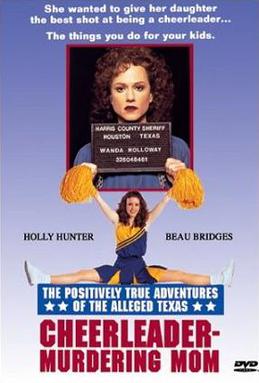
The Positively True Adventures of the Alleged Texas Cheerleader-Murdering Mom. The Television Movie.

THE POSITIVELY TRUE ADVENTURES OF THE ALLEGED TEXAS CHEERLEADER-MURDERING MOM

Everything is bigger in Texas: the hair, the egos, the crimes. You know that your true-crime story is tinged with a heavy helping of tongue-in-cheek when you title it, deep breath, The Positively True Adventures of the Alleged Texas Cheerleader-Murdering Mom. The television movie is less about the crime itself than it is about the spectacle of the insatiable taste for chronicling at times oddball crime stories. It does not shrink from delving into the case in question. However, it also balances that story with just how people appear to take the thirst for fame to almost killer levels.

Wanda Holloway (Helen Hunt) is unhappy that her daughter Shanna Harper (Frankie Ingrassia) has come up short of joining the cheer squad. Shanna seems to enjoy cheerleading, but unlike Wanda is not obsessed with it. It may be that because Wanda's religious father would not let her join cheer, Wanda is living vicariously through her daughter.

Wanda seems less interested in her son Shane (Frederick Kohler). Shane should be used to that, as both Wanda and his biological father Tony Harper (Gregg Henry) seem to not have any interest in him, let alone in his constant hopes for a truck. Shane and Shanna's stepfather C.D. Holloway (Eddie Jones) is not a bad man. However, he seems very quiet, impassive, rarely interfering or being involved with anything in the household. He does suggest that Wanda not spend money on rulers with Shanna's name on them as promotional material for Shanna (the students being elected to the squad once they pass preliminaries). Wanda ignores this and is enraged when she and the other parents are told that only paper fliers can be distributed. Her efforts to get around this by using the rulers on the handouts backfires disastrously.

Wanda now has rage against her neighbor Verna Heath (Elizabeth Ruscio), whose daughter Amber (Megan Berwick) is both Shanna's rival and friend. Determined to get her way, Wanda contacts her loser ex-brother-in-law Terry (Beau Bridges) for a special assignment. She wants him to find a hitman to get rid of either or both Verna and Amber. Terry finds that his niece's mother is bonkers. She would be the second crazy woman that he has to deal with. At home, Terry's fifth wife Marla (Swoosie Kurtz) is pretty much bonkers herself, shifting from putting Draino on herself to rambling incoherently.

Eventually convincing the police that Wanda is serious, Terry manages to get her on tape for criminal solicitation. Once this story of murder-for-hire over a cheerleading spot makes news, everyone starts looking out for Number One. Everyone involved, even in the most tenuous manner, soon starts getting reporters serious and sleazy to offer them all kinds of incentives. Tony is very happy to try and cash in on his ex-wife's infamy and stupidity. Even Verna seems open to getting some cash consideration in exchange for her side. Who will ultimately cash in on crime? What will Wanda's fate be?

It is if not amusing at least telling that this story of clumsy contract killings and cheerleaders did end up becoming both a tabloid feast and a television movie. Curiously enough, Willing to Kill: The Texas Cheerleader Story television movie premiered a year prior to The Positively True Adventures of the Alleged Texas Cheerleader-Murdering Mom. Even more curious, the former is actually longer than the latter in terms of runtime. However, no one remembers Willing to Kill. People do remember The Positively True Adventures (I'm tiring of typing out the deliberately lengthy and comic title).  

I put it down to tone. While I have yet to see Willing to Kill, I am guessing that it takes the premise seriously. The Positively True Adventures does not. It instead plays things mostly as dark farce. Wanda Holloway is not a serious person either before or after attempting to get the dimwitted Terry to find someone to dispatch Verna. I think that at one point, she contemplated selling Verna and Amber into white slavery or sending them to Cuba. 

The Positively True Adventures has a great deal of fun looking at the collection of people involved with a very wary eye. Gregg Henry's Tony Harper is probably the sleaziest and shadiest of people, including his own less successful brother. As Tony starts contemplating various offers for his story, we see him on the phone offering pictures of his family for a thousand dollars per photo. He eventually is talked into selling them for $500 per photo. Shanna, who was at times highly upset by the whole ordeal, is similarly able to think about what this means to her. At one point, she is walking down the halls of her school with her friends, talking about how she met television talk show host Phil Donahue and that the tabloid show A Current Affair was going to feature her story.

As this scene goes on, we see Amber walk by to the taunts and sneers of her classmates. Director Michael Richie then moves the camera upwards to show a "Vote for Amber" banner, upon which someone painted a bullseye on it.  We also see that the Heaths are no saints. Verna, despite her claims of trauma over the entire sordid spectacle, is seen cutting out newspaper articles about the case and pasting them onto an album. Whether she does this to chronicle her survival or delighting in the notoriety is not stated. However, the smile that crosses her face suggests that she is enjoying being famous.

About the only one who comes across as remotely rational is Eddie Jones' C.D. The man who seems distant from everyone and everything is the only one who realizes the gravity of the situation. He also comments to himself that he should have spent the money on the flyers, accepting that if he had, the entire situation would have been avoided.

The Positively True Adventures is very knowing about the story. Again, the crime is not the focus of the television movie. To be fair, it does chronicle the events that led to Wanda Holloway's arrest. We even get comic lines before the media frenzy. When Wanda is confronted at her home, she asks to go inside to put away her groceries. Once inside, the serious trouble that she is in appears to escape her. At one point, Wanda asks what she should wear when going to jail. The flummoxed Detective Helton (Gary Grubbs) says to himself as Wanda walks away, "God, I miss drug busts". 

The second half of the television movie, however, is spent on how all these people were basking in the media spotlight regardless of how they ended up looking. It shows even the Heaths as less than ideal. 

For example, as Verna is discussing the possibility of selling the rights to her story, she is told that rival companies are contemplating casting choices for the role of Wanda. Told that they are considering Holly Hunter, Ruscio's Verna says that Hunter would be wrong. She thinks that Susan Lucci should play the woman who attempted to sell her into white slavery. That Verna seems more interested in who is playing her rival than in how someone contemplated murdering her seems to escape our Texas housewife.


This is a deliberately ironic statement in Jane Anderson's screenplay as Holly Hunter did play Wanda Holloway. She, in an Emmy-winning performance, was wonderful in the role. While Hunter sounded more Southern than Texan (a product of being from Georgia than from the Lone Star State), I thought she was absolutely spot-on as Wanda. She made Wanda into a comic character, silly, snobbish and less dangerous as she is clueless. When attending a church service after her arrest, Shanna alerts her mother to a reporter who is there as well. Wanda is all smiles as the unseen pastor tells the congregation, "Let us all take a moment now for a silent meditation for any of our parishioners who are sick, troubled or indicted". The shift in Hunter's face from almost inattentiveness to disbelief adds to the hilarity of things.

Beau Bridges, who like Hunter won an Emmy for his role, is equal as Terry. He goes from wanting to change his life for the better to not. His constant efforts to get the police to take him seriously are fun and funny to watch. He is able to also show a dramatic side in dealing with Kurtz's Marla. I was surprised that Swoosie Kurtz was not nominated for her turn. She made Marla into a near-total loon who spoke negatively about Terry for no other reason that no one in the press was asking to speak to her. Gregg Henry, who seemed to specialize as sleazy men, was fun if at times a bit broad as Tony, the ne'er do well ex-husband who was loving every minute of this scandal. He relished not just seeing his ex-wife make a fool out of herself but also of the fame that he was getting. 

The Positively True Adventures also has an early appearance by future Late Night with Conan O'Brien sidekick Andy Richter as a disinterested police offer. We also see Giovanni Ribisi in an early role as one of Shane's friends. I do wonder if casting Ribisi as someone named Pete Reyes would go over well today.

The Positively True Adventures of the Alleged Texas Cheerleader-Murdering Mom is fully self-aware. It is a bit of a slow start to where I wondered why so many find it hilarious. However, it soon started to click in its amusement about how the most sordid to eccentric figures involved in equally sordid to eccentric stories can end up lapping up the infamy. It lets this collection of colorful people speak for themselves. That show us how to some, being famous and being infamous is interchangeable. 

8/10

Sunday, October 12, 2025

Kiss of the Spider Woman (1985): A Review

KISS OF THE SPIDER WOMAN (1985)

Magical realism gets the cinematic treatment in Kiss of the Spider Woman. This adaptation of Manuel Puig's novel feels its two-hour runtime. I also wonder if its Oscar-winning performance has aged well in these forty years. However, it does have a strong conclusion that makes it worth at least one viewing.

There are two polar opposite political detainees in a Brazilian prison. One is Valentin Arregui (Raul Julia), a committed revolutionary. The other Luis Molina (William Hurt), an openly and flamboyantly gay man. The dictatorship has locked both of them up for their actions. Valentin is not thrilled to be sharing his cell with Molina (the former refers to the latter by his surname while the latter uses the former's first name).

Valentin is committed to the revolution. Molina is apolitical. To combat their boredom, Molina recounts one of his favorite movies, unaware that it is a Nazi propaganda film. In the various sepia-toned reenactments, we see that this faux-film is about a doomed love. Beautiful French chanteuse Leni Lamaison (Sonia Braga) is not thrilled to see Paris under German occupation, but she is not involved in the Resistance. Her friend Michelle (Denise Dummont) has simultaneously fallen in love with a German soldier who has knocked her up and worked with the Resistance. Leni wants to help, but Michelle is killed by the Resistance. Complicating matters is how Leni herself has fallen in love with Werner (Herson Capri), head of Nazi intelligence.

Despite their disparate backgrounds, eventually Valentin and Molina become friends. Valentin shares parts of his life. While he talks of Lydia, he reveals that this is not his true love (probably a fellow revolutionary to keep his torturers off the track). Instead, he talks of the last time he saw the beautiful Marta (Braga in the second of three roles). Valentin, though, is unaware that Molina is playing him. The warden (Jose Lewgoy) and his flunky Pedro (Milton Goncalves) have promised Molina early parole if he can get information from Valentin to give to them. Molina uses this to his advantage to get food delivered to him. He is also desperate to see his ill mother (Miriam Pires) once more. Molina also gives Valentin snippets of a second film once he finishes talking about the first. It is another love story set on a mysterious island ruled by a Spider Woman (Braga in her third role).

To both their surprise, Molina has been granted parole despite Molina's limited success with Valentin. They also share one night of love before Molina goes. Before he leaves, Valentin gives Molina a phone number to contact his fellow revolutionaries. Molina reluctantly accepts the number. He now returns to his mother. He reunites with his gay friends. He is also pretty much a recluse, frustrating Pedro who has been following him. Pedro hopes that Molina will lead them, unwittingly, to Valentin's fellow revolutionaries. Once Molina does finally make contact, the lives of Molina and Valentin will perhaps meet the same fate though in different circumstances.

One of the most interesting things when thinking about Kiss of the Spider Woman now is how it is not in the public consciousness. It received positive reviews when it was released. It also received four Oscar nominations including Best Picture. Kiss of the Spider Woman won William Hurt his only competitive Oscar. Yet, I do not think that anyone remembers the film or Hurt's performance. 

If Kiss of the Spider Woman is remembered at all, it is probably mostly due to that Hurt win. Even now, I do not know how that win will look to contemporary audiences. Here is a straight actor playing not just a gay man, but a flamboyantly gay man. Add to that how William Hurt, as an American, is playing a Brazilian. If modern audiences find straight actors playing gay roles objectionable, they find Anglo actors playing Latino roles doubly so. In today's parlance, William Hurt in Kiss of the Spider Woman and his Best Actor Oscar win for the film has not aged well.

This is not the time nor place to say whether or not William Hurt deserved the Oscar for Kiss of the Spider Woman. It is the time and place to talk about his performance. It was pretty solid, the early scenes of a slightly exaggerated manner notwithstanding. Over time, Hurt seemed to tone down Molina's flamboyance into something more restrained. He has a wonderful, quiet moment when he says his goodbye to his sleeping mother. I suspect that this scene was what won Academy members over. He also has a very moving moment at the end when he sees that he will not make it out of Brazil's chaotic political scene. Here is Molina, so unaware of politics that he did not realize that the romantic movie he loved was Nazi propaganda, done in by essentially his own ignorance of the world. I think, in retrospect, it might have been a bit too quiet, but it was a good performance.


William Hurt, to his credit, stated that he shared the Oscar with Raul Julia. He was correct in his analysis. Julia holds his own as Valentin, the revolutionary who eventually warms to his cellmate. Julia did not rant and rave political diatribes in Kiss of the Spider Woman. Instead, while Valentin was passionate about politics, he was also a man. He did not want to hear parts of the story that involved food or sex, two things that he wanted and could not get. Julia, however, also showed that warming towards Molina. He displays commitment, regret and acceptance, a man who does not break under difficult conditions. It is a showcase for Raul Julia's skills as an actor.

Sonia Braga is someone who is not spoken of often. Here, she had three roles. She was Marta, Raul's mistress. She was Leni, the exaggerated character in Molina's film. She was the Spider Woman, who ends up leading Valentin to a paradise. Braga was most realistic in her one scene as Marta, the woman who loves Valentin but knows that his commitment to the cause is greater than his commitment to her. 

Braga was appropriately exaggerated as Leni. The entire faux film, complete with its sepia tones, was meant to be exaggerated and overly dramatic. She was not on screen long enough as the Spider Woman to make an impact. However, she played all three roles correctly.

Here, I think, is where I had some issues with Kiss of the Spider Woman. The faux film is so overly broad that it starts looking like spoof. This, I think goes counter to the serious nature of the main story of these two men in prison. Moreover, as played by those in these scenes, it is so exaggerated that you don't believe that even someone like Molina would think that it is good. 

I get that these scenes were meant to be broad. I get that the ending was meant to be on the fantastical side. One is left to decide for him/herself if Valentin died or was dreaming that Marta/the Spider Woman came to him. However, it again seemed to come from a whole other film versus staying within the world of Kiss of the Spider Woman

Leonard Schrader's adaptation of the novel clearly draws parallels between the faux movies and Valentin/Molina's current situation. Again, I get that such a thing was the film's intention. It does, however, lend itself to the idea that the movie never existed but was Molina's efforts to draw Valentin into trusting him. I get that director Hector Babenco was adding moments of magical realism into the film. You had the counter of Molina's film with the serious negotiations between Molina and the Warden. However, it did not fully work for me.

I think the hardest part of Kiss of the Spider Woman is its two-hour runtime. I felt every minute of it. The entire subplot in the fake movie about Christine's pregnancy and doomed romance, I think, could have been cut. Parts of that overall faux flick could have been done away with too.  It does take away from the main story to keep up the pretense of the fake film. 

I also think that some audiences will find the deliberate shift from the natural look in the prison to the sepia toned ways of the fake film a bit hard to accept. I know that it was a directorial choice to show the difference. I just do not think that both the sepia tones and the deliberately exaggerated acting manner helped make Kiss of the Spider Woman better.

It is, I think, a safe bet that both Kiss of the Spider Woman and William Hurt's Oscar winning performances has faded from view. It is not to say that either or both are not worth seeing at all. I just think that it may have all been a bit much, especially now. While nowhere near terrible, I cannot mount a Kiss of the Spider Woman revival.  

DECISION: C+

Saturday, October 11, 2025

Min and Bill: A Review (Review #2050)

MIN AND BILL

MGM was the center of where the most glamourous stars in early film were to be found. You had Clark Gable. You had Greta Garbo. Among those fabulous figures were a ragged looking man and a large, dumpy old woman. Yet Wallace Beery and Marie Dressler were two of the most popular film stars of the early sound era. Min and Bill, one of their collaborations, is a delightful dramedy, balancing humor and heart.

Min (Dressler) runs a shady seaside hotel catering to the sailors that dock nearby. One sailor in particular is a mostly welcome guest. That is Bill (Beery), with whom Min has a romance with. Said romance can sometimes be sweet, sometimes tough. Despite it all, Min and Bill have an affection towards each other.

They also have an affection for Nancy (Dorothy Jordan). Nancy was left in the care of Min by her frenemy Bella Pringle (Marjorie Rambeau), a lady of the night. Nancy believes her mother, whomever she is, is dead. Min and Bill have protected and watched over Nancy all this time as an informal mother and father. However, the long arm of the law, coupled with Nancy growing up, have pressured Min to send Nancy to school.

Min sends Nancy to live with the Southards, the schoolmaster and his wife. Min is outwardly harsh towards Nancy, but privately she is heartbroken at being separated from her. Her sadness is tempered by knowing that Nancy has a chance at a better life. Min, however, faces a greater concern. Bella is back. Min is enraged that Bill is making whoopie with Bella. She is also concerned that Bella will find out that Nancy is alive.

To get Nancy out of town, Min gives her life savings over to the Southards on condition that they send Nancy to a private school. Years later, Nancy has developed into a sophisticated lady. She also is engaged to Dick Cameron (Donald Dillaway), scion of a cannery tycoon. Nancy and Cameron had tangled before, down to her and Min accidentally using his speedboat. He either has forgotten or forgiven Nancy's early affronts to him. Nancy still loves Min and Bill and wants them to come to her and Dick's wedding. However, Bella happens to be on their same ship. Will Min's efforts to keep Bella and Nancy separated succeed? There is tragedy, even murder, in these lives, but Min and Nancy end up happy in their own way.


Marie Dressler was one of the biggest box office draws in the early 1930's. I think it is quite easy to explain why, despite her not being anywhere near to a glamour girl, Dressler was beloved by contemporary audiences. I think it is due to audience identification. Here was this woman, large, weathered, yet lovable. There was an ordinariness to Dressler. She was "one of us", someone that audiences could see being part of their families. She was not exotic or mysterious or elegant or otherworldly. She was someone people could relate to. That, I think, was her appeal.

It also helps that Marie Dressler was a skilled actress. She in Min and Bill deftly balance comedy and drama. Early in the film, she and Jordan are hilarious when attempting with no success to stop the speedboat from going out of control. Dressler in particular made the scene hilarious with her expressive face, revealing her comic terror. This scene culminates with her being hauled up, the funny fear making one almost keel over with laughter.

However, the end of Min and Bill will break your heart. The final moments of the film are reminiscent of Barbara Stanwyck's turn in Stella Dallas seven years later. Unlike Stanwyck, who was nominated but did not win Best Actress for Stella Dallas, Marie Dressler did win for Min and Bill. I can see why she did. Dressler's face as Min and Bill fades out expressed so much. There was sadness. There was resignation. However, there was also a quiet joy, knowing that her unofficial daughter was now fully safe and happy.


In many scenes of Min and Bill, we saw the genuine tenderness behind the gruffness. Dressler's face revealed a lot of emotion, often during the same scene. When the police confront Min, her expression changes from defiant to scared. Sometimes her face is more for comic effect. Sometimes it is so movingly serious. At one point, after pushing Nancy away, Min walks the lonely boardwalk. In her expression and body language, we see just how difficult and painful it was to send Nancy away. However, we know that is for Nancy's own good. Dressler manages to comedy and drama especially well in Min and Bill.

Marie Dressler is also able to handle physical comedy with expertise. Her fight scene with Wallace Beery is both amusing and alarming. Min, enraged at seeing Bill flirting and fooling around with Bella, throws everything at a terrified and weak Bill. It is a lengthy scene, but both of them handle it with a perfect blend of humor and fear. 

While they may have disliked each other off screen, Marie Dressler and Wallace Beery had great chemistry on screen. In both of their performances, we see that their bond is sincere, almost sweet. Shortly after their drawn-out physical fight, we see them sitting side by side, Min reading a letter from Nancy. Despite not being married, we see them as a dear little couple, delighting in each other's company and having a warm affection towards the other.


Wallace Beery, like Marie Dressler, had a certain salt of the earth quality. He was able to hold his own with Dressler as her dimwitted but ultimately loyal and protective beau.

In retrospect, perhaps Marjorie Rambeau and Dorothy Jordan could be seen as a bit over the top as Bella and Nancy respectively. Dillaway as the wealthy Cameron and especially Russell Hopton as Alec, the sailor initially desirous of Nancy, were a bit stiff and theatrical. However, as Min and Bill came when the transition from silent to sound was still in its infancy, I cut them a little slack.

Min and Bill is a simple, sweet story. It is hampered somewhat by the clunkiness of early sound film. It also has clear rear-screen projections that perhaps modern audiences might not be forgiving of. However, Marie Dressler and Wallace Beery more than make up for these issues. It is a film that will amuse, charm and ultimately move anyone willing to venture to the docks of this seaside shanty. 

DECISION: B+

Friday, October 10, 2025

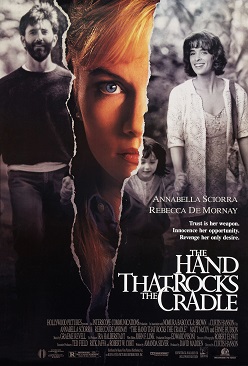
The Hand that Rocks the Cradle (1992): A Review

 
THE HAND THAT ROCKS THE CRADLE

Good help truly is hard to find, especially when said help is trying to murder you. The Hand that Rocks the Cradle is self-aware in how it is a bit absurd, almost camp. However, it has a strong performance that makes it delicious watching.

Seattle mother Claire Bartel is expecting her second child. Her regular obstetrician/gynecologist is temporarily unavailable, so she goes with Dr. Victor Mott (John de Lancie). Dr. Mott, who was referred to her by her regular doctor, seems pleasant enough, but he insists on examining her breasts as well. He then fondles her private part, leaving Claire in shock. That in turn causes her to have an asthma attack. Taking the advice of her husband Michael (Matt McCoy), she reports Dr. Mott to the medical board. That in turn causes four other women to report their own encounters with the bad doctor. The ensuing scandal drives Dr. Mott to suicide. His widow, who is also pregnant at this time, is doubly shocked when she discovers that she will have no money after Mott's death. This causes her to suffer a miscarriage that in turn leaves her incapable of having children.

Six months later, Claire and Michael are the parents of a beautiful baby boy named James. Claire and Michael, as well as their daughter Emma (Madeline Zima) are delighted by Jim. Also delighted is their mentally disabled handyman, Solomon (Ernie Hudson). He has been with them via the Better Day Society since Claire was sexually molested, having started with a fence and now working around the house. While Michael works and Claire volunteers at a local greenhouse, Claire is finding the burden of the second child hard. With that, the Bartels decide to hire a nanny.

One seems to appear out of nowhere. She is Peyton Flanders (Rebecca De Mornay), who tells them that she is a recent widow who lost her child. Peyton is not technically lying, for she is in reality none other than the Widow Mott. Despite being the only one of Dr. Mott's accusers who did not sue him or the estate, Peyton holds Claire Bartel responsible for all her miseries. 

Now, she will enact her slow revenge on Claire. That revenge includes getting James to depend on Peyton's breastmilk, slowly worming herself into Emma's heart, and planting evidence suggesting that Solomon has been sexually abusing Emma. It also includes putting seeds of doubt into Claire's mind about whether Michael has moved his longtime friendship to former girlfriend Michelle (Julianne Moore) to a new position of mistress. 

Slowly, Peyton increases her actions against the Bartels. Soon both Michelle and Claire realize not just who Peyton is but the danger she poses. That knowledge comes at the expense of one of their lives, but now we see whether Peyton will complete her master plan or be done in by it.

One senses that The Hand that Rocks the Cradle is aware that it is a bit loopy in terms of logic. Apparently, no one knows what the Widow Mott looks like. They fail to recognize Peyton Fields as Mrs. Mott despite her face being in the newspapers. I guess one the bad doctor did himself in, Claire was like, "Oh, I guess that's over with". Peyton is pretty much hired on the spot. Claire and Michael do not seem to bother with such things as references. Despite knowing Solomon for some time, they let a variation of Desdemona's handkerchief convince them that he has been taking advantage of Emma. 

Emma, to my knowledge, was never asked directly or specifically if Solomon ever did anything to her. Moreover, given that Claire was a stay-at-home mom, she would have been surprisingly oblivious to any tawdry business going on with Solomon.

As a side note, I wonder if Amanda Silver's screenplay chose the name "Solomon" for our mentally challenged character as an ironic take on "the wisdom of Solomon". Perhaps that is giving The Hand that Rocks the Cradle too much credit. 

I want to give The Hand that Rocks the Cradle credit for being enjoyably goofy. One does not watch something like The Hand that Rocks the Cradle for its plot. One watches for fun thrills within its premise. One of the major thrills is Rebecca De Mornay. Long before the term was created, De Mornay clearly understood the assignment. She is deliciously cool and wicked in The Hand that Rocks the Cradle. She fully embraced the cray-cray of the character. She maintains a soft, patrician manner where one can see initially how the Bartels were duped into taking her on. When she does let out her evil side be it bullying a child or slapping Solomon around, we see De Mornay tearing into Peyton's evil with quiet relish.

She even thrown in a few f-bombs into these moments, almost as if to punctuate Peyton's wickedness. Rebecca De Mornay is the major reason to watch The Hand that Rocks the Cradle because she makes no apologies for Peyton's total lunacy and thirst for revenge. She couches it with an outward coolness and sweetness that screams out insincerity. 

The Hand that Rocks the Cradle is an early film for Julianne Moore. As with another early Moore film (Body of Evidence), you sense that Moore is aware that she is too smart for the material. She plays Michelle as a sarcastic woman, snapping at everyone and having a general dislike of others save Michael. She does even seem to like her husband very much. Moore's intelligence comes through, oddly, when Michelle gets bumped off. As Michelle meets her supposedly gruesome end (the end result is not graphic and almost amusing), as acted by Moore she behaves as if all this is rather silly, but it is a paycheck and an acting credit for her resume.

To be fair, Madeline Zima was winning and charming and believable as Emma, the little girl slowly lured to forgo her own mother for Peyton.

Still, there was only so much that De Mornay, Moore, Zima or any of the other actors could do with the material that they were given. Matt McCoy was genially attractive as Michael. He even managed to get an obligatory shirtless scene when Peyton misguidedly attempts to seduce him. However, McCoy was rather flat as Michael. He seemed if not comatose at least quite disengaged with things. When Peyton is finally exposed (again, I wonder how no one knew who she was to start with), Peyton attempts to turn it to her favor by saying that Michael said that there was only one woman for him. 

"I was referring to my wife", he tells her with very little emotion.


I think the second worst performance was that of Annabella Sciorra. Her reaction to finding Michelle's body was not good. It was actually pretty laughable. Her various asthma attacks were equally unintentionally amusing. At one point, she keels over in a mix of a panic and asthma attack. The whole thing had me chuckling, which I do not think was the intent. Claire is perhaps one of the dumbest characters that I have seen recently. She makes a point to mention earlier that Michael smokes only when he is around Michelle. Yet, for some reason, she cannot quite piece together why Michael's coat smells like smoke.

When she confronts him about her suspicions that he is "f--ing" Michelle, Michael tells her that everyone can hear. The acting from both Sciorra and McCoy is so flat that it feels more like a line reading than a genuine scene. The muted reaction from the guests at her surprise party is equally muted. It was a bit hard to know if they were embarrassed at the situation or for having to try and act as poorly as Sciorra and McCoy. To be fair, when she punches Peyton out, it is a great punch.

As a side note, Michael. Michelle. What a jumble of names.

The worst performance however was from the usually reliable Ernie Hudson. I think that he did the absolute best that he could with Solomon. However, right from the start, Hudson was trying too hard at playing someone with diminished mental capacities. Putting aside for the moment how that portrayal probably would meet with controversy today, it was just bad. The little body tics, the attempt at halting delivery, all of that screamed out that he was ACTING. I think it would have been better if he had not been made mentally disabled.

I think director Curtis Hanson should get some credit for keeping things rolling even when things went way over the top. In some ways, I think Hanson was right in having his actors not try to be smarter than the material. He succeeded with everyone save Moore and De Mornay. Curiously enough, they along with Zima were the good performances.

The Hand that Rocks the Cradle is openly schlocky. However, I find that to be one of its main qualities. Whether by pumping up the music as Peyton holds a pillow near James' head or suggesting that chocolate is a substitute for sex, the film embraced its delicious campiness. It is silly and illogical (how Claire discovers who Peyton really is borders on a series of implausible happenstances). Still, I enjoy how silly The Hand that Rocks the Cradle is. Rebecca De Mornay is the show, and worth the price of admission.

DECISION: C+

Thursday, October 9, 2025

Children of a Lesser God: A Review

 CHILDREN OF A LESSER GOD

The sound of silence is penetrated in Children of a Lesser God, the adaptation of Mark Medoff's play. With strong performances from the cast, Children of a Lesser God gives us an intelligent view of the struggles not just of deafness itself but of within that world.

Idealistic and enthusiastic teacher James Leeds (William Hurt) has come to teach at a school for the deaf. His unorthodox methods are looked on with suspicion by school head Curtis Franklin (Philip Bosco). James believes that the deaf should attempt to speak as much as possible. 

One deaf person who is firmly against such a thing is Sarah Norman (Marlee Matlin). A former student turned janitor, Sarah is highly intelligent but also highly hostile. She is particularly hostile to the hearing but more open with the deaf at the school, both students and teachers. James is convinced that Sarah can eventually speak despite being totally deaf. He is met with an intense opposition from Sarah, who will not speak.

James finds himself attracted to Sarah separate from his savior complex. For her part, Sarah finds herself slowly drawn to James too. He also wants there to be a reconciliation between Sarah and Mrs. Norman (Piper Laurie). He learns that it was not Mrs. Norman who cut off the relationship. He also learns that prior to going to the school for deaf, Sarah was treated no different than her sister Ruth. However, Sarah was also sexually active, more than likely in a way to fit into the hearing world.

Eventually, Sarah and James become lovers. Despite their romance, Sarah is enraged that James got his students to use their voices at a Christmas pageant. The ups and down of their romance leads to Sarah leaving her employment and moving in with James. For once, James finds himself the odd man out when he accompanies Sarah to meet her sociopolitical idol, who like her is also totally deaf and only signs. Will these two lovers bridge the divide between their different views on speaking or not?

If Children of a Lesser God is remembered today, it is because Marlee Matlin had two historic records with her Best Actress Oscar win. At twenty-one, she is of this writing the youngest Best Actress Oscar winner. She is also the first deaf actress to win an Academy Award (Troy Kotsur being the second and first man to win for CODA, which costarred Matlin). Any suggestion that Matlin won for anything outside of her performance is wrong.

Matlin is strong as Sarah. She is angry, defensive but also in her own way free. Matlin has a hard act to pull off in Children of a Lesser God. In another actor's hands, Sarah might have come across as merely sullen. Matlin though, gives her a pained vulnerability behind that abrasive exterior. There is a scene when she talks about how she let herself get used by her sister's male friends. Obviously not speaking but signing her dialogue (with William Hurt speaking her words), Matlin nonetheless manages to move the viewer.

In the scene where she storms off after seeing James' students sing, we are left to wonder where her anger is directed. Is she angry that the students used their voices, going against her belief that deafness is nothing to be "cured" of? Is she angry that she, whether by inability or by choice, will not be able to do as the students do? It is, I think, left open to interpretation.

Matlin also has a wonderful moment with Laurie when she finally goes to see her. Matlin is able to more than hold her own against a veteran like Laurie as well as William Hurt. That speaks to Matlin's skill as an actress. Near the end of the film, we do hear Matlin speak in a roundabout way. Her pained shrieks of "I'M NOT AFRAID! HEAR MY WORDS! HEAR MY VOICE!" shake the viewer with their raw emotion. Finally breaking her longstanding vow not to speak, we see just how much she has within her that cry out to come out but come out on her terms with her hands. 

It is not just Matlin who excels in the scene where she tries to not bring up the past. Laurie, who was nominated for her small role, is equally moving as she admits mistakes and asks for forgiveness. They manage to not only heal the wounds of the past but become friends. It was a wise decision by director Randa Haines and screenwriters Madoff and Hesper Anderson (the former co-adapting his stage play of the same name) to let their relationship build over time. You do see the evolution of Sarah and Mrs. Norman from regret to genuine love.

I think Hurt, who like Matlin and Laurie was nominated for his performance, had a slightly harder task. One might think that because Hurt is not deaf, he would have an easier job communicating. In reality, he has to metaphorically translate what Matlin is saying without making it sound like literal translation. I think that the majority of audiences are not deaf and do not have an understanding of American Sign Language. As such, we would not understand what Matlin or the other deaf performers are saying. Hurt is the only one who can fill us in.

This is a tall order for anyone to fill: to make speaking American Sign Language out loud sound natural. Hurt does not miss in Children of a Lesser God. He maintains that balance between his own performance and serving as the voice for the deaf performers. His James Leeds is caring but also carrying something of a savior complex. He never questions the rightness of whether the deaf should try to speak. Perhaps he, as a hearing person, figures that speaking would be better for them. Sarah does not agree. That makes up part of their conflict in Children of a Lesser God. 

The romance is another part of their conflict. I found the pool scene where they consummate their passion lovely to look at, if a bit too poetic for my taste. These are not just rivals but lovers, and both Hurt and Matlin carry the characters' troubled romance well.

Philip Bosco was equally strong as the somewhat sneering but well-meaning school head. He was a voice of negativity, but he did genuinely care for Sarah and did not want her hurt in any way.

Viewers should not ignore that Marlee Matlin is deaf, but they should also not focus on it. Children of a Lesser God has good performances and an interesting story. I think it does start feeling longer than the one hour forty-five-minute runtime it has. On the whole though, that is a minor flaw. Children of a Lesser God is worth seeing, its tale of a distinct love affair capturing the viewers' attention.