Thursday, February 11, 2016

Unforgiven (1992): A Review


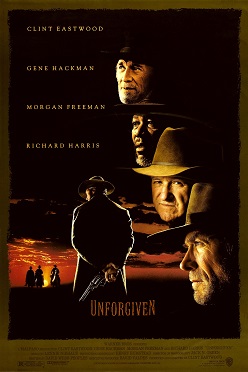
UNFORGIVEN (1992)

How The West Was Truly Won...

The first time I came across Unforgiven, I think both the subject and the length made me wary of it.  The violence, the darkness, of it all played in my memory, so much so that I could not remember if I had seen it when it was first released.  Well, the passage of time and the Best Picture retrospective have brought Unforgiven back into my life.  I think of what John Ford's The Man Who Shot Liberty Valance said: "When the legend becomes fact, print the legend".  Unforgiven goes against Ford's maxim, and gives us a very unvarnished, unpleasant, ugly West.  Unforgiven is a dark, somber film, but one that is brilliant in the exploration of redemption (and lack thereof), of the struggle between justice and revenge, and how what we know of The West is built on myth, a myth perpetuated by those who themselves knew better.

Big Whiskey, Wyoming, 1881.  Delilah (Anna Thompson) a novice prostitute, starts laughing when one of the cowboys she's servicing undresses, revealing what she considers a particularly small penis.  Enraged, the cowboys slashes her face.  The main whore, Strawberry Alice (Frances Fisher) is enraged that the brother owner, Skinny Dubois (Anthony James) is willing to take compensation for the assault rather than pursue actual punishment.  Dubois doesn't care for his whores, just for what he can get out of them.  For his part, "Little" Bill Daggett (Gene Hackman), the local sheriff who insists no guns enter Big Whiskey, would rather keep the peace than get justice for the women.  Furious, the whores collect a bounty and offer it to anyone who will take the two cowboys involved in the assault.

Enter The Schofield Kid (Jaimz Woolvett), a young cocky gunfighter who wants to make his mark.  He hears of the bounty and wants at it, but he needs help, and goes to legendary gunfighter William Munny (Clint Eastwood).  We learn earlier that Munny was a notorious murderer, but that he married a quiet woman who helped reform him, and he became a widower in 1878 with two young children.  The former bad man is now one filled with regret for his actions, and has sworn off violence and booze.  However, he is a failure as a farmer, and the bounty will provide for his children.  With that, he rides out to meet the Kid and insists on taking his old riding partner, Ned Logan (Morgan Freeman) on the job.

Back in Big Whiskey, Little Bill is too obsessed with building his house to care what the whores are up to, but he is aware of a new and unwelcome visitor.  English Bob (Richard Harris), 'legendary' British gunfighter has come to get at the reward too, accompanied by his biographer W.W. Beauchamp (Saul Rubinek).  Beauchamp, writer of pulp Westerns, thinks English Bob will make a great subject for a book, giving the book and the subject the grandiose title of The Duke of Death, which Little Bill keeps referring to (accidentally or not) as The Duck of Death.  Little Bill knows English Bob and the truth behind The Duck's exploits (and it helps that he has to power to lock him up).  Little Bill throws English Bob out of Big Whiskey, but Beauchamp stays on, fascinated now by Little Bill's exploits, which are technically true but also rather unsavory.

Munny, Logan, and The Kid enter Big Whiskey, but Little Bill doesn't know who Munny is.  The three of them do manage to escape, but not before Munny gets beaten by Little Bill for having a gun in town despite his law.  While Munny recovers out of town, he learns about Delilah's life and how she did not deserve what she got.  The three of them do eventually manage to kill one of the cowboys, but now Logan and Munny find that this life of violence is no life for them.  Logan opts to get out, while Munny is honor-bound to complete the job.  He and The Kid do, but now The Kid finds the violence too much for him.  Despite all his bragging and boasting, he's never killed another person in his life and it takes just one kill to have him forever renounce violence.

Delilah has bad news for Munny: Logan, despite being the one who leaves, was captured, tortured, and killed by Little Bill.  Munny, enraged, goes into Big Whiskey for one last confrontation to avenge his old friend and get Logan buried, Little Bill using his corpse as a warning to those who would enter town.  There is a final confrontation between these two old gunslingers, and after Munny kills the unarmed Little Bill, he rides out, warning them all that if Logan isn't given an honorable burial and the women left alone, he will return to kill them all. 

We end Unforgiven as we began it, with Munny in profile, learning that his mother-in-law came years later to see where her daughter was buried but not finding Munny or the children there.  They moved on, to California, where Munny became a merchant, removed from his former life.
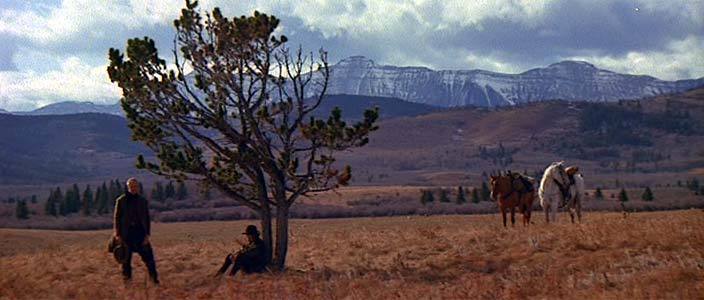
Unforgiven is a meditation on the act of killing, captured so well by Eastwood's "It's a Hell of a Thing, Killing a Man" monologue.  In a way, Eastwood's film is a declaration against the mythology of the Old West that he has been so closely associated with.  Beauchamp is both the promoter and follower of Old West tales with his stories of English Bob and Little Bill.  He isn't chronicling the Old West as it really was, but as how he would like it to have been: full of action and adventure and daring-do.  The Schofield Kid too is one who was taken in by the myths of the Old West.  He too only saw the action, the thrill, the adventure, but when it came down to doing the actual dirty work that the old men like Munny, Logan, even Little Bill did, he couldn't do it. 

Unforgiven strips the ideas we have of the Wild West and makes it into a story about how this violence cost people their lives and their souls.  It was not romantic or exciting.  It was dark and ugly and brutal.  It is a bit reminiscent of All Quiet on the Western Front.  Just as that film brought no honor to the brutal act of war, Unforgiven brings no honor or glory to the taming of the West.  In short, Unforgiven is not a romantic Western, and that is part of its brilliance.  We can dispense with Western clichés and instead see the story Eastwood is telling: how the world is not black-and-white, how the truth is more brutal than the fiction we accept.

Eastwood's directing is very sparse, very simple.  He doesn't complicate shots with a lot of cutting.  One moment that impressed me was when English Bob first comes to Big Whiskey.  Eastwood doesn't jump from one person to another.  Instead, he lets the camera move between them, giving us almost a 'you-are-there' style, as if we were moving back and forth between them all.

Eastwood also directed all his actors in an extraordinarily excellent way.  Hackman was brilliant as the blunt but brutal Sheriff, a mixture of evil and cold-eyed realism.  In his own way, Little Bill has his own dreams (that house he constantly works on), but his actions will deny him the house that is his great passion.  I am conflicted on Little Bill: he is direct about his ideas of justice and the law but he is also hard and cold.  Thompson is almost innocent as the injured hooker, and Woolvett is cockiness exemplified as The Kid.  We should know it is all an act, and both Woolvett's performance and Eastwood's directing of it shows that The Kid is really a front for a good man taken in by the myth.  Freeman lends dignity as Logan, who is just as weary of the bloodletting as Munny.

It is difficult to direct oneself, but Eastwood can do it.  His William Munny tries desperately to be the man his late wife made him into, but slowly he wears down to his old self.  Having seen the darkness he can so quickly slip into, he knows enough that so long as he is close to temptation, he will never break free.   

About the only real flaws in Unforgiven are the length and the English Bob storyline (the both tie into each other).   It's always nice to see Richard Harris in a Western, but if he was the entry for the Beauchamp character, it would have been easier to get him to see Little Bill or just come to Big Whiskey to do a story about the whores and get sucked into this world.  The entire English Bob story lengthens the film and it makes things feel longer than the two-hour plus running time.

Apart from that, Unforgiven is a beautiful film, a thoughtful meditation on the difference between myth and reality, on killing, on how justice doesn't always get it right.  As he lays wounded, Munny standing over him ready to kill him, Little Bill, in his fury, says he doesn't deserve this.  "Deserve has nothing to do with it," Munny replies before ending Little Bill's life.  Unforgiven, the last Western to win Best Picture (so far) is an elegy to the image of the West, a farewell to the ideas we all have about this period.  Eastwood didn't print the legend.  He did make a brilliant film.

DECISION: A+

1993 Best Picture Winner: Schindler's List 

Tuesday, February 9, 2016

Annie Hall (1977): A Review

ANNIE HALL (1977)

One New York Love Story...

Before Woody Allen became notorious for his private life, culminating in a scandal that shocked even blasé New Yorkers, he was seen as this brilliant comedic genius.  Annie Hall is a love story about two very different people, who meet, fall in love, and fall out of love.  After watching it, I thought it clever, sometimes amusing, but not this great comedy I was led to believe it was.  Then again, I've never been particularly amused by The Woodman, finding him a bit of an acquired taste.

In a non-linear story structure, we see the relationship between Jewish writer Alvy Singer (Allen) and WASP actress/singer Annie Hall (Diane Keaton).  Alvy is a neurotic Borsch Belt comic, one who finds sex has burdens and with two failed marriages.  Hall doesn't have all the hang-ups Alvy has, a bit of a free spirit.  They meet while playing tennis with mutual friends, and they begin a romantic relationship.  Things don't go smoothly: her family (particularly her grandmother, whom to Alvy's amusement she refers to as Grammy Hall) look on him as this odd figure, and their differences eventually lead to a break-up.  Alvy wants to understand why his relationship with Annie failed, and he delves into his past to try and work things out.

There is a reconciliation but still things don't work out for our pair. She finds romance with record producer Tony Lacey (Paul Simon...yes, THAT Paul Simon), and while he sees other women, he is still neurotic about it all.  Eventually, he accepts that 'love fades' and is if not happy (as he can never be happy) at least at peace with the rise and fall of his romance with Annie Hall.


Annie Hall is the type of film people talk about to death.  Let me try to explain that.  The film has earned a reputation as being this unimpeachably brilliant film, one that is hilarious, touching, intellectual, and above all else, perfect.  Perhaps all the build up around Annie Hall will inevitably lead some people to find it a bit of a letdown.  I don't think many films can survive this type of reputation, making them a bit remote to people.  Casablanca and Citizen Kane are good examples: how many have not touched them BECAUSE of their reputations as 'the greatest films ever made'?

When I went into Annie Hall, perhaps this idea that this was THE love story of ALL love stories made me think it was going to be hilarious.  It was funny, with certain moments that are extremely clever and insightful.  The sequence where an adult Alvy is in a room with his elementary school classmates as children with them describing how wrecked their future lives became is intelligent and sadly true-to-life, a mixing of innocence and despair that works very well.

A particularly great moment is when Alvy and Annie are on her rooftop garden.  Ostensibly a conversation about her photographs, the 'translations' that appear on-screen give what they are really saying: their flirting with each other.  This is such a true moment because it is a real moment, one that people can relate to and understand.  It's exaggerated for comic effect, but it is true: people do flirt by saying one thing when the subtext is another.

The moment when Alvy, Annie, and their mutual friend Rob (Tony Roberts) end up in Alvy's past is also quite clever and inventive, as is the dual therapy sessions of Annie and Alvy as they discuss with their respective therapists their different views on the same subjects.

However, some things in the course of almost forty years do date the film.  As Alvy and Annie stand in line for a Fellini or Ingmar Bergman movie if memory serves correct, Alvy gets extremely irritated by the person behind him, attempting to tell his companion what is wrong with the director in pseudo-intellectual terms. 

As a side note, you can't imagine HOW many times I've endured such a scenario myself.

Allen breaks the fourth wall to address us directly, kvetching about how moronic this man is, culminating with him pulling intellectual Marshall McLuhan from almost out of thin air to lecture the man about how wrong he was on just about every level.

Two or three things about this.  First, who is Marshall McLuhan?  That's a bit of a rhetorical question, in that perhaps McLuhan may have been a wildly popular figure in the 1970s and among a certain circle of people, but let's face it: he isn't exactly a big name among the hoi polloi that Allen has barely a nodding acquaintance of.  Second, something about this particular scene struck me as terribly smug and self-satisfying.  Sure, the man behind Alvy may be a moron, but was it really Alvy's burden to put him in his place and show him what a doofus Alvy knew him to be?  I know that when people attempt to sound intellectual within my earshot I tend to either make caustic remarks to my own companions only or simply keep those views to myself.  I can't remember a moment when I told someone how dumb they were about a particular topic...unless I was asked.  Third, while it's a clever scene I did wonder how it connected to Alvy and Annie's relationship.  Fourth and finally, it does have the negative effect of dating the film, and with the passage of time one I think would watch this and wonder not so much what is going on but why we should take McLuhan's word for it.

I will say that Keaton is entirely winning as the title character, a mixture of ditzy and endearing in her joys and own particular hang-ups.  She's so good in the film where we can find ourselves falling in love with her too.  Charming, sweet, but true to herself, her Annie is a delight.  It's hard to judge Allen's performance given that when he is in front of the camera he usually is the same nebbish, neurotic character almost to where there appears to be no difference between Alvy the character and Allen the real person.  Come to think of it, I can't recall the last film of his I saw where he was the main character.  I'm sure there are differences between the on-screen and off-screen Allen (I don't think he's a nebbish at all), but given he's done that shtick for so long I can see why Annie Hall is seen as autobiographical. 

I figure it is partially autobiographical (a lot of his films I think are), but I wouldn't read Annie Hall as completely true-to-life.

In a certain way, I did like Annie Hall: the steady handling of one love story in a low-key and realistic manner, with memories flowing in and out.  I'll be frank: I prefer Love & Death and Sleeper over Annie Hall.  I think those two are funnier.  However, I wonder whether Annie Hall was meant to be hilarious (and as a side note, the voice-over here wasn't a big deal-breaker for me as it is for most other films).  It wasn't a spoof like the other two.  It was a love story and a good one.  It not a film I would necessarily go back to but not I will reject either.  Perhaps if it hadn't been so built up I would have appreciated it more.  As it is, Annie Hall is a good film, a bit dated now perhaps, a trifle too intellectual for some I imagine, but on the whole, not a bad time.  Maybe it even Seems Like Old Times...   


DECISION: B-

1978 Best Picture: The Deer Hunter

Sunday, February 7, 2016

Supergirl: Fight or Flight Review


SUPERGIRL: FIGHT OR FLIGHT

For some reason, Superman's shadow keeps falling on Supergirl, and in Fight or Flight, the third episode from the debut season, it quite literally falls on her.  Fight or Flight tackles the burden of legacy: the family legacy of the Supers, the legacy of past actions, and the burdens of reputation.  Part of me wonders why Superman HAS to be a big thing on Supergirl, always haunting the series, as if the show is itching to put him into the series.  Curiously, Fight or Flight makes The Man of Steel's presence (or lack thereof) part of the story, giving the Girl of Steel a chance to fight for a room of her own (thanks, Virginia).

Supergirl/Kara Danvers (Melissa Benoist) has agreed to give an interview to Cat Grant (Calista Flockhart).  She attempts to put things into perspective for our foul-tempered media tycoon, but Cat is having none of it.  In her frustrations, Supergirl reveals that Superman is her cousin, and the aggressive Cat gets her scoop.  Cat, with this info, decides to write a major expose on Supergirl, bemoaning the Millennials she sees Supergirl representing.  Kara's sister Alex (Chyler Leigh) is unhappy about the cover story too, and more unhappy that Kara has an unofficial team with her: her unhappily platonic friend Winn (Jeremy Jordan) and hunky photographer James Olsen (Mehcad Brooks).

More furious is Department of Extra-Normal Operations head Hank Henshaw (David Harewood), who snaps at Supergirl's new mass exposure.  "What's next: a reality show?  Keeping Up With the Kryptonians?!" he bellows.  All this comes when we get a new threat: Reactron (Chris Browling), a name Olsen gave him back in Metropolis.  A former foe of Superman, Reactron blames Supe for killing his wife and leaving him dependent on nuclear power to live when Superman stopped a nuclear reactor from exploding.  James tells Supergirl that Reactron nearly killed Clark (thus revealing to a stoked Winn that Clark Kent IS Superman...nice job, JIMMY).  James is worried Supergirl's lack of experience will leave her vulnerable, especially if she opts to rescue Maxwell Lord (guest star Peter Facinelli), industrialist who can help Reactron (real name Ben Krull) repair his suit.  When she faces off against Reactron in her rescue of Lord, she is nearly killed until You-Know-Who shows up (in shadow, of course).


Supergirl is not a happy girl at all: NOT happy that her younger cousin had to step in to save her, NOT happy that Maxwell Lord thanks HIM rather than HER for the rescue, and DEFINITELY NOT happy that Cat has made Supergirl into a Millennial poster child for virtual idiocy.  Looking over the article in her role as Cat's assistant, Kara is highly upset at the following:

"Supergirl embodies the worst traits of her generation: the earnestness without purpose, the unshakeable belief that she has a right to be heard...even when she has nothing to say". 

(For the record, as a proud GenXer myself, I wholly agree with Cat's statement on the generation following me). 

Supergirl is most upset however, that Superman showed up at the behest of James, who called him in.  Supergirl is adamant about doing things on her own, without Superman jumping in to get her out of trouble.  She essentially is determined to fly her own path.  At the party for the Supergirl edition of the magazine, Winn continues to basically openly pine for an oblivious Kara (he loves her even before she was Supergirl) while she continues to waver over James (whom she mends fences with).  Meanwhile, Maxwell and Cat appear to have something going on (or at least in the past, and maybe the future), but no time for romance: Reactron appears to take down Supergirl as payback for what her cousin did to him and his wife.  With a little help from James, Supergirl is able to stop Reactron (saving both Winn and Lord again, with the latter hopefully more appreciative). 

In the end, things get more complicated with the appearance of Lucy Lane (Jenna Dawan Tatum, wife of professional stripper Channing), with whom James had a relationship and looks to be interested in reviving here in National City.  Kara gets a text from Clark, telling her that he won't interfere again and congratulating her for defeating Reactron (something he wasn't able to do, thanks to the combined efforts of Alex and Hank).  This was a job for Supergirl.  On the home front, Alex and Kara make up as well, proving that family relationships are sometimes harder than super-villains.


I found part of my shall we say frustration regarding Supergirl stems from the 'freak of the week' style that it's adopting.  This was an issue with the first season of Smallville (at least the parts I remember of the only season I watched of a show I thought should not have run ten seasons).  It was also a bit of an issue with the first season of Gotham (which the show corrected in its stronger second season).  I am speculating, but I think that I will find this issue again when I finally get to Season One of The Flash (and I understand there will be a crossover between the two, something I find most curious).  Actually, I sense The Flash will be more organized, though the first version of The Flash did have that problem.  Would it have REALLY killed Supergirl to have had Reactron be more recurring?  Are we going to have a real threat slowly emerge (unless that threat is Maxwell Lord)?  I know there's Aunt Astra, but even then, we had Supergirl meet the villain, they fight, she wins after stumbling, and there you go.

I'm not going to say after three episodes that Supergirl is getting repetitive or losing direction, but I do wonder why we keep getting pretty much the same thing three times (a bit Rubio-esque, sorry Marco).

However, Fight or Flight has a lot more positive going for it than negative.  Metaphorically and literally, the long shadow of Superman on the series is finally dealt with.  I never concerned myself with 'why and/or if Superman would appear' on Supergirl (I guess since he didn't in Supergirl: The Movie and I didn't give it much thought then either).  The theme of Fight or Flight is that of Supergirl and Supergirl being able to stand on their own, and Benoist's speech about how she needs to do things on her own after her cousin saved her was excellent. 

In fact, Supergirl is really elevated by the cast, especially Benoist, who brings that mix of youthful enthusiasm and insecurity into focus.  This Supergirl is not afraid, but she is also untested.  She wants to contribute, but finds herself letting her eagerness trump her abilities. After three episodes I think we can safely say Benoist IS Supergirl in the same way Christopher Reeve IS Superman. 

For once, Jordan's Winn didn't strike me as a bit of a sad-sack, but as what a lot of viewers are: fanboys who thrill to discovering Superman's alter ego and in helping out the heroine.  I actually liked Jordan here.  That means that Brooks is still a bit of a puzzle (and the entire Lucy Lane love story isn't something I'm eager to explore).  I also think I was wrong in dismissing Flockhart's Cat Grant so quickly despite the "Devil Wears Prada" approach the show took with her.  Now we see her as not antagonistic just to be antagonistic, but as a shrewd thinker who wants to, in her own way, improve the lot for women.  Whether she said it here or last episode, Grant is right: women do have to work twice as hard to prove they are half as good as the men.  Grant's harsh manner now has a sharper focus: she doesn't want Supergirl to screw it up for women, but she can't decide whether the Girl of Steel can measure up.


I'm also intrigued by two story threads coming around: the identity of Henshaw (those eyes!) and the Grant/Lord storyline.  Just like my views on Flockhart are going up, so are mine on Facinelli as Lord, this billionaire science-mind who is I figure going to play a larger role than mere one or two-off guest star.  While I may never truly forgive him for the Twilight series (excuse me, SAGA), Facinelli and Maxwell Lord are both starting to grow on me.  I'm hoping both stories play out well in the future.

I am on the whole pleased with what Supergirl has done so far.  I'm hoping that we can eventually move away from there being one threat a week to slowly building up more of a major villain (be it Lord or Astra or even a combination).  Things seem go be going well for Supergirl and Supergirl, and I hope things continue to get better.    

8/10

Next Episode: Livewire

Thursday, February 4, 2016

Supergirl: Stronger Together Review


SUPERGIRL: STRONGER TOGETHER

Returning to the world of National City, we see that Stronger Together, Episode 2 of the debut season of Supergirl, has moved in a, yes, stronger direction.  Having gotten the introductions out of the way, we can start developing the characters (and even throwing in a few surprises our way).  Stronger Together does at times play like a repeat of the Pilot in terms of story, but that I figure is merely growing pains.

Supergirl aka Kara Danvers (Melissa Benoist) is still struggling to find her place in a world dominated by the legend of her younger cousin.  She has the heart to be a superhero, but while she's got the skills she still can't quite get the handle on the experience.  An effort to stop a fire from reaching an oil tanker proves successful, but in her efforts to pull the ship away from the fire (her efforts at blowing it out having failed), her strength pulls the ship apart...causing a major oil spill. This unfortunate incident draws the ire of National City magnet Maxwell Lord (guest star Peter Facinelli).  This dual disaster also irritates CatCo head Cat Grant (Calista Flockhart), who is both irritated and fascinated by Supergirl.  Cat, who started out as Perry White's assistant and clawed her way to her own empire, finds in Supergirl both a mirror image and a dumb girl mucking it for women everywhere (especially in the shadow of her more famous rival, Superman). 

Cat isn't above using James Olsen (Mehcad Brooks) to use his connections to land an interview with Supergirl, which he is reluctant to do.  Kara doesn't want to do it either.  Instead, she, James, and her friend-zone coworker Winn (Jeremy Jordan) decide she will go small-scale, to build up her rep and confidence.  This seems to have the desired effect: more positive press and rebuilding her reputation after the oil spill debacle.  However, Kara's sister Alex (Chyler Leigh) and Department of Extra-Normal Operations Hank Henshaw (David Harewood) aren't keen on this either.  Alex, in a Kryptonite-filled room, shows Kara that sheer strength isn't enough.  Whether Kara listens is another matter.

 
Despite her best intentions, there is still evil at work.  Kara's Aunt Astra (Laura Benati) is plotting against her niece for world domination.  To help in this, we get a Hellgramite, one of the aliens who escaped from the Phantom Zone prison where Astra was locked up too, by her own sister Alura (Benati in a dual role).  To try and draw the Hellgramite out, a trap is laid but in that Alex is captured.  Kara is stunned to find her Aunt alive and determined to kill her, but using Alex's words of wisdom, she realizes that one is 'stronger together' (which we learn is the El-Mara Family motto).

Astra is temporarily disabled, and Alex brings Kara to her own mini-Fortress of Solitude, where she has an emotional encounter with the hologram of her mother.  She also agrees to grant Grant that interview she wants (especially when she learns that James' job is threatened). 

We also learn that Dr. Henshaw has some secrets of his own (the red glowing eyes being a clue).

Friend?  Foe?  We shall see (even though I already know, it will be fun to see how they get there).

Stronger Together works primarily because the cast does so well, particularly Benoist as Kara/Supergirl.  We see in her performance the eagerness to do good with her lack of experience clearly coming through.  I think the audience can identify with Supergirl in that youthful mix of enthusiasm with clumsiness.  Benoist does not make Supergirl either a peppy girl jumping into things without thinking or someone just trying to prove herself.  Instead, she makes Supergirl into someone who wants to contribute to the world with the gifts she has, but who does come to understand that she still has a lot to learn.

After just two episodes, I think Benoist is simply the best choice for Supergirl, and if I had a daughter, I'd be thrilled to have her look to Supergirl as a role model.  Supergirl makes mistakes, sometimes doesn't take advise, but she also learns from her mistakes and is aware that she is stronger with a team around her.

Leigh holds her own as the older and wiser sister, who has a mix of wisdom and envy regarding Kara.  She has worked hard to get where she's at and truly loves her little sister, but a little part of her does have issues with the fact that Kara will best her in other ways.  The mix of sibling love/rivalry elevates Stronger Together.

Even Flockhart's "Devil Wears Prada"-type Cat now if nothing else has a bit of a motivation beyond being a stone-faced tyrant.  Learning that she started out as the assistant to Metropolis Daily Planet's editor Perry White gives a different dimension to her hostility.  Cat Grant is a woman who sees herself having fought hard to get where she's at, and Supergirl is, for her, a female Superman, who like Grant has to prove herself and not make all womankind look foolish or weak.  I find this a most fascinating track to take with Grant: instead of being monstrous just for being monstrous, Cat is in her own way a very fearful person, afraid of being dismissed due to her gender. As such, Supergirl to her holds both the promise and potential failure of feminism and true gender equality.

Flockhart also gets points for the following line: "Drunk at 9 a.m.  That's the last time I have breakfast with Ruth Bader Ginsberg".  That would explain some of Justice Ginsberg's rulings.


One thing I do wonder about is the odd relationships between Kara and Winn/James.  Despite everyone's best efforts, Winn isn't coming across as just Kara's perpetually frustrated friend with no benefits, he's coming across as her perpetually platonic gay friend.  Winn at one point brags to James, "I've got mad sewing skills," which makes James look twice at his potential rival.  Apart from Rosie Grier, I can't think of ANY man who openly brags about his 'sewing skills'.  The fact that Kara appears completely oblivious to Winn's clearly besotted nature and James' reaction to Winn's 'sewing skills' comments doesn't help matters.   I hope the love triangle business is hopefully dispensed soon, because it's not flying. 

Right now I'm on the fence regarding the more manly James.  I like my Jimmy Olsen to be a bit more insecure versus the strapping version we get here. 

I like that there is a mystery being built up regarding Harewood, and that while in a small role, Facinelli I figure is going to be more prominent.  One excellent quality in Stronger Together is how the fights are both really well-done and not afraid to show Supergirl get beat up.  Nothing too grisly, but seeing her take one on the chin is a sign the show is not afraid to tackle the violence a female superhero would face.

If it weren't for the somewhat repetitive nature of the episode (Supergirl has to fight another alien working with her evil aunt), the episode might have ranked higher.  However, thanks to great work by Benoist in particular and some wonderful moments of humor in the middle of the action, Stronger Together is another winner for this debut season.    


MAD SEWING SKILLS
  

8/10

Next Episode: Fight or Flight

Wednesday, February 3, 2016

Room: A Review


ROOM

The subject matter of Room appears to make it either a more unhinged Lifetime movie or a rather uncomfortable feature to watch.   However, thanks to some remarkable filmmakers behind and in front of the camera, Room becomes a sublime film: moving, heartbreaking, realistic, and ultimately uplifting.  The fact that the filmmakers could take what could have been a rather distasteful subject and not give in to sensationalism is one of Room's many achievements, along with the sheer quality of the acting and its ability to be quite loving and compassionate towards the characters and audience.

Jack (Jacob Tremblay) has lived his whole 5 years in a world he calls "Room".  The very small area has the bare essentials of life and one luxury: TV, where he sees a world that he thinks is pure fiction.  All this is to protect Jack from a very harsh and ugly truth: his mother Joy whom he knows only as Ma (Brie Larson) is being held prisoner in "Room", a sex slave to Old Nick (Sean Bridgers).  Old Nick abducted Joy seven years ago, and I figure you can do the math.


Every time Old Nick comes to rape Joy, Jack has to go into Wardrobe.  He is not aware of the horrors she is living, but knows something isn't quite right.  When Old Nick tells Ma that his recent job loss may mean a cutback to their meager supplies, Joy decides it's time to try and make a second escape (her first pre-Jack one having failed).  She is forced to try and explain reality to Jack, that "Room" isn't the whole of the universe, an idea Jack stubbornly refuses at first. Slowly, he accepts that it might be true, that TV isn't all fake and that the skylight above them is not the only source of light. 

Jack eventually is coached to play dead, with Ma telling him to jump out the first stop Old Nick makes and find the first person to give them a message that Joy Newsome is still alive.  The ruse works, with Joy having wrapped Jack in the carpet and convincing Old Nick not to look at him (Old Nick having been led to believe Jack had been struck down with a violent fever).  Jack does as he's told and Joy is rescued (Old Nick having been unable to convince a passer-by that Jack was his 'daughter' due to Jack's long hair and fleeing).


Once Joy and Jack are rescued, you'd think their troubles are over.  No, they have new troubles (albeit not as horrifying as being raped almost daily and being held prisoner).   While Joy is at first overjoyed to be free and be reunited with her parents, her mother Nancy (Joan Allen) and father Robert (William H. Macy) have a surprise: they've divorced in the ensuing years (her disappearance a factor in that), and Nancy has a new husband, Leo (Tom McManus).  Joy and Jack find the adjustment to 'regular' life extremely hard.  Joy is depressed and resentful, mixed with anxious and emotionally wrecked.  She attempts suicide, with Jack puzzled as to why she left so suddenly.  Jack too is finding the real world a place of confusion, but also a place of sheer wonder (the first time he sees a real dog is a joy).

In an act of sheer courage, Jack tells Nancy he will give Ma his hair (from which, like Samson, he draws his strength) and Joy returns to him, thankful and humbled by his sacrifice, telling him he's saved her again.  Eventually, Jack asks to return to "Room", and he makes his goodbye to it.  He tells Ma to say bye to "Room" too, and as he walks out for the last time into the new and more open world, Joy mouths "Bye, Room", and walks away with him.

Again, Room's subject matter I think could frighten people off.  On a personal note, when I told my mother about the story (very reluctantly, as I figured her reaction would be one of revulsion), she looked rather askance at the whole idea.  No matter how hard I tried to tell her the story was ultimately uplifting and positive, the mere concept of a girl and her son being held hostage, of that same girl being raped repeatedly and a child being born under those circumstances all made her extremely unwilling to see it.  She probably would skip it even in the second-run theaters. 

If people are frightened off by the subject matter, they simply shouldn't.  Nothing in Room is graphic or distasteful.  Director Lenny Abrahamson always ensures that whenever something could be horrifying (such as when Old Nick comes to rape Joy) we only get the impression of things.  It helps that Abrahamson and screenwriter Emma Donoghue (adapting her own novel) use Jack's perspective to couch the uglier parts (such as him only hearing things and not seeing the extent of Joy's assaults).  Abrahamson also directs the scenes in Room extremely well, making this 10 x 10 foot area seem livable and real in the eyes of a five-year-old.

Abrahamson also manages to make situations tense when needed, whether when it looks like Joy's plans might go awry or when she is giving an interview to raise money and it goes wrong.  Other scenes, like the delight Joy takes in her first shower or in breakfast made for her (even if it hospital food, which for the record I like), are also so well-filmed.


Abrahamson also has to get enormous credit for getting absolutely wonderful performances from his whole cast.  Brie Larson showed in Trainwreck she can handle comedy.  Room shows she can handle drama, and not just handle it, but excel at it.  Larson has to be among our best young American actresses, adept at just about anything (I've yet to see her in a musical).  Larson's Joy/Ma is a quiet young woman, one who does so well under extremely difficult circumstances.  Joy's only motivation is to protect Jack from the horrors of their life, and we see that caring, nurturing love Joy has for her son.  We also see the anger, the hurt, and ultimately the peace that comes to Joy at the end.  It's a performance that both breaks your heart and fills you with hope at the same time.

Equal to Larson is Tremblay as Jack. His performance was also wonderful and excellent as this innocent, forced into a world he thought wasn't real.  In his petulance, his at times annoying manner, Jack was no sweetheart.  Like any five-year-old, he could be trying, difficult, irritating at times.  However, his discovery of the world was traumatic for him in his own way, and at the same time, very exciting.  When he unrolls himself in Old Nick's pickup truck and looks up at the sky for the first time, the mixture of amazement and disbelief is extraordinary.  He sees for the first time with clear eyes what we take for granted: the trees, the streets, the houses that pass by, even the train tracks where Old Nick has to pause at before crossing.  To him, this is the equivalent of going to a new planet, and the film gives us the world through his eyes, making all this more moving.

If you don't get emotional, maybe even a bit teary-eyed, at the scene where Nancy cuts Jack's hair so that he can pass his 'strength' to Ma, you have no soul.

In their smaller roles, Allen, Macy, and McManus all handle their roles as the parents well, each attempting to handle all this in their own way: compassion, difficulty, patience, anger, fear.

One of the great successes with Room is that the film handles all the situations well and realistically.  Part of that comes from the fact that while there is a score by Stephen Rennicks, it is used sparingly.  Many scenes appear almost documentary-like in their straightforwardness.  It would have been disastrous to have drowned moments with music, and fortunately everyone involved took the story seriously, not attempting to portray Joy's return as one big party but as something to navigate through, sometimes making mistakes (Joy forcing Jack to play with the Legos, her attempted suicide) but ultimately working towards making the best of the situations.

Even the fact we had some voice-over (one of the banes of my film-going experience) didn't impede my love for Room, since here it actually works.  If there is maybe ANY criticism I can make on the film, it's that I didn't quite believe the escape as it appeared, that the situation where the passerby Jack found could have happened the way it was shown.  It almost looked like there was a bit of delay in reaction to what exactly was going on, but that really is a minor issue.

By the end of Room, I came close to joining some in the audience in crying for joy and for Joy. I can say that I was extremely moved by the film: in Jack's innocence and Joy's determination to survive, in the fact that both their lives, scarred in their own way by their ordeal, do look like they will have a happy-type ending.  Room is very moving, beautiful, emotional film.  It was handled exceptionally well, with some simply pitch-perfect performances.  Again, don't let the subject matter frighten you off. Room is one of the best films of 2015, a film made for adults in terms of intelligence and compassion: two things we all need.   

DECISION: A-

Monday, February 1, 2016

Bridge of Spies: A Review (Review #786)

BRIDGE OF SPIES

Sometimes, a historical film can be purely an exercise in studying the past.  Other times, someone can use the events of the past to draw parallels to the present, making them more about today than yesterday.  Bridge of Spies is somewhere in the middle of these two types.  The first half is clearly and as open an allegory about the "War on Terror" as it is about the Cold War to where, if the filmmakers were honest, they would have just substituted "jihadist" for "Communist" to make it even more abundantly clear where they stood on issues like due process for terrorists and Gitmo.  The second half, however, plays it more straightforward, as if we got the message out of the way to get into a different story (though still with political overtones).  Part of my coldness towards Bridge of Spies comes from the former, using the Cold War as a thinly-veiled effort to show how the stack is against those who for some reason are seen as a threat to the country based solely on their efforts to exterminate us...a very thinly-veiled effort.  However, once we get the allegory out of the way, Bridge of Spies becomes more conventional and more interesting.

James B. Donovan (Tom Hanks), insurance attorney, is given a new assignment: defending Rudolf Abel (Mark Rylance), a seemingly harmless man who has been arrested for being a Soviet Communist spy.  Donovan doesn't want to gig and is genuinely puzzled as to why he was selected, but being the moral upright Constitution-loving lawyer that he is, mounts a defense for Abel.  No one in 1950s America wants to see this spy defended as he is an evil man who wants to destroy America with THE Bomb, but Donovan, wisest of all men, knows that America is simply better than this, and that all men in the States, even enemy combatants, deserve their day in court and the best defense possible.  Donovan gets hate mail and his home at one time is shot at, nearly killing his daughter (and some of the beat cops aren't thrilled to be protecting the home of the man who champions Abel).  Eventually, despite losing in the first trial, Donovan continues his one-man moral mission, down to taking it to the Supreme Court.  While again he loses, Donovan does get a small victory of sorts when Abel is sentenced to 20 years rather than death, the lawyer suggesting that Abel may serve a purpose in the future.

That future comes in the U2 Incident, when Francis Gary Powers (Austin Stowell), American pilot recently recruited by the CIA to photograph Soviet installations, is shot down over Soviet airspace, placed on trial, and sentenced (as well as tortured for information).  Donovan is contacted to be the contact man in backroom negotiations for an exchange: Abel for Powers.  It's off to East Berlin to begin the officially unofficial talks between the U.S. and the U.S.S.R.

Then enters a new complication.  American economics student Fredric Pryor (Will Rogers) tried to get his East Berlin girlfriend and professor father out of East Berlin but ended up trapped there as the Berlin Wall was being built.  Not just that, but Pryor too is being tortured by the East Germans.  When he arrives in East Berlin, Donovan is told of Pryor's situation, and he wants to get him in the exchange too.  However, the CIA is interested only in Powers, and while he's given permission to try for Pryor, it's made clear the student is not a priority (except for the upright Donovan).

Donovan finds negotiating between the Soviets and the East Germans rather difficult, their petty territorialism irritating him and making things harder.  Waiting in all this is Abel, who might be able to return home.  Eventually, Donovan negotiates a successful exchange to take place on the Glienicke Bridge (hence, Bridge of Spies).  The East Germans throw a fit when they hear Donovan went to the Russians for Pryor and won't turn him over.  Donovan faces stiff opposition from the CIA, livid that Powers' return might be in jeopardy.  Donovan for his turn is irritated by the East German obstruction, and coolly suggests that if Abel is brought to East Berlin only to be returned due to their petty hurt feelings, Abel, who has maintained his silence, might finally talk, and that the Russians might not be pleased by this turnaround.  That is enough to bring Powers AND Pryor to freedom.  In a post-script, we discover that Donovan continues negotiating with the Soviets, of particular note for prisoners in the Bay of Pigs incident.


There is something within me that instantly rebels against being lectured to in a film, even when I agree with the lecturer.  Bridge of Spies struck me as such a lecture, at least for the first half of the film.  All the talk about enemies caught in the United States deserving a fair trial and due process and the open antagonism of the judge and the public against the idea that even spies like Abel should be put on trial rather than summarily executed, in my view, was as open a call to support those accused of terrorist acts today.  The film, to me, used Abel as a symbol for people like the late Osama bin Laden of unhappy memory.  Rather than being merely shot in the raid portrayed in Zero Dark Thirty, I could not shake the belief while watching Bridge of Spies that those involved in the film would rather have had someone like bin Laden had his day in court.

Perhaps it is how Donovan angrily dismisses the CIA's idea that he violate attorney-client privilege to help them against Abel (whom Donovan constantly points out has been nothing more than 'a good soldier' for his side).  Perhaps it is the open hostility of the beat cop who launches into Donovan after his home was shot at by questioning Donovan's desire to defend Abel (to me reminiscent of a New York City cop going after someone defending Khalid Sheik Mohammed).  Perhaps it is Donovan's stirring defense of the idea of protecting all people's rights in the U.S. before the Supreme Court. Perhaps it is the idea that Powers and the CIA were flying the 1950s version of drones over the enemy. However, throughout the first half the idea of allegory, of using the Cold War to draw parallels to today was something I could not shake.

That isn't to say that I oppose/support giving spies/terrorists their day in court.  It is merely the idea that I'm not convinced that such parallels were necessary.  It also to me made me wonder whether a bit too much time was taken up with the Abel case because to me, it looked like we got two movies put together: the Abel case and the Powers/Pryor situation.  Could there have been a better way to put these two together?
       

However, there was a lot to recommend.  Of particular note is Rylance as Abel, who makes Abel into a sympathetic character.  His casual comment "Would it help?" at many situations shows a somewhat detached manner to Abel, but it also made things wryly amusing.   He steals every scene he is, and when he goes across the bridge we get the sense that he won't get rewarded for being loyal to the State.

As a side note, the scene when Donovan meets Abel's 'family' is amusing and made me wonder whether they were in fact related to Abel. 

Hanks is his solid self as the typical All-American figure he does so well, the upright citizen who sees things through.  I can't fault him for being good at his job, and bringing a touch of humor too (such as when he makes a call to his wife pretending he is 'fishing' in London). 

One thing I didn't care for was Thomas Newman's score (having taken over for an ill John Williams, Steven Spielberg's usual collaborator).  I'm not fond of hearing what is suppose to be 'stirring' music at 'stirring' scenes, punctuating things too much.

Oh yes, Spielberg.  The man's a craftsman, and Bridge of Spies is on the whole pretty straightforward in terms of how the film moves.

For myself, I can admire, like, and respect Bridge of Spies, but I can't go crazy for it.  Again, part of it is the somewhat heavy-handed nature of the symbolism (intentional or not), and part of it was the idea that it was a mix of two films.  Still, it was well-made, well-acted (particularly by Rylance) and an interesting tour of Cold War real politick. 

I saw parallels between then and now, and whether others do or not I cannot say.  For me, they were there.  For others, perhaps not.  Again, whether they were intentional or not I cannot say.  I can say Bridge of Spies is worth crossing.   

DECISION: B-

Sunday, January 31, 2016

Braveheart (1995): A Review (Review #785)

BRAVEHEART (1995)

My Sweet Laird...

I know nothing of Scottish history, and Braveheart will in no way enlighten anyone on the subject.  Braveheart is built around a historical figure (Sir William Wallace) but in most other respects it's a far cry from an actual biopic.  My thinking though, is that it isn't meant to be a strict biography of the Scotsman who fought to keep Scotland out of a unified British kingdom.  Rather, it's about a more universal struggle for freedom, with Wallace as a symbol of that struggle to maintain a people's unique identity over tyrannical conquerors. 

Braveheart has now a major disadvantage: it was the epic vision of Mel Gibson, who has proven himself to be, eh, a little oddball, in the ensuing twenty years.  Long before his "sugar tits" drunken tirades, long before he expressed in unhinged, hyperventilating terms his desire to strangle his mistress/baby mama, and long before he declared Jews responsible for all the wars of the world (I presume, including the one chronicled in Braveheart), Gibson was a respected actor and director, a little manic but harmless.   Now, he is forever tainted by his own darkness, the charming goofball turned anti-Semitic nut, one likely to go postal at the mention of Anne Frank.  Is it fair to praise the greatness of a man's work while condemning the man himself for his vile acts (in the same way we can laud The Cosby Show while being appalled at the accusations against Bill Cosby)?  I think yes, but as well-shaped as Braveheart is, the film itself reveals other aspects of Gibson's worldview that are disturbing: his love for gratuitous violence and his barely hidden homophobia bubbling up in a film that celebrates the notions of freedom from tyranny. 

What to make of it now, when the film stands in the shadow of its creator's own disarray?

Young William Wallace grows up a Highlander of modest means despite his family's reputation and respect among his community.  The Wallaces want to live in peace and freedom, but William sees the evil of the British when he finds his father and brother murdered when lured to a 'peace conference'.  His uncle Argyle (Brian Cox) takes him in, reinforcing his late brother's belief that 'it's our wits that make us men, not fighting'.   He gets educated and grows up, returning to his ancestral home years later.

Now an adult, William Wallace (Gibson) finds his beloved Scotland still under British rule, with the monarch who killed his family, Edward I better known as Edward Longshanks (Patrick McGoohan) still on the English throne.  Longshanks is displeased at his effete son Edward (Peter Hanly) but does believe that his daughter-in-law Princess Isabel of France (Sophie Marceau) is better in so many ways (and I suspect Longshanks would like a Prima Nocte with her).  The issue of letting the lords of the manor have the 'first night' with a new bride is one of many issues causing consternation in Scotland, the English essentially raping virgin Scottish brides on their wedding nights.  This is the reason Wallace marries the great love of his life, Murron (Catherine McCormack) in secret. 

Wallace wants nothing more than peace and Murron, but the world will not allow him this.  English soldiers harass his secret bride and while she proves herself a true Scotswoman she is executed most brutally.  In fury and vengeance, Wallace becomes a one-man army, an avenging angel soon joined by others into a full-scale revolt against English rule.


Wallace's victory at Stirling over the English piques the interest of Robert the Bruce (Angus Macfadyen), a contender for the Scottish throne.  He too wants a free Scotland, but his father is happy to compromise with the English if it will ensure the throne for his son.  Longshanks goes to crush the rebellion, sending Isabel ahead in order to bribe Wallace, but this is for naught.   At the Battle of Falkirk, Wallace is betrayed by his fellow Scots and Robert, who was pushed into siding with the English by his ambitious father, manages to send Wallace out of danger, though the Bruce is wracked with guilt over his actions.  Wallace continues his mad war, and has a fling with Isabel, who coolly informs her hateful father-in-law that the child she carries is not from his gay son, but from Wallace himself.

Both Robert the Bruce and Sir William Wallace are betrayed when Robert sets up a meeting with Wallace only to find it was used to capture the Scottish rogue.  Wallace is condemned for high treason and is to be hung, drawn, and quartered.  Wallace, defiant to the end, will not call out for mercy to spare his life, screaming a fierce "FREEDOM!" as he is killed.  In the end, Robert the Bruce, free from his father's punishing force, decides he will not pledge loyalty to the new English king, but will fight for Scotland's freedom at Bannockburn.

As I said, Braveheart is one of these historic films that doesn't bother itself with historical accuracy if it gets in the way of a good dramatic moment.  So what that Princess Isabel was all of three years old when she was supposed to have had her affair with Wallace!  So what if Prince Edward was probably at most a healthy bisexual who sired children with women other than the Queen while keeping male company! Never mind that whole 'the kilts are all wrong' business.  Braveheart isn't and frankly I don't think ever was about historical accuracy.  It was about a message: the message of a people being free from occupation by a tyrannical ruler.  In that respect, Braveheart's leaps of accuracy are essentially irrelevant.

If however, we focus on Braveheart's message, then it becomes a rousing spectacle.  In fact, as much as I loath Gibson the man for his vile views, as a director he did a simply smashing job.  Almost every element came into sharp focus, and I can see why so many people then and now love the film.  Almost everything about Braveheart is brilliant.

Let's start with John Toll's superb and beautiful cinematography, which captures the beauty of the Scottish Highlands along with the more seamy aspects (the hangings, the bloodiness).  Sometimes Wallace has dreams that are extraordinarily filmed, and when he begins to avenge Murron's death he comes almost as a ghost-like figure, an avenging angel about to execute swift and brutal justice.

The James Horner score is also quite beautiful (a rarity with the late Horner, whom I was not a fan of).  Horner mixes Scottish and classical music in a lovely fashion, and the mixing of Scottish and English music at the Battle of Stirling underscores (no pun intended) the oncoming conflict between the two warring peoples. 

Another excellent aspect to Braveheart is that it might be the last film (at least in my memory) to display its epic battle scenes clearly and without it being confusing.  No quick cuts to make things blurry or hard to follow.  Instead, Gibson put the battle sequences together in a coherent manner where we can understand who is who and what is what.


Gibson as a director also proved adept in drawing strong performances out of everyone.  Of particular note for me is Macfayden as the conflicted Robert the Bruce.  He captures that mixture of morality and ambition, the struggle between being his own man and being pushed and controlled by his father.  Marceau is good as the Princess (though I couldn't quite get over the robes).  Though her role was smaller, McCormack is equal to the task of the noble and strong Murron, the equal to Wallace.  In the lead role, Gibson excels at bringing the determined nature of Wallace, the quiet nature of a man who would rather farm than fight but who is forced into a fight for freedom. 

He even managed a good joke at his expense.  When Wallace first appears before the troops to give his "They Can Take Our Lives..." speech (the Scottish version of St. Crispin's Day), one of the Scotsmen drily comments "Can't be Wallace.  Not tall enough," a wry quip on the 5'9" Gibson.

As great as Braveheart is, and as epic as it is, there were things about the film that disturbed me.  Gibson appears fixated on being as brutal when it comes to the violence as possible. Gibson seems to push the bounds in terms of depicting the horrors of human torture, sometimes to the point of vulgarity.  Of particular note is when Wallace (a bit Christ-like) is being executed.  It seems a bit much in terms of the visuals, to where I openly wondered about historical accuracy being one thing, but 'torture porn' being another.  The violence, or rather the fetish Gibson has about displaying it to such a level, bothered me.  I figure violence has to be part of Braveheart, but at times Gibson appears to show it only to display some sort of delight in it. 

I also have never been a fan of voice-overs, though in fairness they weren't overly done.  I also wonder whether the film really did have to be close to three hours long.

Apart from those issues (particularly the violence), Braveheart more than lives up to its reputation for being an epic.  It's not history by any means, but it is rousing, which is something that would make any Scotsman proud.

Circa 1270-1305


DECISION: B+

1996 Best Picture Winner: The English Patient