Thursday, August 21, 2025

Hud: A Review (Review #2025)

HUD

This review is part of the Summer Under the Stars Blogathon. Today's star is Patricia Neal.

Hud, the title character of the film, is a dangerous man. Dangerously attractive. Dangerously amoral. Dangerously arrogant. Yet, we are still drawn to this figure. With strong performances all about, Hud tells its story beautifully.

Hud Bannon (Paul Newman) cares nothing about no one. He lives only for himself, indulging his pleasures all over his small Texas town. His father, rancher Homer (Melvyn Douglas) is appalled at his only surviving son's amorality. He does, however, concede that Hud is shrewd about ranching matters. While Homer finds Hud rather repulsive, Homer's grandson Lonnie (Brandon de Wilde) is fascinated by his rebellious uncle. Lonnie loves and respects Homer, but Hud is magnetic.

Hud has his way with any woman he meets, even married women. One woman, however, has enough sense to admire at a distance. That is Alma Brown (Patricia Neal), the Bannon housekeeper. She is a tough, blunt broad, able to stand up against Hud. She is also the object of desire to both Hud and Lonnie. 

A crisis occurs when one of the Bannon cattle is found dead. Over Hud's fierce objections, Homer has the state veterinarian examine the dead cattle. The diagnosis is foot-and-mouth disease. The entire cattle has to be destroyed. Hud wants to sell some of the cattle before they received the eventual diagnosis. His father, upright and moral, refuses flat-out. Hud for his part continues a self-destructive path, ending in him attempting to rape Alma. She cuts out of town, but not before Hud sees her at the bus stop. He tells her that he'll always remember her as "the one that got away".

Not getting away are Homer and Lonnie. Will Lonnie ultimately turn out like his honorable grandfather or his rakish uncle?

Hud has the distinction of having the shortest Best Actress Oscar-winning performance as of this writing. Patricia Neal won for a performance totaling a little under 22 minutes of screentime in a 112 minute long film. She makes the most of her screentime as Alma. She is not unaware of things, such as Hud's magnetism. She is also aware that Hud is an amoral, selfish individual, an arrogant man behind the physique and cool eyes. Neal has a wonderful scene with Newman when she talks about her past as he attempts to woo her in her bedroom. She is cooly tolerant of Hud's philandering and his manner. Alma is also loving towards Lonnie, who does not shrink from being in bed nude when she comes in.

What makes Neal's performance so strong is that she makes Alma both vulnerable and unflappable. We see the strength in her. We also see the disillusionment that forces her to leave.

It is interesting that three of the four central cast members of Hud received Oscar nominations. Neal would be one of the film's three Oscars out of its seven nominations. Melvyn Douglas is the other acting winner as Homer. This is an atypical role for Douglas. He specialized in urban sophisticates, men. Here, he shows Homer to be a man of honor, but also a man from the past. He is not a sentimentalist. Rather, he is a man whose values have not changed even as the world has. His conflicts with his son, built on decades of mutual resentment and frustrations, carry Hud so well. Their conflicts are both literal and metaphorical. They do have different views on running the ranch. They also show the conflict between the code of the old west and the corruption and self-indulgence of the new.

I am surprised that Brandon de Wilde was left without a nomination for Hud while his three costars received nominations. Admittedly, de Wilde is extremely pretty as Lonnie. However, in terms of performance, de Wilde is more than capable of holding his own against three skilled actors like Neal, Douglas and Paul Newman. A lot of Hud is from his perspective as the young man caught between his grandfather and his uncle. The push-and-pull between Homer and Hud for Lonnie's allegiance is captured so well in de Wilde's performance. Lonnie is in turns appalled and fascinated by his uncle. He is also admiring of his grandfather's strong morality.

Hud is I think one of Paul Newman's most definitive performances. This was the third of his eventual nine nominations (with one competitive win). Hud the character is mesmerizing thanks to Newman's skill. We see the charming scoundrel that Hud is. He not only does not shrink from sleeping with married women but openly takes them around town. When Lonnie, in the opening scenes, finds his wayward uncle, it is at a married woman's house. It is clear that Hud has slept with her, but Hud does not shrink from letting his nephew take the fall when the husband arrives early. Later, when they arrive back at the ranch, Hud runs over Alma's flower bed. When she scolds him for driving over her zinnias, he is dismissive.

"Don't plant them where I park," he retorts. 

Newman makes Hud Bannon a dangerous figure. We see why Lonnie was drawn to him. We see why Homer was so utterly disappointed in him. We see why Alma was both. Hud simply does not give a damn about anything and anyone other than himself. He will, on occasion, do the right thing, but only if it is absolutely necessary. There is even a spark of honor and protectiveness within him. When the state veterinarian is ready to kill the two longhorns that Homer has hung onto, Homer asks if he could do it later. A doubtful sheriff would rather not. In this rare moment, Hud stands up for his father, angrily telling him that if his father said he would kill them, he would keep his word.

Hud's third win was for James Wong Howe's black-and-white cinematography. Hud is a beautifully filmed movie. The shadows and lights are filmed almost poetically that it makes for visual splendor. Hud also has a beautiful, sparse score by Elmer Bernstein. Major credit should go to Martin Ritt, also Oscar-nominated, for drawing great performances from his cast.

Hud is an excellent film. It has one of Paul Newman's most brilliant performances. It has excellent work from Patricia Neal, Melvyn Douglas and Brandon de Wilde (the latter gone too soon). The viewer will be drawn to this dangerous, rakish figure. Hud is a cold-blooded bastard, but we cannot help finding him almost irresistible. "Nobody gets out of life alive," Hud tells Lonnie. That could be Hud's mantra. 

DECISION: A-

Wednesday, August 20, 2025

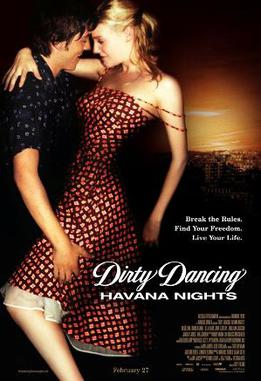
Dirty Dancing: Havana Nights. A Review

 
DIRTY DANCING: HAVANA NIGHTS

I think that one can enjoy a film that is not good. Such is the case with Dirty Dancing: Havana Nights. I was expecting a disaster, yet Havana Nights ended up being pleasant. I did not say good. I did not say Havana Nights is anywhere close to the original Dirty Dancing. I said, "pleasant", which is in the end works at least for me.

It is November 1958. Katey Miller (Romola Garai) is unhappy about having to move to Cuba. She is there because her father Bert (John Slattery) is working there. As such, the entire Miller family has to move to the tropical paradise: Katey, Bert, his wife Jeannie (Sela Ward) and Katey's younger sister Susie (Mika Boorem). Susie easily fits into the other young American expatriates like James Phelps (Jonathan Jackson), whose father is Bert's boss. Katey, more intellectual, does not mix well in this circle. She especially does not fit in with mean girl Eve (January Jones). 

Katey does have an easier time with hotel waiter Javier Suarez (Diego Luna). They meet when she accidentally knocks out his tray and gets berated for "his" clumsiness". Javier, who does speak English, is the son of an opponent to the current Batista regime. Javier's brother Carlos (Rene Lavan) is a supporter of Fidel Castro and the revolution. Javier is nominally sympathetic, but he would rather be at La Rosa Negra, where he can free himself in sultry Latin dancing.

As Bert and Jeannie were once skilled dancers themselves, Katey has some background in the art of movement. She also finds Javier's world more exciting than the WASPish world people like James and Eve live in. A dance competition piques her interest, especially with a chance for the winners to go to America. Taking the advice of the hotel dance instructor (Patrick Swayze), Katey eventually talks the now-fired Javier into being her partner.

How much of a partner will the erotic Latino become? Will the Millers find the prospect of a Cuban boy squiring their daughter a pleasant one? Will the impending revolution upend all their lives? Will Katey and Javier win the dance contest?

As I reflect on Dirty Dancing: Havana Nights, I think that Boaz Yakin and Victoria Arch's screenplay (from a story by Kate Gunzinger and Peter Sagal) pretty much drew from the original Dirty Dancing. It is almost a surprise that Javier didn't go up to the Miller table and say, "Nadie pone Bebe en una esquina". You have the opening voiceover. You have the parents and two sisters, one bookish, one flirtatious. You have the luxurious hotel setting. You have the guy from the wrong side of the tracks with the moves. You have the young man that the parents would prefer for their older, bookish daughter. You have a dance rehearsal montage. You have a climatic dance.

Granted, there are some differences: you did not have revolutionaries attempting to kill people at Kellerman's Resort. Overall, though, Havana Nights is a bit of a Dirty Dancing clone. 

Things get more complicated when you see Patrick Swayze in Havana Nights. Technically speaking, he is not recreating his role as Johnny Castle. He is not billed as "Johnny Castle" but as "Dance Class Instructor". He appears briefly in the film, giving Katey a pep talk and cheers our dancers on the sidelines. I think people assume that Swayze is playing Johnny Castle, but he is strictly speaking not. I do not know exactly why Swayze could not be Johnny Castle. He could have served as a mentor to both Javier and Katey. Instead, his character, whatever he was, was just there and could have been cut out.

In terms of performances, Havana Nights does not ask much from our cast. Romola Garai makes a valiant effort, but sometimes her British accent slips through. It would have been easier to have made her an American who grew up in Britain with her family having lived there before being transferred to Cuba. That way, she could speak in her natural voice versus trying to sound like an American. To be fair, Garai's American accent was serviceable, though not always convincing. She was fine as the hesitant young girl who discovers the rhythm of the island. 

I cannot say that Garai and Diego Luna had chemistry, but they were fine with each other. I find it slightly amusing to see Luna in something like Havana Nights. I do not know if in retrospect, he is particular about being a Mexican playing a Cuban. He was fine in the part of this working-class man who found freedom in the steamy Havana clubs. I think he did as well as he could with what he was given. 

Both Jonathan Jackson and January Jones early in their careers were all right in their roles. I think it might have been better if Jackson's James had not taken a particular action against Katey and been more a dupe than a semi-villain. Jones' efforts to be the mean girl were again, fine, but she was not given much to do.

The real crime is against Sela Ward. She is a talented and beautiful actress who somehow just did not become the star that she I think could have and should have been. While she has done well on television, Ward has never fully broken into film. Havana Nights misused her. I would not go so far as to say that she is miscast. I will say that her efforts to be snobbish and hostile towards Javier and Katey fell a bit flat. It is as if Ward was trying too hard to be harsh. Slattery looked slightly sleepy in the role, but in fairness when he and Ward take to the dance floor, they do look nice.

A major compliment that I can hand Havana Nights is in its soundtrack, full of good Latin music. I cannot extend that to the dance sequences. Guy Ferland filmed some of them poorly, using many midlevel shots and spins, sometimes cutting excessively. While we did get some good numbers, the training montage felt choppy. Worse, we did not get Garai and Luna in full-form shots.  

I did find the ending curious. It is ostensibly a happy ending, with everyone going to La Rosa Negra shortly after Batista flees. Are we supposed to believe that everyone is celebrating Castro's takeover of Cuba? Maybe Luna in real life thinks this is a wonderful thing. I would have thought it would be more realistic to think that the Millers would have fled in terror versus hitting the clubs.

I did not end up hating Dirty Dancing: Havana Nights. It is inoffensive. Yes, it has no reason for being, coasting on the Dirty Dancing name and being a prequel in name only. Still, if you go into Dirty Dancing: Havana Nights, you could end up Havana good time.

Sorry, I could not resist. 

DECISION: C+

James Cagney: Top of the World. The Television Documentary

JAMES CAGNEY: TOP OF THE WORLD

This review is part of the Summer Under the Stars Blogathon. Today's star is James Cagney.

There are two ways to think about James Cagney. Some see him as the ultimate gangster, a small brawler who could take down anyone who got in his way. Some see him as a cheerful song-and-dance man, making dancing down a staircase look effortless.  Cagney was able to play both with equal ability. Perhaps that is why he is still remembered long after his 1986 death. James Cagney: Top of the World is a good introduction to this iconic figure, respectful and with some surprising revelations along the way.

Top of the World uses an archival interview from Cagney himself to fill in bits of information presented by host Michael J. Fox. Fox speculates as to how he got to be our guide through Cagney's life and career. He notes in Top of the World that when he was asked what the difference between himself and other young actors was, Fox replied, "They all want to be James Dean. I want to be James Cagney".  Fox wasn't trying to be flip or glib. He was sincere in his aspirations to be an all-around actor. Perhaps, and this is just my speculation, the fact that Cagney was 5'6" brought a sense of comradery with the 5'5" Fox.

Top of the World starts us out with Cagney's early years in the tough streets of Lower East Side New York City, with his tough mother ruling over the tough brood of Cagney children. Despite this, young Jimmy had a love for the country and rural pursuits. He even applied to agricultural college but did not complete a semester. His family needed help. Cagney then turned to the stage, making his debut in drag as part of the chorus line. He also met his wife Frances "Billie" Vernon, to whom he would be married for 64 years.

Cagney was always studying his craft, learning to improve his acting and dancing. Finally, the years of being a hoofer and on-stage tough guy paid off with the Broadway production, Penny Arcade. Cagney was singled out for praise, and none other than Al Jolson bought the film rights and brought the play and Cagney to Warner Brothers. Retitled Sinner's Holiday, Warner Brothers soon found a solid but at times difficult contract player. His breakout role in The Public Enemy made him a star. 

It also typecast him as a tough guy, which frustrated him. More frustrating were the dangerous conditions that he and his fellow actors worked under. During filming for The Public Enemy, real bullets were used, which could have killed the actors. He also disliked how he was shown as treating women. However, his Public Enemy costar Mae Clarke stated that everything he did was choreographed. The fighting and infamous grapefruit slap was choreographed. So was the dancing, as Cagney finally was allowed to do a little on-screen soft shoe in Footlight Parade, showcasing a different side to Cagney. 

Cagney was not one to back down from a fight. He helped form the Screen Actors Guild, looking out for his other players. However, his lifelong friend and costar Pat O'Brien noted that Cagney was "the far away fellow", who preferred being a gentleman farmer than hitting the Hollywood scene. In real life, James Cagney was the antithesis of his tough guy persona.

But was he a Communist? His political activities brought him to the attention of the House Un-American Activities Committee before it grew into the post-war fright fest it became. While Cagney was completely cleared of any subversive activities, the experience was so strong that he and his brother decided that it would be in their best interest to make a passionately patriotic film. That film became more important when Yankee Doodle Dandy began filming on December 8, 1941.

From there, Top of the World covers Cagney's slow fade out from film by his own choice. Among the twilight triumphs was White Heat, where the documentary's title comes from. After 31 years of acting, making big budget and small independent films, Cagney decided that it was time to close out his career. Retiring to his farm, he would be lured back into the spotlight a few more times, with the American Film Institute salute being the highlight.

Top of the World, as I said, is a good primer for the life and career of this most extraordinary figure. He was an interesting contradiction; the tough guy who had a passion for rural pursuits. On screen, Cagney was a smooth-talking, at times brutal man with women. In real life, he was gentle and devoted to his Billie, the love of his life.  People will learn that, long before method acting was in vogue, Cagney drew from memories of visiting an insane asylum for his White Heat character's breakdown when learning of the mother's death. 

Cagney earned the nickname "The Professional Againster" from Jack Warner for his pugnacious manner when dealing with the studio. However, time mellowed him to where he could look back with some amusement. We see this at his AFI acceptance speech, where he corrected the record on an imaginary quote. "I never said, "You dirty rat". What I did say was, "Judy! Judy! Judy!", laughing at another imaginary quote from his contemporary Cary Grant.

At less than an hour, James Cagney: Top of the World is informative and entertaining. James Cagney was more than his image of the hoodlum. He was a man who loved nature, loved his wife, loved his colleagues. He could also look back on his career with great pride. 

He certainly made it to the Top of the World

8/10

Tuesday, August 19, 2025

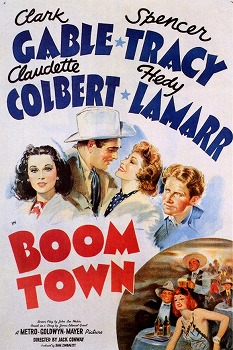
Boom Town: A Review

BOOM TOWN

This review is part of the Summer Under the Stars Blogathon. Today's star is Hedy Lamarr.

Fortunes rise and fall among the oil barons in Boom Town, a strong saga of the daring men who seek fortune and the women who love them. 

"Big" John McMasters (Clark Gable) and "Square" John (or Jonathan) Sand (Spencer Tracy) are both in the new town of Burkburnett, Texas in 1918. They aim separately to strike it rich as oil prospectors, better known as "wildcatters". They initially do not like the other. Sand in particular dislikes how McMasters keeps calling him "Shorty" (Gable at 6 feet did stand taller than the 5'9-10" Tracy). Circumstances, however, bring them together. Sand has the land but not the money for equipment. McMasters has some cash but no leases. They join forces and keep hoodwinking to downright stealing material from oil machine supplier Luther Aldrich (Frank Morgan).

Sand pines for a beautiful girl. McMasters, while in town, encounters newly arrived beauty Elizabeth Bartlett (Claudette Colbert). They marry within a day of meeting, but McMasters soon learns to his horror that "Elizabeth" is really the "Betsy" that Sand has been pining for. Bartlett, who initially had played with McMasters as a joke, had come to town to make clear that she was fond of but not in love with Sand. She hadn't planned on falling in love with his frenemy. 

Despite this, McMasters and Sand continue working together. A near-disaster, however, pulls them apart and they go their separate ways. Nevertheless, their lives continue to cross paths. Sand is protective of Betsy even though she is firmly loyal and devoted to McMasters. Sand is especially leery of McMasters' newest aide, socialite Karen Vanmeer (Hedy Lamarr). He also sees that McMasters, despite his great success, has put his wife and son Jack to the side. What role does their mutual rival Harry Compton (Lionel Atwill) have in bringing both down? Will these two men keep breaking up and reconciling? Who will end up with Big John: Betsy or Karen?

Boom Town keeps a pretty solid pace despite its almost two-hour runtime. Credit should be given to director Jack Conway for keeping things brisk. We see in Boom Town how these two men went from rivals to friends and back and forth throughout the film. In some ways, Boom Town could be seen as an ode to the bonds of male friendship. It takes a big man to essentially forgo the woman he was sweet on to his bestie. 

While today I think the quickie marriage would not be believed, I imagine that this is the only way to have McMasters be seen with Bartlett in the morning. In his defense, McMasters did not know about Betsy's true identity and Betsy did not realize that John was the man that Sand wrote so fondly of. Yet, I digress.

Clark Gable and Claudette Colbert reunite in Boom Town after their Oscar-winning roles in It Happened One Night. They showed that they still had great chemistry together. They work well together, the affection that the characters have for each other acted quite well. Gable dominates his scenes with a rapid-fire delivery that seems closer to screwball comedy than romantic Western. Nevertheless, Gable still holds your attention as this tough yet vulnerable figure.

Colbert, when not with Gable (and to be fair, sometimes when she is with him), does come across as slightly mannered in her performance. However, Colbert too did good work as this elegant figure. 

Tracy is able to match Gable in strength as Shorty. His embrace or rejection of this nickname ebbs and flows, depending on where his friendship with McMasters is. At one point, he lashes out at someone who called him Shorty, saying essentially that only McMasters could get away with it. When they were on the outs, he would tell McMasters, "Don't call me Shorty". 

There is no disguising that Hedy Lamarr is beautiful to ravishing. There is also no disguising that it is her beauty and not her acting that we see. Having a thin accent of vague origin, Lamarr seemed a bit distant as Karen. To be fair, it was not a terrible performance. It just was not on the same level as Gable, Tracy or Colbert. 

The real standout in Boom Town is Frank Morgan as the perpetually flustered Aldrich. Morgan is the perfect person to play these flustery, bamboozled men. His looks of confusion and befuddlement to exasperation bring a bit of comic relief to the manly actions of McMasters and Sand. Atwill is strong as the shrewd Compton, who wants to muscle in on McMasters. Chill Wills is the actual comic relief as Harmony Jones, the deputy who is fonder of cooking than of law enforcement. 

Boom Town has some great sequences. Of particular note is when there is a field fire that could kill them all.  The film even manages to have a bit of a laugh at Gable's expense. When Sands comes to visit the McMasters, he quips that he ought to have brought their son Jack a football helmet as a gift. When McMasters tells him that he is too young to play, Sands merely says that the helmet would be for him to sleep in to help with his ears. McMasters seems surprised and I think says, "Hey!". This could be a good-natured jab at Gable's own large ears. 

Boom Town works as good entertainment. It tells its story of friendship among the wildcatters well. It also has strong performances from just about everyone in the film. Boom Town is no bust. 

DECISION: B-

Monday, August 18, 2025

Here Comes Mr. Jordan: A Review

HERE COMES MR. JORDAN

This review is part of the Summer Under the Stars Blogathon. Today's star is James Gleason.

A little heavenly help is needed in Here Comes Mr. Jordan, a mostly well-acted and clever film that reveals the truth about the importance of doing good while still alive.

Boxer Joe "The Flying Pug" Pendleton (Robert Montgomery) is close to getting a big match. He is training with his loyal trainer Max Corkle (James Gleason). Max begs Joe not to fly his plane despite his flying being one of Joe's trademarks. Joe insists that with his beloved saxophone besides him, nothing can go wrong.

Wrong, however, things go when Joe crashes while on the wrong instrument. Heavenly Messenger 7013 (Edward Everett Horton) takes him to a cloud-filled realm where passengers are boarding their own flights. Despite Joe's insistence to the contrary, Joe Pendleton is most sincerely dead. Unfortunately, he should have died on May 11, 1991. In his eagerness and inexperience, 7013 pulled him out just a bit too early, by fifty years. Worse for Joe, Max had his body cremated. Wise heavenly figure Mr. Jordan (Claude Rains) calmly sorts out the trouble by taking Joe to find a suitable body to inhabit until his proper time.

Eventually, they come upon Bruce Farnsworth, a crooked banker who is around Joe's age. Joe at first balks at taking over such a corrupt figure. He, however, is angered when he learns that Farnsworth's wife Julia (Rita Johnson) and her lover Tony Abbott (John Emery) are murdering Farnsworth in his bath. Joe's anger increases when he sees and hears Julia and Tony, who is also Bruce's private secretary, eagerly putting the finishing touches of letting someone else take the fall for one of Farnsworth's crooked schemes.

Bette Logan (Evelyn Keyes) comes to Farnsworth's home in an effort to plead her father's case. Mr. Logan is in jail for selling useless securities. In reality, Mr. Logan was the fall guy for Farnsworth's scheme, but now it's Joe occupying Farnsworth's body. Julia and Tony are stunned to see "Bruce Farnsworth" very much alive and well (Joe looking like Farnsworth to everyone else). Bette, unaware of anything, is relieved when Farnsworth agrees to help. Joe finds himself drawn to Bette and soon they begin to fall in love.

Joe as Bruce also has decided to go back into the ring. He is especially motivated when Mr. Jordan tells him that it is his destiny to be world champion. Joe/Bruce brings in Max to train him. He also reveals the truth to Max, who takes time to believe it. Unfortunately, while Joe is destined to be champion, it is not as Bruce Farnsworth. Some people can't stay alive, so once again Joe has to find a new host. Will it be in the form of a boxer whose life is at risk because he won't take a dive? Will Julia and Tony get away with it? Will Max ever sort out the confusion? Will Bette find love again?


Both Robert Montgomery and James Gleason were singled out for their performances in Here Comes Mr. Jordan in Lead and Supporting Actor (the film eventually winning Best Story and Best Screenplay, its only Oscar wins from seven overall nominations). I would say that one of the acting nominations is merited, the other is not. 

The merited nomination is Gleason as Max. As the at times befuddled boxing trainer, Gleason has to sometimes act on his own whenever Max attempts to talk to Mr. Jordan. Joe, in his various guises, is the only one who can see or hear Mr. Jordan or Messenger 7013. As such, poor Max has to take Joe/Bruce/K.O. Murdock's word that Mr. Jordan is there (K.O. Murphy being the boxer that is Joe's final body). Gleason plays the comedy well, Max's confusion and disbelief giving way to a begrudging acceptance even if he does not understand. Gleason does have a couple of dramatic moments, both of which are about his accepting that the man he thought of as something of a son is gone. One feels for Max, who keeps losing people he cares about despite meeting them over and over.

The unmerited nomination is Montgomery as Joe. I think Montgomery did as well as he could as this working-class palooka who finds himself prematurely postmortem. His constant use of slang, such as referring to how he is "in the pink" (meaning in top physical condition) coupled with a vaguely Nuw Yawk accent show Montgomery was trying to be something of an average Joe. My issue is that it seemed that Montgomery was trying too hard to be that dim boxer. That is not to say that Montgomery did not have good moments. Every time he played the saxophone badly lent Here Comes Mr. Jordan a nice touch of humor. He also did well in his scenes with Evelyn Keyes, showing Joe/Bruce falling for our damsel in distress. Keyes was a bit flat at times, but she also managed some good moments with Montgomery. Ultimately, she is charming and delightful and pretty as Bette.

While he was not nominated for his performance in the film, I think Here Comes Mr. Jordan is one of Claude Rains' best performances. He is elegant and forever calm as Mr. Jordan, the wise, compassionate heavenly figure who advises Joe through his various incarnations. Charming, urbane and sophisticated, Rains' Mr. Jordan is never ruffled by even Messenger 7013's bungling. His displeasure at how the new messenger bungled his first job is as close to seeing Mr. Jordan angry. Even here though, Rains' elegant voice shows Mr. Jordan to be unflappable and caring. 

Before watching Here Comes Mr. Jordan, I had figured that "Mr. Jordan" was literally God Himself. This was reenforced due to his name, which I figured alluded to the River Jordan. From what I understand, Mr. Jordan is merely a senior Messenger who sorts out things in this situation. The film does not take a theological stand or suggest a Judeo-Christian worldview. There is no mention of God or even angels or Heaven (the otherworldly setting is never called Heaven, and the figures are Messengers). Moreover, the concept of reincarnation or the spirit of one person occupying the body of another are closer to New Age thinking than orthodox or even unorthodox Judaism or Christianity. However, I think that is me reading more into things. The vague suggestion of heavenly hosts is there. As such, it is not a major issue.

Veteran character actor Edward Everett Horton is perfectly obnoxious as the bumbling and at time arrogant Messenger 7013. One does almost wince whenever he comes back, but in a good way. He is bumbling but incapable of accepting how he was wrong. 

Director Alexander Hall, also nominated for his work, keeps things flowing and manages to make things funny or serious when needed. It is surprising that Here Comes Mr. Jordan is a comedy given the number of killings going on.

As a side note, I believe that the plot of Here Comes Mr. Jordan eventually inspired the television series Quantum Leap. On that television show, the main character of Dr. Sam Beckett also occupies someone else's body and has a guiding figure that only he can see or hear. Dr. Beckett, aided by his own Mr. Jordan in Al, attempt to change things for the better while living as the other person. There are differences: Quantum Leap's Dr. Beckett for example enters only living people (though some people he "leaps" into are in danger of dying prematurely). Yet I digress. 

Here Comes Mr. Jordan is charming and sweet. It has good performances from most of the cast and tells its story in a fun and fast manner. The film has a touch of the divine and ultimately wins us over. Here Comes Mr. Jordan is a heavenly treat.

DECISION: A-

Sunday, August 17, 2025

Terminal Station: A Review


TERMINAL STATION

This review is part of the Summer Under the Stars Blogathon. Today's star is Jennifer Jones. This review is also for Terminal Station, not its revamped version, Indiscretion of an American Wife.

While watching Terminal Station, the thought that came to mind was, "how could you make a mess of something so simple?". It is not that Terminal Station is a bad film. Far from it: in many ways, the film's simple story is quite good. The problem is the conflict between director and producer. Their battles over a film would lead to essentially two films from the same material. Terminal Station, version one, is a pretty good film that leans more Italian than American.

Philadelphia housewife Mary Forbes (Jennifer Jones) has been in Rome visiting her sister. During that time, she began an affair with half-Italian, half-American professor Giovanni Doria (Montgomery Clift). Now, she is determined to leave her lover and the Eternal City. Mary must get back to her husband Howard and daughter Kathy. She goes to Giovanni's apartment, then decides not to and rushes to the Stazione Termini to take a train out of Rome. She first opts for a train to Milan, where she will then another to Paris. She also hurriedly calls her sister and gets her nephew Paul (Richard Beymer, billed as Dick Beymer) to bring her a suitcase with some items.

Mary buys a child's Sicilian costume for Kathy and is ready to leave. She, however, spies Giovanni at the station. He has pursued her there, and she leaves the train. They, however, do not leave Stazione Termini. Instead, Giovanni continues to try and talk Mary out of leaving Rome. She has decided to take another train, this time a direct one to Paris. Paul, who has lingered at the station looking at various items, is one of the people who sees an enraged Giovanni slap Mary. Despite this, Mary still struggles to leave. Will Giovanni woo her into leaving Howard and Kathy for him? Will their affair be discovered due to the accidental intervention of the station police?


Terminal Station is Italian director Vittorio De Sica's American debut. Perhaps it was too much to ask him to fit his style to the designs of a Hollywood production. He might have been more successful had he had a sympathetic American producer who would let De Sica's realism play out. Instead, De Sica had the terrible misfortune to deal with Hollywood maverick producer David O. Selznick. 

The man best known for producing Gone with the Wind and Rebecca was never the easiest person to deal with. Selznick was notorious for sending out endless memos to his directors and rumored to be the inspiration for the tyrannical producer in The Bad and the Beautiful. Most directors tended to disregard his incessant memos and micromanagement. De Sica had the added advantage of not reading English. He, however, had a major disadvantage in that Terminal Station's star was Mrs. David O. Selznick. In his crazed obsession with making Jennifer Jones the focal point of everything, Selznick decided to ruin what could have been a great film.

Again, the problem is not Jones herself. She is at times a bit overdramatic as the adulterous house frau, but on the whole Jones handles the material well. Jones has a wonderful moment early in the film when she tenderly caresses the package containing Mary's gift to her daughter. In that scene, we see the character's hopes and longing for her child. Jones makes it plausible to believe Mary's inner conflict, especially as I thought that Mary was an especially stupid woman to want to stay with Giovanni. In his small role, Richard Beymer was fine as Paul, the nephew who soon grows leery of this strange Italian man.


A minor problem is Montgomery Clift. I figure that Clift agreed to the role for the chance to work with De Sica. However, it is pretty outlandish to believe that Clift is Italian in any way. Terminal Station tries to paper over that oddity by having him mention that his mother is American. However, you never believe Clift is this fiery Italian who would smack his woman around because "that's what Italian men do". I do not think the majority of Italian men go around slapping their broads either in public or private. Clift's stabs at an Italian accent never work. I think there were times when he flat-out forgot that he was supposed to have one. 

It simply would have been better to have made the Clift character an American expatriate that Mary fell in love with or cast an Italian or Italian-American in the role. Rossano Brazzi would have been a better choice. You could have had perhaps a Sal Mineo or even Bobby Darin, who would have been more plausible if the film opted for a younger plaything. Clift, I think, did his best, and he was one of the finest actors of his generation. Terminal Station, however, was the wrong material for him.

Terminal Station has some wonderful moments that I put down to De Sica's Italian neorealism. The film is filled with quick bits of outside characters popping in and out. We see priests ordering ice cream. We see a heavily pregnant woman and her brood. Terminal Station has a nice section where, on their way to the station police office, Mary and Giovanni accidentally walk on a red carpet set down for the railroad company president. 

I think an issue is that despite its brief runtime, Terminal Station feels a bit padded. I got the sense that things were padded to keep things going. Then again, perhaps the length was due to people waiting for the Italian trains to get going. 

If we look at Terminal Station, I think we have a good introduction to Vittorio De Sica as a filmmaker. He brought in as much neorealism as I think he could get away with. The film is filled with strong moments. The entire film could be summed up in the question the station police chief asks Mary. "Do you still plan to take (the train)?" he asks her when deciding whether or not to drop charges which would expose the affair. The hesitation to the answer holds you. 

Perhaps Indiscretion of an American Wife, which I have not seen, pales in comparison to Terminal Station. That is for another day. As it stands, minus Montgomery Clift's miscasting, Terminal Station works well. Jennifer Jones did mostly well, though at times again was a bit overly dramatic. Mussolini may have made the trains run on time, but even he would have been no match for David O. Selznick and his interference. 

Saturday, August 16, 2025

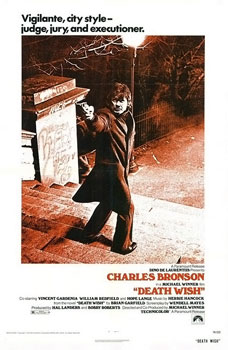
Death Wish (1974): A Review (Review #2020)


DEATH WISH (1974)

This review is part of the Summer Under the Stars Blogathon. Today's star is Charles Bronson.

Justice is dealt out swiftly in Death Wish, the first of what I figure became an unintentional franchise. Still controversial, Death Wish moves fast and gives us a sympathetic portrait of a man pushed to fight whether he wants to or not.

Well-meaning architect Paul Kersey (Charles Bronson) has a charmed life. He has a wonderful wife, Joanna (Hope Lange) and a successful career. He is concerned about crime in New York City, but he believes that crime is a result of poverty versus cruelty. His world comes undone when Joanna and their daughter Carol (Kathleen Tolan) are viciously attacked in Paul and Joanna's apartment. Carol opened the door believing that they were receiving groceries. Instead, it is three hoods who took the Kersey address from the store to at first rob them. Things go out of control when they begin beating Joanna and viciously raping Carol.

Paul is urgently contacted by his son-in-law Jack Toby (Stephen Keats) to come to the hospital. Carol survives but is left shell-shocked in a near-permanent catatonic state. Joanna does not survive. Paul is devasted and equally frustrated at the lack of movement to the investigation. He also starts considering self-defense with an improvised weapon: a sock with coins to use as a battering ram. Paul does use it when someone attempts to mug him. 

To help with his grief and move his career forward, Paul is sent to Tucson to attend to a client. Here, the client, Aimes Jainchill (Stuart Margolin) remains firm on some points. First point is on how the proposed development must not demolish the hills in the area. The second point is on how guns are just a tool, neither moral nor immoral. Aimes gives Paul a gun as a parting gift, though Paul is unaware of that until after he returns to New York.

Carol's condition has grown worse. The police are no help. Paul starts carrying the gun for his protection and eventually uses it against yet another attempted mugger. Soon, Paul becomes what the press dubs The Vigilante, a mysterious figure who is shooting criminals who either attempt to attack him or others. The NYPD is displeased by this Vigilante. Heading up the investigation is Inspector Frank Ochoa (Vincent Gardenia). Ochoa is no fool, shrewdly narrowing down potential vigilantes based on age, sex, crime victims or relatives of crime victims and even military service. Will Ochoa track down the Vigilante? Will Paul Kersey's nocturnal activities find him out or even get him killed?

I think that Death Wish, contrary to some others' perception, does not glorify either gun violence or vigilantism. Paul does not kill for blood lust. He kills only when he sees others being attacked or is himself threatened. Paul also mentions that while he served in Korea, he was a conscientious objector. In short, Paul is a man of peace, a "bleeding heart liberal" as one of his colleagues calls him. In Death Wish, we see that Paul was pushed to vigilantism due to the tragedies he suffered, not through a specific desire for revenge.

Does Death Wish glorify violence? I do not think so. I think rather that it is a reaction against the growing violence. Wendell Mayes' adaptation of Brian Garfield's novel also suggests that the general public is capable of defending itself from violent crime. Paul and his work colleagues see a news report of a Mrs. Alma Lee Brown (Helen Martin), who took on attempted muggers by using a hatpin against them. This is a somewhat amusing moment amidst the violence in Death Wish, particularly when we see the reenactment of this seemingly frail old woman chasing after the thugs who tried to rob her yet again.

This is probably the only part in Death Wish that has anything close to lightness. Actually, the Wild West show that Paul and Aimes go to can be considered lighter given the exaggerated theatrics of the reenactors. This scene is probably here to show the seeds of vigilantism planted in Paul's mind. Still, it was realistic in its theatrical manner, a credit to director Michael Winner.

Charles Bronson is a curious figure in film. He is not traditionally good looking. Death Wish did not leave me with the idea that he was a strong actor. At times, he seemed a bit stiff in his delivery, though he did make an effort when working with Lange. Still, I can see why he became a solid action star. I think it is because of both his apparent flaws. He is closer to an everyman, someone whom we can know in our daily lives versus some glamorous figure. He is also more casual in his manner. Charles Bronson was not striking poses but doing his best to be the character. He excelled when facing off against thugs. He also did well when handling a monologue about how his father's death in a hunting accident was instrumental in his aversion to guns, albeit due more to his mother's insistence than his own views.

Death Wish also has some good performances from both veterans and up-and-comers. Though her role is small, Hope Lange does make Joanna someone we do care about. One is surprised to see Jeff Goldblum in an early role as "Freak One", one of the muggers. We also see a brief appearance from future comic actor/director Christopher Guest as Officer Reilly, the rookie who has the Vigilante's gun. Olympia Dukakis and her future Moonstruck co-star Vincent Gardenia also share a scene in the New York Police Department investigation group meeting.

I think it is a strange choice to have the very Italian Gardenia play a character named Ochoa, which is a Hispanic surname. I wonder what the rationale for such a choice was. Despite that, I think that Gardenia's performance is commendable. His Inspector Ochoa was not a dumb cop nor fanatically hostile to the Vigilante. He is shown as a dogged cop, capable, who uses logic to slowly, methodically narrow down potential suspects. 

Death Wish does not shrink from being at times rather graphic. The assault on Carol in particular is disturbing to watch. In some ways, Death Wish is a B-film, where one can see that it was not a lavish production. However, it works for the film. Perhaps a good chunk of the money went to hiring jazz legend Herbie Hancock to write and perform the score. 

Director Winner also has some wonderful shots in the film. When Ochoa and Kersey finally meet near the end, Ochoa is shown to be holding Kersey's gun in a peculiar manner, almost as if threatening him himself. Ochoa also is shown seen speaking to his officers in front of a target, a clever sight gag.

Death Wish does leave the door open to a sequel. I do not know if a franchise was needed or warranted. As it stands now, Death Wish is a good film that lets one decide if it is pro-or-anti vigilante. 

DECISION: B-