Showing posts with label 1st Doctor. Show all posts

Monday, January 27, 2014

Doctor Who Story 029: The Tenth Planet


STORY 029: THE TENTH PLANET

Ice Station Cybermen...

The Tenth Planet is both a debut and farewell.  It is the first Cyberman story, a monster that has become one of the most iconic of Doctor Who monsters (who have also undergone many alterations in design throughout the series).  It is also the last First Doctor story, where we are left with the very first regeneration.  While the actual look of the Cybermen themselves may disappoint (and actually, I figure it didn't look all that good the first go-round), the actual concept of the Cybermen is in itself a splendid one.  The Tenth Planet also moves well and on the whole works, albeit not without a few hiccups.

It is the South Pole, 1986 (i.e. twenty years into the future).  On Station Snowcap General Cutler (Robert Beatty) is overseeing the routine flight of a spaceship, Zeus IV.  General Cutler (Robert Beatty) is running the International Space Command station while chief scientist Dr. Barclay (David Dodimead) handles the technical aspects.  Two groups arrive at Station Snowcap.  The first group is The Doctor (William Hartnell) and his Companions, Able Seaman Ben Jackson (Michael Craze) and Polly (Anneke Wills).  The arrival of three humans in the middle of the South Pole startles the crew.  They are taken but found to be harmless.
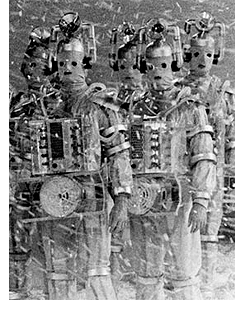
Into this we find that Zeus IV is having technical issues.  The instruments on Snowcap are also experiencing strange readings.  The Doctor knows what it is, and soon his warnings are confirmed: a whole new planet is suddenly appearing.  The Doctor knows what this planet it.  It is Mondas, the Earth's twin planet, lost ages ago but now returning.  With Mondas' arrival we also get new beings: metallic beings who call themselves Cybermen.  They were once like Earthlings, but over time their body parts were replaced with robotic parts, keeping their brains but removing all things called 'emotions'.  The fate of Zeus IV is irrelevant to them.  Mondas is absorbing the Earth's energy and will soon destroy our world.  With that, the Cybermen say they will take humans and turn them into Cybermen.


Cutler and Ben are able to defeat this Cyber-party, but it looks like Earth is doomed due to Mondas absorbing Earth's energy and bringing Earth to an inevitable explosion. Zeus IV is destroyed when it was dragged to Mondas and exploded due to the absorption of energy. Cutler decides that he will use the Z-Bomb, a Doomsday Device, to destroy Mondas.  This of course could bring destruction to Earth, the nuclear force being so great it could wipe out the side of Earth that is facing Mondas.  Just when he is needed the most, the Doctor has become violently ill and is out of commission.  Cutler is also motivated by the fact that his son Terry (Callen Angelo) has been sent on a rescue mission to Zeus IV which was too late to save the ship and runs the risk of a similar fate.  Ben, echoing the Doctor's previous warnings, begs Cutler not to take this act, saying that Mondas is absorbing so much energy that it will destroy itself.  Barclay similarly insists on the dangers, but Cutler will not be dissuaded.

Ben and Barclay manage to sabotage the rocket that was to carry the Z-Bomb, and Cutler orders them killed.  However, a new Cyber-party arrives in time to kill Cutler, inadvertently saving everyone else.  The Cybermen, however, will now use the Z-Bomb against Earth to save Mondas, taking Polly as a hostage.  The Doctor, Ben, and Barclay manage to delay long enough to see Mondas explode, and with that the Cybermen disintegrate.  Ben and the Doctor rescue Polly, but now the Doctor tells them that it's far from being all over.  Having complained earlier that 'this old body of mine is wearing a bit thin', he has them rush him back to the TARDIS, where he locks them out.  Once they finally get inside, they find the Doctor collapsed on the floor.  As the TARDIS starts dematerializing, the Doctor's face begins to change into someone else's...
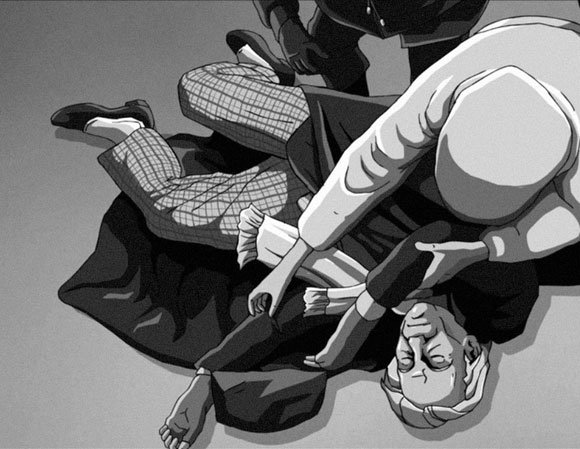


It is the most tantalizing loss in the Doctor Who archive: the very first regeneration.  The actual regeneration sequence does survive, thanks to a clip used on the children's program Blue Peter, but apart from that and a few off-screen recordings Episode Four of The Tenth Planet is lost.  Both the surviving sequence and the animated reconstruction are quite effective and chilling.  In fact, the animation for Episode Four gives indication that The Tenth Planet would have worked brilliantly as an anime-type story.  The destruction of Mondas and the disintegration of the Cybermen in their animated form is brilliant, and I think looks better than the actual footage would have looked like.

The animation is the same as that from the missing episodes of The Reign of Terror, not as fluid as that of the animation for The Invasion, but this time I didn't find it as much of a hindrance as I did for Reign of Terror.  I think it is probably because The Tenth Planet is science-fiction, so that kind of story lends itself better to animation than a historic-based story like Reign of Terror.  Seeing the Cybermen animated also makes them more menacing, even if the initial Cyber-design was not the best.  Fortunately, their design was worked on to where the Cybermen would become one of the great Doctor Who monsters rivaling the iconic Daleks. 


In terms of performances Hartnell, though slowly slipping into illness that forced him (in part) to retire from the role, seems oddly invigorated as the Doctor.  He still commands authority and mixes that with a genuine caring aspect for his Companions.  The fact that Hartnell became ill during the making of Episode Three (thus basically writing him off that episode) works because we can imagine that in retrospect it is the beginning of his regeneration taking effect.  His final moments as the Doctor were brilliant: a sense of fear and terror coming across as he is about to enter a new phase.  Craze takes command as Ben Jackson, being less a man of action and more a man who needs to do things to save others, like a good Royal Navy crewman would.  Wills, sadly, had the run of screaming and looking almost helpless, but that is a reflection of the times.  However, she and Craze have a great rapport, especially when their Swinging London sensibilities come against the ancient Time Lord's more Edwardian outlook, particularly in clothes.

The design for the Cybermen, as I stated, were a bit odd-looking now.  The costume, with that lantern on their head and the mask (whose mouth sometimes did not open when they first starting speaking) runs the risk of looking a bit comical now.  However, they were quite effective whenever they killed, and the sing-song voice they used indicated correctly that they had something vaguely human about them but that they were not entirely machine or human.  I have long wondered whether the Cybermen were the metaphorical ancestors of Star Trek's Borg, and hearing them say in Episode Four that "Resistance is useless" does heighten the suspicions.

I do have some questions in Kit Pedler's screenplay (with Gerry Davis co-writing Episodes Three and Four).  The Doctor has knowledge of Mondas' existence and who the inhabitants of said planet are, but we never learn how he came to this information.  Having the Cybermen have two landing parties does seem a bit peculiar, as does their fortuitous arrival to save them from Cutler.  In particular, the aspect of the Doctor knowing about Mondas but never learning how or why looks like it was thrown in just to have someone understand how this all came about.  The subplot of the Cybermen going to Geneva in their plot to either destroy or take over the Earth also was a bit short-shifted.

Still, apart from those aspects The Tenth Planet holds up extremely well and gives the First Doctor a proper send-off, leaving open so many possibilities that are now part of established Doctor Who Canon (regeneration, Cybermen).  It's a very good story, acted well, which moves steadily and who uses the Doctor's absence effectively.

Sadly, the next two stories,  the Second Doctor debut story The Power of the Daleks, and the historical adventure The Highlanders (which was the debut of Companion Jamie McCrimmon, the first Scottish Companion...sorry, Amy Pond), are lost, with no surviving episodes apart from short clips.  The third story, The Underwater Menace, is the first semi-complete Second Doctor story, and in perhaps the strangest irony, the first completely intact Second Doctor story is Story 037...The Tomb of the Cybermen.  The Tenth Planet moves well, has an interesting story, and despite the now-weak Cybermen look we can see how things will work out in the future.

We will not be deleted...


8/10

Next Story: The Power of the Daleks

Next Available Story: The Underwater Menace

Thursday, April 18, 2013

Doctor Who Story 018: Galaxy 4


STORY 018 : GALAXY 4

A Lost Galaxy Rediscovered...

Until 2011, Galaxy 4 was one of the completely lost Doctor Who stories, with only a few clips being known in existence.  However, Air Lock, Episode Three of Galaxy 4, has been rediscovered, and as a result we now have one less story that has no complete episodes to look at.   The discovery of any lost Doctor Who story is always great news, and with the hour-long reconstruction of Galaxy 4 available, we can now get a glimpse of a unique Doctor Who story, one sadly done in by a failed effort to come up with a monster that just now looks comical, right down to its name.  Minus the 'creatures', Galaxy 4 is a surprisingly strong and solid story that has more pluses than minuses.

The Doctor (William Hartnell) and his Companions Vicki (Maureen O'Brien) and Steven Taylor (Peter Purves) arrive on a seemingly deserted planet.  However, as it stands, it is not deserted.  Instead, they first encounter little round robotic beings Vicki nicknames "Chumblies" (due to their clunky movement).  Believing them to be hostile, the Doctor and Companions escape the TARDIS, only to find themselves taking forced refuge with the Drahvins, a collection of women warriors headed by Maaga (Stephanie Bidmead). 

She believes the Chumblies and their masters, the Rills, are hostile.  According to her, the Drahvins crashed on the planet at the same time as the Rills, and ever since then the Drahvins have been attacking the Chumblies whenever they approach.  Maaga and her minions, robotic females, ignore the Chumblies messages that offer them passage on the Rills spaceship, which they have managed to repair, while the Drahvins' ship has not.  They believe that in fourteen dawns time, the planet will be destroyed (hence making escape vital).  The Doctor, however, realizes they really have two days before the planet is evaporated.

Maaga has come up with the idea of seizing the Rills ship, conveniently killing the Rills off and making their escape that way.  Believing the Chumblies and Rills dangerous, Maaga uses Steven as a hostage and forces the Doctor and Vicki go to capture it.  However, we discover the Rills (who yes, are rather frightening to humanoids) are actually a peaceful group.  They created the Chumblies to help them as the air is poisonous to them, and their efforts to bring the Drahvins with them are sincere.  However, the Drahvins are a warrior group, determined to conquer the galaxies.  The Doctor and Vicki now join the Rills to help their ship take off before the planet explodes.

First, however, they have to rescue Steven, who is nearly killed by Maaga when she won't let him enter from the airlock unless he surrenders.  The Drahvin, infuriated at the travelers escape, pursue them, but it is too late: the Rills have made their escape, and the TARDIS is defended by a Chumblie long enough to escape themselves.  The Drahvin are left to their fate, and the three space travelers ponder at what is going on in another world, one where a man tells himself he must kill...  


The Chumblies are not the first, nor would they be the last, 'monster' that might have looked good on paper but ended up coming across as a bit of a joke.  For whatever reason the First Doctor's tenure was plagued with weak imitations of the Daleks (like the Chumblies or the Mechanoids), and the Second Doctor's reaching a nadir with the Quarks in The Dominators.  It doesn't help matters that starting from Vicki, no one appears to take the Chumblies seriously as a threat (with the exception of the Drahvins).   For the record the creatures are never given an actual name, and it is only until The Exploding Planet (Episode Four) that the Rills use the phrase "Chumblies".  For the rest of Galaxy 4, they are almost always referred to as 'the creatures'.

The Chumblies sadly are the things that push Galaxy 4 down a bit, but despite their comical/cuddly mix the reconstructed episode is actually a good one.  First, I should compliment the editing work done on the restoration.  Using primarily telesnaps (photos taken directly from the screen when initially broadcast), one can sometimes see how it doesn't quite fit, but the did manage to integrate what was thought of as the only surviving footage (a seven minute clip of Episode One: Four Hundred Dawns) so well I hardly even noticed the transition.  Once we got the rediscovered Episode Three, again it flowed smoothly that it was never jarring, and when we returned to telesnaps for Episode Four: The Exploding World, it all fit in rather well. 

I don't want to give a wrong impression: it wasn't perfect.  It was obvious that sometimes the same photos were being used, but given the circumstances on the whole the effect on the viewing of Galaxy 4 made one focus on the story itself rather than on how there's only one episode left. 

Find Me...

As one watches Galaxy 4 one appreciates certain qualities in William Emms' story.  First, it is not often that the Doctor first encounters the villains and begins to take their side.  Galaxy 4 thus reverses the idea that what at first appears good and what appears dangerous really is not perhaps the truth.  Even in NuWho we have almost always had the Doctor and the Companion come across those in need FIRST, then the villains.  Galaxy 4 therefore, is one of the handful (and perhaps one of the few) to reverse that process, making it one with great twists and turns that are above all else, logical.

Second, in another Doctor Who rarity (certainly in the Classic Era) we get an on-camera flashback sequence.  Most of the time, even now, whenever a character talks about the past on Doctor Who, we just hear him/her describe what happened.  In the newly-discovered Episode Three: Airlock, we actually hear the Rills' version of events while watching it at the same time. Most of the time I find this rather distracting, but in Galaxy 4 I found it actually added to the story, primarily because it was so well-filmed.  Given that, it is a terrible shame that the other three episodes are not around to appreciate.  One imagines that Derek Martinus (with an uncredited Mervyn Pinfield) created some wonderful visuals.

They also brought great performances out of the guest stars.  Galaxy 4 is a sparely populated story (you have four Drahvins and hear the voice of one Rill), but the main weight is carried by Bidmead and Robert Cartland as the voice of the Rills.  Bidmead at first comes across as a strong and firm military mind but one who has cause to be hostile to the Rills and Chumblies, but by the end we see her as the villain, and a credit to her performance that she makes the transitional natural.  Cartland's impressive voice carries the rather frightening look of the Rills (which given their look would be nearly impossible to move about without looking strange at best, idiotic at worst).

One thing that is highly impressive is that the core group has great chemistry with each other.  I was very much taken by this exchange between Maaga and the Doctor.  When Maaga asks for them to help the Drahvins kill the Chumblies and Rills, the Doctor flat-out refuses.  "In the first place, Madam, I never kill anything.  Neither do my friends," he angry comments.


What a difference nearly fifty years makes...from a Doctor who says he never kills (and also one who in a future story, Inferno, states he isn't in the habit of telling lies), to a Companion who not only kills with glee but one whom he is supposed to be "passionately in love" with and a Doctor who has Rule Number One: The Doctor Lies.  Given how wildly Doctor Who has spun out of control, Galaxy 4 is a reminder, even in its incomplete state, of when the series took things seriously and has as its lead a man of intelligence and peace, not a nitwit who gave himself over to a psychopath. 

Yet I digress.

The Chumblies are sadly another failed marketing ploy, and their roly-poly appearance (not unlike James Corden) makes them more comical than menacing.  They are the answer to anyone who thought the Daleks were silly-looking.  Minus them, Galaxy 4 is a well-down story with good (and logical) twists and turns

I've faced down pepper pots.
Think I'll be afraid of a trash can?


7/10

Next Story: Mission to the Unknown

Next Available Story: The Daleks' Master Plan

Saturday, March 16, 2013

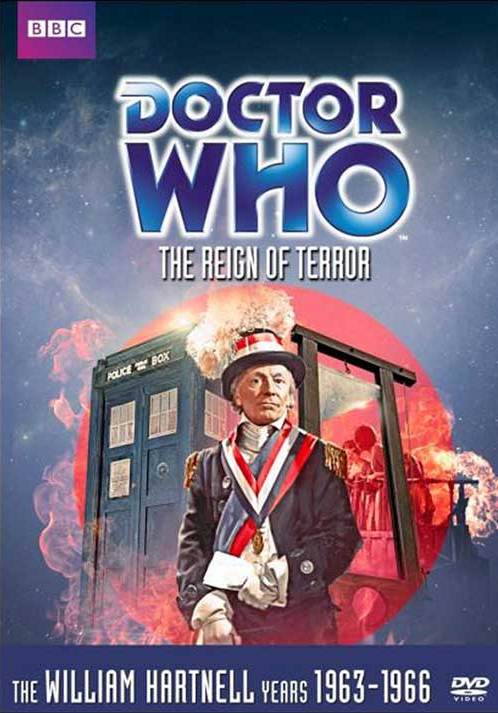
Doctor Who Story 008: The Reign of Terror

STORY 008: THE REIGN OF TERROR

The six-part First Doctor story collectively known as The Reign of Terror is yet another of the 'lost' stories, with two episodes missing.  Through the magic of animation reconstruction, we now have as close to a complete restoration as possible should the episodes never be found.  It is also a historical story, and with the collective title of The Reign of Terror we can guess it takes place during the chaotic post-French Revolution period.  We learn that the French Revolution and the succeeding period is the Doctor's favorite period in Earth's history, though one wonders why a pacifist would enjoy a period a particularly bloody period.  While The Reign of Terror suffers from an excess in length and appears to be taking its cue from other stories (more on that later), it is on the whole less an adventure story and more a history lesson through the six episodes: A Land of Fear, Guests of Madame Guillotine, A Change of Identity, The Tyrant of France, A Bargain of Necessity, and Prisoners of the Consiergerie.

The Doctor (William Hartnell) is in as especially cross mood.  His Companions Barbara Wright (Jacqueline Hill) and Ian Chesterton (William Russell) want to go back to their own time.  With a mixture of anger and hidden sadness he drops them off at what he thinks is 1963 England.  As is the ways of Doctor Who, he is mistaken: he lands them in France, specifically mid-July 1794 at the end of the rule of Maximilien Robespierre. 

The Doctor, his Companions, and his granddaughter Susan (Carole Ann Ford) now find themselves caught up int chaos of the Revolution.  Captured in a farmhouse, Ian, Susan, and Barbara are taken to Paris for prompt beheading as Enemies of the Revolution.  The Doctor, having survived the torching of the farmhouse, goes to their rescue.

He needn't have bothered.  While Ian is separated from the women, their route to the execution is interrupted by a secret group that rescues those sent to the guillotine.  Their rescuers, Jules (Donald Morsley) and Jean (Roy Herrick), suspect that there is a double agent within their ranks.  Also aiding them is the handsome and charming Leon (Edward Brayshaw), who has smitten and been smitten by Barbara.  Susan, however, has taken ill, and after a dangerous visit to a physician, they are recaptured and sent back to the Conciergerie Prison.

The Doctor, meanwhile, has infiltrated the Conciergerie, pretending he is a high provincial official of the Revolution.  The Jailer (Jack Cunningham) is constantly puzzled by this official, while the prison official and Revolutionary leader Lemaitre (James Cairncross) suspects there is something peculiar about this garishly-dressed officer.  It also doesn't help that he thinks Ian knows something about an espionage ring that is working with the British.  Ian, having overheard a dying prisoner, escapes and now has two goals: to find Susan and Barbara, and deliver a message to the mysterious James Stirling. 

Eventually the Doctor and his Companions are reunited, Barbara and Ian arrange a secret meeting where some Corsican general is offered one of three consul positions in a new French government, James Stirling's identity is exposed and Robespierre fell, bringing an end the Reign of Terror.

The Reign of Terror is at heart, a good idea for a story, but it has some flaws.  One big flaw is its length: at six episodes is it two episodes too long.  We go through a lot without actually having the cast be participants in either affecting or altering history be it major or minuscule.  Instead, they were just carried into events, always reacting to things but not impacting them.

Second, Dennis Spooner's story appears to be drawing inspiration (consciously or not) from The Scarlet Pimpernel.  We have a British agent working during the French Revolution who is involved in rescuing people from the guillotine while maintaining a secret identity.  Furthermore, we don't have any specific reason as to why Jean and Jules rescue Barbara and Susan in particular (other than they just happen to be in a passing tumbrel).  Part of me would have liked to have seen a little more humor without flashing back to the Looney Tunes' The Scarlet Pumpernickel.

The entire subplot of Ian's involvement with British spies seems to be there just to A.) lengthen the story and B.) give Ian something to do.  Most of the non-Doctor action involves Susan and Barbara: attempting to escape prison, attempting to stay alive and find both Ian and the Doctor.

Moreover, Ford's Susan proves herself to be shockingly annoying.  One appreciates that she has become violently ill during her time in prison (although to be frank, this whole 'Susan is getting in the way' business is slowly starting to get a bit tiresome), but even as she grows weaker and weaker (only to have a great recovery before the story ends), her whining and complaining about things slowly starts getting on our nerves.   It almost seems that most of the story is there, without the main cast having to do things to either get into or out of their situations.

One thing that was amusing (perhaps unintentionally, perhaps not) was the Doctor's wardrobe.  With his mass of feathers in his cap, it seemed that we can never fully take his get-up seriously.  Granted, it was done to get into the prison, but at times it does prove almost hilarious to see him constantly strut around like an unhinged peacock.  We also have an extended sequence in Episode Two: Guests of Madame Guillotine where the Doctor is put to manual labor which seems to just stretch the story.

Finally, for a story that is set in the Doctor's favorite era in human history (again, though we don't know why this particular time period is his favorite...I would have thought the Renaissance, or the Enlightenment, or even the Era of Good Feelings), he doesn't seem to either know much or show any particular fascination of being within that time frame.  He never stops to marvel that he is rubbing shoulders with Robespierre (who at least is seen as a loon).

However, The Reign of Terror has some wonderful things buried within this lost story.  Cunningham is in turns comic and menacing as the Jailer.  With equal ability he can be flustered, even flummoxed by the Doctor's mind games and suggest that he will take advantage of Barbara.   The identity of James Stirling does come as a true and unexpected shock.  We also have some of best examples of how Hartnell's Doctor is brilliant in how he is able to outwit his enemies rather than by using force.  How he manages to deceive the Jailer and Lemaitre, then use his backfired plan against the Jailer shows he is simply on a higher intellectual level.

One positive aspect is the conflict between Ian and Barbara after Leon the traitor is killed.  While Ian sees things as black-and-white (Leon was evil, he had to be killed), Barbara sees things in shades of grey (perhaps fifty given how she appears to like Leon).  She comments that Leon saw himself as a patriot, not as a villain.  In his perspective, Leon was working for the good guys and Jules and Jean were the bad guys.  It's unfortunate that the suggesting of attraction between Leon and Barbara stumps her argument, it does show that Doctor Who was willing to explore ideas about good and evil.  Unfortunately, this fascinating discussion was dropped pretty quickly but the fact it was introduced at all was a positive step.

Finally, the end of Episode Six has a simply wonderful closing scene with beautiful dialogue.  Having perhaps accepted that the four must keep wandering through time and space together a little bit longer, the Doctor muses, "Our lives are important, at least to us.  But as we see, so we learn."  Ian asks, "And what are we going to see and learn next, Doctor?"  The Time Lord replies, "Well, unlike the old adage, my boy, our destiny is in the stars, so let's go out and search for it."  We now see the chief strength of Doctor Who: limitless possibilities in terms of story. 

As far as the animation for the lost episodes (Episodes Four and Five: The Tyrant of France and A Bargain of Necessity) this is the second time we've had a reconstruction through animation.  The Invasion, the lost Second Doctor story, was brought to life through the work of Cosgrove Hall.  The Reign of Terror's animation is brought by Theta Sigma, and the styles of animation are clearly evident.  It might not be unfair to compare the two works, and I'm willing to acknowledge that perhaps seeing The Invasion first I am prejudiced towards that style of animation.

For myself, the animated episodes looked garish and surprisingly nonhuman.  I recognize that animation sometimes looks unreal, but with the two missing episodes I felt there was too much focus on the art and less on the human aspect.  In short, the animation drew a bit too much attention to itself in my view and less on the story.  While I got lost in the story of The Invasion and gave the animation not much thought (seeing it flow naturally in the story), The Reign of Terror didn't seem too concerned to make things look more natural.

On the whole, The Reign of Terror is a long but straightforward historic piece.  It isn't terrible but it has one or two flaws (particularly the length) to make it among the greats.  Still, on the whole mildly entertaining but nothing to lose our heads over.    

Unofficial Inspiration?
    

6/10

Next Story: Planet of Giants

Sunday, October 7, 2012

Doctor Who Story 009: Planet of Giants


STORY 009: PLANET OF GIANTS

Don't Let the Big Bugs Bite...

Planet of Giants from what I understand was suppose to be the first story (or at least a version of the story eventually broadcast) to appear in Doctor Who, However, it was rejected as perhaps too ambitious.  The general idea of shrinking our travellers however, was revived later on to appear in the next series. 

Planet of Giants was also suppose to be four episodes long.  However, orders from above commanded that a whole episode be lost, thus causing it to collapse elements from Episodes Three and Four (Crisis and the never-aired The Urge to Live) into one episode.  Sad for the story; that decision cost Planet of Giants a chance to be a much better story than the one we have.  However, Planet of Giants isn't bad by any stretch (no pun intended), which is a credit to the production team in front and behind the camera.

While materializing, the TARDIS doors open, causing chaos aboard for the four travellers: the Doctor (William Hartnell), his granddaughter Susan (Carol Ann Ford), and her two schoolteachers, Ian Chesterton (William Russell) and Barbara Wright (Jacqueline Hill).   When they first open the doors, they are thrilled to find they are back in 1960s Earth, but soon it becomes apparent that something is off.  They discover that they have been miniaturized (Doctor, We've Shrunk Ourselves!).

Now they find themselves in a nice English garden, but there is evil afoot.  There is a new insecticide, DN6, that is close to being released on the market.  However, government inspector Farrow (Frank Crawshaw) won't approve it.  DN6 is far too effective: it not only kills insects, it kills all living things, including animals that are important to the environment such as bees or earthworms.  Forester (Alan Tilvern) the financier of DN6, is not happy about learning he will lose millions.  Therefore, he does what all industrialists do: he shoots the inspector.  He also ropes in the weak-willed scientist Smithers (Reginald Barratt) to help him in the cover-up.

The crew realize it's murder and discover that DN6 will unleash on the planet.  Unbeknown to the rest, Barbara has touched some DN6 and she is slowly dying due to its effects.  Now they have to both contact the outside world to stop both Forester and DN6 but also literally grow up and save Barbara.

As I watched Planet of Giants, I thought there was something almost quaint about how poor Barbara has to be the one to face death.   My thinking is that this is 1960s casual sexism at its...finest?  You make the female be the one in danger (far be it for Ian to be the one in danger), and you even give her a fainting spell when she sees a giant fly. 

Moreover, I never understood why Barbara kept stubbornly silent about having touched DN6.  One wanted to shout out, "Tell them you're in danger!" but Barbara kept a ridiculous amount of British stoicism.  It only had the effect of making her look almost stupid (as if another cliche: the woman tripping and hurting her ankle while escaping already didn't do that).

However, it's a credit to Hill as an actress that we genuinely cared about Barbara (even if we did puzzle about her choices).  In fact, Planet of Giants is a well-acted piece from the regular cast.  Ford was given a chance to show that she was at least realistic in that she was the first one to realize that they had been shrunk.  We also look at Hartnell to see that he has not only grown in the role but given the character of the Doctor a softer touch.

For example, in the earlier Whos he was remarkably gruff, almost unpleasant and arrogant.  However, in Episode One (Planet of Giants), he does something almost uncharacteristic: he actually apologizes to Barbara for being short-tempered with her.  It was a nice and touching moment that gave the Doctor a more positive spin than perhaps when we began our adventures in the TARDIS.

If there was one exception to the 'good acting' rule it was with Russell, particularly with the first episode.  He was overacting, especially when he came across a dead ant with Susan.  It was almost as if he was trying to make it bad Shakespeare or he didn't believe any of this.  He did improve over the ensuing episodes but in the first one he was not good.

The guest stars played the parts given: the whimpering scientist, the villainous manufacturer, neither being over-the-top or giving them any deeper thought than they deserved.  Unfortunately, there were two supporting characters that suffered because of the decisions at the top.

There appears to be some comic relief through the characters of telephone switch operator Hilda and her husband, Constable Bert (Rosemary Johnson and Fred Ferris respectively).  One would think that they would have had more to do in Episodes Three and FOUR, but given that the decision was made to combine Episodes Three and Four (Crisis and The Urge to Live) into one, a lot appears to have been lost.

This decision in retrospect was a poor one because the last episode appeared to be remarkably rushed.  We had ended Episode Two (Dangerous Journey) with a great cliffhanger: the Doctor and Susan were in danger of being drowned in the sink.  However, once they got out of that danger (hiding in the overflow pipe and the water not reaching that level), how the got the police's attention, had Bert uncover the murder, gotten back to the TARDIS and rescued Barbara (by making her and everyone else grow the effects of the DN6 were minimized until they became almost harmless) seemed to go by too fast.

In the past, I've been critical of stories that appear to stretch the premise, but in Planet of Giants, I think they made everything go too fast.

Moreover, I never quite followed HOW the Doctor managed to make them all grow.  That resolution to their two great crises (their size and Barbara's health) appears a little too pat.  If it were a four-part story, I would say that this is one of writer Louis Marks' few faults: getting to resolve things a little too quickly and conveniently.

On the whole, however, Marks' script is full of good ideas that might have played well if the crew were of regular size.  The themes of environmental protection and the dangers of insecticides (a Silent Spring for the Who viewing audience) would have been interesting to follow if they had stumbled across the murder or if they were on another planet. 

I also think that the set design for the TARDIS crew was one of the best in the Classic Era, and the visual effects (from the 'giant' bugs to the giant 'sink' and the blending of the characters and their surroundings) was quite effective.  Granted, today they might appear a little obvious that it was a blown-up picture they were being put in front of or that it was mixing two images, but the fact is that the sets and special effects still hold remarkably well.

On the whole, Planet of Giants is an inventive story that still holds up despite some poor decisions from the front office (particularly in splicing two episodes into one).   The effects and sets are extremely well-rendered for their time (and are still pretty good today), the story blends two (the minituarization and the environmental/murder plot) well.  If not for the relegating of the 'weak' role to Barbara and the rushed conclusion of the various problems, Planet of Giants might have ranked higher.  As it is, Planet of Giants is not one of the great Doctor Who or First Doctor stories, but in no ways is it a minor work.          

6/10

Next Story: The Dalek Invasion of Earth 

Monday, March 19, 2012

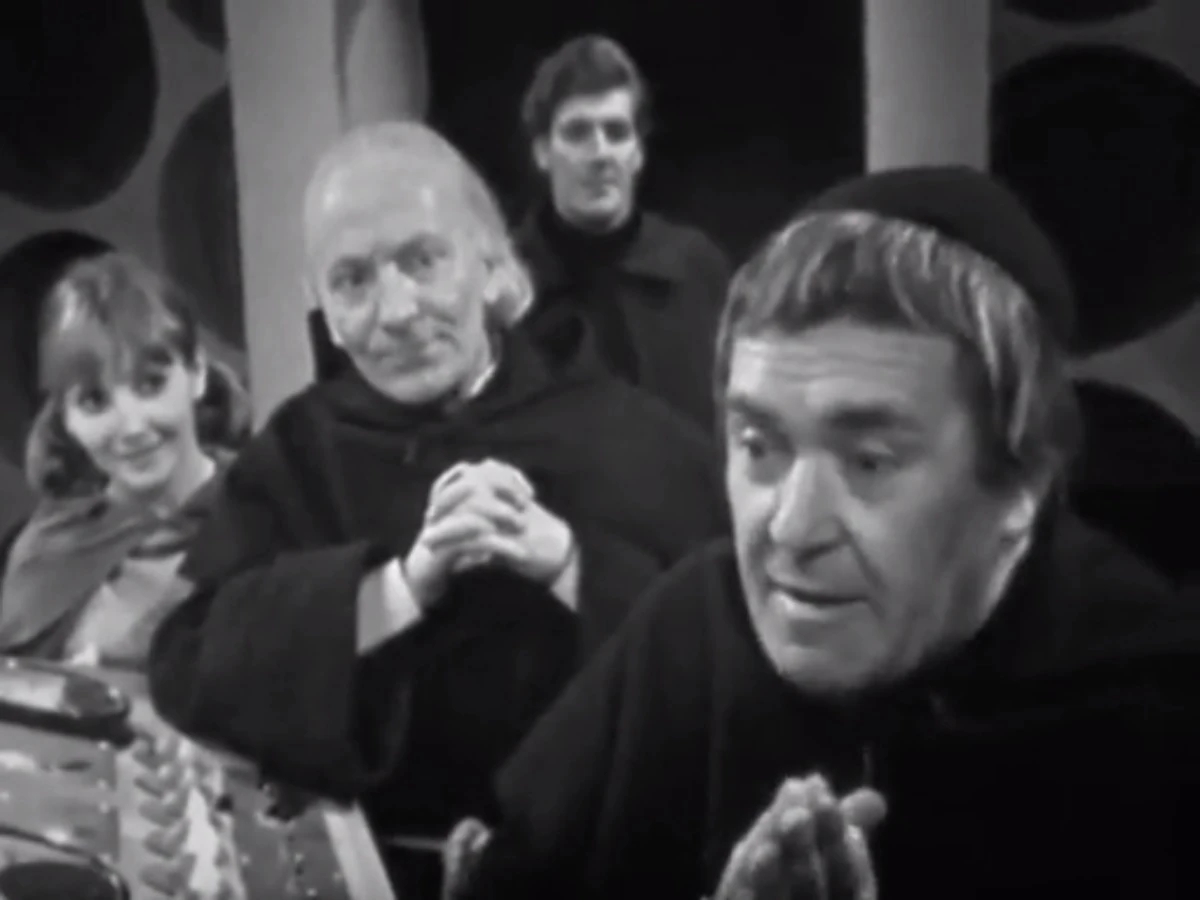
Doctor Who Story 007: The Sensorites


STORY 007: THE SENSORITES

I Can Read Your Mind...

I had heard of The Sensorites, but this Doctor Who story, if I understand things, is one that is not very popular.  After watching the six-part The Sensorites, I don't understand why it isn't as well-known or liked by Whovians.  Despite its length The Sensorites moves fast, has an interesting story, and has better aliens.  Granted, it has some issues (oddly, or perhaps Oodly, that we will see later), but The Sensorites should rank higher in Who circles. 

Picking up from The Aztecs, the Travellers: the Doctor (William Hartnell), his granddaughter Susan (Carol Ann Ford), and her teachers, Barbara Wright (Jacqueline Hill), and Ian Chesterton (William Russell) find that the TARDIS is travelling inside a spaceship.  They find a crew whom they at first think are dead.  Instead, they are under deep hypnosis.  The three crewmembers, Maitland (Lorne Cossette), Carol (Ilona Rodgers), and her fiancee John (Steven Dartnell) are in a curious position.  They are being held hostage by the residents of the planet they are orbiting but are being sent food by the same.  In short, they are not being killed by not being allowed to leave.  John is the most affected crewman: his mind is almost totally controlled by the strange beings holding them.

Eventually, the aliens from the Sense-Sphere come to meet the new visitors.  They are the Sensorites, and we find that they are not true villains.  Instead, they are afraid of the humans.  The last time the Sensorites and humans met, there came a plague that is killing the Sensorites off.  The previous ship had five humans, but it exploded before departing.  Now fearful that this second ship will increase the plague, the Sensorites are holding the humans hostage. 

Susan, who can communicate with them telepathically, convinces them that no harm is meant towards them.  The Doctor, in fact, can help find what is causing the Sensorite plague and perhaps a cure.  Leaving Maitland and Barbara aboard the spacecraft, the Doctor, Susan, and Ian travel to the Sense-Sphere.  There, we find evil afoot.  The Sensorite Leader, the First Elder (Eric Francis), welcomes them, but the City Administrator (Peter Glaze), who is third in command, is convinced the humans will bring more destruction.  The Doctor soon traces the plague to the water supply, and finds the antidote. 

However, in his paranoia, the City Administrator has already plotted a coup.  He has killed the Second Elder and now plots to kill off the humans.  John, having gone to the Sense-Sphere for treatment to the mind control, knows the City Administrator's plans but is too confused to be much help.  We discover that the waters are being poisoned by the humans left behind from the previous expedition, who want to exterminate the Sensorites to then claim the planet and the valuable material of molybdenum of which the Sense-Sphere has in abundance.  With the humans captured, the City Administrator's treachery exposed, and the antidote in the Sensorites' hands, the travellers are allowed to go.

The best quality in Peter R. Newman's script is that each of the six episodes (Strangers in Space, The Unwilling Warriors, Hidden Danger, A Race Against Death, Kidnap, and A Desperate Venture) move on the whole fast and don't get bogged down too much.  However, that very quality pushes The Sensorites down a bit as well.  In Episode Five we get a little too caught up in the Sensorite politics (the fact that the Sensorites themselves look so alike that only the sashes make them distinct does not help), and the resolution to both the plague and smoking out the source of the plague come with little to no buildup.  In fact, the discovery of the humans comes near the end of Episode Six and the revelation of both what the humans are up to and the removal of the City Administrator (who by that time had been appointed as Second Elder) was done with rather quickly to where it was almost irrelevant. 

Moreover, there are one or two points that The Sensorites didn't address.  The big one was how the humans found the deadly nightshade (the atropa belladonna) and placed it to make the poison, but another one is exactly who attacked the Doctor when he was going through the aqueduct.  We are given indications that it is a monster (the growling appears to come from a bear), but what we find is that it must have been a human.  I don't know if that's a cheat but it comes awfully close.

However, one of the bright ideas Newman came up with was to explain how the Sensorites all looked alike.  According to the First Elder, the Sensorites themselves were content in their similarity, thus we could get away with the population looking exactly alike.  Even better, there were moments of humor: the Sensorites are sensitive to loud sounds, so all the times the Doctor rages he inadvertedly becomes violent. 

It was a good idea to start out thinking the menace came from the Sensorites, only to find that they weren't the bad guys.  However, neither were the humans on the spacecraft, since they had not done the Sensorites any harm themselves, only having the misfortune to be humans.  Directors Mervyn Pinfield (Episodes 1-4) and Frank Cox (Episodes 5-6) worked so well that one never noticed the switch.  The closest to anything that could be noticable is the greater use of lighting with Cox: the scenes inside the aqueduct had more ominous lighting than when Pinfield was directing the spaceship scenes.  Pinfield, for his part, directed the actors quite well, keeping the tension building throughout his episodes. 

Both directors were aided by the editing: the montage where the Doctor is searching for the source of the poison juxtaposed with Ian fighting for his life aided so well in both setting the scene and moving the story forward with no dialogue.

Of particular note is Norman Kay's score, which were excellent in setting the mood, in particular when danger or fear was called.  His music for when we finally see the Sensorites at the end of Episode One, which short, set the tension for next week's episode.  In the previously mentioned montage scene from Episode Four the music is so vital and well-written that it helps in getting things going.

The regular cast continues the great work.  Hartnell has softened up a bit in his interpretation of the Doctor, but when he gets mad (causing the Sensorites pain) it shows he means business.  His scenes with Ford show the relationship between grandfather and granddaughter is evolving, and Ford shows that she is slowly coming into her own as a woman.  Hill comes close to being a damsel in distress and Russell continues being guided as the man of action, but in The Sensorites we see that Barbara is a highly intelligent woman who is afraid but works despite of it, while Ian is vulnerable when his life is in danger. 

On the whole, I thought The Sensorites was a well-paced, well-written, entertaining story with slightly better aliens than the First Doctor's era is usually given credit for (and better than some that are to come). 

In conclusion, here is a Sensorite from The Sensorites...


Is it me or do they look similar to The Silence from Day of the Moon Parts 1 & 2...


Just a thought.

I'm told the Sensorites are closer to the Ood...


Potato, potato... I won't argue against the idea.

7/10

Next Story: The Reign of Terror

Saturday, April 30, 2011

Doctor Who Story 017: The Time Meddler


STORY 017: THE TIME MEDDLER

A Little Monky Business...

One can wonder whether the four-part story The Time Meddler (individual episodes The Watcher, The Meddling Monk, A Battle of Wits, and Checkmate) counts as a historic story or a science-fiction story. Certainly, the setting is from Earth's past (Britain just before the arrival of William the Conqueror) but in this case, The Doctor (William Hartnell) and his Companions Vicki (Maureen O'Sullivan) and stowaway Steven Taylor (Peter Purves) aren't trying to influence history: they are trying to keep it as is.

I think it should be the first ahistoric story: one where history is merely the background to a more science-fiction driven story.  It is also unique in that The Time Meddler is the first Doctor Who story where we encounter a villain in the form of a fellow time traveler like The Doctor.

The Doctor and Vicki are mourning the loss of Ian and Barbara, when Steven appears (along with Hi-Fi, his faithful teddy bear).  The Doctor takes him on and they land in 1066 England, Northumbria to be exact.  Steven doesn't believe they are in the past despite lots of evidence to the contrary.  They soon split up, with the Doctor going inland while Vicki and Steven climb up the hill.  Unknown to them, a Monk (Peter Butterworth) has been watching, and he isn't puzzled by their appearance at all.

The Doctor meets Edith (Alethea Charlton) who tells him where and when he is, but the Doctor is intrigued by the chanting coming from the nearby monastery, especially when the chanting carries a curious distortion, like a needle on a record going slightly off.  He goes there, and the Monk traps him.

Vicki and Steven, however, are trying to avoid capture by both the Saxons and a Viking scouting party.  They also suspect the Monk knows where the Doctor is, and they sneak into the monastery to investigate.  Both of them make the startling discovery that the Monk has a record player, but the Doctor is still missing.  To make things curiouser and curiouser, the Monk has a Progress Chart detailing his activities, culminating with the Battle of Hastings, which has yet to occur.  While searching for the Doctor, Vicki and Steven make one of the most truly shocking twists in Doctor Who: the Monk has a TARDIS of his own.  The Doctor, independent of his Companions, realizes who the Monk is: a member of his own race who he calls a Time Meddler. 


The Monk has now decided to interfere with the course of history with an audacious plan: he will defeat the Viking invasion of Britain for King Harold so as to allow the Saxon king to defeat the other invasion force led by William the Conqueror, altering the entire course of British and more than likely, world history.  Now it's up to The Doctor to stop The Monk from playing fast and loose with history as it will be.

He is unwittingly aided by the Saxon villagers, who become suspicious of the Monk when he asks for beacon lights to be put just when they have confirmation of the Viking scouting party.  The Saxons believe the Monk is a Viking spy and raid the monastery.  The Monk manages to escape during the chaos of the raid while the Saxons go after the two Viking scouting party survivors, but when he returns to his TARDIS, he discovers that the Doctor has altered it in such a way that makes escape virtually impossible.


The Time Meddler, especially Episode One, is far lighter than previous stories.  Not since The Romans have we had a story that borders on comedy.  This is evident when Steven is presented with a Viking helmet as proof that he is indeed in Earth's past.

When Steven insists that it isn't authentic, the Doctor snaps back, "What do you think it is? A space helmet for a cow?"  We also see the humor just from the villain.

As performed by Butterworth, the Monk isn't evil.  He doesn't want to change history for his own benefit or to cause harm.  Rather, he involves himself in attempting to change the future because he thinks he is helping.  The Monk doesn't wish to bring chaos.  Rather, he believes that King Harold will be a good king, and thus he should be given a chance to reign.  The Monk figures that without having to fight the Viking invasion, Harold can defeat the Normans and thus prevent a lot of further involvement in future European wars.

In a sense, The Monk is almost innocent, oblivious to how changing the future may lead to worse results rather than better ones.  His villainy if it can be called that, is for the most part a childish one.  That makes the Monk an odd, almost endearing villain, but still a dangerous one nonetheless.  It's Butterworth's performance that keeps a healthy balance between the child-like enthusiasm of his chicanery and the dangers he presents in holding The Doctor hostage.  This Monk will not shrink from using force if need be to get at his aims (the Monk's laughter when he captures the Doctor is quite chilling), but by and large The Monk is a lighter, more humorous nemesis.

As a side note: while he's earned the name The Meddling Monk (more than likely due to that being the title of Episode Two), he should be referred to as The Monk.  This is how he is billed in all four parts, and while I've heard him called the Meddling Monk, he really is just The Monk, if one wants to be technical. 

Dennis Spooner's script should be given great credit because of its cleverness in both the overall plot and in creating an antagonist who is in a sense the Doctor's equal.  It also gave us in Episode Three one of the most genuinely shocking moments in the First Doctor's tenure.  In all previous stories, we really don't know exactly who the Doctor is (no pun intended).  With The Time Meddler, the mythos of Doctor Who has opened up: we now see that The Doctor has a group/species apart from Earthlings.  In short, there are more like him.  From this one point, the world of Gallifrey and of the Time Lords will emerge.

It also created long before the genre of alternative history really took off.  Nowadays, novels about what would have happened if the Nazis had conquered Britain or the Confederacy had won the Civil War are a dime a dozen, but in 1965 television such inventiveness wasn't easily found.  It is a remarkably tight story, with an interesting premise and characters.  In The Time Meddler, the Doctor now serves less as activator of events than as preserver of them. 

The one point in Spooner's script which I though was a touch weak was in how the Doctor (and later on, Vicki and Steven) managed to enter and exit the monastery at will: the whole "secret passage" deal isn't very clever or original.  On the whole, however, this is a minor glitch in an overall clever and inventive story. 

Hartnell is at the top of his game in The Time Meddler.  His best moments are in Episode One, where he delivers comedic lines in a style both humorous and almost harsh.  This same episode also has one of the unintended humorous moments when Hartnell suffers one of his infamous "Billy Flubs".  The Doctor is not interested in climbing a steep mountain.  "...but I'm not a mountain goat and I prefer walking to any day..." an irritated Doctor tells Steven.  The fact that O'Sullivan and Purves could continue without looking at least puzzled by this rather odd statement is a credit to their abilities as performers.  This for Hartnell in The Time Meddler is a rather small matter: throughout the story he is determined to stop the Monk from his plans.  As cranky as he may be (not as much as reputation dictates) Hartnell shows a softer side with both Vicki and Edith, being kind and considerate to both of them.

The curious thing about The Time Meddler in terms of acting is that Purves suffers the most.  His Steven appears incredibly thick-headed, almost stupid in his refusal to admit that he is in the past.  In fact, Steven in his debut story is a remarkably dumb and weak character: Vicki shows greater strength and courage when dealing with the Saxons and the Monk than Steven does.  From his first appearance, stumbling out into the control room with his panda bear, to when they all leave for points unknown Steven as a character isn't standing out as heroic or clever.  O'Sullivan is better as Vicki, tapering down her youthful exuberance from some of her previous stories and become a stronger person in her own right.

A lot of credit should go to director Douglas Camfield, who kept the pace steady and did not build up the twist in Episode Three but let it build naturally.  Aside from a battle between the Saxons and the Viking party in Episode Three that looked a bit comical (as if they really didn't want to fight but had to), Camfield created wonderful moments in The Time Meddler, drawing strong performances from Hartnell and Butterworth.  The closing moments in The Time Meddler, where Vicki, Steven, and The Doctor are almost literally part of the galaxy as they each stare out into the vastness of space, going into the stars to new adventures, is an especially beautiful moment in both The Time Meddler and in Doctor Who the series.


Here's where things get a little tricky.  The next three succeeding stories: the four-part Galaxy Four, the one-off Mission to the Unknown (both the shortest Doctor Who story and the only story not to feature the cast), and the four-part The Myth Makers are incomplete to say the least.  There is a six minute clip of Episode One of Galaxy Four (A Thousand Suns) and that's the longest known surviving footage of all three.*  What few clips of The Myth Makers that exist at all are due to off-air recordings made by fans, and Mission to the Unknown is one of three stories to have no surviving footage whatsoever.

Story 021, the epic twelve-part The Daleks' Master Plan, has three complete surviving episodes.  The optimist therefore says that a quarter of the story survives.   However, the episodes (Episode Two: Day of Armageddon, Episode Five: Counter Plot, and Episode Ten: Escape Switch) are so separated that one would have to fill in many of the plot points to try to make an honest evaluation of the story as a whole.  Story 022, The Massacre of St. Bartholomew's Eve or just The Massacre,  is unfortunately the third and mercifully last Doctor Who story of which no surviving footage whatsoever is known to exist.  Therefore, the next complete story is Story 023, The Ark.

As a side note, it is a terrible shame for television history that so many Doctor Who stories no longer exist.  Some of them might have been quite good, and yes, some might have been awful, but we may never have the chance to see them.  A lot people worked hard to create these stories, and their work is literally lost in time. 

Of course, this isn't to say there may not be a restoration in the future: Mission to the Unknown, being the shortest, seems the most likely candidate for an animated reconstruction. 

As it stands, we'll have to jump from Story 017 to Story 023, in which time we will lose one companion (Vicki, at the end of The Myth Makers) and gain another (Dodo Chapet, at the end of The Massacre). 

I have opted to take a side trip to the surviving episodes of The Daleks' Master Plan and give a review of those, but the next formal review will be for The Ark. 

The Time Meddler is a clever, witty story, not as out-and-out comical as The Romans but certainly less serious than The Chase or The Dalek Invasion of Earth.   It's not often one can say that the villain was delightful, but the Monk (or the Meddling Monk if you prefer) is both dangerous and endearing at once. There was strong directing both in terms of acting and visuals.  In short, The Time Meddler is an answer to our prayers. 

*Since originally written Episode Three of Galaxy 4 (Airlock) has been rediscovered.  Thus we now have a reconstructed version of this story and with that, a review of it. 

Meddling Monks Be Praised...


Next Story: Galaxy 4

10/10

Monday, July 19, 2010

Doctor Who Story 010: The Dalek Invasion of Earth


STORY 010: THE DALEK 
INVASION OF EARTH

Girl, You'll Be A Woman Soon...

It has only been less than twenty years since The Blitz, since the Allies defeated the monstrous Third Reich and brought an end to the Nazi reign of terror. The Dalek Invasion of Earth does what all good science-fiction stories should do: creates a parallel to our world but puts it within the safe confines of another universe. That kind of story-telling elevates something like The Dalek Invasion of Earth from merely a strong fantasy story to allegory: what Britain would have looked like if they had failed in "their finest hour".

This six-part story is unique in many ways. It is the first time in Doctor Who that a monster has made a return appearance. It is the first time that the word Daleks appeared in the title (Episode Two is called simply The Daleks). It is also the first time we lose a Companion.

To combine all these elements into what was essentially a children's series is incredible: giving children the concepts of loss, state terror, and totalitarianism elevates the story to something more adult. In fact, the story (comprising the episodes World's End, The Daleks, Day of Reckoning, The End of Tomorrow, The Waking Ally, and Flashpoint) might be the first one that shifted the series as a whole from something just for the kids to something more adult, one that had a greater intelligence and a desire beyond merely entertaining. We see the end results in stories such as The Green Death, Doctor Who & The Silurians, and even up to Cold Blood Parts 1 & 2: stories that work on two levels: literal and allegorical.


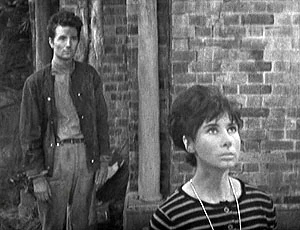
The story itself begins with one of the most chilling openings we've seen in Doctor Who (perhaps one of the most chilling in the entire series, both classic and revived): a man removes parts of a metal helmet and walks into a river to kill himself. Shortly after, the TARDIS materializes, and the travelers discover this is London. However, The Doctor (William Hartnell), his granddaughter Susan (Carol Anne Ford), and her teachers Ian Chesterton (William Russell) and Barbara Wright (Jacqueline Hill) sense something is wildly wrong.

The city is silent: no birds, no boats, not even the chimes of Big Ben (it should be noted that Big Ben is the bell inside, not the clock tower itself). The group is split up & while Barbara & Susan are spirited away by a group of Resistance fighters, The Doctor & Ian are captured by...the Daleks, and their human slaves, called the Robomen.

Now they all eventually join the Resistance: the leader, the scientist Dortum (Alan Judd), the fighter Tyler (Bernard Kay), the young man David (Peter Fraser), and the outwardly tough girl Jenny (Ann Davies). They are captured and escape at various times from the Daleks, and all go to the Dalek mining operation where the man known as Wells (Nicholas Smith) aids them in fighting the Daleks.

Through the story, the feelings between Susan and David grow, and once the Daleks are finally overthrown, the Doctor decides the best thing for Susan is for her to start her own life here. He locks her out of the TARDIS, and leaves her with one of the best speeches ever delivered in the series.


The Dalek Invasion of Earth, more than any other Dalek story since (and far more directly than The Daleks) draws on the parallels between the Daleks and the Nazis. This is most obvious in Episode 6 (Flashpoint), when the Daleks refer to the extermination of the humans as "the final solution". The phrase itself, "extermination", is also reminiscent of Nazi racial ideology. Even in one of the most frightening scenes in the story, when the Daleks wander around an abandoned London, the connection is clear every time the Daleks raise their plunger arms in a Nazi-like salute.

If one expands the concept of Daleks as Nazi substitutes, we see what a defeated Britain would have looked like: empty, desolate, with the population either being collaborators (the Robomen, albeit unwillingly) or Resistance fighters. To those who had survived and endured those years of war, seeing Daleks/Nazis overrun their capital must have been more terrifying than the aliens themselves could be. For the children, it's the idea that this frightening alien force is in the here and now, in their world, bringing them into terrifying proximity.


The imagery of The Dalek Invasion of Earth is aided by Francis Chagrin's score. In Episode 1 (World's End) and Episode 3 (Day of Reckoning) the music is very minimalist: consisting of drumbeats and what sounds like hammers tapping all mashed together, they give the moments with no dialogue an even more sinister, menacing, frightening tone.

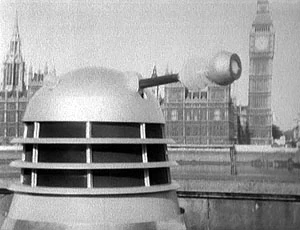
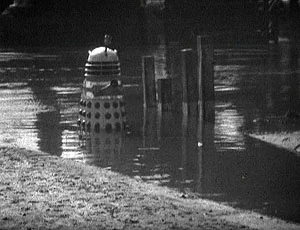
Richard Martin keeps things flowing remarkably fast in spite of a six-episode story, and some of the imagery he created is still impressive: the aforementioned Dalek wanderings through London and the Resistance attempting to avoid them, the Dalek emerging from the River Thames in Episode 1, the camera moving closer and closer to match the ticking of a bomb at the end of Episode 3. This was an extremely ambitious story, and on the whole it succeeds.

The performances are excellent from the guest stars. Kay's gruff fighter is balanced against Judd's rational scientist. Fraser and Ford, under director Martin, made wise decisions to allow the relationship between David and Susan grow slowly, and the scene where David flirts with Susan with the aid of a fish is beautifully shot and acted.

It's here that writer Terry Nation allows a bit of levity into a very dark story-line, and even gives The Doctor a good quip. When told that they were just cooking a fish, he replies, "I can see something's cooking", with the subtext clear. Fraser and Ford are both extremely believable as two young people discovering love for the first time, or at least serious love.

Smith, whom we know mostly as the inept department head in Are You Being Served?, is very strong as the leader of the mining rebels. He is tough, shrewd, caring to his fellow slaves...all the qualities antithetical to Mr. Rumbold.

Davies' Jenny at first appears tough and aloof, but as the story goes on we begin to see the vulnerability and heartbreak within her.

As a side note, there was discussion of her taking Ford's place as a Companion, and while it could have been worked out I don't know if it would have been good to have such an integral and important character replaced so easily. Children and teens would have identified most with Susan, and seeing her be replaced by another teen girl so quickly might have been jarring.

Rather, the fact that the ending to The Dalek Invasion of Earth is rather open-ended (only the second time the ending of one story doesn't lead into the beginning of another, the first being the transition from The Keys of Marinus to The Aztecs) gives the audience a time to mourn and reflect on just what a powerful ending the story has.

At the heart of the beauty of The Dalek Invasion of Earth is William Hartnell's performance. Injury forced him to not appear in Episode 4 (The End of Tomorrow), but he still conveys wisdom and courage in fighting the Daleks. However, here more than he has before, he shows a tender, caring side. His farewell to Susan at the end of Episode 6 is one of the most elegant and touching monologues he ever delivered, and I'd argue one of the best monologues in the entire series, both classic and revived. It is still quoted today:
One day, I shall come back. Yes, I shall come back. Until then there must be no regrets, no tears, no anxieties. Just go forward in all your beliefs, and prove to me that I am not mistaken in mine.
Even now, his delivery of his entire speech, and the genuine sense of loss he expresses, still makes it a hallmark for all future Doctors to measure themselves with. Curiously, he never did "come back", at least on screen*.

Hill and Russell both have their moments, as when Barbara has to flee for her life in Episode 1 or Ian deals with Wells and a smuggler in Episodes 4 & 5 (The End of Tomorrow and The Waking Ally). They continue to act well but have the benefit of knowing their characters very well.


The flaws, though few, are still evident. The biggest was The Slyther, some form of monster that was described as a "pet" of the Daleks. Why the Daleks would want a pet of some sort is a mystery, though I'm sure he really wasn't an actual pet but some form of guard against escape in the mines. The actual look of the Slyther is rather odd if not downright silly--a rubber monster that did look like a deranged Christmas tree. It's up there with the Myrka from Warriors of the Deep as one of the worst in Doctor Who.

The entire reason for the invasion: not for conquest but to take the Earth's core and pilot the planet around like a ship (as far as I could make out) seems so flat-out bizarre. Why on Earth would the Daleks want to fly around on the Earth? The two women in the woods bit wasn't needed and almost stopped the story cold, and I don't remember where Jenny went after the revolt began. She just disappeared, which I thought was curious.

Overall, with the action, romance, terror, adventure, Nazi analogies, and loss within The Dalek Invasion of Earth, Doctor Who created one of its best stories so far.


Fare thee well, fair Susan.

9/10

Next Story: The Rescue

*Susan and the First Doctor did in a sense reunite, when they were brought together for The Five Doctors. However, as of yet no television story has featured Susan or explained what happened to her after she was left on Earth with David.

Wednesday, June 9, 2010

Doctor Who Story 006: The Aztecs


STORY 006: THE AZTECS

Que Viva Mexico!

The Aztecs is unique for several reasons. It is the earliest surviving historical adventure, a type of story quite popular with the production staff during the first two Doctors but which fell out of favor over the purely science fiction stories. In fact, the last purely historic Doctor Who that I can think of is Black Orchid during the time of the Fifth Doctor. All the history stories of the Ninth, Tenth, and Eleventh Doctors have a science-fiction element, making them ahistorical.

It is also the first story that began independent of the preceding story. In other words, there was no lead-in from the story before it (The Keys of Marinus). It's a curiosity in the early days of Doctor Who that the production was very much in tune with the episodic nature of the series and did not see the potential of having stories not connect directly to one another until later on. It also had the first suggestion of romance for The Doctor (William Hartnell) himself, which a future successor (David Tennant) would exploit to full use (to the point of making the Tenth Doctor a bit of a space slut).

The four episodes of The Aztecs (The Temple of Evil, The Warriors of Death, The Bride of Sacrifice, and The Day of Darkness) are a good history lesson and an exciting adventure story which blend together to create a truly excellent Doctor Who serial.

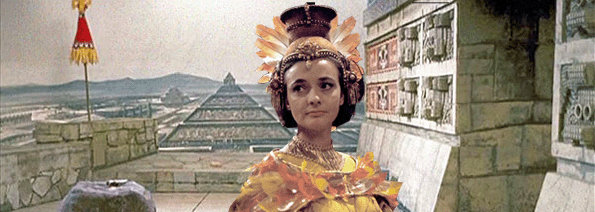
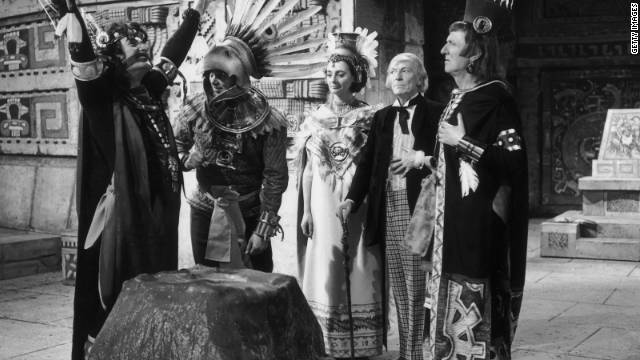
We land inside a tomb. Barbara (Jacqueline Hill) and Susan (Carole Ann Ford) soon realize they are inside an Aztec death chamber (and are on Earth again) but are captured by warriors accompanied by Autloc, the High Priest of Knowledge (Keith Pyott). He mistakes Barbara for the reincarnation of Yetaxa, the priest the tomb is for, and her handmaiden. Soon, the Doctor and Ian (William Russell) appear and are taken for Yetaxa's servants. Barbara (in the eternally imperialist fashion) decides that she will single-handed stop the Aztec custom of human sacrifices with her new power. This doesn't fit the plans of Tlotoxl (pronounced Teh-TOX-il and played by John Ringham), the High Priest of Sacrifice.


As it turns out, Tlotoxl suspects that Barbara is a false goddess and intends to unmask her. The Doctor wants nothing more to stop Barbara from interfering in the course of human history and to get back to the TARDIS which is inside the tomb. Ian has been put in the army and fights the warrior Ixta (Ian Cullen) for supremacy.

As Barbara continues to play with history (and play the sympathetic Autloc against the villainous Tlotoxl), Susan is compelled to marry against her will and the Doctor inadvertently gets engaged to Cameca (Margot Van Der Burgh), a wise elder among the Aztec people. In the end, Barbara fails to change history, though she has made Autloc turn away from human sacrifice.

The Aztecs is nothing short of brilliant. Every element of the story gels so brilliantly, starting with the performances. It's an interesting thing that writer John Lucarotti did in making Barbara the center of the story. It isn't too far-fetched given that she's a history teacher, but unlike previous stories the tension and suspense isn't dependent on action but on the power of the mind. The crew must always keep one step ahead of the machinations of Tlotoxl and Ixta, constantly trying to put them off from confirming the truth about them.

There is action in the forms of fight sequences (almost always between Ian and Ixta) and they are executed brilliantly (courtesy of the fight arrangers Derek Ware and David Anderson), especially the climatic one before they finally manage to escape. Ian, oddly, doesn't make a major contribution to the overall story of The Aztecs except for this. He's the requisite action hero, and he does it well and certainly no fault of his that he is a bit underused, but credit the directing of John Crockett that the story flows so well one doesn't notice how quickly each episode ends.

Hartnell creates some of the best acting he's done so far in the series, especially with Wright. When he tries in vain to convince her not to interfere in an upcoming human sacrifice, the tension, frustration, and fear he communicates is brilliant. "You can't rewrite history. Not one line!" he tells Barbara, going on to say, "Believe me, I know. I KNOW!" Not only does this hint that he has tried to do that himself, but communicating with his voice the foolishness and futility of his attempts.

He also handles the comedic romance between himself and Cameca with gentleness and sensitivity. You get the sense that he does care about Cameca and regrets having to leave her. It almost makes him human and it's a credit to his acting that none of this is ever played for cheap laughs but with real sentiment. At first, I wondered about Ford's performance since she wasn't in much of the story either, but found that her vulnerability was matched by something I hadn't seen starting from An Unearthly Child: an inner strength. When she balks at the notion of marrying someone chosen for her, she isn't a weak little girl, but a growing and independent-minded woman.


Of all the performances, the greatest credit goes to the guest stars. Ringham's Tlotoxl is a villain through and through. Throughout The Aztecs, he had this Richard III vibe going, right down to the way he walked with one shoulder higher than the other (almost as if he had a hump). At the reprise of Episode 2, he is extremely frightening and intense in his declarations of aiming to destroy Barbara. This is made more frightening by Jill Summers' make-up. The stripe that goes across his face and lips makes it look like Tlotoxl is wearing a death mask, fitting for this man who literally rips the hearts out of others (though of course, this would not be shown on 1960s television).

Pyott's Autloc is a wise man torn by his wish to serve Yetaxa and his doubts as to her veracity, especially as she tells him of future events without being able to be specific. As he struggles we see him to be a good man who is beginning to question everything he knew for certain, and Pyott creates an ultimately heartbreaking character.

This is what elevates The Aztecs from a mere adventure story to a highly intelligent one: the struggle between faith and reason exemplified by the murderous Tlotoxl and the thinker Autloc.

Van der Burgh brings a great deal of sympathy to Cameca, and what first starts as a humorous story of mistaken intentions in romance by the end turns tragic as she loses the man she has fallen in love with. She handles the shift with grace and beauty, and her performance also rises to brilliance.


The production elements are also brilliant. Daphne Dare and Tony Pierce's costumes are not only authentic-looking but magically elaborate and lavish, a remarkable feat given the limited budget Doctor Who usually had. Barbara's costume as Yetaxa will remain one of the hallmarks of beauty that few Companions would be able to match (with the possible exception of Romana I & II). The wardrobe for the Aztec warriors as well as the headdresses Ian and Ixta wear in their final confrontation bring one into the pre-Colombian world, which only adds to both the authenticity and enjoyment of the production.

Barry Newbery (who had worked on the previous historic stories An Unearthly Child and Marco Polo) created the best sets he has yet done in the series. They look almost as they had filmed on location in Tenotchtilan itself. Immense credit also has to go to Richard Rodney Bennett's score, which captured the lightness and terror of the varying situations while creating music that appeared to be as close to authentic as this lost civilization will ever likely be.

Every element of The Aztecs came together to create the first true masterpiece of Doctor Who. This has always been one of the things that sets Doctor Who apart from other science-fiction programs: it not only could go through space but also through time, thus it could tell stories that took place in Earth's past without violating its basic premise. Even the inadvertent mistakes (such as when the camera had to be hurriedly moved when it was clear that Barbara's elaborate headdress blocked The Doctor's face or when a weapon accidentally broke when it shouldn't have) only add to the charm of the story. It's a credit to everyone involved (especially producer Verity Lambert) that The Aztecs may be the Citizen Kane of Doctor Who historic stories.

On a side note, the fact that it was the second-shortest story so far (after the two-part Inside the Spaceship) at only four episodes makes it rise. We had just had a seven-part story (Marco Polo) followed by a six-part story (The Keys of Marinus) and both I figure would have been exhausting for most audiences. Eventually four-part stories would be the norm for Doctor Who, so The Aztecs could be the first story since An Unearthly Child to settle to form.

The Aztecs was fast-paced, exciting, with brilliant performances, masterful production values and a great story told exceedingly well. At least now The Aztecs will never disappear from the world, a fate that would rip our hearts out.

10/10

Next Story: The Sensorites