Saturday, April 14, 2012

Sandburg's Lincoln. The Television Special

SANDBURG'S LINCOLN

*Author's note: in recognition of two Lincoln-related films, the biopic Lincoln and the horror/comedy Abraham Lincoln: Vampire Hunter, I've decided to look at two television miniseries about the 16th President of the United States.  This is the first. 

No American President in history has held or will ever hold the power over the American psyche as Abraham Lincoln.  If any President has become iconic, mythical, almost God-like, it's the one-term Congressman who became the first Republican Party candidate to obtain the high office. 

It's no surprise: Lincoln's term was the most tumultuous in American history, one where his entire term in office was consumed by an epic struggle to keep the Union together, where the issue of slavery, which had torn the nation apart, was going to be answered once and for all.  These five monumental years between 1860-1865 were so important and traumatic to the nation that the Civil War divides American history: pre-Civil, post-Civil.  Lincoln's whole life, from backwoods country lawyer to the most revered President in history (sorry Ronnie, sorry Barry) and one of the most respected men in the American psyche is the stuff of legend.  It is also the stuff of great drama.

In 1974 a six-part miniseries was shown: Lincoln (or Sandburg's Lincoln, taking the name from the biography by Carl Sandburg).  In its episodes, we get most of the life story of President Lincoln, with particular emphasis of his time in office.  Sandburg's Lincoln is, if one watches it today, a bit stodgy, and perhaps a little disjointed, but it also has some of the best performances of President and Mrs. Lincoln given as of today. 

Sandburg's Lincoln starts with Crossing Fox River.  It covers the campaign and election to President of the United States by Abraham Lincoln (Hal Holbrook).  First Lady Mary Todd Lincoln (Sada Thompson) is in turns anxious and excited.  Lincoln has no stomach for wheeling and dealing of Cabinet posts in exchange of this, that, and the other, but it is done.  We end with a visit to his stepmother, a widow now, and how he will probably never see her again.

Mrs. Lincoln's Husband covers the machinations of his Secretary of the Treasury Salmon P. Chase (who curiously is called "Solomon" by the President) to become President himself, especially with his daughter Kate (Elizabeth Ashley) pulling the strings.  The First Lady's evolving extravagance and suspicions of her sympathies (in particular when her sister, the widow of a Confederate officer, is housed in the Executive Mansion) is also covered, as that of the death of their child Willie and the First Couple's private moments.

Prairie Lawyer, oddly, goes back in time before his Presidency.  The bulk of the episode covers when attorney Lincoln defends a man against murder charges against his future opponent for President, the Little Giant himself, Stephen A. Douglas.  It also takes time to show the courtship by Lincoln to Miss Mary Owens, who after he through wit and shrewdness wins his case decides to break off their romance.  It ends with Lincoln attending a cotillion, where he meets Southern belle Mary Todd. 

Going back to the future with Sad Figure, Laughing, we see more of the struggle between the basically honorable but stiff Chase and the folksier Lincoln.  The Last Days covers literally that: the end of the war, Lincoln's premonitions of death, the return of their son Robert from the war, and an extended idyll where Mr. and Mrs. Lincoln discuss their hopes and plans for the future: Lincoln's desire to see the Holy Land, the First Lady's wish to see Paris, and a hope for a quiet retirement back to Illinois.   The final episode, The Unwilling Warrior, again, goes back to the past, just before he takes the train from Springfield to Washington City for the Inauguration, the plot to assassinate him in Baltimore, the death of his friend, the young Colonel Ellsworth, his struggles with General George McClennan to get him to fight, and ends with him arriving in a defeated Richmond, Virginia, former capital of the Confederate States of America. 


I trust that Sandburg's Lincoln, as it appears on DVD, is in the exact order of how Sandburg's Lincoln appeared on television in 1974 (I was not around to witness it myself).  That being the case, I do wonder why the producers decided to have Lincoln slightly disjointed; instead of going in a straight, chronological order, we get two episodes about his Presidency, go back to his early years, hop back to his last days, then in The Unwilling Warrior we have a bit of a hop and skip from just before his Inauguration and his early days to the fall of Richmond.  In terms of narrative and structure, I found the decision to jump around a bit puzzling, feeling that a more linear story (with perhaps one glimpse of his early days) would have served better. 

I also found the sets to be unconvincing, looking exactly like sets.  The stage-like setting of Lincoln (apart from when they are obviously on location) took away from the believability of the story.  One can't fully accept you are watching reality when you are thinking the "homes" are on soundstages.

This, however, shouldn't take away from some dynamic performances in Sandburg's Lincoln.  It should be obvious that President Lincoln was not around when audio and video recording existed, so no one alive would know exactly how he sounded.  However, Hal Holbrook so embodies the President it is hard to believe he didn't study Lincoln personally.  Holbrook captures the Lincoln from history: the folksy demeanor ready with a quick joke or story, but he couples him with a shrewd political mind (one who would have a team of rivals in his Cabinet).  He also gives Lincoln a true humility in his dealings with people, an understanding of what motivates them.  For example, while his friends and advisers insist, he get rid of Chase, Lincoln resists.  Holbrook's performance explains why: his Lincoln sees the Big Picture, and moreover, we see how Lincoln understands people, sometimes better than they understand themselves.  Thanks to the script and Holbrook's performance, we see that Lincoln knows that Chase is highly ambitious but also highly principled in his behavior towards his oath of office, making his plots rather weak.

Over and over, through Halbrook we see the intelligence in Lincoln (the President's passion and enthusiasm for Shakespeare, his understanding of human nature), the compassion in Lincoln (how he rarely appears angry when something goes wrong, but more accepting of the flaws of human nature), and the humanity of Lincoln (in his dealings with his wife and indulgence of his children).  In particular are the scenes when we see the President unguarded, as when he is with his stepmother, who raised him, in the first episode.  It's a beautiful, tender interaction between parent and child, and shows us a bit of the private man behind the legend.

Finally, Holbrook's performance is helped by the strong regional accent he carries in Lincoln.  His pronouncing of "widow" as "widder" and constant stories of rural life show us he was both highly educated and a common man.


Matching him is Thompson's Mary Todd Lincoln.   Thompson shows us both the woman easily wounded by the slightest of slights and one deeply in love with her husband, forever loyal to him.  Mary Todd could be odd (as when she accuses her husband of flirtations with other women) but we do see that behind a brittle exterior is a woman deeply and passionately in love with her husband.  In The Last Days, Thompson and Holbrook share a long scene where the Lincolns plan for the future, and as one watches, they are so good one almost feels like one has dropped in on an intimate conversation.  They joy and optimism they express comes true, and our knowledge that it is not meant to be makes their last moments on screen, where they ride off blissfully before heading to Ford's Theater, all the sadder. 

Sandburg's Lincoln is not without its flaws (the structure is a bit odd, important characters such as Secretary of War Cameron come and go while others such as Lincoln's loyal secretary John Nikolai appear but never make clear why they are so loyal to the President, and the sets are not altogether convincing).  Also, the picture quality has been compromised; despite it being only almost forty years since its broadcast Sandburg's Lincoln looks like it is close to freezing in the middle of the picture.   A greater reliance on structure (in particular with Ashley's wonderful turn as Kate Chase, both respectable lady and conniving bitch) would have helped tremendously.

However, with great performances from Hal Holbrook as President Lincoln and Sada Thompson as First Lady Mary Todd Lincoln, Sandburg's Lincoln is a good introduction to what made President Lincoln so extraordinary as both a leader and a man.  I would recommend it more for elementary to middle school students who won't be too bothered by the sets, but on the whole, Sandburg's Lincoln is a worthy miniseries for the Citizen Kane of Presidents. 

7/10

Wednesday, April 11, 2012

We Bought A Zoo: A Review

WE BOUGHT A ZOO


I love animals...they're delicious.  I actually do love animals, and cute children, and I can even go for the cute love story.  I am going to imagine that We Bought a Zoo, the film version of Benjamin Mee's non-fiction book, is on the whole close to the source material (and close to the truth).  Be that as it may, Cameron Crowe's latest effort goes by the numbers, from Plot Point A to Plot Point Z in a nice and gentle way that will please those that want familiarity and predictability.

Benjamin Mee (Matt Damon) is a recent widower with two children: 14-year-old Dylan (Colin Ford) and 7-year-old Rosie (Maggie Elizabeth Jones).  As one can expect, the ladies are all eyeing the newest catch (lots of lasagna plates) and Dylan is 'troubled'.  "Troubled" enough that in order to make a new start, Benjamin quits his newspaper job and decides to start out in a new home.

With Rosie's help, they find what appears to be a perfect home, but with one catch: it's a literal zoo.  The house and property is a wildlife park that opens to the public in the summer.  He decides that it is worth the asking price, and with the zoo staff, headed by Kelly (Scarlett Johansson), make all the necessary repairs and restorations to pass inspection.  The staff is a quirky lot, primarily the almost always drunk Scotsman MacCready (Angus Macfadyen).  Rosie is thrilled to be surrounded by all the animals, but Colin hates it there, even if Kelly's niece Lilly (Elle Fanning) is obviously infatuated with Colin (side note: I've had one or two of those infatuations, and they can be a bit spooky, so I can relate, only his infatuation appeared to be sane, but I digress).

The repairs, improvements, feeding of the animals and paying of staff is a pretty penny fast burning through Mee's accounts.  His older brother Duncan (Thomas Haden Church) thinks the whole thing is bonkers, and bookkeeper Rhoda (Carla Gallo) soon gets the staff against him because he has no money.

Don't be surprised that money comes to him magically via his dead wife (gotta love those Deus Ex Machinas). 

All this is backdrop to Benjamin's continuing struggle to get over the death of his wife, his struggles with his son (who is going through his own brand of mourning), and the dreaded Inspector Javert...I mean Ferris (John Michael Higgins).  Ferris is not a fan of anyone, a petty bureaucrat who delights in frightening the staff, and whom MacCready so despises he has to be at one point locked in a room to stop them from meeting.

Eventually father and son see how much they love each other, Kelly and Benjamin see how much they love each other, Duncan sees how much his brother was right, and all is well.

Again, I figure that since We Bought A Zoo is based on Mee's memoirs, a lot of what occurred happened.  I figure Crowe and fellow screenwriter Aline Brosh McKenna changed a few things, so the fact that I have never read (or until the movie, heard of) the book shouldn't prejudice me against the film.  However, as I watched We Bought A Zoo, I kept finding that the film was amazingly predictable in where the plot was going.

It wasn't just that one excepted the widower was going to be pursued by almost every woman he met (which makes me wonder if what I need is a wife in order to get a girlfriend), that the male and female leads to eventually find they were in love, that there was going to be at least ONE complication at the Big Inspection, that the son was going to be angry and the cute little girl precious and adorable.  It was that there were one or two things that We Bought A Zoo didn't quite answer. 

How Mee solves his financial situation is a curious thing.  As the single greatest character in River Song (formerly known as Doctor Who) would say, "SPOILERS".  He's just about out of money, but he suddenly discovers that his wife has had a secret account she'd been saving up for her family because she knew she was dying.  The proof of this is in the pocket of the hoodie Mee simply cannot part with, which he slipped on that one time to remember his wife.

I was not only troubled at just how easily Mee's financial problems were resolved (far too cinematic), but in retrospect I kept thinking how in all the time he had the hoodie he never once sensed the paper detailing her secret account inside the pocket.  Morevoer, does it strike anyone else as mean that Mrs. Mee never mentioned this secret account?  Yes, I'm aware that she was dying (I think it was cancer), but couldn't she have left instructions or even a message to be read upon her death mentioning over $80,000? 

I also fault Crowe for making what I think was a terrible mistake with the character of Ferris.  I know he's suppose to be the antagonist, but as played by Higgins, he was far too cartoonish to be taken seriously.  I figure this was done purposefully, to perhaps have some comic foil in what is essentially a family-geared film.  However, I couldn't take Ferris seriously enough to think he could shut down the park, nor could I take him seriously in thinking he was an actual official.  This is where I would have advised Crowe to pull back a bit, make Ferris more of a stickler for rules but to make him less ridiculous and more sympathetic, someone who is just doing his job and not so obviously an idiot or an insensitive man.

There were other things in We Bought A Zoo that made me resist its efforts to charm me.  Besides the "finding money in the most unexpected place at the exact right time" business and the "Ferris the Menace" business, we have standard film fare: the angry and neglected son, the cute little girl, the male and female finally coming together, and the overt symbolism of an old tiger that has to be put to sleep (and the widower who fights so passionately against the reality of it).  I wonder how the last two relate...Such symbolism is a touch too heavy for my tastes, and I'm not fond of things being so overt.  I have nothing against symbolism, or even overtness, but about heavy-handedness, I do.

The efforts of comedy (primarily from Macfayden's MacCready) never really worked because Crowe never allowed almost any of his characters to be anything but stock figures and cliches rather than real people with real flaws, real hurts. 

Still, I don't think there was anything particularly awful in We Bought A Zoo.  Damon was acceptable, though whenever he fought with his son one could tell he was reaching for something that didn't quite make it.  Johansson is an actress who frankly hasn't been given enough credit.  Too often I think people dismiss her actual acting abilities simply because she is so beautiful.  Granted, she hasn't always done good work (The Spirit, The Island--although the latter is one of my guilty pleasures, while the former is just hideous) but in We Bought A Zoo, she was sympathetic and believable as an efficient zookeeper.  Church was there to be the Bonnie Hunt-type character (the wisecracking, disapproving older sibling Hunt perfected--and should have been nominated as Best Supporting Actress for--in another Crowe film, Jerry Maguire).  If Cameron Crowe ever made a mash-up, these two would make a great comedic team in giving one-liners to all the proceedings. 

I think I've already gone over how Macfayden and Higgins were too silly to be believed and I found their parts to be distracting. 

On the whole, We Bought A Zoo is simply meant to be a sweet little film with a cross of indie and intelligent songs (always a Crowe signature) that is meant to make us cheer and raise our spirits.  I won't begrudge them that.  The fact that it didn't have that power to move me in the way it wanted to is something I won't begrudge either.  Is it a cutesy little film?  Yes.  Is it a good film?  It's passable.  We Bought A Zoo...but we didn't quite buy the premise (even if it is based on reality). 

DECISION: C+

Tuesday, April 10, 2012

Salmon Fishing in the Yemen: A Review

SALMON FISHING IN THE YEMEN

If Allah is Willing and the Creek Don't Rise...

I've gone fishing exactly once, didn't catch anything. As a result, Salmon Fishing in the Yemen is almost a foreign film that shows a strange world where people enjoy standing in the middle of a river, throwing lines in order to catch fish.  Much has been made of the title, which is apparently confusing or putting many off.  SFY knows what it is: a sweet romantic comedy that puts an equal emphasis on romance and light comedy. 

Harriet Chetwode-Talbot (Emily Blunt) works for the wealthy Sheik Muhammed (Amr Waked).  The Sheik has gained a passion for fly fishing, and he wishes to bring the sport to his native land in the Yemen.  This is a difficult task given that Yemen is in the Arabian Peninsula.  With total sincerity, Miss Chetwode-Talbot contacts Dr. Alfred Jones (Ewan McGregor), a fisheries expert and fly-fishing enthusiast himself.  Dr. Jones thinks the whole thing both daft and a waste of his time and lets Miss Chetwode-Talbot know this.  As it turns out, the idea of introducing salmon fishing in the Yemen catches the eye of Patricia Maxwell (Kristin Scott Thomas), Press Director for the Prime Minister.  Desireous of a positive story from the Middle East, she orders Dr. Jones' superiors to put Jones on this major priority project.

Dr. Jones is openly contemptuous of the whole scheme, while Miss Chetwode-Talbot tolerates his disdain with a barely concealed amusement.  It isn't until Dr. Jones meets the Sheik and sees his passion and vision for the sport that Dr. Jones starts warming up to the idea (even if he still has reservations).  The Sheik has faith that it will work, but Dr. Jones, an atheist, doesn't.  The Sheik finally wins him over by drawing parallels between his faith both in God and this project and Jones' "faith" of how he spends hours wading in water with the hope of catching those elusive fish.

The plans continue, but Miss Chetwode-Talbot hits a personal roadblock: her boyfriend, Captain Robert Mayers (Tom Mison), has been reported missing in action and probably killed in Afghanistan.  Devasted, she just wants to sink into her own well of despair, but Dr. Jones, showing a bit of human warmth, brings her around.  Now in the Yemen, Miss Chetwode-Talbot and Dr. Jones find an enthusiasm for this insane project, and their relationship growing from professional to personal to romantic.  This causes conflict for the married Jones, who realizes that his life has been pretty stable but empty, with a wife who isn't evil but not the warmest.

Jones, in agony, decides to leave his wife, and just as the project is about to open, we get a complication: Captain Mayers is found very much alive (much to Harriet's joy and Fred's sadness).  In an effort to draw greater publicity, Mrs. Maxwell withheld the news so as to give the fishery opening a bit of a romance.  Sadly, fundamentalists, who think salmon fishing in the Yemen is an affront to God, ruin the opening by opening up the dam, nearly killing everyone.  After some time to think, Harriet realizes where her heart is, and ends her affair with Captain Mayers.  Fortunately, a few salmon have survived the maelstrom, and the project can begin anew. 

Before the movie, I was unaware of Paul Torday's novel which was the basis of Simon Beaufoy's screenplay.  However, if Salmon Fishing in the Yemen stuck close to the source material, on the whole the book must be a delight to read.  The film is populated with real characters, people who are flawed but intelligent, and gives each of them their own moment.  One should know from the get-go that Dr. Jones and Miss Chetwode-Talbot will end up together, even if both of them have partners, but the fact that they have to end their previous relationships to do so doesn't make them villainous or selfish.  Instead, both of them realize they will be making someone else unhappy and they themselves are unhappy about that.  However, they also realize that to stay with their partners would in itself make the other unhappy.

Both McGregor and Blunt (two splendid actors, especially when given good material) play the relationship between Jones and Chetwode-Talbot (for most of SFY they address each other formally, adding a very British touch to the proceedings) as something that evolves, where their constant interactions beget inside jokes which beget emotional opening which beget true love.  They both play the moments of comedy (such as when Jones crashes into a see-through partition or is almost condescending to her ideas) and drama (when Jones comforts a deeply grieving Harriet) with equal sincerity.    Waked as the Sheik comes across as a man with far-sighted vision, whose private faith informs his life but is also aware enough to know what Jones and Chetwode-Talbot are not: that they are falling in love.

Scott Thomas (again, an actress that really should be given more film work) brings a bit of the comic relief as the stern and determined Mrs. Maxwell.  The intelligent decision of both Beaufoy's script and Lasse Hallstrom's direction is to move away from time to time from the Jones/Chetwode-Talbot story and give us a glimpse into Mrs. Maxwell's home life, where we see her as a hard-working wife and mother with her own set of family problems (most from children giving her a hard time).

The positive thing about Salmon Fishing in the Yemen is that it's a simple story where there is no real adversary to the romantic side.  It treats the love story and the fish story with equal respect.  Even other things that normally are a bother (such as having split screens) flow by quickly and are used sparingly to where they work.

If I would fault SFY for anything, it would be in the predictability of the story.  Who here DIDN'T think Captain Mayers wouldn't come back at the most inopportune time? While it was expected, it felt a bit forced, as if the lovers needed one last complication to overcome.  I also don't think anyone was surprised that just enough fish survived to start again.  It brought to mind the ending of A Walk in the Clouds.  Granted, I liked that movie too, but while I don't object to happy endings, something just didn't quite fit. 

Salmon Fishing in the Yemen is a delight from start to finish, with great performances and a sweet story done well.  It certainly is worth catching. 

DECISION: B+

Sunday, April 8, 2012

The King of Kings (1927): A Review

THE KING OF KINGS (1927)

*Author's note.  This review is of the 155-premiere version of The King of Kings, which may differ from the 112-general release version.

The Gospel According to DeMille...

The Bible makes for a great source of film. Even those who do not believe the Scriptures are the Word of God (or who don't believe IN God), have some knowledge of the stories within the Old and New Testament.

Therefore, if someone were to make a film based on any part of the Bible (starting from the Book of Genesis and Exodus through the reigns of Kings David and Solomon on down through the Life of Christ and up to the Book of Revelation) it would be easy for audiences to follow the stories without too much exposition, something that an adaptation of the Bhagavad Gita or even the Koran into film would need. A story as central to millions of lives as that of Jesus Christ would need a filmmaker with the ability to create powerful imagery on an epic scale.

Fortunately, we had one Cecil B. DeMille at the ready.  The King of Kings gets the full DeMille treatment: it's big, it's lavish, it mixes sin and salvation, the story of Our Lord and Savior, God in human form...with a little sex in it.  The King of Kings is the blending of the sacred and salacious, the pious and profane, the divine and the decadent.  The film, despite nearly a hundred years, still has some powerful moments and despite its length moves amazingly fast. 

While The King of Kings (with story by Jeanie Macpherson) uses the Gospels and New Testament letters for the story, it also adds extra elements that are un-Scriptural.  In fact, The King of King BEGINS with an extra-Scriptural story.   Mary of Magdala (Jacqueline Logan), the famed courtesan, is holding Court among her admirers.  As she 'entertains', she learns what has happened to her favorite lover, one Judas Iscariot (Joseph Schildkraut).  He has joined a group of wandering disciples led by a carpenter from Nazareth.  Obviously, no man has greater power than our Mary Magdalene, so it's off to get Judas back.  When she finds her estranged lover, she find him with Jesus of Nazareth (H.B. Warner), who has come to heal the sick, raise the dead, and bring salvation for all mankind.

Mary doesn't care about that, and truth be told, neither does Judas.  Instead, he sees Jesus as a future earthly king, and himself as his right hand man.  After Jesus has healed a young future-Gospel writer Mark (Micky Moore) and brought sight to a blind girl, Mary Magdalene confronts both Judas and Christ, but Jesus is too strong for her, and seven demons are expelled from the harlot, who now is a repentant woman.

Jesus continues on his mission, much to the displeasure of the Pharisees.  Christ confronts the hypocrisies in the Temple, withstands the temptations of Satan, and leads the Disciples in the Passover Seder that will be known as the Last Supper.  Judas, by now disillusioned about how Jesus will not be King, sells out the Master for 30 pieces of silver.  Jesus is arrested, scourged, and crucified, while Judas, overwhelmed with agony about what he's done, hangs himself.  Finally, Christ rises from the dead, comforts the Apostles, and we end The King of Kings with Christ above all the world.

The King of Kings is nothing if not a spectacle, but despite the years the film still has an amazing visual splendor that overwhelms the audience.  Some of the sequences are thoroughly thrilling and innovative.  DeMille, for example, holds back the introduction of Christ for as long as possible, and when we finally come across the Messiah, it is by giving us the point of view of the blind child He has healed.  It's a beautifully filmed sequence.  Some of his other scenes, such as when Mary Magdalene's seven demons are exorcised, as still amazing to watch, creating that mixture of sinister beings besieging a tortured soul. 

One other scene I would point to show showcase DeMille's greatness is the Temple sequence (which is a very long section of the film).  We go from the massive crowds about to stone a woman caught in adultery through Judas' failed efforts to crown Christ right down to Satan appearing behind Jesus to tempt Him with all the kingdoms of the world.  In the first part, DeMille shows us what he imagines Christ to have written down on the sand (the Gospels never say exactly what Christ wrote).  The brilliance of DeMille showed that Christ was writing out the sins of those ready to stone the adulteress, a powerful moment to emphasize the sin in every man.  The crowds about to crown Jesus are in the DeMille tradition of being large, but they fill the screen to where everything else (even the Savior of Mankind) is overwhelmed.  The final part where Satan tempts Christ has the appropriate hint of menace from the Dark Overlord against the purity of the Light of the World.

The King of Kings also has tender moments.  One of the most light-hearted is when a group of children come up to Jesus.  At first, Judas sends them away, but Christ tells him to "suffer the children to come up to me" (almost all the intertitles in The King of Kings quote Scripture, with the chapter and verse accompanying them).  One of the children asks Christ if he can heal broken bodies.  Responding yes, the little girl promptly brings out her doll and asks Him to heal his broken leg.  A slightly embarrassed Christ looks at it, and manages to fix it. 


DeMille also could break your heart with the smallest thing.  The Last Supper is beautiful and sad, particularly Peter's reaction to holding, drinking, and passing the cup which Jesus has said was His Blood.  When Christ is first seen carrying his Cross, we get a ground-level view, seeing only the foot of the Cross being dragged, along with the bystanders both for and against Him along the Via Dolorosa. 

At the Crucifixion, we see a mother at the cross, but it is not Mary.  Instead, it's the old mother of one of the thieves crucified alongside Christ (the one who asked Him to remember him in Paradise).  Seeing the agony of another mother about to lose her child and her treatment by the Roman soldiers will bring if not full tears a sense of agony and sorrow to the viewer's eye.

I digress to say that The King of Kings disproves the idea that Cecil B. DeMille was incapable of directing intimate scenes. 

However, if anything The King of Kings is highly respectful and reverential to the story of Jesus Christ.  There are strong signs that the story was treated with great care so as to not cause offense among believers.  DeMille controlled the lighting brilliantly, showing the Holy Grail glow powerfully as a dove descends upon the sacred vessel.  The scene where Lazarus is resurrected is also lit beautifully, making the scene look almost like a tableau brought powerfully to life.

The sequence where Christ breathes His last and the earth trembles violently is still, nearly a hundred years later, amazing in its power and sheer spectacular nature.  A careful study will show that it is not really the Earth coming apart (and it is highly reminiscent of the earth splitting open near the end of DeMille's remake of The Ten Commandments), but it still is so overwhelming that the viewer becomes thoroughly captured by its force.

The King of Kings also benefits from an opening and closing that has early Technicolor, making the first (the sight of Mary Magdalene's Court) and the second (the Resurrection) even more decadent and powerful respectfully. 

The performances are also excellent.  Schildkraut's Judas starts out as a dandy not interest in the power of Redemption but in earthly power, but when he realizes what he has done, the mixture of horror and crazed agony is a brilliant turn.  Similarly, Logan's Mary Magdalene shifts from wanton slut to redeemed follower (dare I say, Disciple) of the Christ.  Even in smaller roles, Ernest Torrence's Peter shows how the Apostle was both a man who was both a rustic fisherman and a devoted yet flawed friend of Jesus. 

It is Warner that brings a mixed emotion in his portrayal of Christ.  It would be correct to say that Warner played Jesus as a man of many sorrows, and as someone who is God in the flesh.  However, apart from the scene with the children Warner's Jesus came off as forever forlorn, sad, pained.  Yes, Christ is God (if one is Christian) but while we see the Divine in Jesus, we do not see much of the human in Jesus.  I don't know whether it's because there is that tendency to portray Jesus as an almost remote figure (in few films about Jesus is He seen as a man with even a modicum of humor or even humanity--the miniseries Jesus with Jeremy Sisto as Christ a rare exception) precisely because His divinity is at the heart of Christianity or a desire to place an emphasis precisely on that divinity rather than His humanity.  It is a remarkably respectful portrayal of Jesus (one that haunted Warner for the rest of his career) but it has, at least for me, the effect of making Christ a distant figure, one worthy of worship but not of an intimate relationship.

I would also say that The King of Kings is respectful of Judaism and Jewish people.  When the crowds are being whipped up to ask for Barabbas rather than Jesus, one of the crowd says he will not accept a bribe because it is against Jewish law to do so.  Caiaphas at the end asks that God's wrath be visited upon him and not upon the Jewish nation.  The King of Kings is not whipping up anti-Semitic feelings, but instead asks us to recognize the Jewish nature of Jesus (whom I always tell people was among other things, a nice Jewish boy).

The King of Kings is the kind of epic spectacle that Cecil B. DeMille will always be associated with (and sometimes damned for).   As a film (silent or otherwise) The King of Kings still has an extraordinary power to move and overwhelm the audience, both in its reverence and in its decadence.  The King of Kings is a film worthy of the story of Christ. 

DECISION: A

Friday, April 6, 2012

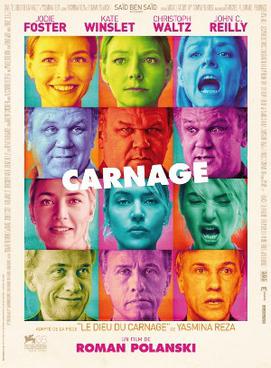
Carnage: A Review (Review #365)


CARNAGE

The Myth of Sticks and Stones...

I imagine Carnage is the type of film that would appeal to those it mocks: the touchy-feely lefty intellectual who thinks that dialogue will lead to a peaceful resolution.  With Carnage, we see that words uttered by even the most 'civilized' people can become weapons against even those who are ostensibly on their side.  It is a comedy but the laughs come less from the situations than the participates; in other words, we laugh AT these people, not with them, because underneath the veneer of rational discussion they are all brittle, self-righteous, even vindictive.

The whole of Carnage (based on the play The God of Carnage by Yasmina Reza) takes place at the apartment of the Longstreets save for the opening which sets up the entire story.  We see the Longstreet child, Ethan, whacked pretty hard by Zachary Cowan.  We then shift to the Longstreet flat where Penolope and Michael Longstreet (Jodie Foster and John C. Reilly) are writing out a letter about this unfortunate incident with Nancy and Alan Cowan (Kate Winslet and Christoph Waltz). 

The Longstreets and Cowans are doing their best to be civil and respectful, to discuss this like adults, to try to sort out the responsibilities of their children.  As the 80-odd minute film continues, we see that one wrong word, one seemingly innocuous gesture, builds on itself to where one adult reacts in a way different than what might have been intended.  Apple cobbler offered in friendship causes Nancy to vomit, which cause the Longstreets and Cowans to discuss how much they dislike the other for actions both accidental and deliberate. 

As the afternoon goes on, with the Cowans appearing desperate to leave, the Longstreets appearing desperate to stay justified, and both groups starting to snipe at each other, we see the shifting alliances, from the spouses to the genders and back again.  Each of the four in Carnage comes off as rather horrid: the uptight Nancy, the on-the-edge Penelope, the accommodating Michael, the disinterested Alan.  By the time they finally part company, we have enjoyed (or endured) a comedic version of Who's Afraid of Virginia Woolf? with slightly less booze and no sex.

Carnage is amusing in that it is funny seeing all these allegedly bright, intelligent, well-off people go at each other and come apart, revealing that under their veneer of liberal thinking (liberal in every sense of the word) they are just as petty and small-minded as the 99% can be. 

The performances are remarkably true and understanding of gender roles.  Men, especially Michael and Al, are oftentimes more casual about things like fights among boys (the husbands have no problem sharing drinks and being slightly more nonchalant about their children's altercation).  Women, in particular Nancy and Penelope, are more quick to see their children's actions as reflective of something wrong: in society, in the family, in the way the world is. 

Each of the actors is allowed a moment in Carnage where they can have their moment, whether it's to look foolish or come apart.  Foster reminds us of what a strong actress she is in her Penelope (aka Penny), a woman so determined to do the right thing she ends up becoming more and more angry that things aren't being seen the way she sees them.  Winslet manages to hold her own as the uptight Nancy, who finds her husband's constant distractions via his cell phone so impossible that at one point she takes action that will both surprise and make one laugh. 

At times I confess to wondering why Winslet is considered this brilliant actress (finding her ability to be naked on screen neither a turn-on or a point of her 'brilliance').  Some of her work appears to be her playing at playing a great character (and I will be one of the few who thought both The Reader and her work in it was rather awful).  However, she did a great job in Carnage as the high-strung Nancy.

The men were equally excellent.  Reilly is the go-to guy for lovable schlubs and here his desire to be accommodating to everyone soon begins to take on at times a desperate air, at times a frustrated one.  Waltz's Al makes it clear by his actions that he is really not interested in anything going on, but even he allows the cracks within him to rise, in particular when he takes offense at something Penelope says about his son.

I think the fact that Carnage is a well-acted film is both the blessing and curse of Carnage as directed by Roman Polanski (whom I'll always have a moral distaste for and wouldn't allow my wife, daughter, or mother around--for his safety, not necessarily theirs).  The adaptation of The Gods of Carnage by Reza and Polanski makes the film Carnage no more than what it is: a filmed play. 

We see that as good as the cast's performances are, that is exactly what they are: performances.  None of the characters come to life because Carnage is very conscious of the fact that the screenplay is very actor-friendly.  The film allows good actors (and Winslet, who can be a good actress at times) to show how good they are on a technical level. 

However, as I watched Carnage, and enjoyed it, I could not help thinking I wouldn't get anything different if the four of them did a theatrical version of The God of Carnage on the stage.  I think this is where my admiration for Carnage dives into my separation from Carnage.  In short, the performances were great, but there was an artifice to it all, as if they knew we knew they were acting.  To my mind, theater acting and film acting are different (I learned that from Mary Pickford and Lillian Gish--not from them personally but by watching how both toned down the exaggerated theatricality of the stage for the more intimate nature of film).  Yes, each of the actors were good, but they weren't real people, just characters.

Still, this isn't to say that Carnage is bad.  It isn't even to say the film isn't something that people cannot relate to.  That is one of the chief positives of Carnage: the fact that it draws on a common human experience, that of saying the wrong thing or saying things wrong.  I am a witness that something said one way can be interpreted another, leading to nothing but trouble.  As I watched Carnage, I was able to go back into moments in my life where I said something that turned out wrong and made people mad, but when they responded I was the one that got mad even if they did not necessarily mean to be hurtful. 

Just ask anyone who has heard me on the subject of Occupy Wall Street or the Tea Party movement.  What I meant as a joke turns into a fiasco of hurt feelings and self-righteous posturing, where I cannot make amends because they "know" whether I'm sincere or not and can even inform me as to the sincerity of my sincerity (thus granting them greater wisdom over my heart, soul, and mind than I myself possess over my heart, soul, and mind).

Yet I digress.

Carnage is well-acted.  Check.  Carnage draws on common human emotions and frailties to portray even the most civilized and open-minded people as petty, with grievances that lead to explosions over trivial matters.  Check.  Carnage is efficient and quick, just like a play.  Check and check again. We do see that indeed, words hurt.

It's just like seeing the play.  That's the good and bad of seeing the end results of this Carnage

DECISION: B-

Tuesday, April 3, 2012

Mutiny on the Bounty (1935): A Review (Review #364)

MUTINY ON THE BOUNTY (1935)

Seas And Resist...

One can argue about the historical accuracy of Mutiny on the Bounty, but the film itself has some extraordinary, now-iconic performances.  It is both a tale of adventure and romance, an exotic travelogue, and a terrifying journey to a heart of darkness. 

It is 1787, and the HMS Bounty is about to sail.  In order to get a crew, the Bounty second-in-command, Fletcher Christian (Clark Gable) presses men from taverns (which he had full authority to do by law).  Among the unfortunates are now Seaman Smith (Herbert Mundin), a nervous bumbler assigned to the be the Captain's manservant, and Ellison (Eddie Quillan), a young man with a newborn son.  Also on board is Roger Byam (Franchot Tone), a member of the aristocracy who joins to learn the Tahitian language. 

In command of the Bounty is Captain Bligh (Charles Laughton), a man who will brook no opposition or dissent and runs his ship as a totalitarian.  Things obviously start out disastrously when Bligh orders that a sailor be lashed...even though said seaman is already dead from having been whipped to death as the unfortunate was flogged by other ships.  The sight of Bligh ordering that the prescribed punishment be inflicted on a corpse horrifies and angers the Bounty crew, but Bligh is clearly not interested in what they think. 

In fact, he delights in inflicting fear among his crew and will order flogging and other punishments regardless of whether they are right or even sane.  At one point, some mild horseplay by Byam against another causes Bligh to order Byam to ascend to the highest point on ship.  Bligh keeps him there for hours and hours, and won't consider pulling him down even when they are caught in a storm.  As Byam, virtually unconscious, hangs on only because he had tied himself down, Christian goes up in the storm and brings him down.  When Bligh hears that Byam was brought down, an enraged Bligh orders Byam go back up while the storm rages on. 

As the Bounty sails on from England to the Cape Horn, then to Cape of Good Hope and onwards to Tahiti, we get hints of Bligh's cruelty and tyranny.  He flogs the crew, has them eat rotten meat, works them mercilessly, and with every incident Christian's patience wears thin.  They come to a breaking point when Bligh demands that Christian sign a records book Christian knows to be false.  Just as they are finally about to come to blows, they arrive in Tahiti.

Tahiti proves the paradise one pictures it to be.  The Bounty crew go ashore and enjoy its many delights.  Byam works on his Tahitian/English dictionary, and both Byam and Christian find love with the native women.  Still, they came for a reason, and once they'd collected their breadfruit trees, it was off to England.  However, Bligh's cruelty to the crew goes one too far, and Christian, finally fed up, heads up a mutiny.  He orders Bligh and sailors loyal to him onto a raft, where Bligh damns him and swears to take the raft to England if he must and promising to see all of them hang. 

Amazingly, Bligh manages on his small raft to sail, not to England, but to a Dutch colony, covering open sea in 53 days.  The mutineers on the Bounty, including Byam who had no part in the action, sail back to Tahiti.   Their stay, while idyllic, is also short-lived, as another Royal Navy ship is sighted.  The group splits up: Christian takes some men, along with Tahitians, aboard the Bounty to find a new refuge, while Byam and another group stay to return to England.  To their shock and horror, the commander of the ship that has arrived on Tahiti, the Pandora, is none other than Captain William Bligh himself!

The court-martial ends with the captured men (including those whose only crime was not having gone with Bligh) being condemned.  Byam, who had influential friends, is pardoned by royal command.  Christian and his men find a new island, Pitcairn, where they decide to settle and to prevent any return, burn the Bounty

Again, one should point out that Mutiny on the Bounty is not meant to be historically accurate.  The screenplay by Talbot Jennings, Jules Furthman, and Carey Wilson is based on novels by Charles Nordhoff and James Norman Hall, so those are the sources.  However, the story, despite its two-hour-plus length, moves remarkably fast, a credit to Frank Lloyd's direction.
 
Charles Laughton OWNS the role of Captain Bligh, who is without any redeeming qualities but who terrifies you even from the safety of your home.  In Mutiny on the Bounty, Laughton's Bligh becomes a cold, brutal villain, a man without conscious but with a high degree of intelligence.  Laughton is menacing through his barely controlled anger, his haughty nature, his inability to show or give the slightest compassion or consideration.  However, the fact that he maintains control over his emotions makes him even more evil. 

The scene where he swears vengeance for this mutiny which in his mind came out of the blue (since Bligh has always believed himself to be a firm but fair commander) is a frightening and brilliant piece of acting: Laughton appears ready to bring down the wrath of God Himself in his fury over being thrown off his ship.  Bligh, however, is given his own moment to shine when he leads the raft to safety (a seafaring feat that even today is amazing and might make a film onto itself).  Lloyd was wise to include this in Mutiny on the Bounty (even though it does lengthen the film and could have been cut or trimmed if one wanted a shorter running time).  However, with the extraordinary performance by Laughton, who would want that?  In fact, Laughton as Bligh has become so iconic that, despite the years, when people think of Captain William Bligh, it is Laughton, not Trevor Howard in the 1962 remake or Anthony Hopkins from 1984's The Bounty.


Even today, the imagery of Laughton hangs over the idea of what Captain Bligh looks like, and his behavior is what we think of when we refer to someone as being a "Captain Bligh" even if one does not know the source material.

Likewise, Gable's Fletcher Christian is someone who is an intelligent man but who, unlike Bligh, has a heart.  He does his best to keep his loyalty to the Captain, and his evolution from loyal shipman to head mutineer is another brilliant performance.  Gable can also play the romantic lead, one so enraptured by the beauty of Maimati (played by Hawaiian actress Mamo) that one would swear to go back to her.  Credit should also be given to Tone, an actor not well-known or remembered today: his Byam was the epitome of the wet-behind-the-ears, eager, almost innocent midshipman more interested in knowledge and good times to do much about the cruelty aboard the Bounty.  At times, Byam does appear to be a little too innocent, almost clueless, but Tone does a great job bringing across Byam's enthusiasm for sailing.

I think we should also credit the screenwriters and Lloyd for allowing some comic moments to lift the levity in Mutiny on the Bounty.  The light moments of humor come from Mundin as the hapless and inept Smith (constantly botching things without meaning to).  When he first comes across a native girl and finds her brood, he runs away in fear.  When he has to depart, we see the sadness Smith has, along with his woman and her children.  Nothing is overtly stated, but in Lloyd's capable direction, all is understood.  Also bringing comedy to the film is Dudley Digges as the drunk ship doctor (appropriately named Bacchus).  His constant tall tales as to how he came about to have a wooden leg are amusing (especially since he never settles on one) but at his death, it is the end of whatever revelries the crew would have (apart from those of the bathing beauties). 

Mutiny on the Bounty is a little long, but the pacing is strong and steady, filled with moments of lush romance and great performances, in particular Gable and especially Laughton as the tyrannical Captain Bligh, who has been damned by history and popular culture in the same way he damned the mutineers.  It is a towering performance, one that anchors Mutiny on the Bounty as a thrilling picture that still holds up today (pun intended).


1936 Best Picture: The Great Ziegfeld

Please visit the Best Picture Catalogue for reviews of the top Oscar.

Sunday, April 1, 2012

The Final Countdown?

Maybe he IS crazy.
He's at it again. 

Keith Olbermann, the liberal firebrand who is considered extremely bright but extremely insufferable, just got fired.

Again.

If I'm correct, this is the THIRD time Mr. Olbermann has been requested to clear out his desk and not let the door hit him on his way out. 

There was ESPN.

Then there was MSNBC.

Now there is Current TV.

Now, I can only look on this with my sad, working-class eyes, but I think on how extraordinary it is that someone paid so well (I understand $10 million per year--not bad for someone who speaks for the 99% while being part of the 1%) could be so cavalier about his job.  He got the job in part because he delivers the goods (a sometimes wild-eyed caricature of a leftist but with a sharp mind), but Mr. Olbermann should be the first to know that sometimes, even the most powerful person in broadcasting has to play by the rules, even if he doesn't like them. 

In short, it's not All About Keith (actually, that might make a good parody movie--I copyright that title). 

What exactly IS it about this man that makes even people who agree with him so desperate to get rid of him?

Olbermann I imagine has feelings, and as such, I imagine that it must hurt to be fired yet again (basing that on my own experiences--never happy moments).  However, as I reflect on Mr. Olbermann, I can't help but think that he is the author of his own destruction.

The phrase "doesn't play well with others" comes to mind.  The consensus is that Mr. Olbermann is an extremely bright person, one who is a delight to watch debate someone.  On the flip side, he doesn't appear to understand that he isn't entitled to anything because of virtue of his existence.  If someone pays me $10 million per year to offer my opinions, I sure am going to appreciate what I've been given.

Sadly, I do this for free (and still get pilloried for it, but now I digress).

One thing I wouldn't do is complain about my car and driver.  Imagine: you get someone to drive you to and from work, and you get all huffy because the driver dares to speak to you.  It's here where I imagine Mr. Olbermann saying, 'doesn't he know WHO I am?  I am not to be spoken to by 'the staff'.'  I'm reminded of the stories I've heard about Diana Ross: how she always had to be referred to by everyone around her as "MISS ROSS" and how you were not to look at her. 

However, it makes me wonder whether there is a strange disconnect: if these stories are true, are not the drivers part of the group Olbermann believes himself to be championing?  That being the case, he should embrace his fellow proletarians, not look down on them as peons who do not exist outside his own realm.

On a certain level, if all this is true it all sounds terribly silly to me.  I'd be thrilled to have my driver speak to me...really, I'd be thrilled to have a driver to begin with, but we'll let that go.  You get paid $10 million a year, you show up, do your thing, and go home. 

A primary lesson I learned long ago is 'you don't bite the hand that feeds you'.  There is something in Mr. Olbermann that stops him from comprehending this concept. 


It brings to mind Peter Lorre in M: he can't help himself!

Being fired once is something almost everyone will face.  Being fired twice, well, that still could be a series of unfortunate events.  Being fired THREE TIMES, for basically the same reason (no one could stand working with you), and it's time to look at yourself.

Mr. Olbermann is a very bright man.  I imagine he could out-debate me on almost anything (except, of course, if he were to say that The Hangover Part II is on the same level as Citizen Kane, then I would win that argument). 

However, he has to accept that not everyone will see things his way, and that even he, Keith Olbermann, is beholden to someone higher than him (and I don't mean God, however he defines Him to be).  Sometimes you have to work with what you have and make the best of it; you know, lemons into lemonade and all that.  If the sets weren't to your liking, trust me, they could be modified, but on the whole, that's not a big issue.  If you don't want to promote the network you are at, well, as my supervisor once told me, "tough luck".  You'll just have to man up and get on with it.

Priorities and perspectives, Keith.  Priorities and perspectives.

Believe me, there are things at my job that I'm not too thrilled about doing.  I think that's true of everyone.  Some of us, however, don't have the fortune to get paid $10 million a year.  Some of us wouldn't make $10 million in our lifetime, and to insist that one get their way every day is to my mind, sad, depressing, and quite foolish. 

One wonders how he will get hired again, given his unfortunate reputation.  There are only so many bridges one can burn before finding himself upstream without a paddle (I think I'm mixing my metaphors, but those are the non-sequiturs I can be relied on to make).  He might: after all, M. Night Shyamalan continues to make films despite being responsible for a series of flops both critical and commercial which are some of the most despised by the public.  Controversy sells, as does a train wreck (or the hopes for one).

Olbermann is doing more harm to not just himself, but to the progressive/liberal movement.  I don't think anyone would call me a progressive (in particular the Occupy Wall Street frenemies I have who continue to think I'm stupid on matters both political and cinematic, often for not seeing things their way.  Whether it's drivers licenses at the polling stations or my inability to declare The Hunger Games a work of genius...sorry, another digression).

I, though, would be embarrassed to have Keith Olbermann as my standard-bearer.  It's not because he wouldn't be good in a debate; it's because he appears to go out of his way to antagonize even the most die-hard Occupier by his behavior public and private.   

I'm sure Mr. Olbermann doesn't care one bit about my opinions (especially if they don't concur with his).  However, I would offer this simple bit of home-spun wisdom:

Seriously, man.  Get some therapy.

GOOD NIGHT, AND GOOD LUCK.