Friday, May 17, 2013

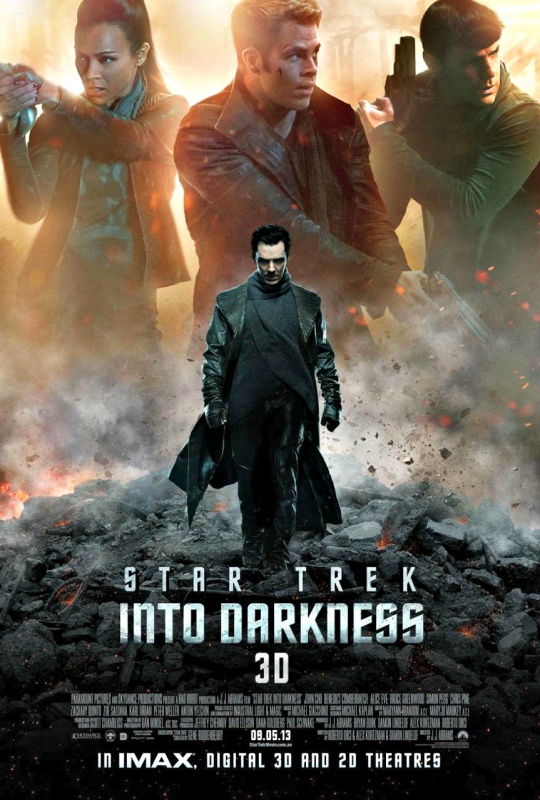
Star Trek Into Darkness: A Review


STAR TREK INTO DARKNESS

*Author's Note: In response to the grief I've been given by posting the 'spoiler' of Star Trek Into Darkness on my private Facebook account I have opted to inform the reader that this review will give as many spoilers as possible.  If one does not want to read them, skip down to the last paragraph and the conclusion.  You have been warned.  Thank you.

The Biggest Khan Job Ever...

I don't know if Star Trek Into Darkness is one of the most anticipated films of the year.  However, for this film I did something I have not done in a long time: attend a midnight screening.  The last time I did that was for 300 (and that was only because I was all but kidnapped into it).  Two hours of screaming, heaving men...and I still struggled to stay awake.   I was surprised by several things in Star Trek Into Darkness.  I did not see people dressed up like Starfleet crew or Vulcans.  The house was not sold out (there were several seats available, and I suspect the 3-D showing next door was the bigger hit).  I did not hear applause at the end of the film.

This is the short review version of the film: Star Trek Into Darkness is in all but name a remake of The Wrath of Khan with a bit of The Search of Spock thrown in for good measure.

Here is the long version.

Enterprise Captain James Kirk (Chris Pine) is on the planet Nibiru, one full of primitive people.  Ostensibly there to survey the planet instead they quickly decide it needs to be saved from a volcano about to destroy it.  However, a problem: the Enterprise (and crew) cannot be seen lest the Prime Directive (non-interference with the evolution of a species) be violated.  Well, as Spock (Zachary Quinto) goes into the volcano,  a series of events force the Enterprise to reveal itself by rising from the sea.   Even though Spock is saved, the Vulcan is still miffed that the Prime Directive has been violated.  As a result of Spock's report (which goes into greater detail than Kirk's), Kirk is demoted by Admiral Pike (Bruce Greenwood).

Well, let us move onto other matters.  There's a little girl dying in a London hospital, and a strange figure approaches the father, one Thomas Harewood (Noel Clarke).  This mysterious figure promises he can save her with a little bit of his blood.  All he has to do is a small favor...blow up the Starfleet Archives.

Having thus launched a terrorist attack on London (not that such things ever happen in the British capital...perish the thought) an emergency meeting is convened.  Here, we learn the name of this terrorist: John Harrison (Benedict Cumberbatch), a rogue Starfleet officer.  No sooner has Kirk put two and two together than Harrison unleashes an attack on the meeting, killing Pike.  With his mentor gone Kirk is giving permission by Admiral Marcus (Peter Weller) to go to Kronos, the planet of the Klingons, to capture Harrison who has been traced there.  Of course, this must be done delicately, given that this pre-emptive strike (emphasis mine) could lead to war.

Well, in Kronos despite the region Harrison is in being uninhabited the Klingons find the small crew of Kirk, Spock, and Uhura (Zoe Saldana).  Uhura cannot convince the Klingons to help them capture Harrison but in jumps Harrison himself, wipes the Klingons, and surrenders.


It's never a good sign when the villain surrenders and allows himself to be captured.  It's also never a good sign when the villain is behind a glass cell where the heroes can be taunted by them.  It just never is a good sign.  We've seen it in The Avengers.  We've seen it in Skyfall. 

Don't these heroes ever learn?

In any case, Harrison taunts Kirk and reveals the whole nefarious scheme.  He is a genetically enhanced super-being over 300 years old being used by Admiral Marcus as part of a secret weapons program to build weapons to destroy the inevitable war with the Klingons.  Marcus has kept 72 of his people frozen, thawing only Harrison out to use his genius for the weapons, in particular a massive Federation Starship that will defeat them all.

And his name is NOT John Harrison.

HIS NAME IS KHAN!

Now Kirk uses Montgomery 'Scotty' Scott (Simon Pegg), who had left the Enterprise when weapons he could not look into were brought aboard despite his strong objection, to find what exactly is located at the coordinates KHAN had given him.  Here Scotty finds a shocking sight: a new Starship ready to go to war.  It is the U.S.S. Vengeance, ready to attack the Enterprise to force them to hand KHAN over. 

Once we learn who KHAN is, Acting Captain Spock (Kirk and KHAN going to attempt to stop Marcus aboard the Vengeance) does what any rational Vulcan would do...he calls his doppelganger (Leonard Nimoy) to find out if on THEIR parallel/alternate universe, they had ever encountered and/or defeated a KHAN.  Even though Spock Prime tells Spock Alternate that he would never tell, he does so anyway.

Allow me to stop for a moment and ask, isn't that cheating?

I am KHAN!!
Well, anyway KHAN and Kirk get on board the Vengeance, where while Marcus is defeated KHAN still holds the upper hand.  Hand over his cryogenically frozen men, or Kirk dies.  While Spock relinquishes, KHAN still won't surrender his mad dreams of frankly I don't know what.  However, a little bait and switch: while the torpedoes that held KHAN's people were sent, they remained on the Enterprise.  The torpedoes were activated, fatally crippling the Vengeance. 

In any case the Enterprise has been fatally damaged as well, plummeting towards Earth.  Only one thing can stop it: repair the warp core, even if it means enduring massive radiation.

If by this point you think the one who makes the greatest sacrifice is Spock, you've been watching the wrong movie.  In Into Darkness, it is KIRK who goes in.  It is KIRK who is behind the glass, radiation overwhelming him.  It is SPOCK who stands unable to save his friend.  It is SPOCK who sheds tears. 

And it is Spock who screams out, "KHAAAAANNNN!"

Kirk is dead, but WAIT!  Dr. McCoy (Karl Urban) notices that the Tribble he has, which he injected with KHAN's blood, is now alive.  Would that not work with our beloved Captain? Well then, only one thing for it: they have to get KHAN alive.  Fortunately, even though the Vengeance crashed into San Francisco (glad we can now reference September 11th without anyone really raising any objections of seeing ships crash into buildings and whole populations), KHAN escapes without a scratch.  Spock now goes after him and with a little help from his girlfriend manages to stop KHAN, get the blood, bring Kirk back to life, and freeze KHAN again, with everyone aboard the Enterprise ready to begin their five-year mission (except for crabby Dr. McCoy).

Unlike Trekkers/Trekkies, I am not upset or angered by the appearance of KHAN in Into Darkness.  I'm not bothered by including his character in this movie.  I am HIGHLY upset and angered that I am asked to watch a virtual remake and have people tell me I am watching something original.

That more than anything else damns Into Darkness for me: the idea that director J.J. Abrams and screenwriters Roberto Orci, Alex Kurtzman, and Damon Lindelof (who brought us Star Trek, a film I feel I need to reevaluate after this debacle) could basically rip off another film in the Star Trek canon and no one either notice or care.  It is just bad enough that they all but stole all of Wrath of Khan, but that they have similar scenes, plot points, and even imagery from Wrath of Khan. 

No sensible person could possible have thought that seeing a character yell out "Khan!" after his friend dies from an overdose of radiation would not have them think of Wrath of Khan.  Into Darkness might work for those who pretend that everything before the reboot did not exist (a bit like Doctor Who fans who think the show started with 2005's Rose and that nothing starting from 1963's An Unearthly Child to 1989's Survival or 1996's Doctor Who: The Movie relates to the show they watch now...even while they proclaim the 50th Anniversary of a show whose first forty years they neither know nor care about).  However, for those who know of that iconic line reading, or who know of Spock's great sacrifice in keeping with Vulcan thinking that "the needs of the many outweigh the needs of the few, or the one",  Into Darkness is nothing more than a shameless rip-off.

There is no other term for it: Star Trek Into Darkness is a shameless rip-off of Star Trek II: The Wrath of Khan.  Star Trek Into Darkness even manages to steal a bit from Star Trek III: The Search For Spock.  In that feature, the whole story revolves around the efforts to bring a believed-dead Spock back to life.  In Into Darkness, it happens in the last ten minutes, in a clumsy way (I know there is Power in the Blood, but this is ridiculous), and in a way that robs us of the emotional impact that Spock's 'death'  had on the viewer in Wrath of Khan. 

In short, you just can't basically copy another film in the same franchise and expect to get away with it with the excuse of 'it's an alternate universe'.  If it is an alternate universe, then why does Spock Alternate (Quinto) call on Spock Prime (Nimoy) to basically give him a crib sheet as to A.) who Khan is and B.) whether he was defeated?  Wouldn't it be obvious if Spock Prime is still around that the answer to B. is in the affirmative?  I found that both despicable (rather than have YOU, Spock Alternate, find things out, I, Spock Prime, will just tell you about it) and illogical.  Why would Spock call on Spock to give him information?

As a side note, we get a little rip-off of all things of The Poseidon Adventure.  The only thing missing was Shelley Winters, but I digress. 


There are other things I disliked about Into Darkness (though the shameless rip-off of Wrath of Khan was probably the biggest thing).  The Klingons were either an afterthought or a way to bring them in for the inevitable sequel because they were irrelevant to Into Darkness (any alien group could have been there).  Moreover, while their new design doesn't particularly bother me I am not crazy about it either.

Another bad aspect is in trying to make us sympathetic to Khan.  He cries when monologuing about how he's been used by Marcus, but again, it's hard to gain sympathy from someone we barely know.  At least with Ricardo Montalban's Khan we at had a reason for his pathological hatred of Kirk.  With Cumberbatch, despite his best efforts I didn't care about him or his people.

Moving on with the performances, Cumberbatch was directed to emphasize his luxurious baritone to full 'villain' effect.  Whenever he spoke, he used his voice to signal, 'I'm a villain, a super-villain, a mad genius'.  However, I always have an antipathy whenever an actor deliberately uses his voice to signal that he is evil.  Cumberbatch's Khan, despite the script's desperate efforts, never came across as particularly dastardly or dangerous or menacing.  He was imposing in his stillness, but whenever called on for an actual threat Khan and Cumberbatch were almost a secondary plot device given that the real villain was Marcus and his George W. Bush-like rush to war at all costs. 

However, what makes Into Darkness at least bearable is most of the Enterprise crew.  Of particular note is the interplay between Pine's Kirk and Quinto's Spock.  Both work very well together to where they compliment each other's character: the arrogance and ego of Kirk tempered by Spock's logic, and Spock's somewhat cold nature guided to a sense that logic is not the answer to everything by Kirk's instincts.  Their scenes together are one of the few bright spots in Into Darkness (no pun intended).

Even though he is criminally underused Karl Urban still has the best moments as the cantankerous McCoy, even tipping his hat for original McCoy DeForrest Kelley's infamous, "Damn it, I'm a doctor, not a...".  Here, it is to Spock that he speaks, "Damn it, man.  I'm a doctor not a torpedo detonator."  Quinto is also strong as Spock, even though I would argue he's less Vulcan and more (horrors) human in his interpretation. 

As a side note, despite the determined efforts to have a Spock/Uhura romance (one of the few things I felt failed in Star Trek), the 'comedic banter' between a bickering Uhura and Spock as they come to the Klingon planet of Kronos struck me as both idiotic (it really is the worst time to start a fight) and unrealistic, even almost sexist (note the woman is the one who started it).  My view of Saldana's Uhura is becoming more tempered, even if she had little to do.

At least in the female department it was better than Alice Eve's Carol Marcus, the Admiral's betrayed daughter.  What she was we call 'eye candy' and a set up for Kirk's son should they opt to remake Search for Spock and The Undiscovered Country as they've remade Wrath of Khan. 

It was an unfortunate decision to sideline Urban for Simon Pegg, whose Scotty came off as a manic comic relief with illogical plot points to boot.  I kept wondering how no one on the Vengeance failed to notice this annoying Scotsman running around the ship causing havoc.  Furthermore, there really was little point of having Scott leave the Enterprise since they could have worked the situation in another way (though the flight of Kirk and Khan across space between the Enterprise and the Vengeance was a beautiful-looking highlight of the film).

This 'get Scott out to make him a more important character' not only forced us away from Urban's McCoy but also generally sidelined both John Cho's Sulu (sorry all these years I thought your character's name was Zulu) and Anton Yelchin's Chekov (who was pushed into Engineering and was made to look almost inept if not downright stupid, a kid who didn't know the first thing about how to get the Enterprise moving). 

As I watched Star Trek Into Darkness or as it should be titled, Wrath of Khan: The Remake I could not help think that I had been had, hoodwinked, bamboozled, led astray (thank you, Brother Minister).  There is simply no reason, no excuse, nothing that can be said to justify attempting a reboot while at the same time dragging the past in front of us (and dragging the legacy of what has come before through the mud, as if Wrath of Khan had never happened).  If anything Star Trek Into Darkness is NOT the highly-touted reboot of the Star Trek franchise we were promised.  Instead, Star Trek Into Darkness is a horrid pillaging of what has come before and a case that those behind this reboot either simply have no ideas or have decided that they can copy and paste and no one will notice or care because it's in an alternate universe. 

Star Trek Into Darkness does have good things in it (Quinto and Urban are the best performances in the film, some of the action sequences are well-made), but frankly it is too evocative of other, better films to be a Star Trek film I would want to watch over and over for pleasure.  This is not the best Star Trek film, not by a long shot.  I question whether it is even a Star Trek film, except in name, and if anything, Star Trek Into Darkness teaches us the importance of names.
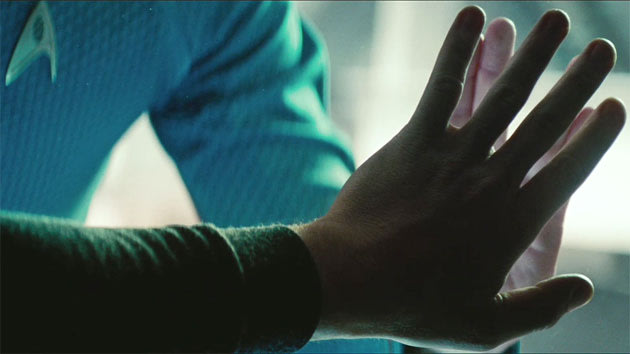
Looks familiar...

DECISION: D+

CONCLUSIONS ON STAR TREK: SIX WORST

Next Star Trek film: Star Trek Beyond
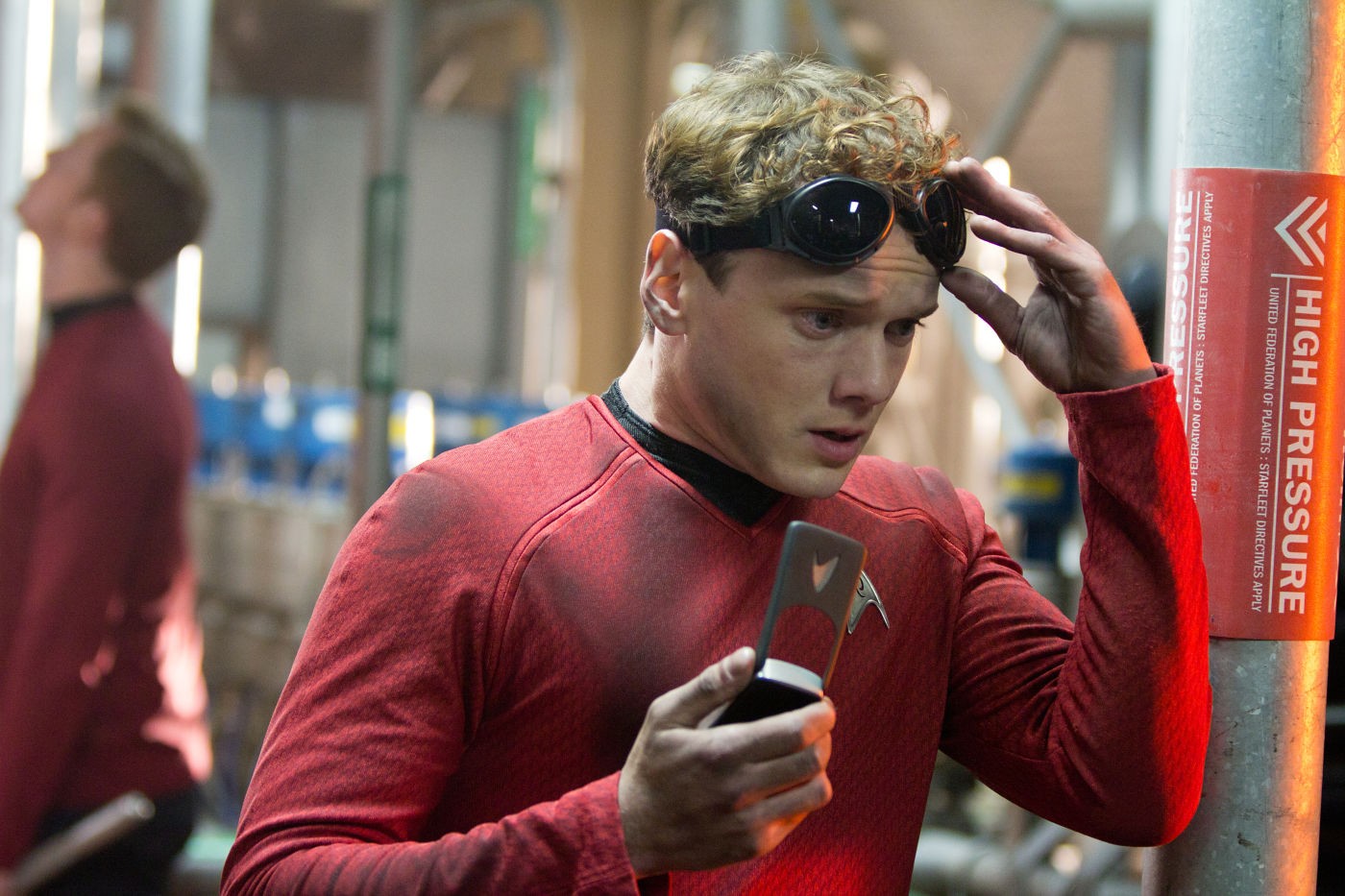

WAIT!  What about me?
I was in picture too.
I even wrote play...

Monday, May 13, 2013

Golden Boy: Reaction To Cancellation


You can't cancel me!
I'm GORGEOUS!
 
GOLDEN BOY: THE END

Rookie Retired...

Alas, I have not had time to catch up with Golden Boy's newest episodes, but fortunately, I won't have to worry anymore about keeping up with future Commissioner William Clark and how he rose in seven years from Homicide Detective to the youngest New York City Police Commissioner in history.  (They really thought Golden Boy would last SEVEN years?  Optimists....) 

CBS announced that Golden Boy has been cancelled after its first and only mid-season.  Let us remember that this was a mid-season replacement, so already Golden Boy was a bit of a stand-by in case something (say a Made in Jersey) flopped.  Thus, the entire series will run a mere 13 episodes, which is ten fewer than CBS' true success story for 2012-13, Elementary.

As a side note, Elementary has been renewed for Season Two, making it at 23 episodes longer than both Golden Boy and its rival, Sherlock...which has been on the air for two years and has cranked out only six aired episodes.  Granted, Sherlock features three 90-minute episodes per season (almost three feature-length films) versus Elementary at 60 minute episodes per season (42 if we skip commercials, something Sherlock does not have).  However, if we go by hours, Sherlock's 90-minute episodes total 810 minutes or around 13 and 1/2 hours overall (and this is including the unfinished/unaired Season Three).  Conversely, Elementary's 60 minute length (including commercial breaks) total an astounding 1380 minutes or close to 23 hours...nearly a full day's worth.  Therefore, there is simply more Elementary than there is Sherlock.  In fairness to both shows, American television is different than British television, or at least it is when it comes to Sherlock Holmes.  After all, the thoroughly British Doctor Who clocks in routinely at 42 minutes or 60 minutes with commercials per episode (even two-part stories which are split per hour) when it airs on BBC America.

However, I wildly digress.

Today, I want to explore WHY Golden Boy failed, at least when it came to attracting an audience.  Personally, I thought the show was quite good.  As I look at the grades for individual episodes, I find that they've rarely dipped under 6/10 (at least of the four I've reviewed, with at least four before I formally grade them).  Conversely, the long-running and wildly praised Doctor Who's recent season can't get past a 4/10.   It had strong promotion, and let's face it: Golden Boy's lead star, Theo James, is delicious to look at. 

That being the case, why did it fail?

I'm too sexy for this show...

I think part of the blame may be the entire concept itself.  Co-creator Greg Berlanti apparently can't let a good idea go.  This flash-forward concept of seeing a character between where he is now (at the pinnacle of success) and where he started from was tried once before in his Jack & Bobby.  The idea isn't a bad one; it's the lack of mystery that is.

Think on it: we already know that Detective Clark will in seven years time become Commissioner Clark.  Again and again I wrote that because of this, I never worried that Detective Arroyo (Kevin Alejandro) would ever rise triumphant over his rival.  That robs us of some of the tension or suspense that might exist if we didn't know what was to happen.  In itself that isn't a bad thing, but it does make us wonder whether people would have invested time in a character that we all knew was guaranteed success.

Take something like Eleanor & Franklin, the miniseries about the 42th President and the First Lady.  We know how the story ends, but since we basically start in the beginning (minus the framing device of the Widow Roosevelt taking her husband's body) we see HOW their courtship, marriage, his affair and relationship carried on and how they went on to change history.  With Golden Boy, it wasn't that much of a mystery: Clark rose to power.

Now the real mystery was in exactly what kind of person did he become.  Did he become like his partner/mentor, Detective Owen (Chi McBride) or like his nemesis, Detective Arroyo?  Every week (of the ones I've seen) little hints are dropped in the 'future' scenes, but frustratingly we are never pointed in one way or another.  The clues as to what kind of man Commissioner Clark turned into are so cryptic audiences who did watch never had much to latch onto.  If Clark shifted to the Arroyo side, he would be a rather loathsome individual, and who would want to have as their hero someone we wouldn't like?  Who would watch a show, invest time and emotion, into someone we would find reprehensible?

If he became more Owen, he wasn't giving much indication that he became a good person (primarily because he rarely listened to Owen's words of wisdom).


I think another thing that damned Golden Boy was the actual crimes were not that interesting.  If Golden Boy had been set in Congress and William Clark would end up as Speaker of the House or maybe even President, we might have basically had the same show that Golden Boy turned out to be.  The first crime investigated in the pilot was almost irrelevant, and in a few episodes the crimes were not important.  They almost felt like they had to be there because that's what cops need to continue working.  Once in a while we had good cases, but on the whole the actual crimes didn't seem that big a deal.

Now I give Golden Boy credit in that it was the interplay between the various officers that was the more important thing, but one can't have a good police procedural without having at least some good crimes.  I found nothing wrong with the more realistic take on police work, but perhaps the audiences did.

It was clear from the get-go that A.) Golden Boy was not about the crimes (which is the main reason people tune into procedurals) and B.) the framing device was not sustainable.  I predicted that it would be dispensed with quickly, and I think by Episode Three we just got a little mention that in seven years time he would achieve power.  We also had the opening and closing in gray, indicating the future, and almost always tied into the crime-of-the-week.

Maybe if HE'D been the lead...

One other thing that might have doomed it was the fact that at times the supporting character, in particular the villain, was more interesting and complex than the title character.  I point to Kevin Alejandro's Detective Arroyo.  Again and again in each episode I marveled at how I was more interested in him than in somewhat wishy-washy Clark.  Yes, James is pretty, and yes, he managed an American accent well (though he never convinced me he was a former hood from Queens), but it was Arroyo who was the more interesting one.  He was a good cop but a bad man: cheating on his wife, sometimes behaving badly with witnesses, but always determined to solve the case and having remarkably good instincts about the killer or suspect.  In fact, I think he more often than not knew who the killer was and just had to work out how to prove it.  This is opposed to Clark, who usually suspects it isn't who it ends up being and then slowly starts to see that it really is.

The mystery in Golden Boy was William Clark, and I don't think people cared all that much as to how or what he ended up becoming.  This is especially true when the villain of the picture was the more complex and interesting character.  Granted, Alejandro isn't as pretty as James, but Arroyo was the character I found more interesting because he was not evil but nowhere near as good as the grizzled veteran.

A side note: having the grizzled veteran and the cocksure rival is a bit clichéd.  Just a thought.

I didn't give Golden Boy much of a chance of going on to a second season despite its efforts to always introduce mysteries about the characters in the end.  Lots of suggestions that something will happen to Owen, suggestions of a mass shooting that might take out a few characters...that might be a good idea on paper but when you keep teasing the audience it might just irritate them more than pique their interest.  However, I liked the show and thought it well-acted and with a strong effort to build characters (even if some, like Clark's recovering alcoholic/unreliable mother and his sweet sister were also pushing two-dimensional...and a credit to the actresses who made them better than what was on the page).  Sadly, not enough people cared and thus, Golden Boy died. 

A combination of weak crimes, a frustrating main character, and a framing device that has failed TWICE (Jack & Bobby and now Golden Boy) killed an OK though not brilliant show. 

It is a curse of mine to watch shows no one else watches.  I loved Street Hawk (cancelled in its first year).  I loved Due South (cancelled in its third year but consistently low ratings and a third year twist that was disastrous).  I loved The Cape (cancelled in its first year) and Journeyman (cancelled in its first year). I loved Live Shot (cancelled after one season). Now, sadly, I must add Golden Boy to my unenviable list of flops that I actually watched and thought well of. 

And I STILL haven't seen a complete episode of Friends...      

Sometimes, a pretty face just isn't enough...

Sunday, May 12, 2013

Superman II: A Review

SUPERMAN II

A Zoddy Tale...

The success of Superman: The Movie all but assured a sequel, and fortunately, producers Ilya and Alexander Salkind decided to make two Superman films concurrently: the debut and the all-but-guaranteed sequel.  Unfortunately, Superman II had a myriad of problems, problems that affected its success (artistic, not financial).  Superman II was taken over by another director because the Salkinds and Superman director Richard Donner no longer could work together.  Richard Lester, who had helmed the Salkinds Three and Four Musketeers, took over, and the end results are obvious.  While Superman II is not a terrible film, it did soon start veering towards more comedy than perhaps it should have.  It also introduced plot points that in the future would muddle things for future Superman features (even those without Christopher Reeve, but that's for another time).  It might even have sown the seeds for the three successive disasters from which the Man of Steel has yet to fully recover from. 

Terrorists have taken the Eiffel Tower, and Lois Lane (Margot Kidder) has rushed to the site.  Her Daily Planet coworker, Clark Kent (Christopher Reeve) was completely unaware of what was going on in Paris (oddly, this seems to be a recurring theme in Superman II, but more on that later).  As Superman, he races to Paris, saving Lois and throwing the hydrogen bomb they've placed into outer space; this however, has an unforeseen effect: the explosion destroys the Phantom Zone where three villains briefly seen in Superman were placed: Non (Jack O'Halloran), a mute giant of a Kryptonian, Ursa (Sarah Douglas), the femme fatale of the group, and General Zod (Terence Stamp), who attempted to lead a coup and take over Krypton.  Now free from their imprisonment, they make their way to this planet called "Houston".

Also making a daring escape is Lex Luthor (Gene Hackman), with a little help from Miss Teschmacher (Valerie Perrine), in the process leaving poor Otis (Ned Beatty) in prison.  Luthor has put all his mental prowess to good use: attempting to locate Superman's lair.  With a little aid from his latest gadget he finds the Fortress of Solitude and also learns of the Three Supervillains (and that they would have the same powers as Superman).  Luthor thinks that would be the beginning of a beautiful friendship.

Meanwhile, back in Metropolis, Lois and Clark are sent to Niagara Falls to investigate a honeymoon scam.  Lois is putting together the fact that Superman and Clark are never at the same place at the same time.  At first, she believes she is wrong about her 'Clark and Superman are one and the same' theory when Superman fails to come to her rescue when she deliberately attempts to be a damsel in distress, but when Clark trips and his hand literally is put in the fire but he comes out unscathed Clark is forced to reveal all.

Faster than a speeding bullet...

That's not the only thing he reveals when he "takes her to his place".  In the Fortress of Solitude Kal-El speaks to his long-dead mother Lara (Susannah York) about what would happen if he wishes to be with Lois (whether he means in the Biblical sense or not I leave to you).   He is told that if he is to be with a mortal, he must be AS a mortal (begging the question, are Kryptonians...immortal?).  However, once he goes into a chamber where his powers will be stripped and he will become a mere mortal, THERE CAN BE NO GOING BACK...his powers will disappear FOREVER.  Superman chooses love, and now AS A MORTAL, ORDINARY MAN he and Lois consummate their love.

Sadly, this could not come at a worse time, for General Zod and his Crew have conquered Houston...well, East Houston, Idaho, but soon the rest of the Earth falls into line.  Sadly, while even the defeated President (E.G. Marshall) calls for Superman, the Man of Steel is on a date and far too busy to notice an invasion (see how his lack of knowledge/interest is a recurring theme).  Zod and his underlings soon find their conquest rather boring...a bit like Megamind, but I digress.

Enter Luthor, who is the only person on Earth who knows that Zod, Ursa, and Non are the enemies of Jor-El and his Son, who is now merely a mortal man.  In exchange for letting Luthor rule over Australia, he delivers if not Kal-El, the next best thing...his girlfriend.  During this time, when Superman has disappeared, he goes back to the Fortress and finds something...and then Superman Returns!

A battle between Kryptonians appears to end in a draw, and just when Zod tires of Luthor he offers the General something just as good...Superman's address.  Up in the Fortress of Solitude, Superman and Zod again fight, but threats against Lois are enough to have him all but surrender.  However, using Luthor's deviousness, the Last Son of Krypton is able to defeat all his enemies and bring peace on Earth once again.


As I watched Superman II, I kept getting more and more disappointed.  I should know that Superman II is  the work of Richard Donner as well as Richard Lester, but somehow the epic nature of Superman, and especially the seriousness of the first one, seemed to vanish.  To my mind, a lot of Superman II felt almost like a joke, veering towards camp.  What can one say about how poor Otis is dispatched...the joke that he is so fat that he literally pulls the balloon down whenever he tries to climb up the ladder.

As a side note, Superman II felt no compulsion to get rid of characters once they were no longer needed.  I wondered whatever happened to Miss Teschmacher once she helped Lex find the Fortress of Solitude...

Continuing on this "Superman II is a bit of a joke" motif is when Zod, Ursa, and Non arrive in East Houston, Idaho (already calling the town "East Houston" when the trio believe the planet is called "Houston" is already pushing credibility).  The entire 'encountering hicks and laying waste to a backwater town' thing is already a hackneyed idea, but the execution leaves much to be desired.  First, the special effects, a hallmark of what made Superman a brilliant film, look less convincing and almost cheap (obvious rear screen projections for example).  Second, the three villains looked almost bored being there, as if saying, 'I guess we have to conquer this place'.  The worst decision involving "East Houston" was to hire Clifton James to play the Sheriff.  James played the exact same role in two James Bond films (Live and Let Die and The Man With the Golden Gun), and that's the FIRST thing I said when I saw James (it's Sheriff Culpepper!).  In the Bond films, Culpepper is played for laughs, but when he is pulling the same shtick in Superman II that he did in the Bond films, it just falls so utterly flat.  Not only do we think he's doing the same thing (I'd be amazed if it wasn't the same CHARACTER) but the situation calls for serious, almost terror, not humor.

The big sequence that robs Superman II of the tension and menace the Kryptonian Trio are suppose to have is the battle between a fully regenerated Superman and Zod & Company.  These groups are suppose to be fighting an epic battle, but one wonders why the humans didn't have enough sense to hide or stay indoors.  Instead, we are treated to bits after bits that don't stretch believability but look downright stupid.  Zod, Ursa, and Non are using their super-strength to blow massive wind towards the public, but does the public attempt to hide from the chaos they've witnessed?  No, they're eating ice cream (allowing for it to fly into people's faces), they try to get their chicken home (and get blown away), the continue making phone calls (apparently oblivious to how the phone booth has crashed and is barely holding them in place) and we even have a guy with the unfortunate luck to be in ROLLER SKATES when all this is going on.

I looked at this and said, this is stupid.  Lester is more known for having comedy bits, and there isn't much wrong with that (the sequence where Lois attempts to unmask Clark by putting herself in danger may not be too funny, but it at least is logical).  However, scenes like this (where it looked like it was filmed in massive soundstages with models of cars and buses) took away from anything that can be called either 'exciting' or 'intelligent'.

Kneel Before Zod!
An Iconic Line...

Going on about intelligence, there are plot points that I find infuriating.  The entire "Superman becomes Man" bit was just idiotic.  Allow me to make my case.  First, I kept wondering how curious it was that he apparently had never asked what would happen if he wanted to mate with a human (given there were no Kryptonian Mingle sites he could go to).  Second, I thought it was rather insensitive to not ask Lois what SHE wanted (after all, she really had fallen in love with Superman, not Clark Kent)..  Third, I never understood why he had to give up his Kryptonianism to be with a human.  Is this a bit like EDWARD CULLEN, a man so perfect that the mildest sex with him could kill you?

Finally, we have this "one and done" bit.  Lara (and the screenplay by Mario Puzo and David and Leslie Newman with Tom Mankiewicz as 'creative consultant) made it clear that once he made that choice, there was no way he could become Superman again.  Guess what happens...he becomes Superman again!  Despite this constant declaration of Mommie Dearest that if he goes into the chamber he comes out a mere mortal, by the end we have the most fortuitous turn of events that allow Superman to rise once more.  That kind of Deus Ex Machina explanation always irritates me to no end because we are asked to invest emotionally in something only to find, 'surprise...just messing with you.  We found an easy way out'. 

When Wynken, Blynken and Zod are defeated, it is done so quickly and so easily and so almost unenthusiastically one barely notices how quickly it all goes.

There were a lot of things Superman II could have done better.  There was a disjointed sense to things, introducing characters and situations, dropping them, and bringing them back without much structure.  For example, what would have been so wrong with starting Superman II with Luthor's escape and then having the Kryptonian Trio's story told to him before the Parisian bomb released them?  Maybe Luthor himself could have used the Eiffel Tower heist as a way to get the explosion into space and thus having Zod pledge loyalty to Luthor...see how that works so well?

Also, whatever happened to Lois & Clark's Niagara assignment?

In a film like Superman II, one really shouldn't wonder about things like that.  Just a thought.

Also, I need to remind people, when Kent and Lane got it on, he was a MERE MORTAL.  This will prove VITAL in the future; remember that, because I will make reference to it again at a later date (no pun intended).

And seriously...Lois forgets everything about Clark's true identity with a KISS?  A KISS?  Talk about your easy and quick ways out of an impossible dilemma...

What good things come in Superman II are courtesy of some of the actors.  Hackman is closer to parody than true menace as Lex Luthor, but he still manages to pull off a mixture of raging ego and a light touch in his own self-aggrandizement.  Stamp is commanding as Zod, one who is used to giving orders and how rarely if ever goes on tirades.  The best villains are the ones that don't go unhinged on you, and Stamp manages that (even if at times he looks almost bored with everything).  Kidder and Reeve have a great scene when she discovers Clark Kent's secret identity: underplayed with little to no dramatics, and their comic bits are the rare ones that work.  It is also a credit to the movie that Lois Lane is seen working it out rather than just come across Superman's alter ego.

The sleeping together bit, maybe not so much.  Kidder herself in the definitive Superman documentary Look, Up in the Sky! has said that she in retrospect thought Lois and Clark should not have slept together.  "I would side with the prudes on that one," she remarked.

Superman II is not a terrible film (certainly not when compared to what would come later) and in some parts the film works.  However, for me the magic is gone.  The effects look less convincing, the comedy bits too distracting, the villains not as memorable or even good (though yes, Stamp's constant calls for people to 'Kneel Before Zod" have become part of the vernacular...odd fixation Zod had on people kneeling before him...) and the resolutions far too pat for my liking (a crystal and a kiss allow for everything to basically be reset).  It's a lesser film that what came before, but what came afterwards...


DECISION: C-

Alternate Version of Superman II

Next Superman Film: Superman III


Thursday, May 9, 2013

An American in Paris (1951): A Review

AN AMERICAN IN PARIS (1951)

Please visit the Best Picture Retrospective for all reviews of the Top Prize at the Academy Awards.

Not So S'Wonderful...

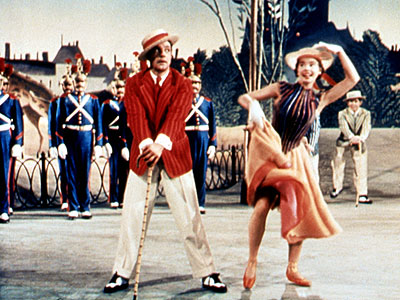
I have seen An American in Paris twice now, and each time I cannot muster the enthusiasm I'm almost ordered to have for it.  It's a pretty-looking picture, it has some fine moments in it, and it really just wants to be loved.  However, in both viewings I thought the story was pretty thin, some plot points veering on the creepy, and while it's a great showcase for Gene Kelly and the Gershwin Brothers' music, An American in Paris never found a way to bring all the varying elements (songs and whatever passed for the story) together.

Jerry Mulligan (Kelly) is the titular character, an ex-G.I. who stayed in Paris to pursue his career as a painter.  He isn't very successful, but he has a quick quip for anyone who says he isn't very good (or very bad, depending on his mood).  He has a best friend, Adam Cook (Oscar Levant), a concert pianist who doesn't care for either.  Adam was the pianist for French singing star Henri Baurel (Georges Guetary), with whom he still keeps somewhat in touch with (especially when Adam needs to touch on someone for a few francs). 

Jerry soon catches the eye of patroness of the arts Milo Roberts (Nina Foch).  Ostensibly attracted to Jerry's paintings, it's clear to everyone that her interest in him is more than artistic.  Jerry isn't too pleased about that, but he's not discouraging it either.  As it happens, while Milo is squiring her latest boy-toy...I mean, discovery at a hip Parisian bar, who should come in but Lise Bouvier (Leslie Caron).  Jerry is instantly smitten by her, although she makes it clear the feeling isn't mutual.  After some pursuing by Jerry, Lise agrees to date him, despite being engaged to someone else.

That someone else just happens to be Henri Baurel.  Now both Henri and Jerry are unaware that Lise is seeing both of them at the same time.  Despite herself, Lise falls in love with Jerry, who is simultaneously protesting his independence and being patronized by Milo.  Only Adam is aware of what's going on because he knows the girl both men are talking about is the same one, but he can't tell either.  Taking advise from an unwitting Henri, Jerry confesses his love for Lise, but she is too devoted to Henri, who saved her during the Occupation, to abandon her fiancée. 

Devastated, Jerry agrees to be with Milo and takes her to the Art Student's Ball (where everyone wears black-and-white).  It seems everyone is there: Adam, Henri, and Lise.  A heartbroken Jerry and Lise say goodbye before she and Henri go off to get married, but someone just happened to overhear their conversation.  A drawing flying to Jerry brings him a lavish fantasy sequence, the famous American in Paris ballet sequence, a lavish 16-minute dance number set to George Gershwin's famous music.  In the end, Jerry and Lise are reunited thanks to the most understanding fiancée in film history (and I'd argue setting the standard in romantic comedies of the 'other fellow', the boyfriend or fiancée who willingly gives up the girl for the lead).


If we took the songs and the big ballet number and the prettiness of it all, An American in Paris would come close to being almost a horror film.  Let's take a look at some of the rather shocking elements in Alan Jay Lerner's (inexplicably to me) Oscar-winning screenplay.  First, you have a thinly-veiled suggestion that Milo is almost a madam, seducing struggling artists to satisfy her own appetites.  Jerry is perfectly aware Milo is after his body but he doth protest too much about his artistic aspirations.  Moving on to Jerry, in any other film, particularly one made today, his actions of following Lise and harassing her into going out with him would be called 'stalking'.  Yes, it was the 1950s, so perhaps certain things were accepted then that aren't today.  However, Lise made it perfectly clear that she found Jerry repulsive (I figure not physically, it IS Gene Kelly after all), but after some persistence Lise quickly gives in, gleefully I might add.

If one thinks on Lise, we have to wonder what kind of woman would willing go out with a guy when she is engaged (even if she is more grateful than in love with him).  The word I found was, "tramp".  Any woman who dates another man (especially one she at first was disgusted with) while being engaged to another man is a tramp.  No matter how pretty the package, the actual story is rather shocking.

Milo is wildly possessive of a man she wants to bed.
Jerry plays hot and cold with his patroness AND goes out with an engaged woman.
Lise pursues a secret romance with someone while engaged to someone else.
Henri is quick to give up a woman he is engaged with, making one wonder whether HE was ever in love with his fiancée at all or just saw her as a little girl who could provide legitimate sex (and given he's French, one would have thought he would opt for a mistress).

And all of this is suppose to be romantic.

An American in Paris in terms of story is just so awful I still don't understand why so many people don't ever question the logic of it all.

In terms of story, the film is a flop.  In terms of the actual music, that's hit and miss.  Obviously, the Gershwin Brothers catalogue is among the most beautiful and brilliant that one can have to work with.  Sadly, the songs rarely were integrated into An American in Paris with any degree of success.  Let me give you a few examples.  Early in the film, Henri makes it clear he isn't a fan of jazz, preferring something By Strauss.  Well, who cares what the annoying French star thought. or that Adam and Jerry were both mocking him for his passé tastes?  I should point out his dislike of modern music (which adds zero to the plot) didn't stop Henri from belting out I'll Build A Stairway to Paradise as part of his nightclub act (and a lousy act at that...if it had been at the Moulin Rouge I would have asked for my money back). 

Even worse is what is suppose to be Levant's show-stopping number, the Concerto in F for Piano and Orchestra.  In this sequence, Adam is lying in bed, smoking, and fantasizing about giving a concert.  He is the pianist at this concert, then we see Adam is also conducting.  We then see a row of Adamses making up the violin section and conclude with him in the audience applauding himself.  It might have been innovative at the time, but no one as far as I know has stopped to wonder exactly what either this number, or the By Strauss number, or the Stairway to Paradise number have to do with anything involving the plot (weak as it is). 

I think it comes from the fact that the songs were not written specifically for the film.  Instead, Lerner and director Vincente Minnelli had to put the songs somewhere and whether they actually fit or not was irrelevant. 

That isn't to say that the Gershwin music isn't used in good ways in An American in Paris.  Setting a ballet number to Embraceable You where we are introduced to Lise is a brilliant idea, allowing both a showcase for Caron's dancing ability and is pretty to look at.  Another highlight is Our Love is Here to Stay, where Caron and Kelly have an enchanting pas de deux.  One can almost see in their dancing the two characters falling in love and it's a wonderful moment.


Naturally, the highlight is the lavish An American in Paris number, which takes up the last quarter of the film.   In terms of visual spectacle, it certainly delivers.  One cannot fail to be impressed with Gene Kelly's mix of artistry and athleticism as he metaphorically tours the city through French art and Gershwin's music.  It has a mixture of passion and joy.  It may look artificial, but deliberately so with the artifice of it all being one of the primary points.  In the end it is a wildly impressive Impressionistic number.

For me, however, it takes more than pretty costumes and lavish/ambitious numbers to make a good film, let alone a Best Picture winner.

An American in Paris has other things that I didn't care for.  I'll cut Leslie Caron some slack: for her film debut, she is a pretty weak actress.  As a dancer it's a beautiful thing to see.  Guetary is sadly annoying as Henri, a thin character who serves as nothing more than a plot device.  Given he was a big star in France, one wonders if it explains the French obsession with Jerry Lewis: his singing is awful, especially the vibrato in it.  The film begins with three voice-overs (Jerry, Adam, and Henri) that is quickly dropped.  Longtime readers know I hate voice-overs with rare exceptions (Sunset Boulevard, Blade Runner), and this is no exception.  Even more bizarre, once we get past the introduction that device is dropped.

Also dropped are characters when they are not needed.  Foch suffers the most: her desires for Jerry go almost totally thwarted, and what happens to her after the lovers are united we neither know or apparently care about.  Same goes for Adam: as soon as he does his job by informing Milo that Jerry's got the hots for another girl, he too disappears.

I'm sorry, but the idea that Henri would so willingly give up the girl to someone else is something that I just can't embrace.  I've seen too many romantic comedies where the third part in a love triangle, usually a male, gives up the woman he supposedly loved so she could be with another man.  I can't say that An American in Paris started this trend, but no matter what the setting I find such men weak and unbelievable.  In fact, he strikes me as rather dim-witted.   

Again, there are elements in An American in Paris that are wonderful.  Levant steals the show as the wise-cracking, sarcastic Adam.  Just before we get another musical number, S'Wonderful, where Guetary and Kelly sing about the same woman, Adam puts two and two together and attempts in his comic way to stop them from putting two and two together.  "Did you know I once gave a command performance for Hitler?" he tells them in an effort to distract their conversation.  He also does a bit with cigarettes and coffee that is a great bit of physical comedy. 

An American in Paris is beloved, and I can see what the appeal is.  You have pretty people, you have pretty songs, you have pretty costumes, and you have pretty sets.  However, the story is terrible (if not almost ghoulish in Jerry's pursuit of a woman and an engaged woman's two-timing her fiancée and an older woman attempting to make the lead into her kept man) and the songs were almost never integrated into the film successfully.  Its Best Picture win indicates to me that An American in Paris faced pretty weak opposition.


If only there had been another nominee that year which had brilliant acting, an intense screenplay, and could also be a love story.


If only they could have found some other nominated film in 1951 that could have challenged An American in Paris as a true cinematic landmark. 

I guess that year they just couldn't, so they threw it to the prettiest picture they could find...        


Sorry, Gene.
I can't accept your rose...


DECISION: C-

1952 Best Picture Winner: The Greatest Show on Earth

Monday, May 6, 2013

Star Trek: Nemesis. A Review


STAR TREK: NEMESIS

Hardy Not Worth the Time...

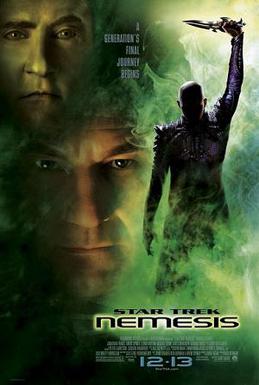
Star Trek Nemesis was the final Star Trek film featuring the Next Generation crew, and with good reason.  Nemesis is bad, and despite everyone's best efforts, it can't rise above some of the weakest material the Enterprise has come across.

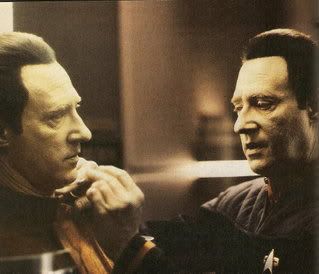
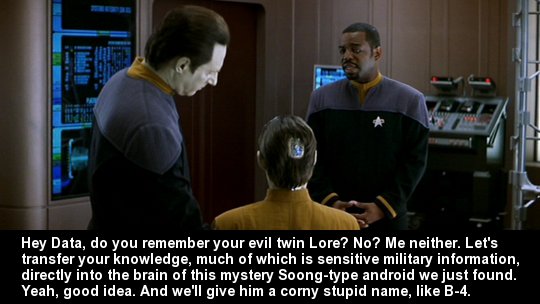
The Romulan Empire has a coup (which I understand is a common occurrence on the planet).  However, there is a twist: the new leader is a Reman, a native of Romulus' twin planet of Remus (no wonder there is a vague Romanesque style to the machinations of the Empire).  Admiral Janeway (Kate Mulgrew from the Star Trek: Voyager television series in a cameo) now asks Enterprise's Captain Jean-Luc Picard (Patrick Stewart) to go to Romulus and see if their new overtures of peace are true.  Of course, this will delay the honeymoon of newlyweds Commander Riker (Jonathan Frakes) and Counselor Troi (Marina Sirtis).  Things are complicated enough as it is with a discovery on Kolarus III: an android that is almost a double for Data (Brent Spiner), whom we discover was an earlier version called B-4 (how punny).

On Romulus, we find the shadowy leader, a Reman named Shinzon (Tom Hardy...yes, THAT Tom Hardy).  He gives Riker, Troi, Data, Worf (Michael Dorn), and Picard a shock: he is eerily similar to Picard in almost every way.  Shinzon makes it clear that they are connected, and we get the whole story: he is Picard's clone, created by the Romulans as part of a nefarious scheme to infiltrate the Federation by attempting to replace Picard with his doppelganger.  That plan, however, was abandoned when there was an earlier coup, and Shinzon was left to wither away on Remus.  If not for the courage and nobility of a Reman guard, he would have perished.  Instead, this Reman became Shinzon's protector and for his loyalty he is now Shinzon's Viceroy (Ron Perlman).   In the ensuing years, Shinzon has managed to build a master ship, the Scimitar, from which he will launch his vengeance against both Romulan and Federation.

There is one major problem: the Scimitar has as its energy source thalaron radiation, which can kill quickly if released.  As Picard attempts to bring Shinzon to the Light Side of the Force...er, make him see the error of his ways, Shinzon will not hear of it.  In fact, he is determined to capture Picard, as he needs his genes to live since as part of his cloning process he was programmed to age quickly.  Therefore, he is running out of time.

As it so happens, so is Data.  Having transferred all his memories and 'emotions' to his brother B-4, he sees that B-4 is a danger.  He was placed there as bait and now has put everyone unwittingly in danger.  As Shinzon begins his attack, Romulan and Federation join forces against a common enemy.  However, Shinzon, now either desperate, uncaring, or insane (we're not sure), decides to make it a suicide mission.  Picard and later Data go to the Scimitar to stop the thalaron radiation explosion Shinzon plans, with one making the ultimate sacrifice.

Or perhaps not....

Perhaps this open-ended finale to Nemesis is what really irritated me on two fronts.  First, one of my Golden Rules of Filmmaking is: Never End Your Movie By Suggesting There Will Be A Sequel.  In a strictly technical sense, Nemesis didn't end by saying 'there will be more Next Generation films, but it left the door open, and in a particularly vile way.  I say vile because the subplot in John Logan's screenplay (based on a story by Logan, Rick Berman, and Brent Spiner...Data himself) appears to have been there for one reason: to rob the audience of the poignancy of the 'loss' we've witnessed.   If you are going to give a major character a noble end, don't cheat by having a literally ready-made replacement waiting in the wings. 

Somehow, despite all their efforts, the 'twist' involving said character is almost telegraphed so brazenly anyone who thinks about where the story is headed is already five steps ahead, right down to how it will all come out.  More than anything, this 'non-death' is what I found most appalling about Nemesis...we are being asked to mourn the loss of a major and perhaps beloved character only to basically be told, 'No, we've got another version right here, so basically he never really died'.

SPOILER ALERT!  IF YOU DON'T WANT IT SKIP THE NEXT PARAGRAPH. 
YOU'VE BEEN WARNED!

As a digression, let us compare the loss of Spock in The Wrath of Khan with the loss of Data in Nemesis.  In the former, it looked pretty definite, and we got to see this iconic character make a great sacrifice (and a chance for Leonard Nimoy to have a great death scene).  In Nemesis, we don't see him really die, and given that B-4 is there, implanted with all his memories, it is as if he really didn't die.  It is a cheat.  You could say that The Search for Spock is a cheat in that the character is basically revived, but the film made a case as to how it happened (the newly created planet of Genesis brought EVERYTHING to life), but in Nemesis, it's basically an upload that brings about a new Data.  In short, where Spock's death was poignant, Data's death is empty of emotion.   

END OF SPOILER!

You have my permission to die, Batman...
I mean, Picard...

There are other things in Nemesis that push the film down.  The film had moments of intended comedy that fell flat (Data SINGS!, but who would have thought Worf wouldn't like the android's rendition of Irving Berlin's Blue Skies...or that Klingons would even know who Irving Berlin was), and there was a lot left unexplained.  Exactly WHEN did the Romulans take Picard to make a clone?  Did this come before or after Picard was taken by the Borg on the television series (and did this cloning take place DURING the series...so was I supposed to have watched Next Generation to follow the plot)?  Poor Picard...always getting used by aliens.  You'd have thought by now other beings would have picked another Enterprise crew member (the super-slut Riker is a good candidate I would imagine).

Also, what exactly IS Janeway doing here?  I'm no expert on Star Trek timelines, but wasn't Voyager stranded 75 years from her original time?  Furthermore, while it is nice to see her pop in, I imagine something like this would appeal to Trekker/Trekkies only, and those of us with limited or no knowledge of the Star Trek mythos, we'd say, "Who's THAT?"

As much as Nemesis wanted to portray Shinzon as either Picard's double (and hammering this theme of duality excessively with both Picard/Shinzon and Data/B-4) our villain came off looking a bit like a camp and whiny kid.  I think Hardy looks imposing as Shinzon and did his best, but part of me felt he knew this was all a bit silly.  One thing that James Cagney, a master of the amoral gangster, always believed was that when playing a villain, one should realize that to a villain, he doesn't see himself as 'the bad guy'.  The great screen villains (a Hannibal Lecter, Norman Bates, Veda Pierce in Mildred Pierce, The Manchurian Candidate's Mrs. Iselin, or Cagney's Cody Jarrett in White Heat) never think of themselves as villains.  They see themselves as almost heroic, or at least above morality.  With Shinzon, you always believed he saw himself as evil, not wounded.  Ostensibly he was motivated by his mistreatment by the Romulans, but he seemed more concerned with having "Daddy" Picard love him than anything else.

I know you want me...
As a side note, the erotic fixation Shinzon had on Counselor Troi was introduced (and given a bizarre moment when he enters her mind via Inzadi...not ask me to explain let alone understand what Inzadi actually is) but never followed through.  If Shinzon really wanted to make Troi his Reman Queen, he didn't seem to bother even trying to capture her.  Of course, this would reduce her to mere eye candy/plot device, which is more than can be said for Dr. Crusher's Gates McFadden.  Same can be said for LeVar Burton's Geordi LaForge...what exactly was the point of having him (apart from contractual obligations)?  I could even say that both Frakes' Riker and Dorn's Worf was similarly irrelevant.  Sad to see so many Next Generation characters appear so fleetingly and/or unnecessarily while Stewart and Spiner hog as much screentime as possible.

There were other things that bothered me.  Jerry Goldsmith, usually a reliable composer, appeared to have ripped off/paid homage to Stravinsky's Rite of Spring when Picard and Data escape the Scimitar.  Speaking of which, this escape was filmed in such a way that I felt I was watching a video game.  Data's literal plunge into space had me laughing more than marveling, another moment of humor (though I have to imagine it was unintended).   Jeffrey Kimball's cinematography went overboard at times (on the desert planet of Kolarus III, the sepia tones were bordering on parody, if not actually crossing said border).

Did YOU come up with this?

Oh, Nemesis...you spoiled your chance to give the Next Generation a respectable send-off.  It isn't to say Nemesis was all terrible: it is nice to see Tom Hardy when he was young and thin, not the gigantic block of muscle he has morphed into.  He certainly looks imposing in black, and he is a good actor (when directed well, which Stuart Baird did not do).  However, he was almost silly as a villain (and I never shook the sense that Hardy thought the same).  Given that Spiner came up with part of the story, I similarly never shook the sense this was his effort to make Data almost the co-star of Nemesis (logic be damned).  I'll give him credit: it takes chutzpah to have your substitute waiting in the wings to give you a character both new and old.

However, Star Trek Nemesis all but doomed any future hopes for another Next Generation-based film.  In fact, its spectacular failure doomed the franchise for almost a decade, and it was such a bad film that rather than attempt to bring back the Next Generation or any other Star Trek series (Voyager, Deep Space Nine, or Enterprise...would have loved to have heard Russell Watson treat us with Going Where My Heart Will Take Me one more time), it took an entire reboot where we had to basically start from scratch to bring the Enterprise out to the stars once more...

No Blue Skies for The Next Generation, alas.      


DECISION: D-   

Next Star Trek film: Star Trek (2009)

Sunday, May 5, 2013

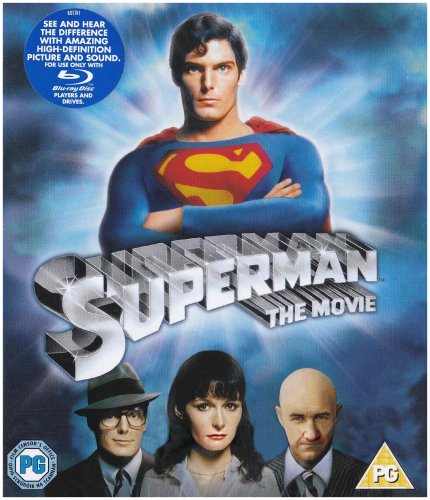
Superman: The Movie (1978). A Review (Review #525)

SUPERMAN: THE MOVIE (1978)

The Citizen Kane of Comic Book Films...

When Superman: The Movie (aka Superman) was released, the idea of adapting a film around a comic book character (even one as iconic as Superman) was simply unimaginable.  However, Superman did the impossible: it created a whole new genre of film and established the ground rules of how to do it successfully (in every sense of the word).  Superman did so many things right that even when the same group made more films, all would sadly fall short of the standard Superman set for all those that would follow.

Superman is a very long film (the original cut is close to two hours and fifteen minutes by closing credits time, the extended edition I imagine longer), but it can be summarized quickly.  On the distant planet of Krypton one of the leaders, Jor-El (Marlon Brando) warns that the planet will be destroyed soon.  He is not only not believed but has been ordered to remain silent, lest he inspire panic in the population.  Jor-El says neither he nor his wife will leave Krypton.  He doesn't say anything about his infant son, Kal-El.  The father places his newborn on a small spacecraft and sends him to Earth just as Krypton is destroyed by its red sun.

The spacecraft crashes near Smallville, Kansas, where Jonathan and Martha Kent (Glenn Ford and Phyllis Thaxter) find the child.  They soon realize this is no ordinary child, and decide to raise him as their own with the name Clark Kent.  Young Clark (Jeff East) is a good kid, but frustrated that his powers: his incredible strength, speed, and enhanced senses like sight and hearing, must all be kept hidden.  Sadly, Pa Kent dies and Clark decides he needs to find himself, find who and what he is.

He goes north, all the way up to the Arctic or North Pole, and with a crystal he found on the Kent farm he is able to create a Fortress of Solitude.  Here he also meets the shadow of his father, who takes him on a twelve-year journey to the stars, returning him when Clark would be 30 in Earth-years.  Clark Kent (Christopher Reeve) now goes to Metropolis to work as a mild-mannered reporter for The Daily Planet newspaper.  Here, he meets his rapid-fire editor Perry White (Jackie Cooper), star reporter Lois Lane (Margot Kidder) and eager young photographer Jimmy Olsen (Marc McClure).


You've got me?
Who's got YOU?
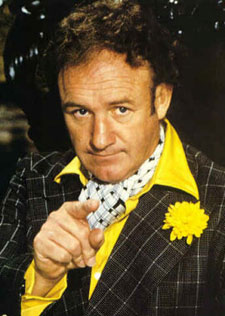
Lois shows no interest in Clark and only begrudgingly acknowledges that he might be a good reporter, but in a helicopter accident that nearly kills Lois Lane, in sweeps to her rescue 'a friend', whom we know is Superman.   Soon Superman starts coming in to fight for 'truth, justice, and the American way'.  This does not sit well with Lex Luthor (Gene Hackman), the self-proclaimed criminal mastermind who has come about with the greatest swindle/crime/mass murder in world history.  Aided by his bumbling henchman Otis (Ned Beatty) and luscious secretary Miss Teschmacher (Valerie Perrine), he is going to use twin nuclear missile tests to set off the San Andreas fault, sinking much of California to the sea...and build a new California with him as the exclusive property owner.

Superman is lured to his underground lair but Luthor proves a worthy adversary: he has kryptonite in wait for the Man of Steel, the only substance that can weaken him.  Luthor's missiles will strike two places: California and Hackensack, New Jersey.  Miss Teschmacher, discovering that her mother will die since she lives in Hackensack, strikes a bargain: she saves Superman in exchange for him stopping the missile headed to Jersey.  Despite knowing that Lois and Jimmy will be affected by the one in California, he keeps his word.  Even with his superspeed, Superman cannot stop death...or can he?  Superman ends with the Man of Steel bringing Otis and Lex Luthor to prison while they await trial, the Daily Planet staff all safe, and the Last Son of Krypton flying above the Earth...

Superman as I said makes so many right decisions, chief among them the fact that it takes the premise seriously.  Mario Puzo, the writer of The Godfather, wrote the story but the screenplay was by four people (at least credited): Puzo, David and Leslie Newman, and Robert Benton (with Tom Mankiewicz as creative consultant).  This is a violation of one of my Golden Rules of Filmmaking: There Should Be A Maximum of Three Writers on A Film, but Superman proves the very rare exception to this rule.  I think in this rare case it works because everyone treats Superman as an epic, almost a biopic, as opposed to a comic-book feature. 

Superman is a massive production, but the production (both in front and behind the camera) made the wise decision to play everything straight.  As far as they were concerned this was a real world, populated by real people.  There was never any attempt to mock Superman or even Lex Luthor (despite his own raging comic megalomania).  The film never treated the material like a joke, suggesting that the audience not take all these people and events seriously. 


Now let me be clear: this isn't to say that there aren't funny moments in Superman.  There are some winks to the audience (such as when Clark Kent attempts to change in a phone booth only to see it is not a full-length booth).  Most of the comedy comes from Luthor and his henchmen Otis and Miss Teschmacher, particularly whenever he has to come up with more and more plans to gain control of the twin missiles.  However, the genius of both Gene Hackman as Luthor and director Richard Donner is that it is never broad or makes Luthor look like an idiot (Otis, who is suppose to be a bumbler and is basically comic relief, can be an idiot but that's not a flaw).  What is brilliant about Hackman is that his Lex Luthor never rages or rants.  Instead, it is his arrogance, his excessive confidence in his own genius and the way he is incapable of understanding how no one else sees things his way that makes him both amusing and dangerous. 

Make no mistake: Lex Luthor is not stupid.  He is the only one to make the connection between Superman and kryptonite and the only one who sees all of Superman's vulnerabilities: both the kryptonite and Superman's total devotion to goodness.  Luthor is not comic in his evil: when Superman asks him if he gets his kicks by dreaming of the deaths of innocent people, Luthor calmly replies, "No.  By causing the deaths of innocent people."  Luthor is not a man to be trifled with.

The idea of having leading stars like Hackman and Marlon Brando in supporting parts while giving the chunk of story to relative unknowns like Reeve and Kidder was another brilliant idea. This allows us to both enjoy talented actors show sides they rarely showed (for Hackman, a strong sense of comedy with menace, with Brando a sense of great seriousness and importance).  Speaking of Brando, while he is only on screen for the first fifteen to twenty minutes (and from what I understand, getting paid $5 or $10 million for a bit part), he makes the most of his time, creating an imposing figure in Jor-El.  The only thing I would quibble with Brando on is his pronunciation of the planet as "Kryp-TUN" rather than the more established "Kryp-TOHN", which still strikes me as odd.

However, that is really a minor point. 

The smaller parts are also so brilliantly played.  Ford's Pa Kent in his few moments gives his son words of wisdom (he was put on this Earth for a reason, and it wasn't to score touchdowns), Cooper was a delight as the short-tempered Daily Planet editor, and McClure shone as the eager young photographer.  Even in virtual cameo roles, like Terence Stamp's General Zod or Susannah York's Lara (mother to Kal-El), they made the most of their screentime.


Moving on to the main roles, they were simply perfect.  Reeves had to play two roles: the meek, timid, almost frightened Clark Kent and the strong and noble Superman, and he did it beautifully.  He not only changed his physicality (hunched over, neck sinking into his body when Clark, erect with chest sticking out as Superman) but also his voice, shifting from a small voice to one that almost appears to be deeper and more confident.  Similarly, Kidder's Lois Lane goes from assertive and almost dismissive with Clark to a weak-in-the-knees giggling schoolgirl with Superman.  The scene where she is clearly befuddled when interviewing Superman is textbook on how to play a girl in love.

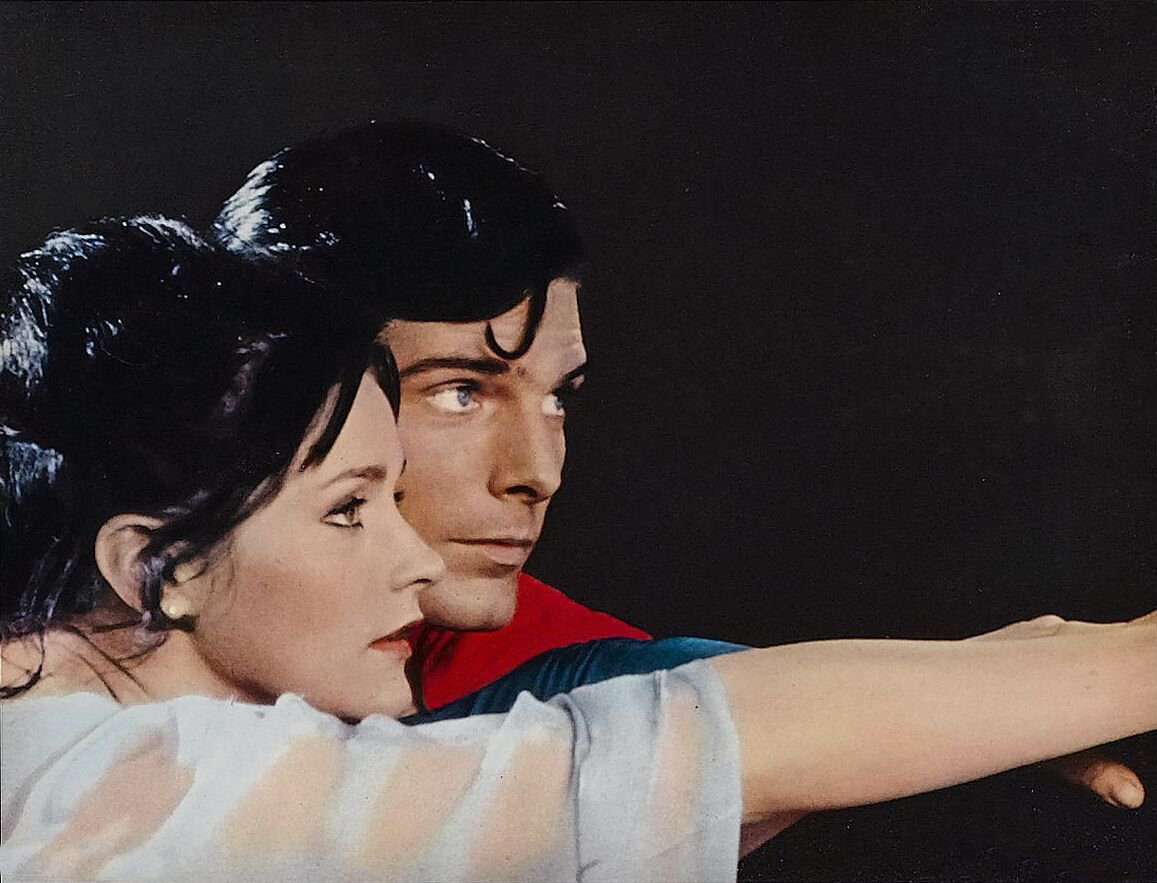
Of course, it is easy to fall in love with simply one of the most beautiful sequences in Superman: the Man of Steel taking Lois to flight.  Accompanied by John Williams' lush and romantic music and Geoffrey Unsworth's cinematography, one can see Lois and Superman falling in love.  This is enhanced by Kidder's internal monologue, where she begins by metaphorically asking Superman, 'Can you read my mind?'  It's basically the lyrics to a song she's speaking, but every element is so beautiful it seems as if she is truly speaking to herself, attempting to work out the complex emotions overwhelming our cynical, jaded reporter.

As a side note, Unsworth sadly died after completing Superman, and the film is dedicated to him.  This is extremely fitting, since his camera work was vital in bringing that epic feel to the project, from the grand sweeping sights of Krypton to the sweeping plains of Kansas (via Alberta, Canada) and the stunning flight sequences above Metropolis (which looks oddly similar to New York City).

So many other elements work to make Superman such a brilliant film: Yvonne Blake's costumes (from the shimmering gowns on Krypton to the small-town wardrobe of Smallville and Lois Lane's gown to Luthor's suits...although McClure's plaid jacket was very '70s), John Barry's extraordinary sets (the doomed planet Krypton, the unruly Daily Planet offices, Luthor's massive underground lair),Stuart Baird's smooth editing, and above all this impressive work, John Williams' absolutely perfect score.  From the stirring opening theme (where like Richard Donner, I too can hear 'Superman' when the fanfare hits its first big moment) to the haunting love theme as Lois and Superman take flight, Williams' Oscar-nominated score is still a brilliant piece of music.

Despite the fact that as of today Superman is almost 35 years old, the visual effects still stand, particularly the flying sequences.  In a bit of nit-picking the climatic earthquake and flood is a bit undone by the fact that we can tell they are obviously miniature models, but that really is a minor point.

By taking this seriously without being somber about it (allowing for humor to slip through), by grounding things in a certain reality (no pun intended), by casting unknowns in the leads and anchoring them with established performers, Superman did just about everything right.  Even the length is not an issue: it took its time in building the myth of Superman.  Instead of rushing through his origin: birth, teenage years, and metaphysical journey to other worlds, Superman builds its story for those with no real concept of his origin.  By allowing the story to build, we get to know Superman and how he (and Clark Kent) came to be.

Superman is the standard to which all other comic-book based films are measured against.  It is an extraordinary film, one filled with great performances, a sweeping epic feel, both serious and humorous, and one that set the standard for all comic book films that came after. 


DECISION: A+