Showing posts with label Golden Boy. Show all posts

Friday, October 4, 2013

Golden Boy: The Complete Series Overview

America, how could you turn ME down?
I'm GORGEOUS!

GOLDEN BOY: THE COMPLETE SERIES

Rookie Fails To Advance...

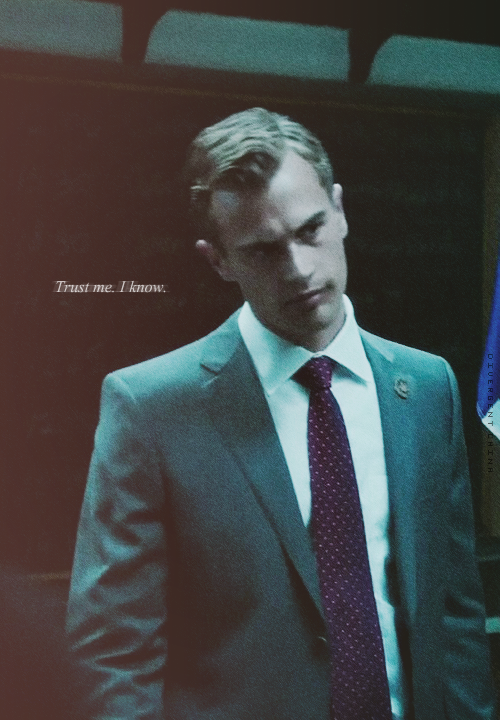
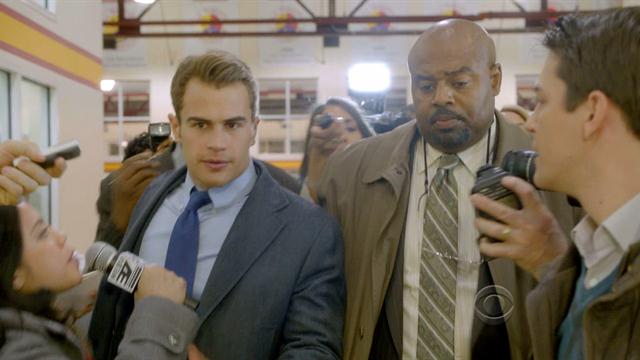
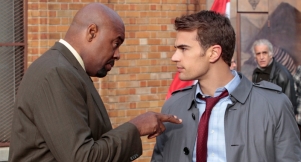
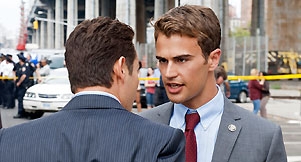
Poor Theo James.  Golden Boy, the television series that chronicled the meteoric rise of former hood Walter Clark, Jr. from street cop to detective to Police Commissioner in seven years time didn't even last half a season.  This was going to be James' breakout role on the American scene, after his scene-stealing turn as the luscious Turk Kemal Pamuk in an episode of Downton Abbey.  You remember, the man who deflowered Lady Mary Crawley and then dropped dead immediately after?

The pitfalls and perils of American television.  Some Englishmen manage to find hit television shows in the States (Jonny Lee Miller in Elementary), while some flounder (such as James).   Granted, Miller had built-in cache as Sherlock Holmes while James had to create a character from scratch. 

I've already covered why I think Golden Boy flopped (a somewhat dull and opaque lead, better secondary characters, and surprisingly dull crimes).  Now it is time to look over the series as a whole, to see what was the best and worst of James' (failure to) launch board.

First, the official ranking of Golden Boy Episodes, from best to worst.

Role Models (8/10)
Vicious Cycle (8/10)
The Price of Revenge (7/10)
Young Guns (7/10)
Just Say No (7/10)
Pilot (6/10)
Scapegoat (6/10)
Atonement (6/10)
Longshot (6/10)
Next Question (6/10)
McKenzie on Fire (5/10)
Sacrifice (5/10)
Beast of Burden (4/10)

Average Score: 6/10

He Shoots...

Now, on the whole I think the show itself started well.  After the second or third episode the focus wasn't so much on the future Commissioner Clark, keeping the flash-forwards to the opening and closing of the episodes.  We then got an above-average police procedural where the cases were excuses to explore both the interpersonal relationships and office politics of the 39th Precinct.  The growing and intense rivalry between James' Clark and Kevin Alejandro's Christian Arroyo was well-acted.  The overall story though, had some rather clichéd moments: the wise mentor, the hotshot rookie, the bitter antagonist. 

We already were having problems with Golden Boy in that, despite the show's best efforts, the most fascinating character wasn't the lead.  I was becoming more interested in Arroyo's journey, his crumbling fall from his unquestioned role as King of 39th to having his power diminishing to this kid.  You can't have a good show when the actions of the main character aren't as interesting as that of the villain.  I already had some difficulty with the closing moments of almost every episode hinting that "something" was going to happen to Chi McBride's Owen.  We didn't need almost repetitive reminders that a major character might meet a shocking end.  Leave that to the season finale, I say, not at almost every turn. 

He Scores...

It was only as the season progressed that Golden Boy started turning into a bit of a soap opera.  In particular the love triangle between James' Clark, Trieste Kelly Dunn's Margot Dixon (the reporter who begins an affair with Clark), and Eric Morris' Deputy Mayor Holbrooke (who happens to be her soon-to-be ex-husband).  The crimes, already not the most original, began to fade further in the background as we focus on Holbrooke's machinations to stop Clark and Dixon's romance.  The story of them wasn't horrible, but it was taking a great deal of time away from both his work and how he rises to the heights of power.  How he was able to rise to Police Commissioner when he didn't seem to be the best policeman (whatever his flaws, Detective Arroyo was a better detective than the pretty Clark) didn't seem as important as how he got into Margot's bed.

As the show kept moving, it started becoming less about Clark's education in the ways of power and more about Clark's way with women.  Again, there is nothing wrong with giving Clark a girlfriend.  There IS something wrong with giving him a girlfriend who somehow keeps getting involved with powerful figures, who in turn keep making crimes for him to investigate. 

He Bombs!

I found the succeeding episodes were becoming more ludicrous in terms of both crimes and stories.  Some of the crimes were easy to solve, and what was supposed to be a subplot of Clark's romantic escapades instead was becoming THE plot.  The focus, already given to a lead character who was still stubbornly a mystery at the end of the season, got overshadowed by a fascinating villain which in turn got lost with a not bizarre but at times hard-to-believe romance. 

I think in the end the reasons why Golden Boy failed to last a whole season are many.  It isn't because the cast didn't have talent.  If anything it is a loss that Alejandro's Arroyo will have no more stories, for despite the show's best efforts he was my favorite character in his flaws and talents.  The lead character was a mystery which gave us few if any clues.  The crimes weren't altogether interesting.  The stories got bogged down with a secondary story taking over. 

Finally, for a show about police, we were never able to solve the mystery of William Clark.  On the whole, I don't think Golden Boy was a bad show, but I can see why it failed to catch on.  You can't build up a show where your lead remains a little out of reach, no matter how beautiful the packaging. 

The Good, The Bad, and The Beautiful

Sunday, August 25, 2013

Golden Boy: Next Question Review


GOLDEN BOY: NEXT QUESTION

Rookie Remains Silent...

Next Question brings this back around to the very beginning of the series in our thirteenth and final episode.  It does what a good season finale should do: leave questions unanswered.  Unfortunately, because Golden Boy was cancelled long before Next Question aired, the little tidbits we are given will never be resolved.  Thus, what eventually happened to Detectives Owen (Chi McBride) and McKenzie (Bonnie Summervale), whom we are told met an unhappy end, will remain forever hidden.  These questions would have been answered as the series (would have) continued, but Next Question leaves other questions that the second season premiere would have answered.  As an individual episode, Next Question does better than some of the ones that have come before, but truth be told the series had put itself in a corner that it couldn't get out of. 

Let me start my review of Next Question the way the episode began, with a warning:

Scenes in this episode include flashbacks to the 9/11 attacks on the World Trade Center.  Viewer discretion is advised.

Nothing like using the horrific mass murder of thousands of people to close out a season of a low-rated television series. 

Commissioner Walter Clark (Theo James) is still being interviewed by Paul Daly (Richard Kind).  The Commissioner is admiring the Freedom Tower, the building that will rise 1,776 feet over New York City near where the World Trade Center once stood.  We then go back to present day, where Detective Clark, having been relegated to desk duty, is given something to do by his partner, Don Owen (Chi McBride).  He brings out his old cold case, that of Jozef Dworaczyk, a recent Polish immigrant who happened to be murdered on September 11, 2001.  In the midst of all the chaos of that day, he was kind of forgotten.

We now get flashbacks within flashbacks (if we go by the premise that Golden Boy really takes place seven years from now).  Owen is now in the Clark position, attempting to sort out this bizarre crime, bizarre in that Dworaczyk had no enemies.  He is in turn mentored by Andrew Lightstone (Robert John Burke), who advises him to never promise someone they will find the perp.  Circumstances force Lightstone to go the World Trade Center while Owen continues the case.  He is able to observe the second plane hitting the second tower, and later on, as he attempts to reach his partner and friend, the towers fall (though Owen bravely rescues a pregnant woman about to be engulfed by the debris).

In yet another of those strange twists Golden Boy takes, the Dworaczyk case is related to the case the 39th Precinct is handling, a drive-by where the driver is unharmed but the passenger is killed off.   Clark finds that Eddie Roque (Peter Scavanivo), who bore a striking similarity to Dworaczyk, has left prison.  Roark we find not only was the intended target but knows who put out the contract on him because Roark himself had used the same hitman. 

Roark, who now has months to live, decides that he might be in need of some redemption.  He tells Clark who the hitman is: Pablo Vega (Eric Todd Dellums...and is it me or is there something odd about casting an African-American in what would appear to be a Hispanic role?).  Cracking the case of a hitman would have great implications for whoever brings him in.  That person, in the mind of Detective Christian Arroyo (Kevin Alejandro) is none other than Detective Christian Arroyo.

Arroyo really could do with some good news, given that he has had simply the worst day of his life.  First, his wife has found out that he has been having an affair.  While she hasn't found who his mistress is, he is unceremoniously dumped. Next, his actual mistress, Deb McKenzie (Bonnie Somerville) has really moved on, and he is actually heartbroken.  Third, he has grown tired of Clark thwarting him at every turn and will get that promotion.  He won't let some old man or his junior partner get in his way, especially since his onetime ally Deputy Mayor Holbrook (Eric Morris) all but screwed him over.  However, the hits keep on coming, literally: to add to Arroyo's awful, terrible, no good, very bad day, Mamma said knock Arroyo out.  Clark punches him unconscious and then handcuffs him to where he can't go with everyone else.

Roark goes to the shop to attempt to hire Pablo, but Pablo in turn tries to kill him.  He at first encounters Clark when attempting to flee, but since Clark has no gun or badge, he slashes him out of the way.  Owen, however, DOES have both.  Pablo, in his own way, is in need of redemption: he had given up the hitman job after the botched killing, for which he feels actual guilt. 

With both cases solved (at least I think both solved...we've all but forgotten about the first), Owen not only is able to close out his last case with Lightstone but bring peace to Mrs. Dwaraczyk and I figure her now 11-12 year old son (she was pregnant at the time she became a widow) AND get a promotion.  While Arroyo himself does nothing at this point, we know Deputy Mayor Holbrook does.  We discover that Holbrook has allowed innocents to go to jail (connected to this corruption case or the hitman job, I forget).  That, along with Clark sleeping with his wife, push him over the edge.  He approaches Clark and Margot while having dinner, first turning a gun on him, then on her.  The screen goes dark as shots are fired.

In a subplot, Junior finds that he needs the shady connections of Senior (Michael Madsen) to crack the case.  Senior for his part, convinces his daughter Agnes (Stella Maeve) to take a ride with him...what could have been for next season.  Next Question ends with us learning that Clark will now work to clear the innocents blamed for Pablo's killings, but that this cost him two weeks in a coma, and that both Owen and McKenzie are in seven years no longer with us. 

We are told to come back next week for more Golden Boy.  Promises, promises...


As I stated, Next Question left us with a host of questions: what DID happen to Margot?  how did Owen and McKenzie meet their ends (the pilot did suggest something about a shooting, but whether that would have happened in the future or was what already occurred in Sacrifice we know not)?  What will become of Arroyo now that his life seemed to implode in one day? 

Those questions are likely never to be answered now that Golden Boy has been cancelled, but for myself I am not a fan of long teases (which might explain my dating life, but I digress). 

Nicholas Wootton, Golden Boy's creator, penned the season/series finale, and I trust that he knew the wisdom of featuring September 11th as part of his story.  I do not look kindly to such things, fearing that such a horrific and traumatizing event in human history should not be relegated to a plot device. 

That, however, is not the only thing I found fault with in Next Question.  Again, the idea that all the cases have to be connected somehow is something I'm finding more and more ludicrous (McKenzie's brother, Holbrook's Client Number 9 deal), and now this: a twelve-year-old murder conveniently coming together with the case they are investigating?  That point I might concede only because I cannot recall anything about the present-day murder, which is not a good thing. 


That isn't to say Next Question didn't have anything good in it.  Michael Madsen, though underused in both his episodes, has a good comeback at the beautiful Theo James' expense.  This is the first time they have seen each other in years, and Walter Clark, Senior greets his son with, "How's your modeling career?"  Cinematically, I thought it was highly clever that McBride's Owen in his flash-flashbacks would enter the light whenever he threatened someone, but slip into the shadows when he was being soft and gentle; this is a good twist in the visual department.  Credit also has to go to Alejandro, an undiscovered acting treasure who really needs to work more.  Apologies to the breathtakingly beautiful James, but Alejandro was the more compelling actor with the deeper character as opposed to James' Clark, whom the series kept shifting from good to bad.

I know, that was the point of Golden Boy: to see how he became whoever he became, but James was a bit more bland, especially to the good cop/bad man Arroyo who in one season we see slowly evolve and even crumble.  Clark just seemed to be more grumpy and short-tempered, as if his years on the force did not shape him into someone with more (or less) compassion or insight.  Arroyo on the other hand, was the more fascinating character.  I'll give you that James is prettier than Alejandro (though the latter ain't bad-looking by any stretch), but I would give Alejandro the title of 'better actor'...and he wasn't the lead.

It almost made me wish Arroyo had punched Clark.  Heaven knows he had many reasons to do so.

Next Question was not a bad way to end Golden Boy.  However, the questionable use of September 11th as well as the questions never to be answered leave a lot to be desired....

6/10

Next Episode: None due to Cancellation.
Golden Boy Series Overview

You're the only one who does now...

Golden Boy: Beast Of Burden Review


GOLDEN BOY: BEAST OF BURDEN

Rookie Finds Client Number 9.5

Beast of Burden, our twelfth and next-to-last episode of this now-cancelled series, is by far the worst Golden Boy episode of the entire season.  Had there been more seasons, Beast of Burden might have been the worst Golden Boy episode of the entire series.  There is so much thrown at us, so many subplots and nonsensical story twists that appear in the hour-long running time that if Beast of Burden had been among the first instead of among the last Golden Boy episodes, the show would have been cancelled much sooner.

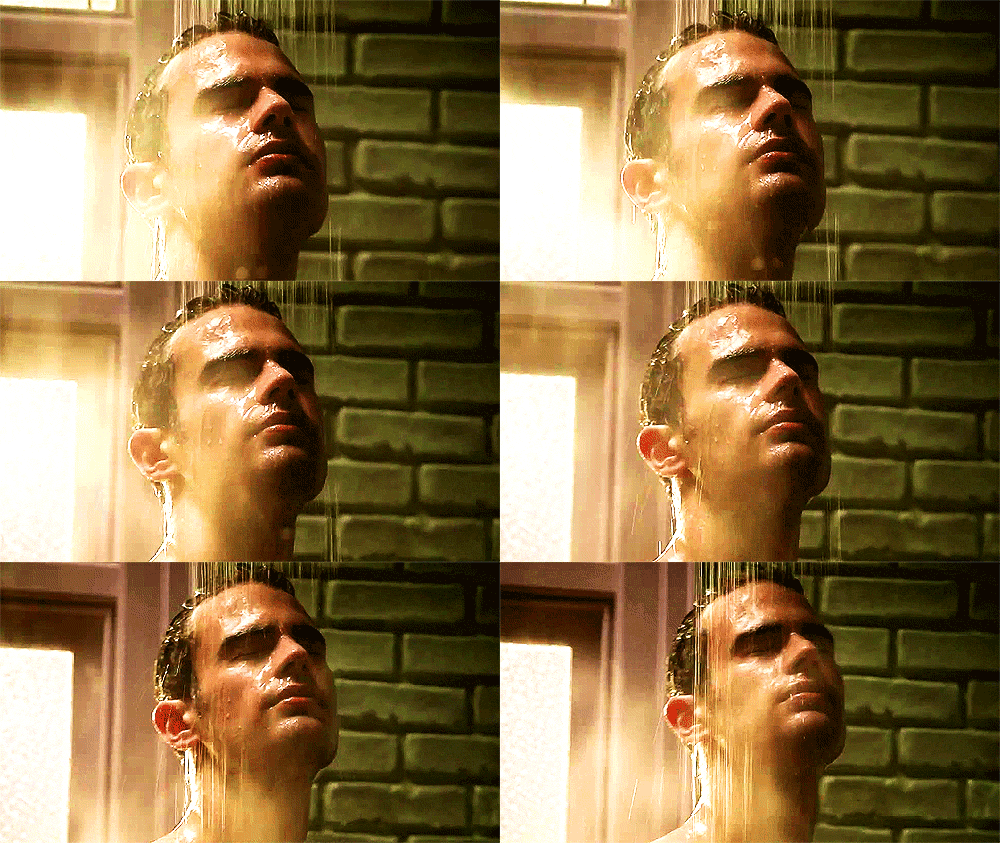
We go back to Paul Daly (Richard Kind), the reporter interviewing Commissioner Walter Clark (Theo James) in the pilot.   We hear about the issue with then-Deputy Mayor Carlton Holbrook (Eric Morris), and we now slip back into the past.  Then Detective Clark and the soon-to-be-ex Mrs. Holbrook (Trieste Kelly Dunn) are enjoying the pleasures of a hot shower when duty calls.

In the first of what can only be called unbelievable twists, the case in question is tied directly to the Deputy Mayor.  A prostitute is found dead in a hotel, and the man last seen with her is none other than Deputy Mayor Carlton Holbrook.  Clark, who already hates Holbrook for being a nuisance in his relationship, now has something to use (apart from the bribes he has evidence Holbrook has been taking).  While Owen (Chi McBride) urges caution (which is really what he always urges but is rarely taken up on), Clark charges full steam ahead.

As it happens, Holbrook admits he was with his favorite good-time girl, but that what happened was that when he woke up, she was already dead and he has no idea how this happened?

What, did they steal this idea from The Godfather Part II?

In any way, we now have to find who killed this hooker.  The newest suspect is...MARGOT! (Dun, dun DUN).  Somehow, she failed to mention in her trysts that her husband had been consorting with a particularly hooker, and that she had been in a fight with her, or that she had a bracelet or necklace that once might have belonged to Margot.

How soon we forget...

Well, we now have the guy who set Holbrook up (seriously, did they steal all this from Godfather Part II?), an Armenian mobster (?) whom Holbrook at first asks Clark to kill for him (??) but who in a chase manages to get killed by Clark (???).   In exchange for this killing, Holbrook won't tell others that Clark once committed perjury for his father as a kid (????). 

Oh, and in between all this, we get a subplot where Detective Diaco (Holt McCallany) must deal with his increasingly senile father Francis (Dan Hedaya) and at long last, Agnes (Stella Maeve) meets her long-lost father (Michael Madsen).

I don't think they could have created as spectacularly disastrous an episode as they did with Beast of Burden.  Perhaps by now they knew Golden Boy was bound for the dump heap, so they opted to go all-out in creating something that would look so astoundingly bad it would justify CBS' decision to get rid of the series as soon as they fulfilled the initial 13-episode commitment. 

The chances that Holbrook, a man who has been fastidiously careful in all his actions, should suddenly be found to be the prime suspect in the killing of a hooker is insulting to the audience who has remained loyal to the show.  It also doesn't help that they appear to steal from the Law & Order playbook and make Holbrook a substitute for Elliot Spitzer, who minus the dead body was similarly brought down by a hooker sex scandal as "Client Number 9".

The fact that Clark, Jr. was the alibi for his father in, wait for it, The Killing of a Chinese Bookie, is laughable (and another time I wondered whether the production team just picked movie titles and plots at random and shoved them down our throats).


Adding to that idea, since when did we slip into Dad territory?  While I don't find fault in Hedaya's performance, the entire subplot of Diaco's father seemed like filler, something to stretch out the episode while we moved away from the increasingly bizarre and idiotic storyline.  Until this point, I didn't even Diaco had a wife, let alone a family life.  This is clearly the production's fault, since no other episode has so much as bothered to give McCallany much to do.  The Diacos domestic situation seems to come from another show altogether, and I cannot understand why Golden Boy waited until now, near the end of their first season, to venture A.) outside the precinct into a secondary characters private life, and B.) away from the titular character.  We had the whole season to delve into the Arroyo/McKenzie affair, and got bits (usually at the end) with Owen's life.  We have been putting much effort into the love triangle of Clark, Dixon, and Holbrook, but now, NOW, we get Diaco's life.  Honestly, I rarely if ever even heard his first name, let alone anything outside the job.

Another aspect that was introduced way at the beginning but has never been touched since is Clark's nervous hands.  In either the first or second episode his trembling hands (the results of the circumstances that got him to Detective) were introduced, but now, after apparently never seeing a therapist (which I figure is standard in any shooting involving police officers) he is a dead shot.  I don't buy it, nor do I buy that the Armenian mobster (that already a bit of a stretch) would still be killed by Clark in a plan that works out for Holbrook. 

Beast of Burden shows Arroyo as being the most sensible detective around.  "History, motive, and means," he says when their attention turns to Dixon (already someone who never bothered to mention any of this to her lover, or apparently to her lawyer, who could make hay out of how Holbrook has been cheating on her).  Besides, given how Holbrook nearly got Arroyo killed you would think he would applaud Dixon. 

There are a few moments of wit.  "Which head are you thinking with now?" Owen asks Clark when the latter won't answer what he's thinking of.  Madsen also gets a great opening when he first appears, seemingly out of nowhere, to defend his daughter from a bully at the coffee shop. 

However, these bits are not enough to save Beast of Burden from being an embarrassment all around, as if even they gave up on the series altogether. 


4/10

Next Episode: Next Question

Golden Boy: Longshot Review


GOLDEN BOY: LONGSHOT

Rookie Shoots And Scores...

On the eleventh episode of Golden Boy we go into what seems to be a spectacular case: the murder of a major basketball star.  Longshot has in a sense, another continuing theme from Golden Boy: the sins of the father are visited upon the son.  In fact, if one thinks about it, this is the third episode where a parent's past fells the child (after Scapegoat and Sacrifice).  Whether it is intentional or not I know not, but Longshot is a more favorable variation on this theme and a better Golden Boy episode than we've seen...but not by much.

Commissioner Walter Clark (Theo James) makes a purchase of a very rare item, which takes him back to the case that brought him here.  Quinlan Reed (Jay Horton), a LeBron James-type basketball star, has been found murdered in the team's workout facility.  Given that Reed made his own version of "The Announcement" (side note: that was one of the most self-serving and embarrassing moments in television history, up there with the opening of Al Capone's vaults), there are many suspects. 

However, the 39th Precinct, including Detective Deb McKenzie (Bonnie Somerville), who doesn't know who Quinlan is (she follows baseball), narrow it down to one or two.  The first is Martin Wilson (Walter Jones), a member of his entourage who was helping train Quinlan.  Martin is as ex-con, so he claims to have panicked at finding Quinlan's body.  We then get another suspect in Vince Cole (Glenn Fleary), an old running buddy of Quinlan who recently had a fight with him (caught on videotape of course, think the Drake/Chris Brown fracas). 

As the investigation goes on, Deputy Mayor Holbrook (Eric Morris) wants regular updates into this high-profile case.  Complicating things is that Holbrook, soon-to-be-ex of Clark's mistress, Margot (Trieste Kelly Dunn), has finally found out about their relationship.  Is his interest in the case only because Quinlan played for New York, or is it to keep tabs on Clark?  It might be for revenge, as Clark and Owen (Chi McBride) are taken off the case after they arrest Vince, who has the most amazing alibi: he was robbing a store at the time of the murder.

The case takes a turn when we find that Quinlan's father Darryl (Charles Malik Whitfield) is the one that suggested Martin to his son and who was on the same winning basketball team with Martin back in the day.  The marks of a distinctive ring on Quinlan's face makes them turn their attention to Martin, who was on the championship team before he turned to crime.  However, I offer ONE GUESS as to who else might have a similar ring...

Darryl is much more involved in the case than he is letting on, and while Clark finds evidence that Holbrook is on the take, his mentor Owen (Chi McBride) offers advise of not moving in so quickly.  This corruption is connected somewhat to the case, for Darryl had mismanaged his son's finances, causing a break.  From there, we find that Martin might be trying to cover up for his friend, but Owen shows him that he now has a second chance and it would be foolish for him to give it up.  The sins of the father come to light as we find who killed Quinlan Reed.

On other fronts, Detective Arroyo (Kevin Alejandro) is hedging his bets: while he claims to want to be with Deb, he hasn't quite given up on keeping his marriage to Lorraine going.  Nora Clark (Polly Draper) and daughter Agnes (Stella Maeve) in their own way attempt to get Walter to see or look for his father.  Agnes has discovered Walter, Sr.'s criminal past...on the Internet of all things.  We end with Commissioner Clark at someone's graduation, that of Martin's nephew, and the Commissioner presenting Martin with a particular ring...


Longshot again has that thread of how in particular fathers cause problems for their sons.  There are three screenwriters (Brett Mahoney, Jennifer Corbett, and Christal Henry), but I don't know if they were asked to hit on something we've seen already.  The major drawback to that is that since we've had the son be the killer in one episode, is it really a surprise when we see the father bump off his child in another?  More and more Golden Boy is focusing on the triangle between Clark, Dixon, and Holbrook, with sometimes laughable results (how did Holbrook manage to tip off his ex without anyone suspecting it).  What is suppose to be the subplot is turning into the central story, and I leave it up the viewer whether he/she likes it or not (I could do without it). 

I also could do without the talk of Clark's criminal past as a yute (to use Nuw Yowkese).  It is becoming uninteresting to hear in almost every episode how he was a juvenile delinquent who was either pushed into it via his father (the father/son issue coming in again) or just did it to vent.  Longshot was better than the past few episodes, but overall I find Golden Boy is beginning to dim.


6/10

Next Episode: Beast of Burden

Golden Boy: Sacrifice Review


GOLDEN BOY: SACRIFICE

Rookie Finds Model Behavior...

We've reached our tenth Golden Boy episode, and this one may be the worst one yet.  The show, which due to low ratings was cancelled before Sacrifice aired, could hardly afford to make episodes this weak and even nonsensical.  Golden Boy was sold as the backstory of how titular (and gorgeous) character William Clark (Theo James) became in seven years the youngest Police Commissioner in New York City's history.  Sacrifice now signals that Golden Boy will be about his love life, one that has nothing to do with the latest crime, a crime that leads us down so many roads that ultimately take us nowhere.

We start seven years in the future, where Commissioner Clark is at a parole hearing, speaking about how the parole candidate did not do what good parents do: make sacrifices for their children.  Instead, the parole candidate made his children sacrifice for him, and that leads us to the case in hand.

There is a missing girl who has sadly been found washed up from the river.  She is Shana Taylor (Harper Carroll), teen girl and aspiring model.  At the crime scene is none other than Margot Dixon (Trieste Kelly Dunn), Clark's unofficial girlfriend.  Oddly, this reporter thinks Clark will give her some information.  Can't imagine why.  It also strikes Clark as odd that her estranged husband, Deputy Mayor Carlton Holbrook (Eric Morris) has tapped him to be a liaison for the Safe City Initiative (whether this is related to the Safe Streets Initiative mentioned in Just Say No is left unanswered). 

As the investigation continues, we find that Shana might not have been an aspiring model, or rather that she herself did not actually aspire to be one.  These dreams of fame and fortune came about from her mother, Linda (Anastasia Barzee), who moved her daughter from the Midwest to New York to enter Shana in the world of high fashion (already we think shades of an older JonBenet Ramsey).  Shana's father Hank (Jeb Brown) had opposed her move, but he wasn't the one who had custody after the divorce, did he? 

While Detectives McKenzie (Bonnie Somerville) and Arroyo (Kevin Alejandro) investigate the contemptible modeling agent Spenser Amano (Carman Lacivita), who had curiously taken out a life insurance policy on Shana, we get a clue from Shana herself.  She had been caught shoplifting, but her 'father' had come to the store and gotten her out without an actual arrest.  Yet how could this be if Hank was half a country away? 

Well, that answer comes easily.  Neil Jacobs (Christopher Evan Welch), a neighbor who sells antiques from his home, is the 'father' from the video.  However, when Owen, Clark, and Joe Diaco (Holt McCallany) come to ask questions, he has up and left.  It seems that The City Light, the newspaper Margot writes for, has received a mysterious scoop that allowed Jacobs to flee.

More incompetence from the future Commissioner, a little inappropriate pillow talk, perhaps?

Well, now the 39th Precinct has to find Jacobs, which they do.  At first he appears to be a potential but not serious suspect, but things get pushed to a whole new level when Hank decides to be an avenging angel and gun down Jacobs.  Clark instinctively tackles Hank, saving Arroyo in the process.

The shooting leaves Arroyo rattled in more ways than one.  It's bad enough that he nearly got shot, but that the Boy Wonder saved his life is almost unbearable.  Still, this changes Arroyo tremendously: he now seriously comes close to leaving Lorraine for Deb, and also pushes him to investigate the source.

Sadly, that source is not Margot...it's none other than Holbrook!  The fact that his ally in bringing Clark down nearly got him killed infuriates Arroyo, so much so that he actually starts helping Clark, shocking everyone around him.  More devastating is that McKenzie has clearly moved on and is starting to see someone else. 

As for the investigation, well attention turns from Jacobs to Linda, whom they suspect of being a stage mother.  However, as it turns out Linda, while pushy, was also unaware of Shana's friendship with Jacobs.  A wristband both Shana and Jacobs wore proves the missing clue.

As for the future, we find that Commissioner Clark was at the parole hearing...of his father, and as he storms out angrily we find that Sacrifice would probably have caused Golden Boy to not be renewed if the decision hadn't already been made.

Frankly, this last twist not only was not a surprise but one I figured almost from the beginning.  It also is a flaw in Andi Bushell and Brett Mahoney's script (one of many) in that the theme of Sacrifice, that of the parent who sacrifices their child for their own interests, is not followed through. 

The end result is that Linda may have been a poor mother, but it never decided whether she was reprehensible or just clueless.  Barzee's performance as the constantly whimpering mother did not help.  Linda was softened in the screenplay to make it look like she might have been merely clueless rather than vicious.  Brown's distraught father was similarly overplayed, so much so that the phrase, "He doth protest too much" came to mind; I even wondered whether HE killed his own daughter given how exaggerated he was.  It certainly would not only have been a better twist but it actually would have tied into the theme of Sacrifice, whose ending was nowhere related to the crime of the weak...I mean, week.

That is just one of the myriad of difficulties Sacrifice has.  We have so many clichés of what we've seen before it really doesn't elevate the episode to anything particularly good.  You could even make an argument that even the title is unoriginal.  You have the stage mother, the father about to kill the suspect, the office shooting...what is special about situations that appear to be going through the motions than telling us something unique.

Further, one wonders HOW, given they no longer live together, Deputy Mayor Holbrook could be the inside source.  That question is never answered, as well as why Amano would take a life insurance policy on a teenager he is suppose to promote.  The shady world of teen/tween models is touched on, but not explored.  Instead, we get another cliché: the creepy neighbor who at first is innocent then via a convenient wristband is guilty. 

About the only good thing in Sacrifice was Alejandro's Arroyo, a man who, having faced death head on, might actually be turning a new leaf.  His story would be fascinating to watch, but given it's CLARK we're suppose to care about... 

Sacrifice signals that the Dixon/Clark/Holbrook triangle will become the central storyline of Golden Boy, which I think is a poor decision.  Less now about how William Clark found his destiny, Sacrifice shows it is slipping into soap opera. 

5/10

Next Episode: Longshot

Saturday, August 24, 2013

Golden Boy: Atonement Review


GOLDEN BOY: ATONEMENT

Rookie Shows Some Respect...

In our ninth Golden Boy episode, we get a little bit of divine guidance when investigating the murder of a priest.  Sadly, no miracles could save the sinking show, and while Atonement makes smart decisions in regards to previously-seen characters, we also get some truly laughable 'twists' that make this a pretty abysmal episode in a series about to meet an untimely end.

Father Steven Truitt (Hisham Tawfiq) approaches Commissioner Walter Clark (Theo James) in church, discussing the Commissioner's offer to be the NYPD Chaplain.  This has Clark going back seven years to when he was a rookie.  Clark has finally found a love life, having an affair with Margot Dixon (Trieste Kelly Dunn), the reporter from McKenzie on Fire who is doing 'undercover work' with Clark, shall we say.  She however, has a problem.  She is going through a divorce, and the soon-to-be-ex is none other than Deputy Mayor Carlton Holbrook. 

How a detective never figured out the woman he was sleeping with is married to someone who might cause problems for him in the immediate future is left unexplained, but I digress.

In any case his girlfriend is not his only concern.  Nora Clark (Polly Draper), Clark's mother, has going missing, and despite his sister Agnes' (Stella Maeve) concern, Walter is dismissive of the whole situation.  As far as he's concerned, Nora has been a screw-up and this disappearance is just another sign of how bad of a person she is. 

Still, cases must be solved, and we have a doozy.  A priest known for helping criminals has been murdered, and as far as Detective Arroyo (Kevin Alejandro) is concerned, good riddance to bad rubbish.  Even the remarkably pleasant Detective Diaco (Holt McCallany) is not broken up about the good father's end.  However, Clark and Detective Owen (Chi McBride) know personal feelings are irrelevant and the crime must be solved.


In the middle of this case is Natasha (Stephanie Brait), the reluctant informant last seen in The Price of Revenge and whom we know is doomed to die before Clark becomes Commissioner.  She was found with literal blood on her hands as well as stolen watches in her possession.  Has she been stealing and rubbed the padre out to protect herself?  No, she insists.  She was turning her life around and he was helping her.  She was attempting to save his life for she found him, but couldn't.

We do have a suspect: Miguel Montez (Andhy Mendez) whose daughter was killed and whose killer the Catholic priest would not reveal.  Sadly, he has an alibi and things are looking pretty bad for Natasha.  Arroyo is convinced she is up to no good, but given their past she won't talk to him or Clark, so we turn to the woman, Detective McKenzie (Bonnie Somerville). 

Arroyo has a habit of having conclusions and using them as a starting point, a bit of working his way backwards.  Despite his good track record obviously Clark is not going to try that approach.  Instead, he does what any sensible person would do: allow a suspect in a murder case one hour of unsupervised freedom to allow her to find the fence she thinks killed the priest.

Poor decision-making skills on the part of Clark give Arroyo a perfect weapon and at long last Owen let's Clark know what's what.  Part of that involves NOT letting suspects wander off without having any idea where they are going.  Eventually, the entire precinct is dragged into Clark's incompetence, leading to a wild chase where Natasha is being held hostage.  Atonement ends with Natasha getting shot (though whether she actually dies is left unanswered), Agnes discovering Nora's secret (she has found a job as a cleaning lady and does not want her daughter to know) and Holbrook needing forgiveness seven years from now.

Much of my difficulty with Atonement involves the idiotic decisions of the Clark family.  First is that the big secret of Nora's (that she's a cleaning lady) is so laughable, finding no payoff with this revelation.  Given how bad of a mother Nora has been, one would think if she had any common sense she would relish the idea of telling both her children that she has found a job.  We also have Walter's shockingly insensitive reaction to both his mother's disappearance and his sister's concern.  Yes, Nora may have been rather inept as a mother, but to just be so flippant makes our hero rather loathsome. 

Finally, the idea that any sensible person would allow a suspect to wander about without so much as having someone tail her is just dumb.  Andi Bushell and Brett Mahoney's screenplay make it clear that Walter is slowly blending Natasha and Agnes in his mind but somehow this boneheaded decision is simply inexcusable. 

It's clear that the affair entre William et Margot and the triangle with Holbrook is slowly building in Golden Boy, though I wonder whether the payoff will be anywhere as good as the future sequences suggest.  OK...in this I am cheating a bit since I already know (somewhat) where this subplot is going, and it's nice to see the bits coming together.  It does work, but given what we already know, it does make the ending more vague, not less.

Still, I find Maeve's performance as Agnes the most interesting: at a crossroad between being a naïve, sweet girl and a woman, she is compelling in her story (and more nice than her idiot brother).  Kudos also to Alejandro, who shows that he may not be the best man around, but certainly among the best cops in the 39th Precinct. 

Ultimately, Atonement may not just be hinting that Holbrook will be playing a larger role in Golden Boy in the future, but also that the overall story is now turning to the here and now and less to how Detective Walter Clark in seven years becomes Commissioner Walter Clark.  On its own, I found Atonement starting to show Golden Boy is slowly losing its golden touch.

6/10

Next Episode: Sacrifice

Wednesday, August 21, 2013

Golden Boy: Scapegoat Review


GOLDEN BOY: SCAPEGOAT

Rookie Hits The Heights...

The eight episode of Golden Boy tackles some interesting character plot points, in particular the now-fierce rivalry between the two 'golden boys' of the 39th Precinct, future Police Commissioner William Clark (Theo James) and cock o' the walk Detective Christian Arroyo (Kevin Alejandro).  Scapegoat has some solid acting and those twists and turns corruption cases hinge on, and on the whole is a welcome return to form for the struggling (and eventually dead) series.

A corruption case comes to the attention of Police Commissioner Clark.  This has us going back to his first year on Homicide, where it brings back the first corruption case he encountered. 

Councilman Isaac Neville is found dead.  Whoever breaks the case is one step closer to promotion.  Arroyo, arrogant to the end, wants that promotion.  However, Detective Owen (Chi McBride) now wants the promotion too.  Helping him along the way is Clark, who would not only be happy to see his mentor rise but his rival fall.  So now the race is on to find the Commissioner's killer.

Arroyo is determined to win the promotion and solve the crime, and he will do anything to get ahead.  This means going so far as to contact IA (Internal Affairs) on Owen.  Dirty tricks in order to get to the case all around.  Clark is furious on this, but Owen again advises to keep going for the case.

At first there is a suggestion of Russian mob connections, but then things turn to Councilman Neville's family.  The detectives discover that his son Tyler (Andrew Stewart-Jones) has been in trouble of all sorts.  However, slowly secrets are coming out.  Far from being a good man, the Councilman is corrupt and shameful, complete with a much younger mistress.

Lucy Reyes (Audrey Esparza), the Lewinsky-type mistress, talks, telling them that in reality Tyler was a good kid who had been repeatedly taking the fall for his father's indiscretions.  Mrs. Neville (Tamara Tunie) basically confirms this, and little details such as the off angle of an autographed baseball bat soon expose Tyler as the killer.  Tired of taking the fall for his dad, he takes his father's life.  A little tit-for-tat with journalist Margot Dixon (Trieste Kelly Dunn), the reported surreptitiously contacted by Tyler to expose Councilman Neville's corruption, brings a pleasant profile of the Precinct instead of the damning expose she could have made about how they are all at each other's throats.

Scapegoat ends with the suggestion from Commissioner Clark that if he had listened to advise to be part of a team rather Owen would still be here...

I thought I liked Scapegoat.  I thought well enough of it initially to make it one of the better episodes of Golden Boy, but in retrospect I pushed it down a bit simply because I couldn't recall much from it. 

On almost every Golden Boy episode I could recall much of the story or some situation.  Here, I could recall the killer and how Owen and Clark came to find him, but minus that I could not recall much or much of interest.  That being the case, I opted to mark the episode down a bit.

What I did enjoy was that contrast between Owen and Arroyo.  The whole series to my mind has been about which direction Clark will take.  Will he follow Owen's example of slow, steady, reliable detective work where he keeps to the rules and focuses only on the investigation, or will he take Arroyo's route of moving fast, bending if not breaking the rules, and making everything personal?  Scapegoat shows that devotion to duty puts Owen ahead of Arroyo morally, but it also suggests that it will get Owen killed.

That of course is speculation given that with the show's cancellation we will never truly know Owen's fate; this, however, is one of the drawbacks of Golden Boy's structure: because it takes place in the now and opens and closes seven years from now, Clark has knowledge that we don't.  It's a tease for something 'to be continued', but now it won't be. 

As for the actual crime, while I admired how little details brought about the resolution I did wonder why Tyler was so weak-willed that he would be willing to be the fall guy to his father's many payoffs and lovers.  It wasn't a bad mystery, just not a great one.

I thought well of Scapegoat but my enthusiasm for it has dimmed a bit between airdate and today.  Still, on the whole I can't say it was bad, so I give it a little above average in a show that had so much going for it, but later on would start losing its way...

6/10

Next Episode: Atonement

Tuesday, August 20, 2013

Golden Boy: McKenzie On Fire Review


GOLDEN BOY: McKENZIE ON FIRE

Rookie Takes A Back Seat...

On the seventh Golden Boy episode, we see the focus shift from the titular lead William Clark (Theo James) to a supporting character, Deb McKenzie (Bonnie Somerville).  It certainly is a good thing to branch out the show to involve other characters.  One wonders whether having the show look at the lives of different characters earlier might have saved it from cancellation.  McKenzie on Fire is a showcase for Somerville's character, and a well-crafted episode.  So, why did I make it the weakest Golden Boy episode since the pilot?

Commissioner William Clark (Theo James) is comforting a female officer after she kills her first criminal.  This takes us back seven years when we come across a murder on a subway.  One victim is dead but another, Angie McGuire (Elizabeth Alderfer), the other victim's sister, lives. We get a twist in that the casings from the crime scene match the ones that killed McKenzie's brother years earlier.  This could be the clue that brings his killer to justice. 

Detective Owen (Chi McBride) advises caution and a steady hand in investigating both crimes (the subway shooting and Officer McKenzie's murder), but by this point we should know no one at the 39th Precinct ever listens to him initially.  McKenzie and her ex-cop father Ed (John Finn) now want to bring down the perpetrator and bring justice. 

As can be expected Deb McKenzie starts losing focus to where the actual crime being investigated, that of the shooting at the subway, is almost lost to her.  We find that the victims are actually connected to a group of Irish and Irish-American mobsters (an old vendetta I think), though the McGuire Sisters themselves were not part of the Gaelic Mafia.  We also find that the McGuire shooting is connected to the McKenzie shooting in that the criminal is involved with both.  Devlin Lehane (Kevin O'Donnell), the likely suspect in the shooting, assaulted Angie the same night of McKenzie's brother's murder. 

Eventually McKenzie thinks of taking things into her own hands, but Clark is there to stop her from doing something she'll regret.  However, Devlin is caught with his own words about both crimes and the McKenzies can find peace.  That also means that she ends her affair with her partner, Christian Arroyo (Kevin Alejandro).


What I liked about McKenzie on Fire was McKenzie.  Everything else I found weak and a little clichéd.  We've got an awful lot of coincidences in Christal Henry's script.  What are the odds that Devlin (a name to be played with) would have shot McKenzie's brother THE SAME NIGHT he had raped Angie?  What are the odds that these two cases would tie together so neatly?  In a city as large as New York, what are the odds that Angie would see Devlin and/or vice-versa so soon after coming back?  You've got the vengeful father who is also going to take the law into his own hands, the highly-pressured daughter, a lot of things that seem to almost happen just to have a story.  I think it would have worked better if the crimes WEREN'T connected because it seemed a bit too pat to have them both join up.

Not only that, but the whole Irish Mafia thing made it almost look like we were slipping into The Departed: The Series.  Irish mobsters?  The McGuire Sisters (again, a poor choice of names) being connected to some sort of Gaelic blood-feud?  Is it me, or is it getting a tad ridiculous?

Finally, and this was a biggie for me, WHY was Detective McKenzie working on a case where her emotions were getting the better of her?  I don't know police procedures, but I do wonder why no one ever stopped to say, 'McKenzie, you're too close to this.  You need to be off the case.'  No one apparently thought to pull her off both investigations.  If I were investigating my brother's murder, I might forget myself (and McKenzie clearly did), but not once did anyone appear to say that she shouldn't.  Instead, sometimes it almost looked like she was being put in charge of the investigations.  It just never made any sense to me. 

Again and again I questioned why McKenzie is let in on this case, but I never got an answer.  I found it all so puzzling, bizarre, and ultimately unrealistic.

In terms of acting I thought Somerville especially did her best work in an episode that failed her and her character.  I can't remember anyone else, even the titular star James.  They were there as a supporting cast to McKenzie, and it is nice to see Golden Boy opted here to give someone else the limelight for a bit.   

Personally, I found Somerville excellent in McKenzie on Fire.  Everything and everyone else, however, makes this episode a flame-out. 

5/10

Next Episode: Scapegoat

Monday, August 19, 2013

Golden Boy: Just Say No Review


GOLDEN BOY: JUST SAY NO

Rookie Drug Problem...

Episode Six of Golden Boy marches on, despite its premature end.

Ah, the good and bad of one Detective William Clark (Theo James), destined to be the youngest New York City Police Commissioner.  Is he a good guy?  Is he a bad guy?  Well, the world may truly never know given that Golden Boy was axed after a half-season, but let us now look at what came before and gleam from Just Say No whether our hot officer would have followed in the steps of mentor, Detective Don Owen (Chi McBride) or his nemesis, Detective Christian Arroyo (Kevin Alejandro).

The possible elimination of the Safe Streets Initiative brings Commissioner Clark to remember a particular investigation.  The 39 Precinct is hit with a new case.  A wealthy philanthropist and former addict, Claudia Drexler (Rachel Barrer) has been murdered.   Due to the victim's wealth and influence Detective Owen urges his protégé to have a soft touch (the wealthy are not like the rest of us, he warns).  Clark being Clark has no patience in this, and rather than finesse them he charges straight ahead, displeasing a suspect, Nathan Drexler (Paul Fitzgerald) as well as his father, power broker Marvin (James Naughton). 

Arroyo, whom we first see in the throes of passion with his partner/mistress McKenzie (Bonnie Somerville), immediately suspects Paul as the murderer, but Clark is not convinced.  First turning to Edward Rodriguez (Joey Azuene), a client at the treatment center Claudia funded, Clark soon finds that the actual case is much muddier than he first thought.  The investigation is keenly followed by Deputy Mayor Carlton Holbrook (Eric Morris), who makes things clear to Clark that he is to tread lightly.  We also discover that Paul himself is an addict.

Arroyo is slowly coming apart due to Clark's growing influence at the precinct and McKenzie wanting to slow down their relationship.  The investigation continues until we find the killer (hint: close to home).  On the domestic front, Clark's mother needs help to deal with a loan shark and we find that Clark's juvenile criminal past is slowly coming to light.  The petty thief is told by Owen, "We all have a past".  Loan shark is taken care of, and Arroyo's wife Lorraine (Andrea Navedo) proves herself adept at firing a gun, much to McKenzie's horror and fear.

Just Say No has kept the rather odd habit of tying the past to the present, and I say odd because in the future Marvin Drexler, the man who did his best to hide the truth, is seven years from now a powerful and influential councilman.  The suggestion is that Clark himself has something over him, which keeps the Safe Street Initiative he so favors from being eliminated.

Frankly by now the flashforwards are not even all that interesting.  In Just Say No, we see Clark as a jerk: short-tempered, aggressive, even unlikeable.  Given that, one wonders how he could work within the complicated political jungle of New York if he charges at things like a bull in a china shop.  We almost expect Clark to not follow Owens' advise about dealing with the elite, and if he couldn't muster the enthusiasm to offer a soft touch when questioning them about a murder, how will he behave with them once he has power?  His interaction with Marvin indicates he went the Arroyo way of knowing the criminal's identity and working his way back.

In fact, Golden Boy still does what it shouldn't: showcases the supporting actors rather than the lead.  Kevin Alejandro's Arroyo is the more compelling, interesting, and frankly smarter of the two characters likely to be a 'golden boy'.  Arroyo was right when he zeroes in on the husband, and Clark has to stumble around a bit before getting to what Arroyo was saying all along.  Arroyo also is the one that has a lot of balls in the air: his job, his rivalry with Clark, and his complicated love life.  Clark, on the other hand, just has his mother and being a somewhat unpleasant person there really is no joy in following him around.   As for his criminal past, it is played well but in retrospect is actually a bit boring. 

Still, in terms of this episode of this workplace drama with corpses, Just Say No has an interesting subplot and ends on a genuinely funny scene as the pistol-packing Lorraine shows McKenzie a thing or two (the subtext hilarious).  Sadly, Golden Boy is shifting from the Golden Boy to his nemesis as the more interesting part. 

7/10

Next Episode: McKenzie on Fire

Monday, May 13, 2013

Golden Boy: Reaction To Cancellation


You can't cancel me!
I'm GORGEOUS!
 
GOLDEN BOY: THE END

Rookie Retired...

Alas, I have not had time to catch up with Golden Boy's newest episodes, but fortunately, I won't have to worry anymore about keeping up with future Commissioner William Clark and how he rose in seven years from Homicide Detective to the youngest New York City Police Commissioner in history.  (They really thought Golden Boy would last SEVEN years?  Optimists....) 

CBS announced that Golden Boy has been cancelled after its first and only mid-season.  Let us remember that this was a mid-season replacement, so already Golden Boy was a bit of a stand-by in case something (say a Made in Jersey) flopped.  Thus, the entire series will run a mere 13 episodes, which is ten fewer than CBS' true success story for 2012-13, Elementary.

As a side note, Elementary has been renewed for Season Two, making it at 23 episodes longer than both Golden Boy and its rival, Sherlock...which has been on the air for two years and has cranked out only six aired episodes.  Granted, Sherlock features three 90-minute episodes per season (almost three feature-length films) versus Elementary at 60 minute episodes per season (42 if we skip commercials, something Sherlock does not have).  However, if we go by hours, Sherlock's 90-minute episodes total 810 minutes or around 13 and 1/2 hours overall (and this is including the unfinished/unaired Season Three).  Conversely, Elementary's 60 minute length (including commercial breaks) total an astounding 1380 minutes or close to 23 hours...nearly a full day's worth.  Therefore, there is simply more Elementary than there is Sherlock.  In fairness to both shows, American television is different than British television, or at least it is when it comes to Sherlock Holmes.  After all, the thoroughly British Doctor Who clocks in routinely at 42 minutes or 60 minutes with commercials per episode (even two-part stories which are split per hour) when it airs on BBC America.

However, I wildly digress.

Today, I want to explore WHY Golden Boy failed, at least when it came to attracting an audience.  Personally, I thought the show was quite good.  As I look at the grades for individual episodes, I find that they've rarely dipped under 6/10 (at least of the four I've reviewed, with at least four before I formally grade them).  Conversely, the long-running and wildly praised Doctor Who's recent season can't get past a 4/10.   It had strong promotion, and let's face it: Golden Boy's lead star, Theo James, is delicious to look at. 

That being the case, why did it fail?

I'm too sexy for this show...

I think part of the blame may be the entire concept itself.  Co-creator Greg Berlanti apparently can't let a good idea go.  This flash-forward concept of seeing a character between where he is now (at the pinnacle of success) and where he started from was tried once before in his Jack & Bobby.  The idea isn't a bad one; it's the lack of mystery that is.

Think on it: we already know that Detective Clark will in seven years time become Commissioner Clark.  Again and again I wrote that because of this, I never worried that Detective Arroyo (Kevin Alejandro) would ever rise triumphant over his rival.  That robs us of some of the tension or suspense that might exist if we didn't know what was to happen.  In itself that isn't a bad thing, but it does make us wonder whether people would have invested time in a character that we all knew was guaranteed success.

Take something like Eleanor & Franklin, the miniseries about the 42th President and the First Lady.  We know how the story ends, but since we basically start in the beginning (minus the framing device of the Widow Roosevelt taking her husband's body) we see HOW their courtship, marriage, his affair and relationship carried on and how they went on to change history.  With Golden Boy, it wasn't that much of a mystery: Clark rose to power.

Now the real mystery was in exactly what kind of person did he become.  Did he become like his partner/mentor, Detective Owen (Chi McBride) or like his nemesis, Detective Arroyo?  Every week (of the ones I've seen) little hints are dropped in the 'future' scenes, but frustratingly we are never pointed in one way or another.  The clues as to what kind of man Commissioner Clark turned into are so cryptic audiences who did watch never had much to latch onto.  If Clark shifted to the Arroyo side, he would be a rather loathsome individual, and who would want to have as their hero someone we wouldn't like?  Who would watch a show, invest time and emotion, into someone we would find reprehensible?

If he became more Owen, he wasn't giving much indication that he became a good person (primarily because he rarely listened to Owen's words of wisdom).


I think another thing that damned Golden Boy was the actual crimes were not that interesting.  If Golden Boy had been set in Congress and William Clark would end up as Speaker of the House or maybe even President, we might have basically had the same show that Golden Boy turned out to be.  The first crime investigated in the pilot was almost irrelevant, and in a few episodes the crimes were not important.  They almost felt like they had to be there because that's what cops need to continue working.  Once in a while we had good cases, but on the whole the actual crimes didn't seem that big a deal.

Now I give Golden Boy credit in that it was the interplay between the various officers that was the more important thing, but one can't have a good police procedural without having at least some good crimes.  I found nothing wrong with the more realistic take on police work, but perhaps the audiences did.

It was clear from the get-go that A.) Golden Boy was not about the crimes (which is the main reason people tune into procedurals) and B.) the framing device was not sustainable.  I predicted that it would be dispensed with quickly, and I think by Episode Three we just got a little mention that in seven years time he would achieve power.  We also had the opening and closing in gray, indicating the future, and almost always tied into the crime-of-the-week.

Maybe if HE'D been the lead...

One other thing that might have doomed it was the fact that at times the supporting character, in particular the villain, was more interesting and complex than the title character.  I point to Kevin Alejandro's Detective Arroyo.  Again and again in each episode I marveled at how I was more interested in him than in somewhat wishy-washy Clark.  Yes, James is pretty, and yes, he managed an American accent well (though he never convinced me he was a former hood from Queens), but it was Arroyo who was the more interesting one.  He was a good cop but a bad man: cheating on his wife, sometimes behaving badly with witnesses, but always determined to solve the case and having remarkably good instincts about the killer or suspect.  In fact, I think he more often than not knew who the killer was and just had to work out how to prove it.  This is opposed to Clark, who usually suspects it isn't who it ends up being and then slowly starts to see that it really is.

The mystery in Golden Boy was William Clark, and I don't think people cared all that much as to how or what he ended up becoming.  This is especially true when the villain of the picture was the more complex and interesting character.  Granted, Alejandro isn't as pretty as James, but Arroyo was the character I found more interesting because he was not evil but nowhere near as good as the grizzled veteran.

A side note: having the grizzled veteran and the cocksure rival is a bit clichéd.  Just a thought.

I didn't give Golden Boy much of a chance of going on to a second season despite its efforts to always introduce mysteries about the characters in the end.  Lots of suggestions that something will happen to Owen, suggestions of a mass shooting that might take out a few characters...that might be a good idea on paper but when you keep teasing the audience it might just irritate them more than pique their interest.  However, I liked the show and thought it well-acted and with a strong effort to build characters (even if some, like Clark's recovering alcoholic/unreliable mother and his sweet sister were also pushing two-dimensional...and a credit to the actresses who made them better than what was on the page).  Sadly, not enough people cared and thus, Golden Boy died. 

A combination of weak crimes, a frustrating main character, and a framing device that has failed TWICE (Jack & Bobby and now Golden Boy) killed an OK though not brilliant show. 

It is a curse of mine to watch shows no one else watches.  I loved Street Hawk (cancelled in its first year).  I loved Due South (cancelled in its third year but consistently low ratings and a third year twist that was disastrous).  I loved The Cape (cancelled in its first year) and Journeyman (cancelled in its first year). I loved Live Shot (cancelled after one season). Now, sadly, I must add Golden Boy to my unenviable list of flops that I actually watched and thought well of. 

And I STILL haven't seen a complete episode of Friends...      

Sometimes, a pretty face just isn't enough...

Monday, March 25, 2013

Golden Boy: Vicious Cycle Review

GOLDEN BOY: VICIOUS CYCLE

Rookie Mother And Father Figures...

Our fifth Golden Boy episode has done what I figured would be done in the first episode: basically drop the whole "looking into the future" bit and turn Golden Boy into a more straightforward CBS procedural.  We still have the future elements in the story, which as I suspected are being held to the opening and closing of the story, but for all intents and purposes Golden Boy will be more about Detective William Clark (Theo James) and how he handles the politics of the 39th Precinct along with the cases rather than the focus on the future Commissioner Clark.  That being the case, Golden Boy has found its comfortable niche with its attention to the characters rather than take too much time with the cases.

Commissioner Clark is not pleased to learn a meeting with a victim's advocacy group has been pushed back to allow a longer lunch with the Mayor (who I figure wouldn't let Clark drink a Big Gulp or chow down on a super-sized burger, but I digress).  Now we get to the present.  A local youth named Calvin McGee has been murdered, his body found in a suitcase.  He just happens to be the brother to Rochelle, the confidential informant of Detective Owen (Chi McBride) who got killed when his then-partner, Detective Arroyo (Kevin Alejandro) inadvertently revealed her identity.  Her sister April, unwilling to trust Owen given their history, doesn't want him investigating her brother's murder.  Clark, however, talks her into being slightly more cooperative.

As the investigation goes on it's strange that someone with no known enemies or criminal involvement should have been murdered so viciously.  However, an immediate lead turns up when Landis Murphy, a disgruntled ex-employee at the airport baggage handling where Calvin was a supervisor, is tied as a suspect.  Soon we find that Landis is nothing more than a middle man, who has been using his job to smuggle drugs or cash (I can't recall which) from Jamaica.  When Calvin found out about it, he immediately fired him.

However, things get complicated real quickly.  First, Clark (and the audience) discover that Rochelle became Owen's mistress for a time prior to her death.  We also discover that Dominic Quinlan, April's boyfriend/baby daddy, was the brains in the smuggling operation.  In fact, he only started his relationship with April after discovering Calvin worked at the airport.  Arroyo coaches Clark to use subterfuge to get April to name names, but things soon come to a dangerous point when April pulls a gun on Dominic to avenge his death.  Owen manages to talk her out of it, Dominic's arrested, and case is closed.

In the subplot, Nora (Polly Draper), William and Agnes' alcoholic mother, returns, attempting to make amends.  While Clark would rather not have her return to their lives, especially his impressionable younger sister, Owen convinces him that it should be up to Agnes to make that decision.  Coming clean, Agnes begs for a reunion.  At the end, Mother Clark DOES manage to return, and in the future, we find that April is the advocacy group head Commissioner Clark was meeting.

Vicious Cycle, like all Golden Boy episodes so far, has a double meaning.  We have the vicious cycle of death that has taken two siblings from April.  We have the vicious cycle of Owen's mistake with Rochelle being played out with April's mistake with Dominic.  We have the crossing of sexual lines between Owen & Rochelle in the past, and between Arroyo and his partner McKenzie (Bonnie Sumerville) in the present.  We finally have the vicious cycle of family between Clark mere et enfantes.   In terms of the actual case everything falls into place rather quickly but neatly. 

Again it is not the actual crimes that are the central point of the series.  Instead, it is the interplay between the characters, and Vicious Cycle has the benefit of making the noble character flawed and the flawed character noble.  All this time Detective Owen has been seen as the straight arrow, the one who plays by the book.  Finding out that he, of all people, began an affair with a C.I. (not only cheating on his wife but also violating police codes) is an unexpected twist.  On the other hand, finding that Arroyo is a damn good detective even if he has to play tricks on witnesses shows him to be on occasion focused on the job versus focused on getting his own. 

It also allows Clark, who has been pulled both ways in his slog to the top, to see that even those who are generally good (like Owen) and generally bad (like Arroyo) have moments where they don't hold up to their images.  We also see that Clark, as much as the Dark Side is tempting him and he doesn't object to going there for the good of the case, has also turned to Owen's example.  He is now trusting almost everything to his senior partner: he is now quick to apologize for things and more open with personal matters (such as his mother), and he is adopting a more 'honesty is the best policy' manner when dealing with his sister. 

I think this is Draper's first appearance as the troubled mother, and her performance was excellent.  She had the mix of sympathy and frustration a recovering addict who has not been the best of mothers would elicited.  I actually was rooting for her to overcome her troubles and hopefully begin a real relationship with both her children.  Given she wasn't the focus of Vicious Cycle, that I thought more of her small screen time than of some of the regular cast is a credit to her performance.

The regular cast is also still in top form, from McBride's weariness as Owen to Alejandro's good cop but questionable man Arroyo (personally, I'm finding him to be my favorite character.  I figure the fact that he's more gray than black-and-white helps). 

Vicious Cycle has a straightforward, logical crime which ties together well while the dynamics of the precinct continue to be the main story.  I keep thinking that eventually the little clues we're being left (like at another episode, we learn that Owen is no longer with us by the time Clark becomes Commissioner) will be almost to a minimum.  I personally don't mind when we have flash-forwards (which are always bathed in grey) but as a series about a young man on the rise, struggling between being a good cop and a good man, Golden Boy is starting to build up steam...even if on occasion the future is not bright and I figure will soon become almost forgotten.


8/10

Next Episode: Just Say No

Tuesday, March 19, 2013

Golden Boy: Role Models Review


GOLDEN BOY: ROLE MODELS

Rookie Hero Sandwich...

And in our fourth episode of Golden Boy, the mysteries continue and deepen.  Will our 'golden boy', Detective William Clark (Theo James) rise through honest work in the footsteps of his senior partner Owen (Chi McBride) or through duplicitous machinations, outdoing his nemesis Detective Arroyo (Kevin Alejandro)?  Role Models, which is easing its way to being a traditional CBS procedural with little nods to the future, put some work into the mystery-of-the-week, but it also gave Arroyo something we haven't seen either with him or much with Clark: a moral crisis that reveals him to be more complicated than our traditional 'villain'.  In fact, given how Clark is being painted in light grays (perhaps not as clean-cut as we would like our heroes to be but still closer to the angels), Role Models actually gives a greater focus, even sympathy, to Arroyo to where he is making Golden Boy about him than Clark.

In the future, we see Clark playing chess with disgraced former Commissioner Dowdell (William Sadler), currently residing in prison.  Now we go back to the case when first their paths crossed.  A police officer, Detective Novak, has been shot under the bridge (why do I have Red Hot Chili Peppers playing in my head) while working as security for a rap mogul.  Said rap mogul, one Kyle Burton (Jermel Howard) is first thought to be the target.  However, we find this is not the case.

Arroyo is particularly concerned for several reasons.  One: the Commissioner is looking into this personally, and as someone with ambitions of his own Arroyo doesn't want to be caught flat-footed.  Two: the dead detective was the old partner to Arroyo's mentor, Lieutenant Madrid (Nick Chinlund).  Three: the dead guy is a cop, and that to him means they pour everything into the investigation.

Owen, while not happy about a fellow cop getting gunned down, isn't as concerned about what either the Commissioner thinks or in Novak's posthumous reputation.  Owen and Madrid have their own rather bitter history between them (which begs the question, 'Does Detective Owen get on with ANYONE or does he always end up feuding with every officer he meets?').  Owen soon wonders how Novak could afford so many luxuries on his salary.

Obvious answer: Novak was dirty.  While Owen and Clark see that clearly, and that Madrid is also dirty, Madrid's buddy Arroyo either can't or won't believe that.  He now is in a terrible dilemma: Arroyo, with all his flaws, is a good cop, but he finds it difficult to believe and accept that one of his own, particularly the one he learned all the tricks of the trade, could both be corrupt and have killed a fellow officer.  Arroyo confronts Madrid, and with this an angry Arroyo hands the evidence over to Owen and Clark.

The Commissioner asks Clark to massage the final report so as to not taint Novak too much: allow his widow to collect his pension.  At a benefit for the slain brother of Arroyo's "partner" McKenzie (Bonnie Sumerville), who was also a cop, Owen is taken by surprise twice: first that Arroyo and Clark appear to reach an entente cordiale (neither will tell on the other), and that Novak is held to be a hero.  Clark, who has had a touch too much to drink, is taken home by McKenzie.  While there, she and his sister Agnes (Stella Maeve) have a little girl-talk, but Clark tells McKenzie that Arroyo doesn't deserve her.  We go back to the future, where the current and former Commissioners end their chess match.

It is curious that Brett Mahoney's script for Role Models centers more on Arroyo than on Clark.  Throughout this episode the story about how Arroyo handles this emotional crisis.  Think on it: to Clark, Madrid is a warning of some kind.  He is either a warning of what he might become or of what not to do.  For Arroyo, however, Madrid is a mentor and friend, someone he looked up to and emulated to a point.  Coming to discover that his mentor and friend has violated the codes Arroyo has about looking out for fellow officers and not being shady must have been brutal.  Arroyo is not a likeable person in that he is the antagonist to our 'hero', and he himself has done unethical things (sleeping around on his still-hot and nice wife, slapping someone in custody, letting his ego get in the way of dealing with others) but Arroyo is also a shrewd officer who pursues cases to the end and has results to back up his ideas about his effectiveness. 

As Golden Boy continues, I find Arroyo to be the more compelling character because he is the more complex.  He is arrogant, self-centered, but he's also effective and at heart a good cop (if not a good man).  Clark, on the other hand, is shifting between being closer to Arroyo's brand of egocentric bully and Owen's honest and methodical officer.  Owen would never have parlayed an advantage to benefit either himself or someone else.  Clark does. 

In terms of the mystery, I think it was pretty clear from the get-go where it was going.  Even highly-paid officers like Novak (who had to take a sideline with a rap superstar) couldn't afford all the luxuries he had.  Again, it was not the mystery that is the important issue in Golden Boy: it is the interworkings of the cast, in particular the Arroyo/Clark/Owen triangle.

It is a credit to all three of the actors (Alejandro, James, and McBride) are all able to play their parts so well: the Ego, the Moral Center, and the one in between. 

Again, we can figure that Clark has survived any and all plans against him and that whatever he's done he has managed to either get past it or hidden it.  I think it was the Commissioner (guest star Sadler, who was appropriately sleazy) who said to Clark, "You're either going places or going to jail."  That is what is carrying the show.  Each case brings him (and us) closer to finding out what kind of person Commissioner William Clark is going to turn out to be.  All the future sequences don't give us any solid information as to whether Clark is corrupt or harsh or brutal or if he's honest, straightforward and considerate.  Golden Boy right now is shaping him into who he will end up being, and so long as they can keep the audience guessing, I figure it will do all right. 

WHO are you?


8/10

Next Episode: Vicious Cycle