Friday, September 10, 2010

The Expendables: A Review (Review #115)


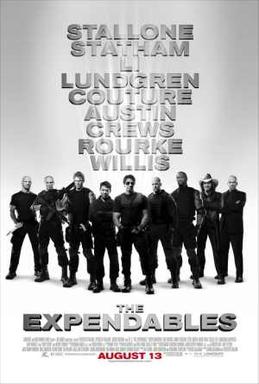
THE EXPENDABLES

The Old Boys Club...

As I look at all those who are in The Expendables, I keep coming back to one major point: They Are Old. The combined age for all the members of The Expendables is 346, with the median age being 49. Jason Statham is the youngest of the crew at 43, while Stallone is one year from qualifying for Social Security at 64. My Mexican mother has an expression that translated goes, "They're too old for those dances". A looser translation would be, "They should act their age".

The Expendables doesn't go for that. Instead, it's going for that "one last hurrah" deal. Few films revel in their own trashiness, their own pointlessness, their own clichés, their own total lack of intelligence or coherence. I don't know if it's a throwback to those 80s films that Stallone and Company made, but conversely, the idiocy of The Expendables is its saving grace. Otherwise it would be thoroughly unbearable.

We begin with an intro as this group (called, what else, The Expendables) launch a rescue operation against a group of pirates. We have the leader, Barney Ross (Stallone), and his right-hand man cum best friend Lee Christmas (Statham). Also in the group is Ying Yang (seriously, that is his name) (Jet Li, 47), Gunner Jensen (Dolph Lundgren, 52), Toll Road (I heard Toad) (former Ultimate Fighting Champion Randy Couture, 47), and Hale Caesar (no, by this time we should get that these are either code names or really bad puns) (former NFL player Terry Crews, 42). Jensen is beginning to crack under the pressure, and Ross is forced to let him go.


After their successful rescue, Ross is approached by a mysterious agent who calls himself "Church" because they meet in a church (Bruce Willis in a cameo role). He hires the Expendables to go to Vilena to overthrow General Garza (David Zayas). However, things get complicated when Ross & Christmas discover that Sandra (Giselle Itié), the beautiful contact on Vilena, is El General's daughter.

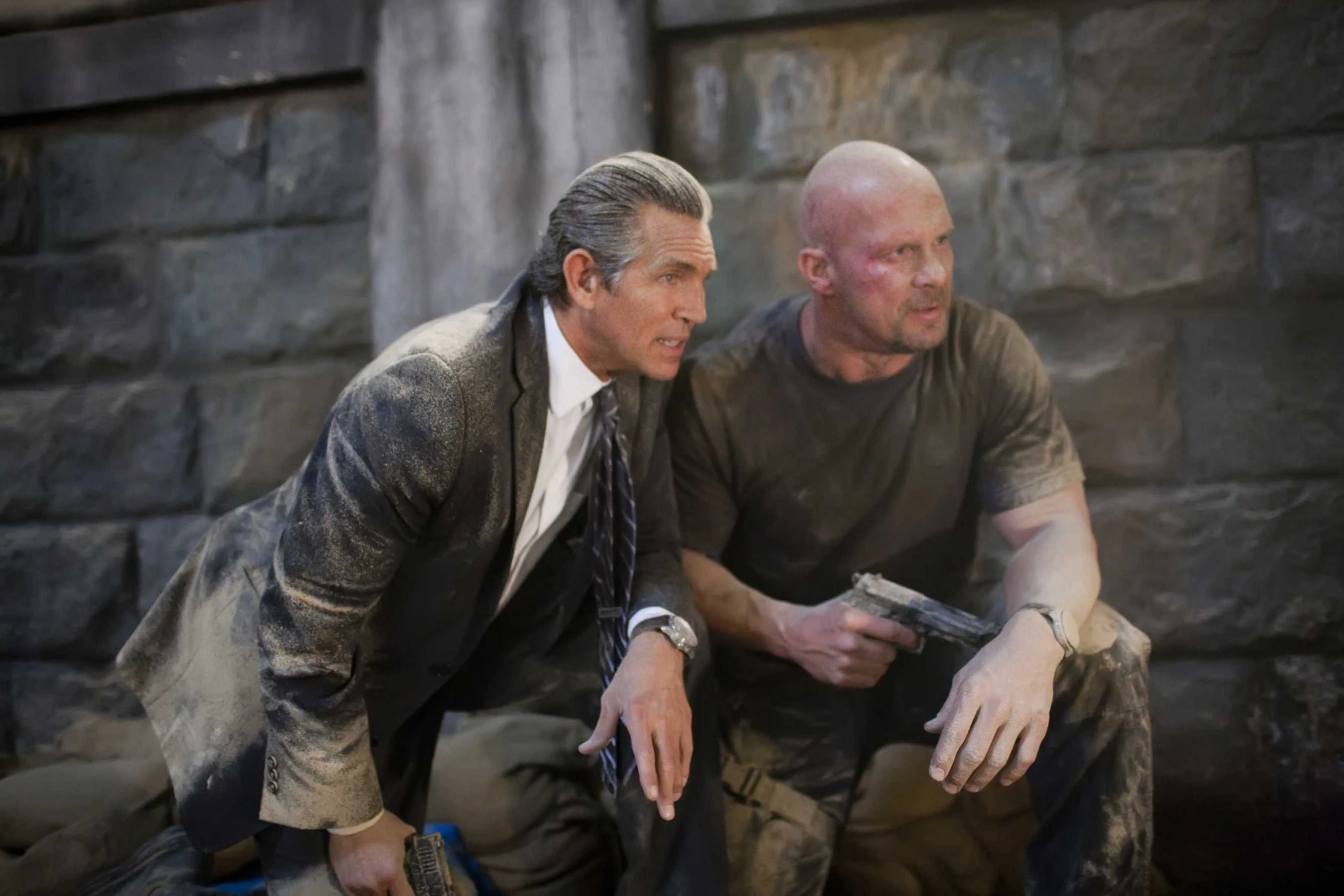
The real power behind Garza is James Munroe (wonder why he wasn't called something like Chester A. Arthur) (Eric Roberts), a renegade CIA officer who has turned Vilena into a narco-state, aided by his henchmen Paine (dear God why can't I stop laughing at all these names) (ex-WWE or WWF or whatever it's called now superstar "Stone Cold" Steve Austin, 45) and one simply known as The Brit (Gary Daniels, 47). At first, Ross is going to decline Church's offer, but when his other friend (and I suspect honorary/ex-Expendable member) Tool (Mickey Rourke, 57) recalls his regrets about an earlier mission, Ross feels compelled to go (otherwise, we'd have no movie). His crew joins him, although one of them has set Ross up (one guess as to who you think "must break him"). Eventually, they go to Vilena and have an intense battle royale to see who will win out in this war.

Let's put our cards on the table: The Expendables is not smart, clever, intelligent, original, and has no real acting or story altogether. It has loads of violence (how should one react when they see an upper body literally blown away, let alone several heads blown up and having someone's neck snapped back), big explosions, big dramatic entrances, and loads of rather unbelievable action. The only thing that was missing to complete its cliché checklist was a love scene, and while you'd think Sandra would be game for it (as all Latinas would be in Fantasyland), there was none.

Having said all that, The Expendables at least for the most part knows what it is: a dumb, stupid action flick that serves no purpose other than to wallow in death, destruction, and absolute idiocy.

Stallone's script (co-written with David Callaham) goes astray often. We get only one actual attempt at a character with Statham's Christmas (though I digress to say there's nothing merry about him--why should Stallone, who also directed, be the only one with bad puns). This comes in the form of Christmas' romantic relationship with Lacy (Charisma Carpenter, which I trust is her real name), whom he loves but who finds herself involved with another man...one who, shall we say, gives her the Chris Brown treatment. Yang mentions he has a family, but we never actually see any family, while Caesar and Road appear to have no existence outside the group. It's a strange thing that in The Expendables it's Garza who seems to be the most real person since he has an actual hobby: he paints, and we see him paint. Everyone else except for Tool just lives to fight.

Perhaps it isn't a surprise that a lot of the focus of The Expendables is on Jason Statham. Like Stallone, he is building his career on action films. Unlike Stallone, I would argue that Statham is not an actor but rather an action star. Don't get me wrong: there is nothing wrong with being an action star, but Statham hasn't been called upon to take roles offered to someone like Jude Law or Paul Bettany. While Law and Bettany have tried their hands at action (Repo Men, Legion), Statham has yet to appear in a costume drama.

It would be interesting to see Jason Statham as Fagin in Oliver!  Maybe in Oliver! II: Fagin's Revenge...

Here is where we go into a discussion of acting: there wasn't any. "Stone Cold" Steve Austin (in fairness, he doesn't use the "Stone Cold" moniker in The Expendables, but I just love saying it and that is how I know him) has about twenty lines, the first which he says about halfway into the movie.  People didn't actually act as say silly lines of dialogue without breaking up laughing if they stopped to think about what they were actually saying. Roberts has this doozy after killing someone in the back,
Now we can see inside of him, and I see lies.
How can you not laugh at that, especially at Roberts' so wildly over-the-top reading, or when Statham (after having walked to Lacy's boyfriend John Wayne-style and punctured his basketball) tells the guy,
Next time I'll deflate ALL your balls.
Those lines are either consciously or unconsciously cheesy, which would make Stallone either brilliant at how he reads his target audience or amazingly inept at writing things that sound real. Given he wrote Rocky, I want to say the former, but given he hasn't written anything that comes up to Rocky, it might be the latter.

Let's be frank: there was no acting in The Expendables because that isn't what is required. This film isn't about ACTING; it's about ACTION. There is one exception to this: the scene where Rourke as Tool recalls his mission in Serbia (or Bosnia, I can't recall). It was a deft and surprisingly touching and beautiful piece of acting, but it looked as if we'd wandered into another film altogether.
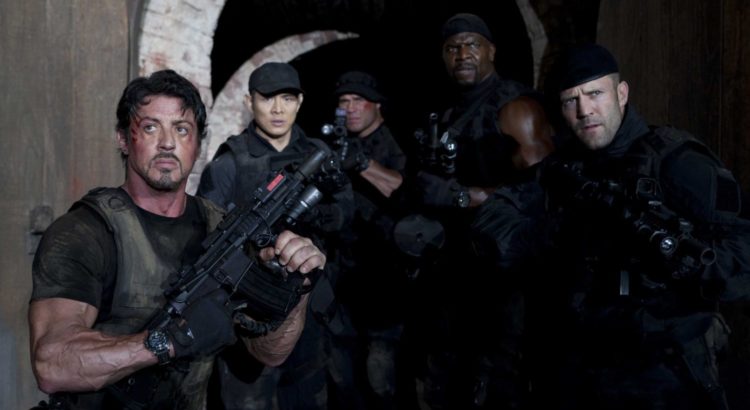


The action scenes were entertaining and massively outrageous to the point where credibility is broken (seeing the Presidential Palace collapse like that you'd think someone would have noticed) but again, with The Expendables, we're not suppose to get a Werner Herzog exploration into the dark recesses of the human heart; we're suppose to get big blasts with as little thought as possible.

All that could be enjoyed, but at times The Expendables fails at being this homage/throwback to big action films the co-owners of Planet Hollywood made their reputations on. The long-awaited teaming of Stallone, Willis, and current California bankrupter...I mean, Governor Arnold Schwarzenegger (63) was beyond pointless. It didn't add anything to the plot, was totally gratuitous , and what's worse, they shared virtually no screen time whatsoever.

If Stallone had more imagination or thought things out better, he might have had Schwarzenegger and Willis appear either as different characters or in a different setting (perhaps Arnie could have been on Vilena setting the ground work for The Expendables, for example). The only good thing that came out of it was when Arnold is leaving. Church asks what his problem was. Ross replies, "He wants to be President", which made the audience laugh. Yeah, we get it (thank you, Constitutional requirements for President).

In spite of all its flaws (and boy, does it have them) The Expendables can be a pretty good time. I know the audience I saw it with thought so: when Ross is going to tell Church he won't take the job, someone from the audience said loudly, "You can't tell Bruce Willis no". When people get that into the film, you can say that they are having a good time...and that you might too.

It could also say that we truly are coming to The End of Western Civilization, but I digress. Here's my advice and conclusion: You'll have a good time at The Expendables. All that is required is for you turn off your brain.

Wednesday, September 8, 2010

2010 Kennedy Center Honors: Some Thoughts


Alas, Betty White did not get recognized this year. Could it be she's too popular, too "White Hot" so to speak? It isn't as if they could use the ratings.

I also confess that I'm disappointed that none of my suggestions were used, although one person that I had on my shortlist has been selected for this year's honors: Broadway composer Jerry Herman.

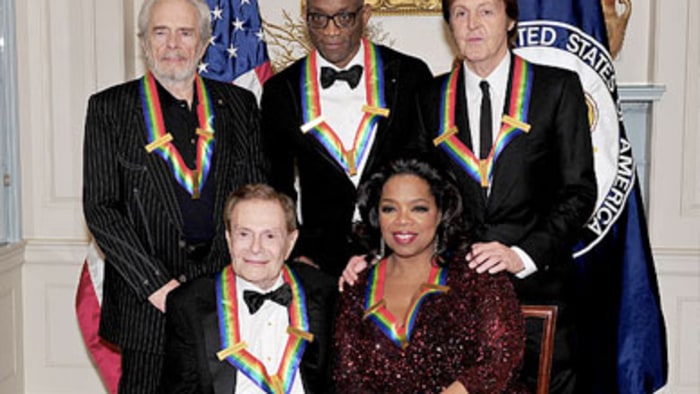
Now, this is the list of this year's honorees:
  • the aforementioned Herman

  • Country Music legend Merle Haggard

  • Choreographer Bill T. Jones

  • former Beatle Sir Paul McCartney

  • talk show hostess Oprah Winfrey
I will start out by saying I have absolutely no idea who Bill T. Jones is. I figure he's from the world of ballet, and minus former Honorees Maria Tallchief and Mikhail Baryshnikov I don't know any ballet stars. Haggard's recognition is well-deserved: his career has been going strong for more than 30 years. Herman? Of course--who hasn't sung a bit of Hello, Dolly! in his/her lifetime, let alone something from Mame or La Cage Aux Folles.

Now, I find it very interesting that Sir Paul is being re-honored. Let's remember that in 2002 he had been selected as an Honoree but asked that it be postponed for a year due to "an inescapable personal obligation". They did, but then reversed their decision and opted not to present a Kennedy Center Honor in 2003. Come a few years later, and he's back. It goes without saying he is deserving of the honor: as a songwriter, he has few peers (no pun intended). However, I do wonder why they opted to re-reverse their decision.

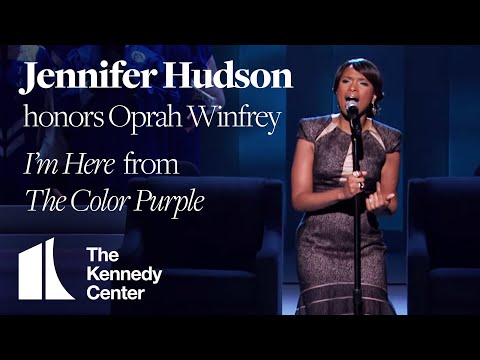
Finally, we come to Winfrey, who strikes me as the odd member of the bunch. Minus getting Barack Obama elected President, what exactly has she done for the arts? What has she done artistically that puts her in the same league as Joan Sutherland, or Fred Astaire?

She doesn't sing, she doesn't dance--acts a little. Let's see: present/produce television movies that weren't major television events (such as Their Eyes Were Watching God or A Raisin in the Sun)? Producing the stage version of The Color Purple? Yes, she gave a wonderful performance in the film version of The Color Purple, but I am hard-pressed to think of what else she's done artistically. You have The Women of Brewster Place and the bomb Beloved, but other than that?


WHAT HAS SHE DONE ARTISTICALLY? Will they show clips of her wheeling out pounds of fat on her talk show? Will we have a musical salute to Eckhart Tolle, Deepak Chopra, and Dr. Phil? Maybe we'll be treated to a long montage of how The Secret will save America. Perhaps a herd of dancing cows to celebrate her victory against the cattle industry when they sued her over comments on her chat-show?

I suppose it comes from my world view: I'm not fond of confessing all to all the world. My father had a saying, "Confession is good for the soul but best saved for your priest". By that he meant one should be able to talk about their deepest issues and problems, but it should be limited to either your spiritual advisor or your closest family/friends. In short, I am opposed by the "Oprahfication" of our country. That type of situation, where people go on television, tell everyone their biggest issues/sins/crimes, and asking 'to be loved' is anathema to my sense of being. I just feel this age of confession is wrong, and it shouldn't be celebrated, but then again, I'm not the billionaire.

Well, there it is: this year's Kennedy Center Honorees. I'll still watch, and I'll still suggest names. There are a lot of artists who should get recognized for their accomplishments. I think Miss Winfrey is an erroneous choice while all the others are right decisions, but, there you go.

Congratulations to all of this year's recipients.

Tuesday, September 7, 2010

Star Trek Film Retrospective: A Preview


STAR TREK FILMS: A PREVIEW

Perhaps people are right: maybe I am proud that I am not a Trekkie/Trekker (I'm told that Trekker is a respectable fan, while Trekkie is just a nerd who thinks Klingon is a legitimate language). As of today, I have only seen two episodes of Star Trek: The Original Series (and those under intense pressure)--Spock's Brain and City on the Edge of Forever. I have, however, seen a few of the films.

As of this writing, I have not seen all Star Trek films, and I know there will be more after.  However, I decided to start this Star Trek film retrospective to see how the franchise has evolved over the decades.

I start with the original Captain of the Starship Enterprise: William Shatner as Captain James T. Kirk. He stars in the first six films of the franchise: The Motion Picture, The Wrath of Khan, The Search for Spock, The Voyage Home, The Final Frontier, and The Undiscovered Country. It can be argued that he was the star of the seventh Star Trek film (Star Trek: Generations) but he wasn't suppose to be the focus.

That honor goes to Sir Patrick Stewart as Captain Jean-Luc Picard. The seventh through tenth films: Generations, First Contact, Insurrection, and Nemesis, all were the adventures of the crew of the Enterprise from the Star Trek: The Next Generations series.

Curiously, we've yet to have a film version that stars anyone from Star Trek: Voyager, Star Trek: Deep Space Nine, or Star Trek: Enterprise. Curious that.

Starting in 2009, we had a new Captain Kirk in Chris Pine. So far, he's been at the helm in one film (Star Trek), but we can be assured that he will be in at least two more Star Trek films.  He has the added bonus of being in the only Star Trek film to have won an Academy Award (a well-deserved Best Make-Up Oscar).

Now, I've embarked on a new mission: watch every Star Trek film made between 1979 and 2009. That's thirty years of film adaptations of a failed television series. Some are good, some are bad, but now it's time to have a retrospective of all of them. I've already written reviews for Star Trek: The Motion Picture (1979) as well as Star Trek (2009), and I am looking forward to tackling all the rest. I now look to the stars to guide me...and by stars, I don't mean Shatner, Stewart, or Pine, just for the record.

To watch all eleven Star Trek films (so far) while not being a fan of any of the series versions. I have only one thing to say about that:

MAKE IT SO!

Saturday, September 4, 2010

Takers: A Review

TAKERS

Heist & Lows...

There are times during Takers when the movie almost appears to be a parody of the various heist films it wants to emulate/rip-off. The first is when our group of master criminals walks away as an explosion goes off behind them. As if we haven't seen that before. We also get treated to other things that are innovative: the relentless cop who doesn't go by the rules, the group of master thieves going for a big score, the rogue cop's financially-strapped partner who falls to temptation, a climatic robbery where (wouldn't you know it) something actually goes wrong, and a Mexican stand-off.

The thing is, Takers isn't suppose to be a parody, or at least I think their intent isn't to make fun of these type of films. They are suppose to equal or even out-do them. Pity no one told director John Luessenhop or the three people that worked with him on the screenplay (Peter Allen, Gabriel Casseus, and Avery Duff).  As a comedy, Takers might have been good.  As drama, well, let's see.

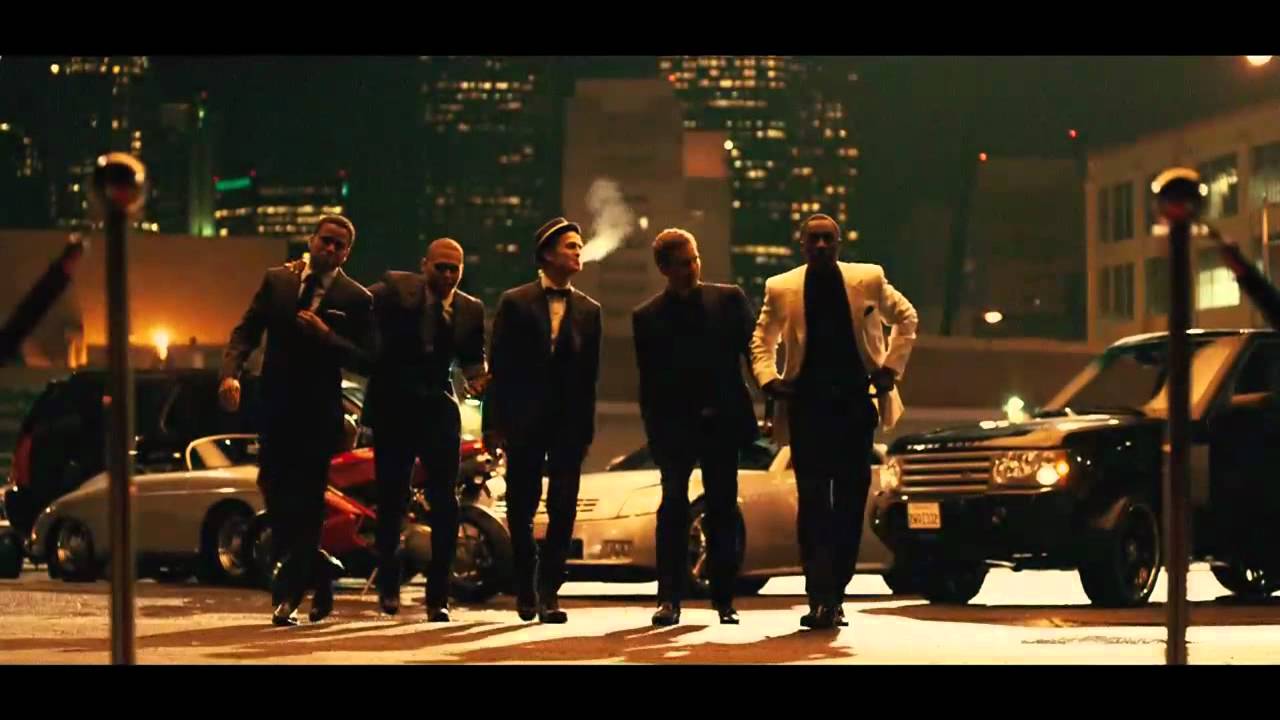
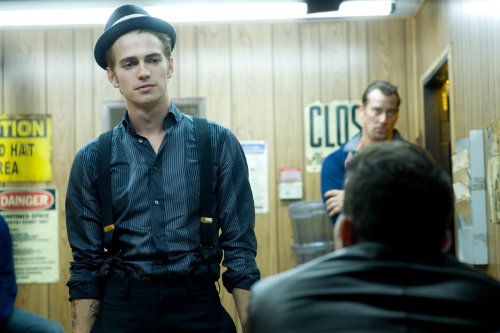
This group is a collection of master bank thieves. We have co-leaders Gordon Cozier (Idris Elba) and John Rahway (Paul Walker), and their crew: A.J. (Hayden Christensen), and brothers Jake and Jesse Attica (Michael Ealy and Chris Brown). They've just executed a major heist and are enjoying the fruits of their labor, when one of their old members, Ghost (Clifford Harris, Jr., known by his nom de guerre T.I. but billed at Tip 'T.I.' Harris) has been released from prison and invites them to take on another job: stealing $30 million from an armored truck.

Of course, this goes against the crew's modus operandi, which usually involves laying low after a robbery and taking a long time to plan it, but (of course) they do it. Meanwhile, Detectives Jack Wells (Matt Dillon) and Eddie Hatcher (Jay Hernandez) are investigating their most recent heist. They come across evidence linking Ghost with a group of Russians, and the clues there lead the cops to suspect our group of master criminals.

The relationship between Ghost and the rest is strained, especially given that Jake now is in a romantic relationship with Rachel (Zoe Saldana) Ghost's ex (I digress to say Rachel probably didn't hook up with Jesse because she was concerned Chris Brown might physically assault her the way he did Rihanna). As Wells and Hatcher close in, the crew goes through with the plan, but...wouldn't you know it...one of them is planning to double-cross the team and take all the money for himself (one guess as to who the villain is).


One shouldn't be harsh on Takers. In many respects, it really is useless: as entertainment, as a movie, as a vehicle for real criminals. However, the fact that it can take talented actors (Matt Dillon, Marianne Jean-Baptiste as Gordon's drug-addicted sister), those whose acting ability is secondary to their physical beauty (Paul Walker, Hayden Christensen), and those who shouldn't have a career of any kind but should be in prison (T.I., Chris Brown), throw them all together, and still expect us to be either excited or cheer them on pushes Takers even lower in the quality aspect.

Few films start off so badly. From the get-go the dialogue feels forced and fake. One especially feels for Oscar-nominee Dillon, who looks and acts as if he is waiting for the check to clear. He is responsible for a second moment which plays almost as parody: when his partner is facing death at the end of a shoot-out. The scene between him and Hernandez was missing only the requisite coughs of a dying man and him saying, "It's getting dark" to play as a joke.

I give Hernandez credit for trying to act (and applaud the fact that a Hispanic is playing a part which I figure was written for a non-Hispanic), but it wasn't a good performance. Oscar-nominee Jean-Baptiste did as much as she could with a somewhat stereotypical role, but it also wasn't enough.

Curiously, all these detours into the private lives of the characters (Cozier's drug-addicted sister, Wells' problems with being a good father, Hatcher's ill son) seem so strange when you consider that other characters (John, A.J., Jesse) have apparently no outside life. This suggests a lack of focus: trying to give us ideas as to only certain characters are but not others may tempt one to wonder as to what the rest of them are like in their off-hours. Does John like to paint? Will A.J. play more piano? How many women has Jesse assaulted?


Let me digress to point out the "Creepiness" Factor in Takers. You have a kid who brutally beat a woman and a man who has already served time for weapons charges and is at the time of this writing facing drug charges. There is something disconcerting, even infuriating, in the smiling face of Brown, knowing that this guy thought he was so good that he could (perhaps in his mind should) beat on someone physically smaller who wasn't in a position to defend herself. Seeing him on screen, taking in all the glory of having basically 'gotten away with it' and still being celebrated as a star, especially by those who still listen to his music, is grotesque to me.

The same goes for Tippy. Both of these people are pretty reprehensible and apparently incapable of running their lives with any sense, yet here they are, attempting to be movie stars and living out their fantasy lives. As an actor, T.I. has nothing but his swagger and unjustified self-confidence. I can't speak for the audience, but I felt uncomfortable watching these two, knowing that in the real world, they would not have life as easy as they do now.

Now, let me move on to the other actors. Walker, at age 36, still has an amazing body which he shows off briefly. However, he is basically expressionless throughout Takers. Christensen lets his Canadian accent slip out when saying 'about', but the most irritating thing about his performance wasn't the fact that he hasn't progresses from the whiny Anakin Skywalker, but it was that damn hat.

My pet theory as to why he insisted in wearing that hat was so that we could distinguish him from Walker: it might be difficult to tell the difference between two blonde, blue-eyed wooden actors so you needed a visual aid to tell them apart.

Luessenhop is not imaginative in his filmmaking either. What is suppose to be this climatic chase scene between Brown and Dillon/Hernandez was made in the ubiquitous shaky-camera style that makes things hard to follow. I'm of the mind that chase/action scenes should be as clear as possible, not as chaotic as possible. It might have worked in The Bourne Supremacy, but then Paul Greengrass is simply put, a better director.

There were also some flat-out strange moments in Takers that made you wonder if those behind the camera had any sense. We're suppose to believe Wells loves his daughter, but he loves her so much that he's willing to put her in danger by pursuing them (albeit slowly). I kept wondering, 'if he's going to tail highly dangerous criminals, why doesn't he just tell his daughter to write down the license plate number as he dictates it to her instead of taking her crayons to try and write them himself?' That just made me wonder what was going through their minds.

Takers is aptly named if by that they mean they take the audience for fools or idiots. What is there to recommend Takers? The acting? There wasn't much if any. The story? Not original. The characters? We don't end up caring about any of them (with the possible exception of Jean-Baptiste's Naomi). The fact that it suggests there might be a sequel (violating one of my Golden Rules of Filmmaking)? Not interested. The best suggestion I can make is, Take Your Money and Run Away.

Friday, September 3, 2010

Countdown to Zero: A Review (Review #113)

COUNTDOWN TO ZERO

Countdown to Zero gave me much to think on, but oddly, most of my thinking did not involve the subject at hand: nuclear proliferation. Rather, my mind floated between my childhood and my thinking of current cinema viewers.

I am a product of the 1980s, and as such remember the fear & paranoia nuclear weapons unleashed from Hollywood. I'm not old enough to remember The Day After, but I do recall the earnestness of Superman IV: The Quest for Peace, even a thinly-disguised "very special episode" of The Golden Girls. When you have Rose Nylund on a peace mission to Moscow, you know the issue is serious.

The curious thing is that, in spite of all the protests calling for a nuclear freeze or nuclear disarmament going on in the Age of Reagan, I was never terrified about "the bomb" going off. Perhaps it had to do with childhood obliviousness, but having the Russians blow us up (or conquer us, like they did in a miniseries called Amerika--does anyone remember that one?) was just never on my lists of worries. Therefore, whatever fear there was about "the bomb" escaped me.

The second thoughts Countdown to Zero unleashed involved something that in my entire life has never happened: in all the years of going to the movies, Countdown to Zero is the first film of any kind (animated, documentary, even silent) where I was the only person there. Just me. I had the whole theater to myself. On a Friday evening of all things.

I've come close: Joan Rivers: A Piece of Work was almost empty, but three other people showed up as the movie began. What made that remarkable was that her documentary was showing on a Wednesday night (we're talking around 9-9.30). Same thing almost happened at An Education: I almost had the whole theater to myself, but a few came in also at the last minute. Even really lousy documentaries like Celsius 41.11 or films like An American Carol or The Second Chance had at least one other person show up.

Countdown to Zero however is the first time I've ever been completely alone in a theater. Talk about The Final Countdown.

In any case, I digress.


Director Lucy Walker gathers a who's who of experts and leaders (Tony Blair, Mikhail Gorbachev, Jimmy Carter) to tell us how close we all are to nuclear annihilation. We begin with just how the first nuclear bomb came to be, then followed by various terrorist attacks ranging from Madrid and Bali down to Oklahoma City and New York on September 11th, 2001. We're told on how easy it is to acquire highly enriched uranium (H.E.U.) from the remnants of the Soviet Union, and how we can all be exterminated due to, in the words of President Kennedy, "accident, miscalculation, or madness".

We get a run-down as to who has the bomb, from the U.S. and U.K. to Israel (which has never confirmed it) and the bitter enemies India and Pakistan, right down to North Korea. It discusses the role of Dr. A.Q. Khan, the 'father of the Islamic bomb', especially how he had no qualms about dealing with both the Chinese and the North Koreans to get his hands on the bomb. We learn of Iran's determination to get their hands on the bomb, and how the Iranians and the North Koreans were hand in glove to help each other get what they wanted in terms of nuclear weapons (and oddly enough, justifying former President George W. Bush's view about the Axis of Evil), and ends with a call to do what we can to stop the insanity (such as banning production of nuclear weapons, destroying the stockpiles we have, and a virtual nuclear freeze).

Countdown to Zero has as its center J. Robert Oppenheimer, the creator of the bomb who forever regretted the fact. We begin and end with him, first working to create this weapon and ending with his famous quote when he saw it tested for the first time, quoting Hindu scripture, "Now I am become Death, The Destroyer of Worlds", and the man on the verge of tears.

Countdown to Zero strikes me as something created by an overly enthusiastic and energetic graduate student filled with liberal euphoria about the rightness of his/her cause. I don't blame her for trying, and this is an important subject. The biggest problem is that is is couched within so many points that one starts to wonder exactly what she is trying to say.

As I left the theater, I kept wondering if Walker shouldn't have put a focus on one of the various topics she hit on. She could have focused on the dangerous world of Dr. Khan, a man who was not above dealing in deception in order to get Pakistan the bomb. She could have focused on the sheer lunacy of governments working feverishly to get their hands on the bomb (for my money, the most chilling moment in Countdown to Zero comes when we see the montage of countries celebrating the successful testing of bombs, down to hearing the Pakistanis say they will get the bomb 'even if we have to eat grass').

We can extend that last one to a focus on how governments ignore truly pressing needs of their people just so they can find a way to destroy humanity...as well as how the population celebrates the fact they have nothing to eat or homes to sleep under so long as they can disintegrate the planet as a whole. Walker could have also focused on the ease of acquiring nuclear material, or on how South Africa decided to abandon its nuclear program, or on how Iran and North Korea are great threats.

No, instead we have a wide smorgasbord of information, told with a dull but sincere urgency. Although the film is 90 minutes, it feels far far longer.

Countdown to Zero also suffers from what can only be described as naivete. We can place our hopes that President Obama will work to eliminate nuclear weapons, but can we take Russian President Dmitri Medvedev or his puppet-master, I mean, his Prime Minister Vladimir Putin, to do the same? Ronald Reagan said it best when he said, "Trust but verify". How could we possibly do that with Mahmoud Ahmadinejad or Kim Jong-Il?

Countdown to Zero seems to think they are pretty much like us and not tyrannies that cannot be trusted. There was an interesting point raised in Countdown to Zero, that North Korea believes Saddam Hussein was ousted because he had no nuclear bombs (though it wasn't for lack of trying), therefore they rushed to get their hands on it. In a case of unintended consequences, Countdown to Zero almost give Bush cover for his invasion of Iraq or his ideas that Iran/Iraq/North Korea are dangers to the U.S.

Nuclear proliferation, especially if it were to fall in the hands of groups like Al-Qaeda, the Taliban, or a group like the Japanese cult Aum Shimrikyo (which was responsible for the sarin gas attack on the Tokyo subway system and which also attempted to acquire nuclear material), is a serious issue that should be discussed. Countdown to Zero took up that challenge, and while its goals were noble, its methods were heavy-handed to the point of boredom.

It would have served its goals better by trying for one subject than trying to hit so many targets at once. It might be respect for what it talked about, but cinematically, you could say it will give audiences Mutually Assured Boredom.

DECISION: C-

Thursday, September 2, 2010

Star Trek: The Motion Picture. A Review


STAR TREK: THE MOTION PICTURE (1979)

In Space, No One Can Hear You Snore...

I figure Trekkies were jumping for joy in the basement of their parent's home when they heard that at long last, Star Trek, their all-time favorite television series, was finally getting the big-screen treatment.

All the original cast was coming back!
Two-time Oscar-winning director Robert Wise as director!

It would have all the advantages of film: a vast canvas, big-budget effects, a grand plot. What could possibly go wrong?

Judging from Star Trek: The Motion Picture, the question should have been, 'What could possibly go right?' The Motion Picture had everything a Star Trek film debut could have asked for...except story, pacing, and human interest, and that's just for starters.

There is a mysterious force that is headed for Earth. This menace (which looks like a large blue cloud in space) has already destroyed a fleet of another species, and there is fear that it is coming to destroy our planet. There is only one ship within travelling distance to intercept and perhaps destroy this threat: the U.S.S. Enterprise.

Into this menace comes Captain James Kirk (William Shatner). He retakes command of the Enterprise, much to the anger of its current captain, William Decker (Stephen Collins). Kirk uses his influence to get Dr. Leonard "Bones" McCoy (DeForrest Kelley) aboard, although the surly doctor is extremely upset about being dragged up there. It's even more irritating considering there already is a ship doctor, one Dr. Christine Chappel (Majel Barrett).

We see the engineer (James Doohan), Scotty (right down to his Scottish accent). The crew includes Uhura (Nichole Nichols), Chekov (Walter Koenig), Sulu (George Takei), and a new member, Commander Ilia (Persis Khambatta--perhaps the most remarkable name in Star Trek or really all film history). Also coming aboard, after completing an extra-terrestrial version of a vision quest, is Mr. Spock (Leonard Nimoy), whom I understand is a half-human, half-Vulcan (beings who purge all emotion from within them and rely purely on logic) and who is, or was, the science expert on the Enterprise.

The Enterprise finds this menace, but not before this force abducted Commander Ilia (who was once a love of Decker's). Her physical form is returned on board, and tells the crew that an entity named V'Ger is approaching Earth in search of The Creator.


There are certain words that best describe The Motion Picture: glacial, reverent, ponderous, but they might be the wrong words. For example, calling its pacing "glacial" might imply that it actually moves. These are the problems with The Motion Picture, problems that for a newbie, one who has little or no knowledge of Star Trek mythology, will drive him/her insane:

  1. We are not introduced to the characters.

  2. There is an excessive stillness, slowness, and reverance for what is going on in the film.

  3. Conversely, there is no real sense of danger or menace in the challenge the crew faces.

  4. A proliferation of bad acting and underused actors.

All these brought together make The Motion Picture a slow, dull, lifeless exercise in nostalgia for die-hard Trekkies but will make the rest of the population wonder what all the fuss was about.

Let's start with Problem One. If you have never seen a single Star Trek episode (or in fact have never heard of Star Trek, and it is possible to have done so), you will have at best only the vaguest idea as to who anyone is. For example, a non-Trekkie/Trekker will not know that Dr. Chapell started out as Nurse Chapell in the original series. It's nice she got to play the part she was intended to play by her husband/Star Trek creator Gene Roddenberry, but how are we non-Trek fans suppose to know that?

How are we to know what the relationship between Spock and Kirk are? We don't know anything about Chekov, Uhura, Sulu: the dynamics between them, what they've been doing all this time, so the non-Trek viewer will have no vested interest in whatever happens to them. For example, how are we to know Scotty has that nickname because his last name is Scott and not because of Doohan's always broad, broad, BROAD Scottish accent?


Take this as the prime example of how Problem One causes difficulty. I wrote earlier that this force, V'Ger, has already destroyed a fleet of another species. How will someone who hasn't spent hours, days, weeks, months, years, pouring over all things Star Trek possibly know that these are the Klingon?

We don't have a clear idea of who/what they are, and that's because The Motion Picture isn't made for a general audience. It's made for fans, and if there is one thing I hate when one adapts a book/television series to the screen is when it's made strictly for fans. I have long argued that an adaptation should invite all those not in the know to enjoy what those on the inside already love. I could hear in my mind all the Trekkies whispering in hushed tones when they see the Enterprise for the first time on a massive screen. Those of us not into the mythology won't be as overwhelmed with it as they will be.

This, curiously, leads us to Problem Two. Throughout The Motion Picture there is this stillness, this hushed reverence for what is going on in the film. There is this quiet tone that dominates The Motion Picture, as if we are all supposed to be awed by whatever is said, seen, or done, as if everything is historic rather than entertaining. When Kirk goes back to the Enterprise, there is this quiet as he sees the ship he commanded for the first time in I believe five years. He doesn't look excited. He doesn't look happy. He doesn't look like someone who's been given a new lease on life or another glorious adventure. He looks like someone who's been granted an audience with the Pope before being publicly declared a heretic.

There really is no action throughout the film. The crew sees the destruction of the Klingon fleet and there is really no reaction from them, just awe at the fact they were in The Motion Picture. This stillness, this reverence for what is basically a sci-fi movie kills whatever sense of excitement and adventure there should be.

The best example of this is when Mr. Spock finally arrives on board. Wise and screenwriter Harold Livingston (from a story by Alan Dean Foster) could have built up what would be a great, climatic moment. This is the arrival of Mr. Spock, one of the most iconic characters in television. Instead, he just appears, and in the stilted acting of the entire cast, his arrival is no more exciting than if someone had just delivered the pizza. A great opportunity lost because we were suppose to be so thankful that Star Trek finally has a film version that an actual story was lost in the process.

With Problem Three, it comes from the fact that we are told constantly just how close this cloud is from the Earth (three days, two days, and so on) but oddly, no one seems even the slightest bit concerned, worried, excited; in short, there are no emotions. It's as if everyone got their Vulcan on.

This force, V'Ger, can destroy anything coming at it, but no one acts as if their lives are at risk. There is no sense of urgency, no sense of danger, but a strange detachment from any real emotions.

The issue with Problem Four brings about some moments of unintended laughter. There's a lot of staring about in The Motion Picture, especially when the crew on board the bridge is staring out at the vastness of V'Ger. I counted the number of times McCoy was on the bridge without any dialogue: it was twice where he showed up for no reason, said nothing, then disappeared.

My theory as to why Kelley did this was to remind those in the audience still awake that he was still in the movie, since his presence wasn't needed on the bridge...or in the movie overall to be honest.

When V'Ger attacks the ship, it looks like the crew is doing their version of The Robot. Particularly bad is Collins, who is a good actor but who finds himself giving one of the worst performances in the film. The scene where he learns he's being demoted is a really awful bit of acting, but he's just the tip of the iceberg.

At least once Shatner is up to his old tricks, when he tells Decker, "Stop...competing with me, Decker", giving one of those pauses within a line of dialogue that he was notorious for on the series. Khambatta doesn't do herself any favors. The following line had me howling with laughter, and not just because it was unintentionally funny, but because her delivery made it even more hilarious:
"My oath of celibacy is on record, Captain".
Alas, we lost our chance for a good love scene, but given that no one on board the Enterprise could muster even a hint of emotion, why would we see love when we saw nothing else?

There is a giant build up to what V'Ger could be, but once we discover what V'Ger actually is, one is left with a sense of frustration mixed with laughter. V'Ger's identity has to be one of the silliest and most idiotic reveals in science-fiction history. I rolled my eyes and thought the whole ending is really foolish and dumb. Given how silly, foolish, and dumb The Motion Picture was throughout, it seemed fitting.

This isn't to say that everything about The Motion Picture was awful. The film has some beautiful imagery of space, including the interior of V'Ger, and rightly earned its Best Visual Effects Oscar nomination.

The best thing of The Motion Picture is Jerry Goldsmith's beautiful and brilliant Oscar-nominated score, which includes one of the most sublime musical themes in history. The opening theme is simply remarkable. I won't argue Alien had better Visual Effects (hence its win at that year's Academy Awards) but I do wonder if the music for that year's Best Original Score winner, A Little Romance, could equal the elegance and excitement of The Motion Picture, which was so excellent that it was used as the theme for the Star Trek: The Next Generation television series

Pity the film itself couldn't reach the same level of excellence of the score.

Star Trek: The Motion Picture might be enjoyed by the Trekker/Trekkie, but for those of us who aren't familiar with the franchise, it is a very tedious film. It was too busy being "important" to be "entertaining" or "good". It won't serve to help you understand or introduce this cast of characters, and that's one of its greatest flaws.

The tagline for Star Trek: The Motion Picture should be, "To Boldly Snore Where No Man Has Snored Before".

DECISION: F

Next Star Trek Film: Star Trek II: The Wrath of Khan

Wednesday, September 1, 2010

Harry Potter & The Goblet of Fire: A Review (Review #111)


HARRY POTTER & 
THE GOBLET OF FIRE

Put Some Fire Under the Potter...

This Harry Potter film, the fourth in an epic series of eight (the seventh book being split into two films) finally gets it right, mostly. Of course, I'm not a fan of the books, having read only one and finding that one a bit underwhelming. I figure that they have to be a bit repetitive because each year Harry goes off to Hogwarts, faces great danger, and comes out all right. Have I got the gist of it?

That being the case, Harry Potter & The Goblet of Fire put things in that were needed (a genuine sense of danger/darkness/terror) and took out things that were always needless (no Dursleys!). As a result, what we have is an actual film that shifts the franchise from the cuteness of the Columbus films to the darkness, even evil, within the world of Hogwarts under new director Mike Newell.

Harry Potter (Daniel Ratcliffe) is not with his Muggle relatives for once but with the Weasleys. He joins them to go the the Quidditch World Cup (I figure a bit like the FIFA World Cup, except for Quidditch), and it's the final match between Ireland and Bulgaria. It's here though, that chaos breaks out: Lord Voldermort's murderous henchmen, known as Death Eaters, crash the festivities, killing and destroying and of course threatening Harry's life. Be that as it may, Harry, along with his friends Ron Weasley (Rupert Grint) and Hermione Granger (Emma Watson) still go off to Hogwarts.

There is a special event this year: the Triwizard Tournament. Future wizards/warlocks/witches (whatever they're called) from other schools: The Beauxbatons Academy of Magic of Girls from France and the Durmstrang for Boys from Russia, or at least some Slavic country even if the name sounds vaguely German. They are coming to compete against the British co-ed Hogwarts for the championship.

Professor Dumbledore (Michael Gambon) informs them that the winner will receive great glory, but must survive THREE EXTREMELY DANGEROUS TASKS (begging the question, are there ever any other kind?). Anyone seventeen or over who is willing to face these THREE EXTREMELY DANGEROUS TASKS must submit their name into the Goblet of Fire, which will select one champion from each school. Since Harry & Company are fourteen (although none of them actually look fourteen, so we have to suspend disbelief for a bit) they concentrate on their studies, with yet another Professor of Defense Against the Dark Arts: Alastor "Mad Eye" Moody (Brendan Gleeson).


The Goblet now releases the names of the competitors: from Durmstrang: Viktor Krum (Stanislav Ianevski), from Beauxbatons (which sounds like Beautiful Batons) Fleur Delacour (Clémence Poésy), and from Hogwarts Cedric Diggory (Robert Pattinson pre-Twilight). Then, the Goblet unexpectedly releases a fourth name, an unexpected choice. Any guess as to who was named?

Now, they have these three competitions (all dangerous): getting a golden egg away from a dragon, rescuing someone from the bottom of the Black Lake, and the third, and most dangerous of all, entering a maze that could devour them to reach the Triwizards Cup. Through each danger (with some sequences extremely frightening) Harry is always aided by others, be it his bumbling classmate Neville Longbottom (Matthew Lewis) or even Cedric. However, in the midst of all this Harry has two great issues to deal with: Lord Voldermort is still Out There, plotting to rise again and kill him, and a greater horror...dating!

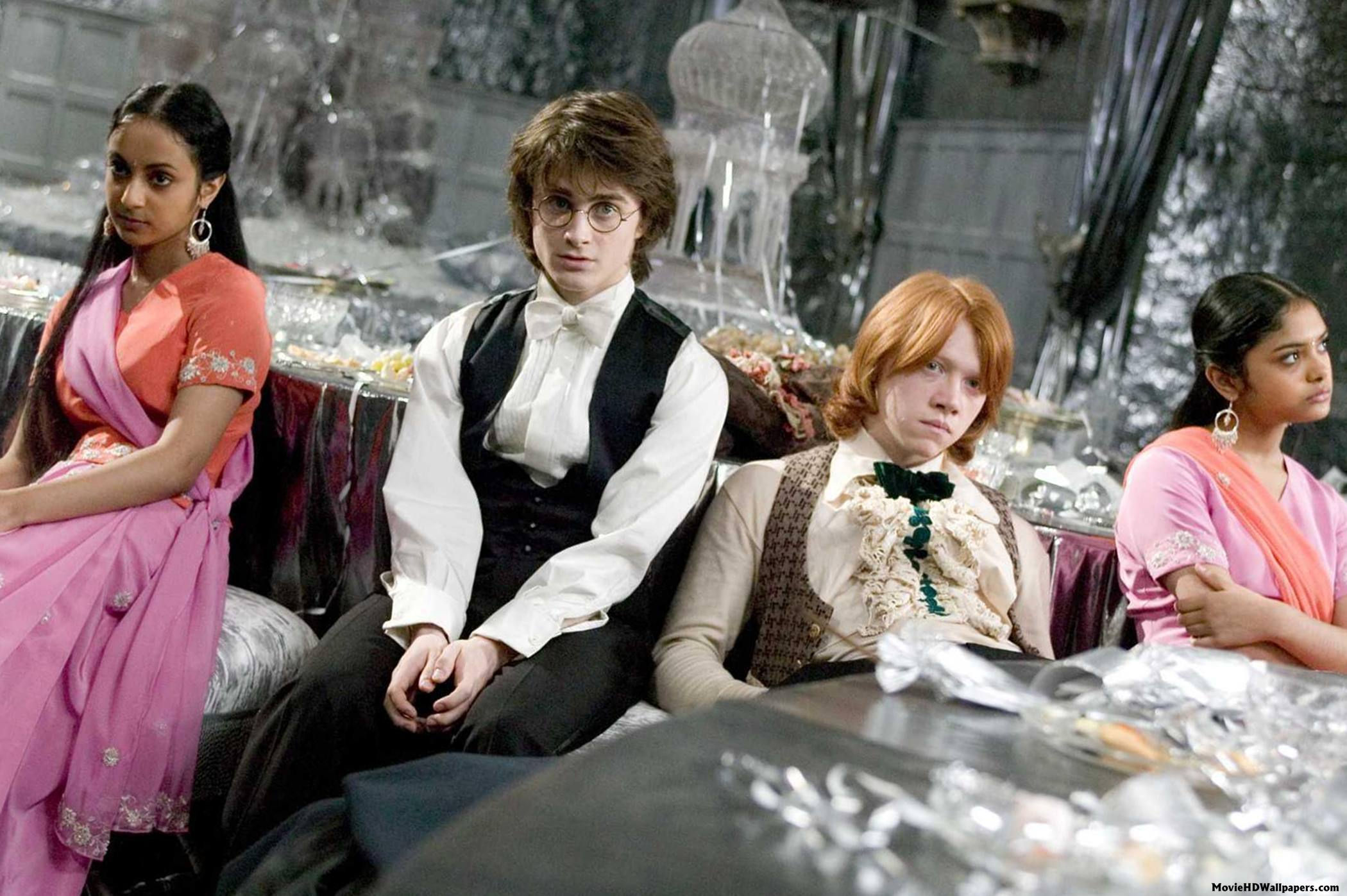
I suppose this is what elevates Goblet of Fire from all the previous films. It has the requisite menace from Lord Voldermort and his Death Eaters, but also has something everyone can relate to: the teenage rites of passage. This is most explicitly shown at the Yule Ball, a Christmas Eve dance where guys have to ask girls out. In the midst of all the danger and evil going on, there are real human emotions being played, among them love, lust, fear, and jealousy.

To my mind, Grint is becoming far more than Ratcliffe's sidekick, but a serious actor who is emerging out of the shadows. Goblet of Fire introduces something into the mix between Ron and Harry: resentment. We all know that Harry couldn't have put his name in the Goblet of Fire, but Ron doesn't believe him, and Grint's face expresses so much: a combination jealousy and anger against Harry that is both brilliant and frightening in its intensity. This is a realistic view because in every friendship at some point there will be conflict, perhaps even jealousy and resentment. When Harry & Ron make up, that also plays realistically, as does when they both realize they have to ask girls out to the Yule Ball. These moments where we see our characters as real people is what elevates Goblet of Fire into a better film in the franchise than we've seen before.

Newell also gives us more visually. Following in Prisoner of Azkaban's footsteps, there is very little lightness in Goblet of Fire, which is again dominated by grays and blacks. Even the moments of visual splendor, as when the students from Beauxbatons and Durmstrang enter the Great Hall of Hogwarts is visually arresting in its pomp and ceremony (although, for my tastes, a bit unrealistic).

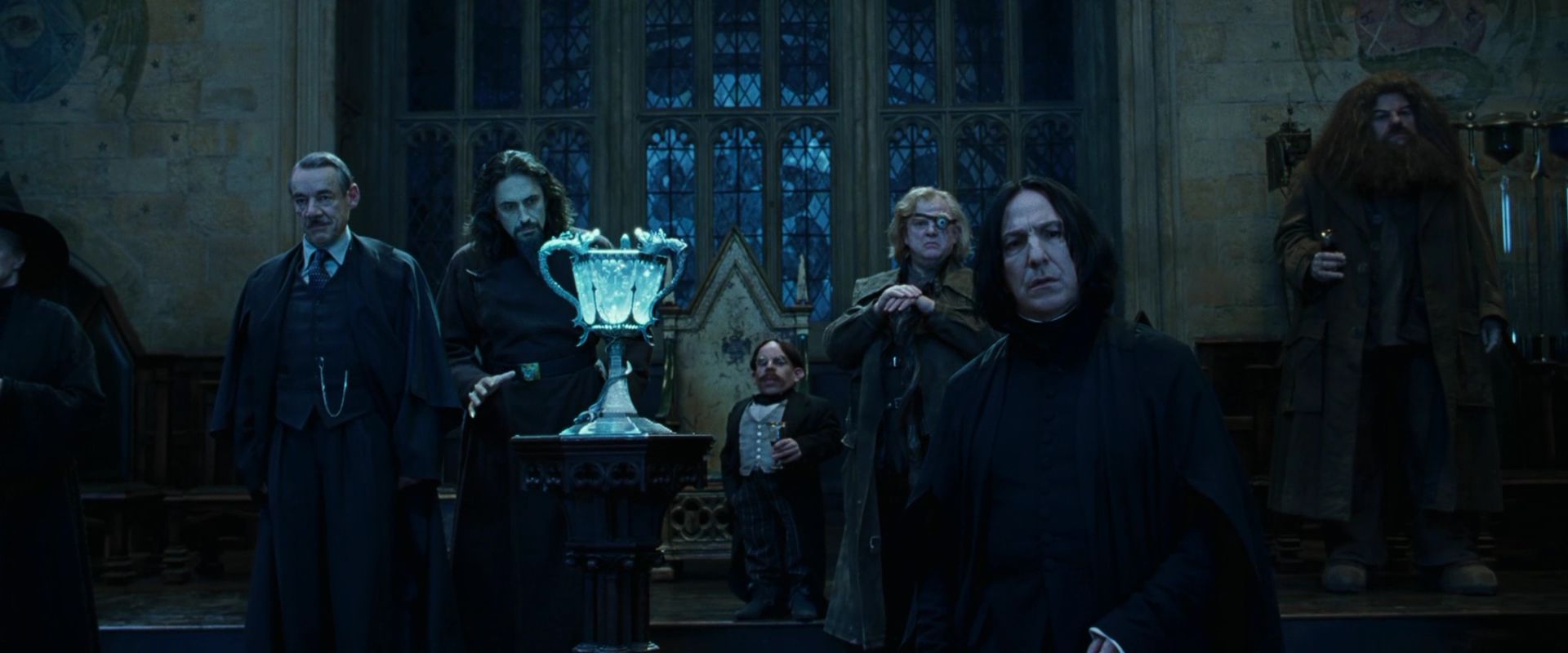
I wonder if J. K. Rowling--whom I understand to now be the Citizen Kane of all British writers--toyed with the idea of sending her Hogwarts students to Beauxbatons or Durmstrang. Now that would have been interesting: to see our heroes in another setting. We might as well, given how little Maggie Smith's Professor McGonagall or Alan Rickman's Professor Snape had to do in the film. Even Tom Felton's Draco Falfoy were almost incident to the overall plot. It's debatable whether this is good or bad: it's good to be able to concentrate the story on our three main leads, but it does sacrifice almost everyone else.


THERE WILL BE A SPOILER HERE. 
READ AT YOUR OWN RISK.

Goblet of Fire has some of the most intense sequences in the franchise so far, so frightening that I wonder if it's a good thing to gear these films toward children. Things as small as Sirius Black (Gary Oldman) emerging from the fire in a fireplace to seeing four people lying at the bottom of the Black Lake to the Maze, where at last Lord Voldermort finally rises, in the form of Ralph  Fiennes (whom I thought was just a touch hammy, but given Lord Voldermort is suppose to be the embodiment of evil, I'll cut him some slack).

This issue with the violence reaches the culmination with the killing of Cedric, which to my memory is the first real death in the entire film (everyone else up to now was merely frozen or somehow able to be revived). Frankly, I wonder why everyone was surprised that we had a character murdered (since we were told it would be EXTREMELY DANGEROUS).

However, why would parents or adults allow children to participate in such gruesome, potentially deadly activities, even if it is in a world of magic?  Is that me being far too logical about fantasy stories?

END OF SPOILER.


If we go over the acting of some of the guest stars, we can't say that Goblet of Fire pushes any great cinematic borders. Pattinson is pretty to look at (given he was a former model, that's not surprising) but he really didn't have much to do with the story. It is nice though, to hear him speak with his native accent. He didn't show any great acting ability here, so whether his awful performances in the Twilight films are a result of the weak material Stephanie Meyer gives or of Pattinson's lack of talent is still up in the air.

There is some comedy thanks to intrepid (and insipid) reporter Rita Skeeter (Miranda Richardson, continuing the trend to behave as if the Harry Potter films were the new Shakespeare where every brilliant actor is fighting to get a role in them, which has me asking where are Sir Derek Jacobi or Sir Christopher Lee, or aren't they good enough for them?).

When I saw that the Weasley's tent at the Quidditch World Cup was larger on the inside than the outside, Harry might have been impressed, but I wasn't. I've seen that before--has Rowling or screenwriter Steve Kloves ever heard of a little art-house miniseries called Doctor Who?  This tent, it wouldn't be called 'a TARDIS' now would it?

The Doctor Who connection continues as we have as Barty Crouch, Jr., none other than The Doctor himself (David Tennant), it's not a surprise we have a TARDIS tent. I like Tennant as an actor (and yes, as the Tenth Doctor as well), but I couldn't help laugh at some of the faces he makes as he's led away. They were almost comic, not frightening.


ANOTHER SPOILER HERE. BE WARNED.

As with any Harry Potter film, we have those lovely Deus Ex Machinas that will always get Harry out of everything. The D.E.M. isn't as atrocious and insulting as the Time-Reversal deal Hermione had in Prisoner of Azkaban, but it still was completely out of the blue: it was the spirits of Mr. & Mrs. Potter as well as Cedric Diggory coming to give Harry more power to fight Voldermort and escape from the maze, leaving a frustrated and furious Voldermort.

I suppose there was no other way a fourth-year wizard student could possibly defeat the greatest force of evil, but it all seemed a bit too convenient. As usual, Harry himself doesn't have to do anything himself to get out of danger; it's done for him.

I think a line the Weasley twins tell Harry at the end of the Black Lake Challenge sums up the entire Harry Potter franchise perfectly: "Even when you go wrong, it turns out all right".


END OF SPOILER.

Goblet of Fire is a frightening film, I'd argue too frightening for anyone under 14. I wouldn't let my preteen children see it or for that matter read this particular book until they get older. Given all the ones that have come before, I'd say that's a good thing in terms of film. This chapter centers the story where it should be: on Harry.

It gives real emotions like love and hate a greater prominence in the story. It still has what all previous Potter films have: a great length (two and a half hours--will they ever be under two hours) which again I think is wrong for films geared toward children. However, the darkness, the danger, the humanity within Goblet of Fire makes it the best Harry Potter film of the franchise so far.

After a few stumbles, Harry's Back!


DECISION: B-

Next Harry Potter Film: Harry Potter and the Order of the Phoenix