Tuesday, March 26, 2013

Star Trek: First Contact. A Review

STAR TREK: FIRST CONTACT

The Borg Identity...

Now, I should state for the record that as much as The Borg are admired, I always thought of them as knock-off of the Cybermen from Doctor Who.  There, my conscience is clean. 

Star Trek First Contact is the first Star Trek film to feature the Next Generation cast without tying it in to the Original Series, in short, their own independent feature.  While I felt that it had a rushed, almost chaotic opening, once it settled down and focused on the main story, First Contact had more pluses than minuses to make it a better Star Trek film than most.

The Enterprise has been advised that the Borg, a group of aliens who conquer by forcing assimilation, are on the warpath.  Enterprise Captain Jean-Luc Picard (Patrick Stewart), who was once captured and almost assimilated into the Borg with the new name of Locutus of Borg, has been warned to stay out of the oncoming war.  This does not sit well with either Captain Picard or the rest of the Enterprise crew, but obey they do...until the Borg Cube comes perilously close to winning the battle.  Disobeying orders, the Enterprise enters the fray, bringing victory.  However, an orb within the Cube escapes, with the Enterprise in fierce pursuit.

We find that the Cube has travelled into the past, taking the Enterprise with it to the mid-Twenty-First Century, April 4th, 2063 in fact.  A quick scan makes a shocking discovery: the Borg have altered history by assimilating all humanity, with only the Enterprise to stand in its way of total domination.  Now, one might ask, why April 4th, 2063?  Answer is simple: on April 5th, 2063, humanity will have First Contact: it is the day that humans make 'first contact' with aliens, and from that the beginning of time/space travel, the United Federation of Planets, the whole shebang.

In other words, its when Star Trek has its genesis, if you will. 

From here, First Contact becomes two stories: one has the Borg slowly taking control of the Enterprise, attempting to use it ti bring down the spacecraft that will attract the attention of alien surveyors and thus, prevent First Contact.  The other has some of the Enterprise crew attempting to make sure First Contact is made, not easy given that the legendary figure who brought about warp speed, one Zephram Cochrane (James Cromwell) is a dissolute drunk rather horrified at the idea that he could be the father of space travel and that he will be made into a virtual godfigure. 

On that front, we have Number One, Commander Riker (director Jonathan Frakes), Engineer Jordi LaForge (LeVar Burton), and Enterprise Councelor Troi (Marina Sirtis).  On the Enterprise, we have Captain Picard, former Security Chief who at the events of First Contact was Captain of his own ship Defiant, Commander Worf (Michael Dorn), and android Data (Brent Spiner) who has been programmed to become more human.

The bulk of First Contact deals with the Borg storyline.  Here, the Enterprise is being taken over by the Borg, led by their evil Borg Queen (Alice Krige).  In turns seductive and sinister, she attempts to seduce Data into joining her Borg...and getting her hands on the codes Data has that will help her bring down Cochrane's ship and prevent First Contact, thus ensuring Borg conquest.  It is up to Captain Picard, aided by Lilly (Alfre Woodard), Cochrane's assistant/main squeeze, to stop this.  Of course, the difficulty is that Captain Picard, obsessed with destroying the Borg, is running the risk of letting his thirst for revenge cloud his judgment.

In the end, Lilly shows Picard he must turn away to avoid the fate of Moby-Dick's Captain Ahab, and thus with a couple of twists the Borg Queen and her minions are defeated, and First Contact is assured.


My big beef First Contact is that for I'd say the first third of the film I had only one question, "What the hell is going on?"  As a non-Trekkie, I had no real idea about Picard's history with the Borg (apart from the quick opening which threw at us Picard's past with them).  Furthermore, Frakes and screenwriters Brannon Barga and Ronald D. Moore (from a story by Barga, Moore, and Rick Berman) were rushing through a lot of information and situations at warp speed (thought I'd throw that part in).   The appearance of the Borg, the battle with them, Worf now heading up his own ship, the quick victory, the flight of the Borg into the past, what First Contact itself was...for someone who isn't well-versed in Trek lore a lot of this might be maddening.  I figure the Next Generation/Star Trek fans would have all this background info, but for the neophyte it is all done so quickly one can barely make sense of it all.

At one point an incredulous Cochrane asks Riker, "A group of cybernetic creatures from the future have travelled back through time to enslave the human race, and you're here to stop them?"  Here, at least finally we get the whole story (though I was never sure EXACTLY how the Borg managed that neat trick of going to the past, figuring if they could have they would have long before the events in First Contact, or am I being too picky).

However, once the film settles down First Contact becomes a tense siege story with Picard and Company fighting the keep the Borg from taking over the whole ship.  The scenes where Picard, Data, and the crew attempt to fight off the Borg almost deck by deck is filled with beautiful-looking imagery and tense action.  First Contact is if nothing else visually arresting.

A great plus is Krige as the Borg Queen.  She is both evil and oddly beautiful, and Krige plays the part intelligently, knowing that a raving mad-creature would be able to entice anyone.  Instead, the Borg Queen is calm, rational, using the power of persuasion rather than brute force to win Data and/or Picard to her side.  Krige makes for one of the best Star Trek villains.

There are also great performances by the guest stars.  Cromwell shows almost a comic aspect to Cochrane, someone whom I would describe as a working-class hero, one less interested in a place in history than a place in bank books.  Woodard is also excellent as Lilly, one who is able to both show a mix of fear and courage when confronting new surroundings and alien enemies.  Her scene with Stewart as she confronts his blindness and rage at bringing down the Borg is brilliant.

Equally excellent are both Stewart and Spiner.  The former brings the epic intensity of a man on a mad quest (the Moby-Dick allusion is accurate), and the latter has great moments of a being tempted by the one thing he wants: humanity.  The final twists to Data's storyline are both brilliant and shocking, making the climax of First Contact worth the time.

The secondary story of Cochrane's flight seems oddly anti-climatic, not to mention a trife dull.  While Cromwell was great the other characters from the Enterprise save for the hero-worshipping LaForge (who without his distinctive visors is a jarring sight) seemed to get lost in the story.  Certainly both Counselor Troi and Dr. Beverly Crusher (Gates McFadden) weren't a large part of the story, which is a shame that the women were mostly regulated to the sidelines.

For some reason the actual First Contact in First Contact was almost secondary, even virtually inconsequential to First Contact itself (those who actually encounter Cochrane and his group are both not a surprise and a welcome presence).  All the sequences within the besieged Enterprise are filled with tension, action, excitement, and great thought, and for that, First Contact is a strong debut for the Next Generation-centered Star Trek films.   For myself, First Contact was rushed in the beginning to being almost chaotic, but once we calmed down the story settles into a good, solid, exciting film with a great villain.  While I would argue that First Contact is geared more for the Star Trek devotee than those who don't know a Prime Directive from a Prime Meridian, First Contact is on the whole a good beginning to a Next Generation. 

DECISION: B-

Next Star Trek film: Star Trek Insurrection


Monday, March 25, 2013

Golden Boy: Vicious Cycle Review

GOLDEN BOY: VICIOUS CYCLE

Rookie Mother And Father Figures...

Our fifth Golden Boy episode has done what I figured would be done in the first episode: basically drop the whole "looking into the future" bit and turn Golden Boy into a more straightforward CBS procedural.  We still have the future elements in the story, which as I suspected are being held to the opening and closing of the story, but for all intents and purposes Golden Boy will be more about Detective William Clark (Theo James) and how he handles the politics of the 39th Precinct along with the cases rather than the focus on the future Commissioner Clark.  That being the case, Golden Boy has found its comfortable niche with its attention to the characters rather than take too much time with the cases.

Commissioner Clark is not pleased to learn a meeting with a victim's advocacy group has been pushed back to allow a longer lunch with the Mayor (who I figure wouldn't let Clark drink a Big Gulp or chow down on a super-sized burger, but I digress).  Now we get to the present.  A local youth named Calvin McGee has been murdered, his body found in a suitcase.  He just happens to be the brother to Rochelle, the confidential informant of Detective Owen (Chi McBride) who got killed when his then-partner, Detective Arroyo (Kevin Alejandro) inadvertently revealed her identity.  Her sister April, unwilling to trust Owen given their history, doesn't want him investigating her brother's murder.  Clark, however, talks her into being slightly more cooperative.

As the investigation goes on it's strange that someone with no known enemies or criminal involvement should have been murdered so viciously.  However, an immediate lead turns up when Landis Murphy, a disgruntled ex-employee at the airport baggage handling where Calvin was a supervisor, is tied as a suspect.  Soon we find that Landis is nothing more than a middle man, who has been using his job to smuggle drugs or cash (I can't recall which) from Jamaica.  When Calvin found out about it, he immediately fired him.

However, things get complicated real quickly.  First, Clark (and the audience) discover that Rochelle became Owen's mistress for a time prior to her death.  We also discover that Dominic Quinlan, April's boyfriend/baby daddy, was the brains in the smuggling operation.  In fact, he only started his relationship with April after discovering Calvin worked at the airport.  Arroyo coaches Clark to use subterfuge to get April to name names, but things soon come to a dangerous point when April pulls a gun on Dominic to avenge his death.  Owen manages to talk her out of it, Dominic's arrested, and case is closed.

In the subplot, Nora (Polly Draper), William and Agnes' alcoholic mother, returns, attempting to make amends.  While Clark would rather not have her return to their lives, especially his impressionable younger sister, Owen convinces him that it should be up to Agnes to make that decision.  Coming clean, Agnes begs for a reunion.  At the end, Mother Clark DOES manage to return, and in the future, we find that April is the advocacy group head Commissioner Clark was meeting.

Vicious Cycle, like all Golden Boy episodes so far, has a double meaning.  We have the vicious cycle of death that has taken two siblings from April.  We have the vicious cycle of Owen's mistake with Rochelle being played out with April's mistake with Dominic.  We have the crossing of sexual lines between Owen & Rochelle in the past, and between Arroyo and his partner McKenzie (Bonnie Sumerville) in the present.  We finally have the vicious cycle of family between Clark mere et enfantes.   In terms of the actual case everything falls into place rather quickly but neatly. 

Again it is not the actual crimes that are the central point of the series.  Instead, it is the interplay between the characters, and Vicious Cycle has the benefit of making the noble character flawed and the flawed character noble.  All this time Detective Owen has been seen as the straight arrow, the one who plays by the book.  Finding out that he, of all people, began an affair with a C.I. (not only cheating on his wife but also violating police codes) is an unexpected twist.  On the other hand, finding that Arroyo is a damn good detective even if he has to play tricks on witnesses shows him to be on occasion focused on the job versus focused on getting his own. 

It also allows Clark, who has been pulled both ways in his slog to the top, to see that even those who are generally good (like Owen) and generally bad (like Arroyo) have moments where they don't hold up to their images.  We also see that Clark, as much as the Dark Side is tempting him and he doesn't object to going there for the good of the case, has also turned to Owen's example.  He is now trusting almost everything to his senior partner: he is now quick to apologize for things and more open with personal matters (such as his mother), and he is adopting a more 'honesty is the best policy' manner when dealing with his sister. 

I think this is Draper's first appearance as the troubled mother, and her performance was excellent.  She had the mix of sympathy and frustration a recovering addict who has not been the best of mothers would elicited.  I actually was rooting for her to overcome her troubles and hopefully begin a real relationship with both her children.  Given she wasn't the focus of Vicious Cycle, that I thought more of her small screen time than of some of the regular cast is a credit to her performance.

The regular cast is also still in top form, from McBride's weariness as Owen to Alejandro's good cop but questionable man Arroyo (personally, I'm finding him to be my favorite character.  I figure the fact that he's more gray than black-and-white helps). 

Vicious Cycle has a straightforward, logical crime which ties together well while the dynamics of the precinct continue to be the main story.  I keep thinking that eventually the little clues we're being left (like at another episode, we learn that Owen is no longer with us by the time Clark becomes Commissioner) will be almost to a minimum.  I personally don't mind when we have flash-forwards (which are always bathed in grey) but as a series about a young man on the rise, struggling between being a good cop and a good man, Golden Boy is starting to build up steam...even if on occasion the future is not bright and I figure will soon become almost forgotten.


8/10

Next Episode: Just Say No

Sunday, March 24, 2013

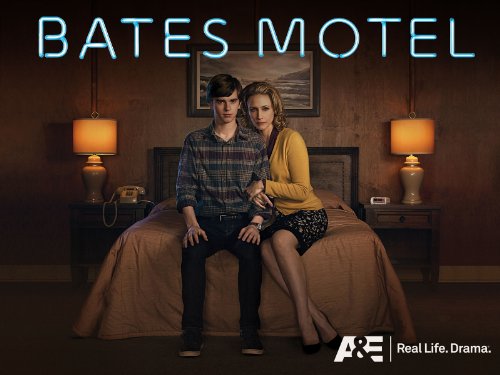
Bates Motel: First You Dream, Then You Die Review


BATES MOTEL:
FIRST YOU DREAM, THEN YOU DIE

The Son Waits While The Mother Bates...

Bates Motel is covering territory that we've seen before.  Ostensibly the story of how Norman Bates went from troubled young man to mass killer, the early years of our favorite Psycho have been covered in Psycho IV: The Beginning (I love how a Part 4 can be "the beginning", but I digress).  Of course, Psycho IV is staying within the film series begun in 1960 and which had two prior sequels (neither of which were envisioned by Hitchcock or anyone else working on that film). 

Bates Motel, on the other hand, is less a prequel to the Alfred Hitchcock masterpiece and more both a reboot and reimagining of the Norman Bates story.  It not only shifts the setting from the 1960s to the present day (the reboot phase) but also moves past the Norman Bates story itself to encompass a more general story of small-town depravity of which Norman and his mother soon become entangled in (the reimaginging part).  Its premiere episode, First You Dream, Then You Die, starts Bates Motel off into something related but not connected to Psycho, and with a strong story and some excellent performances, we start this series in excellent fashion. 

Norman Bates (Freddie Highmore) is sensitive, a bit shy, but now has the burden of having lost his father (under what I think are mysterious circumstances).  His mother, Norma (Vera Farmiga), moves them to an idyllic seaside town six months later (which the dialogue establishes is something within her character).  Now she's bought a hotel there, hoping to in her words, '"start over", especially away from her other son, Dylan.

While Norman soon gets the local cool girls interested in him (either because they do think the guy is not bad-looking or because they just sense new blood), the original owner of the Seafairer Hotel, Keith Summers (W. Earl Brown) comes around threatening them.  One night, the girls ask Mrs. Bates for permission for Norman to come out and play (ie. go to the library).  While Norman wants to go, she says no, saying she needs lots of help to put their hotel and home in order (which is exactly why she didn't want Norman to join the track team and went out of her way to make him feel guilty when she consented and signed the permission slip).  He, in a rare act of defiance, sneaks out of the house to go, but to his surprise they AREN'T going to the library.  At the party he struggles between his shy nature and his burgeoning sexual desires.

However, it looked like he picked a bad night to leave.  Norma is stunned to find a drunk, rage-filled Keith at her kitchen.  She calls for her son and valiantly defends herself, but Keith overpowers her and violently begins to rape her when FINALLY Norman beats him.  At first, it looks like everything will return to normalcy, but when Keith makes a provocative statement Norma in a rage stabs him.  Norman returns, horrified at the sight.  Determined to avoid scandal, she has her son help her dump the body in a hotel room tub while they figure out what to do.  Even though it's the middle of the night, she has Norman start tearing out the carpets to cover up her tearing out the blood-stained carpet.  While tearing out the carpeting in one of the rooms, Norman discovers a notebook with hand-drawn pornography.

To their surprise, the law appears.  While Deputy Zach Shelby (Mike Vogel) is clearly attracted to the Widow Bates, Sheriff Alex Romero (Nestor Carbonell), is not.  Eventually, they do leave.  The next night, the Bateses go and dump the body in the lake.  First You Dream, Then You Die appears to end on some optimist note, with the Bates Motel sign going up and a proposed byway that would have skipped the hotel not going through for now, but we find that something isn't right.  By the flicker of the neon lights, a woman with various needle marks is being re-injected, all while being chained-up...

Bates Motel borrows elements from another television series about small-town weirdness and strange goings-on.  It draws heavily from Twin Peaks, and the influence the short-lived David Lynch series is clear in our first episode: from the moody cinematography (for example at the teenage wasteland party and the closing shots) to the sense of dread hanging over what is suppose to be a nice town, right down to Emma Decody (Olivia Cooke), a girl with cystic fibrosis (at least that's what I understood to be the "C.F." she said she had) who could have been the Log Lady's niece.  Right now First You Dream is establishing the scenario and the setting, and the script by Kerry Ehrin and Anthony Cipriano (from a story by Ehrin, Cipriano, and showrunner Carlton Cuse) all have set the mood and characters excellently.

The screenplay is helped by the brilliant performances by Farmiga and Highmore.  Farmiga's Mother Bates is believable in both how she appears to be truly hopeful that she will be able to start afresh as well in how she is able to bully and manipulate her son.  The conversation in the kitchen when a hesitant but hopeful Norman asks for her to sign the permission to join track plays like something from real life.  The son wanting something but the mother, in the belief that her needs (which she sees and frames as the family's needs) come first but ultimately giving in (and making her son feel guilty about it) would be recognized in many homes.  She doesn't appear to be evil, but one who has grown both highly dependent and controlling of her son (always for his own good, of course).  Farmiga's Norma Bates is a mixture of love and abuse (emotional and mental, not physical), one who sees Norman as HER son, with no identity of his own.  Her actions and reactions to everything, from her attack to her cover-up, are believable though not always right, but at least understandable (mostly).

Highmore is equally excellent as the put-upon son, one who has been trained to confuse obedience for loyalty.  He personifies the shy, awkward teen who wants to be good but who has been browbeaten into being unsure of himself.  The sexual yearnings he has at 17 struggle with a sense of right & wrong which are coming into conflict.  Moreover, as someone with an unsteady background, Norman tries to make sense of things and at times coming up short.  With his thin frame and hesitant delivery, Highmore captures the struggle between being good and being loyal.  To his credit his British accent isn't obvious, and his performance is that of a kid who finds himself slipping into things he doesn't want to do and be.

The rest of the cast is slowly coming into form.  Since the first episode of Bates Motel centers more on the Bateses they don't have much time to establish their own identities, but both Vogel and Carbonell do much with their silences and glances to establish that the former is quick to be drawn to the attractive Widow Bates while the latter is more suspicious of the newcomers.

The direction of Tucker Gates mixes the macabre with the comic.  There is something both tense and amusing when Sheriff Romero asks to use the same restroom where Keith's body is stuffed.  The tension between the knowing Bates mother and son and the unwitting Shelby and Romero is intense, but seeing how something so mundane as going to the toilet can be a source of tenseness (a word of my own creation) is almost funny. 

First You Dream, Then You Die establishes the series and characters excellently, turning Bates Motel into a gothic horror story (dare I say, an American horror story) with offbeat characters and continuing storylines where Norman and Norma Bates (and their actions and being) are just an added piece to a strange world where their antics are just down-home regular folk behavior. 

9/10

Next Episode: Nice Town You Picked, Norma      

Friday, March 22, 2013

Oz the Great and Powerful: A Review

OZ THE GREAT AND POWERFUL

We're Off to Meet the Wizard...

The Wizard of Oz is one of the greatest films ever made, whose power still resonates in the American psyche.   It is a cultural touchstone for everyone who has seen it.  Yet for the legend The Wizard of Oz is, and as expansive as the Oz universe is (from both L. Frank Baum's original stories to those who have added to it), it has remained stubborn in its refusal to have any other adaptations or cinematic stories add or take from it.  With the exception of the musical Wicked (the Oz story from the Wicked Witch's viewpoint), no Oz-related film has ever truly worked, let alone been embraced as much as The Wizard of Oz.  The Wiz, another musical adaptation with an African-American cast that changed the setting from Kansas to Harlem, didn't fare well (although I think Ease on Down the Road is still fondly remembered).  I certainly remember Return to Oz, but for all the wrong reasons.  I was a child when I saw it, and remember vividly being quite frightened: Jack Pumpkinhead made me hide in terror, and he was one of the GOOD guys!

Now we have Oz the Great and Powerful, which is an unofficial prequel to the 1939 classic.  This time, we hear of how the Wizard of Oz came to be.  In many ways, Sam Raimi's film takes all its cues from the Victor Fleming film in that we pretty much have the same story structure, with a journey to defeat a great evil aided by those he meets along the way but with a little bit of suggestion of redemption for our lead thrown our way.  While it will not rank anywhere near the Garland vehicle, it is visually spectacular but not as strong as it could have been.

Oscar Diggs (James Franco) is a magician/flim-flam man/con artists/ladies man in a travelling circus.  It is Kansas, 1905, appropriately black-and-white, and his show isn't going all that well.  The audience heckles him twice: first when they see the wires, second when he declines to heal a wheelchair-bound girl (Joey King).  He abuses his poor assistant Frank (Zach Graff) and finds that Annie (Michelle Williams), the only girl he appears to have genuinely cared about, is going to marry a certain John Gale.  One of his paramour's boyfriends, the circus strongman, then bursts through to take his revenge,  Diggs flees to a nearby balloon, where his loyal Frank throws the good Professor his suitcase and top hat.

However, Oscar is caught up in a twister (it's a twister, it's a TWISTER!), and crashes into a strange and beautiful land, appropriately in color.  Here, he meets Theodora (Mila Kunis), who tells him he's in Oz.  As luck would have it, Oz is Oscar's nickname.  With that, Theodora believes our Oz is THE Oz, the wizard long prophesied to bring peace to the land and defeat the Wicked Witch.  Since such endeavours come with treasure, our Oz gleefully takes on the task.  While on the way to the Emerald City, they meet a flying monkey, Finley (Graff again), who pledges eternal loyalty after being rescued.  Oz tells Finley he ISN'T the Wizard, but no matter: Theodora, who is a good witch, instantly smitten with Oz, believes him so.

Not so her sister Evanora (Rachel Wiesz), another Witch who rules the Emerald City.  In order to win his throne and the gold, all Oz has to do is break the Wicked Witch's wand.  He, being Oz, decides it's worth it if it means treasure, so off he goes with a somewhat reluctant Finley.  On his way, he meets China Girl (King again), a little girl made out of actual china (not connected to David Bowie at all).  She has survived an attack by the Wicked Witch's flying baboons on her village, China Town (seriously), and with a little glue he is able to repair her legs and make her walk.

Eventually, we find the Wicked Witch, but it turns out to be Glinda (Williams again), the GOod Witch of the South.  Glinda truly believes Oz to be THE Oz, and soon gets him to agree to be her champion.  However, we find one of our witches, finding she's been spurned by Oz over Glinda, has embraced her dark side and turns into THE Wicked Witch (one guess).  Finally, we have a battle between the two Wicked Witches and Oz and his group for control of the land of Oz and the Emerald City.

Somewhere along the line I wonder whether either Raimi or screenwriters David Lindsay-Abaire and Mitchell Kapner didn't stop and say, "we're simply throwing in too much into Oz the Great and Powerful".   The film may be just a little over two hours, but if feels so much longer.  Worse, it feels excessively bloated with far too much going on and roads not fully explored (no pun intended).   We get a strange mix from the original and introduction of new elements.  It's not something I like doing when reviewing films: comparing one movie with another, but Oz the Great and Powerful simply demands that I compare it with The Wizard of Oz.  On the one hand, like the 1939 film it has characters in Oz have counterparts (Finley with Frank...in the pre-Oz sequence Diggs calls his ever-faithful assistant a trained monkey, the wheelchair-bound girl with China Doll...Diggs now able to make her walk), but then it throws the two sisters who don't have a Kansas doppelganger.  It makes for a perplexing mix because you're never sure whether you should expect to find similarities between Wizard and Oz or not.

The conflict over control of Oz seems almost secondary when we get the big climatic battle and a very extended Emerald City in peril scene.  Again and again The Great and Powerful wants to be something close to The Lord of the Rings (even to the visuals, where Oz reminded me of a suburb of Middle-Earth), but while it is certainly breathtakingly beautiful, neither the story or the characters appear to be either great menace or a great salvation.

Another issue with The Great and Powerful is that the actual threat Oz the man faces comes from the thinnest of reasons.  All this chaos, all this evil, because a certain witch basically got dumped?  I keep thinking it would have been far better to have simply started out with an evil witch rather than have us go through so much, having us attempt to care about certain people, only to find they change merely because they didn't get what the heart wanted.  It certainly doesn't speak well of women to find that in a nutshell, one of the most evil creations in film history turned out that way just because one guy favored another.  I've heard of being green with envy, but this is too much.

Since I rarely venture into 3-D (thinking it the Work of the Devil), I can see that Oz's arrival in Oz (what I dubbed Mr. Wizard's Wild Ride) was clearly created to give those who plunked down extra cash their money's worth.  It was impressive without the added dimension I'll grant that, but I think a 3-D experience would have left me regurgitating into my popcorn bag.  Sometimes less is more.

In terms of performances I think everyone did as well as they could with the material.  I didn't mind too much that Franco looked as high as he was not when he co-hosted the Oscars, though I think both he and Raimi might have mistaken excessive smirking for excessive confidence.  His Oz was suppose to undergo a transformation from con artist to hero, and while I didn't completely buy the transformation I think Franco did his best.

Kunis was much better as the conflicted Theodora, making me believe her transformation (while a bit of a stretch) was genuine.  Weisz was all slinky and sexy as the more menacing Evanora, borrowing more from the original idea for The Wizard of Oz's Wicked Witch as a glamorous figure like the Evil Queen from Snow White and the Seven Dwarves.   In her dual roles, while I think Glinda might have been better I think Williams was frankly better than the material she worked hard to make good.  Glinda I felt could have been more sweet/naive/knowing, but on the whole I enjoyed Williams' performance.

There are moments of wit (everyone got a chuckle at China Town, and I laughed when Oz tells the Munchkins they put the "merry" in the Merry Old Land of Oz) but some that might have been better-played (as when Oz stops the Munchkins from completing their big musical moment or worse, when Oz presents 'gifts' to those who have helped him defeat the Witches...talk about milking the source).  One thing I did enjoy were the visuals (although I was never sure whether the obvious green-screen work was MEANT to be obvious).  One thing I didn't care for was Danny Elfman's score: he certainly enjoys his vocalizing music, doesn't he.  That was driving me bonkers, and again, less is more.

I would advise parents to be wary of taking their kids to see Oz the Great and Powerful: some sequences might be too intense for them (at the screening I attended, a few young kids hid constantly at the climatic battle sequence).  On the whole Oz the Great and Powerful is a bit overblown and too long, but not a terrible film.  Certainly beautiful-looking, it could have done with trying something different rather than attempting to copy too much from The Wizard of Oz itself.

What can I say: it really was no miracle....     

I see...I see...I see me not as beloved
as my Professor predecessor....


DECISION: C+

Thursday, March 21, 2013

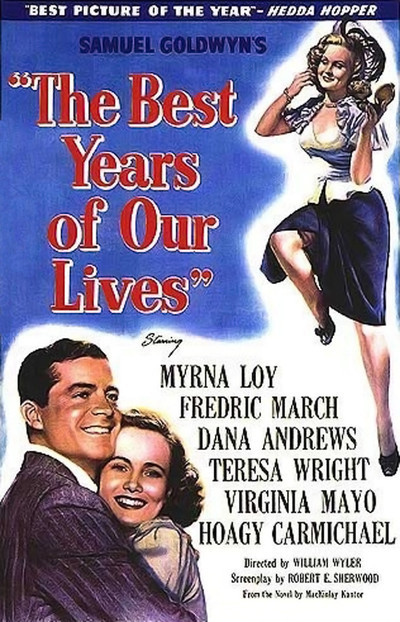
The Best Years of Our Lives (1946): A Review


THE BEST YEARS OF OUR LIVES (1946)

Johnny Finds It Hard To March Home Again...

We've just won the war, confound it. We're entitled to a bit of celebrating and cheering, to be happy, to laugh, pat ourselves on the back and say, 'job well done'. What we got instead was The Best Years of Our Lives, a reminder that sometimes war goes on long after the shooting stops. It was a curious message to give audiences who had been fed a series of films celebrating the men who were fighting in distant lands and the women who waited for them. However, it might have been the message audiences needed, if not necessarily wanted.

The Best Years of Our Lives revolve around three veterans returning to their hometown after the Second World War, each different in civilian life but similar in the emotional impact the war has had on them.  Al Stephenson (Fredric March), a sergeant, returns to his WASP job as a banker and his WASP home: his patient wife Milly (Myrna Loy), and children Peggy (Teresa Wright) and Rob (Michael Hall).  Captain Fred Derry (Dana Andrews), from literally the wrong side of the tracks,  comes home to his bride Marie (Virginia Mayo), but given they married right before he went off and didn't know each other well the homecoming is fraught with uncertainty.  Petty Officer Homer Parrish (Harold Russell) may have survived to come home to his middle-class parents and his sweetheart, the literal girl-next-girl Wilma (Cathy O'Donnell), but he returns without his hands.  They have been replaced with hooks.

The three meet on the plane carrying them to Boone City, your nondescript Middle America town.  Over the course of the film their lives intersect, sometimes at Butch's Bar, the watering hole owned by Homer's uncle Butch (Hoagy Carmichael).  Al finds himself returning to a home with children he doesn't know all that well (and given that Rob all but disappears after the first hour, it's no surprise).  Back at the bank, he is made Vice President of G.I. Small Loans, but when he approves a loan to a veteran with no collateral due to the veteran's character over his financial abilities, he is highly questioned.  Al, a functioning alcoholic, starts seeing a world no longer as how he remembers it.

Derry, who before his daring exploits was a simple soda jerk, finds readjustment hard too.  While once heroic in the air, he finds that Marie is more interested in having good times than settling down.  Furthermore, she wants the daring and dashing Captain Derry, not the regular-guy Fred, who in order to make ends meet goes back to his old shop.  First attempting to sell perfume at the chain store that took over the old pharmacy (and having to endure the arrogance of the man he had once trained now as his stuck-up supervisor), he either was demoted or shifted back to the soda counter. 

It also doesn't help that he and Peggy have fallen in love, so much so that Peggy openly tells her parents she'll break up their already-faltering marriage.

Homer Parrish is stuck in a difficult situation.  Although he seems accepting of no longer having hands, he is surrounded by people who either want to ignore the obvious or be exceptionally 'accomodating' to his needs.  Butch is the only one in his immediate circle who treats him as the Homer pre-war, even giving him piano lessons (yes, piano lessons). Homer himself thinks he's doing well by trying to push Wilma away, she fights for her man.

Their lives continue to cross: Fred loses his job at the soda counter when a radical insinuates to Homer that he had lost his hands (and his fellow shipmates their lives) due to false pretenses, Fred and Marie begin to divorce but Al insists that Fred stay away from Peggy, and Homer and Wilma in the end marry with Fred as the best man and the Stephensons sans Rob as guests.  At their wedding, through all the difficulties Peggy and Fred may face (despite his new job as a prefabricated homebuilder, dismantling planes), they acknowledge their love.


The Best Years of Our Lives has not lost its power or relevance over the years since its premiere.  It is built on many aspects, starting from Robert E. Sherwood's adaptation of the MacKinlay Kantor novel.  Each of the characters are ordinary people, attempting to restart a life interrupted by war.  In their struggles they attempt to deal with the changes both within themselves and around them the best way they can.  We have three men, each from a different socioeconomic background and worldview, brought together by their shared experiences, and The Best Years of Our Lives shows how each man, rather ordinary in his way, does his best to both accept things as they are and build as good a life as possible.

William Wyler doesn't give us "big" moments, places where a character makes a sudden realization or finds a great turn of events (with the exception of when Derry basically is at the right place at the right time to find a job that will keep him in Boone City, but then the love story would have pretty much been thrown out if that had happened).  Instead, the director kept things to the most basic level, but in this we see the genius of The Best Years of Our Lives: this is really OUR story, any of OUR stories, any person who was either going through a situation like this or knew someone going through a situation like this.  Given we had just survived this particularly brutal war, any viewer would have seen him/herself in any of the characters: those who came back to a secure job and home to those who returned to neither to the women who loved them.


The Best Years of Our Lives is on the whole so authentic to wartime experiences that it could easily be seen today and still be seen as something contemporary.  It is filled with such beautiful moments, in particular when the men first return to their various homes.  Each time we see one of the men arrive we are filled with great emotion: Homer's mother, devastated by the loss of his hands and doing her best to put on a brave face, Millie unaware that her husband has come home until neither child answers her question as to who was at the door then coming to the hall, Phillip coming to find his wartime wife not waiting for him.  If Al or Homer's homecoming doesn't fill one with a hint of emotion or the formation of tears, one can only wonder what kind of person that is.

Now, let me turn to some of the things I didn't like about The Best Years of Our Lives.  Let's start with that love story between Phillip and Peggy.  I've seen the film twice and while I didn't find that aspect of the film as boring the second time as I did the first, I just figured this served to stretch the film to its nearly three-hour length.  The movie slowly shifts from the story of the three veterans attempting to rebuild their lives into this tale of thwarted lovers.  I figure we had to have a love story somewhere in all this, but I simply could not warm up to this part of the story.

As good as Mayo is in the film as the insensitive Marie, I wonder if she had to be such a shrew: vain, selfish, almost a golddigger-type.  I wonder if this was done to A.) give Peggy and Phillip a complication and B.) make it acceptable for him to be romancing, ever-so-hesitantly, a woman not his wife. 

I also was concerned that Best Years of Our Lives was almost playing Al's burgeoning alcoholic binges for laughs (especially bizarre given we've just had the previous Best Picture winner revolve around alcoholism).  Early on in the film, Al wants to tear up the town with Millie and Peggy (conviniently leaving Robbie behind).  Besides wondering why Millie would be so painfully patient and understanding as her husband keeps getting drunker and basically making her and Peggy bar-hop, the hangover also seemed to be on the lighter side.  Later on, a slightly intoxicated Al gives a speech basically harranging his superiors for basically putting profit over people.  My beef with this aspect is that it might have been playing light with something that now would be seen as cause for alarm.

Finally, speaking of Rob, few characters have been as short-shifted as the Stephenson's youngest son.  Rob appeared to be there just to be able to give a little anti-nuclear bomb statement, then rushes off to school...to never be seen or heard from again.  I marvelled that at Homer & Wilma's wedding, he didn't show up and no explanation was given for his absence.  He appeared to be Chucky Cunningham before there was a Chucky Cunningham.

These on the whole are minor flaws, because so much about The Best Years of Our Lives is so beautiful.  The performances are all so excellent, from Marlene Aames' Luella (Homer's sweet little sister) to Teresa Wright's luminous performance as the lovelorn Peggy.  While Myrna Loy received top billing, she was clearly a supporting performance as the wise and patient Millie, but she was total perfection as not just the perfect wife and mother but as a woman.  While Al rages about Peggy going with a married man, Millie understands that her daughter's heart is leading her head.  She sees things as more complex than Al does, giving her a deeper dimension that speaks more about her than about her husband.

As already stated, Mayo was excellent as the shrewish Marie, and Andrews was equally brilliant as Phillip, a man who finds himself adrift now that his exploits amount to nothing in the civilian world.  His Derry seems to be constantly holding in his frustration, his anger, barely within himself, working to accept things as they are but still hoping to move past everything.  March to my mind might sometimes slip into comedy as the borderline alcoholic Al, but he also expresses that he simply is not the same man he was when he left the comforts of upper-class society.


The term 'courageous' is wildly overused in film.  I find nothing 'courageous' in two wildly heterosexual men playing gay characters (think Heath Ledger and Jake Gyllenhaal in Brokeback Mountain).  However, 'courageous' is the only term appropriate for Harold Russell's performance.  He was an untrained actor when he made his debut, and his performance is so authentic one can see he brought true nobility to all those who came back from war physically disabled.  Homer never drowned in self-pity, wondering, 'why me', but worked to continue his life with dignity and yes, courage.  It was a brave performance, winning him TWO Oscars: a special Oscar "for bringing hope and courage to his fellow veterans through his appearance" as well as Best Supporting Actor. 

Harold Russell earned both honors, for in his appearance he did bring hope and courage, but he also had a strong performance of the wounded veteran, especially given he was not a professional actor.

Curiously, as a side note, the third veteran (the role Russell played) was meant to be suffering from shell-shock, and we do get a sense that an aspect of that was shifted to Dana Andrews' character.  He has dreams about a mission, but this line is never followed through.  My personal view is that it was a version of the shell-shock the third character would have suffered from just transferred to another character, but not explored.

The Best Years of Our Lives is a bit long and gets diverted by the romance between Phillip and Peggy, which sometimes takes center stage.  However, it is too good to ever age.  As more veterans continue to return from all theaters of war, from Korea to Afghanistan, The Best Years of Our Lives will always be relevant, vital, important, and true to life.            

Please visit the Best Picture Retrospective for reviews of all Oscar winners in the top category.

DECISION: A-

1947 Best Picture Winner: Gentleman's Agreement

Wednesday, March 20, 2013

Elementary: Deja Vu All Over Again Review


ELEMENTARY: DEJA VU
ALL OVER AGAIN

Holmes and Flower Show...

For some time we've gotten the sense that in Elementary, the relationship between Sherlock Holmes (Jonny Lee Miller) and Dr. Joan Watson (Lucy Liu) would shift from partners in detection to mentor/apprentice.  Good thing or bad I leave to each viewer.  For myself, I'm not sold on the idea that it will be a road they will be travelling long on.  I keep thinking this is a whim of an overly-eager Holmes to find someone he can totally mold into his hero...himself.  For her part, Watson appears equally eager to be a consulting detective in her own right.  Deja Vu All Over Again is her debut case of sorts (she still turns to Holmes and isn't on her own) but we also see Watson coming into her own with a case that takes fascinating turns that I think pretty much hold up.

We have a flashback to six months ago, when a woman is handed a bouquet of roses by a stranger on a subway platform, then shortly after is pushed onto an oncoming subway by same said stranger.  Meanwhile, Joan is hanging out with old friends when she's contacted about her latest client.  She accepts, but does ask what kind of name is Sherlock. 

Move forward to now: Holmes is not pleased that his father has called upon him to help a lawyer under Holmes, Sr.'s employ.  However, Holmes gets a surprise: it isn't for his lawyer, but the lawyer's assistant Rebecca (Geneva Carr).  She is concerned about her sister Callie (Roxanna Hope), who has gone missing.  Rebecca suspects her brother-in-law Drew (Josh Hamilton) has killed her, but there's no proof of anything except for a farewell tape Callie left and the disappearance of a family trunk.  In the tape, Callie mentions something about the "woman with the roses" falling off the platform as being some kind of trigger to get her to leave.

Holmes decides this will be the perfect case to throw Watson in, although she still has misgivings.  Holmes decides to also take up the investigation of who pushed Vivian Tully (Penny McNamee) off the platform six months prior.  Watson's first step is to interview Drew himself, who denies knowing anything about his wife's disappearance.  Watson, however, is convinced Drew killed her and stuffed her body in the missing trunk.  Holmes anonymously sends a "we know what you did"-style message to Drew in hopes of drawing him out, but nothing doing.

Watson is so convinced Drew did it that when she and Alfredo (Ato Essandoh), Holmes' sponsor/ex-car thief, find Drew does indeed have the trunk, she dares to break into Drew's car.  We find the trunk...empty. 

Holmes, meanwhile, deduces that to avoid the cameras the pusher must have cased the joint.  While he finds someone who was stalking Vivian he has the oddest alibi: he videotaped the crime.  On that videotape we find a street violin player who witnessed the crime who abruptly stops before the pusher strikes.  A little investigating leads Holmes and Detective Bell (Jon Michael Hill) to Thaddeus, our Joshua Bell-knockoff (and I'd venture, a better violinist than Bell, but I digress).  Thaddeus says the killer might recognize him due to his attempt at pickpocketing, especially since he recognized the jacket.

The jacket had a distinctive patch, which Watson recognizes in a picture of Callie.  Still, tying the subway pushing to Callie's disappearance is nearly impossible...unless...the case is solved.  Holmes and Watson find the killer (thrilling Joan) and Emily (Susan Pourfar), Watson's friend and a reporter, tells her while she is still concerned for Joan's new endeavour she was wrong to have staged an 'intervention' of her own.

Deja Vu All Over Again is on the whole a delightful episode: smart, with some good twists and some great moments of humor.  In fact, the episode is both a clever mystery and almost a comedy.  Brian Rodenbeck's script has a great moment of comedy between Miller and Aidan Quinn's Captain Gregson while examining the tape.  Holmes observes that the violin player abruptly stops just before Vivian is pushed.  He can even recognize the piece being played by the fingering, telling Gregson he plays the violin, adding if Gregson didn't know that.  Gregson remarks that up till now, he didn't know Holmes ate food.  When inquiring about the violinist, Gregson asks about the violinist playing "Panini's...Whatever" had to do with the crime.  How Miller and Quinn work together so well is one of the highlights of Deja Vu All Over Again and Elementary in general.

Miller in particular has been elevating Holmes into a figure who is manic and remarkably light, almost amusing without being ridiculous.  When Watson tells Holmes she'll do her best Colombo impersonation on her first case, Miller's reaction is terribly funny without being idiotic.  His expression can either read that he doesn't get the reference or is not amused by it.  Miller's stiff manner and blank expression makes the whole thing humorous without making our lead look genuinely crazy.

As this is Watson's first 'case', Liu just shines as the growing junior detective.  Her performance shows amusement in the discovery of the killer along with something Holmes rarely if ever shows: vulnerability.  Her scene with Miller when she expresses a fear that if HE had opened the trunk the body would have been there shows that despite her intelligence and hard work Watson still has moments of doubt and insecurity in her new job.  At one point Drew offers to drop charges against Watson in exchange for an apology.  Holmes is dismissive of such an offer and says Watson should dismiss it off hand, but Watson almost snaps, "I'm not like you," to him.  Elementary will continue to play with their interplay and it will make for interesting watching.

In terms of the mystery one thing that is great is that the two stories eventually dive into each other and in a way that shows that is on the whole both logical and clever.  One thing that perhaps didn't quite work was the secondary suspect of Vivian's stalker.  What are the odds that he A.) would have videotape the crime, B.) not submitted it anonymously to help find the killer, and C.) hold on to it.  Granted, it was needed to find the witness who led to the killer, but it all seems a little too convinient. 

However, when Watson suggests that in this case, B led to A, I had come up with that conclusion myself though hadn't fit exactly how. 

Finally, it is good to see Alfredo back (especially in how he helps Holmes and Watson solve the crime and in showing that Holmes' addiction recovery will not be forgotten).  I also think that putting in some of Watson's pre-Holmes lives with friends were integrated into the story.  The 'intervention' among them over Watson was odd but logical, and we hope to see more of Emily (given she's a reporter, I don't see any difficulty integrating her into future stories).

Deja Vu All Over Again moved fast, moved logically (mostly...the videotape deal didn't quite work, one might have thought someone using their cell phones would have been better than the stalker deal) and allowed great teamwork between Miller and Liu (who especially shines in a leading role).   At least this season, for myself, the bloom has not faded from Elementary.

You don't bring me flowers anymore...
8/10

Next Story: Snow Angels

Tuesday, March 19, 2013

Golden Boy: Role Models Review


GOLDEN BOY: ROLE MODELS

Rookie Hero Sandwich...

And in our fourth episode of Golden Boy, the mysteries continue and deepen.  Will our 'golden boy', Detective William Clark (Theo James) rise through honest work in the footsteps of his senior partner Owen (Chi McBride) or through duplicitous machinations, outdoing his nemesis Detective Arroyo (Kevin Alejandro)?  Role Models, which is easing its way to being a traditional CBS procedural with little nods to the future, put some work into the mystery-of-the-week, but it also gave Arroyo something we haven't seen either with him or much with Clark: a moral crisis that reveals him to be more complicated than our traditional 'villain'.  In fact, given how Clark is being painted in light grays (perhaps not as clean-cut as we would like our heroes to be but still closer to the angels), Role Models actually gives a greater focus, even sympathy, to Arroyo to where he is making Golden Boy about him than Clark.

In the future, we see Clark playing chess with disgraced former Commissioner Dowdell (William Sadler), currently residing in prison.  Now we go back to the case when first their paths crossed.  A police officer, Detective Novak, has been shot under the bridge (why do I have Red Hot Chili Peppers playing in my head) while working as security for a rap mogul.  Said rap mogul, one Kyle Burton (Jermel Howard) is first thought to be the target.  However, we find this is not the case.

Arroyo is particularly concerned for several reasons.  One: the Commissioner is looking into this personally, and as someone with ambitions of his own Arroyo doesn't want to be caught flat-footed.  Two: the dead detective was the old partner to Arroyo's mentor, Lieutenant Madrid (Nick Chinlund).  Three: the dead guy is a cop, and that to him means they pour everything into the investigation.

Owen, while not happy about a fellow cop getting gunned down, isn't as concerned about what either the Commissioner thinks or in Novak's posthumous reputation.  Owen and Madrid have their own rather bitter history between them (which begs the question, 'Does Detective Owen get on with ANYONE or does he always end up feuding with every officer he meets?').  Owen soon wonders how Novak could afford so many luxuries on his salary.

Obvious answer: Novak was dirty.  While Owen and Clark see that clearly, and that Madrid is also dirty, Madrid's buddy Arroyo either can't or won't believe that.  He now is in a terrible dilemma: Arroyo, with all his flaws, is a good cop, but he finds it difficult to believe and accept that one of his own, particularly the one he learned all the tricks of the trade, could both be corrupt and have killed a fellow officer.  Arroyo confronts Madrid, and with this an angry Arroyo hands the evidence over to Owen and Clark.

The Commissioner asks Clark to massage the final report so as to not taint Novak too much: allow his widow to collect his pension.  At a benefit for the slain brother of Arroyo's "partner" McKenzie (Bonnie Sumerville), who was also a cop, Owen is taken by surprise twice: first that Arroyo and Clark appear to reach an entente cordiale (neither will tell on the other), and that Novak is held to be a hero.  Clark, who has had a touch too much to drink, is taken home by McKenzie.  While there, she and his sister Agnes (Stella Maeve) have a little girl-talk, but Clark tells McKenzie that Arroyo doesn't deserve her.  We go back to the future, where the current and former Commissioners end their chess match.

It is curious that Brett Mahoney's script for Role Models centers more on Arroyo than on Clark.  Throughout this episode the story about how Arroyo handles this emotional crisis.  Think on it: to Clark, Madrid is a warning of some kind.  He is either a warning of what he might become or of what not to do.  For Arroyo, however, Madrid is a mentor and friend, someone he looked up to and emulated to a point.  Coming to discover that his mentor and friend has violated the codes Arroyo has about looking out for fellow officers and not being shady must have been brutal.  Arroyo is not a likeable person in that he is the antagonist to our 'hero', and he himself has done unethical things (sleeping around on his still-hot and nice wife, slapping someone in custody, letting his ego get in the way of dealing with others) but Arroyo is also a shrewd officer who pursues cases to the end and has results to back up his ideas about his effectiveness. 

As Golden Boy continues, I find Arroyo to be the more compelling character because he is the more complex.  He is arrogant, self-centered, but he's also effective and at heart a good cop (if not a good man).  Clark, on the other hand, is shifting between being closer to Arroyo's brand of egocentric bully and Owen's honest and methodical officer.  Owen would never have parlayed an advantage to benefit either himself or someone else.  Clark does. 

In terms of the mystery, I think it was pretty clear from the get-go where it was going.  Even highly-paid officers like Novak (who had to take a sideline with a rap superstar) couldn't afford all the luxuries he had.  Again, it was not the mystery that is the important issue in Golden Boy: it is the interworkings of the cast, in particular the Arroyo/Clark/Owen triangle.

It is a credit to all three of the actors (Alejandro, James, and McBride) are all able to play their parts so well: the Ego, the Moral Center, and the one in between. 

Again, we can figure that Clark has survived any and all plans against him and that whatever he's done he has managed to either get past it or hidden it.  I think it was the Commissioner (guest star Sadler, who was appropriately sleazy) who said to Clark, "You're either going places or going to jail."  That is what is carrying the show.  Each case brings him (and us) closer to finding out what kind of person Commissioner William Clark is going to turn out to be.  All the future sequences don't give us any solid information as to whether Clark is corrupt or harsh or brutal or if he's honest, straightforward and considerate.  Golden Boy right now is shaping him into who he will end up being, and so long as they can keep the audience guessing, I figure it will do all right. 

WHO are you?


8/10

Next Episode: Vicious Cycle