Sunday, August 19, 2018

I Could Go On Singing: A Review

I COULD GO ON SINGING

This review is part of the Summer Under the Stars Blogathon. Today's star is Judy Garland.

I Could Go on Singing was Judy Garland's final film before her death at just 47. The title seem apropos to Garland, a woman whose voice to this day still has few equals, let alone rivals.  The title could also reflect her indomitable will to fight on, until she couldn't.  In this, her unintended farewell performance, we get a mere glimpse of what her stage shows were like, and greater glimpses of still untapped acting potential done in by her own demons.

Jenny Bowman (Garland) has come to London ostensibly to give a series of concerts.  There is a hidden agenda, however.  She asks her old flame, Dr. David Donne (Dirk Bogarde) for a chance to see Matt (Gregory Phillips).  Matt believes himself to be adopted, but in reality, he is the biological child of David and Jenny, the product of a long-ago relationship.  Jenny gave Matt to David and his now-late wife, putting her career first.  Now she yearns for one chance to see her son, who knows nothing.

David is reluctant to open Matt up to Jenny, especially after she promised to not make contact.  However, he gives in for what is meant to be a one-time thing. No surprise that it isn't, as Jenny finds herself yearning for more of Matt.  Matt, for his part, is equally entranced by this famous American singer, though puzzled as to why he is of such interest.  David has to go to Italy on medical business, so Matt and Jenny conspire to take some time to be together.

This is concerning for Jenny's longtime dresser, Ida (Aline McMahon) and her manager George (Jack Klugman), who think Jenny is not only sacrificing her career for this whim, but setting Matt up for a fall.  Eventually, David returns, knowing of what's been going on and furious with Jenny over this.  The truth is accidentally revealed to a surprised Matt, and after some struggle, Matt opts to cut off Jenny.  Devastated, she seems to lose interest in everything, especially her concert appearances, until David comes in, tells her he loves her, and giving her hope for one last chance at happiness.

Image result for i could go on singingThere is something about I Could Go On Singing that hits too close to home, as if Judy Garland weren't so much making her final film but her unofficial biopic: And Starring Judy Garland As Herself.  A lot of I Could Go On Singing plays like screenwriter Mayo Simon took elements of Garland's life and brought them out for everyone to see.

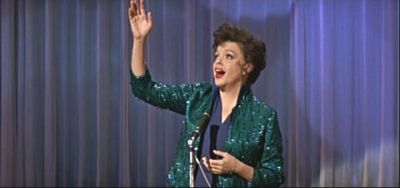
Take for example her concert appearances.  They are almost exactly how the real Garland would take to the stage, when she managed to take to the stage.  As the orchestra played the overture, she'd wait in the wings, clap her hands and shout to the orchestra, ramping herself up to give it her all.  While one imagines that an actual Garland concert would have been more raucous, I Could Go On Singing gives us a taste of what a stage performance would be like.

The most overt moment in I Could Go On Singing is near the end, when Bogarde tries to lure her to her concert.  She lets out an epic speech that sums up Garland's entire life and career.  She comments about how she 'can't be spread so thin', on how people can take her to the stage but they can't make her sing, and on how she's 'held on to every piece of rubbish there is, and thrown all the good bits away'.  In 'Jenny's' regret, her ego (proclaiming that "I'm ALWAYS a sell-out!") and her talent, it crystallizes far too eerily everything that Garland had.

Intentionally or not, Bogarde too has a statement that is as good a summation of Judy Garland and her alter ego Frances Gumm as any ever spoken.  "Jenny gives more love than anyone, but she takes more love than anyone can possibly give".

Over and over, there seems to be no line between the fiction of 'Jenny Bowman' and the fact of Judy Garland, the two overlapping in a role that is not parody but essentially a variation on reality.
Related image
As such, it's almost hard to gauge Garland's performance in I Could Go On Singing, for the difference between a character and the 'real' person is so blurred as to make the distinction impossible. If I were to put a view as to Garland's acting, I would say she gives a very strong performance as this talented and needy woman, who wants love and wants to give love but who still struggles to balance life and career.

There is no question whenever she is singing, for Garland makes every song a standout.  As perhaps can be expected, each song reflects something in the story: in the beginning, a joyful and optimistic Hello, Bluebird; when Matt discovers the truth and David pushes her away from the both, the melancholy yet defiant By Myself, and at the end, the title theme.

Curiously, I Could Go On Singing was written by Harold Arlen and E. Y. Harburg, the same team that wrote Garland's iconic theme, Over the Rainbow, again another case of reality and fiction melding in strange ways.

Bogarde comes across as a little stiff as David, but he managed to hold his own against a titanic force of nature like Garland, his reticence to have her and Matt together a genuine concern and not a selfish one.  He also showed that David cared for his son and treated him with respect, not talking down to him about the situations.

Phillips was also strong as Matt, keeping both a strong upper-lip and showing vulnerability and hurt, though one would have expected a greater shock when he learned who his parents were.

As a side note, it's interesting that no one mentioned the potential scandal of Bowman having an illegitimate child revealed or its impact on her career at this time, and the ending is a bit muddled.  David starts by being backstage, but when Bowman looks again he's disappeared.  Has he actually left her for good?  Is he rushing to get Matt there?  I guess it's left to the audience.

A Star is Born is unintentionally autobiographical in that she was in real life both Vicki Lester and Norman Maine.  I Could Go On Singing is more overt to where it almost sad to see, as if everyone knows this is Garland's story dressed up as fiction.  It's well-acted and entertaining, but one never shakes the sense that I Could Go On Singing is equally autobiographical, as if Garland wanted the world to see 'the real Garland' while still maintaining plausible deniability.

It is a good film, though it is up to the viewer to decide how close or far it is from reality.

DECISION: B+

Saturday, August 18, 2018

Three Identical Strangers: A Review

THREE IDENTICAL STRANGERS

The 'strangers' in Three Identical Strangers can have more than one meaning, intentional or not.  It relates to three men who were not aware they had two other identical brothers, but it could also relate to the strange twists and turns in a story that seems more the product of mad scientists than anything else.

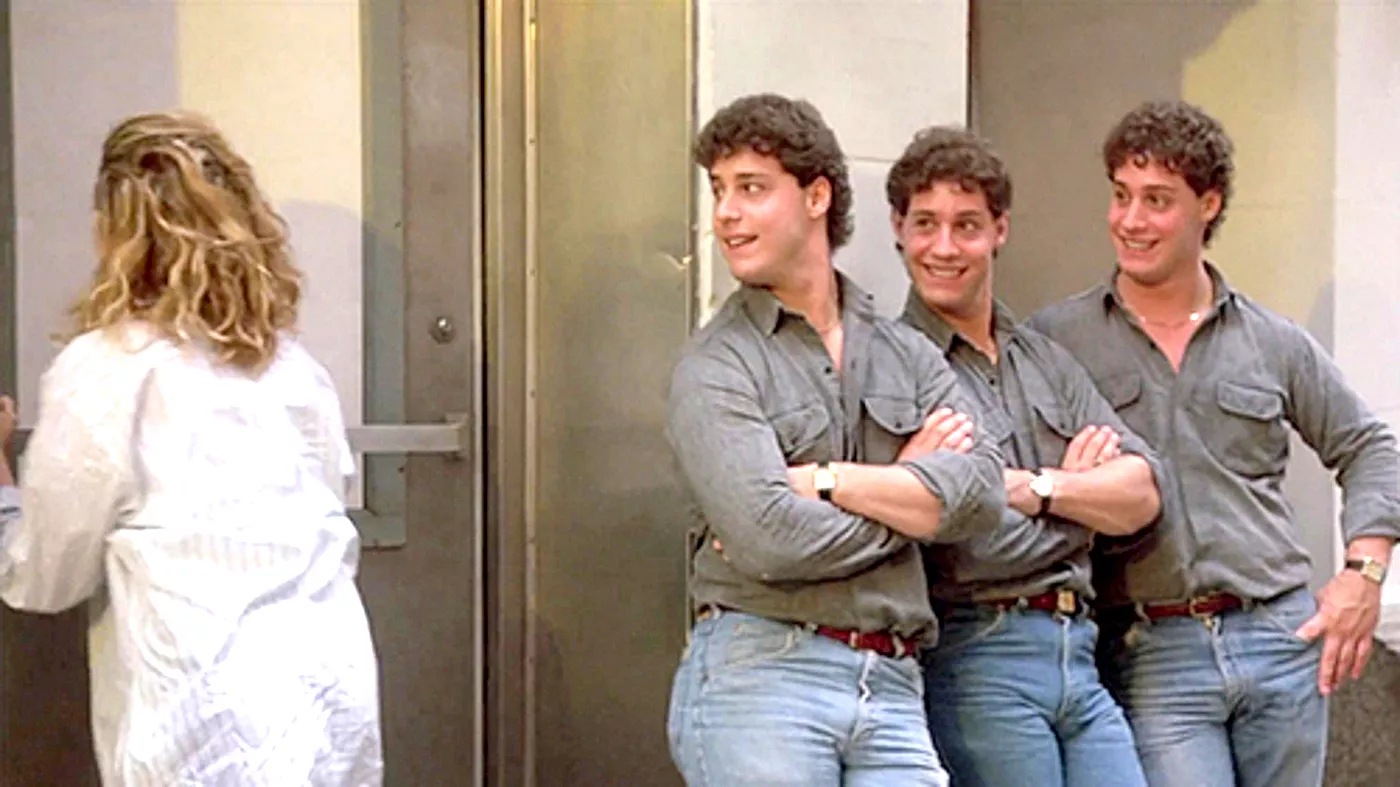
In 1980 Bobby Shafran goes off to a community college.  He is surprised to find so many people be so friendly to him there, hugging, high-fiving and in a few instances kissing him even though he has no idea who they are.  It isn't until he sees his college dorm-mate that he makes a shocking discovery: he has a double.  That 'double' turns out to be Eddy Galland, who is his hereto unknown identical twin brother. 

Both Shafran and Galland knew they had been adopted, but neither family knew there was a second brother.  Things take a stranger turn when another man, David Kellerman, reads about them and finds these two men look exactly like him!  Turns out the twins are really triplets.

The brothers are thrilled to be reunited and they become media sensations.  The press and public fixate on their surprising similarities: same taste in cigarettes, women, sports.  Their families even, in a strange coincidence, all had an older adopted sister before adopting the boys. They live a grand public life, open a restaurant called, what else, Triplets, and even have a cameo in a Madonna movie.

Image result for three identical strangersAs they live out their lives, they begin searching for their birth mother, who turns out to have been a teen mother and who both drinks too much and has mental health issues.  Little do they know that all those 'coincidences' are anything but.

The triplets find that their lives were essentially orchestrated by Dr. Peter Neubauer as part of a 'nature vs. nurture' long-term study of which the respective families knew nothing about.  Moreover, they were not the only set of siblings who were separated.  This almost Mengele-type experiment on children seems more disturbed when you realize that Dr. Neubauer was a Holocaust survivor and that the Jewish Board of Family Service, which still holds various records in the never-published study, would not release information.

Even though the men were identical, they were not the same.  There were mental health issues leading to Galland eventually taking his own life. The 'coincidence' of each man having an older adopted sister was anything but.  It was part of an almost-deranged 'master-plan', as was placing the boys in a working, middle and upper-class family.  Eddy Galland's father, by his own admission, was a strict disciplinarian, while another brother had an avuncular father. 

While some of the JBFS's records were opened as a result of the film, there is very little information to them.  Dr. Neubauer's own notes, donated to Yale University at his death, are sealed until 2066.

Three Identical Strangers, directed by Tim Wardle, resists the temptation to make this a 'meet-cute' story, even as we see the brothers indulging in celebrity with interviews on Donahue.  It has some reenactments, but most of them are early in the film.  However, they are put to great use, particularly when the three sets of parents go to the Louise Wise Services agency to confront them about why they were not told or given a chance to adopt two or all three.  They report that when Mort Shafran went back to the conference room to get his umbrella, he saw the agency heads opening a bottle of champagne, as if celebrating that they'd 'gotten away with it'.

Image result for three identical strangersWardle, instead, lets the story tell itself with interviews from the surviving brothers and their parents, friends and relatives, along with Lawrence Wright, an investigative reporter who uncovered this crazed science experiment. Wardle and Wright go deeper into a story that becomes more nefarious as it goes on.

Even now, we see that there is still a strange disconnect among those involved in this 'mad scientist' type plan; the surviving research assistants to this 'nature vs. nurture' study, such as Dr. Lawrence Perlman, who conducted on-site visits with the triplets for a brief time, and Natasha Josefowitz, Dr. Neubauer's personal assistant, still insist that the separations of the brothers along with other twins/triplets, was warranted for the scientific information they learned.

The ethics of these endeavors, however, never seems to have either crossed their minds or be of concern now.  It's both fascinating and highly creepy how men and women of science can appear so shockingly myopic on the fact that many lives were damaged, ruined, or even ended as as a result of their own actions.  Just as one is appalled to hear someone rationalize killings by saying 'I was just following orders', one sits these highly educated men and women almost in disbelief when hearing them say nothing on how their studies altered the subjects' lives.  It is almost like equating lab rats with human beings.

Three Identical Strangers touches on this with a comment that one of the brothers relates came from Eddy.  "I don't know if this will turn out great or terrible," one of them quotes Eddy about discovering the other two, a prescient comment given Eddy would be the one to suffer from manic-depression that would eventually lead to his suicide.

The film points out that the public and even the families focused so much on the similarities they failed to notice the differences in each of them.  Moreover, the eternal question of 'nature vs. nurture' is still left unanswered, and not just because the study was never published and the records sealed.

Some moments in the film are brilliant, such as when after meeting their birth mother the brothers are still no closer to knowing the truth.  We see New York City in a fog, and intentional or not, it reflects a literal and metaphorical fog and clouding of the study and the circumstances in their lives.

Three Identical Strangers is in turns fascinating, amusing, shocking, infuriating and ultimately sad yet thoroughly engrossing.

Albert Einstein is quoted as saying, "Science without religion is lame.  Religion without science is blind".  I have always interpreted that quote as meaning that faith should have an intellectual basis in observable, testable reality and that science should be guided by high ethical standards of morality.  From the infamous Tuskegee Experiment to Joseph Mengele's obscene acts on Holocaust victims to the Milgram study to the Stanford Prison Experiment and now this 'nature vs. nurture' study, it appears that Einstein's dictum has yet to be integrated into scientific thought. 

Sadly, this failure led to David Kellman, Bobby Shafran, Eddy Galland and their families all being wrecked in so many ways.

DECISION: A+

Friday, August 17, 2018

Yentl: A Review

YENTL

This review is part of the Summer Under the Stars Blogathon. Today's star is Barbra Streisand.

Yentl was something more than a passion project for its writer, director and star: Barbra Streisand.  It was an obsession, something she needed to create and complete no matter what.  After seeing Yentl, I thought about that fine line between 'passion project' and 'vanity project', for Yentl happily zigs and zags across that line.

In 1904, Yentl (Streisand) is an unmarried Jewish woman in an Eastern European shtetl. She yearns to study the Talmud, but as a woman this is forbidden to her by Jewish law and custom.  Her culture expects that she not study, defer to a man be it father or husband, and be satisfied with being a mother and homemaker.  Her beloved Papa (Nehemiah Persoff), however, indulges her by teaching Yentl and answering as many inquisitive questions as he can.  Papa would prefer that she fulfill her womanly duties, but as his son Anshel died, Yentl is as close to a son as he has.

Papa dies, and with no man to care for her, this old maid is about to be shipped off to a shop in the shtetl.  At the thought of this, she cuts her hair, flees her village and more importantly, dresses like a man.  Seeking guidance and perhaps forgiveness from above, she eventually wanders into seeking to join a yeshiva where she can study her beloved Judaic law.

She takes on the name 'Anshel' then meets Avigdor (Mandy Patinkin), a burly young man whose pursuit of knowledge equals her own.  'Anshel' continues this cross-dressing rouse and is admitted into the yeshiva.  Avigdor has a beloved, Hadass (Amy Irving), who loves him too.  Their engagement is broken by Hadass' parents, however, when they discover that Avigdor's brother did not die of illness but by suicide. Fearing a stain of insanity in Avigdor's family, the wedding is off, but neither can object.

Avigdor considers 'Anshel' his best friend, and he urges him to take his place with Hadass.  Hadass' parents also look on 'Anshel' with delight, and while Hadass' heart still remains with Avigdor, she will as a respectable Jewish woman do as her parents say.  As such, Yentl finds herself in the odd position of marrying a woman, even though Yentl herself has feelings for Avigdor.

Yentl soon stars sharing her love of knowledge to Hadass, who is starting to grow fond of 'Anshel'.  Yentl's own feelings become jumbled, not so much sexually but in terms of whether and how long she can keep up this drag act.  Finally, while on a trip with Avigdor, she literally reveals all, much to Avigdor's astonishment and anger. 

Yentl writes out a confession, admitting to her deception.  As Jewish law would find the marriage between two women forbidden, not to mention that this 'marriage' was unconsummated, it frees Hadass and Avigdor to marry, while Yentl, now dressing as a woman, heads out to the New World to see if there, her dual desire for womanhood and knowledge can be fulfilled.

Related imageIt is hard to call Yentl a true musical, at least in the traditional sense. Yes, there are songs that are sung, but unlike every other musical that I know of, Yentl opts to have every song sung by one person: Streisand herself.

Streisand, for good or ill, has a reputation for both perfectionism and egocentricity, and having her be the sole singing in Yentl does not help in mollifying that reputation. No one questions Streisand's singing abilities: she is one of the finest voices of the Twentieth Century.

However, her decision to give herself all the songs comes across as a shockingly vain decision, especially given that sometimes her singing is done is voiceover.  There is only so many times one can endure hearing someone's feelings set to music.

Moreover, the songs are, to use a good Yiddish term, schmaltzy. Apart from Papa, Can You Hear Me?, I don't think anyone can sing the songs now, let alone tell one song from another.  Part of the sameness in Yentl's songs come from one singer performing them all, and part from them all sounding the same, almost as if it's one long song cut into bits save for Papa, Can You Hear Me?, which is the only actual standout. 

Even more bizarre, is that Patinkin is known as a good singer, down to winning a Tony Award for Evita before Yentl was made. Why Streisand never thought to give Patinkin or anyone else a chance for a solo or even a duet is a mystery to me.  I praise Streisand for not making Yentl a musical comedy, as there are upbeat numbers.  One wonders, however, if perhaps the film would have been better served if there had been, or at least had someone else express themselves in song.

Credit should be given to Streisand as a visual artist, for Yentl is a beautiful-looking film.  At times, the visuals become almost absurd in their lushness, such as when Yentl and Avigdor are about to kiss once she's revealed herself.  Streisand makes sure to bathe herself in such bright light as to become almost parody, and another time when she is belting out another number the spotlight looks almost as if a flashlight suddenly burst upon her.

These moments do at times seem vain and excessive, pandering to her ego than to her story.

Image result for yentl
However, in Streisand's defense, she takes Isaac Bashevis Singer's story Yentl the Yeshiva Boy and does not make it into a comical situation.  Resisting the temptation to have even a little fun with the gender-bending, Yentl is a perfectly straight and serious look at this woman who yearns for something that her society has forbidden her to do.

She also draws strong performances from her cast, especially Patinkin and Irving.  I think Irving was better as the poor Hadass, trained to be a respectable Jewish wife and finding a spark of desire for knowledge.  Patinkin at times was a little broad, but on the whole he played the idea that he would never have thought Anshel was a woman seriously.

It's a curious thing though that while Yentl saw how 'male privilege' works by being on both sides of the gender divide, she never comments on it or even appears to try and exercise that privilege.

There are some good things in Yentl to make it a strong directorial debut, but at times it does seem a touch self-indulgent, particularly in Streisand's parsimonious hold on being the sole singer.  To answer her question, yes, Papa could hear her...because she was the only one singing.

DECISION: C+

Thursday, August 16, 2018

Sorry To Bother You: A Review


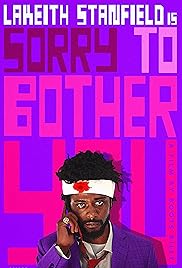
Image result for sorry to bother youSORRY TO BOTHER YOU

I once worked at a few call centers.  I, unlike those at the center of Sorry to Bother You, worked at an inbound call center where people called us rather than us calling them.  I never wanted to work at an outbound call center.  It just seemed rude to my mind to call up people I didn't know. Sorry to Bother You has some moments of genuine wit and visual flair, but that isn't enough for me to think it is actually good.

Cassius 'Cash' Green (Lakeith Stanfield) is struggling to find employment, so he goes to an outbound call center, RegalView, where the mantra is 'Stick to the Script'.  Cassius does this, much to his consternation as he finds himself struggling to get ahead.  With his abysmal record, he'll never reach "Power Caller" status, which allows one to ride up an elegant elevator to the top floor versus schlepping downstairs to a crowded cubicle area.

However, words of wisdom come his way from Langston (Danny Glover), an older telemarketer.  To get ahead, Cash is going to have to use his 'white voice' to get ahead.  Cash takes this advice to heart and soon starts making it big-time.

As a side note, I wonder if anyone thought of using Peter Gabriel's Big Time in this montage.  Great song in my opinion, but I digress.

So, Cash moves up to the literal Regal View, where he is one of two African-Americans, the other being Mr. ____ (Omari Hardwick) (his name is never given).  Even here, they have to speak with their 'white voice', but that's a minor trade-off for the great wealth and power they have.  All the while the underlings at RegalView have decided to go on strike, and leading this is Squeeze (Steven Yeun).  Also joining the strike is Cash's girlfriend Detroit (Tessa Thompson), an artist who has also started working at RegalView.

Cash at first was going to participate, but the lure of going up was too much for him and he is now playing hot and cold.  His power selling soon attracts derision from the strikers and their sympathizers, who at one point throw a soda can at him.  This makes him a viral sensation.

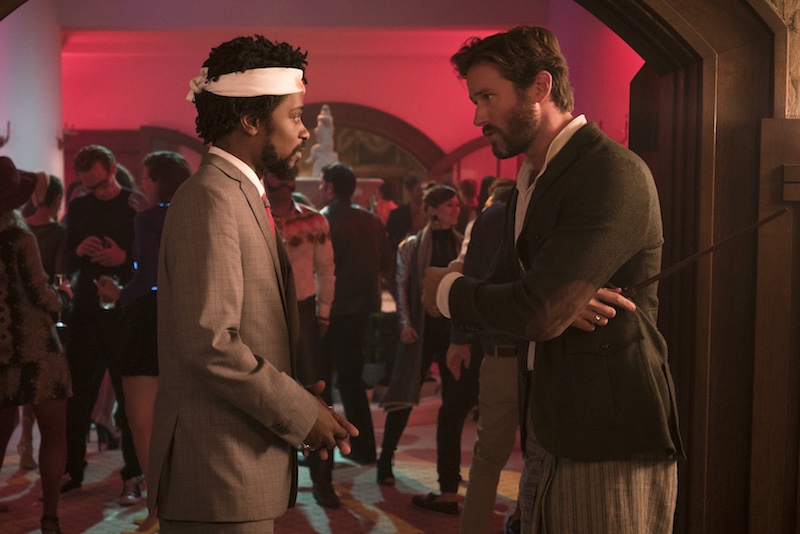
Cash's power selling also attracts Steve Lift (Armie Hammer), a billionaire who runs Worry Free, a place which guarantees jobs and housing and looks suspiciously like a series of prisons.  At a big party at Lift's mansion, Cash is not only cajoled into entertaining the guests with a 'rap' (since he's black he has to have mad rapping skills), but also discovers the shocking truth about Worry Free: they turn their employees into horses.

Forget the idea of spoilers.  In this case I'm not hiding this bonkers twist.

Eventually, through Cassius, the world learns about these Equi-Sapiens, the world goes crazy and Lift gets his comeuppance, thanks to Cassius who finds himself slipping into horse.

Image result for pinocchio fantasy islandI do not understand why Sorry to Bother You has received the passionate love from critics that it has.  It is clear that I missed something in the telling, because a lot of Sorry to Bother You seems to take from other films altogether.

I could see traces of last year's Get Out, Airplane! and even Pinocchio of all things.  I could even see bits of The Golden Girls at the strike opening rally, where Squeeze diverges into commenting on sexually transmitted diseases.

A lot of the 'comedy' was pretty obvious, and I always find it difficult to embrace a film that 'knows' it's a comedy. Everything from the aforementioned STD tangent to naming a character 'Diana DeBauchery' and worse, drawing attention to the name 'DeBauchery' conspire to keep Sorry to Bother You at a distance from me.

That isn't to say that there weren't genuinely funny, even clever moments in the film.  One of writer/director Boots Riley's best parts were whenever Cash made a phone call, starting out his conversation with 'Sorry to bother you'.  He literally falls into their lives and observes them doing things like having dinner and having sex.  The opening when Cash's own sexual tryst with Detroit is interrupted by the 'wall' being the garage door and the shifting material wealth is also quite inventive and amusing.

I also thought well of some of the performances.  Lakeith Stanfield is excellent as Cassius Green (or is it 'Cash is Green', which if this is where Riley got his wit then I am not bowled over). He has an almost resigned manner to his Cash, a somewhat world-weary figure who finds himself in more and more absurd situations and does the best he can with them.  Thompson's Detroit is as close to a voice of reason in this insane world, though I thought her art show was idiotically pretentious.

Hammer goes all-in to be this bonkers billionaire, though the fact that he's a scion of the Armand Hammer family and its accompanying wealth makes me wonder whether Armie Hammer knows a bit about living the rather luxurious life Lift has.

Apart from that though, the fact that this is a first-time screenwriter/director shows.  I find that Sorry to Bother You is a film that goes in a certain direction because that is what one expects, not necessarily because that is what would happen, and that does not include the 'turning people into horses' bit.

Image result for sorry to bother you
I found the comedy and social commentary forced and thoroughly hammered in (no pun intended).  The overt suggestion that people would not notice that "Worry Free" employment is essentially prison, complete with an unamusing MTV Cribs-type profile; the idea that Lift's guests would be so asinine as to think Cassius would know how to rap and worse, cheer on a rap that consisted of nothing other than "N****r, n****r, n****r, s**t, s**t, s**t', repeated over and over again. The STD mention at the protest.

All of that I didn't find funny but almost insulting.

That does not touch on the 'white voice' bit (provided by David Cross, Patton Oswalt and Lily James for the characters of Cash, Mr.___ and Detroit respectively).  I could not help in being reminded of another angry cinematic polemic that went all crazy and that I hated.

Sorry to Bother You seems to be a child of Bamboozled, where Damon Wayans' character of 'Pierre Delacroix' also spoke in exaggeratedly posh tones to 'underscore' how far removed he was from his roots. Just as I could not accept the idea that the nation would so quickly and willingly embrace people wearing blackface or awarding the faux-minstrel show Emmys, I cannot accept Riley's world where people will react more positively over the telephone if your tones 'sound' different.

Perhaps I'm naive, but I don't see why I should surrender to pessimism.

I think my biggest issue with Sorry to Bother You is that the comedy is so obvious, yet it wants me to also embrace this world as real.  This isn't to say again that there aren't some good things in it.  However, for me the film was already going into a 'sinking place' long before we got this Island of Dr. Moreau bit.

DECISION: D-

Wednesday, August 15, 2018

Sunday Bloody Sunday: A Review


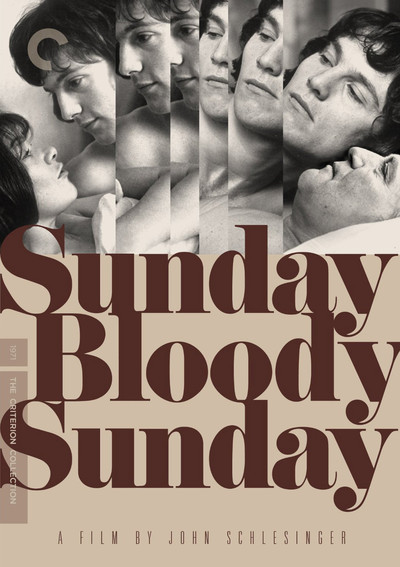
Image result for sunday bloody sunday 1971SUNDAY BLOODY SUNDAY

This review is part of the Summer Under the Stars Blogathon. Today's star is Peter Finch.

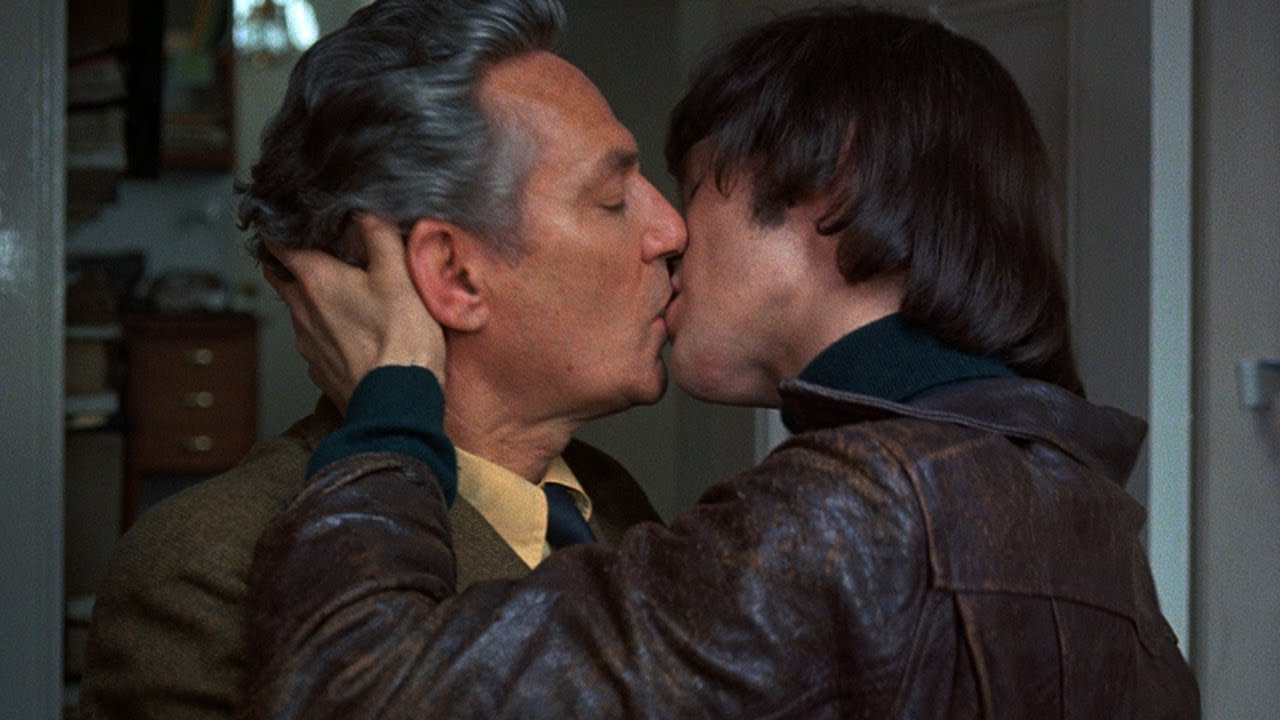
The subject of Sunday Bloody Sunday was pretty shocking for its time. Even now, this 'bizarre love triangle' where a man and a woman share a lover is still pretty radical.  Sunday Bloody Sunday stays away from sensationalizing the story or making it a tawdry affair.  Its exploration of the curious turns of the heart is worth looking at.

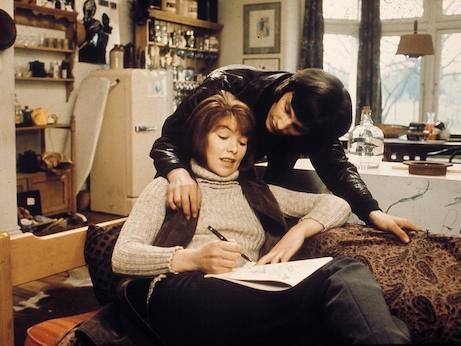
Over a week, we see the tangled lives of divorced employment agent Alex Grenville (Glenda Jackson), middle-aged Jewish doctor Daniel Hirsh (Peter Finch) and artist Bob Elkin (Murray Head).  Bob goes between Alex and Daniel's bed, sleeping with both of them.  Alex and Daniel are both fully aware that Bob transitions between them, dividing his time between Alex and Daniel.

Alex, still going through the aftereffects of her divorce, spends the weekend with Bob watching over the home and kids of friends, where the lowest point is when the family dog Kenyatta is killed when it ran out into the street.  This almost killed one of the children, but Bob through his art helps.  Alex is also haunted by her past during the War and her present by her distant and disapproving parents.  She picks up Bill (Frank Windsor), who had come to her employment agency before she decides to resign her job.

Daniel's greatest issue is enduring difficult patients, but he has his circle of friends and his beloved art and music.  He also has Bob, with whom he hopes to travel to Italy in the spring. Daniel is both out and in: he does not make a great deal about his homosexuality publicly and his friends know he's gay, but he still keeps his private life secret to his Jewish family.  This might explain why at his nephew's bar mitzvah, his widowed father and aunt chide him for still being single and try to fix him up.

Bob has received an invitation to exhibit in New York, but that means leaving Alex and Daniel.  Both of them, in their own way, decide that Bob is not worth following to New York or asking him to hold off.  Finally meeting face-to-face, Alex and Daniel exchange pleasantries and decide to let him go.  All three part on friendly terms, and Daniel addresses the camera to tell us that he is happy.

Image result for sunday bloody sunday 1971We can tell that Daniel is happy because before we see him speak to us, we see him learning Italian.  He is going on with his life, going on his trip without his lover.  In short, he is now a man in full, unencumbered by affairs of the heart.

Sunday Bloody Sunday is a step forward in the portrayal of gay/bisexual characters in that Daniel is neither ashamed or tortured by his sexuality and Bob does not appear troubled by having a relationship with people of both genders.

I do wonder whether the fact that Bob is younger than both Alex and especially Daniel is indicative of a generational shift on views of love.  I never got the sense that Bob truly loved either, though he seemed more affectionate towards Alex.  This might be because Alex had at least a semblance of a family which he could interact and show a tender, almost paternal side.  He couldn't do this way Daniel's family, as the idea of Bob bringing a 'boyfriend' to the bar mitzvah would still cause raised eyebrows.

I also am puzzled why Alex and Daniel would settle for a part of Bob, knowing full well that he won't belong to either. I suppose love is very strange.

Director John Schlesinger's follow-up to Midnight Cowboy touches again on a hidden world, where love is if not sale at least on a trial basis.  He draws great performances out of his triangle.  Peter Finch plays against type as this gay man, but he also plays Daniel as a man who sees his sexuality as part of his being, not the whole of it. There's a brief bit where Daniel is talking to his neighbor, and his eyes quickly but momentarily shift to a handsome young jogger passing by.  It's subtle, but well-done to show Daniel is attracted to attractive men.

It's more than like that Daniel Hirsh probably gets more blowback for being Jewish than for being gay.

At the bar mitzvah, we sense that he is looking for spiritual connection as well as a physical one, which perhaps is why he did not fight to keep Bob with him or become hysterical at the thought of his lover leaving.  Daniel might be sad to see the end of this affair, but he is not going to chase after him.

Finch's closing monologue, directed somewhat at us, is a wonderful piece of acting, contemplating a bit about his life and realizing he is content.

Image result for sunday bloody sunday 1971
Jackson brings life to Alex, a woman haunted by her own past but who also sees that Bob won't block her future.  Her tryst with Bill does make her a bit of a tart: after all, she has sex with two men in a twenty-four hour period. However, when she is playing opposite someone other than Head, be it Peggy Ashcroft as her mother, Winston as Bill or with the children, we see that Jackson makes Alex a fascinating woman to where a whole film could be built around her.

Perhaps Head underplayed Bob, or it could be that he is not on the same level as Jackson or Finch.  However, I cut him some slack because Bob is supposed to be, at least to me, a bit of a mystery.  I'm not sure he can love, truly love, anyone.  He might have feelings for Alex and Daniel, and he didn't come across as selfish.  He wasn't a rent boy of any kind, but he also was someone who freely floated between two people.

The gender of the people is immaterial.  The fact that Bob could go from one person's bed to another person's bed to me shows not indecisiveness but far too much casualness.  Love is a very strange thing, but it isn't that free.

Bessie Love, who starred in silent films and starred in The Broadway Melody, the first sound film to win Best Picture, had a small but amusing role as the telephone operator connecting and reporting to these three intertwined people.

Certain elements of Sunday Bloody Sunday will probably shock even today's audiences, let alone the ones in 1970. I was aghast to see not just the free and casual bed-hopping, but children openly smoking. Whether they were smoking pot as they claimed or not, it still ought to have surprised people then.

Sunday Bloody Sunday takes a remarkably adult and mature take on this three-way love affair.  It is not sensational.  In fact, it is pretty quiet and straightforward.  With strong performance by Finch and Jackson, excellent direction from Schlesinger and Penelope Gilliat's screenplay (all of whom received Oscar nominations), Sunday Bloody Sunday is a strong film on the curious nature of love.

DECISION: B+

Tuesday, August 14, 2018

Paris, Texas. A Review


PARIS, TEXAS

To be honest, I started despairing on whether Paris, Texas would take me emotionally or leave me cold. I was finding it a little too eccentric for my own tastes.  However, once we got to the end, with two standout performances by Harry Dean Stanton and Nastassja Kinski, I found that perhaps Paris, Texas' reputation is well-earned.

A man is found wandering the West Texas desert.  Soon, we learn that this man is named Travis (Stanton), and his brother Walt (Dean Stockwell), whose number Travis carried despite Travis not speaking, goes down to get him.  Travis is mute for a while, until he finally speaks the word 'Paris'.  From this, we learn that Travis has bought a piece of land in Paris, Texas, the place he believes he was conceived and which he takes a most reluctant Walt to.

Eventually, Walt gets his brother to come back with him to Los Angeles, where Travis re-encounters Walt's wife Anne (Aurore Clement) and seven-year-old Hunter (Hunter Carson).  Hunter calls Walt and Anne 'Dad' and 'Mom', but in reality, he is their nephew as Travis is Hunter's real father.  Travis, eccentric in his manner, starts working to bond with the son who doesn't know him, and eventually wins his trust and affection.

Travis decides he should meet with Jane (Kinski), Hunter's mother, and he finds that Jane has been sending money for Hunter from Houston.  Travis goes to Houston, though I cannot remember if it was his idea to bring Hunter with him or if Hunter came of his own initiative.  Travelling to Houston, they stake out a bank and Hunter sees the woman he knows is his mother. 

Following her vehicle, Travis finds she works in a peep show, something Hunter is oblivious to.  Travis finds the right show and at first cannot bring himself to communicate with her.  He goes back the next time though, and bares his soul to Jane, who eventually realizes who he is as he recounts their story: the good, bad and ugly.  Telling her where Hunter is, Jane goes and sees her son for the first time, and while Travis sees them from the parking garage, he leaves.

Image result for paris texas moviePart of me thinks that Paris, Texas is more than one film put together: the first half of Travis and Walt with Travis attempting to reenter society, the second half a road movie with Travis and Hunter, the former attempting to make amends for his own sins.  I say this because once Travis and Hunter leave for Houston, it does not seem that Anne or Walt put up much if any fight to try and find them.

I don't even think we get any moment when they either see that Travis and Hunter may have both gone off the deep end or are resigned to let them make their own quest.

As such, I felt Paris, Texas was going a little off, as if I were watching a precursor to Rain Man with Travis and Walt.

However, it isn't until Wim Wenders' directing and Sam Shepard's screenplay give us a very emotional scene at the peep show between Stanton and Kinski that we see why so many hold Paris, Texas close to their hearts. 

It's an extremely long sequence for Stanton and Kinski, the former speaking and the latter reacting.  We hear in Stanton's voice the pain and sorrow of a man filled with regret and seeking redemption in an unlikely place, and we see in Kinski's face the hurt of the past and the acknowledgment that he who sinned against her is here to atone.

The age discrepancy between Stanton and Kinski (he was 58, she 23) was addressed in the monologue, and it's to Stanton's credit that he played it as if Travis knew it was a bit out-of-the-ordinary. There was no effort to make it a fiery love or a daddy-complex one, just two people who found each other.

Image result for paris texas movieCertain moments visually almost seem to put them, to coin a phrase, faraway so close. They are in an intimate setting but are still separated.  They can hear and see each other but cannot touch.  The hurt, the pain, the regret and a tinge of hope are all there in their performances.

Paris, Texas is really Harry Dean Stanton's show, and he does so much with it that I can see why he became a bit of a cult figure among a group of cinephiles.   From when he attempts to attract Hunter's attention by trying different kinds of walks to his soul-baring sequence, Stanton delivers what is probably one of if not his defining performance.

Though we don't see Kinski until near the end of the film save for a scene where she's in a home movie, she too does a heartbreaking performance as Jane, who is a very nice girl but who in her own way is terribly haunted by that child she longs for.

Stockwell and Clement, though given smaller roles, are real and realistic as Walt and Anne, who function as well as they can with the curious circumstances, they find themselves in. 

I admit that at times I was put off by Paris, Texas, what with a strange similarity to Rain Man in the 'estranged brothers, one of whom is a bit eccentric, take to the road' story (even if Paris, Texas long proceeds Rain Man). I thought the film was going nowhere and had a touch of magical realism with Travis & Hunter's search for Hunter's mother.

However, it is almost impossible not to react emotionally to that long sequence between Stanton and Kinski, among the most moving I have seen.

In a certain way, Paris, Texas echoes something from Casablanca, the sense that for some, the phrase 'we'll always have Paris' does not necessarily mean the joy of love.  It could also mean the pain of love, as well as the possibility of redemption.

DECISION: B-

Monday, August 13, 2018

Our Town: A Review

OUR TOWN

Thornton Wilder's play Our Town is held as one of the landmarks of the American theater, a paean to small-town America that even those who never lived in a small town can relate to.  I cannot verify how close or far the screen adaptation of Our Town stays to the original production since I have yet to see a stage version.  However, the film we have I imagine stays close to the play, which shows why Wilder's work remains a hallmark of American theater.

Mr. Morgan (Frank Craven), our Narrator, tells us the story of Grover's Corners, New Hampshire, a small town typical of the time and place, starting in 1901 and ending in 1913.  We learn of the population and some of the residents, particularly the Gibbs and Webb families who live next to each other.

The Gibbs family is made up of the local Doctor (Thomas Mitchell), his wife (Fay Bainter) and their son George (William Holden).  The Webb family is made up of local newspaper publisher Mr. Webb (Guy Kibbee), his wife (Beulah Bondi) and a daughter, Emily (Martha Scott).  Over time we see them live out their lives, with George and Emily eventually falling in love.

Emily and George both have doubts about marrying on their wedding day, but their parents, in their own way, guide their children filled with doubts and fears until they do have their church wedding.  George gave up college and baseball to take on his uncle's farm, and Emily, highly bright, also made sacrifices to be that farmer's wife.

It looks like Emily will join some of those at the local cemetery when giving birth to their second child.  Among those at the cemetery is her mother-in-law and her younger brother, who died after a burst appendix.  As the spirits offer her advice, especially about the pain of looking back, the newly arrived Emily decides to look back on her 16th birthday.

There, she sees her family moving about their lives: her mother at the stove, her father coming down from a house call, and herself eagerly awaiting what the day will come.  Emily sees how despite their love she and her mother really don't spend much time together, both involved in living to do much with each other.  Emily yearns to reach out and talk to her still-living mother one more time, but as she is dead, she cannot.

However, we find that it was all a dream, for she awakens to find her newborn and her family there at her bedside, and Mr. Morgan the Narrator bids us all a good night.

Image result for our town 1940I think one of the reasons both the play and film Our Town works so well is because it is a simple story told simply. There are no big dramatic moments, no Earth-shattering events.  Instead, we learn about 'simple people', who live out their lives and have their own private hopes, dreams, fears.  There is Mrs. Gibbs' great wish to see Paris, but she is resigned to having a workaholic husband.  Our Narrator does inform us early on that Mrs. Gibbs will die as we see her for the first time, and he also tells us about a paperboy who will also die during 'the Great War' (World War I).

One could see this as a touch morbid, his fixation on telling us this Death Roll Call, but it is true to life: Death can strike at any time and it strikes all of us.

Most of the performances are absolutely beautiful.  I was particularly moved by Bainter as Mrs. Gibbs, her sweet and gentle manner showing her as an ideal mother.  It was also nice to see Guy Kibbee in a rare dramatic performance.  Kibbee tended to play besotted 'sugar daddies' to pretty young things or more comic types, but Our Town showed he could play straight and gentle drama.  Bondi and Mitchell perhaps didn't break type as Mr. and Mrs. Webb, but they did wonderfully in their roles too.

It's curious that while Holden was only 22 when he played George, he looked a bit too old to be a convincing high school student.  However, seeing him in this early role you see how beautiful he looked. You could also see him developing as a strong actor, his scene when he struggles to confess his love to Emily at a soda fountain so well-done.

While Scott earned an Oscar nomination for Best Actress for recreating her Broadway performance (with Craven also coming from the original Broadway production), I found her a touch too dramatic and mannered.  That isn't to say she didn't have some good moments, but at her pre-wedding jitters or her moments at the cemetery, it seemed a trifle overdone.

Image result for our town 1940
One that that wasn't overdone was Aaron Copland's lush Oscar-nominated score.  His music for Our Town was haunting and beautiful, and probably among his finest and sadly underappreciated film scores, especially compared to music for The Red Pony, Of Mice and Men and The Heiress, the latter winning him the Oscar.

I do not know if anyone has written how Our Town covers similar ground to the Spoon River Anthology poetry collection. Both have the dead talk about their lives and both focus on small-town America.  Perhaps the biggest difference is that despite the deaths in Our Town, there is a greater sense of hope and optimism there than in Spoon River Anthology.  The lives in Grover's Corners weren't as miserable as those in Spoon River.

This sense of hope might be why we had Emily live at the end, her visions of the grave resort to the Dallas-like 'it was all a dream'.  Given how moving this simple story was, it would seem slightly unfair to have film audiences have Emily die.  The theater, perhaps, could be more open.

"There's something eternal about every human being," a character says in Our Town.  There is such wisdom in those words.  Each person who has ever lived has their own unique story, one filled with laughter and tears, joys, pains, secret longings and public celebrations.  Our Town speaks to that, to the eternal in all of us.  It is a very moving experience and moving film, one that could do with a remake or at the least a greater appreciation.

DECISION: B+