Showing posts with label Ben Hur. Show all posts

Sunday, August 21, 2016

Ben-Hur (2016): A Review


BEN-HUR (2016)

Ben-Hur, Done That...

WHAT WERE THEY THINKING?!

It is a dangerous thing when you remake a film that is not only beloved, but considered among the greatest films ever made.  It is no good pointing out that the 1959 version of Ben-Hur is a remake.  I know that it is, but let's point out also that the original is a silent movie (a great silent movie).  Therefore, sadly it isn't as well-known as the Charlton Heston version.  As such, when people complain about others remaking 'the original', they do not know about the silent version.  I'm not going to be all picky about the lack of knowledge of the 1925 version (or for that matter, about the 2003 animated version or 2010 television miniseries).  None of these versions have so dominated the popular imagination as the Charlton Heston version, so trying to sound clever by drawing attention to the fact that this "tale of the Christ" has been done many times is foolish. For many, the 1959 version is THE Ben-Hur, and I'm not about to be legalistic on that subject.

Yet, I digress.

Ben-Hur makes some simply disastrous choices in terms of structure, plot, action, and characters that consistently bring the film down, down, down.

It is 33 A.D. in Judea.  A chariot race is about to begin between two men who know each other and hate each other...then we go back eight years to when these two knew, even loved each other.  They are Jewish prince Judah Ben-Hur (Jack Huston) and his adopted brother, a Roman named Messala (Toby Kebbell). Messala feels out of place among the wealthy and influential Hur family: while he has his eyes on his adopted sister Tirzah (Sofia Black-D'Elia), mother Naomi (Ayelet Zurer) does not approve.  In fact, she doesn't apparently approve anything Messala does (like pray to idols for Judah's recovery...begging the question as to why the Hurs never took Messala to Hebrew school).

Messala feels out of place within the wealth and joy of the Jewish family that took him in, so he goes off to claim his birthright and join the Roman army, where he goes to fight in Germania and Persia, all for Caesar and to reclaim his family name, one tainted by his grandfather's involvement in Julius Caesar's assassination.  Judah, meanwhile, despite himself goes and marries the woman he loves: one of his slaves, the beautiful Esther (Nazanin Boniadi).  He also has to deal with the rise of the Zealots who want a free Jewish state and some verse-spouting carpenter named Jesus of Nazareth (Rodrigo Santoro).  
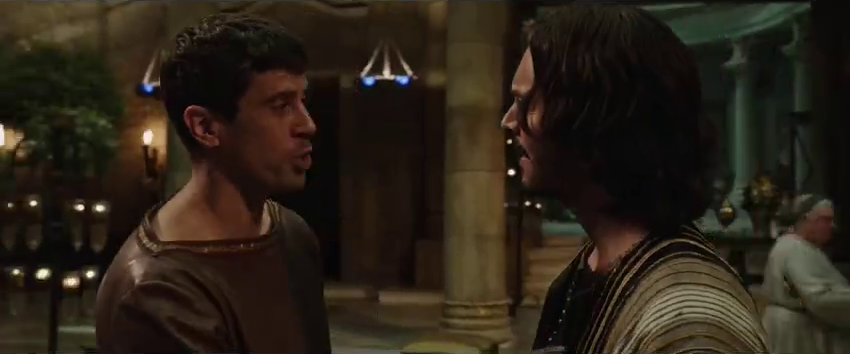
Now Messala comes back to Jerusalem as a commander, the protégé of Pontius Pilate (Pilou Asbaek), the new governor of Judea.  Some in Messala's company think he's too 'Jewish' for them, too willing to be gentle with these conquered people.  Judah for his part wants nothing to do with the Zealots, even after Esther helps them and he himself treats their injuries.  It all comes to a head when Messala leads Pilate through the streets.  He wants a peaceful march for everyone's safety, and it looks like he'll get his wish.  However, Gestas (Moises Arias), the Zealot that Judah had treated for his wounds and whom he tried to convince to avoid violence, decides the rooftop of the Hur palace is the perfect spot from which to assassinate Pontius Pilate.

No weak falling tiles for the Millennials' Ben-Hur!

Messala and his men storm the palace, and Judah decides to 'confess' to the assassination rather than turn Gestas in.  Esther manages to escape, and the Hur women are sent to prison...and Judah to the galleys.

We go to 5 years later (I really don't want to do the math here in these flashbacks/forwards).  Judah is a slave galley when a battle frees him and he washes upon the shore where he encounters Sheik Ilderim (Morgan Freeman).  Ilderim is wary of this Jewish slave, but after Judah cures his horses he agrees to keep him from the Romans.  Ilderim does one better: take Judah to Jerusalem to race against the master Roman charioteer, one Messala.  Sensing his chance for revenge and to avenge his family (whom everyone believes dead), Judah takes a couple of lessons from Ilderim and is capable of taking his brother on in a race to the death. 

He's also found Esther, who is a follower of the Nazarene, and who urges Judah to not seek his revenge.  Nothing doing, for he tries to kill Messala and fails.  It's now in the race where Judah must find his own justice against Messala, and while he wins the race, Messala is still stubbornly alive.  It is only when Judah goes to the Crucifixion that he sees the need for forgiveness, and goes to a legless Messala to give and offer forgiveness.  Good thing too, for Naomi and Tirzah, imprisoned all these years, are cured of their leprosy and are out of prison just in time for everyone to be reunited, feel good about it, and go off...perhaps for more adventures.

Who here is up for Ben-Hur 2: Damascus Road?


I wish I were a good enough critic to say I can completely avoid knowing what Ben-Hur 2016 cut out or altered from all other versions of the story.  I can't: Keith R. Clarke and John Ridley's screenplay changed so much within Ben-Hur that one sometimes wonders whether in their efforts to stand out, they ended up dumbing down the story.

They for example decided to cut out two important characters found in the novel and subsequent adaptations.  They are Balthazar, one of the Magi who connected Judah with both Ilderim and Christ, and Quintus Arrius, the Roman commander who survives the sea battle thanks to Judah and ends up adopting him.  Perhaps they thought it would simplify the story.  Perhaps they couldn't do to legal reasons (I understand that while the General Lew Wallace novel is in public domain, certain aspects of the 1959 adaptation are still fiercely under copyright protection).  In any case doing this ends up making things more silly than simple.

Quintus Arrius was the entryway for Judah Ben-Hur to be the master charioteer that could challenge his former friend (friend, I repeat) in the race.  It gave him the wealth and power and protection that otherwise would not be afforded a galley slave.  Now, thanks to Clarke and Ridley, the task of preparing Judah for his epic chariot battle is left up to Ilderim.  This results in the highly implausible, if not downright ridiculous idea that in a few quick lessons, a man who had been hunched over an oar for five years and was apparently still adjusting to life in the free air could match someone who had been racing chariots for years if not decades....and best him at it.

Talk about beginner's luck!

By removing Balthazar, the subplot of how Christ interacts with Judah is also excised, and we get a couple of other problems.  First, why and how did Naomi and Tirzah (who had been locked up all these years and gotten leprosy for their troubles) end up being cured?  They did not know Christ at all.  Judah had at most two encounters with Him, so where did Judah's faith in Christ come from?  He wasn't at the Sermon on the Mount, or seen any of His miracles, so it all seems to come out of nowhere.

Judah Ben-Hur has neither asked for or sought Christ's atonement for his sins (let alone had his family or the pagan Messala), so how did God in human form grant it (along with healing of a disease that didn't have anything to do with the story)?

It isn't just in the jumbled story where Ben-Hur flops.  Ben-Hur commits one of those cinema sins that I sorely detest: the voice-over.  Longtime readers know how much I detest voice-over, finding that it rarely works (Blade Runner and Sunset Boulevard being rare examples of good voice-overs).  Ben-Hur not only has voice-over, it has THREE voice overs (Freeman's Ilderim, Huston's Judah, and Kebbell's Messala).  I simply loath whenever a film has to narrate what I'm watching, as if I wouldn't understand what's going on.  Having three of them do it is just insulting.

I consistently thought while watching Ben-Hur that it was a terrible decision on the part of Clarke, Ridley, and director Timur Bekmambetov to try and make Messala a sympathetic character.  Again and again the film seemed to think the title should have been Messala instead of Ben-Hur thanks to how he was given legitimate grievances for being so hostile towards his adoptive family.   As my friend Fidel Gomez, Jr. observed to me after we left, Naomi Ben-Hur was 'kind of a bitch' to Messala: constantly belittling and berating him for everything from racing with Judah to looking at Tirzah to worshipping Roman idols.  It's as if he wasn't actually adopted or even part of the Hur household for years, but was more a pesky guest who couldn't take the hint that he was starting to grate on the mistress of the house.

There was never a believable moment when I thought Messala was in any way part of the Hur family.  One would have thought that despite being born a Roman the Hurs would have made him aware of Jewish customs, traditions, and beliefs.  Why would they simultaneously keep Messala a Roman and complain whenever he does what a Roman would do?

Another part of the plot I couldn't figure was why Judah opted to shield Gestas at the cost of his and his family's fortune and safety.  If I had been in Judah's position, I would have said, "THERE'S the man...get him!" 

If we go into the performances, Ben-Hur is a failure.  I don't remember Jack Huston from American Hustle or Hail, Caesar!, and the only film I do remember him from is Pride & Prejudice & Zombies. As such, he is a fresh face to me, and for the life of me I don't understand what Huston or his director were going for.  Huston growls every line, as if he had been asked to do a Russell Crowe impersonation, delivering every bit of dialogue in the same tone, whether he was happy or sad or angry or what have you. 

I don't know whether it's a good thing or not that Kebbell's best performance was as the villainous ape in Dawn of Planet of the Apes (though given he was in the Ian Curtis biopic Control, I'd have to see that again).  With this and Fantastic Four, Kebbell is sinking in my opinion of him as an actor.  He was absolutely dreadful whenever he had some sort of romantic scene with Tirzah, falling into the Huston trap of being weak and emotionless throughout.

Perhaps I can cut both of them some slack given how poorly directed they were and the poor script they had to perform, but a good actor can almost always lift his/her script.  Huston and Kebbell couldn't. 

When someone after the attack on Pilate shouted, "Who shot the arrow?", it took all within me to not shout at the screen, "I, said the Sparrow!"

Freeman has the 'wise elder' part down pat, but his Ilderim was more an instrument to move plot forward than a real figure.  I also add that having Christ speak and be seen is another mistake, especially given that Santoro might as well have come from The Passion of the Christ: English-Language Version.  This Christ comes across as just some nice guy who talks about love, not the Lord & Savior so many believe Jesus to be.

As a side note, while Ben-Hur has been apparently marketed towards the 'faith' market (aka evangelical Christians), I can say that AS an evangelical Christian myself, I found little in Ben-Hur to affirm my faith or in the power of such things as forgiveness.
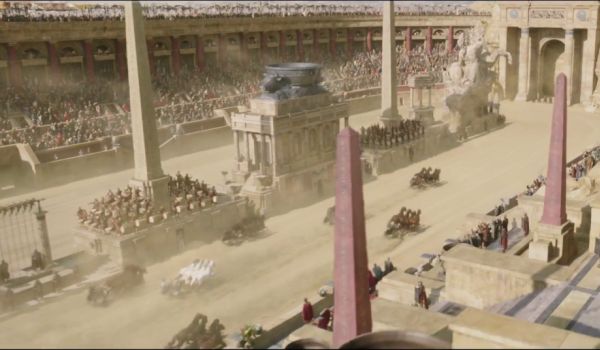


Let us now move on to the main action pieces: the sea battle and the chariot race (which the film shamelessly teases twice if not more, as if begging us to stay just so that we could get to it in the end).  In regards to the former, the decision to keep it all within Judah's perspective (in the galley) was yet another lost opportunity.  If I am going to get a sea battle, I want to see a sea battle (even if we have to cut away from the slaves' perspective).  By keeping things at Judah's eye-level, we end up being removed from the chaos and excitement of what is going on.  It's akin to hearing a boxing match from across a room while others get to watch it live.

In regards to the latter, there are a couple of moments of good tension, but for the most part the reliance on CGI and chaotic editing (not to mention the perpetually grungy look the film has, so dominated by dark tones) makes it less exciting than it could have been. It was disjointed, confused, CGI-heavy, and worst, boring.  Belting out Marco Beltrami's score during the race was bad enough (I don't need music to telegraph to me whether something is exciting or not).  Ending the film with some sort of love song (The Only Way Out by Andra Day) puts a coda on the jumble the film is.

Sure, the song's nice, and Day is a fantastic singer, but The Only Way Out seems so at odds with both the setting and anything connected with Ben-Hur.  I think maybe The Only Way Out could be Ben-Hur's only real shot at an Oscar nomination (versus the twelve the 1959 version earned, winning a record-setting eleven Academy Awards).

2016 seems to be The Year of the Remake: Ghostbusters, The Jungle Book, Pete's Dragon, the upcoming Beauty & The BeastThe Magnificent Seven, and with remakes of Witness For the Prosecution, Splash, A Star is Born, Murder on the Orient Express, and Clue in the works.  Ben-Hur joins that list, and it's a shame that something good could have come, something original that added to the oft-told tale while not taking away from the best-known version.

Cluttered with a bad script, poor direction, weak performances and no sense of purpose, this Ben-Hur keeps going in circles and circles and circles.

DECISION: D-

Sunday, August 14, 2016

Ben-Hur (2003): The Animated Version

BEN-HUR (2003)

I have seen just about every version of Ben-Hur: A Tale of the Christ, but there was one that slipped through the cracks.  It is the animated version made direct-to-video, and in a certain way, it is a very bittersweet production.  Charlton Heston, who won the Oscar for playing the title character in the 1959 remake of the 1925 silent epic, returns to play both the title character and serve as narrator.  What could have been a triumphant return to his most iconic character instead became his farewell performance, for Heston announced shortly afterwards that he had Alzheimer's Disease and quietly retired from the scene, dying five years later. 

The decline of Heston is sadly evident between the product and the post-production. If one watches the special features that have an interview with Heston, he looks weak, stiff, halting, even slightly confused.  When we see him introducing the film and speaking his lines in it, however, he sounds strong and confident, the old Chuck we know and love.  This Ben-Hur is more child friendly and more overtly Christian as I believe it was geared towards the evangelical market.  This does not make it either bad or good, but those who know the 1925 or 1959 versions, or even the 2010 television miniseries might be surprised by some of the changes made to make it palatable to both target audiences. 

Ben-Hur opens and closes with a live-action version of the voice of both the main character and narrator, Charlton Heston.  The film sticks pretty close to the story: Judah Ben-Hur, a wealthy Jewish prince in the Roman province of Judea, is at first thrilled to see his old friend, the Roman Messala (Duncan Fraser).  However, there is a dark change in Messala, more mocking of Judah's faith and people.  When the new Roman proconsul to Judea arrives, Judah is watching from his rooftop with his sister Tirzah (Willow Johnson), and some tiles become loose which strike the Romans.  Some Judeans take this as a chance to throw stones at their hated occupiers, and Messala sweeps in to arrest the Hur family, unaware of the presence of their slave Esther (Kathleen Barr).  He orders the house sealed, Tirzah and her mother Miriam (Tabitha St. Germain) arrested, and Judah sent to the galleys.

Judah survives five years in the belly of the Roman ship thanks to his strong faith, and at a sea battle manages to save the life of the commander, Quintus Arrius (Richard Newman).  In gratitude, Quintus frees Judah and adopts him as his heir.  Despite his mastery of Roman pursuits, Judah still longs to know what happened to his family.  Unbeknown to Judah, Quintus had sent his servant to Jerusalem to find out, and is shocked to learn they've turned into lepers. They are immediately turned out of prison and go to the Valley of the Lepers.  Judah insists on searching, and Quintus relents.  Once back in his homeland, he encounters the chariot races there and Sheik Ilderim (Dale Wilson).  He also encounters Balthazar (Long John Baldry), who is in search of The Christ. 

Judah has met Jesus Christ before, when He offered him water.  First, though, he must find his family and race the arrogant Messala.  The Roman does not die in the race, but is left crippled.  Judah is left with guilt on both fronts: aware of what has happened to his family and shamed over Messala, where he finds no peace.  Now, they find Him (Scott McNeil) and Judah wants to serve in His army, not understanding it is not an actual army but one of forgiveness.  They go to the Crucifixion and there the Hur women are healed.  Christ is resurrected and Judah, with his wife Esther and their children, tell them about the Christ.

As I said, Ben-Hur was made for the Christian market, particularly towards children, so the focus is less on Judah's bloodlust and desire for revenge and more on faith and forgiveness.  We can tell this because if memory serves right, not once does Judah mention any desire to strike back at Messala or offer hatred as a motivation.  It is faith, not a desire to avenge his family, that keeps him alive in the galleys.

As it is geared towards children, certain things had to be changed.  The chariot race does not lead to any deaths, and Messala not only is not killed, but ends up joining Judah at the Crucifixion, going so far as to ask for forgiveness of him early. 

Ben-Hur is also more Christ-centered than previous versions.  First, going against all traditional adaptations, Christ is shown and heard.  Perhaps this is why all future versions violate General Wallace's instructions and wishes to leave Christ speechless and faceless.  In this case, it is understandable, as not hearing or seeing Christ would confuse children.  However, one wonders whether now this violation of tradition has seeped to adults, who in theory would have some knowledge and understanding of Christ and who He was (either historically or faith-wise).

The voice performances are pretty strong, not talking down to children and making things as realistic as possible.  McNeil, who does not speak often as Christ, sounds a bit too much like Heston to where one can be forgiven for thinking that Chuck took three roles. Heston himself manages to make the two roles he has distinct even though there isn't much variation in his own distinct voice.  Fraser was appropriately sleazy as Messala, haughty and arrogant, and Wilson was almost chipper as Sheik Ilderim.  To the film's credit, they made a strong effort animation-wise to make the characters look authentic, using darker tones for the Arab characters and even making the Romans less fair and more olive toned.  Only Judah was essentially white, which I figure is in keeping with Heston's look.

The animation was good, not great, and they did have a mix of computer generated and traditional cell animation.  For big scenes (the sea battle, the chariot race), they relied on computers, sometimes to their detriment (if you look quick, it looks like the soldiers in the sea battle have no faces).  The cell animation was fluid, allowing for expression.

On the whole, I think this animated version of Ben-Hur would be a good way to introduce very small children to both some ideas about Jesus and this story.  By no means epic like its live-action counterparts, it is palatable for its target audience.

1923-2008

DECISION: B-

Sunday, January 12, 2014

Ben-Hur Retrospective: The Conclusions


Well, now we come to a point in our program where we do those comparisons.  For Your Consideration, the three versions of General Lew Wallace's epic novel Ben-Hur: A Tale of the Christ.

The contestants are:

The 1925 silent film version.
The 1959 remake.
The 2010 television miniseries

We have a lot of ground to cover, so let us start.

BEST JUDAH BEN-HUR


Ramon Novarro
Charlton Heston
Joseph Morgan

You just can't keep a good Jew down...even if he is the in the form of a WASP like Chuck Heston.  It is a sign of the power of Heston in the role that no one else comes to mind as Judah Ben-Hur.  Curiously, Charlton Heston was not among the first choices, or even a major contender for the part.  Paul Newman was offered the role, but after his disastrous debut in The Silver Chalice, he declared he would never act again in "a cocktail dress".  Marlon Brando, Burt Lancaster, Rock Hudson, and Leslie Nielsen were all either offered the role or tested for it (Nielsen's screen-test as Messala is available as part of the Ben-Hur special features). Kirk Douglas wanted the part, and would have been good in it.  However, he was I believed turned down in favor of Charlton Heston, known for his larger-than-life persona and resonant voice.  Douglas in turn turned down the role of Messala when he was not given the lead.

Despite Charlton Heston not being highly considered for Judah, now we simply can't see anyone else as the noble Jewish Prince.

I know many people dismiss Heston as an actor, but I think he was magnificent as Judah.  He dominates the screen both in the epic scenes (the chariot race) and in the more introspective moments (such as when he sees his mother and sister in the Valley of the Lepers).  Navarro today suffers from the typical broadness of silent film acting, and poor Morgan: he scowls his way through the television adaptation, looking as though he thinks he's in Gladiator

BEST MESSALA


Francis X. Bushman
Stephen Boyd
Steven Campbell Moore

Only, my choice of Boyd was not a slam-dunk.  I thought well of Moore's take on Messala, erstwhile Roman friend of the Jewish Judah.  He had a strong motivating factor throughout the television Ben-Hur, and he was a rare bright spot in the Spartacus-fication of the General Wallace novel.

However, Boyd also had a motivation to destroy his friend, and it was how he was corrupted by Rome and Roman power than a desire to strike at his father.  I really think that all of them, even the relatively forgotten Bushman, gave strong performances as Messala.  However, when we see how well Boyd matches Heston, he wins by the thinnest of margins.

Pity about the race, though...

BEST SHEIK ILDERIM


Mitchell Lewis
Hugh Griffith
Art Malik

Here's an unexpected surprise.  In fairness to Mitchell Lewis, I don't think he is remembered even by those who watched the silent Ben-Hur.  Yes, Hugh Griffith won the Best Supporting Actor Oscar for the role, but while I don't think it was terrible I also never have been able to shake the idea that Griffith's make-up belabored the idea that this was a non-Arab playing Arab.  Sometimes that kind of casting works, but here it was too distracting for me.  Also, while perhaps it was intended to be a more comic role, I was not wild about it.  Don't get me wrong: I don't hate Griffith as Ilderim, but am not crazy about him either.

I guess because Malik is Pakistani, it lends his performance at least a certain credibility.  Though not strictly Arab, it is closer than the Welsh Griffith. 

BEST QUINTUS ARRIUS


Frank Currier
Jack Hawkins
Ray Winstone

Again, I don't recall Currier at all.  That knocks him out altogether.  That brings the contest down to two strong actors.  I think Winstone was miscast as the noble Roman in the television Ben-Hur.  Complicating things was the fact that the script gave Winstone virtually nothing to work with.  He was so remarkably passive, not the arrogant consul who grew to see Judah as the son he had lost.  Hawkins did get that, and made the transition work beautifully.  His scenes with Heston, while short, are so memorable, especially when he formally adopts Judah as the son he lost and found again.

BEST ESTHER


May McAvoy
Haya Harareet
Emily Van Camp

I quickly dismiss McAvoy, who came across as a pretty but vapid little girl.  She suffered from the 1920s view of woman as the sweet child rather than a woman who was caught in slavery and a terrible oppressive world of Roman domination.  I think Van Camp did what she could, and she actually wasn't all that bad as Esther.  However, for me Harareet is the best Esther.  She is beautiful, strong, and a woman strong enough for both Charlton Heston and for Judah Ben-Hur, one who loves him but also can stand up to him.

It also helps that Harareet, still currently with us, is Israeli, making her the only actor in any of the versions who has any ties to the Holy Land. 

BEST CHARIOT RACE


1925
1959
2010

One thing is for certain: the 2010 Ben-Hur television miniseries has a literal race if by race you mean going from Point A to Point B.  It is not that it is so very dull (which it is), but that it looks so cheap.  It isn't exciting, it isn't a true challenge of rivals between Messala and Judah. 

As for the other two, I find it so hard to choose.  On the one hand, the 1959 version has a simply thrilling chariot race, one that overwhelms you and even its detractors (and yes, I know a few who think the Charlton Heston version is a lumbering bore) admit it is one of the greatest action sequences in film history.  However, when you think that in 1925 you had this equally massive spectacle, one that did something the 1959 version didn't (having shots where they are literally underneath the chariots).  It is especially astounding that in that there was no reliance on special effects but the ones that were used were incredibly convincing. 

Ultimately, I think both film versions have created extraordinary chariot scenes, so while I would call it a tie, I give the slight edge to the William Wyler version.

BEST ADAPTATION


1925
1959
2010

It is not the fact that Ben-Hur has won the most Academy Awards in history (tied with Titanic at eleven Oscars).  It is not the fact that Ben-Hur is a sprawling epic that runs three-and-a-half hours (though it goes by so quickly one never feels overwhelmed, a credit to William Wyler's direction). It is not the fact that Charlton Heston has become an icon to where when we think 'epic film', it is his face we see. 

Well, it is all that I grant you.  However, it is because within Ben-Hur there is not just spectacle, but an intelligence that makes Ben-Hur the 'thinking man's epic'.  There are ideas within Ben-Hur that make the viewer think.  The struggle between being true to your people and collaborating for security.  The cost of loyalty to one's ideals.  The fight against oppression.  The freedom and peace found in faith.  The need to take pride in one's history.  Judah Ben-Hur could have continued as Young Arrius, son of the Roman consul, found a wife and become Romanized.  Instead, he made himself clear: his name is Judah Ben-Hur, and he will stay true to his heritage.

Moreover, the Christian subtext is brilliantly handled.  At the end of the chariot race, Pontius Pilate awards Judah a crown of laurels, declaring him the people's 'one true God'.  Anyone with a cursory knowledge of Scripture knows that Pontius Pilate will be responsible for bringing another type of crown upon another Judean who is the people's 'one true God'.  The Christianity is not as overt as the 1925 version but not as absent as the 2010 version, and moreover Wyler and the screenwriters did not dilute the religious aspect of Ben-Hur (though they didn't beat you over the head with it). 

I also would be remiss if I didn't mention Miklos Rozsa's score for the 1959 version.  From the opening theme to the love theme and The Parade of the Charioteers, the score is both grand and sublime, capturing the gigantic emotions within the story.

Ben-Hur is a film that all three monotheistic faiths can embrace.  Judah Ben-Hur remains a faithful Jew (before the final race, Judah observes Jewish tradition of covering his head before prayer, and note the Star of David is prominently displayed).  Moslems, though not strictly represented as Islam did not come into existence until long after Rome's fall, have a positive figure in the Arab Ilderim, who gives the Star to Judah (while the Sheik is more comic, he is also in his way wise).  Christians embrace the transformative power of Christ as He fills the story.

It is true: it took a Jew (William Wyler) to make a good movie about Jesus.

Large in scale but intimate in story, the 1959 Ben-Hur remains among the greatest films ever made, one that will be watched and enjoyed by people of all backgrounds.  Cineastes will enjoy the 1925 version and find good things in it.  The 2010 version will be forgotten.

Thus I end my Ben-Hur Retrospective.  I found the 1925 version to be brilliant and which still holds up.  The 1959 version is one for the ages, and is assured a place in the ranking of Great Films.  The 2010 version is a mockery of the source material.

Wednesday, October 23, 2013

Ben-Hur (2010): The Television Miniseries


BEN-HUR (2010)

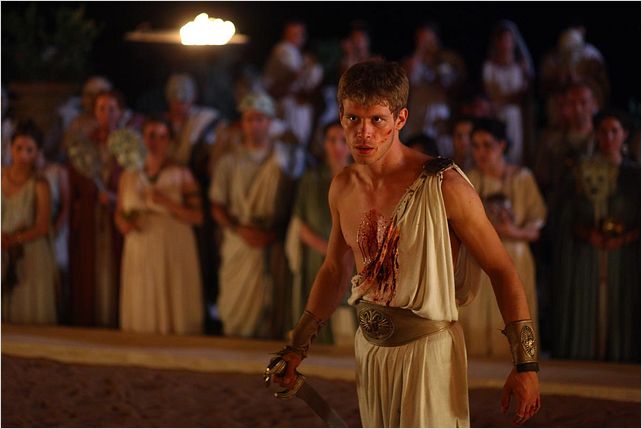
Judah: Blood and Sand...

It is so hard to make a new version of an established classic.  You deal with people's memories and emotions upon seeing a new film version of something that was made by craftsmen in front and behind the camera in an earlier time.  There is a reason why such films as Gone With the Wind or Lawrence of Arabia have not been remade (apart from a prohibitive cost...and the television sequel to the former, Scarlett, does not count).  The films were so good: the acting, the directing, the story, that to do them again seems to make a mockery of both original and remake.

Ben-Hur, apparently, is another story. 

If one is picky about things, we can point out that the 1959 version of Lew Wallace's Ben-Hur: A Tale of the Christ is technically a remake of the 1925 original.  I think both the Ramon Novarro and Charlton Heston versions of Ben-Hur are absolute masterpieces: thrilling, intelligent, respectful of the author's Judeo-Christian worldview (and both have astonishing chariot races, among the most spectacular and intense sequences in all film).  For many, the Heston version of Ben-Hur is THE version, never to be equaled again.  Certainly it is the better-known version of the Tale of the Christ, and the idea of there being another remake is almost blasphemous.

That having been said, we now find that there indeed HAS BEEN yet another version of General Wallace's massive epic novel of a Jewish prince-turned-slave-turned-Roman-turned-charioteer-turned-Christian and his fierce rivalry with Rome and his once-friend, the Roman Messala.  However, the 2010 television miniseries adaptation of Ben-Hur, as far as I know, never aired in the United States.  It was a product of the Canadian Broadcast Corporation (CBC) and only now is available on DVD.  Given the popularity and acclaim of both the 1925 and especially the 1959 version (it was the first and one of only three films to win a record-setting 11 Academy Awards, a record tied only by Titanic and The Lord of the Rings: The Return of the King), tackling a new version of Ben-Hur is daunting to say the least.  Even with the added advantages of both a longer playing time as well as the popularity of historic epics ranging from contemporary television series like Rome and Spartacus to The Borgias and Da Vinci's Demons down to Downton Abbey, we are talking about Ben-Hur, one of the most iconic movies in history.  The television version of Ben-Hur, while entertaining on its own, will never challenge either film version as THE Ben-Hur.


Judah Ben-Hur (Joseph Morgan) and Messala (Stephen Campbell Moore) have been lifelong friends.  The son of a Jewish merchant and the bastard son of a high Roman general love to race chariots in Jerusalem, ever since they were children (Eugene Simon and Toby Marlow as Judah & Messala respectively).  Messala is recalled to Rome to learn the ways of the conquerors, upsetting Judah and his family, mother Ruth (Alex Kingston) and sister Tirzah (Kristin Kreuk). 

Many years pass, and Messala, now a major Roman officer, returns to his old haunts with Pontius Pilate (Hugh Bonneville).  Judah in the interim has grown wealthier, but because he deals with Rome he is seen as a collaborator at best, traitor at worst.  Judah is merely trying to keep a delicate balance.  Messala wants Judah to serve as informer, but Judah won't.  A fortuitous accident with Judah knocking some tile down on Pontius is excuse enough for Messala to send the Hur family to prison, with Judah sent off to the galleys.  Here, he meets Quintus Arrius (Ray Winstone), a powerful military leader.  In a sea battle Arrius and Judah survive thanks to the Jewish slave, and the grateful Arrius takes Judah under his wing: if memory serves correct adopting him after training him to be a gladiator.

That's right: Judah trains in gladiatorial sport.

Judah, now Sextus Arrius, grows in strength and beauty.  His skills as Gladiator attract much attention: from Marcellus (James Faulkner), a friend of Quintus and confidant to Emperor Tiberius (Ben Cross), from the Emperor himself, and from Athene (Lucia Jimenez), Marcellus' mistress/ prostitute.  It helps that Marcellus just happens to be Messala's father, who only now is beginning to recognize his son in every way.  The Greek whore is powerfully attracted to the Jewish kid, and they begin an affair.  Tiberius wishes to be entertained, and Sextus fights to the death, but when his opponent refuses to kill Judah and instead attacks Tiberius, the Emperor, filled with rage, demands Quintus make amends.  With that, Quintus takes 'the pink bath', and with his father figure gone, Sextus now goes to Jerusalem to settle old scores.   


Neither Marcellus or Pontius are aware of Judah's true identity, though I'm not sure on Athene.  Judah now has a chance for revenge, thanks to Sheik Ilderim (Art Malik), who needs a driver for his chariots in a race.  Esther, who now has taken refuge with the zealot David Ben-Levi (Marc Warren), an old business associate of Judah's, sees the folly of revenge, but Judah will not be dissuaded.  With the Sheik's patronage, the Jew will race the Roman to a battle to the death. 

In case you were curious, Ben-Hur wins the race, managing to run over his once-friend in the process.  A crumpled and defeated Messala waits for Judah, while Pontius Pilate has the matter of an obnoxious Jewish carpenter to deal with.  As Jesus (Julian Casey) is led to Calvary, He tells Judah to 'forgive them, for they know not what they do.'  Judah and Messala reconcile at the end as the Roman's life slips away as result of his wounds.  Marcellus, still upset at his bastard son and having to pay a fortune to Sheik Ilderim, can only look upon his illegitimate child with disgust, but Athene, mistress of poisons, has one last gift for her Roman master.  Judah and Esther are united at last and all is well.


One particularly shocking aspect of Ben-Hur (out of many) is summed up by the advertisement: Rome made him a slave.  Revenge set him free (emphasis mine).  Those behind Ben-Hur appeared to miss the entire point of the novel: forgiveness of oneself and of those who did evil to them through Christ, is what 'set him free'.  The story hinges on the idea that at the end, Judah accepts that vengeance will not bring peace but the ideas of Jesus (loving your enemy, forgiving those who do you harm) and Christ Himself will.  Ben-Hur, on the other hand, holds that Judah is liberated by seeing his rival vanquished (as well as getting a lot of action on the side).  Granted, that at the end Christ's words are the trigger to having Judah go to a dying Messala, but it's curious that Messala asks for forgiveness rather than Judah offering it.

I think it has to do with the fact that Ben-Hur is more interested in copying such programs like Starz's Spartacus than in staying within the source material.  Spartacus in many ways is almost gloriously over-the-top in its sex and violence, where that was a selling point.  Ben-Hur has plenty of sex and violence, but somehow they seem to be a bit out of place.  I still don't know whether the line, "I didn't expect virginity along with virility, but I am honored to receive it," was meant to be cheesy or just came off as unintentionally hilarious.  However, with Athene's breasts popping out all over and the show's every effort to showcase Ben Morgan's beautiful form we get a lot of nudity.

Here is another element where Ben-Hur looks more like a pilot for a pay network than something for general audiences.  There is a great deal of sex and violence in Ben-Hur.  That in an of itself isn't particularly shocking.  What does shock is how much we get of both that sex and violence.  In regards to sex we get some strange turns.  While there has been a homosexual suggestion in the 1959 version (thanks to uncredited screenwriter Gore Vidal, who insists he put a gay subtext between Charlton Heston's Judah and Stephen Boyd's Messala), here we get the two of them in a bath as well as talk of a "Greek affliction" (whatever that meant).

In regards to the violence we get a spectacular number when Judah is in a gladiatorial fight for Tiberius pleasure.  While we don't get a lot of blood and gore (minus the fact that we do think this is a lost scene from something out of Spartacus the television show) the comparisons to the Kirk Douglas Spartacus is impossible to miss.  ANYONE who has seen the Stanley Kubrick epic will recognize the scene, right down to how it ends.  It was almost embarrassing to watch. 

In short, there is simply too much focus on the physical beauty of Ben Morgan and the violent clashes between Morgan and Messala's Stephen Campbell Moore than there is in the actual story (which has been wildly altered from anything anyone who saw either version remembers). 


Of all things that Ben-Hur either ditches or alters, it is the figure of Christ that is the most scandalous.  In every adaptation of Ben-Hur, the Christ character is there, but always a bit hidden.  The stage play had Christ appear as a shaft of pure white light.  In both film adaptations, we never see or hear Christ: He is shown as only a pair of hands in the 1925 version, or we see His back or shadow or in long shot where His face was obscured.  In the television version of Ben-Hur, we not only SEE Him but HEAR Him too!  In a total break with all tradition, the Christ character appears before us, and the fact that in truth Jesus had NO role in Ben-Hur: A Tale of the Christ makes His appearance even more bizarre.  Putting the topper on this ghastly decision in Alan Sharp's adaption is to give Christ as virtually His only line of dialogue, "Forgive them, for they know not what they do," on both occasions when they meet. 

Talk about taking the Lord's words out of context!

Hello, Sweetie!
If you weren't my son...

Turning to the performances I can't say that Joseph Morgan is a good actor.  He has a fine form (which Ben-Hur does its best to feature), but this Judah seems to be all glum and grouchy (even when things are going well for him).  Scowling his way through the film, about the only time Morgan shows even a hint of human emotion is when he sees the Sheik's horses (and that's near the end of Episode Two of the two-episode film).  Moore was much better as the bitter bastard son and Judah's rival, for at least he had a motivation in his actions.

Allow me now to be generous.  Longtime readers know how I feel about both Alex Kingston and the character she plays on Doctor Who: River Song (a vile piece of ...).  However, in Ben-Hur she did a good job as Ruth, Judah's mother, caring for both her 'boys' (even if she, like Kristin Kreuk's Tirzah was underused in the story).  However, allow me also to point out a few things.

Alex Kingston: born March 11, 1963 (Age: 50)
Joseph Morgan: born May 16, 1981 (Age: 32)
Matt Smith: born October 28, 1982 (Age: 30)

In Ben-Hur, Kingston plays the MOTHER to a man 18 years her junior.
On Doctor Who, Kingston plays the LOVER to a man 20 years her junior.

I'd like all the Riveristas, those who insist the River/Doctor story is this great love story, to remember that in real life, River is old enough to be the Doctor's MOTHER.  There's an odd, even grotesque incestuous feel whenever I watch Kingston and Smith together or when I'm asked to believe this 'The Doctor's One True Love' nonsense (as if believing the Doctor would be passionately in love with such a murderous narcissist like River Song when he could have had Romana, Leela, Jo Grant, or Sarah Jane Smith among others wasn't already nonsense in and of itself). 

Sorry, but any chance I get to trash River Song, you bet I'll take it.  Yet I digress.


I thought well of Ben Cross' Tiberius, though here Ben-Hur seemed to have lost its way and slipped into Gladiator territory.  Perhaps this was part of the overall problem with Ben-Hur: too much focus on the sword and sand spectacle to give much thought to the actions and motivations of the characters. 

Moving on to other aspects, if anyone expects the chariot race between Judah and Messala to be 'epic', be in for a disappointment.  I'll cut it some slack in that this is made-for-television, but it was not the chariot race we're used to (going around in circles), but a literal race from Point A to Point B.  The sea battle was well-made, though the CGI was pretty obvious too.  We also have the issue of taking too much time away to feature lots of skin, some blood, and situations that seem to come from another story altogether (Arrius' suicide, Athene's forced and not-so-forced bed hopping, for she also sleeps with Messala as well as his father and Judah) and hardly any focus on other things.

It may be the familiarity to other stories (Spartacus the film and television series primarily) that damns Ben-Hur from achieving greatness, let alone equal pairing with its more famous predecessors.  It wasn't terrible, and if one likes to see lots of sex and violence (with a little bit of Jesus in there), Ben-Hur might be worth the time.  However,  perhaps the fact that it could have been more is what disappointed me in the long run.

Sorry, Joe. I'll take Chuck anytime, no matter how pretty you are (except for your face, which seems to have this perpetual scowl)...

The General would not approve.


4/10

She's 50.
He's 30...
and younger than her TV son.
Just a thought.

Tuesday, October 15, 2013

Ben-Hur: A Tale of the Christ. A Review


BEN-HUR:
A TALE OF THE CHRIST
 (1925)

*As per tradition this review will not compare the original and the remake.  In another post there shall be comparisons.

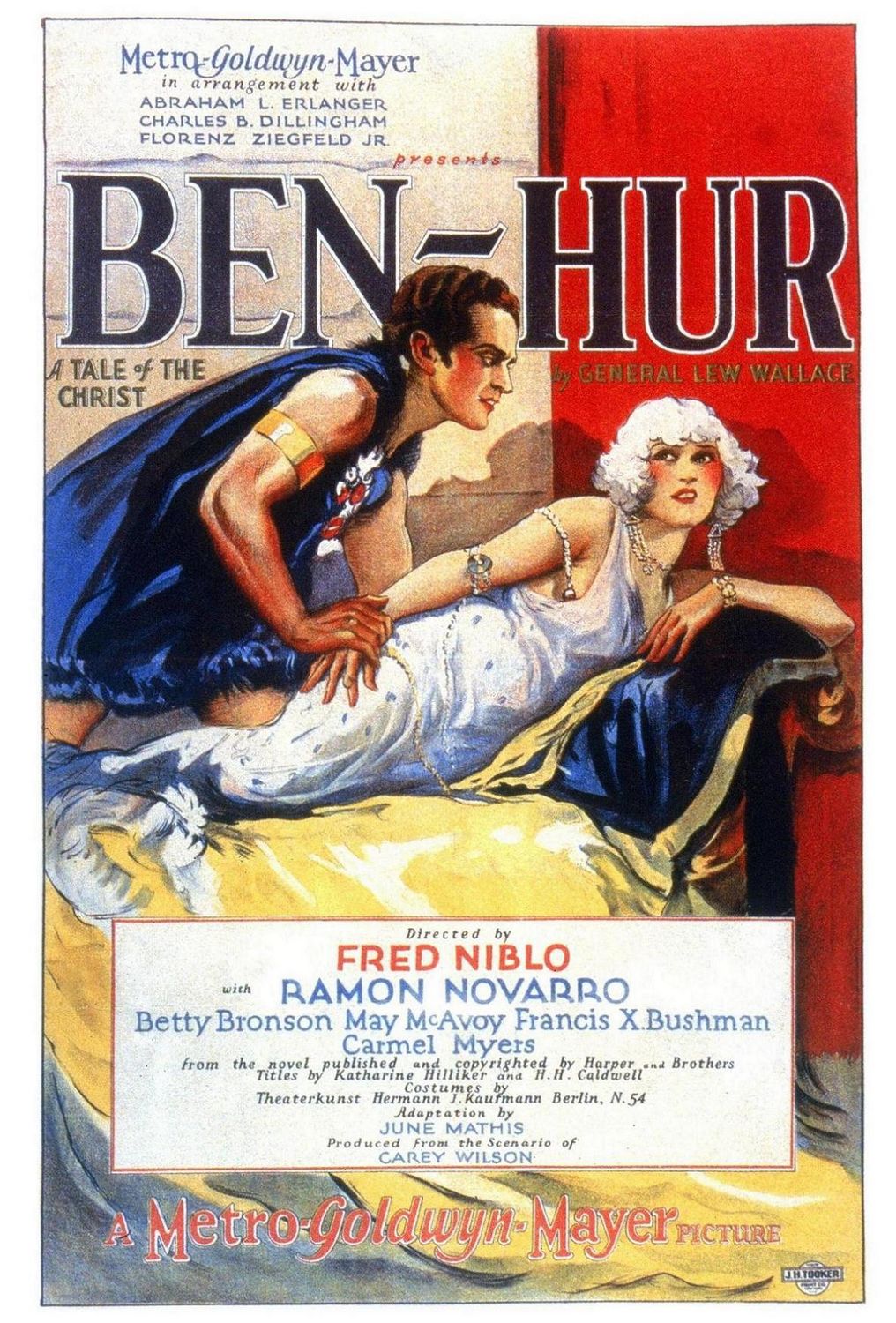
Ben-Hur had already been a wildly successful book and a long-running play when it made its feature-film debut.  It was a no-brainer as to why Ben-Hur held the public's attention.  How can one fail when you mix two things Americans love and are fascinated with: God and Sex (sometimes in that order).  The blending of topless dancing girls with the redemption Christ offers is a tantalizing combination to the American psyche.  Ben-Hur: A Tale of the Christ, is not as well-remembered as its spectacular 1959 remake that saved MGM (temporarily) from bankruptcy, so much so that I suspect many people are not aware that the Charlton Heston version is a remake at all.  Ben-Hur is in many ways as equal to the William Wyler epic, in some ways better, in some ways weaker.  On the whole, it is still grand entertainment that especially silent film lovers will enjoy.

I'm going to figure people know the general story of Ben-Hur (though again, never having read General Lew Wallace's novel I cannot vouch for how any version keeps to it): Judah Ben-Hur (Ramon Novarro) is a Jewish prince at the time Jesus of Nazareth is born.  Judah was friends with Messala (Francis X. Bushman), a high Roman officer, since childhood.  However, Messala believes that Rome has the divine right to conquer all the Earth, which does not sit well with the Jewish patriot Judah, who wishes his country free from Roman rule.  An accident involving the new Roman governor of Judea is the incident that Messala uses to arrest his former friend as well as Judah's mother and sister Miriam and Tirzah (Claire McDowell and Kathleen Key).  Only the loyal Hur slave Simonides (Nigel de Brulier) and his daughter Esther (May McAvoy) escape arrest.

Judah is condemned to the galleys, where again fortune takes a turn: an attack of pirates brings him and Roman General Quintus Arrius (Frank Currier) together.  Arrius at first wants to kill himself, but Judah saves him, and once they are rescued Arrius is so grateful he adopts Judah and makes him his heir.  Judah has earned fame and glory as a charioteer, but still he yearns for two things: to learn the fate of Miriam and Tirzah and revenge against Messala.  He returns to Judea, where Sheik Ilderim (Mitchell Lewis) convinces him to race his chariot against those of Messala.  Judah, while in Antioch, meets the mysterious Miser of Antioch, who is really Simonides and recognizes Judah.  The Miser, however, keeps silent, for if he acknowledges Judah he knows he and Esther will legally return to slavery for they belong to the House of Hur.  However, beautiful, sweet Esther, who has loved and been loved by Judah, convinces Simonides to reveal himself.

Judah's true identity (known in Antioch racing circles as The Unknown Jew) is learned by Iras the Egyptian (Carmel Myers), Messala's mistress, who attempts to seduce Judah but who fails due to his all-consuming obsession with Messala.  Once they meet on the chariot field, we know who won, but still Judah's heart is empty.  Miriam and Tirzah have now finally been released from prison, but they are lepers and thus cast-off from society.  In all this, the figure of Jesus the Christ comes in every so often, and Judah is convinced He is the Warrior King who will lead the Jews to victory.  He spends a fortune raising an army, but at Christ's crucifixion Judah at last realizes that victory will not be won by blood but by The Blood.  Now, with the Hur family reunited and healed, come to see the Christ will live in their hearts forever.

I cannot say that Ben-Hur is terrible.  Far from it: the film has much going for it.  First off, the story is quite Christ-centered.  We never see Christ (hearing Christ would be impossible in a silent film).  Instead, we only see his hands at the most, and the film opens with Christ's birth in a stable (though if one is to be historically accurate, the title cards reading 'It was the twenty-fourth day in December' is wrong since more than likely Christ was not born on Christmas).  In fact, we can see in Ben-Hur the parallel stories between these two nice Jewish boys.  We see Christ delivering The Sermon on the Mount and the Last Supper (plainly echoing Da Vinci's painting) and while both are beautifully filmed it is almost bizarre to see how director Fred Niblo went to hide His face, even at birth.  In this regard, we see that the subtitle of A Tale of the Christ is quite accurate. 

The cinematography is one of the glories of Ben-Hur.  The film has some beautiful early color sequences (all but one involving Christ) that render the scenes as beautiful as paintings.  The one color sequence that doesn't involve Jesus is when Judah rides in triumph after another chariot victory (and one sees quick glimpses of topless girls leading the parade).  Here, we're allowed to see how beautiful everything (and everyone) is.  The two big pieces in the film (the sea battle and the chariot race) are also beautifully filmed, and more importantly very exciting.  The editing is fast-paced in both sequences, and with regards with the chariot race itself it thrills in its rapid movement (in particular with two POV shots where we are underneath the chariots, an amazing feat for any period, let alone the 1920s).

The story is also quite rich.  The various subplots (Simonides, the Hur women) give the film a greater feel.  When Judah's mother and daughter come across a sleeping Judah, their tender goodbye is quite moving.  Similarly, when Judah and Esther meet it is also quite pretty, even cute.  Even the story of Iras adds something to the story: the temptress who fails to tempt, and Judah's desire to serve as the Lord's Army general also lends Ben-Hur a more fascinating secondary story.

One also marvels at some of the special effects, such as how Christ heals the Hur women from leprosy or the Announcement of Christ's birth.  When we think when the film was made, it makes it all even more extraordinary.

What Ben-Hur has as a flaw is that is has what most silent films have: acting that today is seen as rather broad.  Novarro is rather overenthusiastic as the title character, and while he started well by the end he almost seemed to be whooping it up to his full abilities.  It is a bit hammy but in his defense his performance isn't unexpected in the realm of silent films.  Few actors of the silent era could be called subtle: Garbo comes quickly to mind, but few others.  McAvoy's Esther is all so prim and pretty, but Bushman did the best of the main cast as the brutish Roman.  I also thought well of de Brulier's Simonides, having to struggle between being loyal to the Hur family and his desire to keep Esther free.

Myer's Iras is a bit of a mixed bag: on one level she lends a great deal of sex to the film, but on the other when her lover is killed, one isn't sure if she is crying or laughing given her performance.  Then again, perhaps we are not meant to know for sure.  I could also add that some of the title sequences were equally overwrought ("If you are as slow tomorrow as you are in lovemaking tonight, Messala could race snails and win").

For this film, Carl Davis' score is beautiful, lending the film greater power.  However, in what seems strange is that while Ben-Hur is almost two-and-a-half hours, to me it felt longer and in some moments dragged. 

On the whole, Ben-Hur: A Tale of the Christ is a great film.  It does feel a bit long and some of the performances now look rather silly, almost comical.  However, the film holds up extremely well with some thrilling sequences.  It has meaning and power...but with a little sex in it. 

DECISION: A- 

Thursday, July 28, 2011

Ben-Hur (1959): A Review


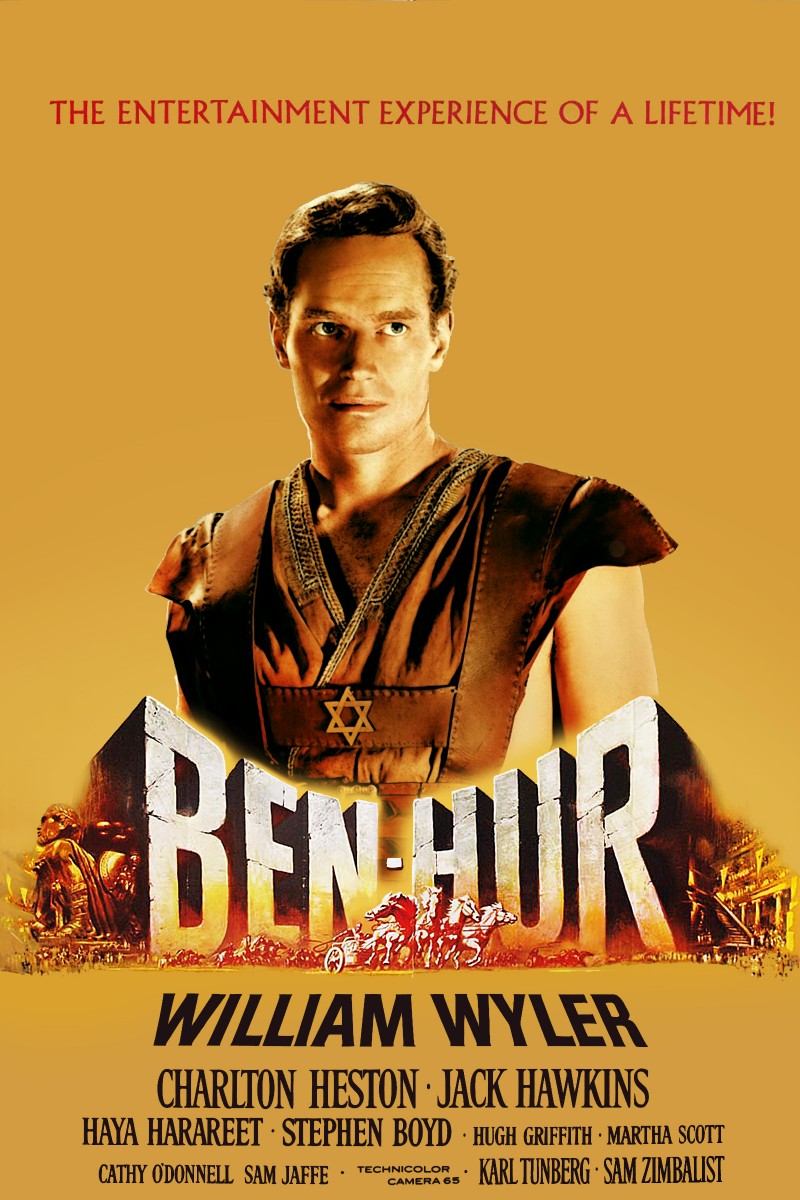
BEN-HUR (1959)

Our Chariots Await...

In an age where epic films were all the rage, few can hold themselves to Ben-Hur's equal. It isn't just in the grandness, the vastness of the film itself. It is also that, unlike other big films, there is a real personal story within Ben-Hur, a human drama that, stripped of its more grand features, is remarkably intimate.

While I know today sprawling films like Ben-Hur are distrusted, even dismissed because of their sheer size, when watching the film one is struck at the intelligence behind it, the themes it touches on, and putting the spectacle aside, what a remarkably deep film Ben-Hur actually is.  At heart, Ben-Hur is a story about freedom: physical and spiritual, forgiveness versus vengeance, and the cost of staying true to yourself.  It also has one of the greatest action sequences in film history.

It is around the time of Christ, when the land known as Judea is under Roman occupation.  Messala (Stephen Boyd) is the new Roman commander in Jerusalem.  He is not a stranger to the land, having spent his youth there.  He had an extremely close friend there: a Jewish prince, Judah Ben-Hur (Charlton Heston).  Judah is thrilled to see his old friend back, but in the ensuing years their views have altered them: Messala believes in Roman supremacy over the Earth while Judah strongly believes the Jewish people should be free.  Messala wants Judah to collaborate with him and give him the names of Jews opposed to Roman rule.  Judah refuses.  Thus, they that were once the deepest of friends turn into the bitterest of enemies. 

On the arrival of the new Governor of Judea, Judah's sister Tirzah (Cathy O'Donnell) accidentally causes tiles from their palace to fall on him.  She, along with Judah and their mother Miriam (Martha Scott) are arrested.  Messala, knowing they are innocent, decides to take revenge by condemning Judah to a slave ship and the women to imprisonment.  Judah attempts escape and nearly kills Messala, but cannot do it.  Thus, it's off to the galleys.

While as a slave, Judah comes into contact with Quintus Arrius (Jack Hawkins), a Consul of the Empire.  In an epic battle, Judah saves Arrius' life and both fall overboard.  A Roman ship rescues them, and a grateful Arrius not only sees to Judah's freedom but adopts him as his son.

Judah now is with the cream of Roman society, meeting all kinds of important people, including the new Governor of Judea, Pontius Pilate (Frank Thring).  Still, Judah seeks vengeance against Messala and a return to his homeland, to his family, and to Esther (Haya Harareet), the beautiful daughter of the Hur family servant Simonides (Sam Jaffe).  Arrius reluctantly allows him leave to return.

One in Judea, he comes across Balthasar (Findlay Currie),  a wise man from the East who is searching for a man whom he once brought gifts to as a child.  Balthasar is staying with Sheik Ilderim (Hugh Griffith), a rich Arab whose main ambition is to race his chariot against the greatest charioteer in Judea, one Messala.  Judah's reputation as a charioteer preceeds him, and he sees this as his chance to take revenge (and also sets up one of the most iconic moments in film history).  They race, Judah wins, Messala is crushed (literally), but Judah learns what both Esther and Messala know: Tirzah and Miriam are now in the Valley of Lepers. 

Judah's revenge is still unsatisfied, but Esther has turned to the teachings of a young rabbi, who teaches that one should "love your enemy and do good to those who harm you".  Judah will hear none of this, and he is determined to bring his family out of the Valley.  He does so, with a hope that the young rabbi may cure them.  However, the group arrives in Jerusalem just as Pontius Pilate is condemning the Teacher to death.  Upon the Cross, they look in sorrow.  However, after the storm that strikes Jerusalem upon the Teacher's death, there is healing and ultimately forgiveness in the House of Hur.

In truth, you can reduce all of Ben-Hur to three lines: A Prince who became a Slave, a Slave who became a Charioteer, a Charioteer who defied an Empire. 

Director William Wyler made two jokes about Ben-Hur.  One, that he wanted to see if he could make a Cecil B. DeMille picture, and two, that it took a Jew to make a good film about Jesus.  He wasn't kidding on either count. Wyler kept the film moving so brilliantly that one never notices how long Ben-Hur is: an astonishing three and a half hours long (not counting overture and entre'act).  However, nothing in Ben-Hur ever appears gratuitous or unimportant, especially considering how Wyler managed to combine the spectacle with the intimate.   He not only managed to do that, but to connect the story of Judah with that of Christ, almost having them parallel each other.  Wyler had the main story (that of Judah Ben-Hur) as well as that of Christ.  In Wyler's genius, he brought in characters from both their lives in the film to let us know that eventually Judah and Jesus would meet more than once. 

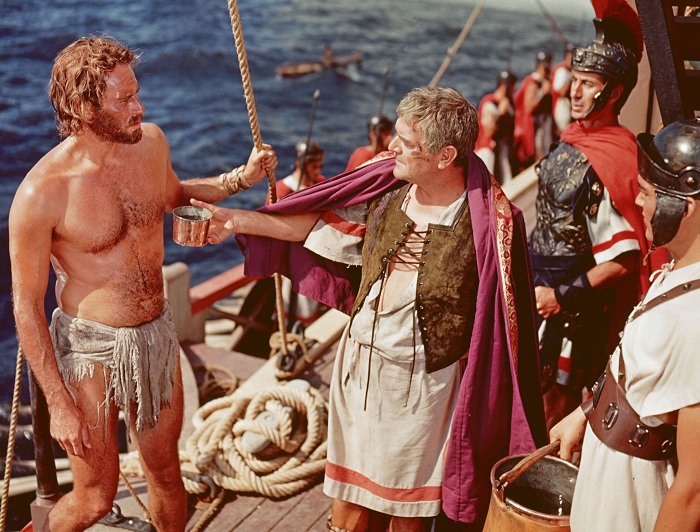
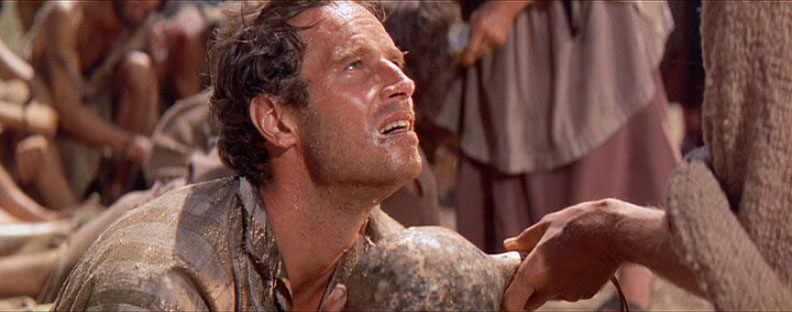
For example, in the prologue we have the Presentation of the Magi to the Christ Child.  Among them is Balthasar.  Once we get to where Judah returns to Judea, we see Balthasar again.  Thus, we know that the story of Christ will keep coming into contact with that of Judah.  We should already know this because from time to time in Ben-Hur, we see the idea of Yeshua Ben-Yosef (though we never see His face or hear His voice).  Instead, soft organ music plays when His presence is on screen.  Judah and Christ had already come into contact when the former is being led to the galley ships.  In an unnamed town, Judah is desperate for water but the Romans are under orders to deny him.  In his despair, Judah begs God to help.  At this point, we hear the soft music and a hand that brings him water. 

In this moving scene, it is Wyler's direction that is at the height of its power.  The Roman commands this man to stop giving Judah water and the strange figure rises quickly.  Without seeing the stranger's face, the Roman soon starts to back away, on occasion turning to look at Him with a strange mixture of fear and awe.  We in the audience know the stranger is suppose to be Christ, and thus we can understand the Roman's reaction, but it is Wyler who directs the scene so well.  If one looks at it, there are no strong words, there are no strong actions other than Jesus rising quickly from the ground.  Yet we still feel the emotional impact of this pagan coming into contact with the Christ.


Wyler's direction of people is brilliant throughout Ben-Hur, and is even more impressive given the variety of emotions the film goes through.   There are moments of intense action (the sea battle and the legendary chariot race), but there are also moments of intimacy.  Take the love story between Judah and Esther.  Here, Wyler directs the lovers to be gentle towards each other, even perhaps a bit hesitant.  The same goes for when Miriam and Tirzah go back to their home after their release.  Only Esther knows they are alive, but Wyler does not show the effects of leprosy on the Hur women.  This is all done by suggestion: the lighting (or lack thereof), keeping them in the shadows, the reaction in Esther's face to what she has discovered.  We even have moments of comedy through Sheik Ilderim, a lusty man who loves his horses and is a general bon vivant.

Ben-Hur manages to sweep you into both its grandness and its intimacy, and William Wyler is the central force in that.  He directed all his actors so well, and their performances in the film are some of the best in their careers.  Heston, curiously, was not the first choice to play Judah Ben-Hur, but now it doesn't seem possible that anyone else could have done it.  He is imposing in the action scenes (as he usually is), but in the love scenes between him and Harareet he shows a remarkable tenderness that he isn't known for.  One of his best scenes is actually not the chariot race, but right after.  He comes to a dying Messala and realizes that even while he has defeated his bitter enemy, he still has not found the peace he expected from his revenge.  He goes into the now-empty racetrack, aware of his hollow victory.  It is a beautiful scene.

Credit should also go to Boyd's Messala, a man who we see evolve from a good friend into a bitter enemy.  A good actor understands that a villain never sees himself as a villain, and Messala doesn't see himself as evil but as a Roman on the make.  If it means getting even with a former friend and member of high Judean society to teach the population a lesson, so be it.  Griffith is also a delight as the Sheik who persuades Judah that by running in the chariot race he can stamp the arrogance of the Romans--to be defeated by a Jew is a thought too rich for him to pass up (side note: it is nice to see a film where Arab and Jew work together, and where they show respect to each other).  Even the smaller parts: Jaffe's loyal servant and Currie's Wise Man, add to the great performances.  Harareet perhaps is a bit too gentle as Esther, but her scenes with Heston are done so well that you believe they have loved each other for a long time.


There is an element in Ben-Hur that I have not mentioned but that without it the film would not be as brilliant as it is.  That is Miklos Rozsa's score: among the greatest ever made for motion pictures.  Again and again, it is Rozsa's score that sells every scene where music is heard: starting from the very beginning where we see the Presentation of the Magi (where the music enhances the gentleness of the birth of the Christ Child as well as reverence for this monumental event) and then to the gigantic opening music where we know THIS will be an epic, right down to the love theme between Judah and Esther, the battle on the sea, the rowing music, the triumphant arrival into Rome, the ghastly horror of Miriam and Tirzah's leprosy and the restoration of the Hur family.  Few scores have captured both the grandness and intimacy of a story, but Miklos Rozsa's music for Ben-Hur does it so well and so consistently that we must marvel at just how one film score can be as powerful and overwhelming as the movie itself.   

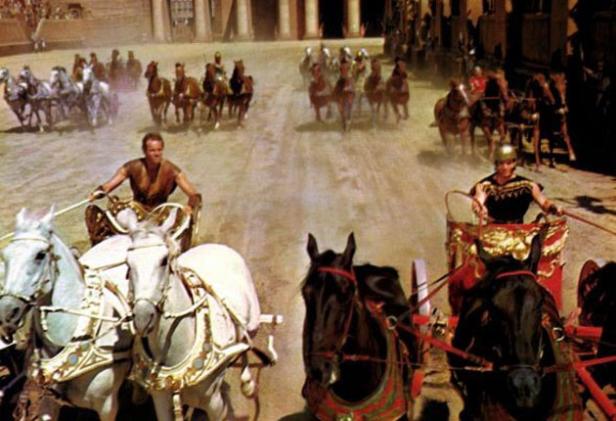
Curiously, the one major scene in Ben-Hur that does not have music is perhaps the most legendary scene in the film (and one of the most legendary in film history): the epic chariot race.  The film has been building up to this moment, not just in terms of action but in terms of story: the fierce rivals will finally confront each other.  By this time into Ben-Hur, we know everything there is to know about the characters, their motivations, and their goals.  Once we start the race, we get a thrilling sequence that moves (in every sense of the word).  Wyler gets the camera close to the action, and we get brilliant stunt work under the direction of Yakima Canutt.  In those ten minutes or so the race never lets up and the audience is completely caught up in the excitement and terror of this battle between Judah and Messala.  The best compliment that could be given to the chariot race is that it was all done live: no great technical tricks, few stunt doubles, so the scene becomes thoroughly real.

As much as Ben-Hur has great action scenes, it also has a compelling personal story.  It is about ideas: in fact, Messala tells Judah early in the film, "How do you fight an idea?"  The idea of staying true to your principles and to yourself (note that Judah was a secular Jew and later had no problem dressing as a Roman but at heart his loyalty still lay with his people), how truly an occupier and the occupied cannot be friends so long as one holds himself master and the other slave.  We also have the themes of revenge versus redemption, best captured between the two Judean princes (one of the House of Hur, the other of the House of David), of two Jewish freedom fighters (one political, one spiritual), one who wins a Crown of Laurels, the other a Crown of Thorns.  The brilliance of Ben-Hur isn't just with the action (although those in themselves make it brilliant), but also that the film is highly intelligent in how it deals with the ideas of love, revenge, justice, and mercy. 

There are other things to mention.  All the elements in Ben-Hur work: Elizabeth Haffenden's costumes (from the simplicity of Christ's robes through the grand Roman robes), the sets by Edward Carfagno, William A. Horning, and Hugh Hunt, and Robert L. Surtees' brilliant cinematography.  If there's anything I would object to, it is Griffith's frightful make-up work: not only is it excessively dark, but you can tell where they stopped making him up.  However, that's really a tiny complaint to a brilliant film like Ben-Hur.

Finally, I'd like to address the point of any gay subtext in Ben-Hur.  Gore Vidal (who did not receive credit for his work on the screenplay) insists that there was a gay subtext between Messala and Judah and that it was Judah's 'rejection' of Messala that turned him into a villain.  After having seen the film, more than once, whatever gay subtext there might be is thoroughly lost on me.  If one wants to read that in the film, they are free to do so.  I did not see it and am puzzled as to why Gore Vidal insists there is one. 

What Ben-Hur is in the long run is an intimate epic (which is not an oxymoron).  We have the vastness of the story as well as at its core a human story about forgiveness in spite of terrible things.  It is truly an epic film about ideas.  A great film that still thrills, Ben-Hur simply runs away with it.

1960 Best Picture: The Apartment
There are more Best Picture reviews as well as Essentials.