Showing posts with label Television Miniseries. Show all posts

Saturday, May 16, 2026

Catherine the Great: The 2019 Miniseries

CATHERINE THE GREAT

In truth, the Russian sovereign Catherine II was not Russian but German. History, however, has intertwined this minor German princess as Catherine the Great, Czarina and Autocrat of All the Russias. She has been the subject of many films and television projects. In 2019, Dame Helen Mirren returned to her own Russian roots to portray this legendary historic figure. Catherine the Great has a lot of sex and appears to want to shock with its four-letter words. It is not bad but far from what it could have been.

Two years after the coup that brought her to power, Empress Catherine II (Mirren) still has to contend with forces that could bring her down. There is the mysterious "Prisoner Number One", who may have a legitimate claim to the Russian throne. There is the mysterious soldier, Mirovich (Lucas Englander), loyal to Prisoner Number One. 

Then there is Count Grigory Orlov (Richard Roxburgh). He is one of the men who helped her overthrow her loutish husband, Peter III. He is also Catherine's current lover. Grigory and his brother Alexei (Kevin R. McNally) always remind her that they put her on the throne. The suggestion is that they can pull her off. The Orlov Brothers scheme and scheme away, making snide remarks about everyone out of earshot. That includes the newest member of Court. It is another Grigory: Grigory Potemkin (Jason Clarke). Brash, daring and belligerent, Potemkin is quickly besotted by our Autocrat. 

That does not stop him from schtupping her BFF, Countess Bruce (Gina McKee). Eventually, Potemkin bends the royal ear. He also bends other things for both Mother Russias. One person who cannot bend is the frustrated heir, Prince Paul (Joseph Quinn). He still hero worships his late father. He also detests his mother and is the only man in Russia who does not see that his wife, Natalia (Georgina Beedle) is screwing Paul's best friend, Count Razumovsky (Phil Dunster). 

Orlov soon becomes indispensable to Her Majesty inside and outside the royal bedchamber. He leads her armies to triumphs in Crimea and against the Turks. He also is imperious, haughty and prone to anger against all his enemies. The Orlovs are bitter foes. He is able to outmaneuver them. The Czarevitch is another enemy, though to be fair Paul is a very bitter boy, trashing about hither and yon. As Catherine continues her struggle to stay in power over Russia and the various men in her life, she fails to see how her need for power has made her abandon her early liberalism. The woman who once corresponded with Voltaire now burns his books. Personal tragedy hits this great love story of Catherine and Grigory, but will she get the heir that she wants or the one who manages to stay?

I think Catherine the Great thinks itself daring with all the sex scenes and f-bombs going off all over the place. I figure that Catherine and her Court were not immune from letting out a torrent of vulgarities and bed-hopping back in the day. However, Catherine the Great seemed oddly fixated on the sex and swearing and less on the political machinations within the Winter Palace.

Screenwriter Nigel Williams and director Philip Martin have a very surface level look at this debauched world. Episode One of the four-episode miniseries ends with a drag ball. The sight of the Orlov Brothers in dresses and wigs while Catherine and Potemkin are cutting a little rug to Russian music is a sight to behold. It is a curious sight though, not helped by an effort at a Barry Lyndon-like cinematography.

It is curious that Catherine the Great is dominated by a lot of voiceovers of Mirren's Catherine and Clarke's Potemkin reading their letters to each other. We get many such scenes and the added scenes of riders passing those letters to and from our lovers. 

Somehow, Catherine the Great does not seem all that interested in things outside the nocturnal. Events like Pugachev's Rebellion or the killing of the unfortunate Prisoner Number One (Czar Ivan VI) do not seem to register. They happen almost because they have to. The miniseries just does not spend much if any time on them.

Take Pugachev (Paul Kaye). He pops in for a bit in Episode One, then a bit more in Episode Two. In what I figure Catherine the Great intended as a great moment Her Majesty appears before Pugachev's followers while he rants in a cage. Here, the peasants suddenly began to kowtow to the Czarina. Why? It does not matter. 


Catherine the Great is worth only what Dame Helen Mirren brings to the role. She brings a great mix of haughtiness and vulnerability to our Mother Russia. She is coy and playful when Matushka (Grigory's pet name for the Empress) is with her Grishenka (her nickname for Potemkin). She can also be ruthless with him when needed. "I own you. Don't forget that", she reminds her paramour, enraged at having been essentially scolded before her council. Mirren shifts so well into the Czarina's mercurial nature. She makes her efforts to build a rapport with Paul and her grandson Alexander believable, even as she plots against the former. 

The rest of the cast is not terrible. They are just hampered by their one-note roles. Jason Clarke is an interesting choice as the brash, arrogant Potemkin. I thought all he did was shout and bluster. Granted, that is how the character was. After a while, though, that grows boring. The same goes for Kevin McNally and Richard Roxburgh as Alexie and Grigory Orlov. Almost all their scenes consisted of Alexie telling Grigory not to f-it up. Whether it was Grigory's stud status or a political negotiation, it was pretty much the same. Joseph Quinn's Czarevitch Paul was better, but he too did nothing but skulk about and whine. 

Again, I get that is how the role was written and directed. Again, it gets rote.

Catherine the Great does have some beautiful moments. The battle of Ushakov is a standout. The costumes and sets are nice. 

Ultimately though, Catherine the Great failed to live up to its title. It was more Catherine the OK. 

Tuesday, February 17, 2026

Liz: The Elizabeth Taylor Story. The Television Miniseries

LIZ: THE ELIZABETH TAYLOR STORY

Dame Elizabeth Taylor simply hated the nickname "Liz". She especially hated when she and her fifth and sixth husband Richard Burton were referred to as "Liz and Dick". Such a detail would not matter to the production crew of Liz: The Elizabeth Taylor Story. While the lead performance is effective, Liz fails to capture the full scope of her stardom and genuine talent.

Young Elizabeth Taylor is set on being an actress and not a movie star. Her mother Sara (Christine Healy) has a powerful ally in movie gossip queen Hedda Hopper (Katharine Helmond). It is Hopper that brings Taylor to MGM. While Elizabeth is American by citizenship, she was born and spent her early years in the United Kingdom. As such, Elizabeth speaks with a British accent, which is perfect for the role of an English girl in National Velvet. Her violet eyes and elegant manner help too. 

Soon, Taylor (Sherilyn Fenn) blossoms into a glorious, ravishing beauty. She becomes good friends with two other young actors. One is the sweet-natured Debbie Reynolds (Judith Jones). The other is brooding and gloriously ravishing beauty Montgomery Clift (William McNamara). Monty loves Liz, but only platonically. She is slightly disappointed but accepts him for himself. She also listens and studies his acting methods. 

I do not think that Clift ever gave her marriage advise. If he did, it did not work. We go through two marriages in Liz quickly. The first is to young Hilton heir Conrad "Nicky" Hilton (Eric Gustavson), a bullying and abusive drunk. The second is the older English actor Michael Wilding (Nigel Havers). He is steady but a bit dull. He also is convinced that Taylor is getting too close to her Giant costar Rock Hudson (Dan McVicar). 

Now on her second divorce, third time seems the charm with outrageous film and theater producer Mike Todd (Ray Wise). Sadly, Todd leaves her a widow. For comfort, she turns to "that Fisher man" as Mama Sara calls him. Eddie Fisher (Cory Parker) comforts the Widow Todd a little too intimately and slips from Debbie Reynolds' first husband to Elizabeth Taylor's fourth.

Now comes Husband Number Five: Richard Burton (Angus MacFayden). This lusty lush Welshman wins her during the filming of Cleopatra. Their extramarital affair became the greatest public scandal of the age. As the Battling Burtons boozed their way through life, something eventually had to give. A few more marriages, a few stints in rehab, and a new mission as an AIDS activist all conclude our story.

I genuinely do not know if Liz: The Elizabeth Taylor Story can be called "the Elizabeth Taylor Story". I say this because so much of Liz is really about Liz and Dick. Husband Number Seven, Senator John Warner, gets pretty much ignored. Granted, we do see their relationship. However, the end of it came from seeing a newspaper headline. Come to think of it, her second divorce from Richard Burton, I think, also came via headline. 

Taylor's first marriage to Conrad "Nicky" Hilton also went pretty fast in Liz. It went from marriage to spousal abuse to divorce probably within ten minutes if that. 

As I think more on Liz, I think that the film did Dame Elizabeth a terrible disservice. There is so much focus on her myriad marriages that one forgets that Taylor was more than her many romantic escapades. I figure that there was a reason why director Kevin Connor and screenwriter Burr Douglas opted not to touch on Taylor's screen performances. Taylor remained a star for decades. However, I do not think we got a hint of any of her performances. We saw her in costume for Giant, Cleopatra and Who's Afraid of Virginia Woolf? but apart from that, Liz was all about glitz. We never saw her actually act save for perhaps a bit of Cleopatra. Even that was just set-up for the Burton-Taylor affair. 

Liz does not make a case for what exactly made Elizabeth Taylor such a legendary figure within her own lifetime. We never did get what made Taylor tick. What we got was beautiful people wearing beautiful costumes and sometimes making spectacles of themselves. 


Curiously, Liz is an adaptation of C. David Heymann's biography Liz: An Intimate Biography of Elizabeth Taylor. I say "curiously" because Liz left off some vital moments. During Cleopatra's long production, Taylor came dangerously close to dying when a viral infection turned into pneumonia. A last-minute tracheotomy saved her life. Yet I do not remember that being part of Liz. It might have been mentioned. However, if it was, it left little impression.

As stated, so much of Liz revolves around Burton and Taylor that one is surprised Liz just didn't stick with that. Two other television biopics were built entirely around the Burton-Taylor marriages: one being good, the other being dreadful. Liz is somewhere in the middle. Nowhere near as tawdry and laughable as Liz & Dick yet not as intelligent as Burton and Taylor

In terms of acting, Liz is all over the place. I have long considered Sherilynn Fenn one of the most beautiful women that I have ever seen. She is simply gorgeous as Elizabeth Taylor. Fenn astonishes the viewer with her beauty and grace on screen. Her Elizabeth Taylor comes across as both strong and vulnerable, a woman carried by passion. She also has a moral core despite her reputation as a black widow and femme fatale. 

Taylor early in her liaison with Burton says that she will willingly be his mistress. Later on, though, she is enraged when a still-married Burton proposes to her. "You can have a wife and a mistress. You cannot have a wife and a fiancĂ©e", she angrily tells him. Fenn as Taylor portrays a woman who comes into her own. A particularly surprising moment is when attempting to campaign for Warner, she takes offense at some of his positions. Taylor audibly boos his stump speech, shocking the donors. 

Sherilynn Fenn elevates Liz. Some of her fellow actors match her in acting. Some do not. William McNamara's role as Montgomery Clift is small. However, he does well even if McNamara does not look much like Monty. Nigel Havers' Michael Wilding was fine. He was not particularly great nor was he embarrassing himself. To be fair, there was an unintentionally amusing moment when Wilding storms onto the Marfa, Texas Giant location. He says that he flew in from El Paso to see what was going on between Taylor and Hudson. On his arrival, Havers' Wilding looks like a British butler.

Husband Number Three was played by Ray Wise. I found his take on Mike Todd to be really broad bordering on cartoonish. I give a little leeway in that Todd in real life was rather flashy. "You've been married to a kid and an old man", Todd tells Taylor when he first pushes himself into her life. I do not know if Liz intended to echo Rhett Butler's line to Scarlett O'Hara in Gone with the Wind

Wise at least was better than the actors who played Rock Hudson and James Dean. They did not look or sound like either of her Giant costars. They looked and sounded like random men that just wandered onto the Liz set and got thrown in there. 

And then there is Angus MacFayden's Richard Burton. As stated, the bulk of Liz centers around this notorious relationship. Therefore, MacFayden gets the lion's share of attention in the television miniseries.

MacFayden sounds fine, approximating Burton's luxurious Welsh tones. However, he also seemed to relish devouring the scenery at every single scene. There was no calmness to MacFayden's Burton. He was broad no matter what the situation. To be fair, Richard Burton could also devour the scenery with naked abandon both on screen and in real life. As such, I cannot fault Angus MacFayden for sometimes going over-the-top.

There was one moment when it looked unclear whether MacFayden and Fenn were playing their characters or the actors. It is during the section that covers the Who's Afraid of Virginia Woolf? production. MacFayden and Fenn are dressed as George and Martha from the film. However, Liz soon starts blending things to where one is unsure if they are attempting to rehearse Who's Afraid of Virginia Woolf? or actually live it out. It is interesting viewing. It is also a bit muddled.

"There's only one Elizabeth Taylor", her eighth and final husband Larry Fortensky observes at the end of Liz. Replies Taylor, "Thank heaven for that". Liz: The Elizabeth Taylor Story wanted to cover the breath of her life from her National Velvet appearance to 1992 (Taylor dying in 2011). With so much attention focused on her relationship with Richard Burton, something got lost in the miniseries. 

Elizabeth Taylor. 

1932-2011


5/10

Wednesday, November 12, 2025

Henry VIII: The 2003 Television Miniseries

HENRY VIII

Despite having only five monarchs in its dynasty the Tudor era is fascinating to film and television productions. Out of those five only two ever get those two productions. When was the last time anyone saw an Edward VI or Mary I biopic? The long reign of the lusty King Henry VIII continues to be big entertainment. Henry VIII, the 2003 television miniseries, perhaps spends too much time with one of our unfortunate Mrs. Tudors to the detriment of her successors. However, good performances and production design lift up Henry VIII to solid entertainment. 

The first part of Henry VIII is dominated by the love triangle at the heart of "The King's Great Matter". Henry VIII (Ray Winstone) is desperate for a male heir. His loyal wife Catherine of Aragon (Assumpta Serna), widow of his brother Arthur, has managed only one daughter, Mary (Laura Belmont). Mindful of his father's warning to bear a son to keep the dynasty and power going, the King despairs. He also despairs for the attention of the beautiful Anne Boleyn (Helena Bonham Carter). Mistress Anne will not, however, become Henry's mistress. She is also enraged that her own betrothal was overthrown by Henry's chancellor Cardinal Wolsey (David Suchet).

Mistress Anne, however, is too much for Henry to resist. He will discard Catherine for Anne, even if he has to destroy his kingdom and tear Christendom in two to do so. While Woolsey ultimately fails in his mission, Henry is still able to split from both the Catholic Church and Queen Catherine. Sadly, Queen Anne manages to pop out only yet another daughter, Elizabeth. With that, her time is up.


The second half is taken up, minus one uprising, by the fates and fortunes of Mrs. Tudors Three to Six. Jane Seymour (Emilia Fox) manages to pop out the long-awaited son, Edward. Apparently, Henry had to smack Jane around a bit to do that. Jane dies, leaving a vacancy for Queen of England. Henry's loyal chancellor Thomas Cromwell (Danny Webb) finagles a wedding to German duchess Anne of Cleves (Pia Gerard). This German heretic gets probably not even ten minutes of screentime, and I think I'm being generous. Next up is Catherine Howard (Emily Blunt), the tartish niece of Henry's courtier the Duke of Norfolk (Mark Strong). Catherine is no virgin on her wedding night, but Henry is too much in love/lust to notice or care. She will be his second spring, until he discovered her liaisons with handsome courtier Thomas Culpepper (Joseph Morgan). Howard's fall means the imprisonment of Norfolk and Cromwell's execution. 

At last, Henry turns to respectable and twice-widowed Catherine Parr (Claire Holman). She is witty and a good companion for the ailing King. She is also a tool of the Seymour brothers, courtiers who are also Prince Edward's uncles. They bide their time for two things. The first is to position themselves as regents for the future Edward VI. The second is for one of them to marry Catherine Parr, which he had always wanted. How will Henry VIII close out his reign?

Henry VIII is entertaining, with sumptuous costuming and sets that befit our noble subject. Rob Lane's music is also appropriate. It is grand and elegant.

A lot of the acting is quite solid in Henry VIII. This is one of the first if not the first major appearance of Emily Blunt. She makes Catherine Howard into a tragic figure. Catherine Howard is, like Henry, a lustful figure. However, she is also a pawn in the various machinations of her powerful family. She is quite desirous when having an affair. Yet, her end has Blunt give a deeply moving portrait of this foolish, tragic young girl. As she stands on the scaffold, making her final statement, I think audiences will feel genuine sympathy for this misguided strumpet.

Helena Bonham Carter is an old hand at costume dramas. Here, her Mistress Anne is feisty and strong. She is able to stand up to just about everyone. Anne is able to stand up to Henry, up to a point. She also shares sharp words with Serna's Queen Catherine. Like Blunt, Carter excels in showing Anne's courage against her accusers. She is even able to show dismissiveness towards their cavalier and arrogant manner. When facing her own execution, Carter again like Blunt, is moving in her performance.

Serna herself has several strong moments. Of particular note is when she is made to appear before the kangaroo court set to declare her marriage illegitimate. Defending herself as a good, loyal wife, Serna also showcases Catherine of Aragon's quiet strength.

The men are not short-changed either. David Suchet, best known as Agatha Christie's master sleuth Hercule Poirot, does fine work as Cardinal Woolsey. He is cold and unfeeling when torturing Charles Dance's rebellious Duke of Buckingham. He also shows how he is both able to match wits with Carter's Anne Boleyn and see that she is more than his match. Suchet's final scene where he pleads for his life as the guards take him away show Woolsey crumbling.


In a subplot, Sean Bean pops up as Robert Aske, a formerly loyal lieutenant outraged at the Disillusion of the Monasteries and the ensuing violence. We open the second half of Henry VIII with the violent reprisals against the monks and nuns by the state. This arouses Bean's Aske to act against this brutality. Bean expresses that fire and righteous anger. It makes the ultimately false show of friendship by Henry all the more tragic for Aske's final fate. Mark Strong's arrogant and scheming Duke of Norfolk shows his villainy and manipulation. 

In the central role of Henry Tudor, I am of mixed opinion. I struggled initially to see Ray Winstone as our virile young or even middle-aged monarch. He seemed a bit too working-class to be imagined as a regal figure. He did grow on me in the role, however. I think his large frame felt more natural as Henry grew older. However, his gravelly voice did seem a bit at odds with how I see this not-so-merry monarch.


Where I think Henry VIII does go wrong is in where it chooses to focus on. The saga of Henry and Anne Boleyn has been chronicled so many times that one wonders if Henry VIII could have done one of two things. I imagine focusing exclusively on the second Mrs. Tudor would have been old hat, even if Helena Bonham Carter made for a good Mistress Anne. The second choice, to give her story less prominence, might have been better. 

That is because the second half of Henry VIII felt almost rushed into a frenzy. I think that there was exactly one brief scene where we saw the fourth Mrs. Tudor, Anne of Cleves. She disappeared so fast from the program that one would not be blamed in wondering whatever happened to her. We learn via Derek Jacobi's voiceover at the end that Anne of Cleves outlived all the other wives. We do see her pop up at Henry's funeral. However, what she was up to all those years, or how Henry got rid of her, Henry VIII does not answer.

Jacobi's narration also seems a bit meanspirited towards other characters who were virtually invisible. Peter Morgan's screenplay refers to Henry's oldest daughter as "Bloody Mary", adding that she died "embittered and unloved". It seems unfair to trash Mary I so hard. Granted, burning people is not the best thing to do. However, Princess Mary was stripped of her title after Henry dumped her mother for his bit of fluff. She was forced to declare that she was a bastard. She was forbidden from seeing her mother, even from attending her funeral. That would be more than enough to make anyone feel embittered.

These bits of historical fudging of facts seem more editorializing than necessary to move the plot forward. It might make for good drama, but showing Henry beating up the pregnant Jane Seymour seems so odd. This is especially odd given how Henry was so desperate for a male heir. Showing that he came inches from forcing a miscarriage again seems so bizarre. 

As a side note, I figure that Aske and his Pilgrimage of Grace were needed to set up the Jane/Henry conflict. I do think, though, that the entirety of that subplot might be better suited for a miniseries of its own.

Despite some quibbles, Henry VIII does an overall good job covering this most fascinating of historical figures. Good performances and sumptuous production (albeit with some dodgy CGI castles) elevate this Henry VIII to a higher level of viewing. 

7/10


Sunday, November 2, 2025

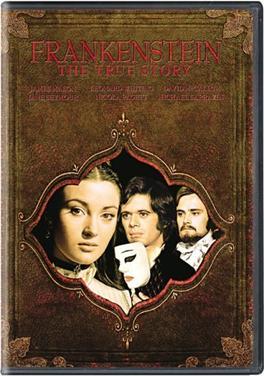
Frankenstein: The True Story. The Television Miniseries

FRANKENSTEIN: THE TRUE STORY

Frankenstein: The True Story is a bit of a misnomer in that it does deviate from the Mary Shelley novel. While it may not actually be "the true story", Frankenstein: The True Story is still an entertaining and well-acted production. 

After a brief introduction by The True Story star James Mason, we go to the Regency-era setting. 

After the death of his younger brother William, Victor Frankenstein (Leonard Whiting) becomes convinced that he should stop death itself. At the very least, he should be able to bring the dead back to life. He finds that renegade doctor Henry Clerval (David McCallum) has managed to reanimate small animals and human body parts. They join forces to achieve the impossible: bring life out of nothing.

They take body parts and resign themselves to using a peasant's brain for their new creature. However, Dr. Clerval dies in the secret lab before being able to write a warning. Clerval has discovered to his horror that the animation process is reversable. Victor, misreading the "R" that Clerval has written to mean "Ready to begin", proceeds with his plan. Out of respect, he takes Clerval's brain to place on his creation. The Creature (Michael Sarazzin) soon begins to learn about life under Frankenstein's tutelage. 

To his horror, Frankenstein finds that the Creature is devolving from the beautiful creature into a less appealing creature. Desperate to escape his horror, the Creature jumps to his apparent death. Alas, he survives his suicide attempt. Soon, the Creature becomes friends with the blind farmer Lacey (Ralph Richardson). Lacey's daughter Agatha (Jane Seymour) and her love interest Felix (Dallas Adams) however, are horrified when they see the Creature. His actions lead to both Felix and Agatha's deaths, albeit both unintentionally.

The Creature goes to the lab, hoping Victor will bring her to life. He's in for a surprise when he finds Dr. Polidori (Mason) instead. Polidori was Clerval's mentor who had a falling out with his pupil when Clerval insisted on using the sun's power rather than Polidori's liquid methods. Now, Polidori has a new corpse, or at least head, to try out his own ideas. With that, he gives metaphorical birth to Prima.

Prima, unlike the Creature, has managed to stay beautiful and pass herself off as human. Polidori cajoles the now-married Victor to let Prima learn from his in-laws and wife Elizabeth (Nicola Pagett) about how to get along in society. Prima is no innocent. She is a hard, cold, cruel creature. She is also being groomed by Polidori into being a mistress for powerful figures as part of his plan for world domination. Those plans are brought to ruin when the Creature returns yet again to life. The chaos he unleashed will soon consume everyone involved in this sordid saga. Who if anyone will ultimately survive this series of terrors?

It has been ages since I read Frankenstein: Or the Modern Prometheus. While the television movie (edited into two parts for American television) bills itself as "The True Story", it goes against my recollections of the novel. I do not recall such things as Doctor Polidori having any role in the Creature's creation. I also do not recall a desperate flight for the Frankensteins and Polidori to the United States. I would say that in terms of fidelity to the source material, the first part is closer.

Once we get past the Creature's first survival, Christopher Isherwood and Don Bachardy's screenplay seems to come from their imagination rather than Shelley's novel. This is not strictly speaking a bad thing. Their screenplay does have some moments of wit in it. When the Creature seems reluctant to have Agatha's corpse seen, Polidori is having none of it. 

"Come on. I have no use for delicacy, especially in monsters", Mason says in his rich tone. His delivery seemed to border between serious and hilarious. It brought back, for good or bad, echoes of when Bugs Bunny was telling his monster about how they must lead interesting lives.

I suspect that Isherwood and Bachardy were having a grand time with The True Story. How else to explain how the Creature would sometimes misremember his name as "Polly Dolly"? How else to explain the impromptu ballet that Prima breaks out into at a ball? How else to explain how Dr. Polidori's first appearance to the Creature made him look like Fu Manchu, complete with two Chinese assistants? 

Good or bad, there was some camp within this presentation. Polidori's end ought to elicit laughter more than terror. In the midst of the tempest that the ship everyone is in is caught, the Creature manages to hoist the terrified Polidori upwards. Polidori is not so much afraid of being strangled as he is afraid of thunder. As he goes higher and higher, Mason seems to go hammier and hammier. It is to where when he meets his end, you are not taking this seriously.

This is a standout for James Mason, though perhaps not in the way he might have wanted. Mason is having a whale of a time being as grand and operatic as his skills let him be. There is something comical in how he relishes being bonkers. As he goes on about how he will use Prima as his ticket to the heights of political power, James Mason looks like he is about to climax in orgasm. It is not a bad performance. I do not think it is even an unhinged or loony performance. I would say that it is a grand, delicious performance, one where director Jack Smight did not bother restraining him. It is hard to take James Mason seriously when he is dressed like an exiled Chinese emperor. 

David McCallum too was intense. His waxing rhapsodic about a dismembered arm with a life of its own looks almost rational. However, it worked for his character of Clerval. He sometimes too leaned into theatricality. However, I found his intensity matched the downright bonkers manner of Clerval. 


I think the best performance is from Jane Seymour. She had to play two parts. She was first the innocent and sweet Agatha, caught up in an unintentional tragedy. She later had to be Prima, the female creature. She was excellent as the villainous Prima, mocking everyone around her. Her failed efforts at seducing Victor. Her simulation of pregnancy, ridiculing Elizabeth. Seymour had to make the smallest gesture with her face or lip to convey false innocence. It is almost to where one feels for her gruesome end.

Leonard Whiting will probably be best remembered for his role in Franco Zeffirelli's Romeo and Juliet. As Victor Frankenstein, he acquitted himself well. He was mostly soft spoken, but like with McCallum, it worked for the character. He was a strong blend of innocence and arrogance, of genuine concern and ruthless dismissal. 

I do have a caveat about Michael Sarrazin as The Creature. The True Story opted to follow Shelley's lead in making the Creature a beautiful figure. However, I do not think that Sarrazin was "beautiful". He certainly was not as beautiful as Leonard Whiting. I think it would have worked better if they had switched roles. Sarrazin was not bad in the role. He communicated the Creature's disillusionment and anger. He was not bad at all. He was just not beautiful.

The True Story is filled with excellent production work. It also moves fast despite its three-hour runtime. Some things do come across as funny, such as how Polidori is a mesmerist who can work on almost anyone. Overall thought, Frankenstein: The True Story has enough in terms of entertainment to keep the viewer interested. It may not live up to its title, but it works quite well. 

8/10

Tuesday, June 17, 2025

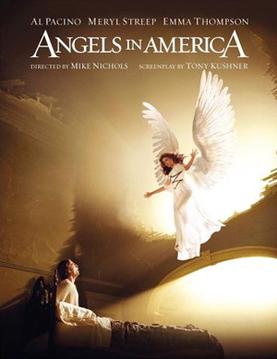
Angels in America: The Television Miniseries


ANGELS IN AMERICA

The theatrical epic Angels in America: A Gay Fantasia on National Themes is held as one of the greatest Broadway productions in all history. I have never seen even a local or regional production, probably due to its expansive nature. For those of us who will probably never see a live production, there is the Mike Nichols television miniseries. After finishing Angels in America, I leave thoroughly puzzled over why people would want to watch both parts. 

Split into two parts, Millenium Approaches and Perestroika, with each part subdivided into chapters, the overall plot covers much territory. The story entangles two groups. On one side, there is Louis Ironson (Ben Shenkman), a Jewish man in a long-term relationship with WASP Prior Walter (Justin Kirk). Walter, scion of an old American family, has AIDS. Louis, despite his liberal leanings, cannot handle his partner's illness and leaves him. 

Weaving in and out of Louis' life is Mormon Republican attorney Joe Pitt (Patrick Wilson). He is married to drugged-out Harper (Mary-Louise Parker), who is stupefied through her Valium pill-popping haze. She occasionally goes into fantasies where Mr. Lies (Jeffrey Wright) takes her through the refrigerator to Antartica. Harper knows what Joe will not admit to perhaps even himself: Joe is gay. 

Someone else who will not admit that he is gay is Joe's mentor, notorious attorney Roy Cohn (Al Pacino). Like Prior, Cohn is dying of AIDS, but he refuses to admit that he has the disease. Eventually though, Cohn needs hospitalization but uses his connections to get his hands on massive quantities of AZT, which were not freely available in October 1981. Prior and Cohn are attended by nurse Norman Ariaga, better known as Belize (Wright in a dual role). Belize is friends with Prior and Louis, though he finds the latter difficult to intolerable.

Cohn wants Joe to take up a Washington job so that he can keep himself from being disbarred. Joe, honest and upright, refuses. He also finally surrenders to the pleasures of the flesh with Louis, with whom he has fallen in love with. Joe also admits his homosexuality to his mother, Hannah (Meryl Streep). While Hannah will not accept this announcement, she sells her home and moves to New York to look after him. 

Prior, for his part, finds himself visited by two of his ancestors (Michael Gambon and Simon Callow), who are precursors to an Angel (Emma Thompson), who declares that Prior Walter is a prophet whose great work begins.


I think that is all Part One. Part Two has Prior tell Belize his vision, which includes him having a version of sex with the angel. He also begins hunting down Louis' new partner, as is appalled that Joe Pitt is actually hot. Belize recognizes him as Roy Cohn's protege, which enrages Louis who thinks of Cohn as the Devil Incarnate. He also suspects Joe was Roy's lover, which Joe vehemently denies. Eventually, Louis cannot abide being with a closeted Mormon Republican. 

Prior, still in his prophetic role, finds an unlikely ally in Hannah. As a devout Mormon, she is not surprised about angels visiting mortals. She even manages to see The Angel come to Prior. While Hannah is terrified, she also instructs Prior on how to battle against the Angel. He forces the Angel to take him up to the ruins of Heaven, as God has abandoned it for humans, who are His playthings. Will he take up the mantle of bringing God back to Heaven?

One person who will not see Heaven is the dying Cohn. He not only is dying but has to content with the ghost of Ethel Rosenberg (Streep), who in her Nuw Yawk accent taunts her nemesis. Will Roy Cohn be defeated by someone from beyond the grave or will he get one last laugh before shuffling off this mortal coil? Will Louis, now with a mother figure in Hannah, live long enough to see the fall of the Soviet Union and begin his own great work?


Who am I to argue against what I have been told is one of the greatest works of fiction ever written? Well, I will be, for I found Angels in America boring and at times outlandishly albeit unintentionally hilarious. I figure that this adaptation is close to how the original production was. After all, Angels in America playwright Tony Kushner adapted his play for the miniseries. I cannot vouch for any changes, but again I figure this production is as close to how a stage production would play out.

If so, I would have been howling with laughter during several scenes. I probably would have started chuckling at the beginning, when we see Meryl Streep in drag playing an old rabbi. You can clearly see that it is Meryl Streep through the makeup, and I was genuinely wondering if Angels in America was a comedy, her Hebrew manner a bit exaggerated for my tastes. 

During Perestroika, I would have been on the floor rolling with laughter when Prior and Hannah see the Dark Angel come to castigate the Prophet for refusing his command. A previous scene where Prior and the Angel have something close to angelic/human sexual intercourse was already making me chuckle at the absurdity that I was watching. I thought Thompson was hamming it up to the Nth degree as the Angel, as if playing a heavenly figure gave her permission to go over-the-top. The Angel's penchant for referring to itself as "I...I...I..." did not help clamp down on my laughter. The grandiose nature of it all, coupled with the acting of Thompson, Streep and Kirk made everything hilarious, at least to me.

Part of me gets that sometimes things had to be a bit exaggerated. Gambon and Callow (whom I initially thought was Peter O'Toole) being quite exaggerated as Prior's foppish ancestors, I get. I can even roll with Thompson's Angel being grand. I cannot quite roll, however, with another of Thompson's roles as Prior's Southern nurse. I thought her Southern drawl was a bit forced.

There are essentially three good performances in Angels in America. Al Pacino, Meryl Streep, Jeffrey Wright and Mary-Louise Parker all won Emmy Awards for their performances. As I said that there were three, I would remove Parker. I understand that her whacked-out Harper was meant to be almost comatose. However, I found her too comatose to where I never believed that she could be a real person, let alone a character. Her final scene where, looking out of an airplane window, she addresses the audience was a bit off-putting to me. I found it a touch theatrical.

Wright was strong and effective as Belize, balancing a flamboyant manner while not being cartoonish. He recreated his Tony Award-winning performance, and I think he had many excellent moments. A highlight is a scene where he puts Louis in his place for lecturing him about his moralizing while justifying leaving his dying lover. In equal turns bitchy and compassionate, Belize was an interesting character worth following thanks to Wright's performance. He was not as good when playing Mr. Lies, but my sense is that he was meant to be a little absurd, so it is not a dealbreaker.

Streep was strong playing both Hannah and Ethel Rosenberg. Major credit should be given to the Emmy Award-winning makeup work, which made Streep look eerily like Rosenberg. She managed to make the two different people look as if they were being played by two different people. Hannah is firm in her faith and worldview, but she is also sensible and a genuine mother figure to Prior. I would say less so with Joe, for whom she seems to almost harbor a dislike. However, it is to Streep's credit that her performances were very strong.

If only she had not played the rabbi. She just looked goofy in that makeup and her accent. I found it a poor way to begin.


Unlike Streep and Wright, Al Pacino played only one role. His Roy Cohn is arrogant, cruel, vindictive and a liar to both others and himself. In his rages and defiance against his metaphorical and literal ghosts, Pacino held your attention. It is to where when he manages to outwit Ethel Rosenberg at his literal deathbed, I actually found him almost likeable. I think that was helped by how Ethel's smug face delighted in Cohn's death. I do not expect anyone to offer sympathy for the devil. I do hope that people, even ghosts, can be better than that. 

The other main cast members, all of whom received Emmy nominations, were not in my view good. Shenkman was at times laughable and insufferable as Louis. Yes, I suppose that Louis was meant to be laughable and insufferable. However, at times it felt as though Shenkman was attempting to do a Woody Allen impersonation. Patrick Wilson was pretty as the closeted Joe. However, he was also pretty blank, not making his internal struggle good. Kirk's Prior was acceptable but not great. He too had some of Shenkman's whining manner. However, given that his character was dying of AIDS, I can be more flexible on the matter.

I confess to both falling asleep and falling on the floor laughing at certain parts of Angels in America. I do not think that was intention. The performances from Pacino, Streep and Wright make it bearable. I would, however, not want to sit through all this again just for them. Ultimately, I think that Angels in America carried too much of its theatrical roots to make a fully formed transition to television. What works on the stage does not necessarily work on television. I know the stage play and television adaptation are both highly praised. For myself, I could not go along with the adulation Angels in America has received. 

I would not want this Angel at my table. 

2/10

Tuesday, March 4, 2025

The Witches of Oz: The Television Miniseries


THE WITCHES OF OZ 

(aka DOROTHY AND THE WITCHES OF OZ)

For my Wizard of Oz Retrospective, I did not get to every adaptation and variation out there. One that slipped through the cracks was The Witches of Oz, a television miniseries that was reedited into a feature film called Dorothy and the Witches of Oz. I cannot say whether the film version was better, but the television miniseries was a bit of a lost opportunity. Some good ideas, some good casting made it bearable. It also could have done with more structure.

Dorothy Gale (Paulie Rojas) has been writing stories about a magical land called Oz for some time. Still living on the Kansas farm that she grew up on with her Uncle Henry (Lance Henricksen), Dorothy is thrilled when a publishing offer is made. She, along with her illustrator friend Allen Denslow (Ari Zagaris) are whisked off to New York by their book agent, Billie Westwood (Eliza Swenson). Dorothy finds herself attracted to Scottish stockbroker Nick Chopper (Billy Boyd). 

Others, however, are attracted to Dorothy but not for any romantic ideas. Billie is really the Wicked Witch of the West, determined to unlock two things. The first is Dorothy's memories, for in reality what Dorothy thinks are fantasy stories are actually suppressed memories of when she was in Oz. The second is the fabled Book of Bini Aru, which was used to create Oz and which would give anyone who reads The Changing Word within it total power over Oz.

Long ago, the Wicked Witch of the West came close to obtaining the Book of Bini Aru, but the wily Wizard of Oz (Christopher Lloyd) managed to deceive her and made it disappear along with the key to open it, the latter which Dorothy unknowingly has. The Wicked Witch has been using Frick and Frack (Sean Astin and Ethan Embry), little creatures known as Muckadoos to spread memory powder on her while she sleeps to jog her memory.

Eventually, she does remember, but will she be able to defeat the Witch and save Oz? How are the thin, scarecrow-like Allen and Bryan (Barry J. Ratcliffe), a cowardly book publishing executive, connected to Dorothy? It's an all-out battle in New York City for the future of Oz, but who will win out?

There is a lot of material in writer/director Leigh Scott's screenplay (with story by him and Witches of Oz actress Eliza Swenson). One can see that some of his ideas are quite good, particularly having the Oz stories be suppressed memories. I think, to be fair, this is not too far from Return to Oz where Dorothy's stories were real but unlike here, she remembered them. 

I think thought that part of the problem in The Witches of Oz is the amount of material. We start the television miniseries with a very long introduction about the creation of The Book of Bini Aru and the rivalry between the Witch and the Wizard. There is nothing particularly wrong with that. I, however, think it would have been better to sparse that part out throughout The Witches of Oz versus giving us that long recap. That part might have served as part of other dreams that Frick and Frack opened to Dorothy.

Later on, we get another longer flashback where Uncle Henry reveals a shocking secret about Dorothy and her ties with Frank (Jeffrey Combs), who she thinks is her grandfather. There just seemed to be a lot of repetition in The Witches of Oz that I think could have been cut back or cut down.

I think some have blasted The Witches of Oz for its poor visual effects. I do think that at least in the television version, they looked like early versions and look pretty weak. The opening scene attempts to give us almost Lord of the Rings-type battles and fails hard. Later on, Dorothy and Allen are saved from a so-so dragon when a bubble lifts them and their cab driver up to safety. That scene also looks bad, but worse is how somehow that bubble managed to save Nick and Bryan too.

The visual effects and sheer length of the film push The Witches of Oz down. I think some of the violence also does more harm than good. The final battle between the Nome King (Allen Sarven) and Princess Langwidere (Mia Sara) was a bit gruesome if the target audience was kids and families. Same goes for whenever poor Allen gets unstuffed. 

As a side note, Allen says something curious the first-time straw is taken out of him. "I always knew that I was different. I just thought I might be gay". Given the suggestions that Allen may have harbored a yearning for Dorothy, this is a strange thing to say. It does not appear to be clear if Allen or Bryan knew who they were supposed to be or were just made to be certain characters because they tie into Oz itself. 

Frick and Frack are original to The Witches of Oz, and Astin and Embry did well as the comedy relief. I think they behaved as though they were in another film altogether and could have been cut. Still, it did give Billy Boyd's Nick a chance to say one of the funnier lines in the miniseries. "Memory dust. Witches. Drunk pygmies dressed as court jesters. I think I get it". 

I think some of the performances were great. It is a shame that Christopher Lloyd did not get the chance to play the Wizard of Oz both more often and in better material. He was a standout, mixing cowardice and cleverness quite well. Boyd managed the romantic lead respectfully, though at times he looked too eager to play situations for laughs versus taking them seriously. Rojas was a bit flat as Dorothy. Swenson and Sara were appropriately over-the-top as the villains, and credit to the latter for having a genuinely clever bit late in the miniseries. As she dreams of taking over both Oz and New York, the Wicked Witch of the West has more ambitions, planning to take over Camelot, Wonderland and even Narnia. That was a nice bit. 

I do not know if The Witches of Oz knew what the target audience was. Too long and a bit too violent for kids and families, poor visual effects for adults. Still, perhaps with more reediting or a remake, The Witches of Oz could be shaped into something good. As it stands, The Witches of Oz is probably best for those who want to be Oz completists.

4/10

Thursday, October 6, 2022

Blonde: The 2001 Miniseries

 BLONDE: THE MINISERIES

Before the Joyce Carol Oates novel Blonde was adapted into a Netflix film, there was a little-remembered miniseries. Another time there may be a comparison between the two adaptations, but for now let us look at the first adaption. Blonde is a well-acted adaptation that should be better remembered.

With many of the characters speaking directly to us including from the title character herself, Blonde tells a fictionalized version of the life and times of Marilyn Monroe (Poppy Montgomery). Blonde opens with a written statement: "Although the following film depicts some actual persons and events, it is a work of fiction". 

We see Monroe almost beached on the shore, then go in chronological order from her childhood as Norma Jean Baker. Her mother Gladys (Patricia Richardson) informs us that her daughter's name came from two of her favorite stars: Norma Talmadge and Jean Harlow, and her surname from the husband she disliked the least. While her grandmother Della (Ann-Margret) tries to shield Norma Jean from Gladys' growing instability, she dies suddenly, causing Norma Jean great guilt. 

Norma Jean is married off to Bucky (Niklaus Lange), a pleasant though sexist young man. Norma's beauty and ambition propel her to first a modeling then film career. Under the management of Mr. Shin (Wallace Shawn), the now-Marilyn Monroe starts gaining more film work. Shin, who is in love with his creation, dislikes her association with Cass (Patrick Dempsey) on both a personal and professional level. 

As her star rises, Marilyn is wooed and lost by both The Baseball Player (Titus Welliver) and the Playwright (Griffin Dunne). Eventually, her affair with the President and her own emotional turmoil kill her at 36, her long-hoped dreams of motherhood unfulfilled.

Blonde breaks the fourth wall quite often, almost to the point of parody. Most of the time these interviews work. Of particular note is when Montgomery as Monroe speaks to us. Montgomery stays away from a breathy, whispery speaking style that Monroe might have used in her films. Instead, this Marilyn was soft-spoken but also strong and sincere. It is only at the end when she bizarrely comments about the President's "Social Security men" in a strange Southern accent that Montgomery/Monroe comes across as bonkers.

Throughout Blonde, the Marilyn Monroe we see is capable, fully aware and an intellectual. Many times in Blonde does Monroe either quote or write poetry. Marilyn came across as caring, frightened and deeply mournful. She declines Shin's marriage proposal even if it would set her up financially for years, but also cries bitterly when she learns of his early death. 

Other performances work well. Patricia Richardson, best known for the sitcom Home Improvement, was quite strong as Gladys both when in a somewhat catatonic state and when being glamorous as she speaks directly to the audience. Shawn too did well in drama as Shin, not in a comic manner but still with a lightness recognizable to Princess Bride fans.

Other performances though could have been better. Dunne was almost blank when with Montgomery. When he mistakes the raspberry stains on Marilyn's dress for blood, he asks "Is that blood? Are you miscarrying?" in such a bored manner one almost thinks he is barely learning English. Oddly, he does better when being "interviewed". Dempsey is admittedly handsome but leaves little impact as what we are meant to understand was a great love in Monroe's life.

Jensen Ackles as Eddie G. (Edward G. Robinson, Jr.) leaves even less of an impression and in my view was miscast as the third party in this strange ménage a trois. Eric Bogosian as the sleazy photographer was one-note in his aggressive manner.

Blonde does well in moving things forward, though other elements seem odd. For example, when the Playwright finds Monroe at the foot of the stairs, it is unclear given her emotional state whether Monroe fell or threw herself. The miniseries also ends on, if not an ambiguous note at least a less depressing one, with her performing and a text telling us that she died without becoming a mother. 

The miniseries played quite well as almost a biopic even if again Blonde is merely based on actual people versus being true-to-life. Well acted in particular by Montgomery and Richardson, Blonde is worth watching. 

7/10

Monday, January 31, 2022

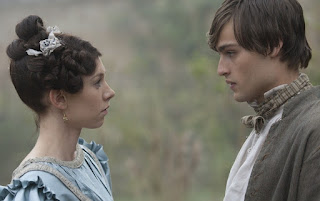
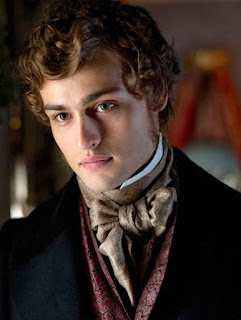
Great Expectations (2011): The Miniseries

GREAT EXPECTATIONS (2011)

While my experience with Charles Dickens' Great Expectations is only through the various adaptations, I think I am safe in saying that this is one of his bleaker novels. Even by those standards however, I was surprised at how bleak and despairing the 2011 BBC adaption was. While in some ways sumptuous, in other ways dull, Great Expectations has some good performances but one awful one in the midst of it that brings the project down.

Young Philip Pirrip better known as Pip is forced to help escaped convict Abel Magwitch (Ray Winstone). Magwitch may be a criminal, but he curiously is nicer than either Pip's sister or Orlick (Jack Roth), the apprentice blacksmith to his uncle Joe (Shaun Dooley), the only kind person in Pip's life. Pip's life however takes a few strange turns.

First is when he is called to serve at Satis House, home of the wealthy recluse Miss Havisham (Gillian Anderson). Havisham is haunted by her jilting at the altar to where she still wears her wedding dress and keeps the rotting wedding feast intact. Pip is made the playmate of Estella, Havisham's adopted daughter, but this is part of Havisham's crazed revenge plot.

A second turn is when seven years later, the adult Pip (Douglas Booth), now apprentice to Joe, is made heir to a great fortune by a mysterious benefactor who wishes him to "live as a young fellow of great expectations". Now off to London to live the lush life, he becomes friends with Herbert Pocket (Harry Lloyd), Havisham's nephew whom as a child he once punched. Their purse strings are controlled by Jaggers (David Suchet), an efficient lawyer who deals with young men of privilege. 

Pip pursues Estella (Vanessa Kirby) now that he is a gentleman, but she has been trained to be cold towards men. Her coldness is perfect for wealthy Bentley Drummle (Tom Burke), who cares nothing for her but only for her future fortune. Once Pip discovers whom his secret benefactor is, things go full speed as he tries to sort out his own life while attempting to help Herbert and his secret benefactor. As much as both Havisham and others attempt to thwart out pair, circumstances bring Pip and Estella together over all their obstacles.

In some respects, this Great Expectations has a wealth of great acting. At the top of the list is Suchet as Jaggers. Cold but efficient, blunt but aware, his Jaggers is frightening in how he makes sense even as he appears coldhearted. He does not tolerate fools and executes his clients wishes with efficiency, and Suchet dominates everyone who shares the screen with him.

Anderson, the only American in the cast, takes a different tact with her Miss Havisham. She has a singsong style to her delivery, childlike that makes her version more sympathetic. Anderson still makes Miss Havisham into a totally creepy figure, but we see the haunted woman behind the cray-cray. Her Miss Havisham does not appear to be the bitter jilted spinster of lore. Instead, she appears more haunted and lost, a broken woman suspended in a living death. Her first appearance makes her look like a literal ghost, giving her a haunted quality. It is as if she were a walking corpse.

She is also more manipulative, fixated on bringing misery to others as vengeance for having misery visited upon her long before Estella or Pip were born. It is an exceptionally strong performance that is to be commended.

Another standout is Harry Lloyd's Herbert Pocket. He is somewhat diminished in this adaptation, but Lloyd makes Pocket into a good man, reformed from his youthful arrogance into someone who is motivated to do good and love well. Cheerful but serious when needed, one wishes for a Herbert Pocket spinoff where we see him and his wife in Cairo.

What sinks Great Expectations a great deal is the central character. It is not Douglas Booth's fault that he is exceptionally pretty. It is his fault that he cannot act, at least not in Great Expectations. One already finds it laughable that such a delicate looking, almost porcelain like figure such as Booth would plausibly be an apprentice blacksmith. He in actuality looks like he's never done a single day's worth of manual labor in his life, let alone something as labor intensive as a blacksmith. 

Booth's delicate features and elegant manners are already difficult to overlook to be seen as a working-class hero. It is his total blankness as Pip that dooms him and Great Expectations. No matter what the situation, Booth gives the same disengaged expression. He is like many people who have film/television careers based more on their looks than their acting prowess. His lack of reaction when his benefactor reveals himself should elicit howls of laughter. It does not matter whether he is trying to con an old hand like Jaggers, express ardor to Estella or feverishly work to save Herbert. Booth gives the audience the same facial expression throughout Great Expectations.

I once commented that Jaime Dornan's performance in Wild Mountain Thyme was more that of a good- looking man who can speak than of someone who could actually act. As a side note, I still feel this way about Dornan regardless of the praise he's gotten for Belfast. When it comes to Booth's performance in Great Expectations, I'm not sure he could even get past the speaking part. It is just so blank and empty. Worse, it makes Pip look less naive and more eternally stupid.

Perhaps Booth's weakness as an actor is why Kirby seemed to match him in the blankness of her own performance. While not as bad as Booth, Kirby looked neither like the cold woman or the simmering woman underneath. 

Great Expectations also, I think, went overboard in its Gothic trappings. The miniseries is dominated by endless shades of grey to where you wonder if sunlight even exists. It is as if the production wanted to encase you permanently in Satis House. Such dour looks and heavy greys work when we venture into Miss Havisham's ruined home, but why do so when entering the magic world of cosmopolitan London? 

Despite having more time to develop the Dickens story than other versions, this Great Expectations seems almost rushed. The heaviness of the production and Douglas Booth's lack of performance pushes the project down. It has the saving grace of strong performances from others (Suchet and Anderson in particular) but I found it a terrible disappointment. My expectations were not met.

5/10 

Tuesday, July 13, 2021

The Six Wives of Henry VIII: The Television Miniseries

THE SIX WIVES OF HENRY VIII

Divorced, beheaded, died, divorced, beheaded, survived. Three Catherines, Two Annes and a Plain Jane. These are two ways to remember the unmerry wives of Tudor, those six unfortunate women who found themselves as consorts to the lusty Henry VIII of England. The Six Wives of Henry VIII cover the tumultuous times of Catherine of Aragon, Anne Boleyn, Jane Seymour, Anne of Cleves, Catherine Howard and Catherine Parr as they struggle to navigate both the political intrigues of Court and the mental gymnastics of their oft-married monarch.

Starting with Catherine of Aragon (Annette Crosby), we see how Henry VIII (Keith Mitchell) came to find himself with this cavalcade of Queens. Catherine of Aragon, loyal wife to Henry, is devastated then enraged to be dumped for pretty courtier Anne Boleyn (Dorothy Tutin). However, Mistress Anne finds life at the top is not all crowns and dances. "You will endure all, Madam. I rule here," he tells the woman described as "a proud shrew".

Anne's fall is mixed with her personal courage, making her worthy of respect. Queen Number Three Jane Seymour (Anne Stallybrass) has something of a fever dream as she lays dying, remembering her courtship and struggles with Henry and his villainous Chancellor Thomas Cromwell (Wolfe Morris). She disagrees on his dissolution of the monasteries, but while she cannot fight this, she at least gives Henry the one thing he's wanted: a male heir. 

The German Princess Anne of Cleves (Elvi Hale) is wary of being Queen Number Four, but Cromwell needs that German alliance. Anne is appalled that the portly, vulgar "King's Messenger" is really the King. Henry for his part isn't too thrilled with Anne, but the wedding takes place. Anne, like Jane, is appalled on how religion is misused by the King and his ministers to torment the people. However, an unlikely bit of luck comes her way when the political winds shift, making the much-hoped German alliance unnecessary. Cromwell's fall is Anne's salvation, as she cleverly suggests an annulment and makes Henry think it's his idea.

Not so clever is Catherine Howard (Angela Pleasance), Queen Number Five. Niece of the powerful and power-hungry Duke of Norfolk (Patrick Troughton), the pretty but stupid and somewhat slutty girl catches the eye of the now very heavy and gangrened king. She attempts to be aroused by him but even he can't arouse himself. Cromwell's execution is soon followed by her own, her indiscretions in an effort to sire a male backfiring spectacularly on her. While her now-disgraced uncle survives with his head intact, he falls out of power altogether.

Finally, there's Catherine Parr, Queen Number Six. The twice-widowed Parr wants nothing to do with the much-married monarch but is pushed into it by ambitious Seymour relatives. She too, like Jane and Anne of Cleves, finds the religious tumult impossible, putting her own views against that of the King himself. It is only by mere luck and Henry's death that she is spared the fates of Anne Boleyn and her predecessor.

The Six Wives of Henry VIII takes the unique approach of featuring each wife in a separate episode both written and directed by a different group of writers and directors. In a more surprising turn, three episodes (Anne Boleyn, Catherine Howard and Catherine Parr) along with one episode (Catherine of Aragon) were directed or written by women (Naomi Capon and Rosemary Anne Sisson respectively). In a time where women were not often given chances to work behind the camera, The Six Wives of Henry VIII gave a chance to offer something of the feminine perspective on the ultimate male chauvinist pig. 

This approach also allows a chance to see the various women not just as pawns in a game but as fully formed figures, with flaws as well as virtues. Of particular note is Tutin's Anne Boleyn. As she faces trial for high treason, adultery and incest, we see her private bravery and courage when she knows there is no hope of survival.

I think every one of the poor Mrs. Tudors did well in the miniseries. There's the foolishness of Pleasance's Catherine Howard, who despite being a bit of a tart you end up feeling sadness for her. Hale's Anne of Cleves showed a deftness as she handled Henry, a man she clearly does not love but who manages to outwit the mad king.

At the heart of the miniseries' success is Michell as Henry VIII. Proud, boastful, arrogant, and with a particular way of seeing the world as he wished it, by the end we feel sympathy for him too. His genuinely heartbreak at his impotence with Catherine Howard is a moving bit of acting. He can be wry at times, suggesting to a man that "if your morality won't let you take a mistress, commit bigamy". In all his virtues and faults: his arrogance, his besotted nature with his wives, his yearning for a son, Michell makes Henry a fully formed figure.

Other roles are equally well-acted, from Troughton's scheming Norfolk to Morris' repulsive Cromwell.

Despite having many hands at work, The Six Wives of Henry VIII has a strong coherence, if at times a bit too stage-bound and dry. Jane Seymour is the only time where I remember there being any location shooting. In fact, Jane Seymour is surprisingly dominated by outdoor scenes, where most of The Six Wives of Henry VIII is studio-bound. Sometimes this is to its detriment: when Catherine Parr and Henry got married, the set literally rattled. 

The miniseries also has very little editing, the camera flowing from one actor or group of actors to another, staged in a way that prevents cutting unless it's to the next scene. Whether this puts people off or not depends on the viewer, but at times it does feel a bit dull.

Still, The Six Wives of Henry VIII is well-acted and written, giving a good primer to the many women who found themselves Queen of England under the larger-than-life King.   

7/10 

Sunday, January 24, 2021

Young Catherine: The 1991 Television Miniseries


YOUNG CATHERINE

Perhaps apart from British monarchs Queens Elizabeth I and Victoria, few female monarchs have been the subject of as many cinematic and television treatments as Czarina Catherine II. The rise of an obscure German princess to Czarina of All The Russias is a fascinating true-life story, with elements of decadent imperial romps among the Enlightened despot's many political and military accomplishments. Young Catherine is another chronicle of our lusty ruler, and on the whole it is quite a good miniseries with strong performances by an international group of actors.

Young Princess Sophie (Julia Ormond) from the obscure German principality of Anhalt-Zerbst is brought to Russia as a prospective bride for Grand Duke Peter (Reece Dinsdale), heir to the Russian throne. Peter's mercurial aunt, Empress Elizabeth (Vanessa Redgrave) is charmed by Sophie, but not pleased that Sophie will not convert to the Russian Orthodox faith. Advised by both British Ambassador Sir Charles Williams (Christopher Plummer) and the Archimandrite Todorsky (John Shrapnel), the now-rechristened Catherine not only embraces Orthodoxy but Russia itself: its language, its culture and its people.

This displeases both Elizabeth's bitter rival the German Emperor Frederick the Great (Maximillian Schell) and Russian Count Voronstov (Franco Nero) for different reasons. Frederick wants the future Empress to be his puppet, while Vorontsov wants to be the power behind both Elizabeth and Peter's throne, seeing the Grand Duchess as both an annoyance and impediment to his own power. Despite being married for two years Peter is more interested in his toy and real soldiers than in the beautiful Grand Duchess. Complicating things is that to Elizabeth's shock she finds that Catherine is still a virgin.

To solve that problem enters hunky Count Gregory Orlov (Mark Frankel), who has yearned for the Grand Duchess on first sight when escorting her to Russia way back when. The lovers conceive a child, fool everyone into thinking it is Peter's, and as soon as Grand Duke Paul is born, Catherine is all but forgotten. A group forms around her though, aware of both her keen intelligence and the dangers the Prussian-loving, bonkers Grand Duke Peter would present when he became Czar. Once this comes about, things move quickly in the power play between Czar and Czarina. Catherine soon wins to take the throne as Catherine II, Czarina of All the Russias.

Young Catherine follows one of the two most popular routes when dramatizing the life of our randy royal: showing her life up to when she succeeds in her coup d'etat. Other Catherine-related projects such as The Scarlet Empress and The Rise of Catherine the Great similarly start with her youth and end with her crowning. Young Catherine works well because of the performances, all of which are quite good.

Ormond is beautiful and strong as Catherine, managing to convey her naïveté with a growing shrewdness and daring. At times, Ormond's beauty makes her almost heavenly: a moment where Peter and his loutish friends crash the bridal bed frames her dark hair against her porcelain face is almost breathtaking. Behind her beauty though Ormond brings Catherine's growing spine of steel, her courage and willingness to play dangerous games successfully.

Of particular note is when Empress Elizabeth finds her niece-in-law has ordered the Imperial Guard to remain in St. Petersburg rather than to the Prussian front. Accused of treason, Catherine manages to win Elizabeth to her side by convincing the dying monarch that her motive was to protect Elizabeth and Paul from Peter, who is open about siding with his great hero Frederick. Ormond brings a mixture of trepidation and strength in this scene, revealing a strong actress.

The supporting cast is equally adept. Redgrave is having a ball as Elizabeth, pious and imperious, one moment caring and motherly, the next tyrannical and frightening. Redgrave shifts easily from banishing Catherine's mother from Court for spying for Frederick to in the same scene tendering caring for the now-orphan Catherine. In her piety and rages Redgrave makes Elizabeth such an interesting figure one almost wishes there had been Old Elizabeth, prequel to Young Catherine.

Only in her death scene do we see Redgrave falter, the moment looking comically bad to where I did burst out laughing at her sudden expiration. 

Nero and Schnell might have been a bit hammy as Vorontsov and Frederick respectively, but they have some leeway as both were plotting and scheming to gain power. Plummer was not called upon much except be the wise mentor to Catherine, but he did well in his scenes with Ormond (curiously the only major player he worked with). A real standout was Dinsdale as future Czar Peter III. Dinsdale made him into a wicked child with the sadistic streak of a grown man. Before Peter is struck with smallpox, he comes across as merely childlike and a bit of an idiot. However, as time goes by, we see Peter as genuinely crazy, something that grows once we see his physical deterioration post-smallpox.   

Peter is not just petulant but dangerous, a Russian monarch who openly hates Russia. In turns stupid, infantile and monstrous, Dinsdale gave the best performance outside Ormond.

Frankel didn't have a great deal to do in Young Catherine except be the figurative and literal stud. Yes, he too was beautiful, but it doesn't take away from a good performance as the not-obscure object of desire. Curiously though, Young Catherine did not indulge in eroticism, no sex scenes human or equine. It was surprisingly chaste, always suggesting but showing our lovers only once in bed together and even then, almost exclusively covered.

Young Catherine also has some strong and clever dialogue. As Catherine fights for her life during one of Vorontsov's machinations, Elizabeth orders Catherine's chief lady-in-waiting/BFF Princess Dashkova (Laurie Holden) to bring food and a stove to her bedchamber. "Surely you don't imagine..." Dashkova begins.

"I imagine nothing. I suspect everything," the shrewd Empress replies casually and calmly. 

When Elizabeth orders Catherine's conversion, the Archimandrite suggests a softer touch is needed. "She might be led. She will never be driven," he tells his monarch. Catherine is surprised Sir Charles still speaks to her while Court ignores her as Peter struggles to live, but the wily tutor simply replies, "I'm a foreigner and an old man. I can afford the luxury of true friendship".

Young Catherine is sumptuous enough for a television miniseries, not opulent but respectable. The music also enhances some of the scenes, suggesting intrigue or romance when needed.

Young Catherine is not the definitive tale of this titan of Imperial Russia, but it's entertaining and with good acting that keeps your attention. 

8/10

CATHERINE II FEATURE FILMS & SPECIALS

The Rise of Catherine the Great (1934)

The Scarlet Empress (1934)

A Royal Scandal (1945)

Catherine the Great (1995)

Catherine the Great (2019)