Showing posts with label Dietrich and Von Sternberg. Show all posts

Friday, January 7, 2022

The Blue Angel: A Review

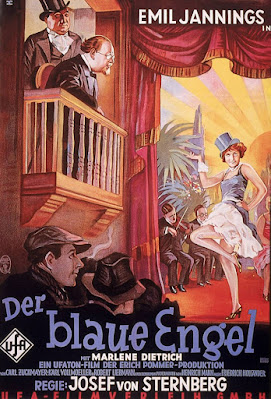
 THE BLUE ANGEL (DER BLAUE ENGEL)

Author's Note: This review is for the German version.

Decadence was never so decadent as that of Weimar Germany, but with Marlene Dietrich as the seductress, I can see how even the most moral of men could fall. The Blue Angel is a star-making turn for our Teutonic goddess as well as an excellent showcase for the man who would ultimately end up going from star to costar.

Strict, moralistic Professor Immanuel Rath (Emil Jannings) is appalled that some of his students have been frequenting the seedy Blue Angel Club. The miscreants, however, do not care what he thinks or even for him, giving him the pun name of "Unrath" (or "Garbage"). Determined to catch them at the club, he visits The Blue Angel.

There, he meets the alluring chanteuse Lola-Lola (Dietrich). It isn't long before he too falls under her spell, where a little Falling in Love Again so overpowers him that he gives up his respectable life to marry our siren. However, rather than him bringing her to his world, she takes him into hers. He starts by selling erotic postcards of his wife, then by being a literal clown in the cabaret show. Lola-Lola soon turns her wandering eye to Mazeppa the Strong Man (Hans Albers) as her husband becomes the stooge for Kiepert (Kurt Gerron), the magician and cabaret show impresario.

Things take a horrifying and tragic turn when the troupe returns to the Blue Angel Club. There's a sellout crowd to see the good professor at his lowest point. This ultimate humiliation drives him insane, causing tragedy for himself.
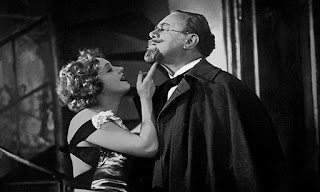
There is no greater fool than a fool in love, and The Blue Angel chronicles this axiom quite well. As much as I have been told this is a commentary on bourgeois hypocrisy, I do not see it that way. Rather, for me The Blue Angel is about a man who is so rigid in his worldview that he cannot sustain it when something that challenges it comes along. 

I found Professor Rath to be stiff but not a monster. Instead, he is a pathetic figure, one who has suppressed his passions for so long beneath the guise of morality and intellect that he soon became lured into Lola-Lola's world. 

Emil Jannings specialized in once-proud men who fall into desolation and disgrace: The Last Command, The Last Laugh, the now-lost film The Way of All Flesh. Jannings' performance can come across as a bit exaggerated as the acting styles shifted from silent to sound, but he also played the part correctly. He starts out stiff and rigid, and his descent into despair comes slowly and sadly. The shock he displays at his ultimate humiliation before his hometown crowd is deeply moving, and you feel great sadness for how he low he has fallen. Rath struck me as more moralistic than prudish, so his fall was not to my mind hypocritical as it was an outlet for his self-imposed repression.

While The Blue Angel was meant as a vehicle for Jannings, it is Dietrich who steals the show as our temptress. The film made Dietrich both a star and icon, the decadent siren of carnal pleasures. It is interesting to see her early on, her voice not yet having that rich, husky manner. Dietrich's Lola-Lola is her own woman, casual with men, one who does not mind playing with them if it amuses her. Whether it is telling one of her school suitors "Cut the English nonsense" when he speaks "I love you" (the little English used in the film) or behaving almost like a respectable hausfrau to her stuffy professor, Dietrich's character is cool to her men.

She sings what would become a signature song, Falling in Love Again, twice in The Blue Angel, but it is to her credit as an actress and von Sternberg's as director that both versions reveal Lola-Lola's character. The first time she is coyly flirtatious veering on amused, the second time there is a sharpness, a bitterness to her declaration that she "never wanted to" fall in love but "I can't help it". It is nice to see Marlene Dietrich before she became "DIETRICH", where she was still raw. You do not like her manner with Rath, yet you do believe that for a brief moment she could love someone like him.

The Blue Angel even has a bit of German expressionism when Rath wanders through the streets. Von Sternberg manages to sneak in little bits of humor in the film, such as when Rath and a student struggle with the English word "the". 

This chronicle of a stiff but not bad man's fall to the demimonde of desire is a well-acted, well-directed film. It is clear why audiences fell for The Blue Angel, and why even after all these years people are still falling in love again with Marlene Dietrich.


DECISION: A-

Sunday, August 16, 2020

Blonde Venus: A Review

Blonde Venus (1932) | The Criterion CollectionBLONDE VENUS

This review is part of the Summer Under the Stars Blogathon sponsored by Journeys in Classic Film. Today's star is Cary Grant.

While Blonde Venus is best remembered for the Hot Voodoo number, a still remarkable almost shocking sequence, the film is surprisingly devoid of the usual glamour associated with Marlene Dietrich. It veers close to a message picture about the nearly tragic fate of a fallen woman, with two of its stars in surprisingly varied roles.

Former German chanteuse Helen (Dietrich) is now an American housefrau, happily married to British scientist Ned (Herbert Marshall) and with a son, Johnny (Dickie Moore). Their happiness is threatened however with the discovery that Ned is dying.

Lifesaving treatment is available in Germany, but they are poor. Over Ned's objections, Helen returns to the stage. Now billed as Helen Jones, the Blonde Venus, she is a hit not just with the cabaret set but with politico and man-about-town Nick Townsend (Cary Grant). Nick gives Helen a check that can send Ned to Germany, and in exchange for his company she gets money to pay for Ned's treatment.

Unfortunately for Helen and Nick, Ned comes home early and soon discovers the truth about Helen's finances. Hurt and humiliated, Ned threatens to take Johnny away, at which point Helen runs away with their son. Helen and Johnny being a peripatetic life, sinking further into squalor until found. Helen agrees to return Johnny to his father, and now free of worry, goes to Europe where she becomes the toast of the cabaret world. Nick re-encounters her, and he engineers a reunion between her and Johnny. Ultimately, Helen and Ned forgive each other and reconcile.

The sight of our erotic Teutonic temptress as a mild-mannered housewife is pretty startling, but Dietrich can shock one without deliberately aiming for it. Blonde Venus allows her to if not totally move away from her image of the alluring woman at least a chance to show she could do more. Her scenes with Moore are always sweet, charming and tender, showing that she could play a loving mother.

This really is the theme of Blonde Venus: that of a mother's undying love. It can be stretched to Helen's love of her husband too, as she made the sacrifice of her virtue to become Nick's mistress to save Ned. It's not exactly and endorsement of her actions, but they are couched in a very sympathetic light to where we see she is not a wanton woman but a desperate one.

We still get Dietrich in drag, the way the public usually saw her, in one of her three musical numbers when she performs I Couldn't Be Annoyed, keeping to the usual Dietrich persona of the cool, distant vixen. However, neither this or the You Little So-And-So numbers are well-remembered, especially compared to her first number, Hot Voodoo.

The Hot Voodoo number probably would not pass muster today: the African theme despite voodoo being more associated with Haiti, Dietrich dressed as a gorilla before transforming into La Dietrich, her blonde wig with two arrows in the hair all would be seen as vaguely racist. The lyrics too that talk of "that African tempo has made me a slave" and its hard to imagine such a number being made now.

However, seeing Hot Voodoo is pretty startling, Dietrich dominating the screen. It's an exceptionally well-crafted number, showcasing both Dietrich's stage presence and von Sternberg's visual style.


Marlene Dietrich dancing in Gorilla costume | Marlene dietrich ...
Blonde Venus is also a surprising turn for Cary Grant. As his career developed, he become more refined, able to shift easily between light comic fare and suave sophistication. However, Blonde Venus is early in Grant's career, and it showcases him in a harder, more jaded role as the somewhat lecherous Nick. Grant had exceptional talent, able to communicate Nick's desires with a glance. Able to punch out a guy and dismiss the lesser entertainer/good-time-girl "Taxi" Belle Hopper" (Rita La Roy) with equal ease, Grant showed a much darker side that was rarely tapped later on (I can think only of Alfred Hitchcock's Suspicion and Notorious being in the same vein). 

Grant, however, could show he did love Helen in his final scene, where he arranged the meeting with Ned. Marshall did well in what could have been a blank role of the betrayed husband, showing that his pursuit and anger towards Helen, despite her sacrifice, was driven more out of genuine hurt than ingratitude or understanding. Tender with Johnny, angry towards Helen, Marshall made Ned a sympathetic character too.

Interestingly, while unbilled Hattie McDaniel makes a brief appearance as Cora, a woman helping Helen hide out from the law.

Blonde Venus shows a surprisingly tender side to Dietrich and surprisingly dark side to Grant. You can see the struggles the film had with the Production Code: the happy ending, the artistic though tastefully opening shot of a group of nude bathing beauties. However, there are some beautiful transitions and the Hot Voodoo number that still hold up exceptionally well. Blonde Venus has strong performances and a still-influential musical number: it is echoed at Poison Ivy's entrance to the ball in Batman & Robin and while not firmly stated probably inspired the If You Could See Her number in Cabaret.

People will fall under Dietrich's Hot Voodoo.   

DECISION: A-

Dietrich & Von Sternberg Films:

Morocco
Dishonored
Shanghai Express
The Scarlet Empress
The Devil is a Woman

Sunday, September 12, 2010

The Scarlet Empress: A Review

THE SCARLET EMPRESS

The Dietrich Of All The Russias...

I figure, merely from watching The Scarlet Empress, that director and auteur Josef von Sternberg would be horrified at the trend in modern filmmaking. If anything, he was solidly against "realism" in film. All this grittiness, all the efforts to make films look like they were 'reality' struck against the core of his view of film.

Von Sternberg argued that film shouldn't look 'real' because it simply isn't real. The Scarlet Empress is his declaration of war against "realism", a lavish tale of eroticism, decadence, opulence, and the power of imagery. Of course, when you have Marlene Dietrich, it is virtually a sin not to focus lavish attention on her.

The Scarlet Empress covers the early years of a minor German princess, Sophia Frederica (played as a child by Dietrich's real-life daughter Maria Riva, billed simply as Maria), who grows to a beautiful but innocent woman. She is betrothed to Grand Duke Peter (Sam Jaffe), heir to the throne of Russia. She is escorted by Count Alexei (John Lodge), who has fallen in love with her but who is rebuffed by Sophia (which is pronounced as So-FI-ah as opposed to So-FEE-ah, which did prove odd).

Sophia is taken to Court at St. Petersberg, and is horrified to discover her future husband is a half-wit who is physically repulsive, a bit mad, and already has a 'companion', Countess Elizabeth (Ruthelma Stevens). Even after the marriage, Peter's aunt, the Empress Elizabeth (Louise Dresser) is furious that Sophia, whom she has renamed 'Catherine', is not behaving like a proper Russian wife and worse, has not produced an heir. Soon, Catherine succumbs to the charms of Count Alexei (who is also 'entertaining' the aging Empress), as well as various soldiers in her retinue. When Peter at last becomes Czar, a power play goes on between them, but by this time Catherine has grown up and seizes power to become Catherine the Great, Czarina of All the Russias.


The Scarlet Empress failed financially when it was released, adding to the idea that Dietrich was 'box-office poison'. Having seen the film, it isn't surprising that it was a flop: it was in some ways a bit old-fashioned and in other ways far ahead of its time, shockingly so.

When it comes to the throwback aspects, the transitions between scenes for example were reminiscent of silent films. Von Sternberg didn't cut the action when we ended one scene and moved to another. Rather, he let process shots do that, where one scene would meld into the next one. He also had various title cards telling us what has happening, like when Sophia & Company rode out to Russia or when Peter finally ascends the throne and how he was a depraved ruler.


On the forward-looking side was the attitude toward sex. Von Sternberg couldn't show overtly lurid sex scenes, but certain moments are remarkably suggestive. Take for example when Alexei gives a shocked Sophia a kiss. She rebuffs him. He tells her that he has kissed her and now he must "be punished", where he then hands her a whip and she looks at him with confusion.

This not-to-subtle hint at sadomasochism is pretty out there today, let alone for the 1934. We also get an almost overt suggestion that the long-hoped for heir is probably illegitimate, given that while we never see Catherine near Peter, but we see her in a passionate embrace with a soldier who has caught her.


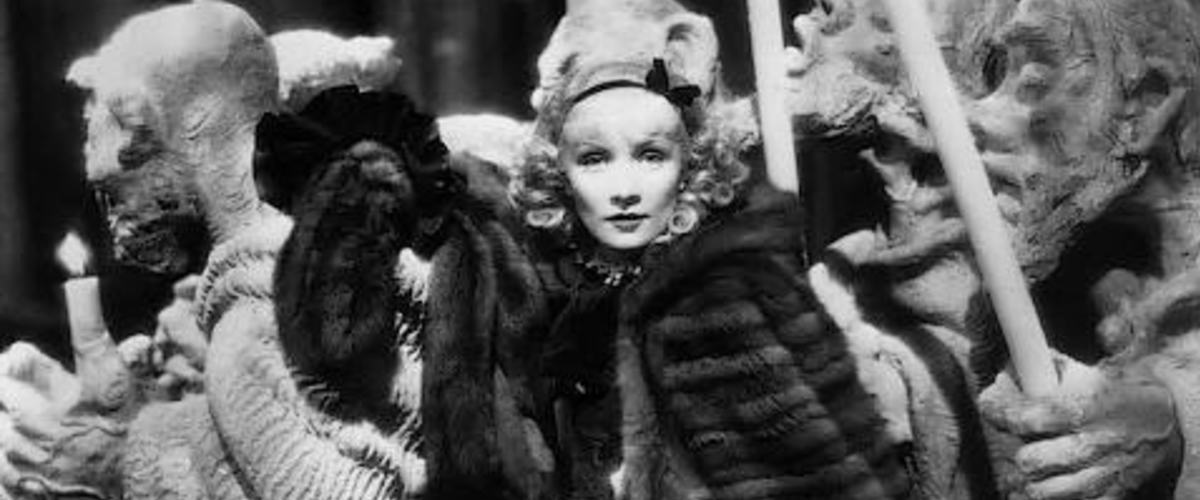
If anything, The Scarlet Empress is first and foremost a feast for the eyes, full of lavish costumes and sets beyond anything that borders on realistic. The uncredited Hans Dreier deserves massive credit for some of the most amazing sets ever filmed. It isn't until Sophia reaches Court where Dreier and Sternberg go all out into making it an amazingly lavish spectacle. Empress Elizabeth's throne is probably not historically accurate, but it simply is amazing: it looks like it was carved from one enormous tree, a massive, unreal thing with a large bird hovering over her.

Catherine and Peter's wedding is also visually arresting, keeping with the von Sternberg motif of filling the screen with people and candles and icons and veils, as if any empty space would be a crime. The chairs of the Empress' Council are also a bit outrageous: also looking as if they were carved from trees, they look like worried old men.  The subtlety in The Scarlet Empress might have been curious then, and it is a bit now, but it is wildly clever.


The wedding feast as well lends visually to the lavishness that was the Court of "the barbarians of all the Russias". Even the briefest scene gets the full spectacle treatment. When Peter visits the body of the Empress Elizabeth, the scene doesn't last for more than a minute, but no detail was spared, to the point where the actual body of the deceased monarch is virtually invisible.

Von Sternberg also created wonderful edits in the film. His montages are amazing. Take for example when we see Russian methods of torture: the images of barbarity and cruelty change like pages being turned, the last one being a bell being rung literally by a man which then transforms into a youthful Sophia gleefully swinging on a swing. A remarkable piece of editing, as is a later montage where Czar Peter III's proclamations bring the Russian people to their knees, a series of proclamations that bring terror, madness, and even sexual depravity.

It's done in a breathless pace that tells you what horror Peter's reign was and shocks with its visuals. The final, frenzied montage, when Catherine rides her horse, leading her army up the stairs of the palace to the conclusion of her successful coup as she laughs maniacally, is indicative of the wildness of now-Empress Catherine II, of Marlene Dietrich herself, and of The Scarlet Empress as a film.

This isn't to take from some of the acting performances. Louise Dresser's Empress Elizabeth is a terror, but she is also a bit of a comic character, like when she inadvertently uses a chicken leg as a scepter, or when she orders Catherine and Alexei out of her presence. "Now get out, the both of you. I have a war on my hands," she bellows.

Jaffe's Grand Duke Peter from the moment we see him on screen appears almost as if he wandered in from a Lon Chaney horror film, his grinning face and wild, crazed eyes signaling his insanity without saying anything. When he does speak, it's in angry whispers, as if his voice itself has the power to kill (which in a sense, it could via his orders).

At the center of The Scarlet Empress is Dietrich. Her screen presence is unmistakable, her magnificent face staring at us with passion and haughtiness. Given Sophia was German, she seems perfect for the role. In the beginning it is a bit unbelievable to see her as an innocent, but once she grows to the confident Catherine, Dietrich is in her element, a cool, slightly distant woman who knows how to play men.

Acting-wise, she isn't given much to do, an ironic fact considering The Scarlet Empress is about that scarlet woman, the intelligent and lustful Catherine II, Empress of All the Russias. However, one has to remember that the film isn't supposed to be a historically accurate biopic, but a visual spectacle to be thrilled by, a vehicle for Marlene Dietrich, and a rejection of reality.

Long May She Reign.

1729-1796


DECISION: A- 

CATHERINE II FEATURE FILMS & SPECIALS


The Great (2020-2023)