Tuesday, June 22, 2021

Dime Cuando Tu (Tell Me When): A Review

DIME CUANDO TU (TELL ME WHEN)

I will grant that the circumstances under which I saw Tell Me When (Dime Cuando Tu)* may have colored my views on the film, but I think I would have reached my conclusions regardless. 

Guillermo or Will (Jesus Zavala) is a Mexican-American, too busy wrapped up in his career to notice either life or his heritage. After his beloved grandfather (Jose Carlos Ruiz) drops dead, Will finds the notebook he had written for his grandson. Here, he advises Will to revisit his roots by going to Mexico City and explore the sights and sounds of the vibrant capital.

While there, Will finds that "Daniel", his grandmother's friend's grandson, is really "Danielle" (Ximena Romo), an aspiring actress who curiously mistakes being the understudy to Mexican actress Ludwika Paleta** as "making it". Fortunately, a car accident renders Paleta totally incapable of taking the stage, clearing the way for Dani. Will, encouraged by Dani's requisite gay best friend Beto (Gabriel Nuncio), attempts to form a romantic relationship with the upbeat Dani, resulting in one kiss.

However, Dani sees that they are not meant for each other, leading Will to feel inadequate and depressed. Reluctantly returning to Los Angeles, it takes a lot of work from Beto and Will's family to get him back to Dani, where he is willing to be with her be it as lover or friend.

My cousin, celebrating her birthday, insisted on having us see Tell Me When as part of an outdoor Netflix screening. It was about nine thirty and I wanted to go home, but one doesn't walk out on family. As such, I endured a movie whose plot was so painfully obvious it is a wonder that anyone could think any of this was clever, let alone good. Writer/director Gerardo Gatica Gonzalez had several sketches for a story, but never brought them together into anything worth the surprisingly lengthy 95 minutes.

Zavala's character was dull, so I cut him some slack, but Will was not interesting to begin with. Truth be told, for a movie filled with clichés (no woman apparently is without a gay best friend), his character never grew. Instead, he just hit the expected beats without earning our interest. I put it down to Gonzalez's script, which not only gives Will/Guillermo (both are translations of the other) nothing to do but never decides if he's merely sheltered or a blithering idiot.

One scene has him "mugged" by perhaps the gentlest pair of ruffians, who take his wallet after removing a pair of blinking sunglasses he literally wears both at night and while walking back to the apartment. A girlish scream is enough to make him flee in terror. I figure this is funny to Gonzalez, but it just comes across as third-rate sitcom. Another odd scene is when Will joins a mariachi group in an impromptu performance. The other restaurant patrons appear unsure if this man is merely drunk or flat-out bonkers, but once he orders drinks for everyone on him, there is a pause before they all applaud.

For a film whose message is to "find life", Tell Me When doesn't find anything. Again and again, Gonzalez flirts with ideas only to drop them, refusing to follow through. One moment a raincloud seems to fall only on him, suggesting a slightly surreal film, but that disappears quickly. Dani's former flame appears but that too doesn't add anything to the story.

Faring much better is Zapata's other costar Romo, who gives Dani something of a character (although the idea that Will's family friend would not make clear that Daniel is really a woman stretches believability). She too was hampered by Gonzalez's script, which at times shifted from making her something of an idiot (an actress would or should know being an understudy is not the same as getting the starring role) to making her a wise woman. 

To be fair, Tell Me When does have an excellent soundtrack, blending everything from Patsy Cline's Crazy to Juan Gabriel's Querida (which has the line "Dime cuando tu"). Anyone who grew up listening to Spanish-language performers like Napoleon or Daniela Romo would appreciate the music. 

Credit should also be given to some of the supporting actors like Veronica Castro as Will's grandmother and Hector Bonilla as her lifelong friend Juancho for bringing life to characters more interesting than Will or even Dani.

Makes one wish the film had focused on them instead.

I love my family, but given that my cousin and I have diametrically opposed views on politics, religion and film (which we respect, leading us to have never had a single fight between us), why she would think I would enjoy Tell Me When is puzzling. To each his/her own, but the only thing I'd ask anyone to tell me is to Tell Me When it's over. 

* While translated as Tell Me When, I would argue that "Dime Cuando" is "Tell Me When" and Dime Cuando Tu is "Tell Me When You".

** While I understand that "Paleta" is her actual Polish surname, it can also mean "Popsicle" in Spanish, which made the Polish-Mexican name "Ludwika Paleta" very curious to my younger eyes and ears. 

DECISION: F

Friday, June 11, 2021

When a Woman Ascends the Stairs: A Review

WHEN A WOMAN ASCENDS THE STAIRS

The transition from Imperial to modern Japan forced many changes. The role and position of women, however, was not one of them. When A Woman Ascends the Stairs chronicles the struggle and sadness behind the smiling faces of women who entertain men.

In post-war Japan the widow Keiko (Hideko Takamine) works as a bar hostess at the Lilac Bar. Mama as the other, younger hostesses call her, maintains her dignity while struggling financially despite having wealthy patrons. She wants to open her own bar, but simply has no money for such a thing.

Her former colleague Yuri (Keiko Awaji) has opened her own place, drawing customers away from the Lilac. Outwardly happy, she too is struggling financially. Keiko may entertain the men, but she won't sleep with them. She also hates going up the stairs to the bars she works at, finding that she can't fake it until she makes it.

In a shocking turn, Yuri commits suicide, though it is unclear whether she meant to or merely misjudged a fake attempt to keep her creditors at bay and accidentally killed herself. For once, Keiko can't go through the façade of the joyful geisha-like figure and berates the man who sent the bill collector to Yuri's grieving mother. Her manager Komatsu (Tatsuya Nakadai), who harbors love for Keiko, insists she do her job. 

Illness, however, along with anger, prevent her, at least temporarily. After finally sleeping with a client who won't leave his wife, Keiko turns down Komatsu's proposal and ultimate ascends the stairs, presenting a happy face to new clients.

When A Woman Ascends the Stairs is a sharp critique of gender roles in Japanese society, one where women must put on a happy face to men who may or may not care for them in order to survive. The men are interested almost wholly in being catered to and entertained, but the private struggles of the women is of little importance.

Even Komatsu, perhaps the most sympathetic of the men, isn't above having sex with Junko (Reiko Dan), another bar hostess whom Keiko serves as unofficial mentor in the demimonde of neo-geisha. He sleeps with her to get information about Keiko, even though Junko sees him in a more romantic light. Naïve and upbeat, Junko wants a marriage but doesn't seem to mind being a hostess if it leads to a wealthy husband. Even a single tryst with Komatsu will make her happy.

It won't make Keiko happy though, and When A Woman Ascends the Stairs succeeds because of Hideko Takamine. Her performance is extraordinary, eliciting sympathy and strength in equal turns. Takamine does not make Keiko a victim but it also does not glorify her as a feminist. Instead, she makes Keiko a survivor, who cares about her fellow bar hostesses but who keeps a rich but private world separate from her work. Her performance is pitch-perfect, from when she denies a true story of her placing a love letter in her late husband's urn to telling off the man who drove Yuri to suicide (intentional or not).

Keiko is a strong woman, who has dreams but also private pains. You want her to succeed, but whether her last moment where she "happily" greets clients is a triumph or a fall is up to the viewer. Despite whatever life throws at her, she maintains her own honor and pride. "I love you but I prefer a husband," she tells her potential benefactor, showing she can't be bought even by what was intended as an act of kindness; when she returns his stock certificates at the train station with his wife present.  

Though a smaller role, Nakadai supports Takamine as Komatsu, the man who privately loves her but who cannot bring himself to say it out loud until it is too late. He carries this torch but also has created a false goddess, idolizing her in a way that is just as regressive as the men Keiko entertains. Reprimanding her for her behavior towards the sleazy businessman, he makes clear what her role is. "You get paid to show men a good time. If you don't like it, take off that kimono and work in an office and starve", he snaps. 

Whether he says this as a way to cover his own pain about her not seeing his ardor for her or because she in a way is business one doesn't know, but it makes Komatsu's struggle all the harder.

The film also has a surprisingly light and smooth jazz score, perhaps reflecting the outwardly upbeat but privately hard world it takes place in.

When A Woman Ascends the Stairs feels longer than it is and I wasn't big on Keiko's sporadic voiceover, but those are minor points. It's a well-acted film about how those smiles we get may not be anything more than a graceful performance, an artifice to keep body and soul together.

DECISION: B+

Thursday, June 10, 2021

Fatale: A Review

FATALE

It takes a certain amount of courage to try and make a clearly psychopathic murderess the heroine of a film. Fatale tries, bungles it in at times hilarious ways, but bless it for trying. 

Successful sports agent Derrick Tyler (Michael Ealy) worries his wife Tracie (Damaris Lewis) is fooling around. Therefore, it seems almost rational that he has a one-night stand in Las Vegas with Val (Hillary Swank). Val enjoys the fling to where she forces him to go another round so he can get his cell phone, which she's locked in the hotel safe.

If that already doesn't scream "psycho", I don't know what does.

So after this indiscretion Derrick attempts to work on the marriage and it looks like things are going well, until an intruder comes and nearly kills him. The lead investigator is none other than Val, displeased to find "Darren from Seattle" is neither. 

Now Derrick has to deal with both the attempt on his life and a woman scorned. As if to add to his troubles there's the fact that Tracie is indeed having an affair, with none other than Derrick's business partner Rafe (Mike Colter), a relationship Val is more than happy to reveal. Is it to warn him that Rafe and Tracie were the ones who tried to kill Derrick off? Is it to get Derrick to help her get custody of the daughter she permanently disabled when she was an alcoholic? Is it not just to help her get custody of said daughter but to get rid of her ex, District Attorney Carter Haywood (Danny Pino)? 

As bodies keep piling up and more people get involved in the myriad of crimes, Derrick has to use all his wits to save himself from being framed and from Val's increasingly whacked-out schemes.

Fatale is so close to a "so bad it's good" film, one that could have embraced its loonyness and been so much camp. It, to be fair, could also have decided to take things seriously and be the psychological thriller it aimed at.

Instead, Fatale decided to tie itself into knots by becoming totally unhinged if not irrational, not unlike Val.  David Loughry's screenplay attempted to make Val sympathetic through her efforts to get back her daughter, but trying to force Derrick to reenact a weird version of Strangers on a Train is an odd way of doing it. 

If I understand things correct, Tracie and Rafe hired a hitman to ice Derrick, but Val decided to kill them both so that Derrick could then kill Cole, thus granting her sole custody. Add to that the idea that a police detective could keep working when she has a restraining order against her from the District Attorney, who is himself embroiled in some kind of scandal. Guess if Cole's killed, his current wife has no rights to her stepdaughter against a woman who caused said daughter's paralysis and who is certifiably bonkers?

Yes, it's a bit muddled, but Fatale decides it needs to go all over the place just to go somewhere.

Fatale in many ways is an unintentional comedy. From when Derrick discovers Tracie and Rafe are humping around to when Derrick's cousin Tyrin (Tyrin Turner) and his fellow hitman Bumpy (Compton Menace) get blown away, these scenes elicited howls of laughter from me. 

Perhaps it isn't surprising how badly Fatale plays, as director Deon Taylor apparently told everyone to look bored. I generally like Ealy and Swank, but Fatale is among their worst performances. Everyone bar none looks so blank, so empty, almost forcing the words to come out with no sense of conviction or even apparently interest. No matter what happened, or what really crazy turns the plot took, everyone in Fatale acted as if they were aware how awful it all was and weren't about to bother trying to make it realistic.

In retrospect, I'm going to walk this back slightly. Pino had one mode: perpetual anger. Even when Derrick comes to try and tell him of a plan he has to catch Val in her own trap, Cole is simply too triggered by Val's name to show an inch of common sense. 

I said to myself, "Derrick, report her psycho ass to her superiors" and if he had he would have spared himself so much misery. However, you can count on people in films to do the dumbest thing possible to keep the story rolling, logic be damned.

I can't say I hated Fatale or that it isn't worth the time to see if there isn't anything else. I can say that Fatale is poorly acted and poorly written, a case of the two going together. "I don't go after something unless I know I can get it," Val tells Tracie and Derrick when she first arrives to lead the break-in investigation. Subtle Fatale is not, but in the right mood it can find a future as less psychological thriller and more camp comedy. 

DECISION: C-

Thursday, June 3, 2021

Cruella: A Review (Review #1491)


CRUELLA

It's a battle of broads in Cruella, not exactly a prequel to One Hundred and Dalmatians but not entirely divorced from the source material either. Longer than it should be, Cruella does what a lot of modern films do nowadays: explain evil. Whether this evil needs explaining is never asked though.

Young Estella, born with black-and-white hair, struggles between being the good girl her mother Catherine (Emily Beecham) wants her to be, and the bad girl inside her. After getting expelled thanks to fighting back against her school bullies, Catherine goes to "an old friend" for financial help. Estella witnesses three Dalmatians push her mother off a cliff, and she blames herself thinking the dogs were after her.

Now arriving in London, she quickly falls in with two pickpockets. Ten years go by, and Estella (Emma Stone) and her partners in crime Jasper (Joel Fry) and Horace (Paul Walter Houser) continue living off their wits and petty crimes. However, Estella yearns to be a fashion designer, so Jasper finagles for Estella a job at Liberty, the chicest of chic boutiques. The job sadly isn't that of a designer but of a cleaning woman.

After drunkenly creating a fabulous window display, Estella grabs the eyes of The Baroness (Emma Thompson), Liberty's owner and the designer of all designers. The Baroness takes Estella under her wing, or at least as much as this catty self-absorbed monster can. It's not long, however, before Estella connects The Baroness with her mother's death. Vowing revenge, enter her alter ego "Cruella", punk fashion designer who upstages The Baroness at every turn. 

It's a battle royale between these two monsters, leading to a shocking connection between Estella and The Baroness and the rise of "Cruella de Vil". 

The character of Cruella de Vil is so ingrained into the popular culture that even if one has not seen either the animated or live-action version of One Hundred and One Dalmatians you recognize the character. She is only one of two animated characters to be listed in the American Film Institute's 50 Greatest Screen Villains ("Man" from Bambi being a questionable third). How else to describe someone who wants to kill puppies to make herself a coat out of them but a villainess? 

Whether Cruella sets out to rehabilitate the reputation of our attempted puppy murderess or not I can only guess at, but here is where I offer a different take on what is meant as a One Hundred and One Dalmatian prequel. Cruella isn't a prequel in my view. It's in an alternate universe altogether, and if you can divorce yourself from One Hundred and One Dalmatians altogether you may find Cruella a better fit. 

Cruella's myriad of writers (five credited with Story and Screenplay, though one suspects more hands were here) attempted to give Cruella's monstrous (future) designs on the puppies some context by having Dalmatians take her beloved mother down. Maybe they thought this was clever. Maybe they thought it gave "context" to Cruella's Dalmatian fixation. It didn't do either.

Simply put, Cruella de Vil wanted to kill the puppies because she wanted a Dalmatian fur coat, nothing more, nothing less. 

Cruella falls into a curious trend in modern storytelling where villains' motivations have to have "a reason, an explanation", some key that will rationalize why they are evil. I don't think such things are necessary: some people are evil because that brings them pleasure in some sort of way. It didn't have to be Dalmatians that did her mother in, but they were chosen because of sheer laziness, to "connect the dots" so to speak.

What Cruella really is a hodgepodge of other films, everything from Hannibal Rising to Maleficent to Oliver Twist to mostly The Devil Wears Prada (or maybe The De Vil Wears Prada). It shouldn't be a surprise given that one of the "story by" writers (Aline Brosh McKenna) wrote the screenplay to The Devil Wears Prada. In so many beats Estella/Cruella is a bizarre mix of Andrea Sachs and Miranda Priestly. For an origin story, Cruella isn't very original. 

Cruella is also drowned out by being far too long and far too bombastic. When a young Jasper asks Estella, "So, what's your story?" we could have started there rather than spend what seemed endless time getting her backstory. The constant one-upmanship goes on and on, exhausting the viewer.

There's also the constant soundtrack of 70s punk songs to set the mood. Even that is barely tolerable, but ending the film with The Rolling Stone's Sympathy for the Devil was so predictable. Sadly, either they didn't or couldn't include The Clash's London Calling anywhere, which seemed like a missed opportunity. 

Whatever positives are in the performances and overall production design. Stone (curiously struggling with her British accent) and Thompson (not struggling) devoured the scenery with total relish. Both dive in full-force in their utter cattiness, begging the question Which Witch is Witch (or something that rhymes with "witch"). Stone's various British tones make the incessant voiceover hard to bear. Thompson understood there was no character in The Baroness save for a British Miranda, so she went for an impersonation. 

Hauser was excellent as the dimwitted Jasper, and Kimberly Howell-Baptiste, sadly underused, was strong as Anita Darling, Estella's only school friend who grew to be a combination Jimmy Olsen/Lois Lane covering Cruella's rising career.

Credit should also go to the makeup, production design and especially costumes, fitting for a film centered around the fashion world. 

Cruella is long and loud, with little if no reason for being. However, if you take the dogs out of it, one could see it as mild entertainment.     

DECISION: C+


Monday, May 31, 2021

Hamlet/Horatio: A Review (Review #1490)

HAMLET/HORATIO

Hamlet/Horatio opts to try something new with its version of Shakespeare's great tragedy. Some elements may scandalize purists, but with exceptional performances from the cast Hamlet/Horatio becomes a mesmerizing visual and artistic work.

While sticking close to the source material, Hamlet/Horatio's concept has it that Horatio (Themo Melikidze) is making a biopic of his dear friend Hamlet (Andrew Burdette). Hamlet is tormented by the death of his father (T.J. Mannix) and quick marriage of his mother Gertrude (Anna Maria Cianlucci) to her brother-in-law Claudius (Michael Elian). Struggling to honor his father's plea for vengeance with his own sense of right and wrong, it not only drives him to despair but his love interest Ophelia (Phage Nolte) to madness.

Horatio stays ever-loyal to the Melancholy Prince of Denmark, but soon things come to a head when Hamlet's actions lead to the deaths of both Ophelia and her father Polonius (Joe Menino). Polonius' son Laertes (Wayne Stephens) now swears revenge, an act that Claudius is only too happy to help with. It is a consuming tragedy, with only Horatio left to tell the tale.

I think Hamlet/Horatio may be a bit too artsy for some due to its concept of Horatio acting as a director, complete with staging. However, once the viewer focuses on the actual story and acting Hamlet/Horatio becomes a rich experience. 

At the brilliance of Hamlet/Horatio is the double-act of Burdette and Melikidze as Hamlet and Horatio respectively. Andrew Burdette is starting out his acting career, but already one sees exceptional promise in his performance. His is one of the best Hamlets I have seen on both stage or screen.

He is youthful enough to convince you that he is a conflicted teenager and blessed with extraordinary looks. Beyond the superficial though, Burdette's Hamlet makes the character come alive, as a real person who thinks these tormented thoughts. Unlike far too many versions of Hamlet and Hamlet, Burdette makes Shakespeare's verse sound authentic versus theatrical.

When, for example, he tells Horatio the line "There are more things in Heaven or Earth, Horatio, than are dreamt of in your philosophy", Burdette has it sound almost like he's adlibbing, shaping the thoughts in his mind and speaking them as Hamlet, not as dialogue. Far too often, actors take these lines and force the recitation, attempting to make them sound grand and glorious.

Burdette, aided by director Paul Warner, speaks them naturally, with no embellishment. It's not only a refreshing to see and hear an actor perform Shakespeare with naturalism versus theatricality. It is also a credit to the actor to make Hamlet's torment, doubt and conflict real. Throughout Hamlet/Horatio, Andrew Burdette never rages or devours the scenery. Instead, he brings a humanity to the role, a calmness that makes his tragedy all the more sad. A case in point is the "Get thee to a nunnery" scene. Many actors, even good ones, go all-in on the crazy (real or faked) as they torment Ophelia. Burdette, conversely, is eerily calm, albeit clearly conflicted.

If one is put off by the concept of Hamlet as almost a student film by Horatio, another director would be wise to allow Burdette to play Hamlet in a more straightforward production, where he would be instantly successful if he taps into the same manner.

He is matched beat for beat by Melikidze, whose Horatio is the loyal friend and perhaps something more. Hamlet/Horatio has a bath steam-room scene where Hamlet is clearly hitting on his BFF. Melikidze's performance makes clear he understands Hamlet's none-too-subtle overtures, but he takes no position on the subject. Melikidze does not reciprocate but does not demure, showing less a conflict and more confusion over what Hamlet means to him.

I think more people might be scandalized that Horatio makes the "To Be or Not to Be" soliloquy a duet, with him reciting some of the lines alongside Hamlet in what is a dream sequence. I do not remember ever seeing a Hamlet where Horatio joins Hamlet in his doubts, but Hamlet/Horatio makes it work. It's a credit to screenwriter David Vando (who also has a small role as the Cinematographer on Horatio's film) that it does work without being showy or ridiculous.

As a side note, the real cinematographer, Hernan Toro, does exceptional work again with a limited budget. While some sequences are more stage-bound, other sequences such as the graveyard scene and Hamlet's dream sequence are atmospheric and visually splendid.

This element of Hamlet and Horatio being more than friends may be new, but hardly scandalous compared to what I took to be the suggestion of incest between Ophelia and Laertes. Intentional or not, I saw Laertes as being both too fond of his sister and him slightly jealous over Hamlet's attention to her. 

The rest of the cast is on the whole equal to the task. Cianciulli's Gertrude is an innocent, loving towards her son and husband yet terrified of both. Elian's Claudius has moments of strong villainy but also a humorous moment when the monarch is clearly bored by the play-within-the-play. 

Some scenes may be a bit too artsy, such as when The Ghost appears and reappears digitally, or when Hamlet is caked in whiteface, lost in his thoughts. Other moments, such as when the Player King and his Troupe perform, is exaggerated and distracting. There's also the film's curious decision to punctuate Polonius' idiocy with sound effects, which I thought were unnecessary.

Hamlet/Horatio still has a few kinks to work out in terms of music, and the concept of Horatio being a film director that is making a quasi-Hamlet biopic may be a bit off-putting. However, Hamlet/Horatio has more positives than negatives, Andrew Burdette's performance at the very top of them, one of the best I've seen this year. Exceptional performances elevate Hamlet/Horatio from artsy film to strong albeit abridged Shakespearean adaptation.    

DECISION: B+ 

Friday, May 28, 2021

Gun Crazy: A Review

GUN CRAZY

Gun Crazy is a short film in terms of running time and clearly limited by its budget. However, far from bringing the film down those elements enhance Gun Crazy, making it an exceptional example of economic filmmaking at its most brilliant.

Despite his fascination and expertise with guns, Bart Tare (John Dall) is at heart a good man haunted by his youthful shooting of a baby chick. After a stint in reform school and the Army, Bart returns to his hometown and looks ready to start a quiet life.

That is, until he meets professional carnival sharpshooter Annie Laurie Starr (Peggy Cummins). The alluring vixen is impressed when Bart manages to outshoot her, while he's impressed with Annie. Even though she knows she is 'bad', they try to make an honest and happy life together. Eventually, the money runs out, but while Bart wants to settle down Annie wants wealth. 

As such, she pushes him into a life of crime, and they turn to bank robbery, creating a crime spree culminating in Annie violating one of his rules on gun violence and a fiery end for our star-crossed gun-toting lovers.

Gun Crazy is an absolutely brilliant example of how one can craft art while on a shoestring budget. Of particular note is a long one-take sequence involving their first major bank heist. Taking a POV from the backseat of their car, we see Bart and Annie interact as they search for the perfect place to park. We don't go inside the bank while Bart robs it, but instead stay with Annie as a policeman comes up.

To distract him, she leaps from the car and makes conversation. The audience can see and hear them, but we stay in the back, building up the tension of the sequence.

This one-take sequence predates Orson Welles' similar albeit more elaborate one-take opening from Touch of Evil, but director John Lewis shows he is able to hold his own. Lewis builds up great tension in other scenes, such as the initial shooting contest between Annie and Bart, where they fire at each other. 

Visually, Gun Crazy dazzles, and it's extraordinary that with a small budget the production could look so inspired. From Annie's first appearance as she looks down towards Bart to the climatic swamp scene, Gun Crazy manages to display exceptional sequences.

The economy Gun Crazy has does not limit but actually enhances the film, using clever elements such as audio distortion when young Bart drowns out the Judge's words or a montage of the couple's declining financial status.


Performance-wise, Gun Crazy is equally exceptional.  In an honest world, both Dall and Cummins would have been Oscar nominees at least for their performances. Dall makes Bart into the most reluctant criminal, a man so enthralled with his femme fatale that he'd dive up everything for her. The horror when he learns Annie's killed, the inability to leave her, his weakness at her, all builds up to an exceptional and heartbreaking performance.

Cummins should equally be recognized as the malevolent Annie. As the woman who leads her man wrong, Cummins makes one shiver at her greed and general unrepentant manner. I say "general unrepentant" because Cummins does not make Annie into a thoroughly evil person. You do get a small glimmer that she at least wanted to try and change for the better. When they rush to marry after being fired from the carnival, she confesses that she isn't any good, but she will try. It's almost as she knows it's impossible for her, yet her love for Bart would make her give it an effort.

It's extraordinary that Gun Crazy also has a score from Victor Young, always brilliant, that balances the danger and menace with a sense of 

The simplicity of economy forced the makers of Gun Crazy to be creative, and the end results are one of the great examples of film noir. 

Monday, May 24, 2021

Gaslight (1944): A Review


GASLIGHT

The term "gaslighting" (to try and manipulate someone into believing something that isn't true) is a dominant one today, yet few remember the origins of the term come from a Golden Era film. Gaslight is a well-acted albeit long film about the manipulation and ultimate revenge of the manipulated.

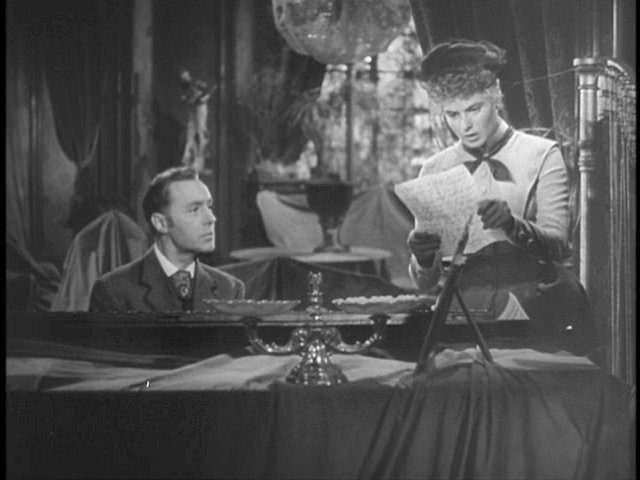
After her aunt is brutally murdered, Paula Alquist (Ingrid Bergman) goes to train as an opera diva like Aunt Alice. However, while her career doesn't take she herself is, by suave pianist Gregory Anton (Charles Boyer). A whirlwind romance and marriage bring them back to the murder house, which Paula had inherited.

Soon, Paula appears to be slipping into insanity. Items begin disappearing with Paula unaware that "she" had taken them. There are footsteps only she can hear, and gaslights dimming with no apparent reason that only she can see. There's evil at work, but what or who can be behind it? Into this case comes Brian Cameron (Joseph Cotten), a detective and fan of Paula's aunt who suspects Gregory is not whom he says he is. As Paula's mind starts disintegrating, it will take all her strength to find out if and who is gaslighting her.

Gaslight is held up by the strong central performance of Ingrid Bergman. She easily transitions from the young woman in love to that of the terrified figure, shivering at the idea that she might be going mad. 

The brilliance of Bergman's performance is that the growing fear and anxiety is played without her becoming fully hysterical. Instead, the struggle between what she knows and what she is being manipulated into believing is played as a woman torn in two. You never see her really going bonkers. In fact, there's a certain restraint in her manner, one where Paula's growing fears fights against her knowledge of her genuine sanity.

It's only at the end, when she gets her revenge, that we see Bergman unleashed, and again it isn't a theatrical performance. Instead, it's the performance of a character who now has full command, enacting her own justice on her tormentor.

Boyer at times seemed a bit theatrical, his French accent making things more so. Of particular note is when he reacts when Paula finds a note from "Sergius Bauer", a gentleman caller of Aunt Alice. It seems clear he is villainous, and I wonder if director George Cukor opted not to make the mystery less obvious. Then again, the adaptation of Gas Light probably wanted us aware that Anton was manipulating her for his wicked intentions. 

Angela Lansbury earned an Oscar nomination for this, her screen debut, and it is well-warranted. As the tawdry new maid Nancy, Lansbury's performance made one wonder whether she too was in on the act. That balance between sleazy and innocent is well-handled by Lansbury. Dame May Whitty was the comic relief as the nosy neighbor, but while she was kept to a minimum at least it didn't come across as silly.

My issue would be with Cotten, who seems slightly miscast as the investigator. I didn't think it a horrible performance, but it seemed a bit stiff, like he was in the theater rather than a film. There was a slight artificiality to it that didn't quite convince me he wasn't "acting".

One excellent element in Gaslight is Bronislau Kaper's score, which gave Gaslight the extra element of Gothic horror. Joseph Ruttenberg's cinematography and the use of shadows also gave the film a sense of the macabre.  

As well-acted as Gaslight is, the beginning did seem very "acted", and the film seemed very long. While minor details they did drag the film down a bit.

Despite this, the impact Gaslight continues to have has not abated. The ability to manipulate people into believing something false is true is a common one. Gaslight may not be as well-known by those more familiar with the term than the film. However, the film is worth watching in particular for Ingrid Bergman's exceptional performance.   

DECISION: B+