Sunday, June 16, 2024

The Golden Girls: Guess Who's Coming to the Wedding


THE GOLDEN GIRLS: GUESS WHO'S COMING TO THE WEDDING?

Written by: Winifred Hervey

Directed by: Paul Bogart

Airdate: September 15, 1985

Out of all the four Golden Girls, only one was divorced. Guess Who's Coming to the Wedding? is the first appearance of Dorothy Zbornak's (Bea Arthur) yutz of an ex-husband. Surprisingly angry but with a great dramatic turn, Guess Who's Coming to the Wedding? establishes a long and strange relationship that would be among the series' most enduring. 

Dorothy is thrilled when her daughter Kate (Lisa Jane Persky) comes to Miami to tell her that she is engaged to Dennis (Dennis Drake). Dorothy's enthusiasm is somewhat dampened when she learns that Dennis is actually a podiatrist versus a "real doctor" in the words of her mother, Sophia Petrillo (Estelle Getty). Still, her daughter's upcoming wedding is joyful news. That is until she learns Kate and Dennis are going to get married in the Bahamas.

Why the Bahamas? Kate wants her father, Stanley Zbornak (Herb Edelman) to give her away, but two years after their divorce, Dorothy cannot stand the thought of Stan, let alone be in the same room with him. Sophia points out correctly that Stan is Kate's father and has every right to be at his daughter's wedding. With that, Dorothy calls Stan, now living in Maui with his new wife, to come to the wedding.

Dorothy is openly hostile to Stan. Her roommates, Blanche Devereaux (Rue McClanahan) and Rose Nylund (Betty White) attempt to keep Dorothy's rage in check. It takes the wisdom of Sophia to get Dorothy to finally confront Stanley and tell him goodbye.  

Guess Who's Coming to the Wedding? is the first appearance of Stanley Zbornak, who would go on to be a recurring character and a thorn at Dorothy's side. While the episode does establish that he and Dorothy were married for 38 years before their divorce, the actual time frame of both the wedding and the divorce will appear to fluctuate. Like many things in The Golden Girls, continuity is something the show never appeared to care for or about. 

If we go by the airdate and add the two years after the divorce, Stan and Dorothy would have been married in 1945. In The Engagement, we have established that Stanley was born in 1920 (Dorothy remarks that Stan is 65 years old at the time). That would have made Stan 25 years old when he married Dorothy. 

If we go by the actress' age as that of the character, Kate would be 30 when she got married. Using that as a base, she would have been born in 1955, ten years after her parents married in a shotgun wedding. As such, Kate would not be the reason they had to get married. We do not know exactly how old Dorothy was when she married Stanley as we have not been given Dorothy's birth year or age as of yet. Therefore, while it is still possible that Dorothy was underage when she and Stan married, we are currently skating on thin ice when it comes to logic. 

A minor point of logic is when Stan shows up for the wedding itself. Guess Who's Coming to the Wedding? to my mind implies that this is the first time Stan has seen Kate since arriving in Miami. Surely, he saw his daughter before the actual ceremony, but as played by Edelman and Persky it appears that they had not seen each other until Stan comes to take her to the church. 

There are two sections from Guess Who's Coming to the Wedding? that are usually cut from reruns. The first is the telephone call that Dorothy makes to Stan inviting him to the wedding. The second is when, at the small wedding reception, Dorothy comes into the living room with a butcher knife. Rose, terrified that Dorothy will literally stab Stanley, rushes her out into the kitchen before Dorothy makes clear she only intends to cut the wedding cake. 

As insane as the idea of Dorothy murdering Stanley in front of everyone is, on this one I have to side with Rose. Dorothy's anger is understandable and even relatable. It is her behavior that is beyond irrational, especially for the most level-headed of the quartet. She literally barks at Stan, which I understand is for comic effect, so it gets a bit of a pass.

What really makes Dorothy's behavior irrational is how she stubbornly refuses to accept or acknowledge Stan's role in Kate's life. For all his faults and all the hurt he caused Dorothy, Stan is Kate's father. Sophia is absolutely right when she says that Stan has every right to be at his daughter's wedding. Moreover, Kate obviously loves her father and has a positive relationship with him. For Dorothy to insist that he be excluded from Kate's wedding is clearly vindictive and short-sighted, not to mention utterly selfish.

This is not to diminish the genuine hurt, anger and hatred that Dorothy has. Arthur has a beautiful scene where she recounts their life together and expresses how she deserved better from the man she was forced to marry who ended up abandoning her for a younger model. It's a beautiful piece of acting from Arthur. It also was good for Edelman, who says very little but shows how Stan is confronted with his own selfishness and cowardice. 

Still, looking back at it, I think Dorothy's overall behavior slipped into tunnel vision. She loves her daughter, but in this case, she also here put herself first. This is terrible for her character, revealing a surprisingly vindictive manner. Dorothy also shows terrible disappointment that her future son-in-law is a podiatrist. It is not as if he is a mud maker or an irresponsible jazz musician. Podiatrist is a respectable position. I never got the joke about how Dennis being a podiatrist was a terrible thing. Rose's sincere question about whether Dennis has ever met Dr. Scholl was amusing.

As a side note, it is a strange coincidence that the character of Dennis is played by an actor named Dennis. 

Edelman does a good job in Stan's debut. His welcoming line, "Dorothy, it's Stan" would later evolve into the more familiar and comic, "Hi, it's me, Stan". The latter became a running gag and amusing entry into a more comic figure. Here, he was slightly more realistic as a character.

There is a nice bit of physical comedy when Dorothy all but crushes Blanche's hand out of suppressed anger. The gag about Rose forever guarding the meatballs from Sophia did not work, however. Why Rose thought Sophia grazing Rose's meatballs was such a crisis is unexplained, not to mention bizarre.

As Guess Who's Coming to the Wedding? is Dorothy-centered, both McClanahan and White were there merely for support. White was excellent when playing naive, less so when playing meatball police. McClanahan also did well when forcing Dorothy to pull herself together for Kate's sake. She also had a nice comic moment when she slips from talking about Dorothy to sweaty, muscular farmhands. Getty is snippier when mocking Stan and his toupee, sarcastically asking who invited Donny Osmond. She did however managed comedy and drama when comparing anger to a piece of shredded wheat. 

Guess Who's Coming to the Wedding? is better at playing the drama than the comedy, but it does have good funny moments. Stanley Zbornak may appear to be out of Dorothy's life, but don't could out the bad penny that is the first Mr. Dorothy. 

I wonder if Coco would have kept Stan's toupee. 

7/10

Next Episode: Rose the Prude

Friday, June 14, 2024

The Golden Girls: The Engagement (aka The Pilot)


THE GOLDEN GIRLS: 
THE ENGAGEMENT (aka THE PILOT)

Written by: Susan Harris

Directed by: Jay Sandrich

Airdate: September 14, 1985

A television pilot, I have found, is not set in stone. Many things can be changed with regards to characters, sets and backstories. The Engagement, the premiere episode of The Golden Girls, would see characters that disappeared and never mentioned again. It was a good way to set things up, though with some curious moments.

Blanche Hollingsworth (Rue McClanahan) has surprised her two housemates, substitute teacher Dorothy Zbornak (Bea Arthur) and grief counselor Rose Nylund (Betty White) with news that she got engaged to Harry (Frank Aletter). This news comes as a surprise to their gay cook, Coco (Charles Levin). This news is particularly upsetting to Rose, who fears that she will have to find a new place to live as she, like Dorothy, rents her room from Blanche, whose house they live in.

Another surprise comes when Dorothy's mother Sophia Petrillo (Estelle Getty) shows up unexpectedly. The retirement home she lived at has just burned down. Sophia instantly dislikes Harry, while Rose becomes quickly suspicious of him. Blanche nevertheless decides to get married quickly at her home. She gets a sad surprise when a cop (Meshach Taylor) comes to tell her that Harry has been arrested for bigamy. Devastated, Blanche retreats from the world until she realizes that her friends have helped her through this crisis. With that, they begin their new adventures.

The Engagement, as I said, sets up the scenario that would hold The Golden Girls together, with some future alterations. We learn that Rose has been a widow for 15 years, that Dorothy had a shotgun wedding and that she is from Queens. We also learn that Dorothy's ex-husband is 65. 

If we go by the original airdate, that means that Charlie Nylund died in 1970. Dorothy's ex, whom I do not think was named in The Engagement, would also have been born in 1920. As a side note, Herb Edelman, who would play Dorothy's yutz of an ex-husband Stanley, was born in 1933. Bea Arthur was born in 1922. 

One of the biggest things that stuck out to me is a bizarre editing choice. When Blanche announces her sudden engagement, there are three other people in the room: Dorothy, Rose and Coco. When we return from commercial, Coco is suddenly gone with only Dorothy and Rose in the living room. He and Sophia appear later in the scene, but I am surprised no one noticed how Coco was in and then out.

Perhaps this is for the best, as Levin's Coco was dropped from the series after his debut. His character, it should be noted, was not only never heard from again but never mentioned again. I think that once people saw how well Getty worked well as the blunt Sophia, Coco was unnecessary. Moreover, I think that having any man, even a gay man, would have been distracting and not well integrated in future episodes. It makes sense to have the mother of one of the characters there. What would Coco do with this mix?

I also find that Coco would have suggested that the three women were more affluent than future episodes suggest they were. I do not know if The Golden Girls thought about such things as "representation" with Coco. I do think that it is amazingly progressive to have a gay character at all on a television comedy. He was, however, something of a stereotype: the slightly effeminate houseboy.  

The Engagement has two scenes that are trimmed from the reruns that I see. There is an extended section on the lanai with Dorothy, Rose and Coco discussing Blanche's whirlwind romance. The last scene with Dorothy, Rose and Sophia again on the lanai before Blanche emerges from her room is also longer than on reruns. 

Many Golden Girls fans complain that the geography of Blanche's house makes no sense. The Engagement makes the house more sensible, as we find that Blanche's room is located stage right where the cast goes out to the lanai. Even with that however, the actual layout would be highly illogical if one thought on it.

What I found was that The Engagement worked best when we get dramatic moments. The scene where Dorothy reads Harry's note to Blanche is well-acted by both Arthur and McClanahan. The visual gags of Dorothy attempting to silence Rose is also funny. Getty does great work in her bluntness. Levin did as much as he could as Coco, though he was given little to do.

Sometimes though, it looks like Arthur's Dorothy is almost too dominant, close to bellowing her put-downs and sarcastic remarks. Still, one has to remember that everyone is still getting their bearings. 

The Engagement ends up a good start to The Golden Girls. There is still work to be done, everything from character names and makeup work to removing Coco. While not laugh-out loud funny, The Engagement has good moments of humor and heart that make it a good but not great debut.

6/10

Next Episode: Guess Who's Coming to the Wedding?

The Golden Girls Retrospective: An Introduction


THE GOLDEN GIRLS RETROSPECTIVE:
 AN INTRODUCTION

The Golden Girls is a beloved television series, running seven seasons and maintaining a cultural hold long after it went off the air in 1992. Think of it: it has been thirty-two years since the series finale aired and the show continues to be seen in reruns, have endless merchandise and keeps gaining new fans. Such was the impact of The Golden Girls that when Betty White, the last surviving cast member, died two weeks shy of her 100th birthday, it was headline news, eliciting genuine public mourning. 

The Golden Girls has earned a place in television history. It won the Outstanding Comedy Series Emmy back-to-back and was nominated for six straight years out of its seven year run. It also is one of only four television series where all cast members won individual Emmy Awards for their performances: White, Rue McClanahan and Bea Arthur for Lead Actress, Estelle Getty for Supporting Actress. 

The show really has universal appeal, and I think I can see why. Each character has something unique about them: terminally naïve Rose Nylund (White), openly sexually voracious Blanche Devereaux (McClanahan), sarcastic Dorothy Zbornak (Arthur), blunt matriarch Sophia Petrillo (Getty). The cast blended well, at least onscreen. The characters were relatable in their problems but also in their genuine affection towards each other. 

The Golden Girls tackled serious issues ranging from age discrimination and AIDS to dementia and drug dependency, mixed in with risqué talk of sex in all its forms. This was very daring stuff in the mid to late 1980s, especially on a show built around four senior women. I think, however, that part of The Golden Girls' success is due to them being four older women. It was like listening in on randy tales from your grandmothers. 

It did not matter that sometimes their situations were outlandish or bizarre. It did not even matter that continuity was almost nonexistent. The same actors could appear in different roles, and sometimes the same roles were played by different actors. The number of children and grandchildren fluctuated wildly. Ages of the characters shifted sans rhyme or reason save for Blanche, who persistently hid or lied about her age. 

There was some continuity: the husbands or ex-husband's personalities did not change when they popped up in reality or dream sequences. Their manner of death, however, was at the writers' whim.

I have long wanted to do a Golden Girls retrospective, where I look at each individual episode, review it, give my thoughts on it and rank the 177 episodes from Best to Worst. I have reviewed one Golden Girls episode, Empty Nests, for Rita Moreno Day when she was featured for Turner Classic Movies' Summer Under the Stars series. 

As a side note and a bit of a spoiler alert: Empty Nests will find itself among the Ten Worst Golden Girls episodes list.

Now I think I am ready to plunge into the life and adventures of Miami's most famous senior citizens. 

I, at long last, begin my Golden Girls Retrospective. 

Thursday, June 13, 2024

Bad Boys: Ride or Die. A Review


BAD BOYS: RIDE OR DIE

It was the slap heard and seen round the world. On his inevitable (and to my mind, inexplicable) march towards his Best Actor win for King Richard, Will Smith publicly assaulted Chris Rock after Rock made an off-the-cuff joke about Smith's wife, Jada Pinkett Smith. Smith went from beloved superstar to public pariah. Now, he is on a comeback if not redemption tour. One way to do that is to return to a well-liked franchise almost guaranteed to be a hit. Thus, Bad Boys: Ride or Die. As it is the fourth Bad Boys film, calling it Bad Boys: 4 Life might have worked, but that title was used already. Bad Boys: Ride or Die is not good, but it should make fans happy, so I can't fault it for that. 

Mike Lowery (Smith) is finally getting married, with his bride the beautiful Christine (Melanie Liburd). There at his side, like always, is his other longtime partner, Marcus Burnett (Martin Lawrence), forever in the hunt for snacks. At the wedding, Marcus suffers a near-fatal heart attack while doing The Wobble. While he does survive, Marcus does have a near-death experience where he sees the late Captain Conrad Howard (Joe Pantoliano), who tells him it is not his time. Now convinced that he is basically immortal, Marcus also sends a message from the Great Beyond, warning Mike that he has to make a serious choice.

A new danger comes from James McGrath (Eric Dane), a former Ranger gone rogue who is attempting to frame the dead Captain Howard as a dirty cop. Mike and Marcus are enraged that Howard's memory is being demolished and seek to find out who is attempting the postmortem frame-up. Now our bad boys must uncover the massive conspiracy. Aiding them are Detectives Kelly (Vanessa Hudgens) and Dorn (Alexander Ludwig), partners in so many ways. Also helping is Mike's ex-girlfriend Rita (Paola Nunez) and Howard's daughter, U.S. Marshall Judy (Rhea Seehorn).

Unexpected help comes from Mike's illegitimate son Armando (Jacob Scipio), who killed Howard in Bad Boys for Life. What role does Rita's boyfriend and aspiring Miami mayor Adam Lockwood (Ioan Gruffudd) have in all this? As Mike and Marcus become fugitives themselves, friends, foes and frenemies must make decisions that may cost them their lives. Except for Marcus, who apparently is immortal. All things end well, complete with a Fast & Furious style picnic. 

I have seen only the first Bad Boys film, which I found entertaining. I can't quite say the same for Bad Boys: Ride or Die. It might be because at 55 and 59, Smith and Lawrence look a bit old to be doing these action films. That might explain why a nice chunk of the action went to Scipio, who is a mere 31. It might also have to do with how I never saw any other Bad Boys films. Perhaps there I could have had a plausible explanation for how Scipio in any way, shape or form could be confused for Will Smith's son. They look nothing alike, not even a passing resemblance, so I am a bit puzzled as to how everyone and anyone could see Armando and say that was Mike's son.

It might have also something to do with Chris Bremner and Wil Beall's screenplay. After one of their informants, who was in the last film, is shot by McGrath's goons, Marcus takes cover behind a table with snacks and drinks. He finds the jelly beans unpalatable, but in the melee, a bowl of Skittles is shot. With Skittles cascading down, we hear Barry White's Can't Get Enough of Your Love, Baby playing as he, in slow motion, enjoys this forbidden treat. I guess one is supposed to laugh. I was more mystified by what I was seeing.

I think it is because the film's directors, Arbi & Fallah, were more interested in various shots than in things like plot or character. We get interesting POV shots of various moments. Interesting here does not mean good, merely a film choice that drew attention to itself. At a few points, it looked like a literal video game. I guess that is the current aesthetic in film, but it did not make Bad Boys: Ride or Die good.

The script goes hither and yon, adding things that are pointless, such as encounter with racist rednecks. It also goes for points of what I figure is unintended comedy. As the climatic raid on McGrath's crocodile lair goes on, we see the previously-mentioned Duke, world's largest white crocodile. The way Arbi and Fallah shaped it, I was waiting for Peter Pan's crocodile to start ticking. I literally could hear the music playing in my head as Duke started floating by. 

As a side note, I did wonder what D!J! KHA!LED! was doing here other than living out some fantasy. Really, what does DJ Khaled do other than shout his name out on whatever music track he is in? He and Tiffany Haddish are just here, add nothing to whatever plot the film has and leave.

One can also see that Bad Boys: Ride or Die is not good based on the performances. There were almost none. Everyone pretty much knows that their characters have one thing (wacky, whacked-out, dim, menacing) and played it as such. I give grudging respect to Ludwig, whose himbo Dorn was slightly amusing in his near-idiocy. I also respect Hudgens as I did not recognize her. 

Smith and Lawrence were not good. They were not called to be, and I figure that they know their characters well enough to not bother doing anything to make them different than the previous films.

While I did not think Bad Boys: Ride or Die was good, I can say two good things about it. The film gave fans of this franchise what they wanted, with the audience that I saw it with enjoying the goings-on. Also, at least it's better than Argylle

DECISION: C-

Sunday, June 9, 2024

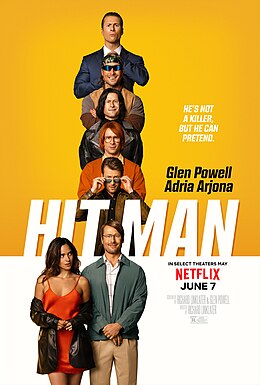
Hit Man: A Review (Review #1820)

HIT MAN

There have been more than a few films that are not technically true despite being "based on a true story". Hit Man joins their ranks, taking a light approach to the subject matter. Longer than it should be, with some good central performances, Hit Man made me smile though I am still put off by one element.

Gary Johnson (Glen Powell) narrates his story. Johnson is a professor of psychology and philosophy in New Orleans. He has a side gig working for the New Orleans Police Department in undercover operations. His job is to provide listening and recording devices in sting operations, almost all related to the hiring of hitmen. The latest assignment hits a snag when Jasper (Austin Amelio) is suspended by the NOPD. Needing someone for the latest operation, Johnson is thrown into the assignment by two other officers: Claudette (Retta) and Phil (Sanjay Rao). 

Adopting the nom de guerre "Ron", he proved surprisingly successful at his first on-the-field operation. It is not long before "Ron", adopting various disguises catering to the specific target, is raking in potential clients for the police to arrest. Gary is enjoying his new venture, until Madison (Adria Arjona) comes into their meeting location.

Madison wants Ron to kill her husband, but Ron senses something different about Madison. She is nervous, hesitant, explaining that she is in an abusive relationship. Ron uncharacteristically urges her to take the money and start over, which is technically not breaking the sting but displeases everyone. Shortly afterwards, they meet again after Madison reaches out to Ron for a non-hitman-related event. Soon, they begin a romance and passionate affair.

Unfortunately, Madison's ex Ray (Evan Holtzman), encounters them outside a club. "Ron" pulls out his weapon, thrilling Madison and scaring both Ray and Gary, albeit for different reasons. In a twist, Ray reaches out to "Ron" for a hit, and now the various entanglements of Ron/Gary and Madison soon start becoming muddled and murderous. Did Madison take matters into her own hands? Will Gary/Ron find his way through the mess without being discovered?

Hit Man was inspired by a real-life person named Gary Johnson (1947-2022), minus the murdering part as the closing text informs us. Hit Man comes from some of the same people who brought us Bernie, another tale of comic killing. You have director and cowriter Richard Linklater (writing with the film's star, Glen Powell). You also have in a more circuitous manner the involvement of Skip Hollandsworth, who cowrote Bernie and wrote both Texas Monthly articles Bernie and Hit Man inspired. I was not big on Bernie, finding it too broad, though I may revisit it. 

Hit Man was not as broad, but I still had a few issues with it. The film is almost two hours long, and I think that much could have been trimmed. I appreciate that it is a showcase for Powell's range, but once the film started focusing more on Gary/Ron and Madison's kinky sexcapades, we did not have to go back to him being a fake hired killer. Same for a scene involving Gary's ex-wife Alicia (Molly Bernard). Alicia appears, if memory serves correct, only once, and does not add anything to the plot.

As a side note, I am not big on voiceovers.

Once we got to see Gary/Ron and Madison in various trysts, we could have shifted our attention there. 

I do see the temptation to make Hit Man into a more droll comedy, with occasional moments of broadness. Amelio's Jasper was broad, with his end played somewhat for laughs. That did not sit well with me. The ending did not sit well with me either. Though I know that Hit Man is fictional with regards Gary doing any actual killings, I still found the concept of Gary and Madison getting away with multiple murders to end as a happily married couple, well, disturbing and distressing.

Something about that did not sit well with me. I think I was meant to find Gary and Madison charming. I found them slightly repulsive by the end, more Madison than Gary. That is more due to Powell. 

There has been a concerted effort to build up Glen Powell as the next big star. Starting in small roles in films like Hidden Figures, he has built up bigger parts like in Devotion and especially Top Gun: Maverick. Now with Hit Man, Anyone But You and the upcoming Twisters, the Push for Powell is at full throttle. Yes, Powell did a good job here, essentially playing a variety of characters: Gary, Ron in many forms and Ron: the Madison version. It may be a case of "too much of a good thing" with so much work he has to do. However, one can accept Powell in these many roles.

Arjona was better as the vulnerable and kinky Madison than some kind of femme fatale. The last section when we find out that she took matters into her own hands was the weakest part of her performance. While not bad, I was not overwhelmed with her.

The supporting cast was strong. Amelio has this sleazy character down, yet he also managed good moments of actual police work; he figured out that Gary was involved with Madison, which no one else did. Retta and Rao were a good double-act as the detectives overseeing the various stings. I would not have minded seeing a film around them. I do not mean a sequel or spinoff, but a separate film with Gary and Madison as the supporting characters.

I thought Hit Man was fine, if perhaps overpraised. I smiled more than laughed, but Hit Man is serviceable. 

DECISION: C+

Thursday, June 6, 2024

The Omen (2006): A Review

THE OMEN (2006)

When you have the date 06/06/06 on the calendar, it does seem a waste to not try and capitalize on it by bringing us the tale of The Beast whose mark is also 666. Thus, we get The Omen, a remake of the 1976 Academy Award-winning film. So, what if it happens to fall on a Tuesday when most films are released on a Thursday or Friday. The temptation was too strong to not release it that day. Unoriginal, slightly boring and toothless, The Omen is too much under the original's shadow to have been remade. 

Career diplomat Robert Thorn (Liev Schreiber) has received the devastating news that his newborn is dead. This will be beyond what his unsuspecting wife, Katherine (Julia Stiles) will be able to endure. However, there is hope from a Catholic priest who tells him that another baby boy, born at the same time as his own, lost his mother in childbirth. Thorn agrees to take the baby, whom they name Damien.

Many years later, Robert finds himself Ambassador to the Court of St. James when his mentor meets a somewhat gruesome end. Katherine is delighting in their new home and child to care about Robert's rise. The suicide of Damien's nanny in front of everyone on his birthday, however, is alarming. The new nanny, Mrs. Baylock (Mia Farrow) should be more alarming to the unsuspecting Thorns. There is also Father Brennan (Pete Postlethwaite), a priest warning Robert that his child is dangerous. Finally, there is Keith Jennings (David Thewlis), a photographer who finds his pictures can predict the subject's demise.

Katherine begins having disturbing dreams about Damien and begins to fear him. She also wants an abortion when she discovers she's pregnant. No worries on that department, however, as Damien has caused an accident which in turn caused a miscarriage and Katherine's near death. Robert now begins to suspect Damien may indeed be the Antichrist. What role does Mrs. Baylock have in these evil games? Who will live and who will die as the spawn of Satan is shepherded into his malevolent rise?  

I remember well a coworker who was highly excited to see The Omen on June 6, 2006, which is when I first saw the film. I marvel that it is now eighteen years since then. I think of the long, strange trip my life has been since then, but I digress. I do not know if that coworker, with whom I have lost touch since, had ever seen the original. For those who had, I think the 2006 The Omen would be a pale imitation.

A good way to measure if this or any remake of a film is good is if you can see it without thinking or remembering the original. The 2006 Omen does not because, for the most part, it does not venture away from what came before. Almost all the same beats are hit, which makes one wonder why anyone even bothered. The Omen's cast and crew simultaneously wanted to make the film reverential to the original and more frightening. It failed in the latter, struggled in the former. The Omen did what many failed films have done: mistake stillness for suspense. 

Those of us who have seen the 1976 version can tell where some of the differences are. Those differences, however, reveal how much better the original was. A change is when Damien is with the animals. The 1976 version had Karen and Damien driving in their car among the monkeys, who sensed the evil to such a degree that they attack their car, with an understandably terrified Karen fleeing in horror. Here, Katherine is at a zoo on a school field trip. The simians start going berserk, but the glass stops them from going ape.

Director John Moore could not bring any sense of terror or tension to this scene or any. There was a detachment from things, coupled with an over-seriousness to everything, as if everyone was aware that The Omen was a remake to a horror classic and should treat things with almost reverence. It does not help that the acting is equally bad. Stiles observes during the ape frenzy, "They're afraid", but her delivery is almost bored. She might as well have said, "We'll have two ice cream sundaes," for all the alleged tension and terror of this moment.

It does not help that it is slightly unclear if her comment was referring to the various chimps or the screaming children fleeing in panic.

My late friend Fidel Gomez, Jr. and I disagreed on Liev Schreiber. He always thought he was wooden, while I thought he could, on occasion, be good. In The Omen, it is clearly in the former. This is probably the worst performance of Schreiber's career. Schreiber had the exact same expression throughout the entire film. I do not think that in the history of cinema, we have had someone not change his expression once on camera as Liev Schreiber did (or did not) in The Omen. The closest he came was when he learned that his newborn was dead. However, that small moment was not good.

Julia Stiles also seemed detached from things. It was only at her end that Stiles shows any emotion, and to be fair, it was good. However, that came too late to save her performance. I think, however, that the screenplay failed to give her much to do. Farrow's casting was stunt casting. Who better than Rosemary as the literal nanny from Hell? She was acceptable, though not great. She was better than Postlethwaite or Thewlis. The former was too serious to almost bored as the renegade priest fighting to save the world from the Antichrist. The latter tried too hard to be a casual observer.

The Omen also had moments of unintended hilarity. When Robert learns of Katherine's death, why they opted to have thunderstorms rolling in the background does not make things more serious. It makes them sillier. Same for when Katherine plunges three floors thanks to Damien. If that fall didn't kill her, why would a Satanic nanny? 

The film also suffers from a rushed to chaotic ending, with the editing going pretty much bonkers in a failed effort at tension. 

The Omen was cashing in on two elements: the date of 6/6/06 and the reputation of the original. If the original did not exist, The Omen would have been dismissed as so much schlock. As the original does exist, The Omen is just dull. 

DECISION: D+

THE OMEN FILM SERIES

The Omen (1976)

Damien: Omen II

The Final Conflict: Omen III

Omen IV: The Awakening

The First Omen 

THE OMEN TELEVISION SERIES

Damien

Wednesday, June 5, 2024

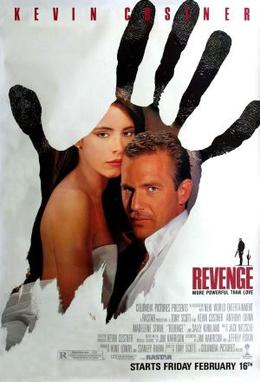
Revenge (1990): A Review (Review #1818)

REVENGE

When I think of Revenge, the term "generic" fits. Everything in Revenge is generic, starting from the title down to the plot and performances. Revenge, I figure, tries for something. One, by the end though, is not sure exactly what.

Michael "J" Cochran (Kevin Costner) has just retired from the U.S. Navy. With nothing but time and some disposable income on his hands, he opts to visit an old friend down Mexico way. That would be Tiburon "Tibby" Mendez (Anthony Quinn), a powerful kingmaker in Mexican politics. J once saved Tibby's life and Tibby has been forever grateful.

He might not be so grateful if he figured out that his much younger, beautiful trophy wife Mireya (Madeleine Stowe) needed some love, attention and affection. It does not help that despite her requests, Tibby will not impregnate her. It is not long before the hunky American and the luscious Latina begin a very torrid affair.

Their affair takes a while to be discovered, but discovered it is. Despite Tiburon having a slew of mistresses, he is quietly enraged at Mireya's own unfaithfulness. Tibby appears duped, but he's anything but. Tibby's revenge is brutal: burning down J's Mexican love nest, brutally beating J and leaving him for dead, slashing Mireya's face and dumping her in a whorehouse. Here, he gives instructions that she be used 50 times a day, using colorful language to make himself understood.

J, however, is not dead. He survives, is nursed back to health, finds a kind but dying American horse vendor and begins his own march to find Mireya. Along the way, others join J for their own motives against Tibby, but Tibby's revenge against Mireya has taken and unexpected and deadly turn. Will J and Mireya reunite before it is too late?

Revenge is surprisingly long at slightly over two hours. I think this is due to Jim Harrison, who wrote the novella on which Revenge is based on and cowrote the screenplay with Jeffrey Alan Fiskin. It is nearly a whole hour before J and Mireya consummate their desires, so the audience is left with a lot of buildup to the inevitable.

Same goes for once J is fully revealed in more ways than one. I do not know if Harrison thought having the dying horse vendor would make us sad or sympathetic to both that character or J himself. It did end up coming across as more a cliché than a real element of sadness. It is not as if he served much of a purpose apart from getting J his vehicle. 

As I think on it, a lot of Revenge does not have things that fit together. Late in the film, Sally Kirkland comes on as a rock band road manager. She flirts with a nonresponsive J, is there when other men come to join him to get their own revenge on Tibby, and then honestly I forgot what happened to her. From what I understood, the timeframe between when J and Mireya meet to when they have sex is five days. 

I think one of Revenge's great issues is with director Tony Scott, who seemed more interested in the look of the film than the film itself. We get lots and I mean lots of images of flowing curtains when Mireya and J are together. We even get them when they are apart, such as when Mireya is trapped in the whorehouse. Revenge focuses on looking very pretty but not on much else.

Revenge is so sluggish in its pacing as to be glacial. That goes for almost all the acting. It becomes an informal contest to see which of our leads can appear so disinterested and disengaged from things. Costner, I think, is the winner, his J coming across as less ardent lover and more as bored throughout. Stowe at least has something of a rationale for coming across as drugged: Mireya was drugged at a certain point in the film. That, however, does not excuse how bored and removed she is prior to her dramatic turn. She can't be bothered to show that Mireya loves Tibby, likes Tibby, tolerates Tibby, hates Tibby. Stowe's performance shows she does not even think about Tibby. She might not even be aware of Tibby.

Anthony Quinn is more engaged, though that is not always a good thing. He is close to hamming things up, but only skims the edges of camp. It might have been more fun if he had gone over-the-top, especially when seeing his goons go after J and Mireya in their love shack. I will say Quinn is fun to watch. I can't say whether he is fun to watch because he is good or because he is so bad it's good. The man's name is literally "Shark" (which is what Tiburon translates to). 

Revenge is too long, too dull and too focused on how it looks to be worth watching. If there is any Revenge to be had,  it is on the unsuspecting audience who endures all two hours of it.

DECISION: D-