Monday, June 11, 2018

Ocean's 8: A Review (Review #1060)

OCEAN'S 8

I've never been interested in what is essentially an Ocean's Extended Universe.  I didn't like the original Rat-Pack Ocean's 11, and while I saw the remake I don't remember anything about it.  I don't think I watched Ocean's 12 and I know I never saw Ocean's 13.  Now we have Ocean's 8, which is where The Divas Strike Back.  The all-female version of the Ocean's de facto franchise could have been good, but somehow by the third act it started dragging to where I lost interest.  It wasn't terrible, but it lost its mojo and never quite got it back.

Deborah Ocean (Sandra Bullock), sister of the perhaps-late Danny Ocean, is now out of prison after five years for fraud and theft.  Debbie, in those five years, has had time to plan a master heist.  Now all she needs is to round up a group to help her.

First is her old running partner Lou (Cate Blanchett), now a club owner who is quick to join up.  Together Lou and Deb get the others: hacker Nine-Ball (Rihanna), mistress of sleight of hand Constance (Awkawfina), fence Tammy (Sarah Paulson), diamond cutter Amita (Mindy Kaling) and eccentric fashion designer Rose Weil (Helena Bonham Carter).

While all are important, Weil plays a major hand in that she is the only one with the cred to get the others connected to Daphne Kluger (Anne Hathaway), a vain actress who is hosting that year's Met Gala.  The target is the Toussaint Necklace.  This $150 million necklace is dripping with expensive diamonds and has been secreted away in the Cartier vaults for close to fifty years.  Cartier has never loaned or even displayed the Toussaint Necklace, but due to Kluger's fame and her role as hostess of the prestigious Gala they agree to loan it out for just that one night.

The plan is simple: steal the Toussaint at the Gala, then secretly replace it with Folgers crystals, or at least fakes.  Each of our females plays an intricate role where everything must go like clockwork.  Then comes the night of the Met Gala, and the plan is executed.
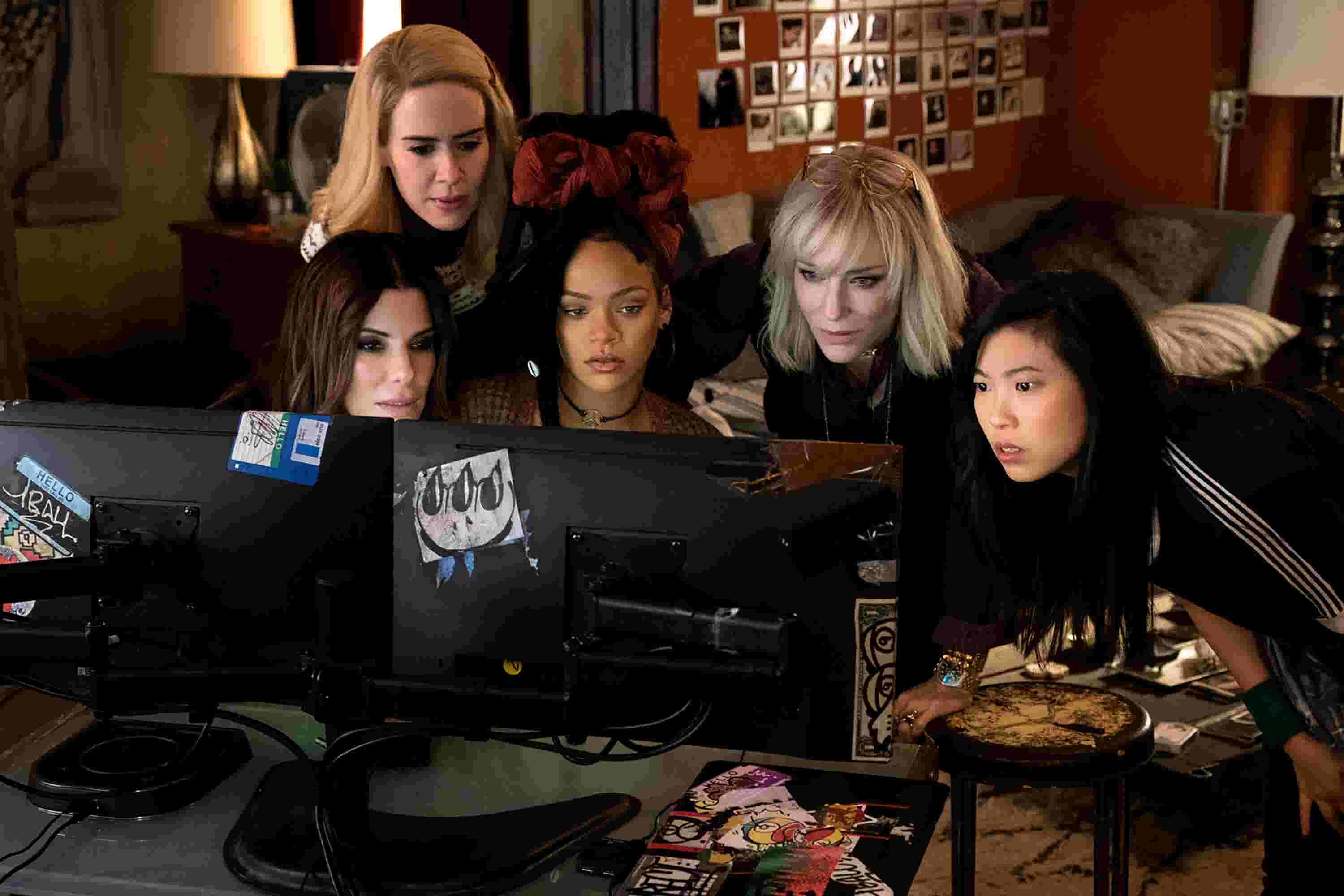
Image result for ocean's 8IF Ocean's 8 had ended where I thought it would/should end (the Cartier representative shocked to find the Toussaint was just a bunch of cheap cubic zirconium), I would have loved Ocean's 8 and even seen where a sequel could be set up.

However, it didn't end there.  Instead, we got a third act, and here is where the film went down for me.

After the heist, in comes John Frazier (James Corden), the insurance agent set on investigating this crime. He quickly zeroes in on Debbie, having interacted with the Ocean family before.  His job is made difficult by the fact that Debbie has an alibi: the Met Gala itself, where she was seen and photographed.

No mention was made in his thorough investigation of the fact that she was passing herself off as German at the Gala, down to speaking nothing but German and pretending not to speak any English, but why quibble about details.  Luckily for her, she has a ready frame-up job: her ex-lover, Claude Becker (Richard Armitage), who let her take the fall for crimes they had been committing.  Now all signs point to him.

It becomes Ocean's 8 because Kluger, far from being the dumb actress she was thought of, put everything together and wants to part of the group to, in her words, have friends. She even helps frame Becker for their crimes. There's one thing that does puzzle Kluger: how their haul is bigger than the Toussaint's total worth.  Simple: the Toussaint Necklace, rather than being the main event, was just the preliminaries to the real heist of all the Crown Jewels on display at the Met.

With that, the various women move on to great successes in their personal and professional lives, and Deborah Ocean goes to her brother's alleged crypt, has a cocktail and tells him how he'd love the heist.


Image result for ocean's 8 met gala
Bet that outfit is from
Bonham Carter's own closet.
I'm not averse to having an all-female heist film.  After all, I think the original The Women is a masterpiece. Ocean's 8 has been sold, in part, as a female empowerment film, showing that women are equal to men when it comes to committing larceny on film. Fine, I don't care one way or another.  On two occasions is the gender made relevant: once when Debbie says "A 'he' gets noticed, a 'her' gets ignored" or words to that effect when she rejects hiring a man for the crew, and in a pep talk where Debbie talks about how out there there's a little girl dreaming of becoming a thief, so they should do it for her.

No offense, but that line didn't get Hillary Clinton elected President, and it isn't going to get me to applaud Ocean's 8.

Therein lies the difficulty: I enjoyed Ocean's 8 for the longest time.  It was fluff, but entertaining fluff.  I liked how we got this harebrained scheme rolling, even if whatever difficulties they encountered were dealt with virtually by hand-waving.  I even enjoyed up to a point how we had our team concoct this wild scheme and managed to check all the multicultural boxes: all-female, two Asians (Kaling and Akwafina) and a black woman (Ri-Ri).

So what if in all this they could not find a Hispanic.  I should get used to idea that in Hollywood, there is no such thing as a Latino/Latina, unless they're the maids, janitors and kitchen crew like they are in Ocean's 8.

Related imageIt wasn't until we got past the heist that Ocean's 8 fell apart for me. In a strange sense, the film starting failing when they brought a man into the picture, and a bad one at that.  James Corden is constantly pushed at me as some sort of comic but he's never been funny.  His character is superfluous to the goings-on around him, and moreover, both the character and Corden just fail at everything they try.

He is not funny.  He is not menacing.  He is not interesting. He is not bright.  He just drags everything down.  I'm supposed to believe he's had this longtime connection to the Ocean family, but why would I care?

Again, I have to wonder how thorough his investigation is if in all the interviews he had, no one ever mentioned that Deborah Ocean was speaking German and pretending not to speak English.

It does seem strange that Ocean's 8 went the route it did.  It makes 'a woman scorned' a prime motivator for the main character.  It makes said scorned woman an attachment to the overall Ocean's Universe rather than have be perhaps someone Danny mentored or even just someone who admired Danny Ocean's methods and decided to do them one better.

The characters, sadly, are mostly paper thin.  Again, it seems odd that for a film that expounds on female empowerment, we never got a real sense that these women liked each other, let alone liked working with each other.  I figure Ocean's 8 passed the Bechdel Test, but at its heart is still Debbie enacting revenge on Claude, something Lou raises the most minor of objections to before that's forgotten.

Apart from a few moments, such as Constance guiding Amita on the fine art of 'swiping left or right', we never saw them bond.  It seems such a waste to have such a collection of talented performers, for the most part, and do little with them.

As they are the big stars, the quartet of Bullock, Blanchett, Carter and Hathaway had the lion's share of work, and they were better than the material.  Both Carter and Hathaway steal the film, the former for bringing real life to her wacky designer and the latter for essentially spoofing her public persona.

I'm far too removed from celebrity/pop culture to know how many cameos there were or who made a cameo, but my last question regarding Ocean's 8 is this: is Katie Holmes really that big of a star to merit an invite to the Met Gala?

DECISION: C-

Sunday, June 10, 2018

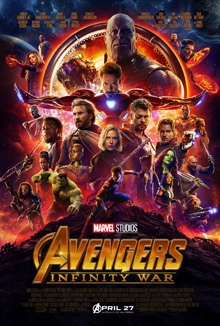
Avengers: Infinity War. A Review


AVENGERS: INFINITY WAR

And the world's longest and most expensive soap opera continues.

I know many people who love the Marvel Cinematic Universe, so much so that they were willing to forgo a day+ of their lives by staying virtually locked in theaters to watch most if not all the MCU films in a marathon.  Part of me admires their devotion, even as I remember that these same people for the most part would not dare sit through the nearly three-and-a-half hour Seven Samurai because it's "too long, black-and-white, and in Japanese".

Avengers: Infinity War is loved by many fans, who have told me that old 'I laughed, I cried' line.

Bless them.

For me, I found it hollow, empty, boring, devoid of anything worth the adulation.  I know more than a few MCU fans would qualify Avengers: Infinity War as 'Shakespearean', whatever that means.  In their honor, I'll quote Shakespeare when it comes to Avengers: Infinity War.  "It is a tale told by an idiot, full of sound and fury, signifying nothing".

A short plot synopsis is "Thanos (Josh Brolin) is on an intergalactic treasure hunt to wipe out half of all living things to save on resources. Various superheroes, some affiliated with The Avengers and Guardians of the Galaxy accidentally meet up to fight him, he wins, some of them appear to die, the end'.

Image result for avengers infinity warI was forewarned that I should see Thor: Ragnarok before seeing Infinity War, and perhaps I should have, as we start in medias res with a defeated Thor (Chris Hemsworth) being tortured by the 'Children of Thanos' into revealing where the Tesseract is.  The Tesseract is really one of the Infinity Stones, a collection of intergalactic jewels that will grant the wearer unlimited and absolute power over all.  A few more deaths from Thanos before Bruce Banner/The Hulk (Mark Ruffalo) is sent back to Earth.

Now, Bruce channeling Kevin McCarthy from Invasion of the Body Snatchers goes on and on about Thanos to those he's crashed onto: Dr. Strange (Benedict Cumberbatch) and Wong (Benedict Wong), one of Strange's Tibetan friends.  Now Strange drags Tony Stark/Iron-Man (Robert Downey, Jr.) and the invasion to get to Strange's Infinity Stone by attacking New York City means Peter Parker/Spider-Man (Tom Holland) jumps into the fray.  To wrap this part of the story, this group save Wong and Banner are taken into outer space.

Out in outer space we have the Guardians of the Galaxy: Peter Quill/Star-Lord (Chris Pratt), his girlfriend Gamora (Zoe Saldana), Rocket Racoon (Bradley Cooper), Drax (Dave Bautista) and a surly teenage Groot (Vin Diesel), more interested in video games than in anything.  They find Thor, and our Norse god goes back to his old pompous pronouncements/tones, dismissing the 'morons' to find a dwarf to make him a weapon with which to take on Thanos.  He takes Rocket and Groot with him to have his weapon forged while the other Guardians go Knowhere to find another stone kept by The Collector (Benicio del Toro).

Pity Thanos is already there, as while Star-Lord comes close to granting Gamora's final wish to kill her so as to protect her secret, Thanos manages to not.  Torturing her sister Nebula (Karen Gillan), Gamora reveals where another stone is at, though at a terrible price.

Image result for avengers infinity warMeanwhile, back on Earth, other Avengers are working to get yet another Infinity Stone out of Vision (Paul Bettany), once a machine now a lovelorn sentient being in a relationship with Wanda Maximoff/Scarlet Witch (Elizabeth Olsen).  That group, made up of Steve Rogers/Captain America (Chris Evans), Natasha Romanoff/Black Widow (Scarlett Johansson), James Rhodes/War Machine (Don Cheadle) and Sam Wilson/Falcon (Anthony Mackie) save them and taken them to the newly-opened nation of Wakanda, where King T'Challa/Black Panther (Chadwick Boseman) opens up their technology.

This also opens up for Thanos' minions to attack to get at this Stone.

To wrap this up, Infinity War then becomes a series of battles across the extended universe with various groups fighting Thanos or his minions to stop him from gathering all the stones and placing them in his gauntlet.  The plan almost came to pass, until Star-Lord went all Brad Pitt in Seven and found that his beloved was dead.  That so enraged him he forgot about his own plan and caused it to fail.  Thanos then popped down to Earth, took the last Stone and won.

With that, the following people were turned into dust in no particular order: from The Guardians of the Galaxy there was Star-Lord, Drax, Mantis (Pom Klementieff) and Groot, from The Avengers there is Falcon, Black Panther, Scarlet Witch with Vision killed by Thanos when he got the last stone through a little 'timey-wimey', Spider-Man and Dr. Strange. Bucky Barnes (Sebastian Stan), who wasn't affiliated with either, also turned to dust in the wind.

Not since perhaps the Doctor Who 20th Anniversary Special The Five Doctors have I seen so many figures from a series brought together and, to quote Jay Mohr's book title, "Gasping for Airtime".  Like in The Five Doctors, various people were paired together where I figure screenwriters Stephen McFeely and Christopher Markus thought 'hilarity would ensue'.  I know a lot of people laughed at particular points, but I don't think I laughed once.

Image result for avengers infinity war
I think it is because time and again I felt that the 'comedy' was unnecessary and dragged this film both story-wise and length-wise. It seemed that almost always, whenever we see or hear that there are high stakes with millions of not billions of people or otherworldly beings' lives at stake, we always had to throw in a quip, most of the time really bad ones.

Anthony and Joe Russo were fond of using the Guardians in particular as comedic foils, and an instructive bit of how not to use comedy in this mashup is right after Gamora asks Peter to kill her rather than let her fall into Thanos' hands.  They kiss, only to find Drax observing them by hearing him crunching some snacks.

We could have stopped there, but instead we kept the scene going by having Drax insist he was now so stealth he could go unobserved, despite being perfectly observable.  It isn't until Mantis comes in and says, "Hi, Drax", that he finally relents.

All that could have been cut out of this bloated nightmare, but the Russos and everyone at Marvel Studios doubled down on trying to trot out comedy bits at serious moments.  From Thor and Star-Lord having a metaphorical dick-measuring contest, down to everyone telling the latter he was getting flabby (a most dubious charge given it's Chris Pratt) to the Odd Coupling of Strange and Stark to where you almost expect The Odd Couple theme to start playing, Infinity War could not get out of it its own way.

I simply don't understand why Infinity War kept ramming comedy when the situations called for at least a modicum of seriousness.

Image result for avengers infinity war spidermanThere was no directing here.  Ruffalo did nothing but look frantic, Holland's "I'm so young I think Aliens is a really old movie' and calling him 'Mr. Stark'" shtick is now tired, and worse, makes Parker look like a total idiot and not a 'plucky' kid.

As a side note to that, it's interesting that even Tony Stark has grown tired of this Millennial's constant 'pop culture references' as he called them.  In that case, I think he was speaking for at least me.  Not that Stark isn't above pop culture references, incurring Star-Lord's anger when Stark refers to Quill's plan as 'plucky'.  I too found Star-Lord's sincere belief that Footloose was 'the greatest movie ever made' as idiotic as Stark and Parker did, though given how Parker is, I think our friendly neighborhood Spider-Man was thinking Star-Lord was referring to the Footloose remake rather than the Kevin Bacon 1984 original, which would have been far too long ago for him to know of.  Peter Parker as written here and in Homecoming and as played by Holland probably wouldn't even know there was an original Footloose.

Bacon's name gets another unexpected drop when Rocket Raccoon, whom Thor always calls 'Rabbit', is asked if Bacon is an Avenger.  He says he might be since it's been a while since he's seen the other Avengers.  It might have been Thor, or it might have been Strange.  At this point I genuinely don't care.

Boseman's nobility as T'Challa/Black Panther now too is fast grating on my nerves. I never cared for Bucky, so I'm hoping he is not just merely dead but most sincerely dead.

Moreover, Infinity War never made me care about anything in it.  The film follows Doctor Who at least in the newest version, in this way too: 'killing' off characters we know are coming back.  As we know there's an upcoming Spider-Man and Guardians of the Galaxy sequel and an almost for-certain Black Panther sequel, we know these characters are not really dead.  As such, why would anyone, casual viewer or die-hard Marvel Cinematic Universe devotee really get emotional when there will be no costs to these 'sacrifices'?

Even in something that should be more 'moving', like Gamora's death, I felt nothing.  Perhaps it was the loud Alan Silvestri score doing its damnedest to make me feel.  Perhaps it's because that Soul Stone was being guarded by something like Darth Maul's cousin.  Perhaps because the emotional impact just wasn't earned either from Thanos or Gamora, but I felt nothing.

As a side note, why did Gamora get so huffy about Star-Lord not killing her when he asked given she too gave Thanos what he wanted to save someone, in her case Nebula?

I also have a question of logic.  When Iron-Man and Spider-Man rescue Doctor Strange thanks to a plot point from "that really old movie, Aliens", the thing that looked like the Cryptkeeper was killed as it went into space, but neither Strange or Parker felt anything when they too were sucked out into the vastness of the universe, even if briefly?

Avengers: Infinity War left me bored and slightly irritated.  I confess to never having enough emotional investment in the Marvel Cinematic Universe to bother keeping track of the nuances of all our characters, but there has to be something wrong when, while watching, your mind starts thinking of Avengers: Infinity War as a nerd version of Battle of the Network Stars.

Next Marvel Cinematic Universe Film: Ant-Man & The Wasp

DECISION: F

Wednesday, June 6, 2018

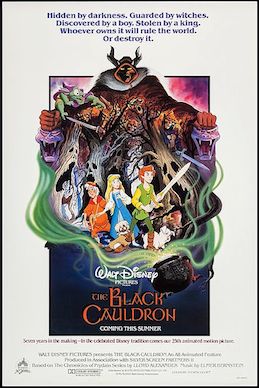
The Black Cauldron (1985): A Review

THE BLACK CAULDRON

I was too young to see The Black Cauldron, or at least to remember if I actually went to see it.  My memory says I did not see it in its theatrical release.  If I had, perhaps I would have been frightened by The Horned King and other elements.  Having finally seen The Black Cauldron, I think I am more puzzled than anything else.  The film looks like it is trying to have it both ways: be a dark story and a cute story simultaneously.

Taran (Grant Bardsley) is an assistant pig keeper in Prydain.  He dreams of being a great warrior, but for now, he has to watch over Hen Wen, a very cute pig who is to be very carefully cared for.  Hen Wen is no ordinary pig: he (or she, I cannot remember which) can see the future.  Hen Wen can locate the Black Cauldron, which can grant whoever controls it the ability to rule the world.

The Horned King (John Hurt) wants it to bring out his Army of the Dead, and the Horned King also knows where Hen Wen now is.  Taran is tasked to keep our pig safe by going to 'the hidden cottage at the edge of the Forbidden Forest', as specific a location as can be found.  Needless to say, Taran's daydreaming of himself as a great warrior allows Hen Wen to wander off and get abducted by the Horned King's dragons.  Taran decides to rescue the pig, despite the warnings of mischievous Gurgi (John Byner), who looks like a dog and talks like a mix of Gollum and Donald Duck.

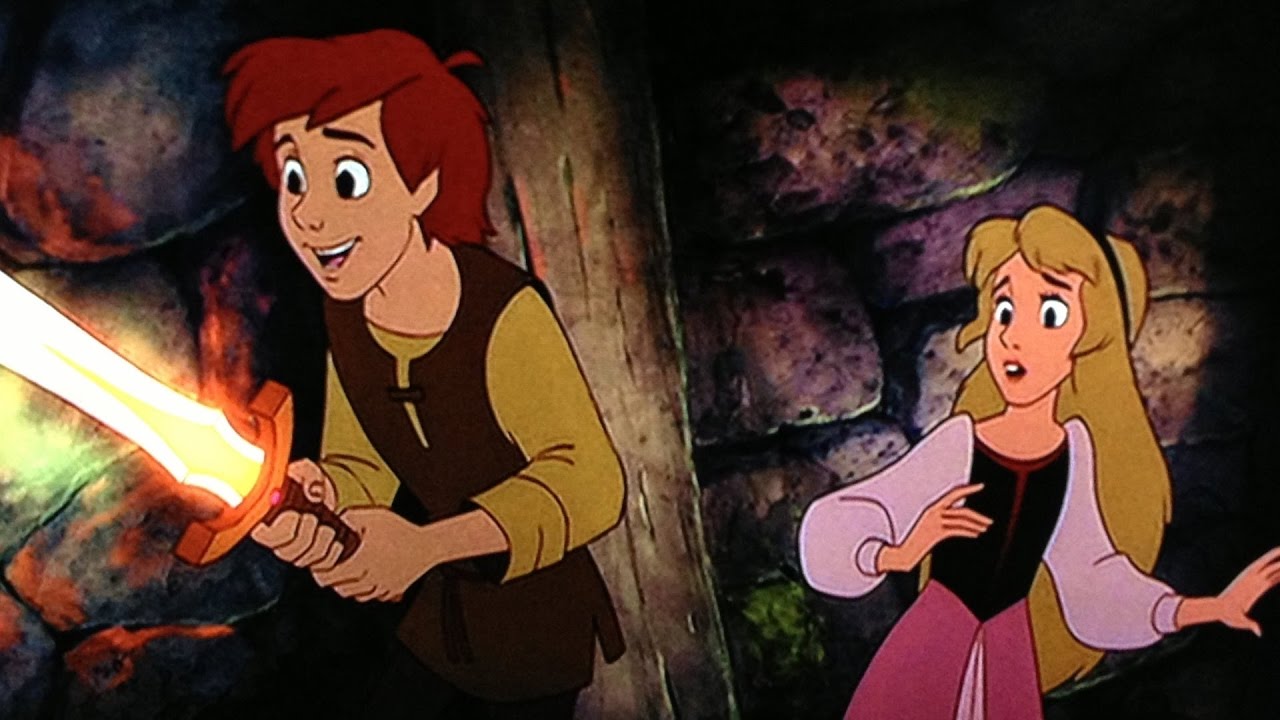
Taran's rescue attempts fail, but he does manage to help Hen Wen escape.  The Horned King throws him into the dungeon, and out of nowhere pops Eilonwy (Susan Sheridan).  She says she's a Princess who is also imprisoned due to her bauble, which the Horned King thought could lead him to the Black Cauldron.  Exploring a way out of the castle, Taran comes across a sword that has great powers, and they manage to not only escape but help a third prisoner, Fflewdurr Fflam (Nigel Hawthorne), an elderly minstrel whose harp apparently breaks when he lies.

The Horned King now searches for them, not helped by his inept minion Creeper (Phil Fondacaro).  The trio find the Fairfolk (what we'd call fairies) and Hen Wen.  The King of the Fairfolk sends Doli (Byner again) to help them find the Black Cauldron, held by three witches.  They strike a bargain: the cauldron for Taran's sword.  The cauldron, however, is useless to them, but no matter: the Horned King's army has found them.

Now he has the power to take over the world and creates his Satanic army.  Gurgi, long a coward on matters, sacrifices himself by throwing himself into the cauldron to stop the army's rise, enraging the Horned King.  It's a final battle to the death.

Taran, Fflewddur and Eilonwy re-encounter the witches, who are about to take the Cauldron.  Fflewddur reminds them they don't take, they bargain, and the witches agree to make a trade: the Cauldron for Gurgi.  Gurgi eventually wakes up and all things appear well.

Image result for the black cauldronThe Black Cauldron, as I stated, really is trying to have it both ways: be dark and intense while also being cute and whimsical.  It seems to have a rather schizophrenic manner, unable or unwilling to go down one way or the other.

Instead, it tries to split the difference, and this uneven tone wrecks the film.  The beginning for example is full of cutesy moments, down to Hen Wen's very adorable look.  Same goes for Gurgi, even if he looks like a mutt who speaks in Gollem-like gibberish.

Other times, it is downright frightening for children.  The Horned King nearly beheads Hen Wen, Gurgi throws himself into the Cauldron, and the Army of the Dead rising and crawling through the netherworld would send young children fleeing in terror.  I understand that at a test screening, that is exactly what happened.

It does not help matters that the Horned King looks like Skeletor's creepy cousin.

The conflicting and contradictory manner of The Black Cauldron can be best summed up by the Three Witches.  They tried to make one very frightening, the other humorously plump and flirtatious with Fflewddur.  It sets up a strange situation in that you don't know whether to take them seriously as villains or as comic relief.

Come to think of it, Creeper is a better example of The Black Cauldron's inability to decide what it wants to be.  He's obviously menacing and scary-looking, but he also is meant to be some kind of comic relief, the inept henchman to the wicked Horned King.

Over and over the film tries to have it both ways and keeps falling over itself.

Image result for the black cauldron
The animation too is hit and miss.  The Black Cauldron's great claim to fame is that it was among if not the first Disney animated films to use computer-generated imagery, and there are some scenes that are quite beautiful, such as when the group meets the Fairfolk.  The Horned King's realm too is beautifully rendered, the sinister world captured so eerily.

Other times though, the animation looks shockingly cheap, such as when the Witches disappear.

I think perhaps one of if not the biggest issue with The Black Cauldron, slightly above the contradictory tones or animation stumbles, is that these characters and their situations have no sense of anything.  Eilonwy just pops up, and the adaption of two of Lloyd Alexander's five-book series gives her no reason to be.  She does not have any defining characteristic: she is not particularly intelligent, brave, romantic or anything.

The script also gives a sense that she may not be an actual Princess.  When the Horned King captures them, he dismisses them as 'a pig boy, a scullery maid, and a broken-down minstrel'.  Taran is a pig boy, and Fflewddur is a broken-down minstrel, but why would The Horned King call Eilonwy 'a scullery maid'?  If she was one and not a real Princess, why is it important now?  This mention was quickly forgotten, but it makes things a muddle.

Fflewddur was there for no reason whatsoever, unless his job was to fret all the time.  Gurgi, rather than look cute, ended up looking creepy primarily due to his voice.  It's impossible now to not hear him as Gollum-Lite.

Taran at least has a motivation: to be a great warrior, but that isn't interesting, and he ends up coming across as rather stupid and worthy of being a pig boy. Curiously, while Elmer Bernstein's score was quite good, at times I thought some songs might have actually done the film good.  On at least two occasions in The Black Cauldron, I thought Taran was going to break out into song, with the situation actually making such a thing plausible.

Granted, Grant Bardsley did a good job in his performance of Taran as a dreamer, but it is Hurt who steals the show as The Horned King.  I think they added a little reverb to his tone, but his vocal performance appears to be taking all this seriously.  He brought menace to his role, without a hint that he was sending it up or spoofing things.  He was a genuine villain, not one playing things for laughs unlike Creeper.

The Black Cauldron is a mostly-forgotten film in Disney animation.  It isn't ranked among the company's established classics like Snow White & the Seven Dwarfs or Fantasia, or among its Renaissance such as Beauty & the Beast and The Lion King.  It is a film that perhaps should be revisited in terms of remake.  Back in 1985, something this dark from Disney would have been unthinkable.  I think now, however, time has changed enough to where the darkness of The Black Cauldron could work.

It didn't here, but that's not to say there aren't possibilities.

DECISION: D+

Tuesday, June 5, 2018

Acrimony: A Review (Review #1057)

ACRIMONY (AKA TYLER PERRY'S ACRIMONY)

Acrimony for all its oddball craziness, is unique in film history.  It's perhaps the first time, at least that I can recall, where the filmmakers took the psychopath's side, where the clearly cray-cray character was made out to be almost sympathetic.

That does not make Acrimony particularly good, but neither does it make it as horrible as many of its detractors insist.  I found Acrimony to be good, whacked-out fun, trashy and almost comical, but entertaining if nothing else.

Told primarily in flashback with a forced therapy session as the present-day section, Acrimony is about Melinda (Taraji P. Henson), and her fraught relationship with Robert (Lyriq Best). Meeting in college, Mel is both drawn and repulsed by Robert.  He says he's an inventor, but to Mel, the only thing he invents is trouble. The day her mother is buried, Robert takes her virginity, though from how it looks, she was the more aggressive of the two.

Mel's sisters Diana (Crystle Stewart) and June (Jazmyn Simon) both object to the relationship, especially since Robert has no trouble taking Mel's inheritance piece by piece with Mel's consent.  Diana, the more aggressively opposed, keeps warning her sister about Robert, but Mel is too much in love.  Even after she catches Robert with another woman, which causes her to ram her Jeep into his trailer and a forced hysterectomy, she still marries him.

Cut to many years later.  Robert is still working on his battery and hounding a particular investor to fund his project.  Melinda is in danger of losing her mother's house despite working two jobs to Robert's none, due in part to a secret prison record.  Robert has finally after ten or twenty years been ordered to leave the investor alone, but not before he finds Brenda (Ptosha Storey), the woman with whom he had that fateful one-night stand.  Brenda now works as an executive with the investor, and Robert tries to play on her sympathies to get a meeting.

Despite all common sense, Brenda looks at Robert's past work and sees the Gale Force Wind Battery he has developed has potential.  By this time however, even Melinda has given up and agrees to stay with Robert only if he works for his in-laws in their food delivery business. 

Image result for acrimony movieWho should call Robert to schedule a last-minute meeting with the investor just when he needs to make a major delivery or his family loses a major contract and their trucks, possibly ruining the family business?  Robert puts himself first, causing the family to lose their mother's home and Melinda pushing for a divorce.

Things, however, take an unexpected turn after the divorce.  Melinda is still angry about everything, and even the sight of Robert washing dishes does not thrill her.  If she knew he had to live in a shelter, it wouldn't have assuaged her fury either.  Just when things are at their lowest, Brenda returns to find Robert, as she has pulled in new sources of capital that will allow Robert to hold on to his notes and be the sole owner.

The deal makes him a multimillionaire, and as a way of atoning for his past mistakes he sees Melinda, giving her a ten million dollar check and the deed to her mother's house.

This, however, still feeds the rage of Melinda when she finds that Robert has moved on to Brenda, and worse, that Brenda was the ho he had hooked up with all those years ago.  Now she sees Brenda living the life Robert had always promised to her: the apartment on the top floor of the riverside building, the yacht, the fancy wedding and the diamond ring.

Her sisters and best friend Sarah (Danielle Nicolet) keep trying to get Melinda to move on, but now Melinda wants to retake her place as the rightful heiress, or at the very least, make sure she gets what she thinks she's due.  Up alone in her home, she stalks them online and generally goes bonkers: at one point, she manages to burn Brenda's wedding dress.

All this we learn at the court-ordered therapy session, but she leaves without resolving anything, and somehow manages to crash the wedding, sneak onto the yacht and try to kill everyone.  Melinda, however, literally gets dragged down to her death.

Image result for acrimony movie
I think Tyler Perry, who wrote and directed Acrimony, has a very curious moralistic streak, where giving in to the pleasures of the flesh leads to death and destruction, and always for the woman.  It's something that he hits on over and over again, even to a point in his Madea films.  The best of them in my view, Diary of a Mad Black Woman, had a subplot where one woman was a drug-addicted ho and it was only when she returned to the church that she found salvation and love with her estranged husband.

It might be interesting to look at Tyler Perry's oeuvre and see if he does have certain themes that he works on again and again.

In both Acrimony and in Temptation: Confessions of a Marriage Counselor, he seems to show a fascination with 'good' women who fall for 'the wrong man' and end up meeting rather grisly fates.  In Temptation, a woman is seduced from morality into decadent sin and pays for her crimes by ending up HIV-positive.  In Acrimony, a woman is seduced from morality into stupidity and pays for her crimes by drowning. Both films involve therapy, a supposedly weak man who manages to come out on top, and disapproving family members.

Also, they both feature a steamy shower sex scene.

Oddly, both Temptation and Acrimony have characters named 'Melinda'.  Tyler Perry might have some serious issues he needs to work out with a therapist, hopefully not named 'Melinda'.

Image result for acrimony movieDespite his best intentions, one cannot leave Acrimony with any sense that Melinda was a wronged woman.  Instead, she comes across as shockingly dumb, signing off her money whenever Robert just hinted at it.  The film is almost protective of Robert, his one indiscretion being the only really bad thing he does.  He does this even when we have that unbelievable sequence where his shot at pitching his battery comes at the exact same time he needs to make a major delivery or bring his extended family to ruin. 

Personally, I think this is something that happens only in the movies, but I digress.  Here, it isn't presented as Robert being selfish and thoughtless, or even asking if the meeting can be set up another time.  Instead, in having Robert quietly try to explain and showing him having regret about it all, Acrimony wants us to feel for him, not his long-suffering wife.

Granted, we generally aren't supposed to sympathize with the psycho, but Acrimony seems to want us to by showing all Melinda endured and seeing the life she was promised instead given to another. 

Interestingly, Acrimony reminded me of the Betty Broderick story, which was made into two television films: A Woman Scorned and Her Final Fury.  This sordid story of an ex-wife gone crazy or vindictive enough to kill her ex-husband and his pretty young wife over having 'her' life stolen is eerily similar to certain aspects of Acrimony.

After her great triumph in Hidden Figures (for which I think she was shamefully overlooked at the Oscars for the song-and-dance shtick of Emma Stone), it's hard to see Taraji P. Henson reduced to such silliness as Acrimony.  I think Henson knew Acrimony was not worth her time, so she decided to make it a bit camp.

That's the only way to explain her 'Crazy Dance' as she descends into psychological meltdown at seeing the online acts of Brenda and Robert, complete with red tinting to show her falling into Hell.  It's actually pretty hilarious rather than terrifying, but only Perry and Henson know if that is what they were going for.

Almost everyone else in the cast was playing his/her character in the same note.  Diana was always angry, June was always accommodating, Sandra was always upbeat.  Brenda was the only one who seemed to behave rationally and have some kind of arc.

Despite all of its flaws, I found Acrimony quite entertaining in a cheap thriller way.  It almost played as a spoof of these type of 'wronged woman gets revenge' thrillers. I cannot fault a film for living down to expectations, and while Acrimony won't enhance the reputation of anyone involved with it, it's not a bad way to spend a couple of hours.

You do marvel at how bonkers it can all get, and that is entertaining.

DECISION: C+

Sunday, June 3, 2018

Personal Reflections on 'The Sandlot'

Image result for the sandlot
PERSONAL REFLECTIONS ON 
THE SANDLOT

The Sandlot is not a 'great' picture if by 'greatness' you mean something revolutionary or innovative like Citizen Kane or Seven Samurai.  If by 'greatness' you mean emotionally moving and even beautiful, then I have no problem calling The Sandlot a masterpiece.  It hits me on the same level as Casablanca hits me.

Bet that's a comparison you've never heard before.

However, just as I am brought to tears by Rick & Ilsa's farewell, I am also moved to smiles and laughter at the hijinks of our group of regular kids during one special summer.

There are many reasons why various people love The Sandlot.  Some hold it dear for the nostalgia it evokes, a time when they were kids and the greatest crisis they faced was getting the ball that flew over the fence.  For others, it is is the sport of baseball itself, the joy it first inspired in them to follow and/or play this most magnificent of games.

I can only say that for myself, The Sandlot holds a special place in my heart for one reason.

Related image
I Am Smalls, oversized cap, buttoned-up shirt and all.

Scotty Smalls and I have so much in common.

We both are more academically than athletically inclined.
We both have fraught relationships with our fathers/father-figures.
We both yearn to fit in but struggle with being part of the group.
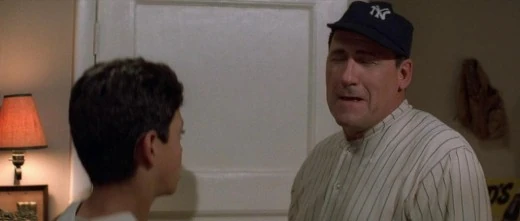
We both have poor knowledge of Yankee legends.

Smalls more than anything wants to fit in with all the other boys playing out in the sandlot, but it is clear he has no knowledge or skill in sport or socializing; his only attribute is heart.  If one remembers, the other boys save one had the same reaction to Smalls' first bungled attempts to be like them: laughter and contempt.  They really wanted nothing to do with him.

Believe me, I've been there.

I Am the Original Last Boy Picked.

I would say that my experiences were more horrific than Smalls, which I will share with you in the hopes you don't laugh.

In elementary and middle school P.E., the coaches would pick certain students to form teams.  It was already humiliating enough getting chosen last, but there were moments that to my eight to twelve-year-old mind, were more ghastly.

There was the time they picked someone with a broken arm over me.
There was the time when, after I was the last one left and they had to take me, the other 'teammates' groaned, loudly, at my inclusion.
While I cannot remember if this was the same incident or a different one, I remember when the others ran up to the coach and begged him to move me.

Things like that eventually eat at one until their perceptions of you becomes your perception of you.  I soon internalized those views until I could barely tolerate myself.

If one thought that such things ended after high school, think again. Even into my twenties, the 'cool kids' still made it clear I wasn't 'one of them'.  My then-church began a softball team and invited people to tryouts.  I bought a glove, did my best, and was not only not called back, I just wasn't called, but I was encouraged to support them team financially.

The knowledge that they proclaimed the love and acceptance of God but wouldn't extend that same love and acceptance to me is something I still think on.

Image result for the sandlot dad
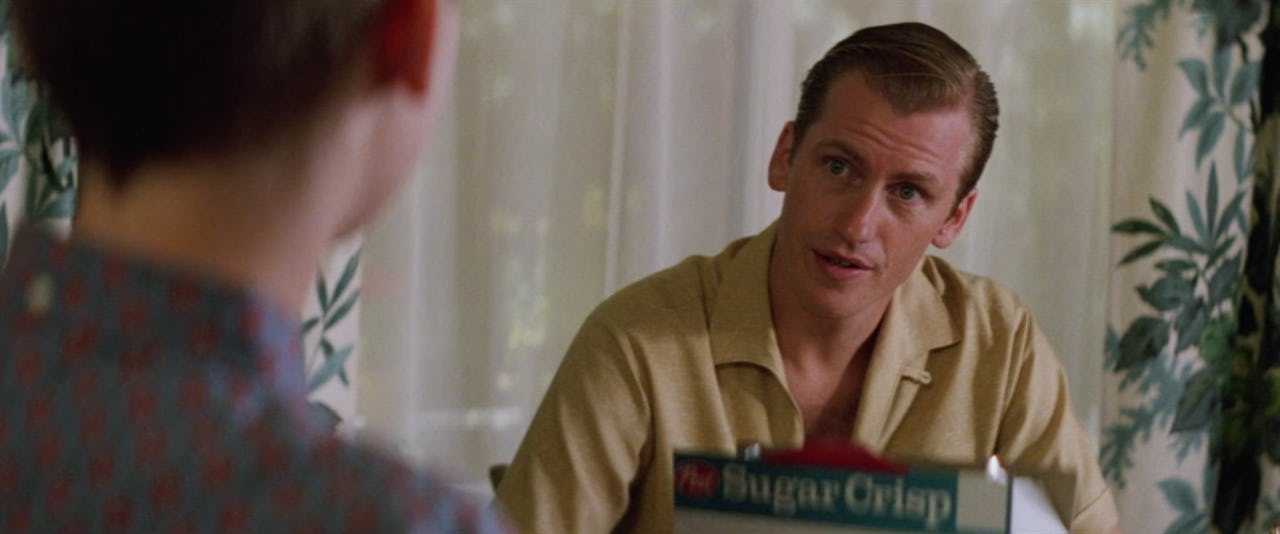
Smalls, like myself, had a desire for that male figure.  Smalls' stepfather Bill (Dennis Leary) was not cruel or violent, but he was a bit distant and at their first catch practice, dismayed at Smalls' ineptness.  Unlike Smalls, I had no stepfather, my mom deciding to not remarry after her divorce.  My father opted not to be part of my life for his own reasons.

Bless single parents, fathers and mothers.  They do an extremely difficult job, the work of two.  I love my mother, but try as she might, she could never be the father I needed.  She's the type to cry at Douglas Sirk films, the kind of woman who is puzzled as to why I'd get irritated at Hour Three of shopping and who is flustered at my inability to declare whether the seventh turquoise blouse she's tried on is nicer than the fourth jade blouse she's tried on.

In short, she is too much of a woman to be a father.

How could a woman who, while aware of who The Great Bambino is, really does still think his name is "Baby Ruth" really be a guide into the Wide World of Sports?

Image result for the sandlot babe ruth
Speaking of 'Baby Ruth', I have my own 'Smalls Knows Nothing About Baseball Story', one that you are free to laugh at since I laugh at it myself.

I went to Yankee Stadium for the first time in 1997.  Before going in to see the Yankees/Blue Jays game, my cousins and I stopped at a Yankee shop nearby (my memory says it was across the street).  As I looked around, I saw one player dominate the merchandising: pictures, posters, cards, shirts and all other type of paraphernalia.

After marveling at all this for a few moments, I said out loud to no in particular, "Gee, I guess this 'Derek Jeter' must be pretty good!"

In my defense, I never watched sports and never pretended to know who any of the players were.

Image result for the sandlot smalls
In all of this, I may wandered off a bit, but now I'll delve deeper into here I share why, for me, The Sandlot has become so special.  Many love the nostalgia and the love of baseball the film has.  For me, however, it is the friendship between Scott Smalls and Benjamin Franklin Rodriguez.

Benny to a point does have an ulterior motive in bringing Smalls in: with Smalls, he now has that ninth player to make a full team.  As such, he can now devote himself more fully to his great passion.  After all, for the rest of them, baseball was just a game.  For Benjamin Franklin Rodriguez, baseball was life.

However, I think Benny saw in Smalls something the others didn't: a shy, socially awkward boy who really wanted friends.  Benny was the only one who didn't laugh at how clumsy and uncoordinated Smalls was.  He instead opted for a different route which most people, certainly more kids, don't take: he served as mentor, guiding Smalls and showing him how things work.  He also showed him genuine kindness, never judging him for his lack of skills or knowledge.

That isn't to say Benny wasn't at times flabbergasted at Smalls' behavior, ranging from walking all the way to the mound to give the ball back to his cluelessness about 'some lady, Baby Ruth'.  Even then, when Smalls reveals how he just casually hit a Babe Ruth-autographed ball into The Beast's backyard, Benny still doesn't become enraged at having his own hero's ball lost.  He isn't happy, but he also realizes that Smalls' over-eagerness to fit in was the reason for this disaster.

Image result for the sandlot chewing tobacco
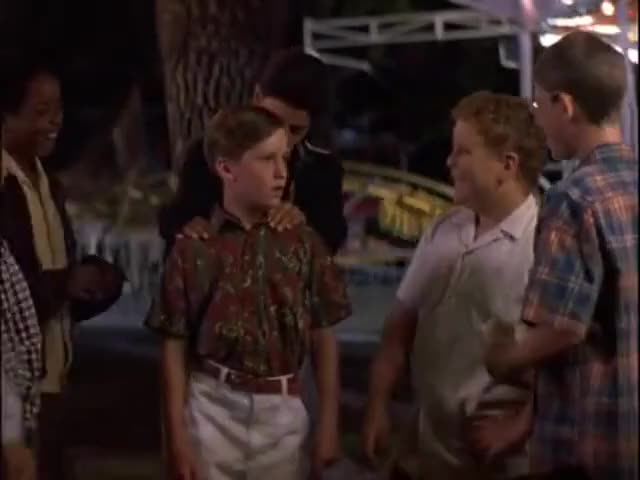
One of my favorite scenes is the Carnival Ride scene, not just because it's both funny and true to kids trying to be adults and failing spectacularly at it.  It's also because of a little detail that gets missed.

As Bertram and Ham attempt to explain to Smalls what Big Chief Chewing Tobacco is, we see Benny in the background, similarly astonished at Smalls' naivete.  However, if you see the scene, you see him puts his hands on Smalls' shoulders in a comforting way (while also putting one hand to his forehead and shaking his head in disbelief).  To me, that subtle moment says everything about the Smalls/Rodriguez relationship: Scotty, well-meaning but unaware, and Benny, always looking out for him while still astounded at this kid's total obliviousness to what should be basic boyhood information.

In my own life, I had three Benny Rodriguezes: Kris Z., Ryan G., and Gabe P., who came into my life in my early-to-mid-twenties.  In tandem and individually, each guided me around sports.  It ranged from Gabe showing me how to throw a football, the sport that is his passion, to the three of them inviting me to join them in playing even when they knew my skill level was none.  They never openly harangued me if I made a major mistake.  They all took the time to explain something if I didn't understand it.

Sometimes they can be a bit excessive in their assumptions about my lack of knowledge or athletic prowess.  Yes, I knew the difference between the Dallas Cowboys and the Dallas Mavericks long before they came around.  Once, at a Thanksgiving Day football scrimmage, I think I genuinely shocked them when I managed to actually avoid their tackles. 

At that game, when I scored a touchdown, it was one of my proudest moments.  I was even proud of my football 'injury' and didn't mind that my toenail was gone and I was bleeding. 

However, Kris, Ryan and Gabe, like Benny, guided me into sports and never passed judgment, never mocked me and never excluded me.  They are, curiously enough, Christians as well, and I say 'curiously enough' because unlike the softball team grandees these three drink, on occasion curse, have failed on other matters and for a time were even into chewing tobacco (which they have all left).  It's as if Kris, Ryan and Gabe were the sandlot kids and the other group was the snooty baseball team who challenged them midway through the film.

I make no judgment on either group's faith. I only report. 

Related image
It's interesting that out of all the sandlot team members, only two made baseball their careers.  DeNunez played AAA, but the others drifted into 'real life', sometimes for good (Squints and Wendy), sometimes not (Bertram, lost to the 1960's). 

Benny 'The Jet' Rodriguez's future was certain: you don't get otherworldly visits from Babe Ruth if he didn't think you were worth it.  His mix of natural talent and intense work ethic got him to be a Major League player.

Benny reminds me of someone like Cody Bellinger, someone who had extraordinary skills as a kid who also worked hard as an adult.  He also brings to mind someone like Jose Altuve, who would not let his 5'6" stature hold him back.

Perhaps others, well-meaning or not, told him his height would not allow him entry. Despite having other excellent players such as Aaron Judge tower a whole foot over him, Altuve, like Rodriguez, worked to achieve his goal. 

He followed his heart, and he never went wrong. 

Perhaps if I had had such voices internal and external all those years ago...

Smalls' career, however, is a surprise: the boy who at the beginning of The Sandlot wouldn't know the baseball player from the candy bar became a sports announcer, which requires both a great knowledge of the game and great passion for it.  If one thinks on it, a sports announcer is the perfect job for Scotty Smalls: someone who would even with hard work never match Benny's skills, but who had vast intelligence, a love of knowledge and the joy of a fan.

The Sandlot is very romanticized nowadays, clouding us to its cinematic flaws.  It is not a 'great' film.  It's not even a 'great baseball film' compared to such work as Bull Durham, A League of Their Own or Pride of the Yankees.  However, I don't think or ever thought The Sandlot was meant to be a 'great film' to rank with Vertigo or The Passion of Joan of Arc.

It was meant as a sweet, nostalgic look at how many, particularly men, would like to remember their youth, even if it is nowhere near what it actually was.

For me, The Sandlot is special because I see myself not in the heroics of Benny, the cockiness of Ham or the goofiness of Squints.  It's because I see myself in Scotty Smalls, the boy who knows he isn't any good at sports, who has trouble making friends, but if given a chance can show he's really no different than the rest of the gang.

Related image
If you give him a bronzed tone, it could be a picture of my early years.

Saturday, June 2, 2018

Days of Wine and Roses: 1958 vs. 1962


Related image

DAYS OF WINE AND ROSES:
THE TELEVISION PLAY (1958) VS.
THE FILM (1962)

As I look at how the 1962 film version of Days of Wine and Roses compares and contrasts to the 1958 Playhouse 90 version, I find that this time, it was almost like looking at two different stories under the same title. Unlike past teleplay to film productions, Days of Wine and Roses the film did not have any of the major players from the teleplay involved save for its writer (J.P. Miller) and one actor (Charles Bickford).  It should be noted that Bickford was billed as a 'guest star' in the television version, so why he was chosen to recreate his performance in the film while the main actors in the television play (Cliff Robertson and Piper Laurie) were passed over makes things more curious.

It makes sense in that Jack Lemmon and Lee Remick were probably bigger names than Robertson and Laurie, who achieved greater fame shortly after the film version of Days of Wine and Roses was released.  Both Lemmon and Remick received Academy Award nominations for their work in the film version, so that should say something in their favor I suppose.

Still, this is a very curious scenario in these teleplay to film comparisons in that Miller was the only aspect connecting both productions, and like Rod Serling with Requiem for a Heavyweight, had to expand his work.  However, while Serling at least stayed close to what he wrote for Playhouse 90 in the film version, Miller and director Blake Edwards essentially created a whole new version of Days of Wine and Roses.

Structurally, they are different. Character-wise, they are different.  It almost was a whole radically different version.  Part of it was due to having to make an 80 minute teleplay into a 117 minute feature film.  That's nearly a half-hour of padding, and in retrospect perhaps it was a mistake to make the film version that long, as a 90 minute film adaptation could have worked just as well.

Later on, I'll take a look at the differences between the Playhouse 90 version and the 1962 theatrical version of Days of Wine and Roses, but for now, let's get the comparisons going.

BEST JOE CLAY

Image result for days of wine and roses
Cliff Robertson
Jack Lemmon

I don't dislike Jack Lemmon, but somehow what I saw out of his performance in Days of Wine and Roses felt like he thought it was a comedy, with him doing a variation of his C.C. Baxter in The Apartment.  There are particularly bad moments, such as his 'striptease' which again relied too much on broad physical comedy than on a more playful tone.  This is a man who is apparently delighting at the thought of boozing it up again after being sober for a few weeks or months.  Lemmon does it with the same mannerisms that he had when playing the maracas in Some Like It Hot.

Robertson, on the other hand, played Joe like an average man, not a clown.  In this same 'striptease' scene, his dance is one of anticipation, not farce.  Robertson made his slide into full-blown alcoholism real and tragic.  Lemmon plays Joe as if he already were a functioning alcoholic, and a comic one at that.

Part of it is the screenplay, though again it was P.J. Miller adapting his own work.  I suspect Lemmon and director Blake Edwards had a hand in pushing for a more comic take on things, much to the film's detriment.  There's a scene in 1962 where Lemmon's Joe, already sloshed, comes home with flowers, only he doesn't realize the flowers got caught in the elevator door, leaving just the stems.  This is meant for laughs, but the tone of Days of Wine and Roses is meant to be more serious, not silly.

I think the best and worst comparison is in the Greenhouse scene.  Here, Joe has hidden a bottle of alcohol in the fifth row, third table, fourth pot.  Why he made it so complicated when he could have gone fourth row, fourth table, fourth pot or something like that I cannot say.  With Robertson, his reaction at not finding it is one of desperation and anger.  With Lemmon, his reaction is of unhinged hysteria.  Robertson seemed like a genuinely angry drunk man.  Lemmon seemed like he'd just gone bonkers.

BEST KIRSTEN ARMESEN

Image result for days of wine and roses lee remick
Piper Laurie
Lee Remick

It is a bit unfair to compare Laurie and Remick only in that they appear to be playing two different characters.  Again, this is a result of the screenplay.  In 1958, Kirsten was already quite familiar with drinking.  In 1962, Kirsten seems almost virginal to it.  Therein lies the difficulty.  In one version, Kirsten was if not already an alcoholic at least one who did drink.  In the other, she did not drink at all and was seduced into it.

Given that, why am I giving the edge to Remick over Laurie, even though both gave excellent performances?  I think it has to do with the fact that Remick looked more disheveled when she turned into a drunken slut than Laurie did.  Well, at least as any star can look disheveled, as Remick still managed a touch of glamour even at her worst.  Laurie made her Kirsten a figure of pity and sorrow.  Remick made hers a figure of tragedy and horror.

With Remick, her interpretation of Kirsten is more tragic because she felt almost forced into drinking at first, only to find herself more enthusiastic to it.  With Laurie, her interpretation of Kirsten is slightly less tragic because she was already on the sauce when we first meet her.  Thus, her fall is shorter.  No less sad, but still not so overwhelming.

BEST DIRECTOR

John Frankenheimer
Blake Edwards

There is no excuse for not allowing Frankenheimer to direct the film version of Days of Wine and Roses.  According to Frankeheimer, he was not given the chance to direct the film version of the teleplay that he had directed because Jack Lemmon thought Frankenheimer could not direct comedy.  Twenty-odd years later, Frankenheimer was still incredulous at this reasons.  "I never saw it as a comedy," he remarked, amazed at this rationale.

I'm with Frankenheimer on this, because Days of Wine and Roses is not a comedy.  It's a very tough drama on a very tough subject, and while there can be light moments in a drama, even funny ones, the idea that Days of Wine and Roses is a comedy is downright nuts.  Granted, Lemmon was right in his appraisal of Frankenheimer: there is in 1958 a 'comical' drunk at the AA meeting who fails constantly to be funny and proves more distracting.  That, however, is a minor detail.

Perhaps the idea that Days of Wine and Roses is a comedy or even a rom-com is what makes 1962 in my mind terribly weak.  It has overtly funny moments, such as Lemmon making a face to Remick behind her back, that are not funny.  Worse, some of the moments that are meant to be extremely dramatic come across as unintentionally hilarious, such as when Lemmon is thrown into the psycho ward.

This scene is in both versions, but Frankenheimer used shadows and light to great effect, and he also pushed Robertson down in his performance, grounding him in fear and confusion but not raving hysteria.  That is something Edwards could not do with Lemmon, who was devouring the scenery as if he had never eaten before in his life.  I found myself laughing at Lemmon when he was locked up in the loony bin, twice if memory serves correct, and when he is rampaging through the greenhouse.  Frankenheimer made the stay at the psych ward almost scary, whereas Edwards made it look hysterical.

I guess under Edwards, Days of Wine and Roses was a comedy, though not in the way they planned.

BEST VERSION

Image result for days of wine and roses 1958
1958
1962

I know many critics hold the film version of Days of Wine and Roses to be a brilliant film, but I found it the Alcoholic Version of Reefer Madness, trying to warn me against the dangers of drink but making it look so outlandish that it made drinking look fun.

For all the mockery Reefer Madness gets, with reason even though I have never inhaled or exhaled myself, I do not understand why 1962 does not get the same mockery.  If I am to believe Days of Wine and Roses, a drink will lead a former teetotaler to become a sex-crazed floozy who all but begs her own father for a romp.  Alcohol, according to Days of Wine and Roses, will lead to incest, attempted robbery and insanity, all things that occur in the film.

There is almost a sensationalist bent to 1962, and I think it has to do with how the material is handled.  I admit to having a touch of prejudice in this matter, since I have seen people drunk and have known serious alcoholics.  What has happened to them, however, was not storming into their parents' bedroom demanding 'a kiss', rampaging through greenhouses or being tied up in straight-jackets.  It's been incoherence, cirrhosis of the liver, and other health issues like obesity and diabetes. None of the alcoholics I've known have been as crazed as Joe and Kirsten Clay.

The 1958 version was more grounded in reality.  When Joe falls off the wagon because his wife seduced him back into it, he was in a hospital.  In the 1962 version, when Joe falls off the wagon because his wife seduced him back into it, he tries to steal from a liquor store and has to be tied down to a bed in what appears to be his second visit to an insane asylum.

1958 also is shorter and thus has little padding.  1962 has endless stretches of 'comedy' that don't work or could have been removed.  I suspect those were added to tailor the film to Lemmon's comedic style, but I did not think it was funny.

I also think we have to see that 1958 is different than 1962 in terms of story and setting.  1958 is set in New York where both characters drink, and their joint boozing brings out the worst in each other.  It also tells its story in extended flashbacks, with Joe's AA meeting taking place in the present.

1962, however, starts us in San Francisco, with a Joe who is already a functioning alcoholic, with Kirsten being almost completely unfamiliar with drink and the AA story set further down the road.  It's more chronological but it skimps on things.  We learn in both for example that Kirsten wants to get an education through a book series.  In 1958, the loss of her books to get more booze is tragic.  In 1962, it's only hinted at, with no sign of the tragedy that the loss of those books are to her character.

I think we can see how different they are with the music.  The 1958 version has a rather intense jazz score, punctuating the tragedy and horror of their slide into the bottle.  The 1962 version has the lush theme song (no pun intended), a very sad and romantic number.  Days of Wine and Roses is a beautiful number, though again I wonder why so many good singers, like Frank Sinatra and Ella Fitzgerald, sing it in an upbeat tempo, as if this song celebrated something wonderful rather than something tragic.

With a shorter running time, tighter performances, a stronger story structure and sharp directing, the 1958 version of Days of Wine and Roses outdoes the in my view overpraised 1962 version.

Friday, June 1, 2018

Days of Wine and Roses: The Television Adaptation


Related image

DAYS OF WINE AND ROSES (1958)

Television dramas could be counted on for at least one thing: being searing, uncompromising portraits to the human condition, with a little sex in it.  Days of Wine and Roses is one such portrait, a tale of the destruction alcoholism can take on even the most respectable people.  Most know Days of Wine and Roses because of the film adaptation, and it seems a shame that the teleplay is pretty much forgotten.  The original teleplay performed as part of Playhouse 90 is a gripping production, moving steadily down to its more hopeful ending.

I should note at least here, I won't compare the original with the remake.

After an introduction by Sterling Hayden, we get our story.  We go to an Alcoholics Anonymous meeting where in a series of flashbacks, Joe Clay (Cliff Richardson) tells us how ten years prior, he first met Kirsten Armesen (Piper Laurie) at a party his public relations firm was throwing for an Arab sheik. Kirsten, like Joe, liked to nip a little, and soon a romance blossoms.

However, in this romance and eventual marriage, there were three: Joe, Kirsten and booze.  The bottle soon starts taking over their lives, and we see this in little ways, such as when their home goes from posh to slum, and in tragic ways, such as in an effort to get money to ostensibly buy food but which ends up used to get more alcohol, Kirsten sells her beloved collection of books that were a source of pride.

Not even the birth of their daughter Debbie or help from Kirsten's father Ellis ('guest star' Charles Bickford) can get these two from their self-destructive ways.  It looks like their time drying out at Ellis' upstate New York nursery has helped them get back on their feet, but Joe, convinced that a 'little nip' won't hurt, smuggles alcohol into their bedroom.  They manage to get sloshed, and in a harrowing sequence, Joe tears apart his father-in-law's greenhouse to find the third bottle he had hidden in 'fifth row, third table, fourth pot'.

Eventually, Joe is rescued by AA, but Kirsten continues down her slide, going off with one guy after another to get her booze, and even manages to lure Joe to fall off the wagon.  Joe does recover, but Kirsten does not.  Just as she is still not able to give up the bottle, he is not willing to take her back, not until she sees she has a problem.

Image result for days of wine and roses 1958Director John Frankenheimer has some really harrowing and tragic moments, filmed so beautifully that it is almost cinematic.  The opening title credits have a man drinking in the shadows, with an off-kilter jazz score, giving Days of Wine and Roses an eerie, foreboding tone. Frankenheimer again and again gives us moments that speak for themselves, where we can fill in the blanks without things being spelled out for us.

There is the aforementioned book selling scene, or when Joe is taken to a psychiatric ward after going on his greenhouse tear.  He achieves this primarily with the use of shadows and the music, where the suggestion is more frightening than if it had been overtly shown.

He also does this with how he guides the performances.  Apart from Spider-Man, I cannot call myself a Cliff Robertson fan (his Best Actor win for Charly over Peter O'Toole in The Lion in Winter is still to my mind one of the worst choices the Academy has made).  However, Robertson's performance was smart and moving.  His collapse in the greenhouse is of particular note, his descent into darkness more one of drunken anger than hysteria, and his 'reward' a sad and frightening moment.

He is matched by Laurie, who is heartbreaking as Kirsten, the good girl who is brought to shame by her addiction with the bottle. Disheveled, chaotic and in denial, Laurie is a figure of pity as she fails to see herself as she truly is. 

Both Laurie and Robertson make Kirsten and Joe sad but not totally pathetic, where they inspire pity and sorrow and not contempt and disgust. Bickford, though with a much smaller role, brings more sadness as Ellis, who sees his daughter fall shockingly low but is powerless to stop her.

There were a few things that were a bit odd.  The AA meeting got interrupted from time to time by a drunk, and it is unclear if this was writer J.P. Miller's attempts at comic relief, but if it was it failed badly. 

However, those moments were brief, Days of Wine and Roses was beautifully made, where the tragedy of 'good people' falling into their sorry state together moves the viewer.  With a wonderful score, strong performances out of the cast, and excellent directing, Days of Wine and Roses is an excellent production.

9/10