Wednesday, August 31, 2022

Being There: A Review (Review #1642)


BEING THERE

This review is part of the Summer Under the Stars Blogathon. Today's star is Peter Sellers.

The saying "it's not what you know but who you know" rings true in Being There, a strong satire on how the most banal to downright imbecilic of people can unwittingly influence the course of the nation.

Chance the gardener (Peter Sellers) has lived completely cocooned from the world. Tending only to the garden of his elderly but never-seen employer, Chance wears his boss' clothes, has his meals taken care of by Louise (Ruth Attaway) and sees lots and lots of television. 

One day, the benefactor dies, an event which does not fully register with Chance. Neither does the order for him to leave the Washington, D.C. mansion he's lived in all his life. Now out on the mean streets, dressed impeccably well and armed only with his television remote, he attempts to make sense of this brave new world.

Fortune smiles on Chance when Washington doyenne Eve Rand (Shirley MacLaine) accidently injures Chance. Mistaking his name as "Chancey Gardiner", Chance's soft musings on gardens soon are mistaken for deep insight by her and her husband Benjamin (Melvyn Douglas). The dying Benjamin has the ear of The President (Jack Warden), who also takes to the wit and wisdom of Chancey. Chance now becomes the toast of the political elite, with the oblivious Chance calmly taking it in. 

Only Louise, far off in her side of town, sees how this nitwit is causing chaos. Those enraptured by Chancey, however, see him ultimately as a potential President. On goes Chance, hither and yon, so oblivious to everything he is able to literally walk on water but unsure how he could.

Chance says "Yes, I understand" often in Being There, but it is clear he does not. He understands as much as he is able to, but his understanding of things is guileless. As such, the various ideas, motivations and plans of those around Chance simply escape him.

The closest Chance comes to actually understanding things is when he is brought to see Ben's corpse. There is a little flicker of emotion that washes over Chance, the beginning of tears starting to form, a brief moment of startled reaction, until he returns to his expressionless self. He knows Ben is dead. He may even be sad about it. However, as Chance states in his resigned monotone, death is what happens to old people.

Being There is both ahead of its time and of all time. Long before the concept of "white/male privilege" became fashionable, Louise, as a black woman, is aware that too many people have turned Chance into some political oracle with nothing to justify that view save Chance's skin color and gender. As she watches the overgrown man-child that she essentially brought up speak his gibberish on national television, Louise can barely contain her rage. Declaring Chance an idiot, he bitterly remarks that it's a white man's world in America.

One could see Being There as The Emperor's New Clothes for the television age. Instead of those around the ruler telling him what he wants to hear, we have people hearing what they want to hear from someone unaware of how it comes across. Chance, for example, has dinner with the Soviet ambassador; the latter believes Chancey speaks Russian and knows an old folk tale. Chance, never changing his expression but clearly confused, merely smiles. From that vague signal, the ambassador is sure he has met a kindred soul.

The film is exceptionally acted. Peter Sellers' Chance/Chancey is spot on. Save for the controversial credit sequence where we see him breaking character and laughing as he struggles through a scene, Sellers' performance is masterful. His Chance is blank, quiet, a total man of mystery. The proverbial innocent, Sellers never shifts in his handling of Chance. His monotone and empty eyes reveal so much of this man, who is unaware of anything outside his garden. 

As Eve attempts to seduce Chancey by performing an autoerotic exercise, Sellers never reacts. While he is clearly engrossed in the television program, he never reacts to Eve making a spectacle of herself. It is his flat delivery, his kind coldness, that makes it plausible for people to think Chancey was more holy than fool. 

Douglas, who won a Best Supporting Actor Oscar for his performance, is surprisingly sympathetic as Ben, the wise old man of politics taken in by Chance's oddball statements. He comes across as surprisingly kind and caring even if he is an oligarch who wields excessive power. MacLaine was equally hilarious and heartbreaking as Eve. In attempting her seduction of Chance, she was perhaps a bit over-the-top, but the situation was a bit over-the-top, so we go with that. When contemplating the death of Ben, she is moving.

Being There is in some ways, a frightening film. We see how leaders can adopt the most banal of statements as deep esoteric wisdom, ceding common sense for words that please them. A comedy with wit, it might be a bit slow for some. However, you may like to watch Being There.

DECISION: B+

Tuesday, August 30, 2022

Mildred Pierce: A Review

MILDRED PIERCE

This review is part of the Summer Under the Stars Blogathon. Today's star is Jack Carson.

Mildred Pierce is the highwater mark in the career of Joan Crawford, though it also has some outstanding performances from the cast en masse. A tale of misguided maternal devotion, Mildred Pierce will both touch the viewer and warn one of the dangers of loving someone too much.

A murder has taken place in a luxurious beach house, with the victim, society vagabond Monte Baragon (Zachary Scott) uttering "Mildred".  It is not long before a whole slew of suspects starts popping up. Could it be Mildred Pierce (Joan Crawford), the victim's estranged wife? What about their business partner, Wally Fay (Jack Carson)? There's Mildred's ex-husband Bert (Bruce Bennett)? Maybe even Mildred's loyal assistant Ida (Eve Arden)? 

As the police investigate whodunit, Mildred tells her story. Mildred and Bert were struggling financially, and his affair with Mrs. Biederhof (Lee Patric) did not help their marriage. Both loved their daughters Veda (Ann Blyth) and Kay (Jo Ann Marlowe), but Veda is slowly devolving into a spoiled snob. 

Mildred needs a job and soon becomes a premiere waitress for Ida. With some help from her frenemy Wally, Mildred gets a property from Monte and opens a successful restaurant, though Kay dies before the restaurant opens. It is not long before Mildred and Monte begin a romance, but she is highly troubled by Veda's growing greed and snobbishness. It's gotten to where Mildred is working herself to death to keep Veda in a lifestyle that she's grown accustomed to. Veda's voracious nature ultimately leads to murder and tragedy for many.

Mildred Pierce was Joan Crawford's comeback after being forced out of Metro-Goldwyn-Meyer and finding a new home at Warner Brothers. This is probably her most celebrated performance, and rightly so. Crawford embodies a mixture of strength and vulnerability, equally able to mourn her daughter and pushing away the various wolves surrounding her. 

Crawford has that steely resolve whenever pushing the sleazy Wally away but also show deep sorrow at how her love for Veda blinded her until she realized it was too late. Tough and weak, sometimes in the same scene, Crawford reveals this woman in full.

Both Ann Blyth and Eve Arden earned Oscar nominations for Supporting Actress, and each merited the nods. Blyth is the embodiment of evil as Veda, selfish, snobbish, self-absorbed. Her cruelty and manipulative nature come through in Blyth's performance. However, we do have some sympathy for her when she falls on hard times. Arden could let the quips fly, such as her remark that alligators had the right idea about eating their young. However, Arden was not quippy in the comic manner, able to play drama without losing the light touch.

For me, the clear standout apart from Joan Crawford is Jack Carson as Wally Fay. He was primarily known for light comedies, but Mildred Pierce revealed a lesser-used ability to be strong in dramas. In turns charming and sleazy, Carson is helpful and harmful as Wally. Carson easily shifts from one moment helping Mildred finagle Monte in getting the building on the cheap to mercilessly hitting on her. He is both cruel and kind, caring and conceited. Mildred Pierce in my view is Jack Carson's finest performance, and it is a permanent puzzle as to how he did not receive a Best Supporting Actor nomination.

Mildred Pierce is another hallmark in director Michael Curtiz's career. He is masterful in using shadow and lighting to convey story. The slow revelation of who is at the beach house that fateful night is simply brilliant. Curtiz moves the story quickly and smoothly. While most of Mildred Pierce is told in flashback, it is a credit to both Curtiz and screenwriter Ranald MacDougall (adapting the James M. Cain novel) that we soon forget it is in flashback until we are jolted back to the police interview.

Mildred Pierce is a brilliant film, with excellent performances and a smooth flowing story. 

DECISION: A+

Monday, August 29, 2022

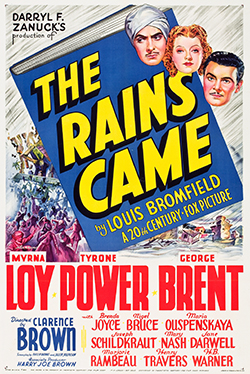
The Rains Came: A Review (Review #1640)

THE RAINS CAME

This review is part of the Summer Under the Stars Blogathon. Today's star is Myrna Loy.

The Rains Came is quite daring for the era, for there is very little subtlety with regards wanton women and interracial romance. A bit dramatic for my taste, and with some familiar beats, The Rains Came still impresses with its Oscar-winning special visual effects which time has not diminished.

India, 1938. Painter Tom Ransome (George Brent) is content in his semi-retirement, living for drink and women and the visits from his friend, Dr. Major Rama Safti (Tyrone Power). He is friend to all, despite his scandalous reputation. Even the social climbing Mrs. Simon (Marjorie Rambeau) pushes her eighteen-year-old daughter Fern (Brenda Joyce) on him.

Among Ransome's friends are the Maharajah of Ranchipur (H.B. Warner) and the Maharani (Maria Ouspenskaya). Invited to a party he'd rather not go, he encounters Lord Esketh (Nigel Bruce) and Edwina, Lady Esketh (Myrna Loy). A fateful reunion, for Edwina and Tom were once lovers. Whether they reignited their affair or not is subject to debate, but what is not is that Edwina is a bit of a hussy.

She now has eyes for Major Safti, though he appears more interested in his medical profession than in playing doctor with the scandalous Lady Esketh. Eventually, Lady Esketh decided it is time to give up notching the Major on her belt, until a combination monsoon and earthquake devastated the area.

After the chaos of the twin disasters, both the Maharani and Lady Esketh are widowed. Will Tom and Fern find love with each other? Will Edwina find redemption for herself and for Rama to love her?

The highlight of The Rains Came is the earthquake and monsoon, which comes at the halfway point of the film.  Winning Best Visual Effects (its only win out of its five Ocar nominations) was no small feat given that it beat out both Gone With the Wind and The Wizard of Oz. I think anyone even now would leave The Rains Came wildly impressed with its visual effects as both the ground collapses and is overwhelmed with water from a shattered dam.

This sequence is absolutely astonishing: the chaos of the water drowning hundreds right after the earth gave way is exceptional. I would rank this sequence with the parting of the Red Sea in The Ten Commandments in terms of visual power. 

I suppose every great romance has to have some kind of disaster, natural or otherwise, bring problems to our lovers. As such, this is where The Rains Came does not completely impress me. In a lot of ways, The Rains Came is nothing new. You have the shameless woman married to the older man, forever longing for someone not interested in her until disaster brings them together.

You even have the standard plot point of the shameless woman reforming and redeeming herself until tragedy comes her way. As such, I felt The Rains Came was pretty standard story-wise. It is a shame that the subplot of how the abusive Lord Esketh gets his brutal comeuppance as the floods race towards his temporary palace while his longsuffering manservant delights in sneering at him gets undercut.

The Rains Came is a product of its time, so people who are bothered by seeing the Irish-American Tyrone Power and more outlandishly the Russian-born Ouspenskaya as Indians should realize that Hollywood was not going to cast actual Indians in these roles in 1939. As a side note, they still struggle with casting Indians as Indians given that Fisher Stevens was able to play one in 1986's Short Circuit.    

Leaving the highly questionable or problematic casting to use current terms, their performances were quite good. Power was quite noble as Rama, and despite the inaccurate casting, I think there is something positive in how this Indian is a positive portrayal on film. Same for Ouspenskaya even if we wonder why there is a hint of a Russian accent to our Maharani. 

It is a puzzle as to why no one mentioned the interracial romance as being an issue. Even more surprising is that there is a very strong suggestion that Ransome and Lady Esketh had sex at the Maharajah's palace. We have them flirting, then as he lights her cigarrette, the lights go out and thunder rolls. We next see them walking together back into the reception room, where the Maharani adjusts Ransome's tie.

Say what you will about the Hays Office, but this is as open a suggestion of intercourse as I have seen from that era. 

Loy is a surprise as the trampish Lady Edwina. She's the antithesis of the elegant, sophisticated lady we are used to seeing Myrna Loy as. Lady Edwina is no perfect wife, but a woman of desires, unafraid and unashamed to fulfill them. The Rains Came gives Loy a chance to play against type, and she did so quite well, even if at times it did feel forced. 

It is surprising that despite receiving top billing, it takes a full fifteen to sixteen minutes before Loy appears on screen. However, her performance is on the whole excellent. Her final scene is glorious, and gloriously lit.

Brent seems more amused than anything as the dashing and lackadaisical Ransome. He at least is aware that Fern cannot possibly stay overnight at his place, even if it she ran away and was her idea. That does not prevent him from having a brief kiss with her. I would say that Joyce is the weak link, a bit too mannered and theatrical as Fern. However, it is not a terrible performance.

The Rains Came is elevated by its still-impressive earthquake/monsoon sequence, which is quite visually arresting. In a lot of ways standard fare for romances, and with questionable casting choices, The Rains Came still has a lot for the viewer to enjoy.

DECISION: B+

Sunday, August 28, 2022

Three Thousand Years of Longing: A Review

 THREE THOUSAND YEARS OF LONGING

I think I should start my Three Thousand Years of Longing review by warning audiences expecting a fun, zippy genre-bending fantasy to temper their expectations. At times pretty to look at and at times filled with naked fat women, Three Thousand Years of Longing is rather talky to fully embrace.

Narratologist Alithea (Tilda Swinton) is in Istanbul for a lecture on the subject of stories. Having already encountered a strange being at the airport that only she could see, another spectral vision causes her to faint. She dismisses any concern for her health, explaining that she has occasional visions she knows are fantasies.

In her hotel room, she starts to clean a bottle she purchased. From it comes the Djinn (Idris Elba), who quickly establishes this new world and asks her to speak her three wishes. Alithea, fully aware that the "three wishes" trope inevitably leads to disaster, refuses at first. However, the Djinn recounts three stories of how he came to twice be imprisoned in bottles to persuade her otherwise.

First is when he wooed the Queen of Sheba, until King Solomon used his mystical powers to entrap him. He next was freed by a young Turkish girl who wished to be loved. She soon finds herself the mistress of the heir to the Sultan's throne. Her story ends in death, as she was foolish in promoting her pregnancy while the heir was killed by a paranoid Sultan, who believed the son was plotting a coup. Finally, he encounters another Turkish woman, wise in intellect, whose paranoia about being possessed forces him back into the bottle.

Now, Alithia makes her first wish: to be loved by the Djinn. They go back to London, but modern technology overwhelms him. Her second wish is for him to speak as he starts disintegrating, and her third is for him to return to the world of the Djinn. Able to tell their story at last, she is surprised and delighted that the Djinn is able to visit her once more.

I do not know if people who go to Three Thousand Years of Longing are aware that the vast majority of it takes place in an Istanbul hotel room with the two leads dressed in white bathrobes. Moreover, much of Three Thousand Years of Longing is comprised of Idris Elba narrating his myriad of Turkish tales, some which seem to go on endlessly. 

We get to see the Djinn (who as far as I remember never has an actual name) tells his various tales of woe. Some of these moments look splendid, while others might shock you. The sight of a gaggle of girthy gals with the second-in-line to the Ottoman throne as he is essentially imprisoned with them may elicit horror or chuckles.

It is hard not to laugh when one of these Rubenesque women falls and cracks the floor to reveal the Djinn. Having her name be "Sugar Lump" does not help matters. 

I think a major issue in Augusta More and director George Miller's adaptation of A.S. Byatt's The Djinn in the Nightingale's Eye is how the Djinn ends up telling while Miller ends up showing. As the tone of the three separate stories were so serious, I think this method may end up alienating some viewers. You have narration in voiceover, and you have such a somber tone that it soon becomes, not exactly depressing but far more serious than perhaps it should be.

I do not fault the leads. Elba is interesting to see as the Djinn, attempting to free himself from this curse of entrapment. His hobbit-like ears are sometimes a distraction, but his performance pushes the material more than what was on the page. 

He had the benefit of a character to play. Swinton was mostly reacting to the Djinn's story, and she was mostly in her bathrobe. I kept thinking that it must have been a long day of her listening to the Djinn tell his three tales of woe.

I think the selling point for Three Thousand Years of Longing were in the visuals more than in the story itself. They were not terrible, and sometimes some visuals were impressive. I was reminded of The Tree of Life, though by the time we got to some of those arresting images most audiences had checked out.

I think the same of Three Thousand Years of Longing. A bit too talky and somber, with the energy petering out once they leave Istanbul, there is a slight sluggishness that keeps me at arm's length. 

DECISION: C-

Saturday, August 27, 2022

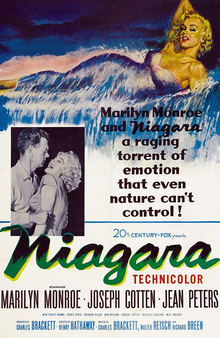
Niagara: A Review

NIAGARA

This review is part of the Summer Under the Stars Blogathon. Today's star is Marilyn Monroe.

Niagara is the rare film noir in color. It also is the rare Marilyn Monroe performance that is dark and dangerous. Far removed from her usual roles in light comedies or musicals, Niagara shows that even pre-Actors Studio, Monroe had the dramatic chops to more than hold her own against seasoned veterans.  

Polly and Ray Culter (Jean Peters and Casey Adams) are on a delayed honeymoon at Niagara Falls funded by Ray winning a Shredded Oats contest for the best marketing idea. They find their cabin is still being occupied by George and Rose Loomis (Joseph Cotten and Marilyn Monroe). Rose begs them to let them stay, as George is still suffering emotional issues and leaving might be bad for his mental health.

They agree, but it soon becomes clear that Rose is anything but a worried wife. She walks around in slinky outfits, taunting George with the song Kiss. Worse, Polly sees Rose in the throes of passion with another man. Soon, we discover that Rose is plotting to have her lover kill George at the falls and make it look like an accident.

Rose thinks the plan works, but Polly is shocked to see George alive when he enters their old cabin, unaware the Cutlers have moved in. No one believes Polly's story and George, insisting it was self-defense, pleads with her to let him stay dead. However, things devolve into more murder and mayhem, leading to a fatal encounter in the famous waterworks.

Niagara was a rare dramatic turn for Monroe in her early Twentieth Century Fox years, far removed from her persona of the dumb blonde. There is nothing sweet or innocent about Rose, which is why Niagara is one of Monroe's best, yet surprisingly lesser-known performances. She is excellent as this femme fatale: cold, calculating, alluring. This is no innocent, starting from her very first appearance on screen, where her face shows a coldness and calculated nature.

As this is the rare dramatic role Monroe had prior to her training at the Actors Studio, it is surprising to me that she or anyone thought Monroe could not be a dramatic actress. She shows she is more than capable of holding her own as a wicked temptress. Yet, unlike other femme fatales like a Stanwyck, Turner or Tierney, Monroe also brings some sympathy to the role at the end.

When she hears Kiss play, fully aware that her plans backfired, her growing fear becomes almost tragic. As she meets her fate, I felt genuine sorrow for Rose, and it is a credit to Monroe as an actress that she does elicit sadness from the viewer despite her wicked deeds.

Cotten was strong as the troubled George, even though at times he looked slightly bored with things. Peters was pretty but not as strong as Monroe or Cotten. Faring worse was Adams (real name Max Showalter). He gave it his best go but there was something a bit forced about him attempting to be a jovial husband to concerned spouse. 

Niagara shows that film noir can have color, and the film is beautiful to look at with its vistas of the on-location shooting. Niagara is the rarely seen Marilyn Monroe: the strong dramatic actress, capable of playing wicked. It should be better known than it is.

DECISION: B+

Friday, August 26, 2022

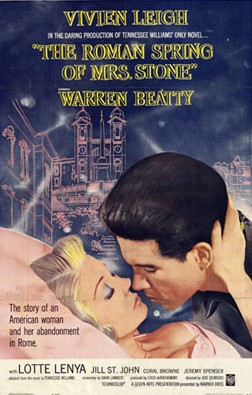
The Roman Spring of Mrs. Stone: A Review

THE ROMAN SPRING OF MRS. STONE

This review is part of the Summer Under the Stars Blogathon. Today's star is Vivien Leigh.

No dolce vita for our title character, as The Roman Spring of Mrs. Stone hits more than a few speedbumps to its ambiguous ending. Just enough to make it passable viewing, The Roman Spring of Mrs. Stone teeters due to its two lead performances.

Famed actress Karen Stone (Vivien Leigh) is now a middle-aged widow, her much older husband having died on their way to Rome. She opts to retire from the stage and live out her life among the ruins of the Eternal City, just drifting and learning to be alone.

The Contessa Magda Terribili-Gonzalez (Lotte Lenya) decides Mrs. Stone is the perfect mark on which to ply one of her stable of handsome young men who keep older women company. For this task, she selects Paolo (Warren Beatty), a talented but narcissistic gigolo. Mrs. Stone likes the company, but she at first will only dine and dance with Paolo. Mrs. Stone's best friend Meg (Coral Browne) warns her against so much as appearing in public with that pretty young thing, but she takes no heed of such talk.

It is not long, however, before the loneliness overtakes her, and they begin their affair. She does not pay him for sex but does pay for everything else. Paolo, for his part, decides to freelance and keep the Contessa out of the loop. However, it is not long before Paolo's hungry eyes turn to American starlet Barbara Bingham (Jill St. John), who is younger and moving up in the film world. Mrs. Stone finds herself now abandoned and more alone. With that, she tosses the keys to her apartment to the strange young stalker who has been pursuing her (Jeremy Spenser). She calmly waits for him to enter, a strange smile on his face as he menacingly walks in.

What I think dooms The Roman Spring of Mrs. Stone is that we have Vivien Leigh reuniting with Tennessee Williams material, the film based on his novella. As such, it is hard to impossible not seeing The Roman Spring of Mrs. Stone as Blanche DuBois Goes to Rome. Granted, Karen Stone isn't anywhere near as bonkers as our forever forlorn Southern belle, but there is something Blanche-like in both the character and Leigh's performance.

I perhaps should be more generous to Leigh in that Karen Stone was an actress and as such prone to more theatricality than most people. However, there seemed to me to be something rather grand, slightly operatic to Leigh's performance. I would not say it was over-the-top, but it was scratching at the ceiling. Try as I might, I could not see Karen Stone. I could see only Blanche, or rather yet a Blanche impersonation. 

As often as Paolo tells Mrs. Stone that she is making a spectacle of herself, in reality it is Beatty who is making a spectacle of himself. The Roman Spring of Mrs. Stone is early in his career, but this has to be one of his worst performances. With his almost cartoonish Italian accent and poor tan, Beatty came across almost as a spoof of what an Italian gigolo would be like. I think Beatty did his best to make Paolo a harsh, even angry figure. However, I never saw the false charm that could get Mrs. Stone to melt. Beatty is openly insincere in his performance, and I think poorly cast.

Lotte Lenya received a Best Supporting Actress Oscar nomination for her performance as the Contessa, and I give credit to her for her oily, sleazy pimp. Whenever she is on screen, we see the greedy machinations of the Contessa working through her thin veneer of respectability. Perhaps her best scene is at a party thrown for Bingham to which Karen is invited. As she attempts to plant seeds of doubt about Paolo's sincerity, we see her taking jabs at both Paolo and Karen. There is a contempt for people that Lenya plays well. 

If anything brings down The Roman Spring of Mrs. Stone, it is Jose Quintero's directing. He, for example, opts to hide Beatty's face when Paolo and the Contessa first call upon Mrs. Stone. The various steps he takes to keep the audience from seeing Beatty/Paolo's face soon become farcical and forced, then worse, when we do see his face, it is not in the dramatic manner the buildup had been made to be. It just seemed to be all for naught.

We also have Gavin Lambert's adaptation of the Williams novella. The film ends on the most ambiguous close as our troubled young man enters Mrs. Stone's apartment. Earlier, Paolo tells Mrs. Stone a story of a wealthy middle-aged woman who was found murdered in her bed after letting a stranger in. As such, the film wants us to believe Mrs. Stone will be iced, which is not a particularly good way to end an already downbeat story. However, we do not know if the crazed young man will actually murder her.

Not that the option of merely raping her makes things any less palatable. I might believe that Mrs. Stone, so desperate and devastated by turning old and being abandoned by her lover, might let a strange man to come to or at her. If only Mrs. Stone hadn't been so grand in her manner.

The Roman Spring of Mrs. Stone could have been better if Vivien Leigh had toned things down and if Warren Beatty had not played Italian. However, it is not terrible, so it can be worth looking in on our doomed heroine.

DECISION: C+

Thursday, August 25, 2022

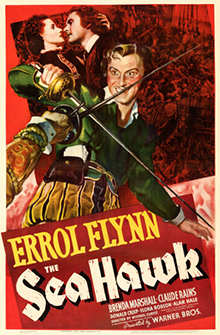
The Sea Hawk (1940): A Review

THE SEA HAWK

This review is part of the Summer Under the Stars Blogathon. Today's star is Gilbert Roland.

Rousing does not even begin to describe The Sea Hawk, as swashbuckling an adventure as has been made. Exciting and fast-paced despite its length, The Sea Hawk is fun and inventive, with a brilliant turn by Errol Flynn in one of his most electrifying performances.

Captain Geoffrey Thorpe (Flynn) is one of what are dubbed "sea hawks", a group of privateers who, with silent and tacit approval of Queen Elizabeth I (Flora Robson) attack Spanish ships and take their treasure, which somehow finds its way into the British coffers. His ship the Albatross has attacked the ship carrying the Spanish ambassador Don Jose de Cordova (Claude Rains) and his niece, the Dona Maria (Brenda Marshall). Captain Lopez (Gilbert Roland) is equally displeased, but there is nothing he can do about Thorpe's victory.

Cordova, secretly working with British Lord Chancellor Wolfingham (Henry Daniell), want England weak, particularly with its Navy, so that Spain's King Philip II (Montagu Love) can conquer it, and from that bring the whole world under Spanish domination. Opting not to attack Philip directly, Elizabeth says nothing when Thorpe proposes to attack the Spanish on land to take their plunder.

Unfortunately, Cordova knows of the plans to attack in Panama and sets a trap that Thorpe and his men fall into. Dona Maria was too late in trying to warn Thorpe, as the half-British Maria has fallen in love with Thorpe and vice-versa. Now condemned to a Spanish galley, Thorpe sees no way out. That is, until a British spy lets himself be captured and is made a galley slave. A coup on board brings the British back to the kingdom, and from there it is a race to inform Her Majesty of Philip's plans for his Armada. Now as Sir Geoffrey Thorpe, Gloriana declares she will build a great Navy to defend this sceptered isle.

Warner Brothers could never do sumptuous in the way their rivals at MGM could. It could, however, they could do grand, which is what The Sea Hawk is. From the first notes of Erich Wolfgang Korngold's rousing score, The Sea Hawk is sweeping and epic, thrilling and romantic. It has the full intention of sweeping the viewer into action, adventure and romance, and it does so brilliantly.

I think people today simply do not appreciate Korngold's score for The Sea Hawk. A good part of the film's success lies in his music. It shifts easily from rousing and grand to surprisingly tender and romantic. It is epic and intimate, able to shift from the sea battles to a beautiful romantic scene in an English garden.

This English Garden scene is simply beautiful in every way. Director Michael Curtiz and cinematography Sol Polito capture a remarkable sequence in every way. The camera moves fluidly, and the interplay between Flynn and Marshall is beautifully acted. Here again too, Korngold's score builds on the tender and growing romance between the two adversaries.

Curtiz and Polito also do something quite extraordinary visually in The Sea Hawk. The entire Panama sequence is shot in sepia versus the lush black-and-white of the rest of the film. Not only was the transition from black-and-white to sepia so well-done one almost does not notice, but somehow the sepia works for this section of The Sea Hawk. It is almost a throwback to silent films, when changes in scenery or mood were indicated by change in color tints.

The sepia and black-and-white sections show that there was a great deal of thought into how The Sea Hawk should look. As such, I think colorization of films like The Sea Hawk is a terrible mistake. This film was made to be in black-and-white and sepia, not in color. It works fine as it is and cannot be perfected.

Errol Flynn is the definite swashbuckler, and The Sea Hawk is a triumph in his filmography. He handles the action sequences with wild abandon, dashing and daring when swinging across the waters to attack a ship or literally crossing swords with Her Majesty's enemies. However, we also see a playful side whenever he acts with a monkey and the romantic, swoon-worthy side when he woos the fair Dona Maria. The Sea Hawk ranks among Flynn's best performances.

Marshall was pretty and moving as Maria, who shifted in her views from hostile to helpful. Claude Rains was villainous but shrewd as Cordova, never showing his hand unless necessary. Robson, I think, seemed to make a career out of playing Good Queen Bess, and here she even allows for a bit of humor to sneak in. She uses a fan to suppress her smile to laughter when the Spanish insist on punishing Thorpe and the other privateers and especially when Thorpe's monkey doffs his cap at Her Majesty.

Daniell was a bit over-the-top as the monstrous Wolfingham, but that was the role. Roland was elegant and noble as Thorpe's adversary, with whom he had a mutual if grudging respect.

If The Sea Hawk has a flaw, it is that in many ways it plays like a remake of The Adventures of Robin Hood done two years prior. The dashing gentleman thief wins heart of noble woman who is first openly antagonistic towards him until she sees her unity in his cause, with the dashing gentleman thief facing off against enemies of The Crown. He is captured and looks like there will be no escape until fortune lets him sweep into a final battle against those who would go against England. For better or worse both The Adventures of Robin Hood and The Sea Hawk follow a similar structure.

They even have some of the same elements: Curtiz directing, Korngold writing the music, and Alan Hale as Flynn's second-in-command. Fortunately, both films work fine independent of each other despite their similarities. Moreover, The Sea Hawk works as de facto war propaganda. From Philip II's shadow falling on the map of the world with his plans for worldwide domination to Elizabeth II's rousing speech declaring she will build her Navy and defend her island against enemies of freedom, The Sea Hawk is subtle enough to be part of its own story while speaking to the then-contemporary audience.

The Sea Hawk is rousing and thrilling and tender. It is a sweeping epic that will thrill and entertain the viewer, who will scarcely notice its length. 

DECISION: A+