Showing posts with label Jane Austen Adaptations. Show all posts

Monday, August 8, 2022

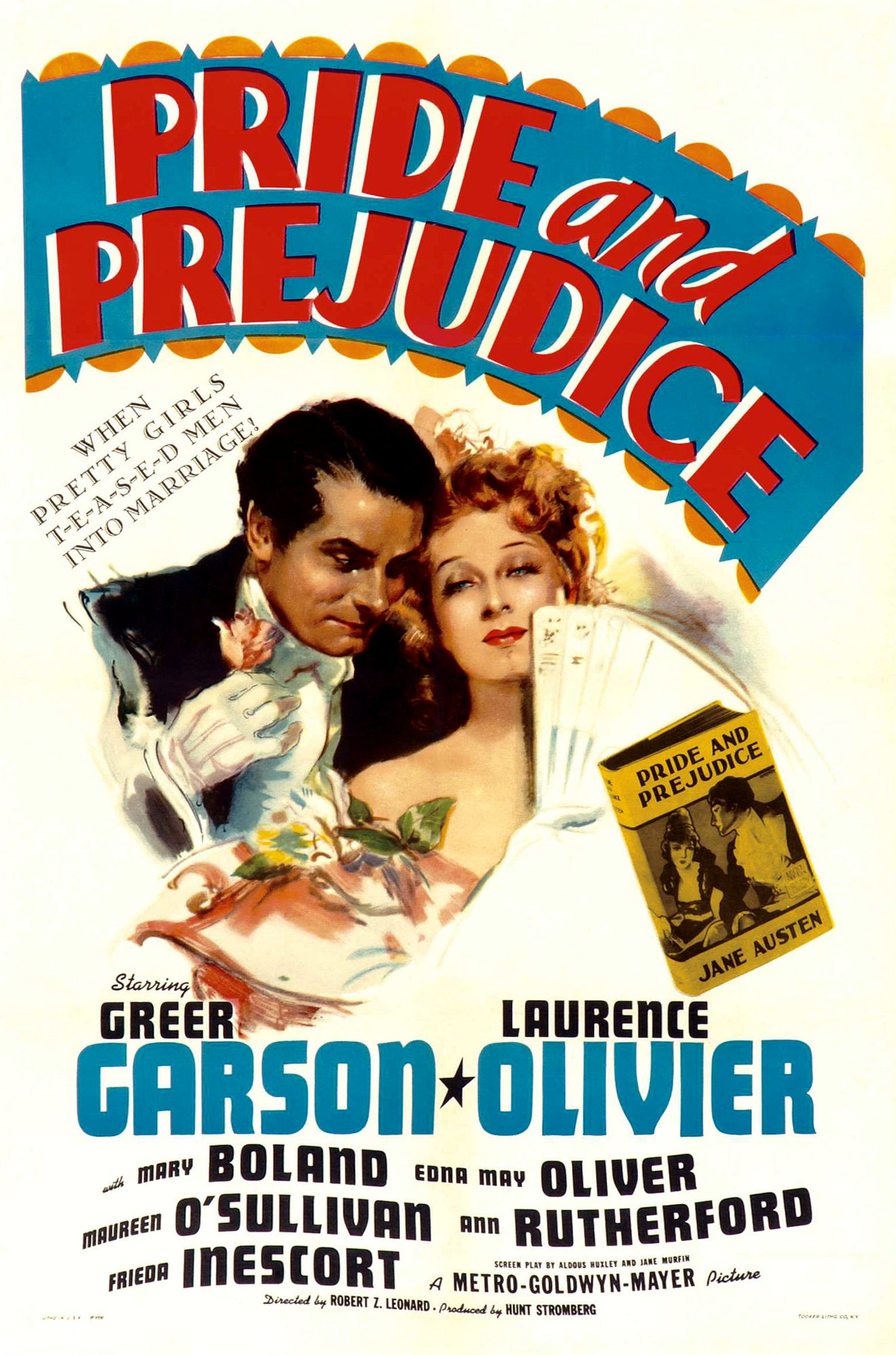
Pride and Prejudice (1940): A Review (Review #1620)

PRIDE AND PREJUDICE (1940)

This review is for the Summer Under the Stars Blogathon. Today's star is Maureen O'Sullivan.

Long before Jane Austen became the biggest (dead) authoress in Hollywood, her work was adapted in lavish style by the most lavish of studios. Pride and Prejudice is a light, quippy film, if a bit long and with stars that might be a bit past it for plausibility.

The Bennet family is not rich but comfortable enough. Mrs. Bennet (Mary Boland) forever frets about her five daughters, aware that none will inherit the family home. Mr. Bennet (Edmund Gwenn) merely looks on with resignation and slight bemusement on the goings-on. The eldest daughter, Elizabeth or Lizzy (Greer Garson) is not opposed to marriage but is not seeking it either. Her other sisters pretty much are. 

Elizabeth is closest to Jane (Maureen O'Sullivan), who is probably the beauty in the family (not that her other sisters are ugly). Jane is pretty enough for Mr. Bingley (Bruce Lester), who has recently taken possession of the nearby mansion. Accompanying him is his haughty sister (Freida Inescort) and the even haughtier Mr. Darcy (Laurence Olivier). 

Elizabeth and Darcy begin their battle of wits, with the latter being proud and the former prejudiced. Elizabeth sides with poor military man Mr. Wickham (Edward Ashley) who claims to have been brought to ruin by Darcy. Wickham has been making overtures to Lydia Bennet (Ann Rutherford), who is clearly taken with any man in uniform. For her part, Elizabeth must endure and escape the attentions of her distant cousin and heir to the Bennet family home, Mr. Collins (Melville Cooper).

As loves come and go, Elizabeth and Darcy realize separately what has been clear: they are in love with each other. Ultimately, the right people find each other and more importantly, find love.

The mind boggles that Aldous Huxley, author of Brave New World, cowrote such a witty, sparkling adaptation (with Jane Murfin). Pride and Prejudice is a delight, reveling in its proper but sharp Regency comedy of manners. "Five thousand pounds and unmarried. That's the most heartening news since Waterloo", declares Mrs. Bennet when she hears how much Mr. Bingley takes in a year. After Lydia embarrasses Wickham by mentioning to Elizabeth that he is interested in her, he quips, "Someday I'll tell you what kind of creature you are". 

We even get some nice subtle insults from Elizabeth to Miss Bingley. The latter is a monstrous snob, forever putting down everyone who is not a Bingley or Darcy. When she suggests that "certain women" should be more dignified by remaining silent, Lizzy retorts that if she is looking for silent figures, she should look to a mummy. 

Who knew Regency era women could throw shade at each other so well?

This does not mean that Pride and Prejudice is all fluff. When the scenes call for drama, the actors are able to rise to the occasion. I think that both Greer Garson at 36 and Olivier at 33 might be a bit old to be young lovers-in-waiting. However, they are both excellent in their roles. Garson's mix of elegance and strength show Elizabeth to be competent, unafraid and caring. When escaping the ardent Mr. Collins, she is even able to have something of a chase scene. Olivier for his part makes Darcy that haughty figure, an arrogant little twit who slowly realizes Elizabeth is more than a match for him.

The more tender love story between Jane and Mr. Bingley is capably carried by O'Sullivan and Lester. They have a wonderful scene when Jane is forced to stay with the Bingleys after catching cold. As the pompous doctor gives her strange-sounding diagnoses, Bingley delightfully translates them to more reasonable answers. Gwenn and Boland play well off each other as Mr. and Mrs. Bennet, loving but enduring each other. Edna May Oliver's haughty Lady Catherine is comically haughty, while Cooper's besotted but idiot Mr. Collins brings a delightful pomposity to a foolish character.

Again, I would argue that Cooper was similarly too old for the role, but he too was amusing and brought life to the film.

If there are slight criticisms, they are that at nearly two hours it feels longer. I was also surprised that while the score is credited to Herbert Stothart, some of the music seems cribbed from the Ballet of the Unhatched Chickens sequence of Mussorgsky's Pictures at an Exhibition. 

On the whole though, Pride and Prejudice, even with the changes to conform to the Production Code, will I think delight Jane Austen fans due to its charming leads. 

DECISION: A-

Sunday, January 9, 2022

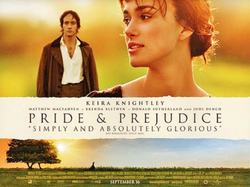
Pride & Prejudice (2005): A Review (Review #1570)


PRIDE & PREJUDICE (2005)

Perhaps to my shame, I admit I never finished Pride & Prejudice. From what I did read, however, I was quite impressed with the celebrated Jane Austen novel. While perhaps her most famous/beloved work has been adapted at least twice on film and television, the 2005 adaption remains one of the most popular versions. This version of Pride & Prejudice is a beautiful film, simultaneously contemporary and traditional, that is a delight throughout.

The five Bennet sisters, living in genteel poverty, are happy. Mrs. Bennet (Brenda Blethyn) wishes nothing but advantageous marriages for her girls, while Mr. Bennet (Donald Sutherland) would like to keep out of things altogether. Jane Bennet (Rosemund Pike) has caught the eye of Mr. Bingley (Simon Woods), the wealthiest man around. Jane's sister Elizabeth (Keira Knightley) is not opposed to marriage but is not looking for it either.

Things take a complication when she strikes a love-hate relationship with the brooding, proud Mr. Darcy (Matthew Macfayden), Mr. Bingley's best and wealthier friend. As the proud Darcy and the prejudiced Elizabeth continue their pas de deux d'amour, their various friends and family intermingle. The small and small-minded distant Bennet cousin Mr. Collins (Tom Hollander) pursues Elizabeth, while caddish soldier Wickham (Rupert Friend) manages to lure young Lydia Bennet (Jenna Malone) away. Eventually, true love triumphs for both Jane and Elizabeth, as the futures Mrs. Bingley and Mrs. Darcy rise above pride and prejudice.

From the opening sequence where the camera flows around the rambling, ramshackle yet loving Bennet home to where our lovers are bathed in the sunlight of their love, Pride & Prejudice is a sweeping, beautiful film. Director Joe Wright is very fond of having the camera follow the characters all around, but this works exceptionally well here. We get quick interactions between small groups of characters that give us story details without bogging things down. 

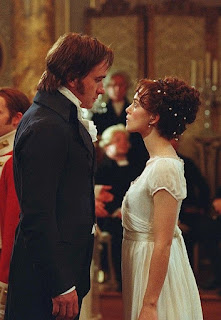
There is spirit of life in Pride & Prejudice as we see the various interactions between characters. Wright, along with screenwriter Deborah Moggach, do allow some moments of magical fantasy to enter the film. As Darcy and Elizabeth dance at the Bingley ball, at one point it appears as if they are the only ones in the ballroom, allowing their sharp comments to disappear as they fight their growing love.

One aspect that stands out in Pride & Prejudice is how contemporary the film feels. There is an almost rapid-fire delivery to the dialogue, not in a screwball comedy way but in a sharp, fast manner that has no sense of stuffiness to it. In short, the world of Pride & Prejudice feels lived, real, alive, as if we were genuine observers in this Regency Romance. I would put it as having the Darcy/Elizabeth romance be made up of respectable flirtation.

Each performance was simply perfect. Knightley comes into her own as Elizabeth, a very modern woman who is sharp, intelligent, not above throwing shade at the arrogance of the wealthy, but also aware of her own mind. She is brilliant when rejecting Collins' proposal, moving when seeing another side to Darcy, and delightful when showing her affection or irritation with her family. 

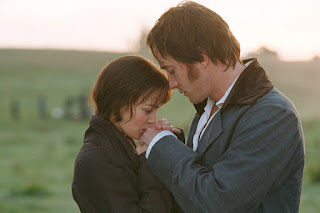
Macfayden, to my mind, has not been given enough credit for his Darcy. He certainly is an extremely handsome man (I would not blame women if they fainted when he appears through the morning mist, shirt open and coat flowing), but he shows the complexity of Darcy's emotions. Starting out openly haughty, he also shows how Darcy attempts to hide his growing attraction to the mind and body of Elizabeth: a quick glance, a flustered manner. Macfayden is excellent as Mr. Darcy.

Hollander brings humor to the bumbling Collins, Friend a plausible vulnerability to Wickham. Blethyn balances comedy and irritation to Mrs. Bennet, Sutherland showing the outwardly indifferent but genuinely caring Mr. Bennet. Rosemund Pike makes the case that one could have a film centered around Jane Bennet, and Woods like Blethyn balances comedy and romance with his Bingley. We also see early performances from Carey Mulligan as Kitty Bennet, and while Judi Dench has a small role as Lady Catherine de Bourgh, she is equally impactful.

Pride & Prejudice may be a costume picture, but there is no sense that it is theatrical. Instead, it is as quietly fiery as the romance between Fitzwilliam Darcy and Elizabeth Bennet, two individuals who are clearly made for each other. Beautiful, moving, fast-paced and keeping the sense of the time setting while injecting a modern sensibility to things, Pride & Prejudice is an excellent film.   

DECISION: A-

Sunday, March 8, 2020

Emma (2020): A Review

EMMA (2020)

You just can't keep a good matchmaker down.

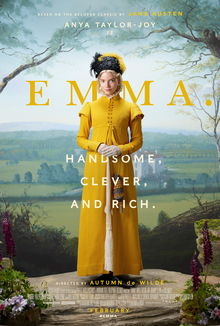
While the Jane Austen comedy of manners Emma has received both an updated version (Clueless) and the more traditional treatment (1996's Emma), the novel continues to find new forms of being told on film. The 2020 adaptation of Emma is a sheer delight, mixing costume lavishness with a hint of modernity in this tale of thwarted lovers who do find love despite themselves.

Emma Woodhouse (Anya Taylor-Joy) lives in opulence with her father Mr. Woodhouse (Bill Nighy), who suffers from an extreme case of hypochondria. She has informally adopted young orphan Harriet Smith (Mia Goth, one of the best names in film today) and decides that she can do better than poor farmer Mr. Martin. Emma opts to match Harriet with the vicar, Mr. Elton (Josh O'Connor), but despite what both women think Mr. Elton fancies Miss Woodhouse.

After this fiasco, Emma wants to stay out of things but she cannot help it. Her brother-in-law, Mr. Knightley (Johnny Flynn) continues to both marvel and object to her meddling, but nevertheless, she persisted. She does so with the aid of Mr. Churchill (Callum Turner), son of her former governess' husband and quite the rake himself. His influence causes Emma to brutally insult Miss Bates (Miranda Hart), who while granted is a bit tiresome on the whole a pleasant person not deserving of brutal put-downs. However, while Emma's various schemes do not work out as she hopes, she also finds that she is in love with Mr. Knightley, but does he feel the same way?

Image result for emma 2020What I found in Emma is a blend of a respectable, posh, elegant adaptation and one that is quite of today. The language Eleanor Cattan's screenplay is very Austen-sounding (not having read the novel, I have no way of knowing if it is taken verbatim). However, I don't think any other adaptation would have introduced Mr. Knightley by showing him nude, hot and sweaty after a brisk ride on his horse.

The film balances posh respectability with an almost wicked sense of wit, moving beyond its quite elegant costumes to a more central focus on Emma and Knightley. In fact, I would say that Emma is surprisingly Knightley-centric in that it is clear long before Miss Woodhouse realizes that he is in love with her.

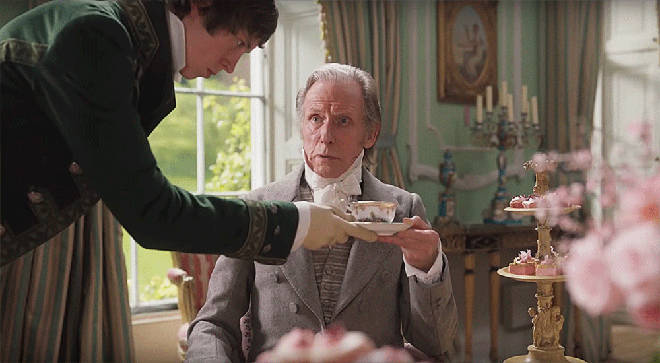
This is communicated through both Flynn's performance and Autumn de Wilde's directing in her film debut. Emma is sharply acted, where the slightest look, glance or tone of voice communicates more than the words themselves. Bill Nighy took what might have been merely a small part and all but stole the show with his Mr. Woodhouse. He has a surprisingly small amount of actual dialogue, but in his glances, his expressions be they of shock, disdain or knowing he tells you everything the loving but worried father thinks. Goth's Harriet comes across appropriately as the plain girl but one who would look to Emma as mentor and role model regardless of the logic of such things.

Hart equally steals the scenes in her brief role as Miss Bates. She makes Miss Bates appropriately chatty and almost insufferable in her constant talk of "Miss Jane Fairfax" (Amber Anderson) but when she attempts to hide her hurt at Emma's cruel put-down it all but breaks your heart. O'Connor as Mr. Elton has a surprisingly eccentric manner to him, less a pious man and more a slightly bonkers one, his too enthusiastic grin and slightly stooped manner not off-putting but suggesting someone a little too eager to please.

Image result for emma 2020
The film is quite subtle in its comedy. Of particular note is the interaction between the characters and their long-suffering servants. Though they never speak, we see in their reactions how eccentric everyone they work for are. Whether they all but run whenever someone is about to make a spectacle of themselves or struggle dressing them, the sly manner never takes away from the humor of the idle rich.

At the center of Emma is the trio of Taylor-Joy, Flynn and Turner. Each of them turns in a wonderful performance. Taylor-Joy makes Emma Woodhouse a bit of a snob and slightly unpleasant but not a monster. She is not cruel but more snooty, a person with a heart but sometimes without a head. The party scene where she puts down Miss Bates makes her actions come across as thoughtless versus heartless, and in her mix of regret, anger and struggle with apologizing she captures Emma's character. Flynn's Mr. Knightley is more proactive and less a commentator on her actions. Their scene together as they dance suggests again more than what they are saying.Flynn plays Mr. Knightley as more brash and assertive but also one who trembles when realizing his love for his frenemy.

While Turner is not in the film for a long period, he makes an impression as the somewhat arrogant, rich Churchill, one who puts himself above all others up to his very patient father and kind stepmother.

Emma also manages to make the music a mix of elegant and cutesy, plus blends folk songs seamlessly into the setting. De Wilde does a wonderful job in showing without telling. Take for example the dance scene, where we can see how the Eltons are not the happiest of couples without distracting from the main metaphorical danse d'amour between Emma and Knightley.

I was charmed and delighted by Emma, a tale of humor and wit that both fits well in and elevates period pieces. It is quite a layered film, one that keeps within the confines of a costume picture but that contemporary audiences will find the humor in.

DECISION: B+

Saturday, February 29, 2020

Clueless: A Review (Review #1355)

CLUELESS

For a brief time in the 1990's, the "in thing" was adapting literary classics and updating them to the present-day. While some have been forgotten (case in point, the 1998 version of Great Expectations), a few have managed to stand out and still stand the test of time. Among the fortunate few is Clueless, the delightful updating to Jane Austen's Emma for Generation X. With a wry style and excellent performances by a future who's who of actors, Clueless is a sweet, delightful romp.

Cher Horowitz (Alicia Silverstone) has little on her mind but shopping, fashion and driving with varying degrees of success. Despite her apparently airhead manner, Cher does have a good heart: she is protective of her father Mel (Dan Hedaya) and is loyal to her friends, especially her BFF Dionne (Stacey Dash).

Distressed at her poor grades, Cher decides to get her persnickety debate teacher Mr. Hall (Wallace Shawn) and her activist teacher Miss Geist (Twink Caplan) together to make them more placid. Her scheme works, and she finds herself enthused with her version of altruism, much to the amusement of her ex-stepbrother, socially conscious Josh (Paul Rudd).

After her wild success in playing Cupid, Cher decides new girl Tai (Brittany Murphy) needs a makeover and a better boyfriend prospect than skater Travis Birkenstock (Breckin Meyer). She picks cool kid Elton (Jeremy Sisto), but things go awry when Elton mistakes Cher's matchmaking for interest in him. More romantic confusion comes when Cher decides to try and land returning student Christian (Justin Walker), unaware Christian's gay.

While enduring her frenemy Amber (Elisa Donovan) and watching with a mixture of amusement and puzzlement the on-off relationship of Dionne and Murray (Donald Faison), Cher comes to shocking conclusions about her feelings for Josh. Happily, everyone from Dionne and Murray to Tai and a now-sober Travis find what Cher and Josh find in each other: true love.

Image result for cluelessClueless may appear to be mocking teens, but writer/director Amy Heckerling shows them in a remarkably positive light, especially Cher. At heart, Cher is a good person: protective over and obedient to her father, never mean-spirited or deliberately cruel and always willing to help, even if at times her help is more harmful than good. The closest Cher ever gets to being unkind is when she casually dismisses Travis away from Tai. Even that, though, was motivated more out of concern for Tai than for any genuine animosity towards Travis, and to her credit she did see that Travis, once he joined a "club with 12 Steps", was a better fit for Tai than either Elton or Josh.

I think one of the reasons Gen X (and now their children) has embraced Clueless is because there is someone whom everyone can identify with or at least recognize. None of the characters are ever overtly mean: even Elton is more dim than cruel. The Clueless kids by and large are endearing, pleasant and surprisingly stable, albeit spacey and unaware of things outside their own world.

As a side note, a line Travis utters proved prescient. He tells Mr. Hall that he shouldn't be too hard on his Mom's taste in music because what the Rolling Stones are to him, Nine Inch Nails would be to his kids. That's surprisingly insightful from a stoned-out skateboarder.

Clueless is also hilariously funny, full of witty lines and situations. There's Cher's views on Dionne's fashion sense ("Shopping with Dr. Seuss?"). There's Travis' speech on being "awarded" the most tardies, and Cher's sometimes oddball debates such as calling to allow the "Hait-tians" to come to the United States. From "What-EVER!" and "As IF!" to perhaps the ultimate put-down, "You're a virgin who can't drive", Clueless is sharp and funny.

Image result for clueless
The film is also exceptionally well-acted. Silverstone, then primarily known for her Aerosmith video appearances, is simply delightful as Cher. While I am not big on voiceover, Silverstone did a simply perfect performance as our lead, capturing that mixture of vapid but kindhearted girl. She makes Cher so likable and shows that she is nowhere near dumb. Instead, Cher is more naive and innocent, a pleasant girl who is materialistic but who also has some common sense and is always motivated by a desire to do good. We see that when she spearheads a disaster relief drive for nearby Pismo Beach. Rather than reject Travis' offer of a bong or criticize him for bringing such a curious donation, she accepts it (albeit a bit puzzled by it) and suggests taking it to kitchenware.

Rudd is also excellent as Josh, the older, wiser young man who is at times bemused at times confused by his former stepsister. The yin to Cher's yang, Rudd expresses that socially aware manner without making Josh an insufferable scold. He brings a nice softness to his joshing of Cher (no pun intended).

Dash and the late Murphy make Dionne and Tai equally amusing. While not on screen often, Donovan leaves an impression as Amber, about the only one who recognizes Cher's debate idiocies while being somewhat idiotic herself.

The men are not behind either: Walker's too cool for school manner, Faison's exaggerated posing, Meyer's sweet but whacked-out stoner. The adults too excel: Hedaya plays slightly against type as Mel. He still barks out orders and insults, but he is also loving and protective of both Cher and Josh. Shawn is hilarious when doing nothing at all, his stunned reactions at his students' antics speaking for themselves.

Clueless holds up surprisingly well. You can see where it is dated, such as in the prevalence of flip phones or a cameo by The Mighty Mighty Bosstones in a party scene. However, Clueless is fun and funny, something that never gets old.With excellent performances, a witty and smart script, excellent directing, and some nice but subtle touches (such as hearing the opening to the song Gigi when Josh sees Cher at one point), Clueless is anything but.     

DECISION: A-

Wednesday, February 26, 2020

Emma (1996): A Review

EMMA (1996)

Has it been so long since the world was not only enchanted by Gwyneth Paltrow but that we believed she could be British? Shakespeare in Love, Sliding Doors and Emma, all made us believe our winsome American was an ever-so-veddy-proper posh upper-crust Brit, her generation's Audrey Hepburn. Emma, the adaptation of Jane Austen's comedy of manners, is charming enough if a bit slight.

Emma Woodhouse (Paltrow) is fully convinced she is a matchmaker par excellence, regardless of whether those in her circle want her help or who they are actually in love with. After successfully matching her governess Miss Taylor (Greta Schacci) with widower Mr. Weston (James Cosmo), she sets her eyes on the plain Miss Harriet Smith (Toni Collette). She will engineer a romance between Miss Smith and the local vicar, Mr. Elton (Alan Cumming) despite Harriet being clearly in love with farmer Mr. Martin (Edward Woodall), but soon the various romantic entanglements start getting out of Emma's control.

All this goes on to the amusement of her brother-in-law Mr. Knightley (Jeremy Northam), who marvels at Emma's mixture of naivete and arrogance. More romantic entanglements come when the dashing Mr. Churchill (Ewan McGregor) comes by, along with seductive Miss Fairfax (Polly Walker), all of whom may have designs on others. Complicating things are both the new Mrs. Elton (Juliet Stephenson) and the feelings of both Emma and Mr. Knightley. Eventually however, all's well that ends well in this hodgepodge of romance.

Image result for emma 1996It wasn't until the end that Emma kind of won me over. Up to when Mr. Knightley and Miss Woodhouse realized what they knew to be true I was not particularly impressed with the proceedings. There was a stuffiness to the film, not quite Masterpiece Theater but still with the feeling that it was being "acted" versus "being". It wasn't so much stuffy as slightly unrealistic, at least for a bit.

However, as the film went on, I did find it an enjoyable, light confection, a harmless romp through the merry world of Regency romances.

Paltrow is not as big a draw in film as she was in the early 1990's, at least apart from the Marvel Cinematic Universe. In Emma, she gives a good though not great performance with an acceptable British accent. More than that, Paltrow is appropriately fluttery while still being a surprisingly unpleasant character. Emma is convinced she know better about love than lovers themselves, so I give her credit for not making me hate her. She is not exactly endearing in her manipulative nature, but more, and I hate saying it, clueless. Again, it's to her credit that she does not come across as a monster.

Northam was at the time the "dish du jour", and he acquits himself well as the man to match wits with our bumbling Cupid. He brings a slyness and even shyness to Mr. Knightley as he slowly realizes that whatever his protests to her machinations, she really is someone worthy of love. Collette was delightful as the sweet but dim Harriet, appealing and charming while not being a ravishing beauty. Schacci is surprisingly elegant as Mrs. Weston despite being essentially a servant who married up.

Image result for emma 1996Oddly, the men apart from Northam seemed to suffer more. McGregor as Emma's temporary partner in crime seemed a bit too bemused with himself, almost as if he knew he shouldn't take thing seriously. The real odd bunch is Cumming, who seems wildly miscast as the lovestruck Mr. Elton. He doesn't convince me he'd be besotted with anyone.

The film does have merits in its costumes and Rachel Portman's score, both nominated for Academy Awards with Portman's chamber music-like score winning (making her the first woman to win for Original Score). It also has demerits in its editing, which was surprisingly clumsy and choppy when trying to cut two lines of dialogue together for a punchline.

On the whole, Emma is slight but pleasant, a nice little diversion for a Sunday afternoon.

DECISION: B-

Monday, March 13, 2017

Love & Friendship: A Review


LOVE & FRIENDSHIP

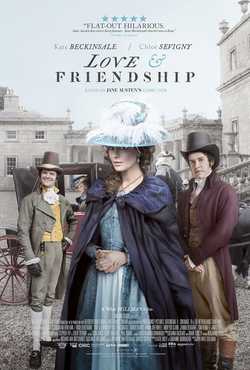
Love & Friendship is based on Lady Susan, a little-known work by Jane Austen.  There was a time, not too long ago, where Austen was the most in-demand dead writer around: Sense & Sensibility, Pride & Prejudice (film and television adaptation), Emma, even Clueless (a modern retelling of Emma) were all the rage.  The mad rush has died down a bit, but Whit Stillman brings this small work to life in a charming, light, amusing portrait of our anti-heroine: clever, manipulative, whom we shouldn't like but end up as bewitched as nearly every man who comes past her.

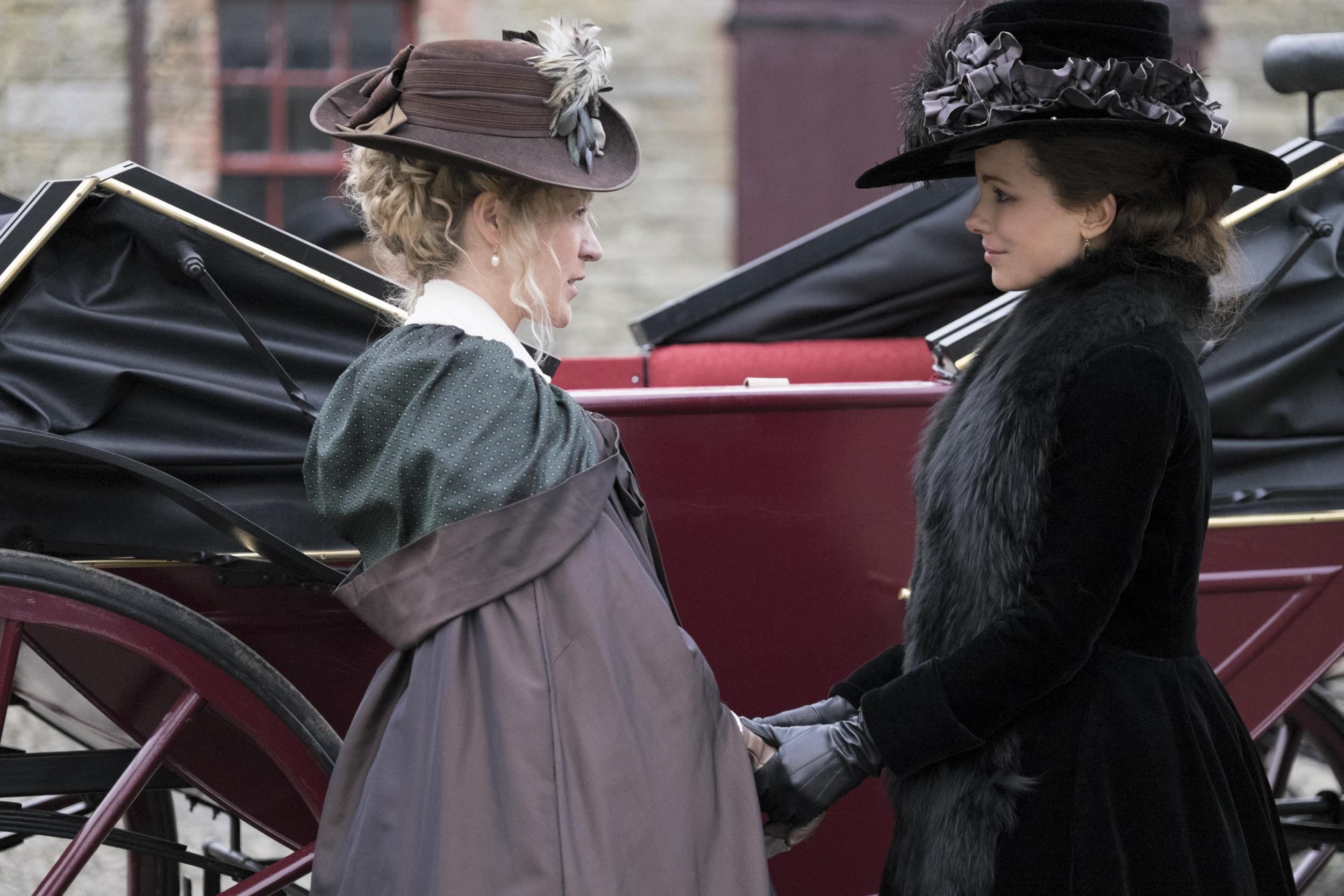
Lady Susan Vernon (Kate Beckinsale) has gone to 'visit' her in-laws at a most opportune time.  The recent widow has 'opted' to leave another estate after certain rumors of a dalliance with the devilishly handsome Lord Manwaring (Lochlan O'Mearain).  While at her in-laws estate of Churchill, her sister-in-law Catherine (Emma Greenwell) and Catherine's brother Reginald DeCourcy (Xavier Samuel) are wary of the notorious flirt's reputation, but it isn't long before Susan has worked her charms on Reginald, convincing him that she is a wronged woman. 

Complicating matters is Lady Susan's daughter Frederica (Morfydd Clark), whom Mother doesn't care much for but is obligated to take care of in some way.  Frederica has run away from her expensive boarding school and thus expelled, requiring her to come to Churchill too.  This might be good, as Lady Susan is determined to marry Frederica off to the wealthy Sir James Martin (Tom Bennett), even if he is a total idiot (when he arrives at Churchill, he tells the astonished family he had a hard time finding it because he was looking for a church on a hill, not an estate).

Frederica has no interest in Sir Martin despite his wealth, which to Lady Susan is downright scandalous.  In her various machinations she has help from her American co-conspirator Mrs. Alicia Johnson (Chloe Sevigny), who stays loyal to Lady Susan despite the objections of Mr. Johnson (Stephen Fry), who constantly threatens to send her back to Connecticut should she keep working with the duplicitous Lady Susan.

Reginald has fallen in love with Lady Susan despite all objection and sense, but in the various scheming Lady Susan has pretty much gotten herself into knots that leave him confused.  No matter, for despite how glum thinks look, Lady Susan's wit, charm, and shrewd mind always help her land on her feet (even if she has to get on her back to do so).  With a little advise from Alicia, Lady Susan herself marries Sir James, which works out well for everyone.  This frees up Reginald and Frederica (whom the DeCorcey's are genuinely fond of) to marry each other.  Happiest of all is Sir James himself, who informs Alicia that he is doubly happy: not only has he a new best friend in Lord Manwaring (who has been staying with him since his own marriage broke up), but is going to be a father himself...the new Lady Martin having told her new husband she got pregnant a week after the wedding.

Will wonders never cease...


Love & Friendship is a light comedy, aided by so many factors.  The first is the performances of the cast, one of the best around.  Given how often Beckinsale is in such awful junk as Pearl Harbor or those Underworld movies one could be forgiven for thinking she either can't act or is just a second-tier star.  Love & Friendship pretty much should silence any who think she can't deliver a fine performance as a legitimate actress.  She was wonderfully droll as Lady Susan, a woman who lived by her wits and wasn't afraid of saying or thinking rather self-centered or snobbish things.  She was wickedly honest about her situation of essentially living through the charity of others and working to fix that, but also not afraid to pursue her own wants.

She even, in a bizarre way, had a nobility to her.  Though she doesn't care much for her daughter, her motives to provide a good future for Frederica were a result of her own precarious situation and a desire not to see her daughter go through that too...even if it meant shunting her off to a total nitwit.  Every time it seems Lady Susan is about to be undone, she manages to pull herself out of the fire, and it's a credit to Beckinsale that her Lady Susan doesn't come across as evil but almost endearing in her self-centeredness and shrewd ability to work a room.  Who else could get away with so much and have us like her for it?

Every actor did a spot-on job, even those who have smaller roles, such as Conor MacNeill as The Young Curate.  He has essentially one scene, where he responds to Frederica how she should follow the Fourth Commandment.  A bit puzzled, he wonders about how one should ask about keeping the Sabbath, then tells her it's the Roman tradition to make 'honor thy father and mother' the Fourth Commandment, which he (I presume, an Anglican) knows as the Fifth.  He then gives a long, perhaps rambling dissertation on it that is a light, amusing moment.

Samuels is appropriately Austenesque as the lovelorn Reginald, intelligent but besotted.  Sevigny lends a wicked wit as Lady Susan's American accomplice, a strong partner to Beckinsale.  I truly can't think of a bad performance in Love & Friendship.


The best performance, however, was that of Bennett as Sir James.  From the moment he comes, explaining his difficulty over 'church/hill', he steals every scene he's in.  His delight at the new invention of 'peas' (which he claims to have never seen) and his puzzlement over the Twelve Commandments is comedy that's both broad and small.  It's broad in that it is so outrageous, but small in that Bennett isn't over-the-top with his delivery of it.  When told there are only Ten Commandments, he continues in his idiocy, wondering which two he could ignore.

Bennett has a gleeful, almost manic delight in Sir James' naiveté and cluelessness, making him less a figure of fun and more a man-child (the scene where he is dancing with others is a delight).  It's a delightfully balanced performance, and I think a credit to him and to Stillman as a director.

Stillman kept things going smoothly, showing that this was a comedy down to how our characters were introduced.  His adaptation of Lady Susan is full of wit, showing a dexterity with words that make our characters smart, or at least well-spoken (well, except for Sir James).

A final point I'd make is on Benjamin Esdraffo's score.  The music appears to be highly influenced by Handel, and I've no objection to the light, delightful score.

I think 'delightful' is the term I'd use for Love & Friendship.  I won't begrudge that it might feel a bit slow for some (a flaw in some costume pictures), but on the whole, with strong performances by the cast en masse (particularly by Beckinsale and Bennett, shamefully overlooked on Oscar time), a witty script by Whit Stillman, it is a nice film for a quiet Sunday afternoon.

DECISION: B+

Thursday, August 4, 2016

Pride and Prejudice and Zombies: A Review (Review #831)


PRIDE AND PREJUDICE AND ZOMBIES

How exactly to judge Pride & Prejudice & Zombies, this bizarre mix of Jane Austen Regency-era romance and schlock horror?  Perhaps the best way is to accept the entire premise is idiotic: Austen and zombies make for poor companions.  Pride & Prejudice & Zombies wants to have it both ways, give us all the romantic battle between Miss Bennet and Mr. Darcy as well as the actual battle between the proper British and the undead.  It's a balance it can't quite keep up, but bless it for trying.

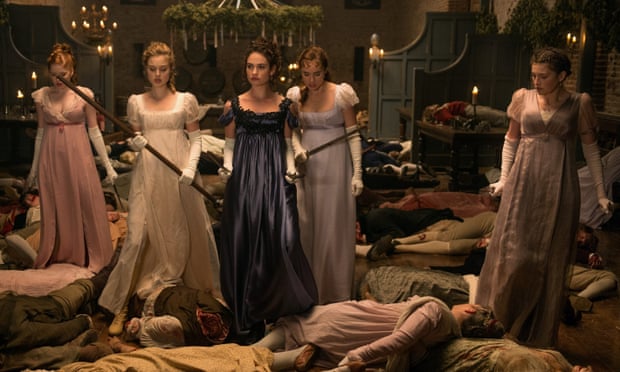
The Bennet sisters have two difficulties in life: the pressure to find suitable husbands and the war against the undead.  The eldest, Elizabeth (Lilly James), a mistress of the blade and the Chinese arts, has no desire to relinquish her warrior skills to any man.   She isn't interested in the newest catch, Mr. Bingley (Douglas Booth), despite his wealth, and she certainly is not interested in his haughty, arrogant friend, Colonel Fitzwilliam Darcy (Sam Riley).  Mr. Bingley is instantly infatuated with her sister Jane (Bella Heathcote), as Jane is with Bingley.  Darcy, for his part, scoffs at all of them...but he does admire Elizabeth's superb fighting skills, which are as entrancing as her dark eyes.

The Bennet sisters have plenty of opportunities to show off their mastery of the Chinese martial arts, which puts them at a disadvantage as the Japanese martial arts are considered more sophisticated by the British.  Darcy is wary of Jane, who appears ill when on route to call on Bingley, suspecting she's been 'infected'.  Elizabeth steadfastly refuses to accept such notions and does her best to keep Darcy's blade and flies away from her.  Jane does recover from her illness, but still Darcy suspects she might be among the undead overtaking the country.

Enter the Bennet's obnoxious, idiot cousin Parson Collins (Matt Smith), the closest male heir to the Bennet's who will inherit their estate upon the death of the Bennet sisters father (Charles Dance).  He first sets his eyes on Jane, but when he's told that she is coming close to an agreement with Bingley, he then sets his eyes on Elizabeth.  She won't have him, especially his insistence on her dropping her weapons.  Things are still unsettled when upon visiting their aunt, the Bennets encounter Lieutenant Wickham (Jack Huston), a dashing officer with a complicated history with Darcy.  At the ball, Darcy overhears Mrs. Bennet (Sally Phillips) boast of Jane's intentions to marry Bingley, which arouses his suspicions she is only after his money.  Little time to worry about that, though, as another zombie attack injures Bingley.
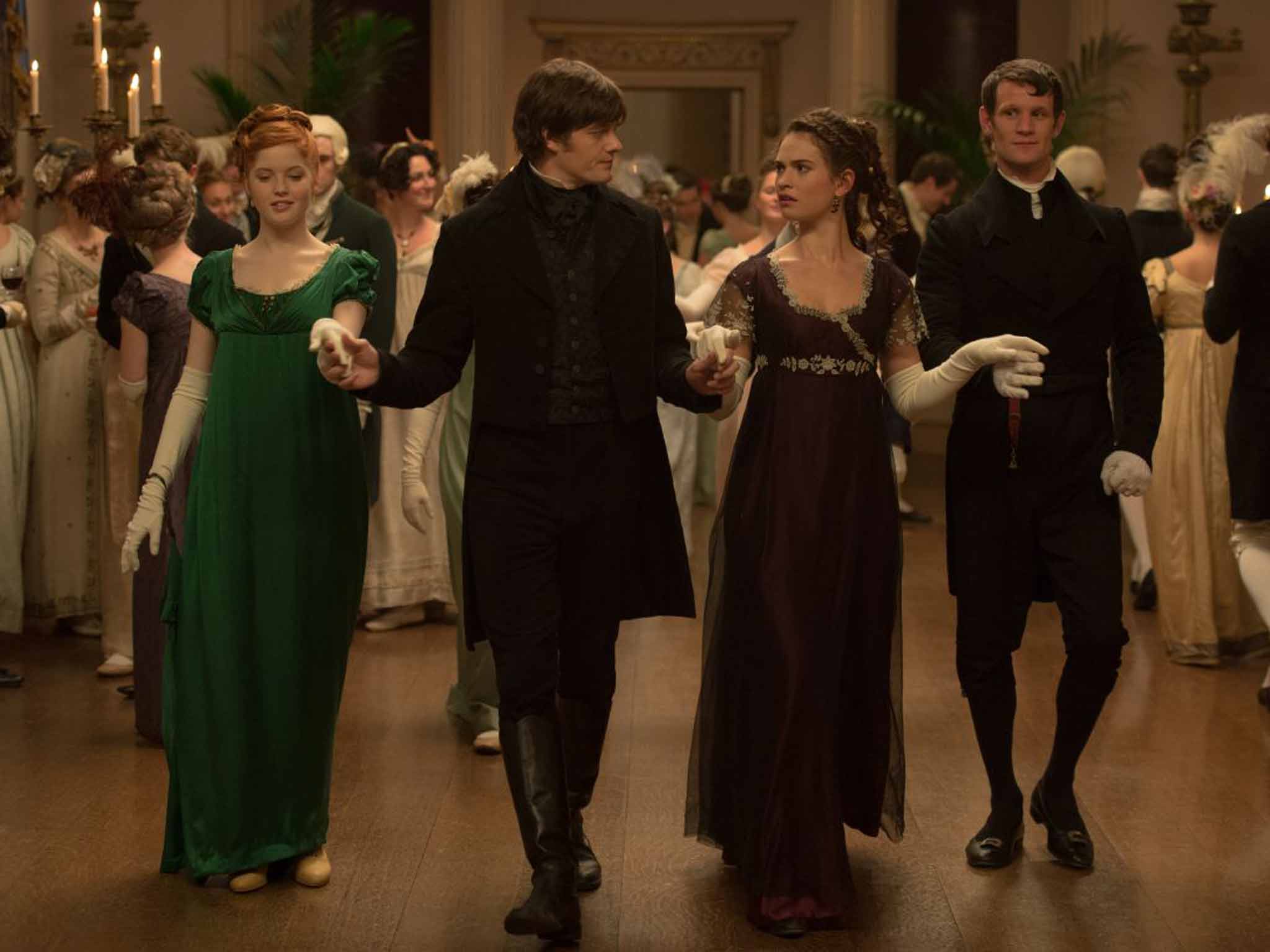
Darcy gets Bingley out of the area, upsetting Jane, who is truly in love with Bingley.  Elizabeth is angered by Darcy's pride and prejudice, and more angered to learn that he has ruined the honorable Wickham.  Making things more complicated is her conflicting feelings for both men, and Wickham's discovery.  He takes her to St. Lazarus, where a group of semi-zombies are living in seclusion.  They are not fully zombies, having substituted pig brains for human ones and keeping a semblance of themselves. 

Wickham persuades Elizabeth to help arrange an audience with Lady Catherine (Lena Headley), a world-class zombie hunter, Collins' neighbor, and Darcy's aunt.  The meeting comes through Collins presenting his newest beloved, to his patroness.  Wickham asks for money to help the zombie/human relations, but Darcy is adamantly opposed.  Later, Darcy shocks Elizabeth by proposing marriage to her, which after a physical altercation, she steadfastly refuses.

When Elizabeth returns home, she receives a letter from Darcy explaining himself: he did attempt to protect Bingley from people he considered fortune hunters but failed to see that Jane was not part of any plan, and told her the truth about Wickham.  Wickham, far from noble, had attempted to run off with Darcy's fifteen-year-old sister to elope (and get his hands on the family fortune).  Lady Catherine attempts to battle Elizabeth through a proxy, but Liz is able to defeat him.  News then reaches them that Wickham has abducted the youngest Bennet sister, but no one knows to where.  Elizabeth deduces it is to St. Lazarus, and Darcy, fighting the zombie hordes that have overrun London and threaten to extend beyond the Royal Canal that separates the living and undead, goes too.  He takes along some real brains, which after the rescue sets the formerly semi-civilized zombies into an orgy of human hunting.

To his shock and horror, Darcy discovers Wickham has been undead all along, but is saved at the last minute by Elizabeth.  Jane and Bingley, waiting at the only standing bridge, struggle to follow orders to blow it up, but in the end, they do...just as Darcy and Elizabeth are racing towards it.  After Darcy recovers at his aunt's estate, Mr. Darcy and Miss Bennet finally confess their love for each other, and Parson Collins has a double wedding: Jane & Bingley, Fitzwilliam and Elizabeth.

As I said, Pride & Prejudice & Zombies wants to have it both ways: be the novel people know and love, and throw in some zombies at them simultaneously.  Perhaps the Seth Grahame-Smith parody is better than the adaptation, but the film doesn't make me want to read it.  In fairness, I'm one of the handful of people who has no interest in the zombie craze (I've no interested in The Walking Dead), but even then, I think the film could not maintain the balance of these two wildly different genres.

We see this every time we get long stretches of what could be a straightforward adaptation of Pride & Prejudice.  At that point, with no zombies stalking about, we can concentrate on what is a good story told pretty well and with pretty good performances.  About the only time the blending of horror and romance mix well is when Darcy and Elizabeth have a literal fight.  The mix of their ever-so-posh putdowns and them going at it with swords and martial arts is pretty lively and oddly entertaining.

This is lent great credibility by the performances.  James would make a fantastic Elizabeth in a straight adaptation, her mix of anger and demands for independence a great watch.  I've been a fan of Riley's since his breakout role in Control, and here it's nice to see him show a slightly lighter side while keeping within action-hero mode.  I thought well of Heathcote as Jane, and it was nice to see Booth at least not embarrass himself like he usually does, where only his beauty counts for anything (case in point, Jupiter Ascending or Romeo & Juliet).  I think Huston could have been a good rival...in a straight version of the story...and to be honest he too did a good job in playing it straight (even if perhaps a little camping it up would have helped).

Curiously, the best performance was from Smith (and I say this as someone who pretty much detested him as the lead in Doctor Who).  His Parson Collins was deliberately fussy, prickly, idiotic, and obnoxious: exactly what the role required.    Yet with Smith we can see where Pride & Prejudice & Zombies was going wrong.  He had nothing to do with zombies and seemed to be in a straight adaptation of the Austen classic.  As such, he showed that the film, perhaps like the book, was not mashing the two ideas well-enough to be either horror or comedy.

The film also has some issues apart from the mish-mash mix-up.  The cinematography sometimes is so dark it becomes difficult to actually see what is going on.  The battle where Bingley is injured is a case in point.  I think he was dragged down the stairs by the zombies, and Darcy in fear asks Elizabeth, who has been fighting them in the kitchen where both are, if he's been infected.  Truth be told it is flat-out impossible to make out anything that is going on. 

The film also stumbles when it wants to build up tension over Jane's potential illness.  Last we see Jane, it looks like she's being attacked by a zombie, and next she is violently ill.  It isn't until much later that we find that she is fully alive and alive, but sometimes the film wants to suggest that perhaps she isn't.  Again, trying to have it both ways.  This whole thing could have been worked out better, rather than leaving things slightly confusing.  It also stumbles with Wickham's reveal (I figured that out long before the film did) and using "St. Lazarus" as the refuge of the undead wasn't particularly clever.  Finally, I did wonder about the semi-zombies, whether the film could have actually have gone in a different direction to have had human/zombie détente.

I will compliment Fernando Velazquez's score, which did what the film as a whole couldn't: keep the balance between romance and horror/comedy/action.   I also enjoyed the fight sequences, that curious mixture of gowns and kick-ass bloodletting.

Again, Pride & Prejudice & Zombies isn't downright horrific.  It isn't particularly clever with its premise, or funny either.  It does make one yearn for what a real, straightforward adaptation with the same cast would have looked like.  THAT I think would have made a far more interesting experience.  When it comes to Pride & Prejudice & Zombies...we could have done with more Pride, more Prejudice, and less zombies.  

1775-1817


DECISION: C- 

Wednesday, April 30, 2014

Austenland: A Review (Review #628)

AUSTENLAND

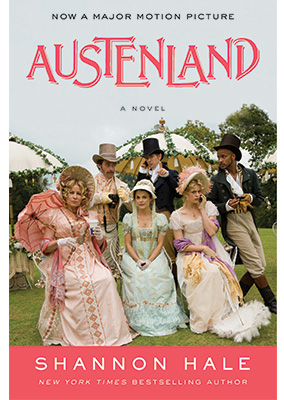
I have never read the Shannon Hale novel on which Austenland is based.  I am not the person to which to judge how close the movie was to the book.  There IS an idea somewhere in the film's story, for a spoofing of the women who mistake Austen's literary figures who are smitten with the idea of Mr. Darcy (and Colin Firth's interpretation) that they soon substitute fantasy for reality.

As a side note, I suspect this is one of the reasons why, despite my best efforts, I am still unmarried.  Women prefer the fantasy of a Mr. Darcy, of an EDWARD CULLEN, of a Christian Grey, over the highly flawed but still living, breathing men around them.

There is also rich source material in turning an author's output into a theme park, a 'Fantasy Island' for the book club set.  Austenland, therefore, has at least a springboard from which to bounce from into being a great romantic comedy.  Unfortunately, it could never figure its way around being either a spoof or a more serious feature, which pushes it down (though not enough to be dreadful).

Jane Hayes (Keri Russell) has had a Pride & Prejudice obsession since high school.  Seeing Colin Firth emerge from the waters in the celebrated television version in particular is the height of eroticism for her.   So obsessed is she that her room is covered with "Darcy" all over, and the cut-out of Firth meets the wrath of one suitor who finds Jane would rather watch P & P (again) than make out with him.   Determined to live out her own Austen romance, she blows her life savings on a stay in Austenland, the vacation resort that takes one back to Regency Britain and lets our ladies (I don't know any men who stayed there) live out their chaste dreams (depending on what package they paid for).

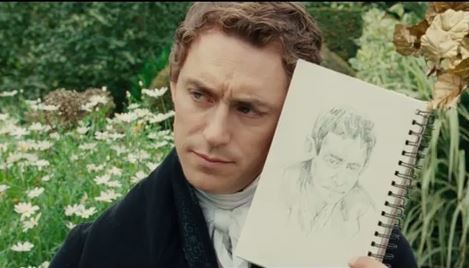
Austenland is run by Mrs. Wattlesbrook (Jane Seymour), who runs the place with an iron hand underneath her velvet glove.  To give one the complete Regency experience, no modern conveniences are allowed.   Plain Jane can only afford the Copper Package, so her Austenite character is Miss Erstwhile, poor orphan relation with no resources.  However, the wealthy "Elizabeth Charming" (Jennifer Coolidge) can afford the Platinum Package, as does Lady Amelia Heartwright (Georgia King), so they get better quarters and more attention from Mrs. Wattlesbrook.  The men at Austenland are all actors: there is the shall we say, flamboyant Colonel Andrews (James Callis) and the aloof Henry Nobly (JJ Feild).  It upsets Jane that Miss Charming knows nothing of Jane Austen's work, though Charming, while boorish, is also genuinely kind to Jane and they soon become friends.

Jane is genuinely unhappy at Austenland until she finds Martin (Academy-Award winner Bret McKenzie*), a groundkeeper who appears to be the only real thing in this bizarre fantasy-world.  She soon starts falling for Martin, but it seems that either she can't fully let go of her Darcy fantasy or Mr. Nobly, in his stiff manner, is starting to fall for her in real life.  Not even the arrival of the hunky Captain East (Ricky Whittle) can shift her too far from Nobly.  Jane is determined to be her own heroine, and while she does take charge of herself she also finds that reality and fantasy can sometimes trick you into thinking one is the other.

In the end, we find that Jane has moved away from her Austen-inspired fantasies but she still finds herself a romantic hero.

Despite its best efforts, Austenland could never find what it wanted to be: spoof or sincere.  The comedy was so forced and obvious sometimes one had to wince at how predictable a lot of it was.  About the only time I actually laughed was when Mrs. Wattlesbrook made the guests and 'actors' perform a theatrical, a silly mythological romance.  Seeing this group of actors deliberately overact was the one bright spot in the film, but it left a lot of questions unanswered.

Why was one particular Austenland staff member so moved by Mrs. Wattlesbrook's latest piece?  Who were all these staff members caught lounging around or making out only to stop as soon as a guest wandered in?  The particular goings-on of the three guests (given that only Jane, Charming, and Heartwright were staying here, I imagine Austenland wasn't particularly popular or successful), my mind started wandering into another movie altogether. 

I would have liked to have seen Austenland, not from Jane's viewpoint, but from the staff's.  What they would have thought of all these genuinely crazy people behaving so strangely as they were unaware that people in Regency-era weren't all that different from people today save for what they could say or do.  We get little glints of that when Nobly, East, Andrews, and even Martin are in the staff pool, but by and large director Jerusha Hess (who co-wrote the script with Hale) appeared to want to make the people in their movie one-dimensional.


I think the performers were at least trying to elevate the material they were given, and I can't fault them for that.  Of particular note is Coolidge, who made her dim-but-kind Charming into someone both idiotic and endearing.  She may have been openly vulgar and clueless, but she was also someone who genuinely cared about Jane and was unaffected by the snobbery she found all over.  I think Russell, while a good actress (see The Americans) was miscast: she seems simply too smart to be a character somewhat divorced from reality.  Judging by Seymour's take on Wattlesbrook, one never knew whether she was either just a bitch or really trying for a completely realistic excursion to a bygone era or even a mixture of both.

Better were the men, who knew their parts and made them convincing.  Whittle was the somewhat dim actor who knew his body was his best feature and Callis the vaguely camp performer.  McKenzie (of whose music I am not a fan of) was convincing as Martin, who appears to genuinely love Jane, and in what can be described as a dual role, Feild was excellent as both Mr. Nobly AND the Mr. Darcy stand-in.

In short, the actors did their best to make the material work, and while their efforts should be commended, there was very little they could do to make Austenland little more than a tolerable albeit weak exercise in froth.

This doesn't do you justice...


DECISION: C+

*McKenzie won the Best Original Song Oscar for the crappiest of The Muppets songs (Man or Muppet), a song that won't be remembered five years from now. 

Tuesday, February 22, 2011

From Prada to Nada: A Review

FROM PRADA TO NADA

Gracias Por Nada...

I start out by saying I've never read Sense & Sensibility or seen any film adaptation of Jane Austen's book. Therefore, I'm in no position to say whether or not From Prada To Nada stayed close to the source material. However, being someone who is of Mexican descent, I think I'm far better able to judge how close or far it comes to capturing the contemporary Mexican-American worldview.

My belief is that it is far easier to play on stereotypical images of Mexicans/Mexican-Americans than to possibly portray us/them as just Americans whose ancestors came from Mexico. It may give From Prada to Nada an ethnic flavor that a more WASP interpretation of Austen's work would have, and while it is good to see Hispanics on the screen perhaps the film itself could have stepped up to be more inclusive of the idea that there is an 'American' aspect to being Mexican-American.

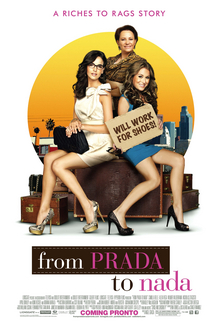
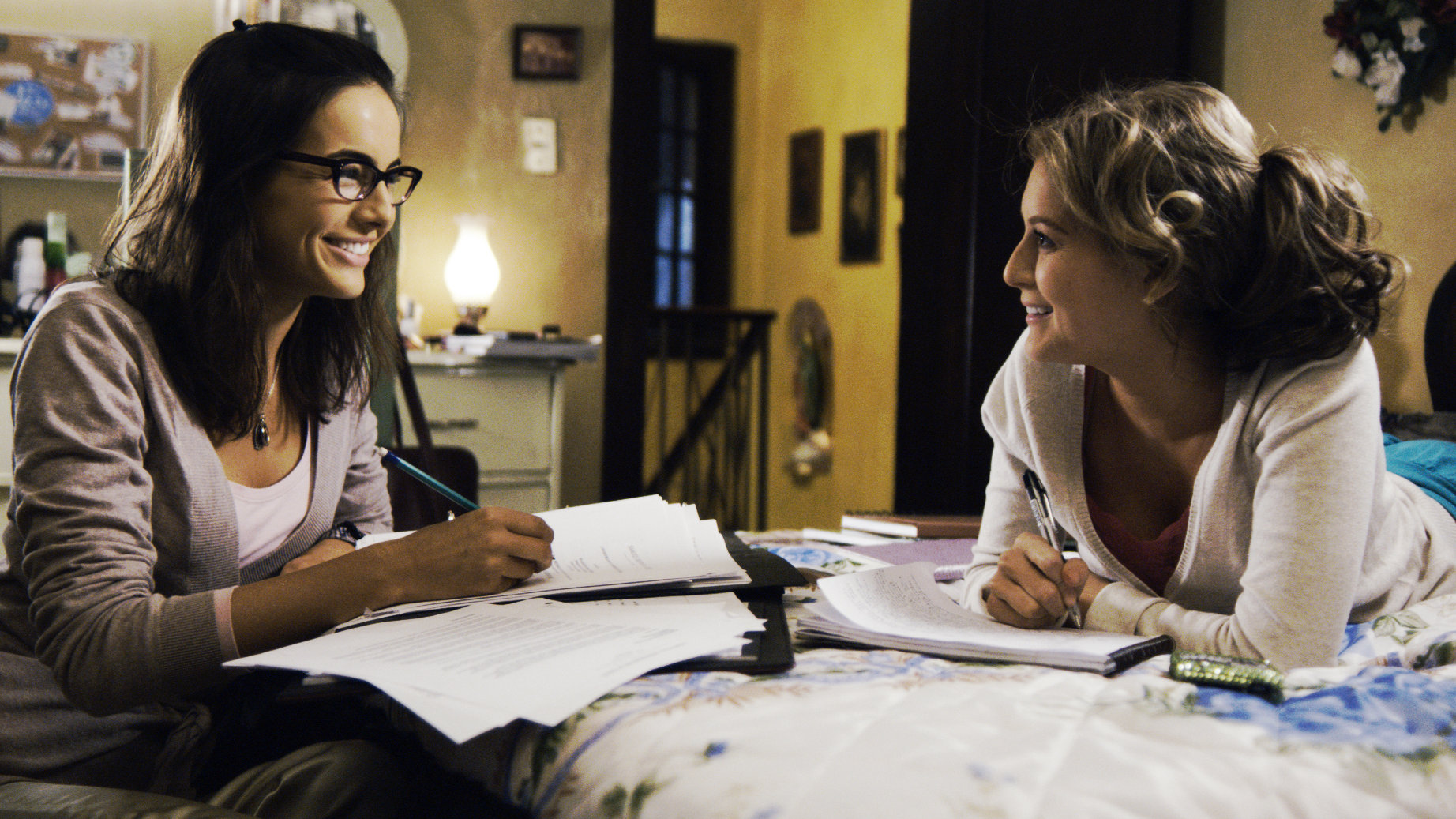
We have two sisters, the Sensible Nora (Camilla Belle) and the Sensibility, although I would argue sensuous, Mary (Alexa Vega) Dominguez. In spite of being Mexican-American, they are remarkably rich. Nora works towards being a lawyer, while Mary is content to merely spend Daddy's money and marry rich. Alas, Daddy dies, leaving them broke and with the added pleasure of discovering at Daddy's funeral that they have an illegitimate half-brother (Pablo Cruz), along with his shrewish wife Olivia (April Bowlby). Because they are poor, they eventually have to leave their home in Beverly Hills, along with the swimming pool and movie stars, and crash at the home of Aunt (or as we would say, Tia) Aurelia (Adrianna Barraza) in that mysterious world known as East L.A.

They arrive to find a totally blue house as in color not depression and the local homeboy, Bruno (Wilder Valderrama). Now, the Dominguez Girls have to adjust to being poor and horror of horrors, ethnic. Nora, still working to doing something productive for society, finds herself in the same law firm where Olivia's nicer brother, Edward (Nicholas D'Agosto) works, while Mary, still in college (though one wonders why, let alone how, she got in and continues to go), falls for the Student Aide, Rodrigo (Kuno Becker, don't let the name fool you; he is Mexican).


One actually doesn't have to have read Sense & Sensibility to know where the story is going or who is going to end up with whom. From Prada to Nada isn't going for originality, not even when taking a novel with a very British worldview and adding a heaping helping of salsa. It is pretty obvious where the story is going (girls learn about true love and ethnic pride), but some things in the actual movie don't make any sense.

From Prada to Nada wants us to know how important family is to the Hispanic community. At one point, when Mary appears reluctant to invite Rodrigo to the family's 16 de Septiembre celebration, her Tia chastises her, pointing out how important family was to their father.

This was the same father who thought family was so important that he also had a bastard, right? This was the same father who apparently thought family was so important that he apparently never bothered to bring his girls to bum with the poorer relations, right? After all, the Dominguez girls seem quite horrified when they see the house apparently for the first time. You can't have it both ways: saying that the theme of family is paramount while at the same time show very little cohesion within the extended Dominguez family.


A more troubling aspect is the fact that writers Fina Torres, Luis Alfaro, and Craig Fernandez (I'm going to guess they are all Hispanic) rely so much on stereotypes to signal the 'contemporary' Mexican-American world. At one point Edward comes calling to Tia Aurelia's home for Nora, and Tia sees a young man in a suit and automatically assumes 'Immigration'. Therefore, all the women working at the sewing machines in the living room quickly rearrange the furniture to watch a soccer match.

As much as I support seeing Hispanics behind the camera, I'm going to take the three writers to task. Old Mexican women, at least the ones I know based on my mother, her sisters, and her friends, would never watch a soccer game or care to. Now, a telenovela (a Spanish-language soap opera)...that's another matter. Heaven Help the Man who dares interrupt a novela for any reason, and I mean ANY.

Another strange moment is when the whole neighborhood comes to Tia Aurelia's home to celebrate Mexican Independence Day (September 16). I wondered if it would have been better to have celebrated Cinco De Mayo (May 5), since this day which commemorates the Mexican victory of the invading French army at the Battle of Puebla has been confiscated by Mexican-Americans in the same way St. Patrick's Day denotes Irish-American pride, and both are excuses for drunkenness regardless of ethnicity. I personally don't know any Mexican-Americans who celebrate 16 de Septiembre, and I especially don't know any who dress up in traditional Mexican garb unless they are part of a show. It might have been to show just how ethnic Mexicans can be, but it all looked a little to cute for its own good.

It just seems that the writers and director Angel Gracia, whom I'm again guessing is Hispanic, weren't at all or perhaps in a limited way interested in showing us a side to Mexican-Americans that didn't rely on excessive devotion to saints or living in the barrio in a garishly painted house. If I had been Mary, I would have said I'm more ashamed to live in a house that would have made Frida Kahlo burst into laughter than in my relations.

Maybe I have the wrong reading on From Prada to Nada: maybe they made this film to appeal only to Hispanics, specifically Mexican-Americans, and if that's the case it did a decent job in pointing out all the oddball quirks of the community: excessively long names, a virtual requirement to know Spanish, having faith healing work its wonders. If you can't laugh at yourself, the film perhaps is saying, then who can you laugh at?


All that I could, albeit reluctantly, give a pass to. It is in some of the performances and plot that I wondered if From Prada to Nada was even trying. Pablo Cruz's Gabriel Dominguez, Jr. is perhaps the worst. In the few short scenes he was in, he rarely did or said anything. In short, he may be the most milquetoast Mexican in the history of film. He was just there, just a plot device to get the girls out of their house and into Kahlolandia. Whatever trauma he may have had about being a bastard is unexplored, as is whatever relationship he may have wanted with his sisters. That is because he appears so bullied by Olivia that he barely says a whisper or at least I don't remember him saying much. Bowlby's Olivia has no real reason to be so hostile to the legitimate branch of the Dominguez family other than it was needed to get the girls out of the house.

Both Vega and Belle did a good job playing the self-absorbed and self-assured Mary & Nora respectively. Both gave good performances where you could see their characters changing to embrace the situations they found themselves in although one wonders how two girls whose Spanish appears so weak could pick it up so fast. Their love interests (D'Agosto, Becker, and Valderrama) also were all right, bringing an almost innocent charm, smooth moves, and gruff likability respectively.

If it weren't for the predictability of the film itself, From Prada to Nada could have been much better. As it stands, it is mildly amusing but perhaps only to those who might get the 'inside jokes'. I hope that Hispanic filmmakers will one day realize that there are outposts of Hispanics that are beyond East Los Angeles, that some Hispanics are actually members of the middle class, and that not every Hispanic is a Catholic. Here's where I'm going to editorialize just a touch:

I don't have tattoos, I was never in a gang or knew anyone who was in a gang, unless you count my brief time in the GOP as gang affiliation, but that's up to you, I do speak Spanish but it is my second language, my first is still English, I don't celebrate Mexican holidays or dress up in colorful costumes, respect Catholics but don't have any saints in my home: Protestants aren't all that big on candles of the Pope, and my home is a nice, one-story brick structure. In short, while I can appreciate the ethnic humor within From Prada to Nada, I can't say it comes from personal experience.

No, From Prada to Nada isn't a bad film. It just isn't original, either in plot or how it tells it. I can't be too harsh with it since from what I saw it wasn't going for a broader market or a broader mindset about Mexican-Americans, so I will give them credit for making an effort.

 Hopefully, we can get to a point where Hispanics aren't portrayed even by other Hispanics as poor, unable to speak or understand much if any English, and/or fearful of immigration or police officials (except in Arizona). It could have been better, but that's the way the enchilada crumbles.