Tuesday, May 29, 2018

Days of Wine and Roses (1962): A Review


DAYS OF WINE AND ROSES

This, I imagine, will be one of the most unpopular reviews I will ever give, because I am going to bash a film hailed as a classic, a searing portrait of an important issue.  Having seen Days of Wine and Roses twice, I still cannot figure out why this film is held in such high regard.  There are good things in it, but I simply am mystified by why I'm suppose to genuflect before it.  I find Days of Wine and Roses a camp film, the alcoholic version of Reefer Madness, only with more polish and a lovely theme.

Joe Clay (Jack Lemmon) is a public relations man who finds his job involves procuring pretty young girls for an Arab prince.  He mistakes Kirsten Arnesen (Lee Remick) for one of our 'good-time girls' when she is really the secretary to Mr. Trayner (Jack Albertson), head of the agency.

Joe is essentially a functioning alcoholic, one for whom drinking is part of the job and who takes a couple every night.  He is hot-and-cold with Kirsten, one moment insinuating she is Trayner's whore, the other asking her to dinner.  Despite slapping him for suggesting her backside is what got her the job, she agrees to have dinner with him.  Unlike Joe, however, Kirsten does not drink.  Joe notes her passion for chocolate, and gets her a Brandy Alexander, which she admits to liking.

A whirlwind courtship leads to a quick marriage, so quick that they spring it on Kirsten's father, Ellis (Charles Bickford), owner of a nursery in northern California.  The Clays soon have a baby, but Debbie is essentially their second child. 

The bottle is their first.

Joe has no problem coming home slushed out of his mind, and despite her own misgivings and the need to keep her breast milk clean, Kirsten soon joins him in boozing it up.  It isn't long before both turn into raving drunks, something that everyone but them seems to notice.  Joe's work starts suffering, and even after getting a smaller account he still keeps hitting the bottle.  As if to do him one better, Kirsten spends all her time drinking and eventually ends up setting their apartment on fire.
Image result for days of wine and roses movie

You'd think that the dual hits of setting your home ablaze and losing your job would be wake-up calls for them, but you haven't counted on how blind, self-absorbed and self-destructive they are.  Joe goes from one bad job to another, their finances a wreck.  It isn't until Joe catches a glimpse of himself in a bar window that he realizes they are both bums, being destroyed by drink.  Kirsten, who has gone from teetotaler to raving lush, refuses to entertain the notion there is anything wrong.

However, both find refuge at Mr. Armesen's nursery, where they dry out and are beginning to repair their lives.  However, dear old Joe decides that they have been so good that 'one little drop' won't hurt them, sneaking in two bottles in his pant legs.  That one little drop turns into a drunken orgy, with Joe going berserk trying to find the third bottle he hid in the greenhouse: fourth pot, third table, fifth row.  Kirsten, again apparently in an effort to top him, storms into her father's room demanding a kiss and shouting about how she does not want to be lonely.

End result: Joe finds himself in an insane asylum, wrapped up in a straight-jacket.  To help him is Jim Hungerford (Jack Klugman), from Alcoholics Anonymous.  Kirsten still won't consider the possibility that she has a problem, while Joe is more willing to go to AA meetings.  While he is working to repair himself, Kirsten is out boozing and carousing, disappearing for days on end.  Eventually, Joe finds her in a hotel room, where despite his efforts at sobriety, he falls off the wagon in a big, big way, ending by attempting to rob a liquor store that just closed.

If I understand the film, the store owner forced Joe to drink some more and once again, Joe finds himself tied to a bed, a near-raving lunatic.  It looks, however, like this time he might finally get himself together.  Following AA principles, he goes to Pop Armesen to pay back his debt.  Mr. Armesen blames Joe for getting his little girl to be a booze-licking slut, and is heartbroken at how far Kirsten's fallen.  Ultimately, Joe finds himself sober, and Kirsten tries to come back, two days sober but still unwilling to admit she has a problem, let alone stop drinking.  Joe makes it clear he'll take her back, but not if alcohol is going to be part of the deal.  As she walks away, he sees her, the neon light of the nearby bar taunting him.
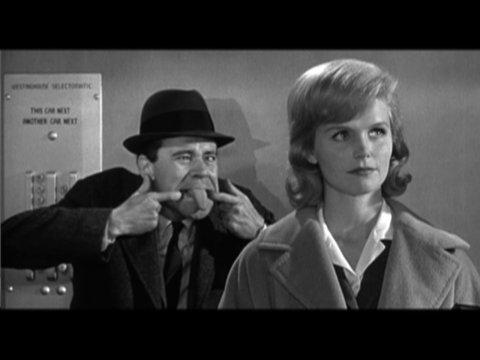
Image result for days of wine and roses movie
I think my problem with Days of Wine and Roses is that the whole thing seems so wildly exaggerated, almost as if it were a spoof. J.P. Miller, adapting his teleplay to the screen, seems to suggest that alcohol can turn a teetotaler into a sex-crazed nut. When both are drinking themselves mad at the nursery, I got the very strange sense that boozing it up would lead Kirsten to want to have sex with her own father!

Her storming of Mr. Armesen's bedroom, where she demands a kiss and screams at her daughter to stay away from her 'daddy' has this almost outlandish suggestion of incest, as if Kirsten's alcoholism causes her to go bonkers and screw anything with a penis. 

Joe's alcoholic frolics aren't any better: twice we see that alcoholism leads to near-insanity.  Remember, he's forced into a straight-jacket at one point and held down by straps in what could be another mental hospital at another. 

I am not suggesting that alcoholism does not cause respectable people, even those who drink socially, to become so out-of-control that they end up attempting robbery and accidentally burning down their home.  I am, however, wondering if alcoholism, as portrayed in Days of Wine and Roses, seems to be a portrait of such extremes that it almost is comical.

Again, I think on Reefer Madness, and how that film's portrayal of marijuana use is now mocked as wildly exaggerated to the point of being hysterically funny: from one puff we slip into sex-crazed murderous insanity.  I'm puzzled by how the same people who ridicule Reefer Madness' take on pot smoking can turn around and say that Days of Wine and Roses, with its tale of unhinged, out-of-control boozing leads to carousing and even a little bit of potential parent-child sexual desire, is a rational portrait of alcohol consumption.
Image result for days of wine and roses movie

I think that while this almost bonkers view of an extreme form of alcoholism is part of my issue with Days of Wine and Roses, I think a bigger part is Jack Lemmon.  As I understand it, this film is meant to showcase Lemmon as a great dramatic actor.  However, I found that Lemmon was more silly in those 'dramatic' moments, such as when he goes berserk looking for that third bottle.

It does not help that Lemmon for much of the early part of Days of Wine and Roses tries to play things for laughs, giving the same anxiety-meets-flummoxed performance he gave in The Apartment.  It's almost as if Days of Wine and Roses were a sort of sequel to The Apartment, with Joe Clay being similar in manner to C.C. 'Bud' Baxter.  Both are 'respectable' middle-class employees with career crisis in their efforts to rise to the top.  As much as Lemmon tried to do drama, and he did try, he also could not escape trying to make things 'funny' and forcing it.

From his insults and mugging at Kirsten to his 'striptease' to show off the booze, Lemmon just struck me as thinking Days of Wine and Roses was a comedy.  I simply could not take him seriously in what is meant to be a portrait of an already-functioning alcoholic slipping further into chaos and dragging his wife down with him.

I however, found Remick to have been much better.  Apart from when she appears to want to rape her father, Remick's performance was strong.  The haunted portrayal of this former non-drinker slipping into the grips of full-on alcoholic hysteria is a sad one, a bit frightening.  Whenever she is on screen, from the denials of her problem to her desperate pleas 'as a woman' to her brittleness and fears of a sober life, Remick rarely hits a wrong note.

I would argue the script fails her in her constant denials of a problem, though mercifully we never got that 'I don't have a problem! YOU have a problem!' speech.

Bickford, the only one recreating his role from the original teleplay, has a small role but a good performance as the father who loves his daughter but can't stop her from self-destruction.

Blake Edwards sometimes has fine visual moments and is unsparing in how he shows the results of unchecked drinking, but he still seems to have too many comic moments intrude.  I still wonder whether scenes that lengthen the film, such as the 'roach kingdom' date and Joe's office meetings, could not have been cut to shorten a rather long film.

If there is anything good in Days of Wine and Roses, it's the theme song, one that mixes romance with melancholy.  It's not a surprise that Days of Wine and Roses is good: music by Henry Mancini, lyrics by Johnny Mercer.  The team that the year before gave the world Moon River wasn't about to botch up the job this time round, and despite my dislike for Days of Wine and Roses, I cannot argue against the loveliness of its theme song.

I feel a touch guilty in disliking Days of Wine and Roses, finding it all bordering on comical.  Alcoholism is an important subject, and anything that brings attention to this illness should be commended.  However, no matter how hard I tried to think well of it, I cannot shake the idea that the whole thing seems so exaggerated a portrait of alcoholism.

Finally, as a side note, I cannot understand why so many great singers from Frank Sinatra to Ella Fitzgerald insist on making Days of Wine and Roses an upbeat, jolly number. To me, it's the equivalent of singing Make 'Em Laugh like a dirge. Given its somber subject and wistful, melancholic quality, I think it should be a slower, sadder number.

Apart from the song, I still cannot bring myself to hail Days of Wine and Roses as a great film.  May be blasphemy, but I can't drink to it.


DECISION: D+

Sunday, May 27, 2018

Throne of Blood: A Review


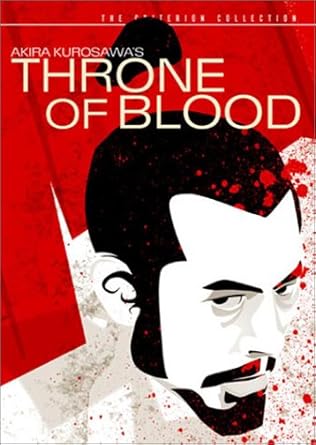
Image result for throne of bloodTHRONE OF BLOOD

Shakespeare works in all languages and all settings.  That is part of his genius.  Akira Kurosawa took the plot of Macbeth, transporting it to feudal Japan in Throne of Blood (original title Spider's Web Castle).  With a powerful performance by its lead, Throne of Blood may be the best cinematic Macbeth of all time.

General Washizu (Toshiro Mifune) and his compatriot Miki (Minoru Chiaki) are returning from having put down an uprising against the Great Lord.  As they go through the Spider Web Forest, they come upon a spirit who makes predictions to them: that Washizu shall become the new Great Lord and ruler of the Spider's Web Castle, and that Miki's son shall inherit the throne after Washizu.

Both men, loyal to the Great Lord, laugh this off as hallucinations.  However, when the Great Lord grants them the titles and honors the spirit predicted they would receive, both men now begin to wonder.

Washizu's ambitious wife Asaji (Isuzu Yamada) pushes her husband to kill the Great Lord and usurp the throne, but he wavers, especially given he has no heir.  He has already agreed to make Miki's son his heir until Asaji tells her she is pregnant.  Now Washizu finds himself in a quandary.

He kills the Great Lord and takes Spider's Web Castle, then has Miki killed, feigning to invite him and his son to a feast to celebrate their successions.  Miki's son, however, escaped the assassination attempt, and now the Great Lord's son and others have joined in a rebellion.

Lady Asaji has a stillborn child, and is now insane, attempting to wash the imaginary blood off her hands.   Washizu is not afraid, however, since Spider's Web Castle has never been taken.  Moreover, in his hysteria he has returned to the Spider Web Forest, seeking out the spirit.  The spirit tells him that he will not be defeated until the trees rise up against him.  Deciding no such thing will ever occur, he is confident of victory.

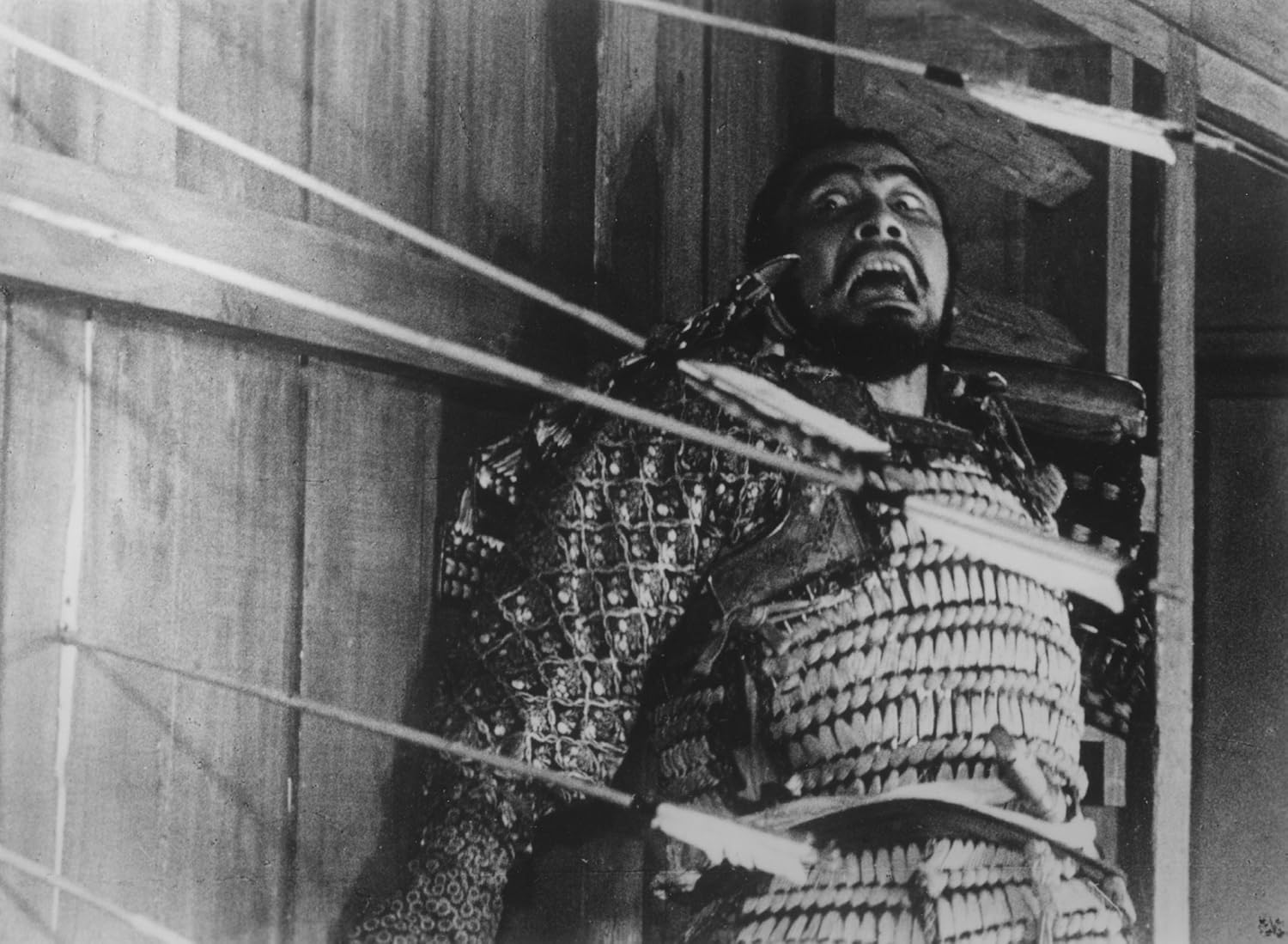
He shares this prophesy with his troops, who cheer on their leader.  The next day, however, they begin to flee in terror, for they see the forest move against the castle.  Washizu himself is stunned to see the forest appear to advance towards the castle.  Chastising his troops, they at first are silent until an arrow flies at him from within the ranks.  In turns enraged and terrified, Washizu attempts to avoid a barrage of arrows, with some managing to hit him.

Finally felled, he falls, and Throne of Blood ends as it began: a mournful male choir singing of the folly of man.

Image result for throne of bloodThere are several elements that make Throne of Blood a rich, vibrant piece of art.  One of them is the performances, particularly by Mifune.  His Macbeth-Washizu is like an almost unhinged wild animal, fierce and dangerous.  Whether he is raging or responding to his monstrous downfall, Mifune is a force of nature.  The intensity of his performance makes Washizu into a compelling figure, frightening in its ferocity.

You see in Mifune's face so much: tension, fear, shock, regret, devastation, arrogance, sometimes in the same scene.  This is not a surprise given that Kurosawa crafted Throne of Blood to be close to the Japanese Noh theater style of acting, one where the face or masks in Noh are meant to express much.

I can see why some people might find some of the acting perhaps exaggerated, but Kurosawa meant it to be a bit theatrical.  To his credit, Mifune never came across as over-the-top and kept a strong balance between the traditions of Noh and a film acting manner.

Kurosawa also brought a strong performance from Yamada as the Lady Macbeth-like Asaji. She is closer to Noh in that she is mostly very still and slow, but in her calm demeanor she displays the cold and calculating nature of this wicked lady.

Another aspect that makes Throne of Blood a masterwork is in Asakazu Nakai's breathtaking cinematography.  The Spider's Web Forest is extremely eerie, and the perpetual sense of gloom and foreboding is enhanced with the scenes set in fog and mist.  In a curious way, they echo the Scottish Highlands that Macbeth is set in.

If one studies Kurosawa's camera movements, you see an economic way to build suspense and surprise.  For example, in the dinner scene the camera moves towards Washizu as he looks upon the empty mats where the doomed Miki and his son were to be at, then the camera moves back and we are all astonished to find the ghost of Miki sitting there.

Image result for throne of blood
If there is a highlight of Throne of Blood, it is in the final scene of Washizu's execution by his troops.  The barrage of arrows coming at him intensifies, with Mifune as a wild animal clawing desperately to escape his fate.  The madness and fury of this, down to the final arrow that fells him, so shocks that it becomes a brutal but fascinating thing to see.

Now, at this point, I think I may be reading too much into Throne of Blood or any symbolism it might have, but I think the film might be a critique of the rise and fall of dictators, perhaps with subtle commentary on Japan's wartime actions.  I thought this when I saw Washizu's speech rallying his troops before the final battle.

We see the great leader, drunk with power and arrogance, standing alone on his balcony, looking down over the faceless troops.  He makes bold predictions, but when his predictions backfire on him, he faces his troops as an emperor without clothes, and is forced out in violence.

I could not help think of people like Mussolini or Hitler or even Tojo, men who led their people into needless wars and in the end were brought down.  In Mussolini's case, strung up by those who a few years earlier shouted 'Duce! Duce!', and in all their cases, came to violent ends.

Again, this might be just me reading too much into things, but that too is part of Kurosawa's genius: to allow for such interpretations.

With breathtaking cinematography, a fast-moving story, and powerful performances particularly by Toshiro Mifune, Throne of Blood is a triumph.  It is my favorite Macbeth interpretation so far, and I doubt it will be equaled, let alone surpassed.

DECISION: A+ 

Sunday, May 20, 2018

Chappaquiddick: A Review

CHAPPAQUIDDICK

Scandal is not unknown to the fabled Kennedy political family, but of all those controversies that engulfed the family in their long public life, the one that occurred in 1969 on Chappaquiddick Island is the only one that resulted in someone's death.  Chappaquiddick, made nearly forty years after the fact, is a tragedy of conscience for all involved.

Edward 'Ted' Kennedy (Jason Clarke) is permanently in the shadow of his dead brothers Joe Jr., Jack and Bobby Kennedy.  As America watches the Moon landing, inspired by his late brother former President John F. Kennedy, he is on Chappaquiddick Island with 'the Boiler Room Girls', secretaries that worked for his late brother Robert F. Kennedy's 1968 Presidential campaign.

One of those Girls, Mary Jo Kopechne (Kate Mara) is debating whether to go and return to politics working for Ted, despite her disillusionment with the system after RFK's assassination. Ted, who knows his way around women, seems to be on the verge of talking her into things when they leave, ostensibly back to mainland.

That's when the accident happens: the Senator drives off a small bridge, the car lands upside down in the water, and Ted manages to get out.  After that, however, things are very murky and very ugly.

Ted manages to get back to the house-party, where he sadly tells his cousin/lawyer Joseph Gargan (Ed Helms), "I'll never be President".  Gargan and their mutual friend, State Attorney Paul Markham (Jim Gaffigan), attempt to rescue the doomed Kopechne, but they could not reach her.  They beg Ted to report the accident, and he says he will, but once he gets back to the mainland he goes to call his father, then bathes, sleeps and eventually starts to have breakfast with people he knows.

Meanwhile, Gargan and Markham can hear the roar of the police, who have already been notified by others about the accident.  In turns enraged and fearful about the growing crisis, they push Ted to finally report what people already know.  The local sheriff seems very accommodating, and things appear to be going well.  However, Ted cannot get out of his way, making things worse by his confusing and contradictory statements.

In comes his stroke-afflicted father, Joseph P. Kennedy (Bruce Dern), who is clearly displeased by his only surviving son's bungling.  Enter longtime Kennedy staffers, who will work to extricate Ted from the chaos of his own creation.  They themselves make ghastly mistakes, such as telling 'sympathetic' reporters that Ted has a concussion and is being treated with sedatives, unaware that such a thing would actually kill a patient.  Defense Secretary Robert McNamara (Clancy Brown) at one point snaps at all of them that the Bay of Pigs was better organized.

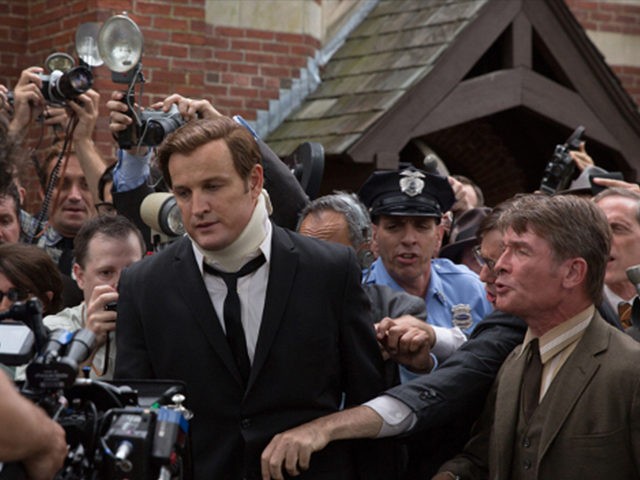
At Mary Jo's funeral, Ted gets it into his head that wearing an unnecessary neck brace will bring him sympathy, but it soon is clear it's all a rouse.  Despite this, the Kopechne family still holds no overt grudge and the other Boiler Girls remain loyal. 

Gargan looks on all this with growing disgust, seeing that Mary Jo is being forgotten in an effort to save Ted and his probable 1972 Presidential run.  He tells Ted, who has been like a brother to him, that he will not be part of any of this, but Ted tells him that when he finally releases a televised statement, he will resign his Senate seat.

When we get to the actual statement, however, Ted opts not to read the resignation Gargan wrote for him, but the more polished speech by longtime Kennedy loyalist Ted Sorenson (Taylor Nichols).  We see that Kennedy kept his Senate seat, though he never became President.


Image result for chappaquiddick movie
Chappaquiddick was probably softer on Ted Kennedy in that it shows him as weak and almost childlike in his attitude and yearning for his father's approval.  It does not shirk from showing Kennedy in an almost pathetic light: his statement about how now he'll never be President sounds as if he's resigned to this fact and sorry for himself rather than in the fact a woman is suffocating slowly, terror of her predicament engulfing her as the waters rise.

Perhaps the most overtly symbolic signaling of what kind of man Ted Kennedy was is when Gargan goes to speak to him while Kennedy is on the beach.  Ted is there, blissfully lost in his kite-flying, the problems of the world floating far above him while on the ground and in the water, destruction and death are all around.  Ted, lost in his happiness, seems content to let others fix his problems.  This is not a glowing portrait of The Lion of the Senate, but of a weak man.

Chappaquiddick is less about the actual accident and more about the cost of loyalty and power, and how far people are willing to go for those things.  There are many sad and chilling moments, particularly when we see the dying and terrified Kopechne in the car, praying the Hail Mary with its call for the Mother of God to pray for sinners 'now and at the hour of our death'. 

For me though, the coldest scene is right after Gargan tells the others at the house-party about the accident and Mary Jo's death.  They first start to cry, then one of them collects herself and asks, "What can we do to help the Senator?", as if she is aware that Ted Kennedy caused Mary Jo's death but that despite that, it was he and not Mary Joe who was the one needing saving.

Clarke as Kennedy is a little hit-and-miss with the distinct Massachusetts accent, but he does a wonderful job portraying the at times insecure, at times shockingly dim and insensitive man-child.  Clarke shows a man who is perpetually pushed by others, down to his frail father.  He has one scene with Dern which shows how Ted really was not cut up for the job fate and family foisted on him. 
Image result for chappaquiddick movie
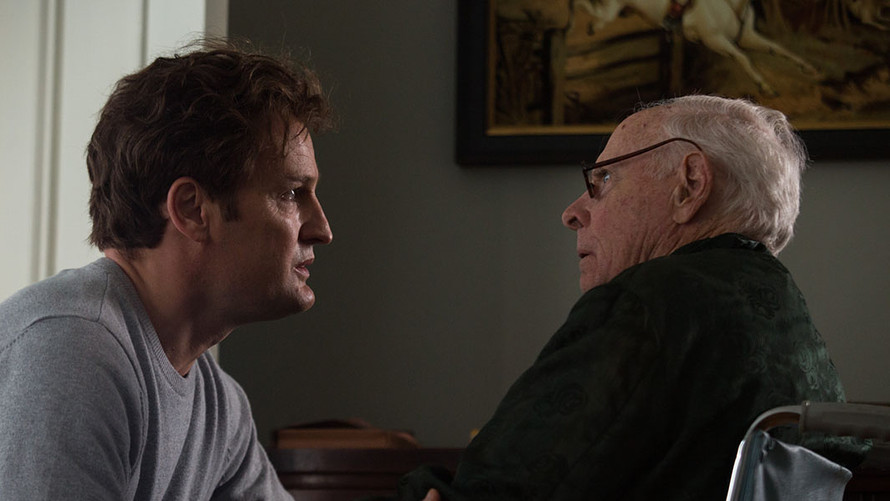
Coming as close to standing up to his father as we will see, he tells Joe, Sr. that his brothers were great not because of their father, but because of themselves.  Joe, Sr., pulls him close and fights through his stroke to deliver his verdict on his last son: "You. Will. Never. Be. Great.".

What really surprises and sells Chappaquiddick is Helms as Gargan, the closest thing there is to a moral conscience in this world.  One wouldn't think Helms, who is mostly known for comedy (good and bad) would have it in him to play a complex and tragic, almost Shakespearean character, a man loyal to his family and their cause but also appalled by how a dead woman is getting swept away to save someone who is pathetic and even reprehensible.

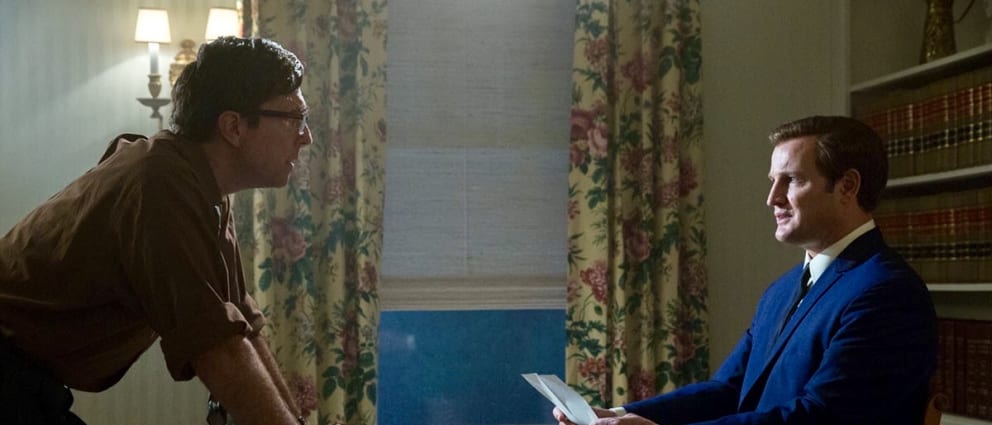
Helms' best scene is when he gives his cousin the resignation speech that he finds Kennedy won't deliver.  As Kennedy bizarrely compares himself to Moses and Peter, pointing out that Moses had a temper and Peter betrayed Christ, Gargan snaps back that Moses didn't leave a girl to drown in the Red Sea.  He is pushed into holding the cue cards for the 'sincere' moment of Kennedy's statement, where he rather than resign asks the voters to let him know what to do.

Here, we see that Gargan has been pushed to go along with something he finds repulsive, but who is also part of a machine that is more interested in saving face than saving lives.

Though in a smaller role, we get a similarly surprising turn from Gaffigan, who is best known for his dry, wry observations on family life.  Chappaquiddick shows that there is untapped potential in Gaffigan for more serious, dramatic work.

Chappaquiddick, in Taylor Allen and Andrew Logan's screenplay, concentrates on both the case and media manipulation and the privileges of power.  We see this when the Kennedy grandees hold court in their smoke-filled rooms, berating Ted's staff for 'bungling' efforts to put a positive spin on things and working out plans to save Ted's political career.  To them, the dead girl is unimportant. I'm not sure the courtiers Sorenson, McNamara, or Ted's brother-in-law Sargent Shriver ever mentioned Mary Jo's name.  To them, the only thing that was important was that this did not damage Ted's presumptive 1972 Presidential run.

Image result for chappaquiddick movieWe even get some humor, as when the Kennedy Courtiers decide on Ted's medical condition, while the poor doctor they've summoned states, partially in shock and partially in puzzlement, "I haven't even examined the patient". Their arrogance is not diminished even after the journalist on the phone tells them the mix of concussion and sedatives would kill the patient.

"Didn't you consult a physician?", he asks incredulously, to which they respond with a dismissive 'Of Course!', unaware of how foolish they all sound.

Director John Curran perhaps could have focused on Gargan's story, making him the eyes to this tawdry world.  However, he also had some wonderful visual moments, particularly in the end when we read the text that tell us of Ted's failed run in 1980 for the Democratic nomination.  We see this as we linger away from the bridge and overturned car, reminding us that Kennedy's long career came at a shocking price.

One leaves Chappaquiddick in sad silence, shocked by the whole sordid affair.  The audience with which I attended the screening sat in their seats for several minutes into the credits, perhaps like myself, needing some time to process the devastating turn of events that left a girl dead and worse, through archive footage, barely any real objection from the constituents. 

The film is not perfect.  You never hear from Ted's long-suffering wife Joan or his equally long-suffering mother Rose.  Truth be told, Chappaquiddick has few female roles, apart from Mary Jo and the Boiler Room Girls loyal to the death.  However, with some strong performances from Clarke, Helms and Gaffigan, and a still-impactful story, Chappaquiddick is a tale that should be told and better-known, and not so much on sordid gossip or the faux-notion of a 'Kennedy curse' (which Ted skillfully or cynically uses to his own benefit). 

Rather, it is a good film on the power of media manipulation, the corruption of power and how sometimes how people are willing to sacrifice honor and even lives so that 'the cause endures, the hope goes on and the dream shall never die'.

The Dream shall never die.  Mary Jo Kopechne on the other hand...

In 2016, future President Donald Trump proclaimed loudly that he could shoot somebody in the middle of Fifth Avenue and not lose any votes.  That hopefully will never be tested out.  However, it appears that in 1969, Senator Edward 'Ted' Kennedy could leave a girl to suffocate, slowly, in terror underwater, and not lose any votes.

1932-2009


1940-1969

Tuesday, May 15, 2018

God's Not Dead: A Light in Darkness Review


GOD'S NOT DEAD: A LIGHT IN DARKNESS

For better or worse, the God's Not Dead series has on the whole been thoroughly trashed in review circles.  Some of the bashing the first God's Not Dead and God's Not Dead 2 received is more than valid (I myself, as a wavering evangelical, was appalled at the clumsiness of God's Not Dead 2).  Now we have God's Not Dead: A Light in Darkness. 

To say that A Light in Darkness is better than God's Not Dead 2 is damning with faint praise.  It was not as horrible as I was lead to think, but the fact that it could have done more with its ideas makes it a bit of a wasted opportunity.

Pastor Dave Hill (David A.R. White), previously arrested for refusing to submit his sermons to the City Council, is released.  In the impromptu press conference outside, he refers to Jesus Christ as 'the One Truth'.  This triggers a group of Millennials who object to there being anything close to 'one truth' as exclusionary.

They are also not thrilled at having St. James Church within the campus of Hadleigh College. It appears that the church predates the college, with the school built around it and there being no issue about it for almost a century and a half.  Now, however, the presence of St. James is seen as school endorsement of one religion, Christianity, over the others, and the students want the building torn down.

Pastor Dave, understandably, does not.  The hostility it brings out eventually has someone hurl a brick at the church, and in a freak accident because of that, dear Pastor Jude (Benjamin Onyango), our cheerful Nigerian pastor is killed.

Now we have a case not just of vandalism, but murder.  Our killer is Adam (Mike C. Manning), an atheist who is also dating Keaton (Samantha Boscarino), who is a wavering Christian.  She goes for advise to Josh Wheaton (Shane Harper), whom you may remember from the first film and who was absent in the second.  Wheaton is now a youth minister for a school group and a friend to Pastor Dave, who is simply not having a good time.

Image result for god's not dead a light in darknessIn an effort to save his church, Pastor Dave drives up to Chicago to look up his hereto unknown brother Pierce (John Corbett), who happens to be a lawyer.  At the most, Pierce is an agnostic who is on the whole uninterested in their father's church in all its forms.  However, he does agree to help where he can legally.

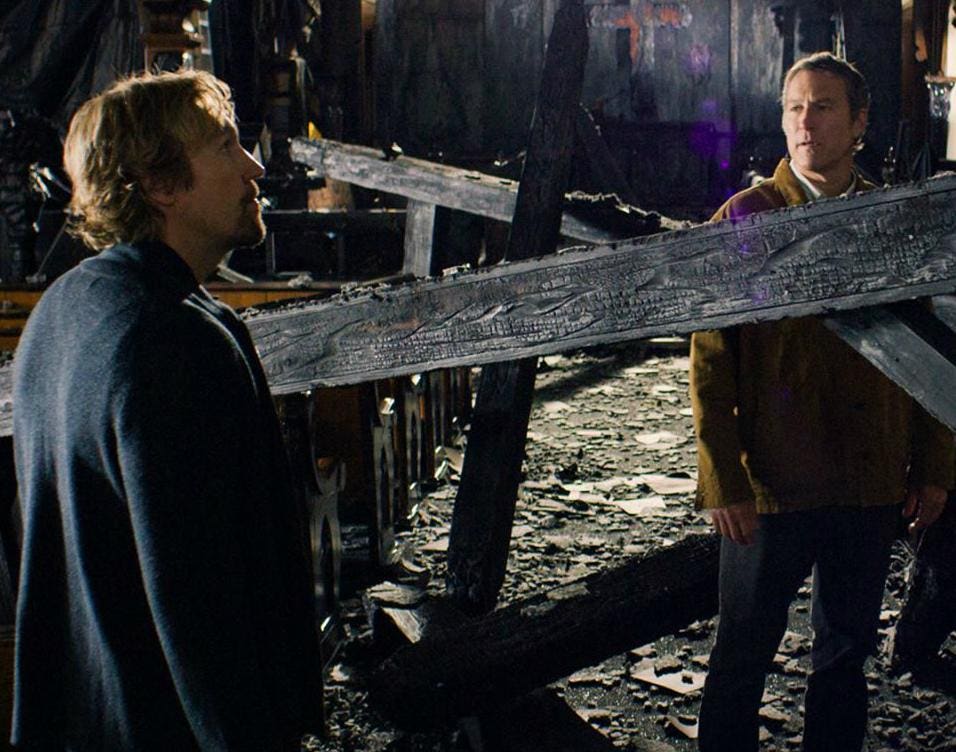
Meanwhile, Pastor Dave's frenemy, Chancellor Thomas Ellsworth (Ted McGinley) is being pressured to put the squeeze on the church, already in ruins thanks to the fire Adam accidentally caused.  It isn't long before the conflict gets Ellsworth beyond the emotional struggle to go after his former friend: a brick is hurled through Ellsworth's window.

As the fights go on, Pastor Dave gets a text revealing Adam's involvement.  Dave angrily confronts him, and while Adam is arrested Dave looks like a bully, which does not help matters.  After a lot of soul-searching Dave gives up: he agrees to let St. James go with the promise that Josh's youth group gets a room in the student building that will take its place, and also drops the charges against a repentant Adam.

He begins work on a new church: St. Jude.

Again, A Light in Darkness is not terrible, at least not in the way God's Not Dead 2 was.  However, by now the series should reach its conclusion seeing as how the film can't work any real enthusiasm for whatever it wants to say.  If you look at A Light in the Darkness, you see that to the film's credit, writer/director Michael Mason at least showed some restraint in how non-Christians were portrayed. 

Adam, far from being a hateful anti-religion being, was, if memory serves correct, more a wounded soul looking for hope but not finding any in what he perceives as a hostile faith.  Pierce too is shown as someone who left his faith because he could not find answers to his questions and who harbors resentment, not at God or Christ, but at his family, a scenario that is surprisingly realistic.

We even get the sense that Josh Wheaton, who went from main character to supporting in this franchise, might even be more inclined to a more liberal, activist form of Christianity than Pastor Dave.  Josh points out that Christ was remarkably progressive for His time on social issues such as women's and disabled rights than His contemporaries.

Image result for god's not dead a light in darkness
A Light in the Darkness also shows that Christians, or at those that side with them, can be just as cruel as those who oppose them.  We never found out who threw the brick at Chancellor Ellsworth's window, though it's clear this was motivated by animus towards the man who would drive St. James out of Hadleigh.

Then again, what should have been the main plot point of Dave's refusal to submit his sermons for review just disappeared and was never mentioned again.

That isn't the only thing that just floated in and out.  The fact that St. James was inside a college campus was hereto unknown until now.  The fact that Dave had an agnostic brother was also hereto unknown until now.  What exactly Josh did during the events of God's Not Dead 2 is still unknown.  Suggestions that our WASP Dave was too much of a whiner towards as he calls himself, 'a black preacher in the Deep South' is mentioned but then left off.

Pastor Dave's semi-romance with soup kitchen proprietress Meg (Jennifer Taylor) came and went, and I would like to point out that Christians do kiss when they find the other romantically or sexually attractive. Keaton's faith struggles were from an unknown source and I'm not sure were ever really resolved.

As a side note, 'Keaton' was a bad name, given how often it sounded like 'Kitten' to where I wondered if it was a very bizarre nickname.

I've known of White for many years given how long he's made Christian-based films.  He is a rare thing: a Christian who can actually act, but here, his performance is so weak and bland.  It's as if White and Mason pulled back on the notion that this highly troubled man could really break out into flawed human emotions, whether they be anger at Adam for accidentally killing his friend or sexual desire when he works with Meg or real resentment at having to care for his parents when Pierce left.

Much better is Harper as Wheaton, who rolls through the film like he's an actual person.  Josh is allowed intelligence and even slightly opposing views on matters.  Even McGinley, nowhere near one of America's great actors, showed the conflict with his friend.

Corbett made Pierce into someone you could relate to: flawed, cynical, sarcastic, a bit angry but also one with a wicked sense of humor and a more realistic understanding of the world.  He keeps encouraging his little brother to pursue Meg, something the more reluctant Dave won't.

As for Manning and Boscarino, they pretty much fend for themselves.

The big surprise is Tatum O'Neal's role, though her character appears so briefly one wonders why she was there.  Actually, at the end of the credits we find that Michael Tait from The Newsboys pops out, though why I have no idea.

God's Not Dead: A Light in Darkness could have been better if it had focused on Adam or Pierce or even Josh again.  Dave is not as strong of a character to lead the film.  It was a good try, but it all could have been so much better.

DECISION: C-

Monday, May 14, 2018

The Snowman: A Review (Review #1050)

THE SNOWMAN

For all the vaunted notions of socialist paradises that the Scandinavian countries are feted for, there must be also in the Nordic soul a sense of pervasive dourness, of eternal gloom and perverse misery and hollowness.  It's not a surprise given that Nordic mythology had their gods and goddesses die in epic battle, a fatalism that has never their Viking ancestors. 

I sense this from their crime literature, from Swedish writer Stieg Larsson's Millennium series to that of his Norwegian counterpart Jo Nesbo. These books and film adaptations drown in misery, in perverse sex crimes, in morose detectives and generally unhappy people.  I don't know why that is so, but it's something I've observed, making me wonder what it is about Scandinavians that makes them such miserable folk. 

The Snowman is Nesbo's seventh novel of a series but curiously the first to be made into a film.  I cannot say how close or far the film stays/veers from the original, or whether it was a good idea to adapt this particular novel into a hoped-for franchise.

I can say that The Snowman adaptation we were given is at times an unintended comedy, with the fact that so many highly talented people ended up creating something so wonderfully weird making things all the more baffling.

A young man is hidden away with his mother in a remote Norway, both caught by surprise by the arrive of 'Uncle Jonas'.  Uncle Jonas quizzes the young boy on Norwegian history, and every time he gets an answer wrong he smacks the boy's mother.  Quickly the boy finds out that 'Uncle Jonas' is really his daddy, and that his mother will reveal all to his family.  For reasons unknown Uncle Jonas abandons them there, and for reasons unknown Mother & Boy either give chase or run away, and for reasons unknown Mother slides into thin ice, where Boy barely manages to escape as she drowns.

Move a few decades later, where we come upon our highly troubled lead character with the most unfortunate name of 'Harry Hole' (Michael Fassbender).* He's a drunk and heavy smoker prone to sleeping in the streets and nooks of Oslo but who despite all this looks extremely fit with firm abs and a taut body.  I guess alcoholism, cigarettes and no protection against the winter does not affect your physical beauty.

Anyway, Harry Hole is a brilliant but troubled detective, struggling with his personal relationships with his ex Rakel (Charlotte Gainsbourg) and her child Oleg (Michael Yates), who for reasons unknown cannot be told is Harry's biological child.  She's moved on with Mathias (Jonas Karlsson), a doctor.  Hole isn't highly regarded but for reasons unknown he's considered among the best detectives on the Oslo Police Force. 

A new officer, Katrina Bratt (Rebecca Ferguson) finds him and informally recruits him to help in a missing person's case.  Using the newest technology Katrina and Harry look for a missing woman, who may be tied to a series of other missing women: all in troubled marriages with children, all of a certain age, all of whom may have seen a particular doctor.

Image result for the snowman movieThere is also one other thing: a 'creepy' snowman is at the site of all the women's disappearances.  Things come to a head when they are called about another missing woman, Sylvia Ottersen, only to find that she is very much alive and well.  Oddly, as they leave her they are called again to find that 'Sylvia Ottersen' is reported missing.  They return to find Ana Pedersen (Chloe Sevigny), her twin.

Sylvia's head on top of a snowman is found shortly afterwards.

Katrina suspects that these killings are tied to Arne Stop (J.K. Simmons), a billionaire working to get a "Winter World Cup Games" to Oslo.  Stop is creepy, and as time goes by we find that Katrina is tied to this case more than she lets on.  She is the daughter of Rafto (Val Kilmer), who we see in flashbacks that are nine years earlier investigating a similar crime.  His investigation ended when he apparently killed himself in a drunken stupor.

Well, we get more red herrings, one of our leads is killed off because she appears to be totally dimwitted and our killer is revealed.

We end The Snowman with Harry, now missing a finger after his confrontation with the killer who threatened Oleg and Rakel (though curiously, not Mathias), agreeing to look in on another case. No explication is given as to how Harry Hole never lost a finger to the frostbite he should have endured by sleeping outside in the cold Norwegian night.

Image result for the snowman movie
I simply do not know what it is about filmmakers today who decide not to establish a franchise by making their debut film stand on its own.  The Snowman violates one of my Golden Rules of Filmmaking: Never End Your Movie By Suggesting There Will Be a Sequel.  I know that The Snowman is based on an already-established series, but given how badly they bungled this maiden voyage, what made them think anyone would want to sit through more?

Director Tomas Alfredson made an absolute mess, primarily due to his decision to not allow anyone any actual emotions.  Poor Harry Hole (again, a name that lends itself to total mockery with everyone in the film apparently oblivious to how it sounds).  I know that Alfredson and Fassbender wanted to make Harry Hole into this troubled being, but as played by Fassbender Harry has no emotion even in things that do require some, like when dealing with Oleg.

You know how The Snowman wants us to think of Harry when you see that it takes twelve minutes into the film before Harry actually says something.  Up to that point, removing the prologue, Harry just stares about in misery and stumbles through the streets of Oslo, apparently none the worse for ware.  Alfredson even gives us an Obligatory Shirtless Scene were despite being a lush who hasn't slept well in days or weeks still looks breathtakingly beautiful.

We even get a hint of a crotch shot to marvel at the magnificence of Michael Fassbender.

Image result for the snowman movieWorse, the adaptation by Peter Straughan, Hossein Amini and Soren Sveistrup makes a lot of the characters dumb.  For being such a brilliant detective (and to be fair, his interrogation of the little girl showed a deft touch), Harry is also incredibly stupid; he fails to note that if the missing woman had just run off with her lover, she left her purse behind, something Katrina noticed.

Not that Ferguson was any better. The revelation of her 'secret' came across as rote more than shocking, and her death came across as more hilarious than shocking or sad.  She seems to want to outdo Fassbender's catatonic manner. Granted the script made her look almost pathetically idiotic and with contrived moments, but she wasn't that compelling a character to begin with. Simmons appeared to try to sound like Fassbender in terms of accent, but the real piece de resistance was Kilmer, whose accent was even stranger but no less hilarious.

The plot is a mishmash of cliches and straight-up nonsense.  There is no sense of urgency or emotion to finding the missing women or tracking down the killer. The worst part of it all is that The Snowman drags at its nearly two-hour running time. 

Actually, I'm going to walk that back a bit.  The worst part is the editing, an atrocious jumble that made things illogical when they weren't hard to follow.  We jump around from past or present almost at a whim, and the climatic fight between Harry and 'the killer' is so confused that you get no sense of what is going on or how things happened.  It was almost as if they tried to pull a fast one: make up for the boredom by making things confusing in the false hope of making it 'exciting'.

The Snowman may hint at a series of films, but for now, the end result make us not care one bit about more Harry Hole adventures.  To answer the question, 'no, I would not like to build a snowman'.

DECISION: F

*I understand that in the original novels, his name is pronounced 'Ho-leh', but again, for reasons unknown, the filmmakers opted to make it 'Hole', making things just even weirder.

Friday, May 11, 2018

13th: A Review


13th

The abolition of slavery via the 13th Amendment to the Constitution is something that most people would think has been a good thing.  Ava DuVernay, however, sees a major flaw with one proviso in the 13th Amendment: Neither slavery nor involuntary servitude, except as a punishment for whereof the party shall have been duly convicted, shall exist within the United States, or any place subject to their jurisdiction.  Out of the highlighted text, DuVernay argues in 13th, has come a de facto slave system targeting men of color, which continues to this day.  One can agree or disagree with DuVernay's various assertions, but 13th covers its views well and opens up important discussions on issues such as profiling and mass incarceration.

After the passage of the 13th Amendment, 13th contends that former slaves were soon arrested on minor charges such as vagrancy and put on the chain gang, thus informally reinstituting slavery.  Over time, each time an advance was made for African-Americans in particular, the system found a way around it to continue taking advantage of the 'loophole' in the abolition of slavery.  There was the lynching of African-Americans, Jim Crow legislation, and later on the 'war on drugs', all of which reinforced the notion of the African-American, particularly African-American men as CRIMINAL.

It should be pointed out that every time someone utters the word CRIMINAL, the word 'CRIMINAL' appears on screen in large text.

As the prison population spikes in the past forty years, DuVernay and most of her interview subjects point to a new form of slavery: the prison-industrial complex, aided by a mix of overt racism and greed of private corporations under the umbrella of ALEC.  ALEC, the American Legislative Executive Council, is a semi-secret organization that funds and writes legislation that will advance the goals of the various corporations that belong to it.  One of them is the Correctional Corporation of America, a private prison system that uses the incarcerated men as de facto slave labor. 

To finally overthrow this newest American slavery, the Black Lives Matter movement is required.

Image result for 13th documentaryWith few exceptions, such as former Speaker of the House Newt Gingrich and Grover Norquist, 13th has a series of left-wing speakers on the subject, ranging from Van Jones to Angela Davies.  I mention this because one should be aware that 13th is of a particular viewpoint and to suggest that it is impartial is wrong. 

That does not make the film automatically flawed.  It just means that your views on some subjects will depend on if you think Angela Davies is a heroine, or you hold Black Panther leader Fred Hampton as a martyr, as Van Jones does.  If you do, then 13th will validate some of your views.  If you don't, then you're more likely to dismiss some of them.

That would be a disservice, for 13th has some solid points to make, particularly on the prison-industrial complex.  The explosion of incarcerations in the United States is not, at least in my view but the view of 13th, due to a calculated mass suppression of minorities.  It might be due to the excess of laws and a misguided idea that locking up people for life for rather small crimes. 

At times, DuVernay reaches way too far in making her case.  The mixing of old footage of blacks being assaulted during the Civil Rights era with then-candidate Donald Trump's various rallies is effective, but I wonder if it is totally accurate.  I sense DuVernay holds that Trump is the new de facto Ku Klux Klan leader and that his words were, to use today's term, 'dog-whistles' to this groundswell of racism.  I, however, cannot quite reach the conclusions DuVernay is leading us with this mixing of old footage with Trump rallies that America continues to be this cauldron of bigotry, using prisons and this 'loophole' to continue the enslavement and oppression of people of color.

And I say this as a Never Trumper.

I give credit to DuVernay for having a great zeal and passion for her subject, though it is hard to find, as Jones if memory serves correct, that Assata Shakur (currently on the lam in Cuba for having been convicted of killing a New Jersey police officer) is a heroine and leader of a movement.  

Image result for 13th documentaryThere is certainly fascinating information to cull from 13th: for example, the KKK cross-burning ceremony was not original to them, but borrowed from D. W. Griffith's masterpiece/vulgarity The Birth of a Nation.  The increase in the prison population, the various incidents between African-Americans and predominantly white police forces, all are worthy of examining.  At times, DuVernay cannot help herself when a more restrained manner might have helped: flashing CRIMINAL every time the word was uttered was, to my mind, gilding the lily.

13th also does not touch on how culture has shaped the views of African-Americans, at least beyond The Birth of a Nation.  Is there something to the glorification of gang culture and 'gangsta rap' that contributes in how non-African-Americans perceive blacks and African-Americans perceive each other?

As a side note, I was fascinated by Kevin Gannon, a history professor interviewed for 13th.  It was not so much what he said that fascinated me, it was the fact that his hands and arms were filled with tattoos.  History professors have changed much from when I went to university, but there it is.

One may accept 13th at face value.  One can dismiss 13th altogether.  Both would, in my view, be wrong.  13th opens up a conversation about various issues, some of which perhaps are too large for one film and worthy of their own.  However, 13th is a conversation-starter, and it's one worth having.

DECISION: B+

Friday, May 4, 2018

Southpaw: A Review (Review #1048)

Image result for southpaw movieSOUTHPAW

I have some pity for Jake Gyllenhaal, at least as much as I can muster for someone richer and better-looking than I am. Try as he might, he cannot get the Academy's attention.  He's done everything he can to get another Oscar nomination short of having sex with every Academy member.

In 2014 he tried for a nod via a Psychological Drama (Nightcrawler). 
In 2016 he tried via an Arthouse Film (Nocturnal Animals).
In 2017 he tried via the Inspirational Biopic (Stronger).
What about 2015? 

That year, he tried via the Inspirational Sports Film (Southpaw).

Whatever the merits of his successive failures, I don't doubt Gyllenhaal's talent. I also think Southpaw is a dreadful film, a bungled effort that is more hilarious than heartwarming, more unintentionally mirthful than moving.

Billy "The Great" Hope (Gyllenhaal) is a talented but temperamental boxer from Hell's Kitchen; an orphan with no education, his only virtues are his wife Maureen (Rachel McAdams) and their daughter, Leila (Oona Laurence). Having successfully defended his title, his manager Jordan Maines (Curtis '50 Cent' Jackson) wants Billy to keep boxing and negotiates a three-fight deal worth $30 million. This is firmly opposed by Maureen, aware that Billy needs rest. 

At a charity event, the Hopes are taunted by Billy's boxing rival Miguel 'Magic' Escobar (Miguel Gomez), who wants to fight Billy and taunts him with remarks about Billy's "bitch".  Their brawl leads to an accidental shooting, and Maureen is killed off. Billy then has a total collapse, losing it all: his fortune, his fighting skills, his entourage, and most devastating of all, his daughter.  Now Leila finds herself in the same foster care system that Billy and Maureen were in.

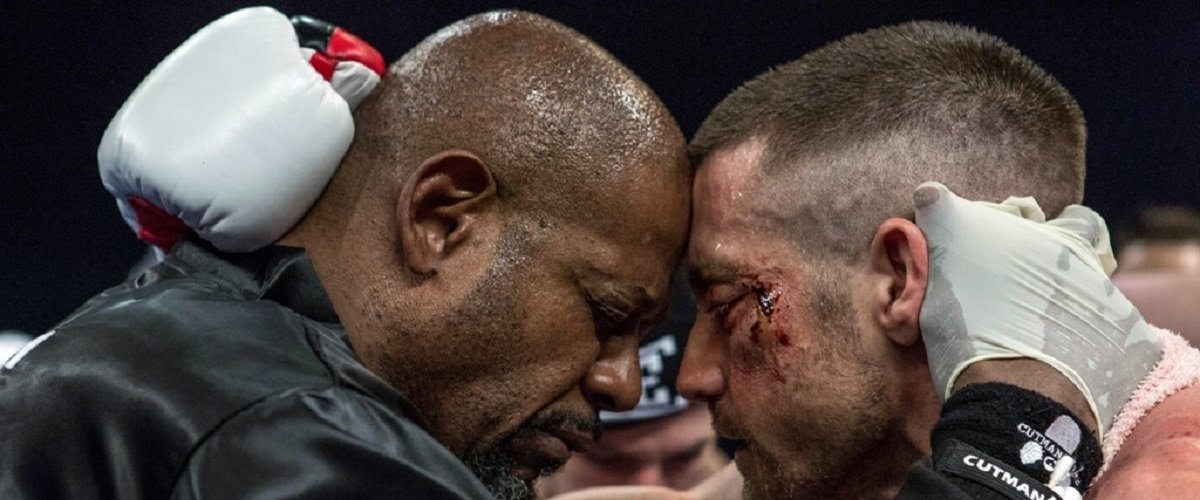
Billy wants to get back into shape to win Leila back, but he is suspended for at least a year after head-butting a referee and generally going bonkers.  It's now up to Tick Wills (Forest Whitaker), Billy's personal Magic Negro/crusty ex-prizefighter, to get Billy to shape up.  At a charity boxing match marking Billy's unofficial comeback (charity boxing not requiring a license), comes Jordan, who sees a perfect opportunity to make more money by having a match between a reinstated Billy and of all people, Magic Escobar.  Tick is opposed to this, but Billy needs the money to win the now-resentful Leila back (she understandably resentful).

With only Angela (Naomie Harris), the caring social services worker with Leila, Billy has the fight of his life.

Image result for southpaw movieSouthpaw is like a bad remake of Rocky V, which is saying so much.  In so many ways, Kurt Sutter's screenplay does not even bother to mask its rather oddball aspirations.  I would recommend Southpaw be studied by future screenwriters in showing what not to do.

The boxer who loses it all, down to having a dead wife and resentful child is straight out of Rocky V.  The grizzled old trainer, the duplicitous manager, the once-happy-now-angry daughter: we've seen all this before, and we've seen it done better.  Even that awful bit about the accidental shooting is nothing new.

Worse, Southpaw manages to throw in some more idiotic elements into the mix.  No one is ever charged with Maureen's killing, and while this is in part because no one talks, in the final boxing match pretty much everyone knows that Escobar is somehow connected to Maureen's death.

Southpaw also manages to text its lofty but clumsy intentions rather quickly.  When Maureen warns Billy about how everyone will abandon him when he slips, I found myself saying 'foreshadowing'. As Billy goes through his 'dark night of the soul', no one apparently thinks to take his gun away from him.  It looks like he's coming close to suicide, and my mind briefly wandered off at this point to think it would have made for more interesting viewing if he'd gone full bonkers and held Leila and her nanny hostage.

Instead, Southpaw has a rather unbelievable storyline that has this famous boxer running around looking for Hector (Danny Henriquez) with only a hoodie to hide his face, and later having Billy survive a massive head-on collision and managing to stumble into his mansion.

Everything about Southpaw was rote and predictable (and in using 'Billy Hope' as a name, embarrassing in its metaphor shout-outs).  At the end of the Hope/Escobar fight, I predicted it would be a split decision.  That was done to 'heighten the drama/suspense', but there wasn't any.


It's the script that sinks everyone, even when they are doing work that is much better than the material.  This is not to say that there isn't blame to be handed out in that department.  Gyllenhaal was trying too hard to act rather than be.  With his soft voice and mannerisms, he came across as too actory, too showy in his performance, as if to show "I'M ACTING!".  Granted, the script gave Billy the IQ of a turnip and a hair-trigger temper but it is not a good sign when Fity manages to out-act you.

Billy appears to not understand that his recent behavior might make people question whether he's in a fit state to care for anyone, let alone a child.  In the film's continued efforts to make me feel sympathy for him, all I could feel was almost anger at his constant self-centered nature and near-total stupidity.

You hate bashing on kids, but Laurence was almost comical when she is slapping her dad screaming "I HATE YOU" after she gets locked up in essentially an orphanage.  Actually, I had a lot of good laughs at Southpaw, such as when Maureen died in an almost hilarious manner.

This was all unintentional, which makes Southpaw playing like a parody almost sad.  Whitaker does not help matters, but in his defense he is called to spout out gibberish masquerading as words of wisdom.

Harris is the only one who saves herself any embarrassment in this fiasco, as she is the only one who appears to be taking any of this seriously and whose character appears actually real.

It just seems everything related to Southpaw was so misguided, and while I give Antoine Fuqua credit for having some good fight scenes, his actors were either excessive (Gyllenhaal) almost bored (McAdams) or a mix (Whitaker). 

The film is a mess; for example, it introduces a minor character, Hoppy (Skylan Brooks) who is not allowed a story because he is killed off-screen.  It's a cheap way to try to get emotion out of us and seems to have wasted time on this long film on something that won't come.  Even the music seems misguided.  An Eminem song, Phenomenal, was the one touted to give Slim Shady a second Oscar, but that was played in the training montage and barely heard.  The closing song Kings Never Die, also by Eminem with Gwen Stefani, was the one we actually heard but not the one touted.

Curious that.

Southpaw tries too hard to use the clichés it gives us to make us think it is in any way original or interesting.  It is neither.  The people involved in the film have talent. 

Where it went we do not know.

DECISION: D-