Wednesday, April 7, 2021

Alice Adams (1935): A Review (Review #1475)

ALICE ADAMS

Aspirations to rise to better circumstances drive the title character in Alice Adams, but it's not a tale of snobbery gone wild. Rather, it's a story of a young woman desperate to be someone, someone more than she is, making her sympathetic.

Unlike her friends and acquaintances, Alice Adams (Katharine Hepburn) is from a poorer background. Her father Virgil (Fred Stone) could have become wealthy if he had pursued the glue formula he had developed with a fellow coworker, but he was pretty content to stay loyal to his employer J.A. Lamb (Charles Grapewyn). Mrs. Adams (Ann Shoemaker) is loyal and loving to her family, but also distressed that Alice can't move up in the world because of their poverty.

As her circle does intermingle with the elite, Alice does attend a few parties. At one where her brother Walter (Frank Albertson) unhappily escorts her, she meets the young, wealthy and dashing Arthur Russell (Fred MacMurray), who may or may not be engaged to her frenemy Mildred (Evelyn Venable). While Arthur is taken by Alice and she with him, Alice is also deeply embarrassed and ashamed of her meager world compared to his.

Mrs. Adams finally gets Virgil to quit Lamb's clerk job and start his own glue works so they can move up. Alice hems and haws about Arthur: in love with him but uncertain about his feelings, let alone about how he will react to the depths of the Adams' family deprivation. After a disastrous dinner where the Adamses efforts to impress continuously go awry, both Walter and Virgil face financial ruin thanks to Walter's tricky accounting for Lamb's company and Lamb's assertion that the glue formula was his.

However, Alice stands up for her father and brother to Lamb, who has a change of heart. Arthur, despite her pleas, stays loyal to Alice and declares his love.


As I have not read Booth Tarkington's novel, I can't say how close or far Alice Adams the film stays or strays from the source material. However, here I think that the happy ending is closer to what audiences expected in a tale of love in peril. 

At the heart of Alice Adams' success (film and character) is Hepburn's performance. From the moment we first see her, we know the inner conflict, her yearnings to be better. As she goes into a flower shop and sees that despite her best efforts no flower is within her price range, the excuses she creates to not buy are thinly veiled efforts to shield what she considers her shame of poverty. 

We like her: her loyalty to her family, her resourcefulness, her deep longing to be not better than others but to be as good as others, or at least how she perceives them to be. "I ought to be something besides just a kind of nobody", she tells Arthur. This is Alice's unofficial motto, and says so much about her. She is not snobbish or trying to put on airs. Instead, she sees this beautiful world that is known to her but cannot fully enter it. She yearns for something better, an ambition to move forward and upward.

In Hepburn's performance you see that love both familial and romantic; when she goes to the window after failing to attract attention while sensing that Arthur, her dream man, is gone, she bursts into tears. It's a deeply moving moment that really hit the viewer.

A lot of the performances in Alice Adams were excellent. A real scene stealer is Hattie McDaniel as Melina, the maid hired to give the Adamses a touch of class. Far from being the highly skilled servant they would have like, Melina is a bit clumsy and confused. It's understandable given that she has little time to learn the lay of the land, and perhaps people will think that McDaniel was a bit of a stereotype.

I saw it through different eyes and think she subverted the cliché of the dimwitted colored maid by showing that in some things she had more sense than the Adams Family. She for example warned that the hot food they were serving was wrong for the weather. She also had wonderful bits of physical comedy, like when she all but thrusts caviar sandwiches at a startled Virgil, unaware of what this dish is. There's also physical comedy such as her struggle to open the sliding doors and a routine where her maid's cap kept slipping. It takes a lot to steal a scene from Katharine Hepburn, but McDaniel did.

Another strong performance was Albertson as Walter, who was more interested in gambling and enjoying himself than in Alice's social aspirations. While he was a reluctant participant, he too loved his sister and family despite his myriad of mistakes. Unlike Alice, he sees through the wealthy facades, constantly calling them "frozen faces". 

Sadly though, Walter's character was diminished by Alice's assertion that him socializing and gambling with "coloreds" was an eccentricity versus common sense. "He tells the most wonderful darky stories, and he'll do anything to get them to talk to him," Alice offers Arthur as a reason for his association with people of color. It's a bit cringe-inducing to hear that now, but one has to accept it as a sign of the times.

I would say MacMurray is the weakest link. It does seem incredible that Arthur doesn't at least see that the Adamses are poor and not in his circle. A plot point of whether he believes Virgil stole the formula is left there, though after the disastrous dinner I think he saw they couldn't pull off such a master feat. However, I think this is early in MacMurray's career, so I cut him some slack.

One can quibble that the stolen money and Russell romance situations resolve themselves quickly, but on the whole I found Alice Adams a wonderful and moving picture. With a pitch-perfect performance by Katharine Hepburn and a sympathetic character, Alice Adams is a heroine you want to succeed. It would be nice to see this story retold, but until we get a remake, this version is one worth seeking.  

Tuesday, April 6, 2021

Aaron Hernandez: Life Inside. The Reelz Television Documentary


AARON HERNANDEZ: LIFE INSIDE

Reelz Channel is back to triple-dip on the late Aaron Hernandez. Having already suggested the former New England Patriots tight end was a serial killer in Aaron Hernandez's Killing Fields, then featuring the boudoir confessions of Kyle Kennedy with Aaron Hernandez: Jailhouse Lover Tells All, now we have Aaron Hernandez: Life Inside. Unlike the haphazard Killing Fields or salacious Jailhouse Lover Tells All, Life Inside (which could have been re-titled Jailer Tells All) is surprisingly restraint, respectable and focused more on the man versus the monster.

Using a mix of reenactments and interviews, Life Inside involves Hernandez's eighteen months at the Bristol County House of Corrections after his arrest for the murder of Odin Lloyd. Here, Hernandez developed something a father-son relationship with Bristol County Sheriff Thomas Hodgson, the head of the corrections facility since 1997.

In two separate interviews Hodgson remembers and reflects on the troubled former NFL great. Hodgson found Hernandez pleasant and friendly, unless you "disrespected" him. At that point, he would become quite violent at any perceived disrespect intentional or not. His temper over any slight real or imagined was so great that Hernandez literally ate a letter rather than admit he was wrong when jailers searched his cell. 

Having worked in law enforcement for decades, Hodgson was no fool. While he recognized Hernandez's positive traits, he was also not taken in by Hernandez. He knew that Hernandez could and would use people to his own advantage.

In his first interview with Hernandez, where Hodgson was called in on his day off and appeared in shorts and a polo shirt, Hernandez flat-out told him no one could read people better than Aaron Hernandez. As such, he "deduced" Hodgson came in such casual attire as a way to gain Hernandez's confidence. Later on, he admitted to Hodgson that he was perhaps Hernandez's equal in reading people, but not his superior.

Sheriff Hodgson had two simple pieces of advise for Hernandez which he gave him at the beginning and end of his stay at the House of Correction: talk to your father and read the Bible. Hodgson believed that all of Hernandez's troubles and torments came from his tumultuous relationship with the late Dennis Hernandez. Aaron idolized Dennis despite Dennis' abusive nature. Hodgson speculates that to Aaron, any sign of disrespect to him was disrespecting Dennis.

It was also from Dennis that Aaron learned not to cry in front of others. This was strange advise given that according to Aaron, his father cried often in front of others. Given that advise, Hodgson was surprised when Aaron cried publicly when acquitted of the double murders of Daniel de Abreu and Safiro Furtado. It was the fact that Hernandez was found not guilty when he knew he was guilty, Hodgson speculates, that pushed Hernandez into suicide.

Those two pieces of advise: talk to your father and read the Bible, sadly did not help Aaron Hernandez.

Life Inside is different from the two preceding Aaron Hernandez-centered specials in a variety of ways. First, the separate Hodgson interviews paint a more sympathetic portrait of Hernandez (which Hodgson repeatedly pronounces as "Her-nan-deez" versus "Her-nan-dez"). The story of how Aaron had visited his father's grave only once is quite sad. 

It also features a credible subject. Unlike Jailhouse Lover Tells All's Kyle Kennedy aka Pure, Sheriff Hodgson does not focus on any potentially unsavory or scandalous elements of his most famous inmate. His portrait of Hernandez is essentially that of a lost boy, one who was deeply broken and tormented by the demons he carried. As a side note, unlike Kennedy, Hodgson not only sounds more credible but also coherent.

Unlike previous Hernandez-centered documentaries, Life Inside stays almost wholly away from other elements such as his drug use or homosexual or bisexual aspect of Hernandez's private life. The closest the program comes to bringing up Hernandez's sexual orientation is when he recounts how the Odin Lloyd murder may have been triggered by a friend of Lloyd's allegedly calling Hernandez a "punk" and "one of those funny people". That's as close to a suggestion that Hernandez's allegedly secret gay life was the trigger to Lloyd's murder.

Hodgson isn't excusing or trying to explain away Hernandez's life of crime, merely noting that Hernandez was in desperate need of genuine affirmation. This is noted throughout Life Inside with revelations from Hodgson that Hernandez preferred basketball over football but dropped the former when his father became adamant his son pursue the latter. 

A more chilling tale is when a former college football teammate offered forgiveness after a falling out. Hernandez, according to Hodgson, calmly stated that once he got his former friend in a relaxed manner, he cold-clocked him for revenge.

Hernandez's hair-trigger temper is brought up by other interviewees, who remark how all these slights and acts of disrespect real or imagined would get Hernandez's ire. These, unfortunately, led to violent retributions. We hear the reluctance of other NFL teams who, while seeing Hernandez's talent, couldn't get past his shockingly low self-esteem and emotional health issues. It was an ominous scouting report that proved that past is prologue.

The focus on the case and in particular the more father-son aspect makes Aaron Hernandez: Life Inside a more professional, respectable telling of this oft-told tale than past Reelz ventures. It's probably the most sympathetic portrait of Hernandez that Reelz has made, and one of the most sympathetic overall. Perhaps if someone decades earlier had told Aaron Hernandez "Talk to your father and read the Bible" or if Hernandez had taken up those challenges, the entire tragedy that destroyed so many lives might have never happened.

8/10

Monday, April 5, 2021

Godzilla vs. Kong: A Review

GODZILLA VS. KONG

The COVID-19 pandemic/panic appears to be over. More people are getting the various vaccines. More states are not just allowing businesses and facilities to reopen with varying degrees of capacity but lifting mask requirements. Sports venues are now allowed to have more fans, and in some cases actual fans versus cardboard cutouts.

However, the biggest indicator that people are either less afraid or flat-out disinterested in the perpetual lockdowns is the return of giant tent-pole feature films to large-screen theaters. Our first example is Godzilla vs. Kong, technically not the first encounter between the giant lizard and the giant gorilla but the most recent one. Plotless, pointless but quite pretty, Godzilla vs. Kong gives audiences what it thinks it wants and I've no complaints.

Godzilla vs. Kong has two separate plots rolling through it. Plot 1 (because I'm not sure which is the main plot, but I think it's this one) is how Kong will be kept much longer in his Skull Island simulation. There's something about evil businessman Walter Simmons (Demian Bichir) who wants to send Kong down into Earth's core. Something about a Hollow Earth in Earth's core and scientist Nathan Lind (Alexander Skarsgard), Kong whisperer Ilene Andrews (Rebecca Hall) and her deaf daughter Jia (Kailee Hottle) who get Kong to travel to this world where something about reverse gravity.

Joining them is Walter's daughter Maya (Eiza Gonzalez) and a nefarious plot to harvest energy that will allow Walter and his sidekick/Charles Xavier wannabe Ren (Shun Oguri) to control their newest creation: Mechagodzilla.

Plot 2 involves Madison Russell (Millie Bobby Brown), annoying daughter of Mark (Kyle Chandler). She suspects something caused the normally peaceful Godzilla to attack the Pensacola facility of Simmons' APEX Cybernetics Corporation. Joining her is APEX employee/podcaster/Titan conspiracy nut Bernie (Bryan Tyree Henry) and some random British guy Josh (Julian Dennison), they begin their own investigation into the dark recesses of APEX Cybernetics, ones that get them from Pensacola to Hong Kong in mere minutes via a secret super-high-speed underwater transportation system, facing off against Mechagodzilla, and trying to stop Mechagodzilla from killing the real thing.

Godzilla and Kong fight each other in Hong Kong, then join forces to destroy the crazed Mechagodzilla.

As I sat (and I confess, slept for a few minutes) through Godzilla vs. Kong, I thought how much fun the shoot must have been. If not fun, at least financially rewarding for many involved, because Godzilla vs. Kong is something you enjoy just with your eyes, not your brain. For how the original King Kong is a landmark in film history and the original Godzilla a tale of nuclear war anxiety, it has created a fantasy universe that is so much cinema candy: unhealthy but quite tasty. 

You can't look at Bichir's performance and think he's being serious. He was ramping up the camp to full blast and then some, so wildly over-the-top you could see him swallowing up not just scenery but his castmates whole. He wasn't acting, but he was hilarious in his deliberately campy manner.

I think you can also bless the actors for delivering their lines with any hint of sincerity. I marvel at Chandler, who stubbornly defies the aging process for looking at least twenty years younger than his current age of 55. I marvel not just at Chandler's ability to look pretty much like he did when he starred in 2005's King Kong but in spouting such lines as "Titans like people can change! Right now Godzilla is hurting people and we don't know why!" and trying to make it sound like it came from a functioning human.

I also bless the physical perfection that is Alexander Skarsgard, who was also going for something different with Dr. Lind. Here, he was more bumbling, slightly dim scientist than action hero. He mentions something about a brother who died trying to enter Hollow Earth, but that's about it in the character department. I take time to also acknowledge Henry, who appears to have decided Godzilla vs. Kong was about his crazed conspiracy nut and tried to inject a semblance of humor into things.

Hall, bless her too, for trying to make a character out of nothing, her rapport with Jia the best aspects of that part. I disliked Brown but put that more to her somewhat whiny character than the actress herself. 

I am not ignoring the various issues in Godzilla vs. Kong. I thought to myself that the super-high-speed transport that takes Plot 2 from Pensacola to Hong Kong in a matter of minutes would be a far better moneymaker to Camp Villain Simmons than whatever silliness he cooked up with Mechagodzilla. How Bernie could go around these secret facilities with nary a problem is also not a big question. Who exactly Josh is or what purpose he serves to be fair might have been mentioned while I dozed off, so I'm not going to be too picky on that.

However, Godzilla vs. Kong is there to feature our two "Titans" clash, and Clash these Titans did. I think Godzilla was the winner, but of course you couldn't kill off Kong. How would that be any fun? I give credit that Godzilla vs. Kong is quite beautiful to look at: the bright colors, well-crafted special effects and the physical perfection that is Alexander Skarsgard all working well. Tom Holkenborg (aka Junkie XL)'s score seems a mashup of Blade Runner and TRON: Legacy, and I thought well of it even if it was more a shadow of those two films than truly original.

Of course, the climatic battle has to be in Hong Kong because the film has to appeal to the vast Chinese market, and if one wants to extend any sense of allegory to it, I imagine Beijing wants to do to Hong Kong what Godzilla, Kong and Mechagodzilla did to it in the film: destroy it completely. 

Godzilla vs. Kong reminds me of a Universal Studios ride. Oftentimes, it looked like one and I figure we'll have a Godzilla vs. Kong theme ride soon enough. As such, Godzilla vs. Kong should be seen as a theme park ride with some pauses for whatever passes for plot or character development. I can't fault it for not pretending to be anything else.

DECISION: C+

Sunday, April 4, 2021

Mulan (2020): A Review

MULAN (2020)

I am at a unique position to review 2020's much-delayed Mulan in that I have yet to see the original animated version. As such, apart from the absence of Mushu the dragon I cannot note what differences there are between the animated and live-action version. Mulan has many positive qualities but it's a bit hard divorcing its qualities from some of its production.

Hua Mulan (Yifei Liu) is the elder daughter of Hua Zhao (Tzi Ma), a once great warrior who now is infirm with old age and a war injury. The Rourans, headed by Bori Khan (Jason Scott Lee) are invading China and the Emperor (Jet Li) orders all families to provide one male for his Imperial Army.

At first Zhao plans to go, but in the dark of night Mulan steals his armor and sword to take his place. Now disguised as "Hua Jun", Mulan channels her "chi" to become a mighty warrior. She also reluctantly makes if not friendships at least comradeship with her fellow troops. Chief among them is Huanhui (Yoson An), who sparks curious feelings.

However, the Rourans continue their war, and the Chinese are unaware that Bori Khan has a secret weapon: the sorceress Xianniang (Gong Li). She not only is a shapeshifter but a powerful witch who can command great resources against Bori Khan's enemies. Xianniang sees a kindred spirit in Mulan, the light to her darkness, but Mulan will not betray her people. Mulan is forced to reveal herself and gain both her fellow warriors trust and family honor as she and her friends confront the Rourans in a final battle.


As I have yet to see the original Mulan, I certainly can't compare. What I saw in this Mulan was a beautiful looking film that had some issues in terms of character. The various sets and costumes were quite well-crafted, with the scenes of the Imperial Throne Room exceptionally dazzling visually.

However, I think Mulan suffered from being overly serious and stern, as if wanting to erase any suggestion that past versions had any sense of lightness. Even the few times the characters try to crack wise, particularly at the expense of chubby recruit Cricket (Jun Yu) or some comedy bits with Mulan's bungled tea ceremony, it falls flat.

Yes, war is a serious subject, but the lack of joy in any of their lives makes it hard to enjoy.

As for Mulan herself, her "chi" is essentially the equivalent of the Star Wars universe's "The Force". She does not grow to become a mighty warrior as she is a mighty warrior from birth. At the opening, we see her effortlessly float down from the highest roof in her circular village. By making Mulan essentially perfect from the get-go, you lose a sense of her growth as a warrior and a woman. Liu is fine as Mulan, able to do the warrior part but less confident when called upon for a hint of comedy.

The other roles are surprising in that Jet Li and Jason Scott Lee are almost unrecognizable. It would have been nice to have seen them fight each other, but also Li in particular didn't seem to be important enough to feature. I also think Hollywood has done Gong Li wrong by having her vamp it up to full force as this sorceress. She shows hints of wanting to be more fully-rounded but the script pushes her down again and again.

I do wonder about how the closing song Loyal, Brave and True works. It wasn't a bad song but for some reason both the delivery and the visuals made it look like it was a Bond theme.  

Mulan is not a bad film, but it could have been more. As it is, it's entertaining enough.

DECISION: C+ 

Saturday, April 3, 2021

Aaron Hernandez: Jailhouse Lover Tells All. The Television Documentary

AARON HERNANDEZ: JAILHOUSE LOVER TELLS ALL

Reelz Channel won't let go of Aaron Hernandez. A network that switches between profiling celebrities in trouble and true-crime found the ideal figure in the late New England Patriots player. Not satisfied with delving into a story that paints Hernandez as a serial killer, Reelz returns to the Hernandez well with the salaciously titled Jailhouse Lover Tells All.  

Kyle Kennedy, already featured in Aaron Hernandez's Killing Fields, now is brought back to tell not just his alleged relationship with the disgraced tight end, but also about himself. In turns shocking and oddball, Jailhouse Lover Tells All reveals surprisingly little that wasn't already known or suspected.

This "major television event", once again hosted by Dylan Howard, features the story of Inmate W107335, also known as Pure. It was a circuitous route Kyle Kennedy went through to earn his nickname. First it was "Cocaine" (because he was crazy and white, as he tells it in his slow cadence), then it went to "Pure Cocaine", but as that was too long, it was shortened to just "Pure". 

Meeting in prison, Kennedy and Hernandez soon became not just fast friends but lovers. Hernandez was Kennedy's first male lover according to Kennedy, but there were strict parameters. Hernandez initiated the physical relationship by performing oral sex on Kennedy, then moving on to intercourse where Kennedy was on the receiving end. Not once according to what I understood from Kennedy did Hernandez ever receive either oral or anal sex. 

Hernandez also confessed to being unsure if he was gay, and that to have sex with his long-term fiancee Shayanna Jenkins he needed to think of men or be "super high". 

The carnal pleasures were not the only aspects of the Kennedy/Hernandez relationship. As a leader in the Bloods gang, Kennedy soon found himself second fiddle to Hernandez, who now was the "shot caller" in that prison gang. Hernandez quickly became something of a drug kingpin among the other inmates, with Kennedy at his side. "He was the most loyalist person," Kennedy remembers. They would spend their days getting high, cooking meals, selling drugs, writing each other love letters.

Kennedy would also hear Hernandez's confessions to his many crimes. Not only did Hernandez admit to killing Odin Lloyd, but bragged about having four murders. That would be Lloyd, Daniel de Abreu, Safiro Furtado and Jordan Miller, the latter apparently a case of mistaken identity. 

While in prison, Kennedy claims Hernandez talked about what his life post-prison would be like. He wanted to both go into business with and marry Kyle Kennedy. The businesses would actually be, Kennedy asserts, fronts to sell drugs. However, by the end of their affair Kennedy saw that the weight of the trials was making Hernandez more mentally unstable. Hernandez, according to Pure, was highly paranoid, convinced everyone he talked to was an undercover officer waiting to get the goods on him. 

While Kennedy eventually found himself in a minimum-security prison, Aaron Hernandez hanged himself on April 19, 2017.

I cannot help think that if Kennedy really was Hernandez's "jailhouse lover", then Hernandez had remarkably poor taste in men. The idea that this heavily-tattooed, poorly educated criminal would not only inspire lust but genuine romantic love in Hernandez seems almost ludicrous. Granted, people love whomever they do for their own reasons. However, for someone like Hernandez, who may have been a self-loathing gay or bisexual man terrified of being outed, it doesn't seem logical to think he would leave his fiancee and daughter to publicly marry another man after being acquitted of three murders.

This claim that Hernandez wanted to marry Kennedy is more puzzling given that a possible motive for the Odin Lloyd murder was that Lloyd may have discovered or walked in when Hernandez was having a same-sex tryst. As such, why would someone so deeply buried in the closet turn quickly around to be in a same-sex marriage if and when he beat the rap? 

Jailhouse Lover Tells All seems ludicrous on many levels. Kennedy claims to have had many love letters but could only produce one via his attorney where Hernandez talks about loving him. The other letters, Kennedy states, were flushed down the toilet. Already the lack of physical evidence makes one dubious of the true nature of their relationship if any. 

That Hernandez was more than likely gay or bisexual has stronger evidence, but Kennedy can't provide much if any evidence of a sexual relationship, let alone a romantic one.

Even Jose Baez, Hernandez's defense attorney, dismisses the idea of a Hernandez/Kennedy affair. Baez doesn't dismiss Hernandez being gay, but flat-out rejects Kennedy's claims. When presented with the sole letter talking about Hernandez "loving" Kennedy, Baez retorts "Aaron told everyone he loved them".

Another curious element is in Kennedy's assertion that Hernandez and he were major players in the Bloods gang. Again, I'm not a prison gang expert, but I always thought the Bloods were primarily if not exclusively a black gang. The notion of this very white man and the Hispanic former football star taking on major roles in even the local Bloods gang seems bizarre. Again, perhaps not impossible, but quite out of the ordinary.

What is perhaps the most puzzling aspect of Jailhouse Lover Tells All is Howard's total unquestioning belief in Kyle Kennedy's story. Rarely if ever does Howard push back to Kennedy's myriad of claims. Instead, he pushes back against Baez, the man who doubts Kennedy's myriad of claims. It's to where Kennedy could claim he and Hernandez danced naked bathed in the blood of chickens before hosting a prison orgy and Howard would merely nod his head in agreement. Kyle Kennedy comes across as an unreliable witness, one who could say what people want to hear. Again he might be thoroughly truthful in his stories of life with Aaron Hernandez, but one has wide room for doubt.

As a side note, Aaron Hernandez's Killing Fields mentioned an attempted murder Hernandez is alleged to have taken part in while at the University of Florida. Curiously, despite their many conversations Hernandez never appeared to have brought up the Corey Smith case to Kennedy. Moreover, Howard never asks Kennedy about the Smith case.  

Aaron Hernandez: Jailhouse Lover Tells All may be true, but it can't get away from being highly questionable, as well as tacky and tawdry. "The things we talked about...it wouldn't be believable," Kennedy says early on. On that I figure many would agree. 

1/10

Friday, April 2, 2021

Downhill (2020): A Review

DOWNHILL (2020)

Downhill comes to us thanks to the American idea that Americans would rather watch a remake of a foreign-language film than the original foreign-language film itself. Adapting the Swedish film Force Majeure, Downhill might have forgotten something in the translation.

Married couple Pete (Will Ferrell) and Billie (Julia Louis-Dreyfus) are vacationing in the Austrian Alps with their sons Finn (Julian Grey) and Emerson (Ammon Jacob Ford) eight months after Pete's father's death. It's already not a particularly idyllic vacation for the Stanton family to begin with: Emerson is slow and uneager for winter sports while Pete and Billie get harassed by Eurotrash Charlotte (Miranda Otto), forever insisting on sharing stories of her various sexual escapades.

Things take an even worse turn when a controlled avalanche seems to swallow hotel guests eating outside. Billie huddles Finn and Em to her, while Pete leaves, taking only his cell phone. Once the danger passes, Pete returns and attempts to be casual about all this. Billie for her part has barely concealed rage. That rage bursts wide open when Pete's work friend Zach (Zach Woods) and his girlfriend Rosie (Zoe Chao) find their European travels take them there.

As the Stantons continue their own cold war, Billie is tempted by hot Italian ski instructor Guglielmo (Giulio Berruti) and Pete tries to overcompensate by attempting to ingratiate himself to the boys. Ultimately though, Pete and Billie reach a certain rapprochement, not happiness.


Downhill bills itself as "a different kind of disaster movie", which is probably not the best tagline for what is meant as a comedy. Perhaps this is one of Downhill's big problems: its inability to balance comedy and drama. It veers from what is meant as goofy laughs via Charlotte to terse drama when Billie drags their sons to confirm her story.

It goes all over the place, attempting to be laugh-a-minute at one point to cold the next. The cutesy choral score does not help clear up whether this is meant as comedy or horror film.

It does not help that you really can't side with either Billie or Pete. Co-directors Nat Faxon and Jim Rash (cowriting with Jesse Armstrong) apparently decided they could improve on the source material by introducing odd elements, such a potential fling with the hot Italian ski instructor or Eurotrash Charlotte. Perhaps this was to satisfy a need for the comedy they were aiming for, but what one ends up is two highly unlikable people.

As played by Louis-Dreyfus, Billie ends up looking like a whiny, boorish shrew. One figures that by the time they got to Austria she had already emasculated Pete so much that his flight reaction was more to get away from her than a stupid decision to save himself. Ferrell has mastered the art of playing dimwitted boobs, with his small eyes expressing perpetual confusion. However, even if one could forgive Pete's hurried decision to save himself, Downhill's insistence on him pushing his sons figuratively and literally is harder to accept.  


Downhill makes vague plays to rationalize Pete's decision by introducing the element of his father's recent death, but Billie brings it up and drops it at her convenience. It also makes some illogical choices. Whatever her anger, I think Pete would be right in being angry at her for her almost mercurial decision to make so many excuses for not getting on a helicopter trip that they miss it altogether. Pete at one point says it cost him $2,000 but she kept going on and on screaming about a lost glove that the helicopter was forced to leave without them.

I think Faxon and Rash were aiming for sadness but it ended up making her look like a screaming selfish harpy. One wonders why either would want to stay with each other. Pete and Billie's decision to take the boys to a more adult-geared resorts when a more family-inclusive one nearby also is a head-scratching decision. 

In their smaller roles neither Chao or Woods impressed or seemed relevant to the plot.

Downhill has an odd tonal imbalance, wavering between attempts at comedy and attempts at drama. It fails in both respects, and it really is all downhill from the beginning.

Thursday, April 1, 2021

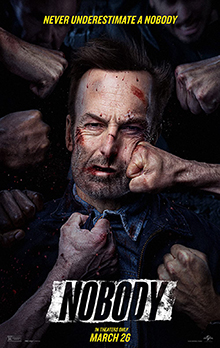
Nobody (2021): A Review (Review #1471)

NOBODY

It's one of television and film's greatest surprises that Bob Odenkirk, one of the co-hosts of the comedy Mr. Show, has somehow ended up the master of dour male angst. Nobody is fully self-aware, not original but fun.

Mild-mannered Hutch Mansell (Odenkirk) lives a quiet life with his wife Becca (Connie Nielsen) and children: teenage Blake (Gage Munro) and adorable pre-tween Abby (Paisley Cadorath). Forever pushed around and pushed over, not even a break-in at his house can make him turn violent.

However, things are not as they appear. Far from being a perpetually beaten-up guy Hutch is really a retired government assassin who has embraced the quiet life. It isn't until Abby remarks that the thieves probably stole her kitty cat bracelet that Hutch finally resorts to his past to get it and some of his self-worth back.

However, after realizing the thieves were a poor family, Hutch's guilt mixes within him. That is, until a group of thugs harass fellow bus riders, unleashing a wave of violence and mayhem that eventually engulfs Russian mob kingpin Yulian (Aleksey Serebryakov), Hutch's seemingly fragile father David (Christopher Lloyd) and his half-brother Harry (RZA).

Nobody does not pretend to be anything new. You get quick montages that show the life of drudgery Hutch lives out. Hutch's accidental involvement with the Russian mob is similarly unoriginal. Yet Nobody is not looking to be original in its brisk 90-odd minute running time. The mixing of soft music to violent action is equally nothing that hasn't been done before. A dramatic fire is accompanied by Louis Armstrong's What a Wonderful World, and the climatic gunfight has people blasting each other away to Rogers & Hammerstein's You'll Never Walk Alone.

About the only genuinely original idea is a literal Black Russian in the form of Pavel (Araya Menshega), Yulian's right-hand man who surprises the fellow Russian mobsters by speaking fluently in their own language.

However, in terms of action Nobody certainly delivers. It boggles the mind to see 82-year-old Lloyd taking out two Russian hitmen, then joining his sons for that climatic battle, but Nobody makes it if not plausible at least enjoyable. Other fight scenes such as Hutch on the bus and the raid on his home also balance between the action and a bit of humor without it being cartoonish.

Nobody's most successful element is in Odenkirk's performance. His world-weary looks and growly delivery show Hutch to be more worn down by his past and present than a man seeking violence or redemption. "We haven't had sex in months. We haven't made love in years," he tells Becca after the burglary, and there's a world of difference between having sex and making love. Derek Kolstad's screenplay allows for these little bits of domestic drama to seep through.

On a certain level Nobody could even be interpreted as allegory of how men have been so pressed down that the rage inside finds a release in literally striking back against dismissive in-laws or self-satisfied neighbors. There's a strange sort of wish fulfillment in being able to beat up on the brother-in-law who belittles you or the guy next door forever bragging about his car (which you help yourself to). The allegory could extend to fathers and sons: David and Hutch are similar, while Hutch and Blake are not. Blake has little to no respect for his supposedly weak dad, but he may find himself in for a few surprises.

Granted, this may not be Nobody's goal to be almost the anti-"toxic masculinity" film but it's there if one wishes to see it.

Lloyd gives a twist to the "weak old man" character and while appearing only on-screen at the end, RZA too seems to be having fun saving, as he puts it, Hutch's "white ass". Given that David and Harry leave riding off into the sunset, one wonders if there will be a sequel or spinoff, both welcome if at the same absurdist standard as Nobody started with.  

If there's a quibble, it's that it leaves Nielsen with little to do, which is a shame. On the whole though Nobody works for what it is: action with a bit of humor, not comedy but humor.  

DECISION: B-