Thursday, February 17, 2022

Dune: 1984 vs. 2021. An Early Comparison


DUNE: 1984 VS. 2021

It might be unfair to compare the David Lynch version of Frank Herbert's science fiction epic Dune to the Denis Villeneuve version insofar as Villeneuve will have a sequel attached to his while Lynch was forced to collapse the massive novel into one film. Despite the impending arrival of Dune: Part Two, I think we can work at having an early look at these two adaptations and draw some thoughts on how they stack up against one another.

For better or worse the Lynch version will always pale to the Villeneuve version. After all, the 1984 version didn't receive any Academy Award nominations, let alone the strong ten nods the 2021 version did. That the 2021 version is a serious albeit highly unlikely contender for Best Picture is a credit to how well-crafted the Villeneuve version is. 

I also understand that many fans of Dune dislike Lynch's version for a variety of reasons. It collapsed so much into one film that it made the final product almost unintelligible. It had an excessive amount of voiceover that became farcical. Characters came and went so quickly they had no chance to play a real role in the story. This is not an issue with the Villeneuve version, especially since he gets to make two films.

Still, I think the Lynch version has its own virtues. Yes, it may be rushed and at times nonsensical, but it is weirdly hypnotic, bizarrely fascinating. While it really is too soon to make a definite comparison, let us begin nonetheless.

BEST BARON HARKONNEN


Kenneth McMillan
Stellan Skarsgard 

Perhaps the dueling Barons can show why the 1984 version is such a bizarre enterprise while the 2021 version is a Best Picture contender. McMillian's Baron is an unhinged loon, one that is ripe for parody. Whether it is literally spitting out his dialogue or being comically evil, you cannot take him seriously as an antagonist. How else to react when he's referred to as "that floating fat man". McMillan seems to devour the scenery, his fellow actors, and even the camera whenever he's on screen.

Skarsgard has limited screentime as the Baron, but he was menacing, dark and unrepentantly evil. I think his longest scene was when he gloated over his archnemesis Duke Leto. Skarsgard's excellence in the role comes from how he uses his voice, the growl and brief statements displaying the darkness and lust for power. I understand Skarsgard and Villenueve drew heavily from Marlon Brando's performance in Apocalypse Now, and I can see that. 

Skarsgard's Baron is a menacing monster. McMillan's Baron is a loon. An entertaining loon, but a loon nonetheless.

It is interesting that the element that made McMillan so comical (the floating) works with Skarsgard.

BEST DUNCAN IDAHO


Richard Jordan
Jason Momoa

As much as the name "Duncan Idaho" is mocked, it is a credit to Jason Momoa that he makes Duncan a strong, heroic, intelligent warrior. It is no slam on Jordan, but Jordan was frankly too posh and elegant to be seen as a fierce soldier. Jordan's Duncan comes across as more a courtier than a fighter. As I think on Jordan, I do not remember seeing him leading armies in major combat, let alone participating in them.  

I am reluctant to say Momoa is an actual actor versus an action star. However, that is what the role of Duncan Idaho called for, so this was right up his street. His imposing physicality and intense manner all shaped to make Momoa an ideal warrior. He also had a noble end, a true warrior to the end. Momoa also manages to bring in what little levity the 2021 Dune has, so that gives him an added plus.

BEST REVEREND MOTHER MOHIAM


Sian Phillips
Charlotte Rampling

Rampling is hampered by the fact that her role as the villainous Bene Gesserit mother is small, though I imagine Dune: Part II will give her a more prominent role. Rampling is an exceptional actress and I hope she does more. However, Phillips is also a strong actress, and there is something vaguely wild to almost camp about her take on the role. She made Reverend Mother Gaius Mother more theatrical, grand, almost crazed.

Rampling was not allowed to be large and operatic unlike Phillips. She tore into the role with almost crazed abandon, but unlike McMillan never went full-on bonkers. Phillips also gets points for her "GET OUT OF MY MIND!", and as much as Rampling may be required to say that I doubt she would top Phillips' take. Given how intertwined the line and Phillips are, I think Dune: Part II will either avoid the line altogether or require a different line reading.  

BEST CHANI


Sean Young
Zendaya

Here, I am waiting for the final product, though I am giving the slight edge to Emmy-winner Zendaya. Young is hampered by a major flaw in the 1984 version: the rushed manner to it. Young, like many actors in Lynch's Dune, was simply not given enough material or time to make a major impact.

Curiously, this hampers Zendaya's role in Villeneuve's Dune also. Like in 1984, 2021's Chani is a bit of a shadow, a mystery, a literal dream girl. However, even in her limited time Zendaya was a more proactive figure, a warrior princess more than the mere love interest that Young had to play. I confess to not being yet won over by Zendaya as an actress, though perhaps I am a bit unfair given that my main if not sole exposure to her has been through the MCU Spider-Man films. 

I think that she will play a larger role in Dune: Part II, but right now I do not see Young overtaking Zendaya in the role. 

BEST GURNEY HALLECK


Patrick Stewart
Josh Brolin

As with Jordan, Patrick Stewart came across as more a member of the Duke's Court than a soldier and military advisor. Brolin's Gurney, on the other hand, was all business, stern and strict. There was little to no levity or humor in Dune 2021, but even by that standard Brolin was the least jocular. I think that fit the role, so I think Brolin did the part right.

As much as Brolin's version towers over Stewart's version, there is something sweetly endearing in Stewart's take. I cannot help thinking that there's something both sweet and crazed about Gurney holding a pug while screaming "FOR DUKE LETO!" as he leads men into battle. I cannot for the life of me picture Josh Brolin's Gurney doing anything so flat-out bonkers. That Stewart did so and did it with a straight face earns mad props from me.   

BEST LADY JESSICA


Francesca Annis
Rebecca Ferguson

I think Annis was like so many in the Lynch version put in an impossible position: act with little to nothing to work with. Her Lady Jessica suffered greatly in that she was quite weak to where she made concubines look almost useless. It is curious that I think once she gave birth to Paul's sister, I cannot remember Annis in the film at all.

Ferguson however was given not just more to do but was also a more capable woman, strong, intelligent and a mistress in the arts of her former order, the Bene Gesserit. That she had an outside chance for a Supporting Actress nomination shows how strong an impression Ferguson left. She may still earn that nod for the sequel.


BEST DUKE LETO ATREIDES


Jurgen Prochnow
Oscar Isaac

Outside of a dream/fantasy sequence we have sadly seen the last of Duke Leto Atreides. Therefore, here we can declare an outright winner: Oscar Isaac. 

It's a curious thing that an aspect that holds Prochnow down is of all things the look of Lynch's Dune. I will get back to this in a bit, but Prochnow does not appear to live in a real world. Rather, his stiff and formal manner make him appear artificial. Isaac, conversely, not only gives us the elegant and noble (in every meaning of the word) figure. He also shows the loving father behind the pomp and ceremony.

When Duke Leto is betrayed in the 1984 version, it comes across as slightly blank. In the 2021 version, there is genuine sadness and horror to the apparent fall of House Atreides. The differences between Prochnow and Isaac are best exemplified in Duke Leto's end. Isaac made his effort to destroy Baron Harkonnen a defiant act. I figure the same thing happened with Prochnow, but I cannot remember it at all. 

BEST PAUL ATREIDES


Kyle MacLachlan
Timothee Chalamet

Surprisingly, Chalamet is one year OLDER than MacLachlan was when the latter played Paul Atreides. However, Chalamet still looks a decade younger than his twenty-six years versus MacLachlan, who looks a decade older than his then-twenty-five years when he debuted in Dune 1984.

I think Chalamet's youthful looks help in his performance as the young man who has destiny thrust upon him. There is a greater hesitancy, a greater uncertainty to how Chalamet plays him than in how MacLachlan does. The doubt, the rage, the loss Paul feels seems deeper with Chalamet. MacLachlan seems almost too strong (and curiously too old) when he is Paul.

However, I think in the back of our minds we have to remember that MacLachlan was making his screen debut in Dune, while Chalamet had a large body of work by the time he was in Dune. Chalamet had already even received a Best Actor nomination before he took on the role. That is not to say MacLachlan is a bad actor or did not do a good job. It just means Chalamet had more experience than MacLachlan, only one factor as to why he did a better job.

BEST VISUAL EFFECTS


1984
2021

It is a terrible misfortune that Lynch's version looks at times creaky. I think the visual effects at times were not only weak but comical. I remember when Dune 1984 first showed us the members of the Guild. My late friend Fidel Gomez, Jr., who was fond of Dune, referred to them as looking like "talking penises". There is no improvement as Dune 1984 keeps going.

The 1984 sandworms look mechanical to farcical, reflective of the film overall. The 2021 sandworms were conversely more authentic looking, as if they were real. That is the hallmark of true special effects: if it can suspend disbelief long enough for you to accept the clearly fictional world you are seeing.

A better example of how poorly the 1984 visual effects came across are in how the House Atreides army looks in their protective gear. They look like big boxes. Compare those to the smoother electric gear the 2021 version gave them. They are realistic for the film's setting, organic versus obvious.

There were also no talking penises in Villeneuve's Dune, so there's that too. 

BEST ART DIRECTION


1984
2021

One big point that separates the Lynch and Villeneuve versions is that the former could never get away from having Dune look like a series of sets, while the latter made Dune look like a real universe. Lynch's Dune was dominated by blacks and an almost industrial look where there was little to no difference between the planets Caladan and Giede Prime.

Villeneuve's Dune conversely made every world, every location look simultaneously ancient and futuristic. These worlds looked lived in, real, places you could go to. There is a wide difference between the lush water-filled Caladan, the dry Arrakis and the darkness of Giede Prime. Each set looks lived in, authentic. 

BEST COSTUME DESIGN


1984
2021

The 1984 Dune did not delve deep into the various worlds either in their set design or their costuming. As such, at times the actors looked like they were acting in plastic trash bags (Sting a very notable exception). There was a certain blandness, a certain sameness, to the 1984 version that pushed the production more.

2021 however, went the opposite route. Here, each world was showcased in various threads: the elegant, regal robes of House Atreides, the sinister dark wardrobe of House Harkonnen, the sensible desert gear of the Fremen on Arrakis, the grand nun-like ensemble of the Bene Gesserit. Even those who played small roles were fitted out in wardrobe that, again like the art direction, looked authentic to each world while still having an otherworldly look. 

BEST CINEMATOGRAPHY


1984
2021

The vistas for the 2021 version are spectacular, matching the epic nature of the film. The viewer is given a massive canvas to observe, swept into other worlds. 2021 understands that it is a large story, one that needs a large scope cinematically.

1984 simply cannot even begin to compete here.

BEST SCORE


Toto
Hans Zimmer

While I think Zimmer's score is brilliant (the various remixes to the Sardukar chant are fantastic), the Toto score for Lynch's version is still to my mind more haunting and otherworldly. It does what most if not all of Lynch's version failed to do: make Dune epic. Whatever the flaws Lynch's version has, I found the music thrilling and still memorable. It is one of the few highlights of the 1984 version.

Hans Zimmer, in my view, has a strong chance of winning Best Original Score. I loved the way he too created vast universes with his music (and bonus points for including both Mongolian throat singing AND bagpipes in this space epic). However, I simply have too strong an attachment for Toto's Dune score, with the Brian Eno-composed Prophesy Theme giving it that Music from the Hearts of Space feel. 

BEST DIRECTOR


David Lynch
Denis Villeneuve

I think at heart Dune was not the right fit for someone as surreal as David Lynch. I think David Lynch is one of the true cinematic geniuses, a genuine craftsman and auteur extraordinaire. Having said that, Dune is outside his own considerable forte. I don't think his heart was in Dune: the space adventures, the complex and dense plot, the floating fat man, the talking penises. That is not to say he did not work hard to make as good a film as he could. It just means that asking David Lynch to make Dune is like asking Federico Fellini to make Schindler's List: the genre and the filmmaker simply not working well together.

Villeneuve is an old hand at science fiction having made both Arrival and Blade Runner 2049. I confess to not liking Blade Runner 2049, but I grudgingly give credit for Villeneuve making his own mark on a world already visited. He is well versed in world building, and also made sure that the acting never veered into camp or odd moments. The "floating fat man" in his Dune was menacing, in Lynch's Dune hilarious. 

Villeneuve did such a masterful job as director that his omission from Best Director was not only seen as a snub but almost a scandal. Most people had him as a certain lock for a nomination, though not a win. To think something as epic and grand as Dune could be thought of as almost "director-less" seems ludicrous. I do not know if Dune: Part II will get him the nomination I (and I think many others) think he was robbed of this year, but here's hoping.

BEST VERSION


1984
2021

On the whole, the 2021 version is if not the definite version of Dune at least a marked triumph that towers over its poorer predecessor. Massive, epic, it overwhelms viewers. I have been accused of becoming obsessed with Dune, and I think this is veering towards the truth. Dune is the only film I have seen more than once in theaters, and I might see it a third time.

I think a major reason for Dune 2021's success is that it takes the material seriously. The 1984 version could not help slipping into camp (talking penises! men leading armies while holding pugs! floating fat men!). However, it was seriously damaged by its screenplay, attempting to collapse a massive tome into one film. So much was lost, rushed through or inexplicable that it ended up being a mess. 

I remember watching an expanded opening where the filmmakers attempted to explain things. However, with the massive backstory taking up about ten to fifteen minutes, it became near-impossible to keep track of the various guilds and houses. Instead of making things clearer, this expanded opening ended up making things more confusing.

Dune 1984 attempted to fill in gaps with voiceover. While Virginia Madsen's efforts made some sense (even if her character served no purpose apart from being the de facto narrator), the endless voiceovers became so nutty it soon did not seem worth trying to sort out the plot. 

Dune 2021 however streamlined as much as it could. It is still massive, but at least it had enough sense to split the story into two films versus trying to ram everything into one. It perhaps was a bit too serious in tone, but it was not a major issue, at least for me.

As such, with a few exceptions, Dune 2021 towers over its predecessor. It will be seen for the grand epic it is. Dune 1984 will be seen more as a curiosity, odd, sometimes bonkers but still weirdly entertaining. 


Wednesday, February 16, 2022

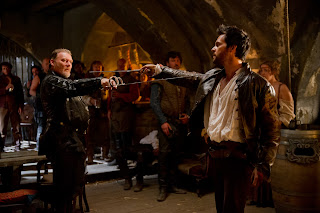
Da Vinci's Demons: The Magician

DA VINCI'S DEMONS: THE MAGICIAN

Written by: David S. Goyer and Jami O'Brien

Directed by: Jamie Payne

Airdate: May 3, 2013

Just when you are sitting on top of the world, you are arrested for sodomy. Such is life, I suppose, and such is the case with The Magician. This Da Vinci's Demons episode builds on its mix of history and supernatural, entertaining while maintaining a strong amount of decadence.

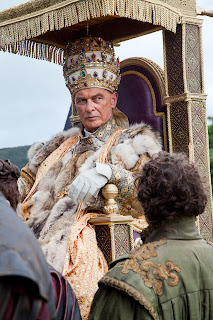
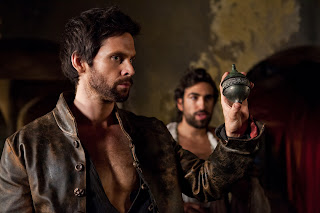
Leonardo da Vinci (Tom Riley) continues to struggle with being the weapons maker for the Medici family. He sees that his weapons, while inventive and useful, will only increase war and death. That, fortunately, is what Rome wants. Pope Sixtus IV (James Faulkner) has allied himself with the Pazzi family, rivals to the Medici, in a secret bargain where the Vatican will use the Pazzi as bankers in exchange for bringing Florence under Rome's heel.

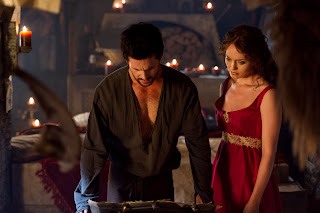
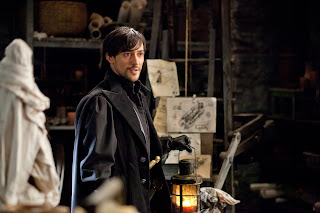
Lorenzo de Medici (Elliot Cowan), convinced that he has uncovered the traitor at Court, still hesitates in killing his old mentor Becchi (Michael Elwyn). Lorenzo's brother Guiliano (Tom Bateman) and even Lorenzo's mistress Lucrezia (Laura Haddock) also doubt Becchi's guilt. Lucrezia knows Becchi's innocent because she is Rome's spy, but she cannot unmask herself. She is a pawn in the hands of His Holiness' nephew Riario (Blake Ritson), who presents terms of surrender to Lorenzo. 

Lorenzo appears to have no alternative, especially when Leo destroys the armory. However, Leo has a few tricks up his own sleeve, saving Florence and with the bonus of humiliating Riario. At a feast to fete the artista, things appear to go Leo's way. He even starts cracking the mystery of the Book of Leaves thanks to clues hidden in plain sight: the painting of Lorenzo's grandfather Cosimo. However, the Officers of the Night, by means of a secret denunciation, arrest the arrogant artist for sodomy, a crime that while tolerated in Florence is still technically illegal.


The Magician gives its lead a chance to show a different, more thoughtful side to our genius. Riley still brings out da Vinci's arrogance and brash self-confidence. However, it allows him to think on the high cost of war. This episode makes Leonardo more contemplative, more aware that if he comes up with a better weapon, inevitably his rivals will find an answer to it. Seeing the cycle of war and ingenuity, Riley brings out a more conflicted man.

That isn't to say he still isn't cocky to the point in insanity. When interrupting Lorenzo's surrender, Leonardo delights in mocking Riario, the joy he has in making his rival look foolish almost uncontrollable. The addition of rain falling on them gives the scene a greater sense of delight.

The Magician also gets points for this bit of dialogue. As Lorenzo celebrates the glories of Florence and Florentine culture, he says that the city "will be remembered for centuries to come as a cynosure of innovation and artistry". Any time the word "cynosure" can be used at all, let alone as something as gleefully and nakedly bonkers as Da Vinci's Demons, should be commended.

For the record, "cynosure" means "a person or thing that is the center of attention or admiration", and yes, I did have to look it up.

There's much witty dialogue in The Magician. The Unholy Father if memory serves right quips at one point, "Resurrection requires death", meaning Florence must die for him to move on his own various agendas. We hear that "The Confraternity of Death are such vultures", again showing more elegance in turning phrases than most television shows. 


While these bits of dialogue are clever, The Magician still has at least one hang-up of Da Vinci's Demons as a whole: making the dialogue serve less as people speaking and more as infodumps to the goings-on. This is especially evident when Becchi is killed off: his final conversation with his assassin is more about giving audiences information about what has and will happen versus the words of a dying man.

To its credit, we do get strong performances from the cast. Of particular note is Bateman, who asks for Lucrezia's help in turning Lorenzo's heart back to Becchi. It shows a quietly desperate man, who knows he is not strong enough politically to go against his brother but who is still loyal to their old advisor. That isn't to say there aren't a few bumps: the scene between Lorenzo and Guiliano is a bit more theatrical than I would think well of, but it isn't terrible.

On the whole, The Magician moves the plot forward and gives us both the now-expected sight of Leonardo's genius but a more vulnerable Leo. That and "cynosure" push The Magician higher in success.

Next Episode: The Tower

8/10

Tuesday, February 15, 2022

Death on the Nile (2022): A Review (Review #1575)

DEATH ON THE NILE (2022)

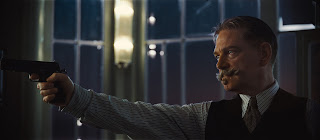
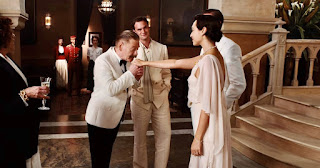
After a series of delays due to everything to pandemics to allegations revolving around one cast member's alleged interest in cannibalism, the second of Sir Kenneth Branagh's Hercule Poirot films is finally before us. Death on the Nile is darker than most Agatha Christie adaptations, but despite some issues does entertain.

World War I veteran Hercule Poirot (Branagh) is now feted as the world's greatest detective, though he still has scars both physical and psychological. Ostensibly on holiday in Egypt, he runs into his old friend Bouc (Tom Bateman), whom he last encountered in the case on the Orient Express. Bouc, traveling with his mother Euphemia (Annette Benning), is part of a wedding party. The newlyweds are fabulously wealthy heiress Lynette Ridgeway (Gal Gadot) and penniless but hunky Simon Doyle (Armie Hammer). They are passionately in love, but there is a shadow to this happy honeymoon: Simon's jilted ex-fiancée Jacqueline de Bellfort (Emma Mackey). Jackie manages to find our lovebirds everywhere, forever silently taunting them.


The Doyles ask Poirot to intercede, but to no avail. They think they have escaped Jackie once and for all when they chart a ship down the Nile, but there is evil at work on the Karnak. Someone in the wedding party appears to want Lynette dead, one who has succeeded in this wicked act. Jackie is the likeliest suspect, especially since she shot Simon, but her alibi is solid when it comes to Lynette.
 
Therefore, whodunit? Is it Lynette's former love interest Dr. Windlesham (Russell Brand)? What about her Communist godmother Marie Van Schuyler (Jennifer Saunders) or Marie's nurse, Bowers (Dawn French), who holds a secret grudge against the Ridgeways? The suspect list even involves the entertainment: blues superstar Salome Otterbourne (Sophie Okonedo) and her niece, Rosalie (Leticia Wright), who is Lynette's friend. The loyal maid Louise (Rose Leslie) is a good suspect, as is Lynette's cousin/business manager Andrew Katchadourian (Ali Fazal). Even Mother and Son Bouc cannot be eliminated as suspects.

As bodies start piling up, Poirot finds himself facing off both a puzzling case and his own past demons. The ultimate revelation of who is behind three murders does not help Poirot heal his wounded heart, nor in a thwarted romance with a passenger. However, as six months pass from the Death on the Nile, there is still a faint glimmer of hope for our Belgian sleuth.


Death on the Nile is a surprisingly dark tale, made darker by Branagh and screenwriter Michael Green to turn Poirot into a more fleshed out figure. No longer just a man who uses his "little grey cells" and is mostly removed from affairs of the heart romantic or fraternal, this Poirot is a man who has seen friends and lovers die. I don't think we have seen a darker Poirot on film or television. It boggles the mind that the doofus clown from The Alphabet Murders would be a haunted man capable of enacting revenge.

In certain ways, Branagh's Poirot gave the actor a chance to show a more dramatic side. It's a deeper version than most Christie readers have seen, and I think he did well in the role. At the climax of his revelation, when he struggles in remembering one victim, we see the pain Poirot is in. We see this also when he sees the surviving passengers exit the Karnak, the last one especially hard for him.     

As an actor, Branagh did especially well. As a director, he indulged a bit too much in both visuals and performances. Death on the Nile has a rather lengthy dance scene that, to be fair introduces the love triangle, but makes one wonder if Branagh secretly wants to make a musicale erotique. The dry humping Simon did with both Jackie and Lynette bordered on the pornographic. It also lengthened the film unnecessarily. It took much longer than needed to get the ball rolling, and while it does pick up once the Karnak sails, it takes its pretty time getting there.


Death on the Nile also has some frightfully bad performances. Before he was shunted off for wanting to allegedly do his own version of Cannibal Holocaust, Armie Hammer showed himself to be just dreadful. His whole performance was just bad: his accent, the excessive manner, his accent, all made Hammer's hamminess horrendous. Mackey's Jackie was no better: too tight and obviously evil vs. wounded, she almost goaded you to hate rather than sympathize with her. Gadot was probably the best of the three here, but not by much: she too felt too forced as the pampered diva.

Much better were the supporting cast. Bateman surprised with his strong performance as the genial Bouc, the Watson to Poirot's Holmes. He had strong moments with Wright, Bouc's love interest in the film. Delightful throughout, he was a highlight of Death on the Nile. French and Saunders, normally a comedy duo, did very well as the more dramatic pair, and I genuinely don't understand the criticism of their roles. They did allow little moments of levity to come in (particularly when Saunders' Commie biddy brings up the issues of the proletariat while feasting on champagne), but they showed strong dramatic skills. 

Brand and Benning were somewhere in the middle: sometimes able to be dramatic, sometimes going a bit overboard.


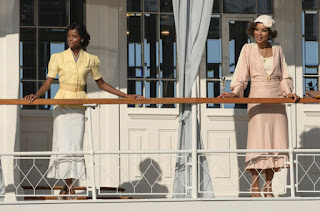
The clear standouts were Okonedo and Wright, and here is a case of diverse casting done right. They played an American blues singer and niece/agent, allowing them to come in with a more plausible reason than just being there for diversity's sake. The racial issues the characters faced were addressed, but they also gave the other characters a chance to not be virulent racists. Okonedo's brassy yet strong Salome was not only nobody's fool, but a strong foil for our Belgian. Wright's American accent may have been a bit off, but she too more than held her own.  

Moreover, the interplay and flirtation between Salome and Hercule was delightful. It makes one not only long for a standalone Salome film but a chance for Salome to be the Irene Adler to Hercule's Sherlock Holmes. 

Death on the Nile also does well in its set design and costuming, though the green screen at times was so obviously fake you'd think it was done at an amusement park versus a major film. 

Still, on the whole I found Death on the Nile good while much longer than it should have been. More dramatic than the usual light entertainment most people think Agatha Christie adaptations are, apart from a few performances and its length this is a journey worth taking. 

Tuesday, February 8, 2022

Da Vinci's Demons: The Prisoner

DA VINCI'S DEMONS: THE PRISONER

Written by: David S. Goyer and Scott M. Gimple (Story by Scott M. Gimple)

Directed by: Jamie Payne

Airdate: April 26, 2013

What can be more fun than demon-possessed nuns? The Prisoner makes the case that Da Vinci's Demons, removed from the more ahistorical and supernatural elements, may be more than just eccentric fantasy.

As Riario (Blake Ritson) plays a board game with a mysterious robed prisoner, we see that they may be subtly referring to the evil at a convent near Florence. There, many nuns appear to be possessed by demons, convulsing and shrieking. One managed to get to Florence, where she horrifies Guiliano de Medici (Tom Bateman) and former nun Vanessa (Hera Hilmar) by cursing the Medici family and gouging her own eye out with Guiliano's sword.

Guiliano's brother Lorenzo (Elliot Cowan) has more pressing matters on his hands: uncovering the spy within the Medici court. However, he knows that reports of demonic possessions could play into his enemies' hands, so he sends Guiliano and his weapons manufacturer Leonardo da Vinci (Tom Riley) to investigate the strange goings-on. Is it the work of the Devil or is there a more worldly, malevolent force at work? As Vanessa herself falls under the mysterious ailment, will Leonardo be able to save her before the convent and the possessed are set aflame? The answer may literally be at St. Anthony's feet, but even after the resolution, visions still hit our lusty artist.

The Prisoner is the first Da Vinci's Demons episode where the fantasy elements were mostly toned down. The end still managed to bring up some crazy visions but on the whole, it stayed close to the ground. A great deal of this is due to having Leonardo use logic to sort out what appears to be a confounding supernatural mystery.

The episode may have mostly centered on the convent of possessed nuns, but it also managed to include both the production of weapons, the continued machinations at the Vatican, and even the false allegations against the loyal Medici advisor Becchi (Michael Elwyn). These came in and out from the central story, but they never interfered with it.

The Prisoner also allowed Bateman's Guiliano his moment. He comes across as dim, hotheaded but courageous, a man of his time who would rather fight than negotiate. As he attempts to sort out the various works of the Devil around him, Bateman crafts Guiliano as the brother who while loyal cannot help feeling a bit inferior to Lorenzo. Riley and Ritson continue their strong performances as the rivals headed towards a showdown. 

I enjoyed the logical nature of The Prisoner. I will say that the overt nature of the board game between Riario and the mysterious figure being a parallel to the nunnery was a bit too on-the-nose. I also see that while I should be getting used to the graphic sex and violence in Da Vinci's Demons, I was a bit aghast at the eye gouging. The anal sex Lorenzo indulges with his secretly traitorous tramp Lucrezia (Laura Haddock) was not as graphic as some other sex scenes in the series, but it was a bit much for me.

However, I found The Prisoner the best episode yet of Da Vinci's Demons. How or if the series will improve later in this season remains to be seen. 

Next Episode: The Magician

8/10

Monday, February 7, 2022

Da Vinci's Demons: The Serpent

DA VINCI'S DEMONS: THE SERPENT

Written by: David S. Goyer and Scott M. Gimple

Directed by: David S. Goyer

Airdate: April 19, 2013

As we continue to delve into the myriads of mysteries Da Vinci's Demons starts serving up, I think that The Serpent is a slight though positive improvement over its pilot episode. While still hampered a bit by its penchant for exposition dialogue, The Serpent offers up more intrigue amidst the supernatural goings-on.

Leonardo da Vinci (Tom Riley) is still attempting to use his massive war machine without it killing everyone. He also wants to find the connection between himself and The Jew (Ken Bones), whose execution set off a mad search for the fabled Book of Leaves. In his unauthorized autopsy of The Jew, Leonardo finds a key that may lead him to this mysterious tome.

The nefarious Vatican group that also wants the Book of Leaves is equally at work to find the key. The Pope's nephew Riario (Blake Ritson) has a spy within the ranks: Lucrezia (Laura Haddock), mistress to Florence's uncrowned rule Lorenzo di Medici (Elliot Cowan). Riario will use any means necessary to get the key. If it involves torturing Leonardo's apprentice Nico (Eros Vlahos) or unwittingly sending his own men to die when attempting to open Leo's boobytrapped chest so be it.

However, what about recruiting Leonardo to join Rome? Will da Vinci betray the Medicis and his beloved Florence to get at the Book of Leaves? Will he instead perhaps give his attempted collaborators a literal twenty-plus gun salute instead?

The Serpent has some wonderful moments, particularly at Lorenzo's lavish celebration for Riario's welcome.  The lavishness of the celebration coupled with the nowhere near subtle comparing of Riario with the Serpent from the Garden of Eden works so well here. It manages a surprising balance between serious and camp.

There was also a great moment when da Vinci put things together by using a blind witness. It was quite a clever and logical scene that worked well. 

The Serpent also allows for some strong acting from the cast. Riley dove into his climatic speech defending his beloved Florence with almost crazed abandon, tearing at the dialogue as da Vinci tore into the Pope's soldiers. He has a manic manner that makes Leonardo more an action figure than a mere artistic intellectual. 

However, he does also show a bit of a rakish charm, particularly when working with Haddock. There is a nice interplay between them that shows them as lovers and secret rivals.

You can tell Riario is a villain due to his all-black ensemble. Ritson's portrayal is quite quiet and methodical, as someone who not only knows he is evil but enjoys it. No self-doubt or introspection for this beneficiary of nepotism. He too knows the part requires a bit of camp, but he keeps it at a minimum.

In their smaller roles, Vlahos, Cowan and Gregg Chillin as Leonardo's friend Zoroaster also do well.

The Serpent's flaws however are as the same from The Hanged Man pilot. Series creator David S. Goyer and cowriter Scott Gimple still have too much dialogue serve as basically exposition dumps. There was also a particularly odd moment when Leonardo attempts to fool the Pope's guard by claiming a snuff box was really an explosive. Granted, they had just seen their fellow guardsmen killed by an exploding chest. However, as played and shown, the sequence made it look like Leonardo was holding a Holy Hand Grenade from Monty Python and the Holy Grail

That Zoroaster knocked it down to reveal it was indeed a snuff box did not help.

Also, I was puzzled by one bit of dialogue. As part of the investigation into the Jew's capture, Leonardo surmises that the best place to hide a book is in a bookshop. "Why would a Jew be in a bookshop?", one of them asks. I was not sure if it was a joke or serious.

Apart from some clunky infodumps and the Holy Hand Grenade bit, The Serpent is an improvement, leading to hopes that Da Vinci's Demons may be moving forward well. 

Next Episode: The Prisoner

6/10

Wednesday, February 2, 2022

Nightmare Alley (2021): A Review

NIGHTMARE ALLEY (2021)

It seems at first strange that a film like Nightmare Alley could have flopped at the box office. It has been lavishly praised by my fellow critics, has major stars like Bradley Cooper and its director, Guillermo del Toro, is loved by both cineastes and comic book fanboys. However, Nightmare Alley had the misfortune to open against the juggernaut known as Spider-Man: No Way Home. It also is a noir film as well as a remake of a film a large number of people have never heard of. All those elements, I think, made Nightmare Alley a hard sell to general audiences no matter how much heavy promotion Turner Classic Movies gave it (it hosted del Toro and co-screenwriter Kim Morgan as TCM guest hosts and played the original Nightmare Alley maybe three or four times the same month). 

While I have yet to see the original as of this writing, this Nightmare Alley is slow, slow, slow, forever taking its time to get to where it needs to go and not knowing when to stop.

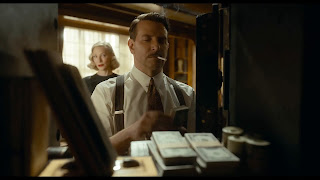
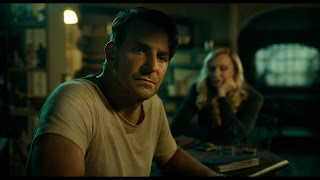
Professional huckster Stanton Carlisle (Cooper) has a shady past already when he weasels his way into a carnival. Here, he soon starts integrating himself into various acts, mostly that of "mind reader" Zeena (Toni Collette) and her much older husband, alcoholic Pete (David Strathairn). Unsurprisingly, Stan and Zeena have been getting it on while she and Pete continue to con the mugs.

It is not long however until Pete dies, but by now Stan has ended his fling with Zeena and turned his eyes to the virginal Molly (Rooney Mara), who is able to absorb huge electrical bolts. They go off together to start their own version of the Zeena/Pete con, but this time to the gullible elites. One of those not gullible is psychiatrist Dr. Lilith Ritter (Cate Blanchett), who sees easily through their con. However, she may be something of a con herself, getting Stan to dupe a judge and his wife who lost their son during the war.

Things, however, take an ugly turn when despite warnings from everyone from Molly to Ritter to Zeena herself, Stan decides to do a "spook show" and claim to be a medium. This brings him to the attention of wealthy Ezra Grindle (Richard Jenkins), who asks to have his former mistress Dory summoned. Using information secretly recorded by Ritter, Stan concocts a wild scheme. However, that scheme takes shocking and deadly set of turns, leading to death and a fall for Stan into geekdom.

I have developed somewhat of a fixation with running times in film. Dune seems to be the standard to which I'm judging all 2021 films with regards length. Nightmare Alley runs a stunning six minutes shorter than the first half of an epic space opera. As such, there is such a bloat to Nightmare Alley that you wonder why it takes so long to get where it is going. 

Del Toro could easily have trimmed much of the first hour where we are at the carnival to get to Stanton's long con. However, that would mean taking away a lot of the atmosphere that del Toro clearly loves. Nightmare Alley is heavy on atmosphere but not much in terms of story, at least again until Stanton and Molly leave for the bright lights of Buffalo. 

Once we leave the carnival, Nightmare Alley seems to wake up, bringing up a more interesting story and building on itself. However, by then many audience members might be dead-asleep from how long the film is. You do feel as if you are waiting for something to happen while del Toro indulges in carnie nostalgia.

It is a shame that Nightmare Alley opted for giving us atmosphere because it has some surprisingly good performances. I would not count Bradley Cooper among them though, even though he did try. His Stanton Carlisle was a bit hemmed into himself trying too hard to be either charming or mysterious. He gave it a good go but somehow, I did not see him as either charming or mysterious. He did manage sleazy well, so there is that.

Blanchett went perhaps a bit too strong on the femme fatale manner, but it works well here. Mara conversely did not make it work well when she played the polar opposite of the virginal Molly. She came across as sleepwalking. Collette and Willem Dafoe as Zeena and a freak show carnie were better. Jenkins seemed to be from a whole other movie altogether and to my mind seemed a bit forced as the mysterious and ultimately dangerous villain.

Nightmare Alley has a positive in its excellent production work and cinematography. Here we do see the sense and feel of the early 1940s, or at least the idea of the era.

If not for its seemingly endless first hour that drags the film down, I would have thought better of Nightmare Alley. It might be worth looking at versus watching, to enjoy the aesthetics for the first hour, the story for the second.

DECISION: C-

Tuesday, February 1, 2022

King Richard: A Review (Review #1573)

KING RICHARD

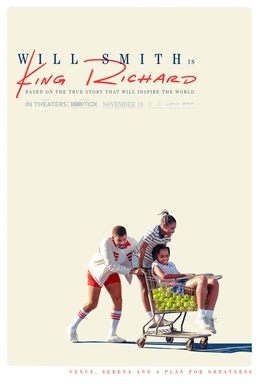
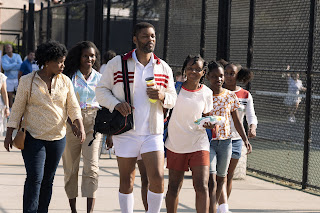
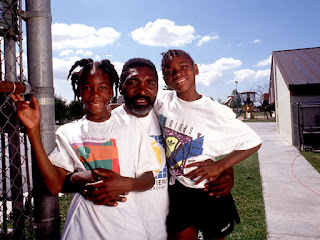
At first, I was confused as to why people opted to make a biopic not of the tennis stars and siblings Serena and Venus Williams but of their father, Richard. Not being versed in tennis lore, I was unaware of who Richard Williams was, let alone how he impacted the game. King Richard doesn't make the case that his life story deserves to be as long as it is. It is, however, a properly pleasant hagiography that should entertain people seeking inspirational stories.

Richard Williams (Will Smith) has one goal in life: to have two of his five+ children be tennis stars. They are his daughters Venus (Saniyya Sidney) and Serena (Demi Singleton), whom he has drilled probably since before birth. Richard's wife Oracene (Aunjanue Ellis) quietly supports his plans though she also disapproves of Richard's bulldozer manner with family and coaches alike.

He hustles to get Pete Sampras' coach, Paul Cohen (Tony Goldwyn) to train Venus for free (Serena, alas, will have to wait her turn). Even here though, Richard can't help interfering, his superiority pushing everyone around. Richard makes the controversial decision to pull his talented daughters out of Junior tournaments. He then gets another coach, Rick Macci (Jon Bernthal), eager to train the exceptional Venus but also displeased at some of Richard's manner. Finally, it is time for Venus to turn pro at 14 and take on the Number One female player, Arantxa Sanchez Vicario, where Venus loses and wins.

There is one long problem with King Richard. It is close to two-and-a-half hours long. For comparison, Dune is only eleven minutes longer than King Richard, and it should be remembered that Dune is meant to be a massive, epic film. King Richard's length forces us to endure long scenes that add little to what story it is trying to say. 

Take for example Venus' first Juniors competition. We get treated to endless montages of sore losers and spoiled sports, girls always scowling and yelling about losing. I figure their antagonistic reactions are meant to be a counterpoint to the Williams sisters more confident, upbeat manner. However, you felt that the editing could have cut down the time. Same with the road trip from Compton to Florida.

It should be noted that King Richard is produced in part by Will Smith and the Williams sisters. As such, we won't be getting many if any hints that Richard is anything less than a great man with a smidgeon of flaws. There is brief mention about Richard's other children, a detail that comes out of nowhere and is not mentioned again. Few people if any appear able to stand up to Richard, and worse, King Richard does not make the case as to why non-tennis fans should care about Richard's life.

Acting-wise, it becomes something of a guessing game to see which part of Smith's performance is meant to be his Oscar clip. From the very beginning Smith is very "actory" in his manner. By that I mean calculating, methodical, not so much playing Richard Williams but playing a man aiming for Academy Award recognition a la Eddie Redmayne in The Theory of Everything (albeit less overbearing). It is still showy in manner, with his curious accent and speaking manner. You can't help but cringe a little when swelling music starts to play as Richard respectfully tells off a Child Protective Services agent who came to their house.

As to why their neighbor apparently hates them so much for her to do such a thing is unanswered.

For some reason, when he tells an agent he suspects is racist "I just ax a simplified question", it sounded peculiar separate from the curious syntax. To me, it came across as forced, as if Smith was not so much trying to sound like the real Richard Williams but some version of a "less-educated and cultured" man. To be fair, I do not know what Richard Williams sounds like and Smith may be accurate (though given the requisite real-life clips at the end I didn't hear much if any similarity).

In some ways, King Richard makes him less heroic than the film would like us to see. He was close to killing a man and comes across as a bullying Little League parent. It isn't until late in the film that we get a reason as to why Richard picked tennis to be his daughters' future. For most of the film, it seemed he just picked that sport at random.

It is a shame that Will Smith is taking up so much Oscar talk, for if there were any justice it would be Aunjanue Ellis who would and should be the focus. She has her own requisite Oscar clip (when she quietly but firmly tells her husband that he is too overbearing to mask his deep-seeded fears that he may be a failure). However, it is the quiet strength she communicates that holds the viewers' attention.

Berthal does well in playing against type as the more chipper Macci. Usually cast as a more brooding figure, it is nice to see Berthal playing less intense man who is eager to please and generally happier.

The story of the Williams Sisters and their impact on both the sport of tennis and greater inclusion is worth knowing. King Richard, while almost harmless, does not make the case as to why their father is of such great importance.

Born 1942


DECISION: C+