Thursday, January 2, 2025

Love, Lights, Hanukkah!: The Hallmark Television Movie

LOVE, LIGHTS, HANUKKAH!

Hallmark Channel is keeping things kosher with another Hanukkah-centered film. Love, Lights, Hanukkah! is curiously part of the channel's Countdown to Christmas series. I guess since this year both Hanukkah and Christmas fell at the same time, it works. I was surprised at how much I enjoyed Love, Lights, Hanukkah! even with some flaws that would normally set my teeth on edge.

Restauranteur Christina Rossi (Mia Kirshner) is still grieving the death of her adoptive mother Sophia. The upcoming Christmas season brings mixed feelings for Christina. There is sadness at her mother's absence but joy in the decorating and upcoming Christmas Eve invite-only dinner. Sudden repairs at the ristorante force Christina to shut down temporarily. It does give her a chance to find out about her past. The DNA results come in, and she is delighted to find that she is indeed half-Italian.

She also finds out that she is half-Jewish.

With that, Christina searches out her Hebrew heritage. That leads her to a "close match" of Becky Berman (Advah Soudack). She and her brother Scott (David Kaye) are also restauranteurs who also took over their late father's restaurant. Becky and Scott want to know how close the close match is. With that, they all go for lunch with Ruth Berman (Marilu Henner). It is not long before Ruth puts things together and reveals a family secret: Ruth is Christina's mother! Ruth had impulsively married Giorgio, an Italian soldier, while she was studying in Italy. Giorgio's family forced them to get an annulment and cut off communication with Ruth, who could not tell Giorgio that they had a child.

With that mystery solved, Christina begins exploring what it means to be Jewish. This includes integrating Hanukkah with her beloved Italian Christmas celebrations. One thing she initially does not want to integrate into things is David Singer (Ben Savage). He is a Berman family friend but also a food critic who described Christina's lasagna as "predictable". Christina still holds a grudge about this dish dissing. In both their defenses, Christina had made that David's lasagna while still in deep mourning over Sophia's death. He was unaware that she was emotionally distraught when he sampled her wares. Despite themselves, Christina and David soon start seeing each other and enjoying each other's company. Will they get together through a Jewish mother's intervention? Will their seemingly separate careers allow them to bring these two lovebirds together? Are latke enchiladas kosher?

Love, Lights, Hanukkah! is a surprise in how it actually manages to make the romance between David and Christina natural. They do not officially date until late into the film. They also are seemingly unaware that they hold hands and wrap their arms around each other. Everyone else sees it, but David and Christina do not.

The movie also manages to introduce the conflict that keeps them apart quite well. David leads a peripatetic life and is on his way to Europe to research Jewish influences on Italian cooking. Christina wants to focus on building up her business. While not the most commonplace reasons to separate people, at least it is not without some logic.

Kirshner and Savage have good rapport with each other as Christina and David. I think it is because Karen Berger's screenplay did not force the relationship. In their scenes where it is just them, Kirshner and Savage have a strong chemistry and make the relationship natural. Their scenes are well-played.

Others though are quite shockingly weak. Kirshner is a bit too weepy and almost whiny when not with Savage, who is able to play his scenes with everyone well. As such, it cannot be all director Mark Jean's fault. I give credit to Henner when she steps away from the kitchen table on first hearing Christina's story. She plays the realization that her long-lost daughter has returned well, when she is alone. It is when she returns and tells everyone the truth that things look bad. For a shocking revelation of secret marriages and lost children, everyone seems pretty underwhelmed by the news. Of particular note are Soudack and Kaye, who do not look particularly shocked or upset or delighted to have a new half-sister pop out of nowhere.

As a side note, Kaye also appeared in Eight Gifts of Hanukkah also playing the loving brother to the female protagonist. I wonder if he is condemned to forever play "the nice, slightly wacky Jewish brother" in future Hallmark Hanukkah movies. He did have the few overtly funny lines in Love, Lights, Hannukah! whenever he proposed new Hanukkah dishes. His creations of Holy Guaca-latke and the Whole Enchi-latke will I'm sure appeal to that demographic of Jewish Mexicans who have yearned for kosher tamales.

Are tamales kosher? At my family's Christmas party, brisket was pretty big. Could we be descendants of Spanish Jews forced to convert? However, I digress.

Love, Lights, Hanukkah! was pleasant and respectful of the Judeo and Christian holiday traditions, where both sides got to show the other their specific customs. There is something amusing about David donning a Santa apron to make noodle kugel and listening to Christmas music. You have the Festival of Lights and the Feast of the Seven Fishes, which I figure is an Italian holiday festivity. The blending of holiday traditions, the importance of family, all blend surprisingly well in Love, Lights, Hanukkah!

The aspect about finding Giorgio felt a bit tacked on, but it was not a major element. 

Love, Lights, Hanukkah! is a nice, charming bit of comfort watching. Respectably acted, with no great disasters, this is a pleasant enough production.

One thing did puzzle me about Love, Lights, Hanukkah! How is it that David bragged about knowing how to say goodbye in 40 languages, but not once did he ever say "Shalom"?

8/10

Wednesday, January 1, 2025

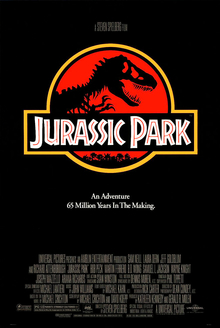
Jurassic Park: A Review (Review #1921)

 JURASSIC PARK

When Jurassic Park was released, it was seen as a fun, thrilling, exciting film with groundbreaking special effects. Whether anyone imagined it would be the start of a major franchise that would be the first of five sequels as of this writing (with one set for release later in 2025) I cannot say. The first Jurassic Park film, removed from what would come after, holds up extremely well, does not wear out its welcome and gives people what they wanted.

Billionaire John Hammond (Richard Attenborough) has created what he delightfully calls an animal sanctuary. However, after one of the creatures kills a worker, lawyer Donald Gennaro (Martin Ferrero) will not sign off on Hammond's new venture on behalf of the investors. The only way to get Gennaro and the investors off Hammond's back is if independent scientists vouch for Hammond's park. With that, Hammond brings paleontologist Alan Grant (Sam Neill) and paleobotanist Ellie Sattler (Laura Dern) to his island. Gennaro for his part brings mathematician Ian Malcolm (Jeff Goldblum) for that verification.

Why these particular figures? Hammond's new island, which he envisions as a nature/amusement park, has brought back the dinosaurs to life. Intoning with a sense of childish glee, he tells Sattler and Grant, "Welcome to Jurassic Park". Hammond, expecting a positive to enthusiastic response from the three scientists, instead encounters firm opposition to the park's existence from all of them, with Malcolm particularly vocal in his objections. Insisting that they will change their minds, all save Hammond go on a motorized tour, with Hammond's grandchildren Lex (Ariana Richards) and Tim (Joseph Mazzello) joining them. 

Tim in particular is an Alan Grant fan, which cuts no ice with him since Grant dislikes children. The tour is a bust, with the dinosaurs not appearing. However, there is chaos growing internally and externally at the park. A tropical storm is brewing, while park technician Dennis Nedry (Wayne Knight) has shut down the systems. Ostensibly, this is for maintenance, but in reality, he is stealing dinosaur embryos to smuggle to Hammond's business rivals. The two things collide when the dinosaurs become loose in the park and Nedry's elaborate computer security software prevents the others from regaining control. 

Soon, total chaos and dinosaurs break out. People start dying and others are in danger. Who will survive and who will not as the dinosaurs start taking over Jurassic Park?

One of the keys to Jurassic Park's success is in anticipation. Director Steven Spielberg builds up the suspense right at the opening, when we see rustling in the trees. We should know that we are not going to see dinosaurs right from the get-go, but the tension builds while we keep getting hints about what they can do. When, later in the film, we see a cow being dropped into a Tyrannosaurus Rex's holding cage, we do not see the dinosaur, but we see the aftereffects of what it did to the cow. The tension slowly builds here too, when big game hunter and Jurassic Park game warden Robert Muldoon (Bob Peck) coldly informs the group that the T. Rex is both smarter and more dangerous than given credit for.

This element in David Koepp and Michael Crichton's screenplay (adapting Crichton's novel) gives audiences hints of what is to come, keeping our interest going. Even after we initially see dinosaurs for the first time at about twenty minutes into Jurassic Park, we know that there will be more. Once we get the first sight of the Tyrannosaurus in all his glorious rage close to an hour into the film, Jurassic Park never fully stops in what audiences expect: visual spectacle and thrills. 

The anticipation continues when it comes to the characters. We know early on that Grant has a dislike to open hatred of children. Therefore, when we see Lex and Tim, we know that there will be conflict. This is added on by knowing that Tim is a big fan, someone who has read Grant's books and is well-versed in Grant's thinking. Tim would be what we would now call a fanboy, so knowing that Grant dislikes children does add two elements to the film. 

The first is a bit of comedy where we see Grant struggle between cool politeness and open contempt. The second is the evolution of his character into a protector of children. Certainly Grant, even for someone who pretty much hates children, is not going to see kids killed. It is an interesting twist that it is Grant, not Malcolm, who risks his life to distract the T. Rex in order to save Lex and Tim. As the film continues, however, Grant becomes fond of them, even allowing himself a moment of humor when he pretends to be electrocuted. It is a credit to Sam Neill that he made Alan Grant both a humorous figure and a man of courage.

This part of Jurassic Park perhaps has not been given much credit: even with the spectacle and visual power of the visual effects, the film does not skimp on the human characters. You have the gleefully wicked Nedry, wonderfully played by Wayne Knight with malevolent joy. Richard Attenborough shows his mix of arrogance, ego and ultimately humility as Hammond, who realizes too late that he cannot control nature. Dern is a showcase for the strong female character, one who can roll her eyes at Hammond's sexism when lives are in danger. However, we also see that she is not a Mary Sue: she too has fears and at one point breaks down in tears. That does not make her weak. It makes her human. In his mix of flirtation, moral indignation and fear, Goldblum does an exceptional job.

The big draw in Jurassic Park are the visual effects, a blend of computer-generated imagery and practical mechanical figures. Despite the passage of thirty years at the time of this writing, the effects in Jurassic Park look thoroughly realistic and appropriately terrifying. To be fair, the birthing of a new dinosaur may not be as completely impressive as it was in 1993, but that is a minor point.

Jurassic Park is also blessed with John Williams score. Appropriately stirring, thrilling and quiet when needed, Williams' music elevates the scenes when it is needed. Note that when the Tyrannosaurus Rex first attacks, there is no music. The lack of music here equally elevates the scene, allowing the tension to build to a fever pitch.

One of the strongest elements in Jurassic Park is that it takes the premise seriously. The T. Rex attack, for example, is played realistically: the kids panicked and terrified, the adults either stunned or cowardly. Extremely well-acted by Richards and Mazzello, this section is simultaneously thrilling and frightening. Richards and Mazzello carry the film well when they have to face the terrors alone.

Jurassic Park will continue to thrill viewers with its mix of brilliant special effects, moments of horror and humor and John Williams' score. A good popcorn film that works on every level, Jurassic Park will never be short of visitors, even on Coupon Day.

DECISION: A-

JURASSIC PARK FILMS

The Lost World: Jurassic Park

Jurassic Park III

Jurassic World

Jurassic World: Fallen Kingdom

Jurassic World Dominion

Jurassic World Rebirth

Tuesday, December 31, 2024

A Complete Unknown: A Review (Review #1920)

A COMPLETE UNKNOWN

Biopics can go one of two ways. They can attempt to cover the entirety of the subject's life, or they can attempt to cover certain time periods of the subject's life. The recent Reagan, which I did like, attempted the former to various degrees of success. A Complete Unknown, conversely, goes for the latter, covering the life of Bob Dylan from when he arrived in New York City to when he shocked the folk world by plugging in at the Newport Folk Festival. With standout performances and a well-crafted story, A Complete Unknown is a complete triumph.

Little Bobby Dylan (Timothee Chalamet) arrives in New York City to seek out his hero, ailing folk pioneer Woody Guthrie (Scoot McNary). Guthrie is impressed by the young aspiring singer/songwriter, as is Guthrie's friend and fellow comrade Pete Seeger (Edward Norton). With nowhere to stay, Seeger has Bobby stay with him and his wife Toshi (Eriko Hatsune). 

Dylan starts making a name for himself through his songs and soon is drawn to two different women. One is pretty Sylvie Russo (Elle Fanning), a student committed to social change with whom he soon moves in with. The other is Joan Baez (Monica Barbaro), Queen of the Folk Singers who soon sees in Dylan a kindred and romantic partner. Dylan's successful folk music oeuvre delights everyone but also becomes something of a burden to him. Seeger and folk music impresario Alan Lomax (Norbert Leo Butz) want Dylan to stay the same, playing his "finger-pointing songs" the same way and be that "voice of his generation".

Robert Zimmerman, however, wants to be released. He wants to expand his work and emulate another musician he admires, Johnny Cash (Boyd Holbrook), who can shift from country to folk to even rock. As Dylan's personal and professional lives keep colliding, will he manage to express himself freely and rock out? Will Sylvie and Joan be with him?


I admit that I am a big Bob Dylan fan, having seen him twice in concert. I will also admit that his voice, especially now, is not what I would call silky smooth (that second concert where he performed songs from the Great American Songbook, was interesting to say the least). However, I figure that his rendition of these standards is typical of this iconoclast, who is forever shifting and changing to fit his mercurial nature. A Complete Unknown, adapted by Jay Cocks and director James Mangold from Elijah Wald's Dylan Goes Electric! gives us a nice overview of the world that Dylan was both entering and shaping. We jump in quickly to when Dylan, this very young, almost naive man, comes to meet his hero and over the course of an admittedly long film, we see him writing, performing, loving and stretching artistically.

This Dylan is not some pure young man seeking out to speak truth to his generation. He is evasive, flawed, sometimes funny, arrogant but also filled with determination to do things his way. Timothee Chalamet bookends his year with a standout performance as Zimmy. He not only gets Dylan's speaking voice and at times halting manner but his persona, at times worshipful to people like Guthrie or Cash but also a bit contemptuous of how others hold him back. Dylan may see Seeger as well-meaning, but he also sees that Pete is in his way stuck in the past, determined to be pure in folk even if that means stifling Dylan's muse. 

Edward Norton is also extremely strong as Pete Seeger. He is seemingly sweet with his banjo and apparently innocent songs. Just as Chalamet does an excellent job sounding and speaking like Dylan, Norton does as well in sounding and singing like Seeger. Norton even manages to make Seeger's elevated head cock look natural rather than actory. 

Fanning and Barbaro were standouts as the two women in Dylan's life. Fanning has the look of love mixed with great regret that she lost Bobby to someone more like him in terms of music and worldview. Her last scene as she leaves Dylan is quite moving. Barbaro too has great moments when dealing with Dylan's work style both on and offstage.

Even the smallest parts were well acted. Dan Folger was good as Albert Grossman, Dylan's manager forever attempting to both protect and promote Dylan's interests whether Dylan helped or hindered his efforts. Butz's Alan Lomax had the arrogance and self-righteousness of someone determined to be what would now be labeled a "gatekeeper" of pure folk music. I did not think Holbrook hit all the right notes as Johnny Cash (no pun intended), but he did well enough.

A Complete Unknown did a fine job production wise, taking you to this folk scene in New York and Newport and making this world come fully alive to the viewer. For those of us who love Dylan's music, A Complete Unknown gives us some wonderful songs sung quite well by those performing. 

I was thoroughly pleased with A Complete Unknown in all aspects. The performances are excellent. The story, despite its two-and-a-half-hour runtime, never feels long or padded. How does it feel? It feels like A Complete Unknown is one of the best films of the year.

Monday, December 30, 2024

Nosferatu (2024): A Review

NOSFERATU (2024)

Atmosphere can go a long way. When it comes to the second remake of Nosferatu, atmosphere is all it has. Somewhere trying to claw its way out, Nosferatu is a film with great visual ambition but not much else.

In 1838 Germany young Thomas Hutter (Nicholas Hoult), newly married to the beautiful Ellen (Lily-Rose Depp), is sent to far-off Transylvania to finalize a major deal with the reclusive Count Orlok (Bill Skarsgard). Orlok is wealthy but causes the local people and the Gypsies to live in terror of him. It is not a surprised, as he is a vampire. There is a connection between Orlok and Ellen, and despite Thomas' efforts he struggles to get back to his beloved.

Ellen, watched over by family friends Fredrich and Anna Harding (Aaron Taylor-Johnson and Emma Corrin), now has strange visions and dreams, sleepwalking and growing more obsessed with how "he is coming". Also obsessed is Herr Knock (Simon McBurney), Thomas' employer who has gone mad due to Orlok's evil power. Orlok comes to Germany, bringing the plague to the area. Only eccentric scientist and occultist Professor von Franz (Willem Dafoe) is able to understand Orlok's power and danger. Orlok, now in Germany, enacts a terrible price on the Harding family to show his power. Will Ellen be able to sacrifice herself to save her world? Will Orlok be triumphant over his enemies?


There is a major problem in Nosferatu that made it difficult if not impossible to recommend. Writer/director Robert Eggers decided that Nosferatu needed to be "atmospheric" by having greys and sepias dominate the film. Unfortunately, the end result made things almost impossible for me to literally see. So much of Nosferatu is so opaque that it devolved into something of a guessing game as to what was going on. Granted, it was not completely impossible to see. However, the lines from a Bob Dylan song came to mind.

"It's getting dark, too dark to see", and that was a major problem. I can give a little leeway and say that maybe the print that I saw was hard to see. However, that I do not believe was the case. I think Nosferatu was trying too hard to be gothic that it made it sometimes impossible to make out what was on the screen.

The few things that I could see did not make me like it more. I figure that audiences know that this is all fiction. However, I still find it highly tawdry to see children killed, even if in shadow and in a supernatural setting. Something about that just hits me hard, hard enough to not want to keep going even in something like Nosferatu. To be fair, I do not remember if this was an element in the two previous versions. If so, I have forgotten or perhaps found that it was not as overt as it was here.

I found the acting overall if not theatrical at least deliberately mannered. Everyone was rather grand in the film, which curiously robbed the film of what great suspense that it could have had. I do think well of McBurney's Herr Knock, who starts out sane and ends up biting off the head of pigeons and goes all-in on the cray-cray. I think it was a deliberate decision of Eggers to hide Bill Skarsgard for nearly the entirety of Nosferatu. I give Skarsgard credit for using his voice and body to create this menacing figure. It is a pity again that we saw so little of him.

What I could make out of the production design and costuming in Nosferatu was appropriate to shape this gothic world. The cinematography though made things remarkably, dare I say excessively opaque.

Nosferatu could have been better. I think it is being overpraised, especially since I could not see much of it. I do not know if it will rank with either the silent original or the German-language remake. I might see Nosferatu again, if I could find a print that was not so dark.

Sunday, December 29, 2024

Speak No Evil: A Review

SPEAK NO EVIL

One tries to be pleasant with strangers even when they behave in very eccentric ways. Speak No Evil, an English-language remake of a Danish-Dutch film, is respectable and held together by a strong central performance. 

While on vacation in Italy, American couple Louise and Ben Dalton (Mackenzie Davis and Scoot McNairy) bond with British couple Patrick "Paddy" (James McAvoy) and Ciara (Aisling Franciosi). The bonding includes how Louise & Ben's daughter Agnes (Alix West Lefler) and Patrick & Ciara's son Ant (Dan Hough) both have issues. Agnes won't let go of her toy rabbit Hoppy despite being eleven years old, and Ant was born with a smaller tongue, making communication hard.

Louise and Ben live in London where they are struggling with professional and personal issues. When they receive an invite to join Paddy, Ciara and Ant on the Devonshire farm, they take it as a chance to recharge. They are unaware of how sinister and dangerous their hosts are. Over the course of their time, Louise and Ben see how Paddy and Ciara behave in strange ways. They simulate sex at a small restaurant and have the Daltons pay. They are quite abusive towards Ant and even have Agnes share their bed. Louise is adamant that they leave in the middle of the night, but Agnes' fixation over Hoppy forces them to return.

From here, we learn a horrifying truth about past guests of Paddy and Ciara, with Ant as their victim instead of their son. Will the Daltons manage to escape this house of horror or will they in turn find themselves the newest trophies for Paddy and Ciara's satanic collection?

Speak No Evil is worth watching for one performance and it is that of James McAvoy. I have always thought well of McAvoy, Victor Frankenstein being a terrible exception. He is the type who can travel smoothly from costume pictures to action pieces and now to thrillers. His Paddy is someone whose seeming pleasant manner is always a bit off-kilter. You sense that Paddy is dangerous and threatening, yet you cannot pinpoint anything specific. McAvoy gives us someone who could fool the Daltons and his past victims, who can come across as menacing but also reasonable.

You also get a chance to see McAvoy show off his extremely buff body, impressive for a forty-five-year-old man of relatively short stature. Most of the cast may physically tower over McAvoy, but he dominates everyone onscreen, making for great viewing.

The other cast members though do not make for great viewing. I think it is because of one thing that McAvoy does that the others at minimum struggle with. It is in taking the premise seriously. Davis and McNairy are at times unintentionally funny and at times stiff on screen. I literally laughed at the end when I saw Davis' face at the end when Ant strikes back. I think it is because due to writer/director James Watkins, they at times seem to be more in a domestic drama than in a horror film. 


I also think that some of Speak No Evil could have been resolved if not for those dumb decisions that the characters make. Given how at one point the Daltons had managed to escape, I find Agnes' insistence of returning for Hoppy to have doomed them. I was with Ben on that issue: no matter how much Agnes hits and screams, they should have fled for their lives rather than return for a bunny to satisfy the emotional needs of eleven-year-old girls. I think that, had they opted to try and quietly leave in the morning, the Daltons could have survived without the horror of the final act. 

Then again, I may be overthinking things.

In many ways, one should know how Speak No Evil will go, separate from it being a remake. There is a familiarity to the story, of those who are lured into danger that will inevitably lead to a bloody conclusion. I think this is the kind of film that gives audiences what it wants: some scares, some suspense and a strong James McAvoy performance. It knows what it is and on the whole, Speak No Evil will please thriller fans. 

Saturday, December 28, 2024

Sonic the Hedgehog 3: A Review


SONIC THE HEDGEHOG 3

I respect films that know their audience and do not try to either insult them or talk down to them. The Sonic the Hedgehog franchise is one that knows what its viewers want and gives it them. A bit dark in my view for younger kids, Sonic the Hedgehog 3 is a fun, zippy film that I found oddly moving at times.

Sonic (Ben Schwartz) is enjoying life with his family. However, he and his fellow creatures Knuckles (Idris Elba) and Tails (Colleen O'Shaughnessy) are immediately taken to Tokyo to face off a new threat fifty years in the making. Leaving their de facto human parents Tom (James Marsden) and Maddie (Tika Sumpter) behind, our trio take on a new hedgehog, Shadow (Keanu Reeves). Shadow is stronger than Knuckles, smarter than Tails, and perhaps even faster than Sonic. To defeat Shadow requires all hands-on deck. 

That means even the villainous Doctor Ivo Robotnik (Jim Carrey), who is being framed for Shadow being released despite the protests of Robotnik's loyal henchman Agent Stone (Lee Majdoub). However, we find that there is a connection between Robotnik and Shadow, and that is Robotnik's grandfather Gerald (Carrey in a dual role), very much alive. The Robotnik grandfather and grandson decide to bond, much to Stone's sadness at being excluded, and also join forces for revenge.

However, it is not revenge against Sonic that they unite against. Gerard Robotnik wants to destroy the world, which even as someone as evil as Ivo Robotnik cannot go along with. He just wants to conquer the world, not kill everyone. Will Sonic convince Shadow, deeply hurt at the loss of his child friend from 1974, to switch sides or will Sonic's own need to avenge those he loves end up helping destroy the world? Will Ivo be able to outwit his villainous and equally brilliant grandfather?

One of the positives in Sonic the Hedgehog 3 is how it goes through things remarkably fast. Perhaps that should not be a surprise given how Sonic is, by his own admission, the fastest creature on Earth. We go from seeing the three creatures to them going to Tokyo to them fighting Shadow to them regrouping and then to reencountering Dr. Robotnik in remarkably quick succession. I figure that those who have not seen the first two Sonic the Hedgehog films might get a bit confused. However, I think that we establish things rather quickly without having to rebuild the characters. We get indications that Sonic is immaturely arrogant, Tails is sweet and smart, Knuckles is strong and self-assured and Robotnik is pretty bonkers but delightfully so.

We also get Shadow's threat quickly when he finally gets out of the secret second holding lab he is at. We do have a flashback via Gerard to explain what happened to Shadow and his human friend, but I think that was needed for even the Sonic fans aware of who Shadow is.

Sonic the Hedgehog 3 also has a lot of in-jokes that those not familiar with the video games will appreciate if not get. After their first encounter with Shadow, the three aliens regroup not in a lab or underground lair, but in a Chao Garden. Those of us who have never played a Sonic game would see it as a cutesy, Chucky Cheese-like place where Japanese families go for child entertainment. Those who have would get the joke about the Chao Garden. In both instances, it works in Josh Miller, John Whittington and Pat Casey's screenplay. One can enjoy it on both levels and/or one level. 

A surprising element in Sonic the Hedgehog 3 is how apart from Carrey and a lesser extent Majdoub, the human characters are unimportant. You had quick cameos from Natasha Rothwell and Shemar Moore as Maddie's sister and brother-in-law and exactly one scene with Deputy Wade (Adam Pally). Both are unnecessary, but they do not negatively impact the film either. Even the lack of screentime for Marsden and Sumpter was barely noticeable.

I think that is because the aliens and Carrey all worked so well together that it made Sonic the Hedgehog 3 more focused. You had a continuing series of events that move well and few if any distractions. You also have great work with the four aliens, each bringing their characters to life. Schwartz made Sonic that cocky but still immature figure, endearing but also in need to learn. O'Shaughnessy's Tails was still sweet and endearing, Elba's Knuckles unaware but confident. Keanu Reeves as the new figure of Shadow made his creature one driven by genuine loss.

And then there is Jim Carrey in the dual roles of Gerard and Ivo Robotnik. The film is smart enough to be self-aware about the logic, or lack thereof, in things when Carrey makes a joke about how they look like the same actor playing two roles in a movie. However, when they do their bonding montage to the Beach Boys' Wouldn't It Be Nice we pretty much forget that Carrey is playing two roles with surprisingly effective visual effects. Director Jeff Fowler even allows a bit more comedy whenever the poor Agent Stone attempts to join in the grandfather/son montage. 

There was a lot of humor courtesy of the screenplay. The entire Chao Garden scene was delightful, and Sonic's quips about calling Shadow "Tokyo Drift" or telling Tails and Knuckles that he did not know if what was attacking Tokyo was Godzilla or Hello Kitty were amusing, even cute. As much fun as Sonic the Hedgehog 3 was having with the story, the film still managed to get in some moments of emotion.

At the end, when the Robotnik death machine is disintegrating, Carrey's Robotnik gives a surprisingly touching, even moving farewell to someone he calls one of the best henchmen ever. "You were more than a sycophant," Carrey tells Majdoub. "You were a syco-friend". Delivered in a comic but true-to-character manner as Robotnik, I admit I was surprised by how much that seeming farewell touched me. 

Sonic the Hedgehog was filled with some beautiful animation that pleased the eye. It somehow managed to integrate songs like the aforementioned Wouldn't It Be Nice to The Traveling Wilbury's End of the Line. Even the comic La Ultima Pasion telenovela that Robotnik got addicted to was in the fun spirit of the film.

Sonic the Hedgehog 3 is a nice fun film. It might be a tad dark for small kids given that the death of a child is involved, even if it is in shadow. However, on the whole Sonic the Hedgehog 3 is an enjoyable romp that respects its audience and gives them a good time at a good speed.

DECISION: B+

Friday, December 27, 2024

Queer: A Review

QUEER

Once the word "queer" meant "strange" or "eccentric". Later on, it was seen as a slur against gay men. Now, some gay men have embraced the term to mean either as a source of Pride or a way to describe a more expansive definition to gay. I do not know in what way writer William S. Burroughs meant the word to be taken when his novella Queer was finally published. I can imagine that, after seeing the film, all three definitions of "queer" would fit.  

Queer is divided into three chapters: How Do You Like Mexico?, Traveling Companions and The Botanist in the Jungle, with an Epilogue of Two Years Later. In its story, we see American expatriate writer William Lee (Daniel Craig), who spends his days in Mexico City boozing, shooting up heroin and seeking the company of pretty young boys. On one night, he spies pretty American Eugene Allerton (Drew Starkey), who may or may not be queer. Lee and Eugene start what can qualify as a friendship with benefits, though Eugene again insists that he is not gay.

Despite the warnings of his friend and fellow gay expat Joe Guidry (Jason Schwartzman), Lee takes greatly to Eugene and asks him to travel with him to the Amazonian jungle in search of a plant that will give them the power of telepathy, a particular obsession for Lee. After some issues, they arrive to find the mysterious and eccentric Dr. Cotter (Leslie Manville) and her husband. Lee and Eugene partake of the plant, which gives them telepathy and some strange visions of them vomiting their hearts out and weird ballets where they meld into each other. They do part, and Lee dies old and alone, with visions of Eugene Allerton coming to him one last time.

Had Queer opted to not be as faithful to Burroughs' work as I think it is (again, I have not read Queer), I think we might have had a strong dramatic film about lost same-sex love, if a bit eccentric on its visual style. However, once Lee and Allerton go off into the Amazon and have their strange, quiet visions, Queer goes so far off the rails that it never recovers. I saw a couple walk out after Lee and Allerton vomit their literal hearts out. 

They missed the strange naked ballet that Craig and Starkey performed with each other, as oddball a vision that director Luca Guadagnino has given us as I can think of. Guadagnino has taken us through a same-sex May-December romance in Call Me by Your Name, though at least in Queer both of them were of perfectly legal age of consent. I imagine that Guadagnino and screenwriter Justin Kuritzkes wanted to stay true to Burroughs' book. That, however, may be the problem.

The film becomes so oddball, so self-important, that it ends up turning most people off. It shifts from an eccentric but interesting drama of a man, lost in his haze of booze and drugs, attempting to find genuine love versus mere sex with a pretty young thing who may be toying with him. It turns into some weird, almost goofy production that delights in its own overt strangeness. One already gives Queer a lot of leeway by its use of contemporary songs for 1950s Mexico (the film begins with Sinead O'Connor's cover of Nirvana's All Apologies and Come as You Are plays when Lee and Allerton first set eyes on each other). Once we get to The Botanist in the Jungle, the film is done, and nothing can bring it back.

I figure that Queer reflects the drugged-out mind of William S. Burroughs and is at least semi-autobiographical. It does not make it any more approachable. On the contrary, it makes it more distant even I figure to a gay audience that might be turned off by how comical the third act becomes.

It is a shame as the fatal Chapter Three kills off whatever good, if a bit odd, goodwill Queer had built up. Daniel Craig, I think, is attempting to build a post-James Bond career by delving into this troubled man, lost in his feeding his vices carnal and chemical. It could have made for an interesting exploration of desire, even as Craig continues to struggle shaking his Foghorn Leghorn accent off whenever playing Americans. It could have been a good performance, but it went off late in the film. Better was Starkey as Allerton, who was not as infected with the strangeness of Queer's narrative and seemed to play someone who was closer to reality.

Two big surprises were Manville and Schwartzman. Both were unrecognizable in their roles, the latter more so under his makeup. They went all in and made for interesting viewing. I cannot say great viewing, but interesting. 

Wandering between esoteric and downright looney, Queer is indeed that.

DECISION: D-