Wednesday, April 5, 2017

Feud: More, Or Less Review


FEUD: MORE, OR LESS

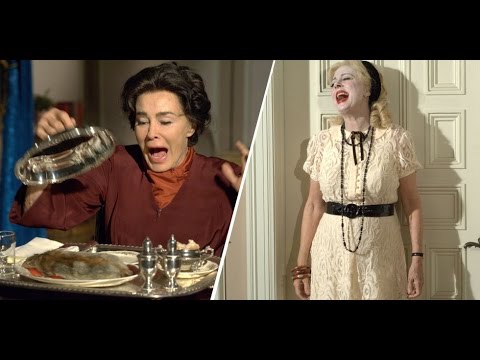
It once was the work onscreen that we judged.  Now we have the backstory, in this case on What Ever Happened to Baby Jane?, the first and last time two notorious rivals and divas, Bette Davis and Joan Crawford, would work together.  Their bitter fight come to a bruising climax in More, Or Less, the fourth episode of Feud: Bette and Joan, and the specter of Oscar hangs over our two dueling divas.  Behind their war over the ultimate status symbol in Hollywood, More, Or Less is also about the difficulties of being a woman in the film industry, both in front of and behind the camera.  Sadly, the more things change...

Joan Crawford (Jessica Lange) and Bette Davis (Susan Sarandon) have private fears about What Ever Happened to Baby Jane?, sensing that if it flops, their careers are essentially over.  Will people watch these two old women (old by Hollywood standards), who are considered has-beens in the industry, revel in grotesque acts against the other?  Things do not bode well for either of them: despite having just made a film, neither can find more work.

Baby Jane director Bob Aldrich (Alfred Molina) has his own worries; he wants to catapult to bigger and better things, but Warner Brothers head Jack Warner (Stanley Tucci) essentially tells him he isn't good enough to be among the great directors.  Aldrich rejects all of Warner's scripts as Baby Jane knockoffs, but he is stuck when forced to direct a Western starring Frank Sinatra.  Ol' Blue Eyes is a monster and nightmare to work with: demeaning to everyone, dismissive of Aldrich as director, and not afraid of threatening gangster violence on anyone who doesn't cater to his diva temperament.

This, therefore, isn't the best time for Bob's loyal Girl Friday, Pauline Jameson (Alison Wright) to try and break into the business as a writer/director.  Pauline has an unexpected ally in Mamacita (Jackie Hoffman), Crawford's loyal Girl Friday who tries to get Crawford to work on Pauline's picture, with Pauline directing.  Crawford, however, has fears about trusting a novice director and female at that, for her first vehicle after her second 'comeback' (Mildred Pierce being her first), and unlike Pauline, Crawford remembers how women directors were shunted off once silent pictures went the way of all flesh.

To the surprise of everyone, What Ever Happened to Baby Jane? becomes a monster hit.  Crawford and Davis are relieved and delighted, but the former soon begins to panic.  She senses that Davis, with the showier part, is running away with the success, and the potential for an Oscar nomination.  Crawford is particularly terrified and infuriated by the idea that Davis will get a nomination and she won't.  Should Davis actually win, it will be her third Oscar, something no other actress had yet accomplished (the fact that Crawford had won only once being more fuel for her wrath). 

Davis goes full-force into promoting Baby Jane, making appearances in theaters and television (even belting out a novelty song called What Ever Happened to Baby Jane?, a brave act given she had no singing voice).  Crawford retreats into bitterness and the bottle.  Davis takes anything offered her, even a guest spot on Perry Mason (which given it's television, Davis isn't thrilled about).

Pauline finds her own dreams of moviemaking gone, but Mamacita, her secret ally, tells her over pie (something the health-conscious Crawford forbids her at home, but cannot stop her from having outside her watchful eye) not to fret.  Mamacita has been studying the growth of the American population, particularly on how women are slowly outnumbering men.  She tells Pauline that by 1970 the studios will be forced to hire more women directors and make more films geared towards women because of the majority of the audience will be women.

They'll be forced to cater to women, and Pauline's time will come.

Pity Mamacita never saw the rise of the Marvel Cinematic Universe or the growth of both the teen boy and Chinese market...

In the end, the Oscar nominations come out.  Joan Crawford is told to sit down by Mamacita, and we hear her wail of torment...

I find that what has been said about films and/or television shows set in the past is true: they are not so much chronicling what has passed but what is now.  Intelligent television and film (for example, The Americans, also on FX) may take place in a particular time and place (such as the 1980s or early 1960s), but they are in fact commentaries about the world now. 

Feud: Bette and Joan may be about the bitter rivalry between these two great actresses.  It is also about how the entertainment industry still struggles with giving women true parity with men on both sides of the camera.

We see this with Pauline, someone who hasn't been strictly in the background but who in More, Or Less emerges as a major part of the story.  Alison Wright is simply an undiscovered treasure (and in a curious turn, one of the major elements of what made The Americans such a great show). Wright balances the mixture of steeliness and vulnerability, between pushing for her own career and conceding the near-impossibility of it.

Pauline is burning with ambition.  She is bright.  She is capable.  She doesn't even want any special favors.  What she wants is a chance, a chance she won't get. 

She has all the accruements that would make for a reasonable chance at a writer/director career but one: she is a "She". 

What is interesting, to me at least, is how Crawford, who knows how hard the industry is to women, will not help a fellow woman.  Her reasoning is logical: after having her biggest hit in years, where there is now hope of a third wind to her career, she would be putting herself as a hostage to fortune by following up Baby Jane with a picture by an unknown, particularly from a woman at a time where a female director was almost unheard of (in the 'Golden Age', Dorothy Arzner was about the only female director of the era).

Mamacita's analysis is perhaps one of the most insightful regarding the state of the film and television industry today.  She (through screenwriters Gina Welch and Tim Minear) predicts that studios will have to eventually bend to giving women more jobs and make films with a female perspective based on the fact that the audience will be majority-female.  However, that precisely hasn't happened. If anything, Hollywood is becoming more resistant to female-centered films, female directors, and female executives (people like Sherry Lansing and Kathryn Bigelow notwithstanding).

Mamacita's prediction failed, in my view, because studios discovered the teen market, particularly the teenage boys, who wanted action over nuance, explosions over character, and sex/titillation over gender equality.  The roles for women have not improved, even when presented in more 'positive' light (Black Widow, the only female member of The Avengers, not only had the indignity of not having her own action figure upon Age of Ultron's release, but in that film, she was essentially relegated to 'love interest/damsel in distress').  The fact that so many films are made from comic books, dominated primarily by young men, with no end in sight for the Cinematic/Extended Universes, shows how current film will not bend to Mamacita's logic.

I've digressed greatly, but it's an endlessly fascinating topic: how despite being the majority of the population, women still are greatly underrepresented in film.  Add to that a limited shelf-life for actresses once they hit forty (something Crawford and Davis faced), and you see that Feud's subtext of the ageism and sexism in Hollywood is still as strong as ever.

One more digression: in the past decade, the youngest Best Actor Oscar winner at 32 was either the same age or older than five Best Actress Oscar winners during the same time period.  I said older, not younger.  Think on that: that five out of ten Best Actress Oscar winners were actually younger than 32.


More, Or Less again brilliantly manages to show the similarity between Crawford and Davis right from the beginning when both meet with their agents.  Crawford's phalanx of agents can't (or won't) get her new roles, and Davis is astonished and horrified to find someone old enough to be her son (and looking every bit his 22 years of age) to be her representative. In this opening scene, there's even a nod to Mommie Dearest, when Lange as Crawford appears in a fur hat and black clothes similar to the ensemble Faye Dunaway wore when meeting with Pepsi-Cola executives (and infamously shouting at this group of men when told she was being retired from the Board of Pepsi, "Don't F*** with ME, FELLAS!").

Lange as Crawford makes her almost sympathetic in her fear and paranoia about Oscar, and Sarandon as Davis gives us someone to respect, one who is hustling hard to make Baby Jane a hit.

In a smaller role, Toby Huss captures both the voice and cantankerous nature of the Chairman of the Board.

Again, this framing device of having Olivia de Havilland and Joan Blondell giving a joint interview in 1978 prior to the Academy Awards doesn't work for me.  I'm still hoping things will work out well for this bit, but so far, not buying it.
      
For its wit, its strong performances (particularly Wright), and for its insight into how the past can illuminate the present, we can't get enough More, Or Less.

9/10

Next Episode: And the Winner Is...(The Oscars of 1963)

Tuesday, April 4, 2017

Kong: Skull Island. A Review (Review #901)


KONG: SKULL ISLAND

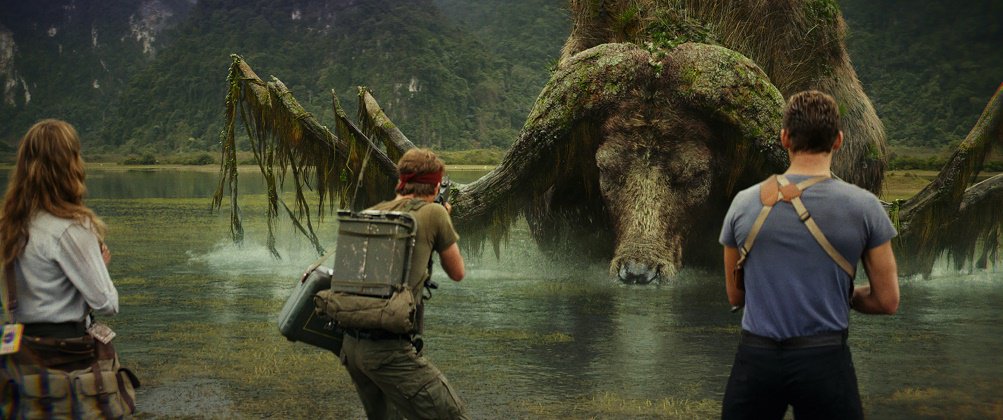
Kong: Skull Island is a curious film in that it is not a sequel or prequel to all the various King Kong films made before (though one wonders given the 1970s setting it would have been closer to the 1976 remake).  However, in its own way, Kong is setting up to be the first part of a major franchise, which fills me with more horror than the big monkey himself.

It's 1973, and scientist Bill Randa (John Goodman), along with his protégé Houston Brooks (Corey Hawkins) get U.S. government help in exploring the mysterious Skull Island, a realm which thanks to a perpetual storm cloud keeps outsiders at bay.  They get military help, headed by General Preston Packard (Samuel L. Jackson), who is eager for one last battle now that the Vietnam War is winding down (a war he's convinced we could have won).  He takes some of his men on this mission, even if means pulling them out from R & R.

Also going is former British Special Forces officer James Conrad (Loki himself, Tom Hiddleston), who is now a tracker for hire wiling away his life in the dens of Saigon.  He senses both danger and something Randa is hiding.  Our final explorer is Mason Weaver (Brie Larson), a photojournalist who has been using her lens to rally opinion against the war. 

They go into Skull Island, where the landing party is almost immediately attacked by a fierce monster: a gigantic ape that smashes their helicopters and kills some of the soldiers.  The group is split into two: one with General Packard, the other with Conrad.  Packard is determined to save his men, particularly Chapman (Toby Kebbell, who is also the body of Kong), and use the bombs he has to blow this thing out.  Conrad, for his part, wants to lead those with him out of Skull Island.  He encounters the natives, as well as Hank Marlow (John C. Reilly), a World War II pilot who in the pre-title credits crashed on Skull Island along with a Japanese soldier.

Like those Japanese soldiers alleged to be stranded on various islands, unaware that the Emperor had surrendered, Marlow is completely unaware of what the world is like now versus 1944.  He knows about Kong (the monster) as well as the creatures who killed Kong's family and are threatening all on Skull Island.  Kong, in his way, has been the only line of defense against these 'skullcrawlers'.  Marlow, Conrad and those with him help put a rudimentary boat together to sail downriver and make a rendezvous point to rescue them.

Packard, for his part, is determined to rescue Chapman (who is already dead).  The two groups eventually meet, attempt to save Chapman, get into battles with the 'skullcrawlers', and split over the fate of Kong.  It's a battle royale to see who makes it out alive and who wins out in this war for the Island of the Ape.

It's not a spoiler now, but in a post-credit scene Conrad and Weaver are questioned, where they are told that Kong is only the beginning of a whole slew of monsters, and we are teased with images of others that look similar to such creatures as Mothra...and Godzilla.

So, essentially, Kong: Skull Island serves as one of the world's longest trailers for another movie that culminates this Extended/Expanded/Cinematic Universe thing overwhelming cinema.  Only instead of comic book superheroes, we get big monsters.

That's one step for civilization...


I perhaps should be more despairing over the state of movies now, given that starting from Iron-Man back in 2008 (wow, less than a decade ago), more and more films are essentially long trailers and teasers for other films set in the same universe (Marvel Cinematic Universe, DC Extended Universe, and now whatever this is called).  That might be a good discussion for another day, but for the moment, I was simply too entertained by Kong: Skull Island to give such things much thought.

It wasn't as if they didn't come to me, particularly when we start our post-credit scene.  I found that part exceptionally irritating in its efforts to be smarter than the audience: we start with just Hiddleston's luxurious voice intoning, "You're just going to sit there, in the dark?"  I don't mind a little winking at the audience, but this bit from screenwriters Dan Gilroy, Max Borenstein, and Derek Connelly looks and sounds like outright taunting and mocking of audiences trained, almost Pavlovian-like, to get a little bit of business after the closing credits.

I might call this bit a slight misstep, one that nearly caused me to downgrade Kong: Skull Island.  The fact that I'm being teased with more films in this universe as opposed to just having an independent story without thought about making it part of a larger, more epic story also made me question whether I should rate it as highly as I did.

However, as I've said, I had too much fun with this film, which doesn't hide the fact that it's pure escapist fare, an action/adventure film that keeps things moving and has some comedy to go alongside the action.

That comedy comes courtesy of Reilly, who brings a gonzo mania to his stranded Marlow.  When telling the story of Kong, he says 'skullwalkers' with a very serious tone...before admitting that he tried to make the name sound ominous because he couldn't come up with anything more frightening to call them.

Pretty much all the performances were solid.  I commented that Kong: Skull Island was essentially Hiddleston's audition tape for James Bond, as he played the strong, tactical Conrad with a mix of intensity and sensitivity.  Jackson has never been better as the take-no-prisoners Packard, who isn't a clichéd mad general but someone with a bit of a backstory (a man who feels this might be his last chance at doing good in the military).


Larson, I don't think, was given much to do, and while to her credit she wasn't a damsel in distress she wasn't as strong as perhaps her character could have been.  I think some of the other supporting players had more to do (such as the duo of Shea Whigham and Jason Mitchell as the somewhat whacked out officer and his more straitlaced partner).  Thomas Mann, in a smaller role as the more naïve young trooper, had I think more to do.  It's a bit of a pity given Larson's talent, but at least she wasn't relegated to screaming woman in need of rescuing...most of the time.

Director Jordan Vogt-Roberts for keeping things flowing fast and furious (though maybe the journey to Skull Island took a bit longer than some might have wanted, I found no issue with it).  However, some things I can take issue with him and with Kong: Skull Island.

It was too enamored of its time: constantly reminding us that this is set in the 1970s (the music, the references, even a Richard Nixon bobblehead in the helicopter...did they have such things back in 1973?).  It is so in love with the era that one might have retitled the film Apocalypse Kong, given how the journey almost wants to think Packard has become some form of Colonel Kurtz.  Some of the deaths (particularly when one soldier gets stabbed through the mouth from a giant spider's leg) were particularly gruesome that belies the PG-13 rating.

Also, as in a lot of things in film, some things are just a little too convenient (such as Chapman's head with its dog-tags literally falling at Conrad's feet).  Their efforts at trying to draw parallels between Conrad's father dying in World War II and Marlow's yearning to return to his own son were either going nowhere or just there (and one feels bad for Marlow, who upon returning to his family in 1973 will have to wait another 43 years to see his beloved Chicago Cubs finally win a World Series, making him around 94 years old when the Cubbies managed to break the Curse of the Goat).

Yet I digress.

For whatever flaws it has, Kong: Skull Island did what it set out to do: be a fast-paced, pretty solid exciting action film that was entertaining, added a touch of comedy, didn't demand much from its audience, and yes, set up more MonsterVerse movies.   I can't complain about a film for meeting its goal.

DECISION: B+


Monday, April 3, 2017

Bates Motel: Marion Review


BATES MOTEL: MARION

I'd call Marion, the most recent Bates Motel episode, a classic...a classic bait-and-switch.  Perhaps it is because the shower scene from Psycho is so iconic that anyone trying for it (even the ill-fated remake) would be hard-pressed to equal it, let alone top it.  The episode is called Marion.  Those of us who know the story of Marion Crane and her visit to the Bates Motel know that she will meet a certain fate.  Bates Motel, however, opted to try something completely different.  Did it work?  Did it not work?  Will Psycho fans be surprised? Disappointed?

Let's take a look.

Marion Crane (guest star Rihanna) has at long last, checked into the Bates Motel, determined to help her lover, Sam Loomis (Austin Nichols).  Motel owner Norman Bates (Freddie Highmore) is conflicted in more ways than one.  First, he is erotically drawn to Marion (who wouldn't?), which is usually where "Mother" (Vera Farmiga) will pop up to kill the object of desire).  Second, he knows that Sam is married, something that Marion is unaware of.

The two slowly bond, and eventually Marion asks for Sam's address.  Norman has the unenviable duty to tell her of Mrs. Loomis, which Marion doesn't believe until she goes to his house and sees Sam attempting to soothe Madeleine (Isabelle McNally).  So enraged is Marion that she smashes Sam's car windows.  To make things worse, when Sam runs out to find out what's going on, he sees Marion storming off into the Oregon night...and Madeleine promptly locks him out.

It isn't just Sam who is having a bad night.  Earlier that night, Marion has opted to shower...and lives to tell the tale.  When she comes back to the motel, Norman almost hysterically helps her pack and leave, urging her to start a new life away from Sam and from her past.  She drives away with the money and won't answer her phone.  Norman answers his, where he finds an enraged half-brother/uncle Dylan (Max Thieriot), furious about not being told Norma was dead.  Dylan insists Norma wouldn't have committed suicide, but Norman won't budge.

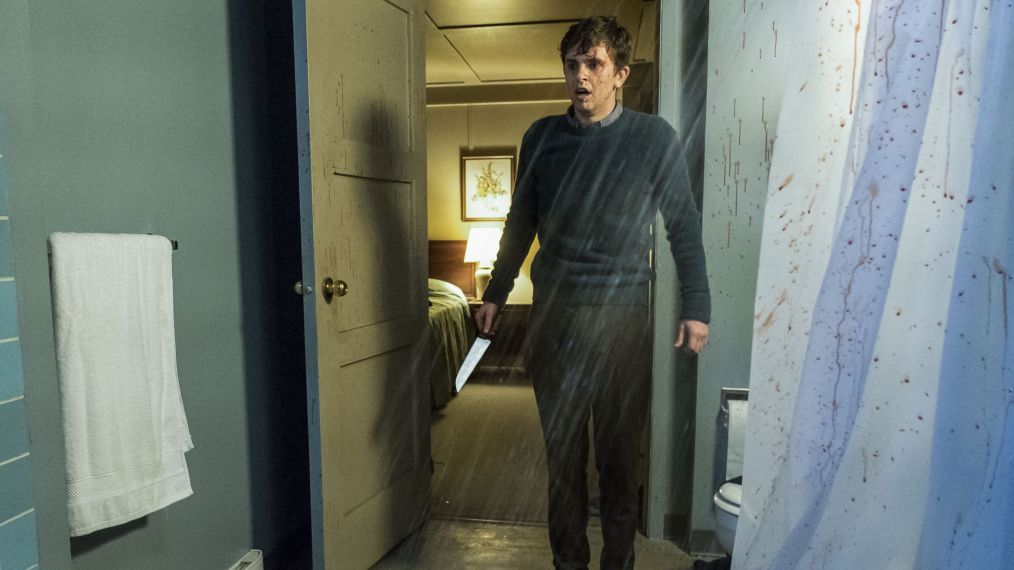
Into all this enters one Sam Loomis.  He goes to the motel to find Marion, hoping to do something.  She isn't there.  After the awful night he's had, he opts to take a shower too.  Unbeknown to him, Norman continues his argument with "Mother" (i.e. himself), him struggling to admit she isn't there.  "Mother" reminds him that Sam is like Norman's father, a cruel man who abuses women.

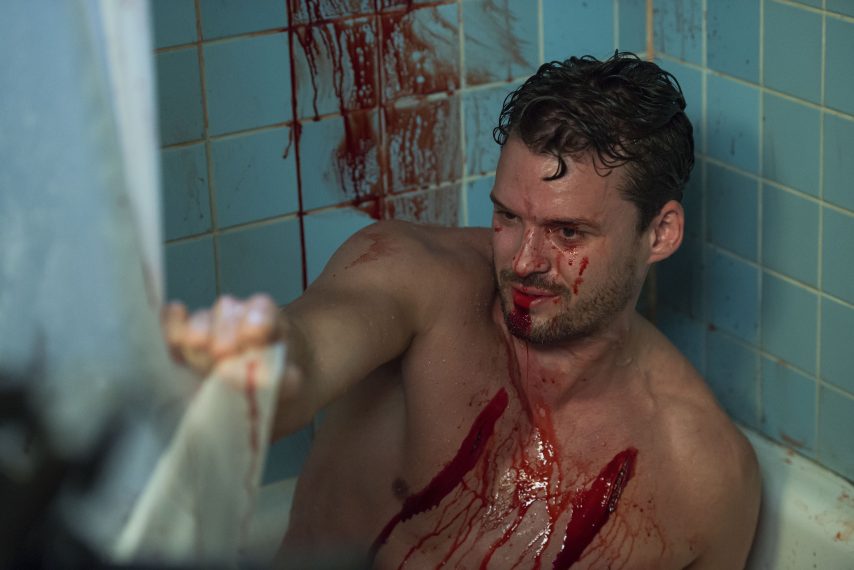
With that, Norman takes a knife, goes to Room One, and stabs SAM in the shower to death.


In the five years Bates Motel has been on, we all knew that eventually Norman would have to hit the showers.  However, I don't think anyone expected anyone other than Marion Crane to bite the dust.  I guess none of us counted on the idea that you just can't kill Ri-Ri.

Changing the established story to have our adulterous Sam be the one to meet the grisly fate, I imagine, will be one of those divisive moments for fans of both Psycho and Bates Motel.  The show has already changed quite a bit already: in the film, Sam wasn't married if memory serves correct.  He also didn't interact with Norman until after Marion was murdered.  As a result, I figure a good number of people will see Norman, dressed as himself, killing Sam rather than Marion to be a stroke of genius.

Others, I figure, will be displeased that it was not the object of desire that spurred "Mother" to kill (or even that "Mother" didn't do the killing).  Rather, "Mother" merely manipulated Norman to kill a man who represented his father, a curious version of patricide.  It almost makes it look justifiable, given how Sam cheated on both women.  No one should be killed for committing adultery and being reprehensible, but there you go.

I tend to fall on the latter side of the issue.  Lust, up to now, was a primary motivation for the killings, and to see Sam stabbed was a bit of an anticlimax, particularly again since the title of the episode is Marion.  I'm not sold on the idea that switching victims (and letting Marion live) was brilliant.  It also makes me wonder whether Sam was that unable to defend himself.  I figure Sam was physically stronger than Norman.  Yes, Norman did take him by surprise and he had a butcher knife coming at him, but unlike Marion he didn't have to worry about trying to both protect himself and cover his nakedness. 

Part of me still thinks Sam could have defended himself and not gotten himself killed.

Perhaps good, perhaps bad was in how Marion teased the audience with the infamous shower scene when Ri-Ri hit the showers, if memory serves right in the middle of the episode.  People were waiting for The Big Moment...only to not have it come. 

Perhaps if Marion had been killed in the way everyone expected, we would have been essentially watching a remake of the rest of Psycho (though it seems unlikely Madeleine or even Sam would have hired a detective to find Marion, and we had Dylan waiting in the wings).

Complicating things in the 'we've gone original' is that Marion didn't completely go original.  As Sam is dying, he copies the movements Marion did in Psycho (in shock, moving her hand to grab at the shower curtain, pulling them down as he/she collapses out of the shower, the look of disbelief etched on his/her face).  You can't say they opted to break with tradition while simultaneously adhering to it. The victim may have changed, but the imagery remained the same.

Let's move on to the performances.  Highmore again really excels as Norman Bates, particularly when he struggles with his sanity as he insists Mother isn't real until 'Norma' so overwhelms him that he surrenders.  He even has a moment of comedy when discussing with 'Mother' about being functional despite his insanity.

"The world is full of mad people who function, many of whom are Heads of State," he tells her.  Was that a sly dig at President Trump?  Who is to say?   

His scenes with Rihanna were also well-acted, particularly given how he, the trained actor from childhood, could have overwhelmed the relative newcomer.  However, both did real well when they talk quietly.

Ri-Ri is not a great actress (or even an actress given her few credits and primary career as a pop singer), and it shows in her last scene with Highmore when she expresses her disappointment in herself by getting involved with Sam.  However, credit should be given where credit is due, and Rihanna handled herself quite well.  It wasn't a great performance, but a good one, showing that perhaps with more training she might make a legitimate second career on screen to compliment her already successful one with a microphone.

Nichols too did well as the overwhelmed Sam, making him almost sympathetic.  Almost.

Curiously, it is the trained Thieriot whom I wasn't convinced with.  His scene where he discovers Norma's dead was not the greatest performance (I felt it a little blank), but he bounced back when he calls to confront Norman.  There was a rage there that pushed him forward.  I've always gone back and forth on both Thieriot and Dylan, and Marion was no exception.

Finally, back to The Change.  Ultimately, I wasn't convinced it was good.  It wasn't terrible and I'm not enraged that established lore was changed.  I just wasn't overwhelmed about its 'brilliance' either.  It was a bit more graphic than Psycho (we did see the knife plunge into Sam's back) but part of me didn't have that 'shock' that I did when I saw Marion in the shower.  I also don't know if having Roy Orbison's Crying during the scene helped or not (again, I lean on the 'not' side). 

I've read the reasons for the change, and I can understand them, even up to a point agree with them.  If we had Marion killed, we might have essentially seen the final Bates Motel episodes lose steam by remaking Psycho.  Still, I'm not fully on board with this alteration.  Could Marion have been killed and still have had major changes?  We already have with Norman killing Sam sans drag. 

I can see why things were done, but I'm still not there yet.


6/10

Next Episode: Inseparable

Thursday, March 30, 2017

Southside With You: A Review (Review #900)

SOUTHSIDE WITH YOU

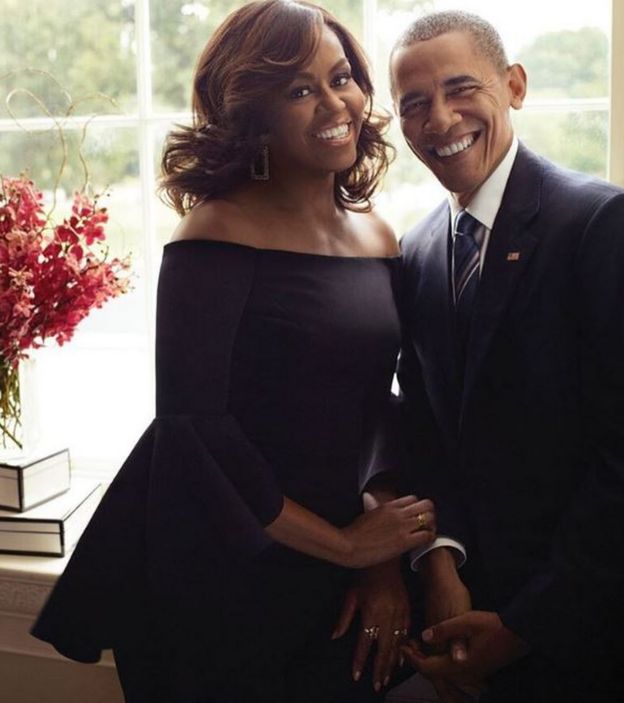
The concern with a film like Southside With You, the story of the first date between future President and First Lady Barack and Michelle Obama (formerly Robinson) is that it will go beyond hagiography into downright sanctification.  One might imagine that at a certain point in the film, the sky will open up, heavenly choirs will sing, a dove will descend on Barry, and we will hear an Orson Welles-type voice call out, "This is My Son, in whom I am well-pleased!" 

It will end with Obama being taken up into Heaven, where Jesus Christ will bow down and worship the One True God.

You know, how Hollywood sees the former President. 

To its credit Southside With You doesn't go full-on worshipful (though the midsection does have touches of idolatry). It isn't terrible or grand, but passable, with some charm and good performances.

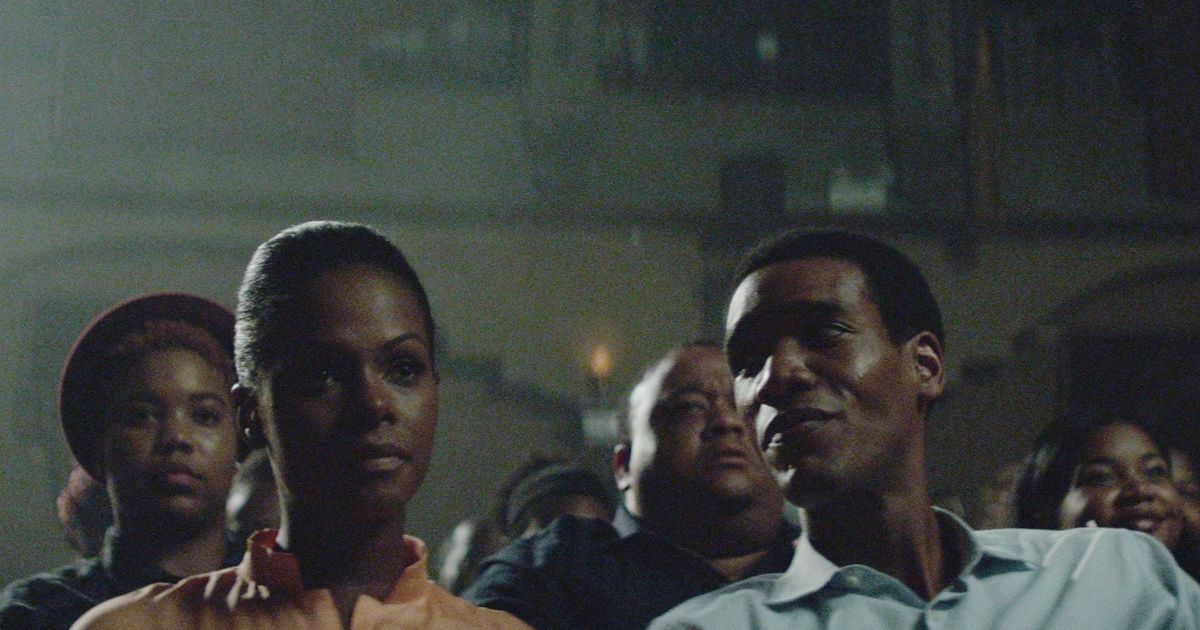
Taking place over one long day, lawyer Michelle Robinson (Tika Sumpter) prepares for the arrival at her house of one Barack Obama (Parker Sawyers), a summer associate at the upmarket law firm where she is technically his supervisor.  She insists it's not a date, something that Barack pushes their time into being.  Ostensibly going to a community meeting, Michelle is surprised and a little irritated when the habitually late Barack tells her that this meeting won't be for a few hours.

He plans to take her to an African-American art exhibit...just to wander in.  While Michelle is none too pleased with this development, she goes along with it, as well as wandering through a park (I suspect Grant Park) before going to the community meeting (where Michelle is mistaken for Barack's newest girl and is dazzled by his speaking) and ending with some beer and a movie, Do the Right Thing (which she is eager to see).

As a side note, Do the Right Thing isn't my idea of a date movie, but there you go.

At the end of the day, Michelle is enchanted enough with Barack to consider this be possibly be a 'date' and perhaps for a second one.

The question one should ask about Southside With You is simple: if their names were, say Terrence Smith and Kristen Jones, would we care enough to follow this, The Longest Date?  If the film is based on the actual first date, it was a very long date...lasting essentially from around midday to midnight.  Would our two young lovers-to-be interesting enough for us to care whether or not they go out again?

My answer is, not really.  Part of it comes from the fact that Michelle came across as a bit of a whiner, protesting too much about how this isn't a 'date'.  Part of it comes from the idea of a 'date' involving having the woman listen to this man give an impassioned speech that shows his greatness.  I think on how Obama, even then, had a way with turning phrases into something almost inspiring. 

At the community meeting, Obama says to encourage the people that they should turn the 'no' to 'on', as in 'carry on'.  "They say 'no', we say 'carry on'", he intones, and you think that despite being a mere intern essentially, Barack Obama is dreaming of when he can say things like 'there's no Blue America or Red America, only the United States of America'. 

And here is where I have a slight beef with Southside With You.  Writer/director Richard Tanne has perhaps too much love for his subject that ironically keeps our two young lovebirds a bit at a distance, as if we should marvel at them rather than fully embrace them as just two young people starting out a remarkable and beautiful romance.

We see this in how Obama is bathed in soft light when giving his speech and how Michelle's views on our lanky, chain-smoking cocky kid evolves into perhaps not love but slightly worshipful admiration.  Early, Tanne had a better scene where we could see Barack falling in love with Michelle when she is taken up by a little girl to do some impromptu dancing.


We didn't need great theatrics to show that Barack went from finding Michelle pretty to finding her a potential life-mate.  We know that Barack liked Michelle, so we don't need much to show his growing enthusiasm for her (though curiously, his slight deceit to get her to attend the meeting and somewhat pushy nature show that he might have been a bit of a harasser, not respecting her 'no').  What we needed was for the strong, confident woman Michelle Robison is to emerge, and that scene of her looking at her well-spoken subordinate was, to my mind, the wrong kind of lovey-dovey eyeing.

As Southside With You is about the Obamas, we get to hear a lot about their families: Barack's absent father and essentially missing mother versus the strong family that the Robinsons were (we learn that, curiously the Robinsons never watched Good Times, preferring the more square Brady Bunch, and what this says about how the Robinsons saw the world is left up to the viewer).  It might have been a nice counterpoint: the distance that Obama's parent had from him versus the closeness that Michelle's family had.

Instead, we got nice talk from them about how Barack should forgive his 'incomplete' father (though curiously, no mention of how the future President's beloved grandmother, Toots, who helped raise him, was, in his own words, 'a typical white woman' afraid of black men). 

In that respect, Southside With You is a little on the deification side.  Despite the slight adulation, when Barack and Michelle meet 'a typical white man', their boss Avery (Tom McElroy), we get a slight dig at the future President.  Avery wonders about Spike Lee's actions in Do the Right Thing, and Barack gives an explanation that appeals to Avery.  Once out of earshot, he gives a different answer to Michelle, which shows that Obama was different with people based on how he thinks they would react. 

On the other hand, you had wonderful performances from our two leads, particularly Sumpter as the smart, elegant, but somewhat brittle Michelle.  Sumpter bears a closer resemblance to a young Michelle than Sawyers does to Barack, but they both are charming and likeable as the future First Couple.  Sumpter in particular carries herself with an air of confidence and perhaps with a bit of a chip on her shoulder, while Sawyers portrayal shows a slightly more charming, eager young man who has flaws (he attempts to hide his smoking) but who also finds that with a bit of charm and determination, he can make this woman his own.

It's a bit unfortunate that Southside With You could not avoid being a bit worshipful towards Barack and Michelle Obama.  It's due to that sense of adulation towards its subject that I'm marking it slightly down.  All the pity, since we got good performances and an interesting story to work with.  Again, the somewhat adoring manner the film treats its subjects leaves them just slightly a little off, as if they were like the paintings and sculptures at the Afrocentric art exhibit: something to admire and respect but also study and learn from rather than enjoy for their own unique beauty.

Ultimately, the question that I have about Southside With You (would we care about them if they were not destined for history) is answered with that slight, 'not really'.  They're a nice couple, pleasant enough, but not particularly interesting.  Maybe a movie about their evolving romance rather than their first date would have made them more human and less divine.     


DECISION: C-

Wednesday, March 29, 2017

Around the World in 80 Days (1956): A Review

AROUND THE WORLD IN 80 DAYS (1956)

Cantinflas' World Tour...

If anything, producer Mike Todd thought BIG!  Around the World in 80 Days was his first, and sadly his last, motion picture, a loud, unapologetically BIG (perhaps even gaudy) film, big and gaudy even in an era of lavish spectacles.  The fact that it won Best Picture is both good and bad.

Good in that it won't be forgotten.
Bad in that it won't be forgiven.

Derided as one of the worst Best Picture choices (especially given that year's competition: the Texas epic Giant, the Biblical epic The Ten Commandments, and the musical epic The King and I), Around the World in 80 Days is the type where one can miss the forest for the trees.  A charming, light film that has fun with itself, it is still a bit long and unapologetically shallow.

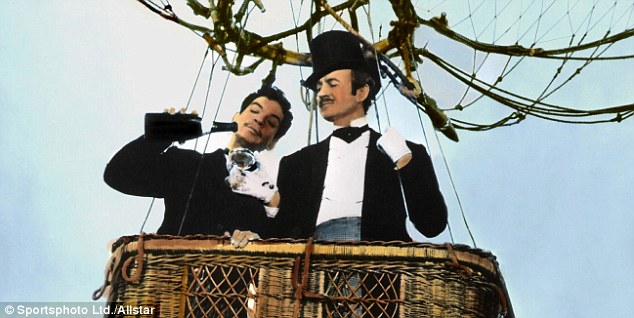
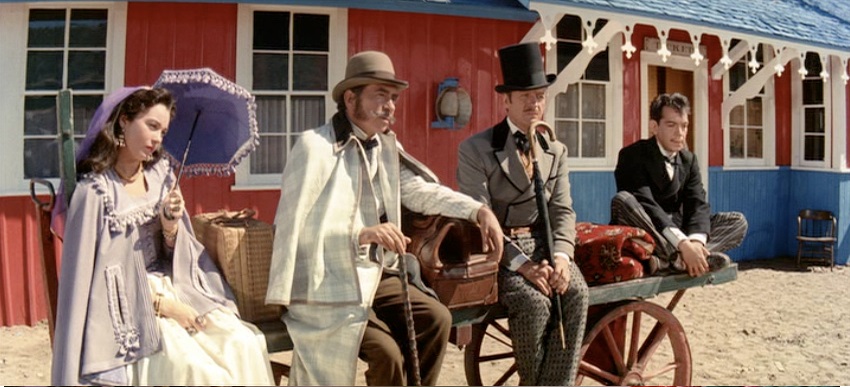
Phileas Fogg (David Niven) is the proper British Victorian gentleman: proper, formal, stiff, and with extra bonus of being obsessed with punctuality.  He goes beyond just being on time but to being exactly on time.  It goes beyond exact time: he insists that his toast be a specific temperature.  This fastidiousness exasperates almost everyone, but now the members of his stuffy club, The Reform Club, think he's gone mad.  He makes a wager with various members that he can travel around the world in 80 days and decides to leave that night.  It's a surprising start for his newest valet, Passpartout (Mexican comic genius Cantinflas).

Coincidentally, Fogg's flight takes place at the same time that a recent robbery of the Bank of England has taken place, and it doesn't help matters that no one knows anything about Phileas Fogg or how he came to have such vast amounts of money.

Well, Fogg and Passepartout begin their journey.  In due course, they hit, either together or apart due to the circumstances: France, Spain, Suez, India, Japan, and the United States.  While in Suez, a surprising threat comes in the form of Inspector Fix (Robert Newton), a detective alerted to Fogg possibly being the Bank of England master thief.  He befriends Passpartout and sticks with Fogg across nearly all his journey save for part of the journey in India, where he misses the highlight of Fogg's mad tour.  It is in India where Fogg and Company save the beautiful Princess Auoda (Shirley MacLaine) from being burned alive on her late husband's pyre. 

Along the way Fogg, Passepartout, and later Aouda and Fix with them, have a variety of adventures, from participating in bullfights to escaping redskins to rescues from a Japanese circus.  It's all done in a mad race to get to The Reform Club in time, with a hitch that when arriving on British soil at last, Fix arrests Fogg.  The bet seems lost, until the pompous Fogg, at last finding love with the beautiful Indian princess, realizes thanks to Passpartout that as he went around the world in 80 days, he crossed the International Date Line and accidentally gained a day.  It's one last mad race to get to the Club.


Around the World in 80 Days is charming and delightful, and unapologetic about its lavishness, its frothiness, and its total jolly nature.  It's a credit to producer Mike Todd that he kept the whole thing from completely falling apart under its massive weight, and I think this is done by keeping things deliberately light.

It's light thanks to the intelligent performances from the four principals.  Niven was shockingly ignored for his performance, which is a shame given that he makes Fogg a funny figure in his excessive strictness, punctuality, and fussiness while simultaneously not making him look like a fool or like a loon.  Part of me figures that Niven being left out of the Best Actor race is not surprising: you had already some strong nominees from Giant, Lust for Life, Richard III and the winner (Yul Brynner for The King & I) but then some that didn't, like Paul Newman in Somebody Up There Likes Me, Charlton Heston in The Ten Commandments, Gary Cooper in Friendly Persuasion, and John Wayne in The Searchers, the Academy was rather spoiled for choice.

Still, Niven was delightfully unflappable as Fogg, the epitome of the British gentleman, never once playing things deliberately for laughs or winking to the audience.  The fact he played Fogg straight made things all the more amusing, and it is one of my favorite David Niven performances.

We now turn to someone else shockingly (or perhaps not shockingly) left off the Best Supporting Actor race: the Mexican comedic genius Mario Moreno, better known by his stage name, Cantinflas (and for the record, it's pronounced "Kahn-TEEN-flaws", not "CANT-in-flaas" as both the late Robert Osborne and not-late Ben Mankiewicz insist).  Perhaps he was not nominated for Best Supporting Actor because he was essentially a costar in the film, or because in Latin America, the film was billed as a Cantinflas vehicle.

It should be remembered that Cantinflas, while generally unknown in the United States, was a gigantic star just about everywhere else.  No less than Charlie Chaplin declared Cantinflas to be the greatest living comic (as a side note, it might be good to watch the biopic Cantinflas to get an idea of both who he was and about how he came to be in Around the World in 80 Days).  Cantinflas had resisted all American offers, but Todd wheeled and dealed to get him into the film, and one suspects that part of that deal involved essentially tailoring the film in part for Cantinflas.

This explains why despite the French name the character of Passpartout sticks close to the typical Cantinflas look.  It might also explain the Segway into Spain (which is not part of the novel and extends the film's running time even more).  Cantinflas was a master bullfighter, and the film showcases his comic abilities, with the Spanish setting allowing him to speak in that dexterous manner that was his trademark.  As a result, Cantinflas the character could be considered the star of Around the World in 80 Days, at least outside English-speaking countries.

Yet I've digress.

Cantinflas handles the comic and language extremely well as is delightful as Passpartout, giving English-speaking viewers a glimpse of what made him truly a comedic genius.

Newton, in his final role, brought a working-class manner to his Fix, a bit of Cockney confidence with a mix of dogged determination.  He also did very well with the comedy, particularly whenever he finds his plans foiled by luck (Fogg's good luck, Fix's bad).

In an early role, MacLaine stretches believability as an Indian, but we forgive this ethnically erroneous casting due to her performance: sweet, kind, elegant and lovely, MacLaine's Aouda is a wonderful element.

Around the World in 80 Days is known for introducing the 'cameo' role: brief appearances by famous people in essentially bit parts, sometimes not even saying anything.  The 'cameo' roles range from the silent (a quick glimpse of Frank Sinatra) to those with few lines (Joe E. Brown probably had at most five lines) to slightly more relevant roles (Marlene Dietrich attempting to entice Phileas Fogg) and those who had small but substantial roles (Sir Cedric Hardwicke as the General helping Fogg in India).  There are some wonderful moments with these cameos too: seeing Red Skelton and Cantinflas work together is a treat with their physical comedy. 

It does become a nice game seeing who pops in and out of the film, but some of the cameos will simply go over today's audiences.  A big star in France and elsewhere back in the day (my Mexican-born mother recognized him), people today may miss Fernandel's appearance as a Parisian coachman simply due to not knowing who he was.  Some of these stars were well-known in 1956, but today they might not draw the delightful gasps they did back then.

One of them is at the very beginning, showing how the film is a product of its time as well as how long it is.  Edward R. Murrow, the journalist best remembered among other things for helping bring down Senator Joe McCarthy, appears to introduce Around the World in 80 Days, or rather introduce Jules Verne and the Georges Melies silent film A Trip to the Moon.  It might be all very interesting, but today, I figure many would simply have no idea who Murrow was, who Melies was, or why we were watching a silent film in a smaller version (the ratio aspect shrunk to fit with how Melies had it). 

It's six and a half minutes long, and one wonders whether this could have been cut out entirely (especially with Murrow intoning such pompous lines as "Speed is good, but only when wisdom leads the way").  Same goes for the Spain sequence, which is in total almost twenty minutes long.  Even if we kept some of it to showcase Cantinflas' genius (such as the nearly ten minute bullfight), what justification was there, storywise or any other wise, with a flamenco dance that lasts about five minutes. 

There's a lot of bloat in Around the World in 80 Days which today might frustrate a viewer (and I imagine, draw deriders' ire).  Cameos could have been cut, scenes could have been cut or trimmed, so there is a legitimate argument in that the film is far too long.


One argument that not even the most passionate hater has been able to make is a slur on Victor Young's beautiful score.  In turns lush and romantic, light and comic, Young's score, particularly its theme, is one of the loveliest, most charming, and beautiful written for film (one I'd rank with the likes of Doctor Zhivago, E.T.: The Extra-Terrestrial, or Vertigo).   Young won his only Oscar for his score, a sad victory in that out of 22 nominations, his only win came posthumously.

Perhaps if it hadn't been so fortunate (or unfortunate) to be declared better than The Ten Commandments or Giant we might think better of Around the World in 80 Days.  Its win says something about the Academy as a whole: either it can be easily dazzled or easily bribed.  While charming and fun, Around the World in 80 Days is also excessively long, dated, and a bit clunky now.  Still, it's hard to argue against such things as some of the performances, its glee, and Victor Young's beautiful score.

Nope, not Best Picture worthy, but a nice big film nonetheless.

DECISION: B-

1957 Best Picture: The Bridge on the River Kwai 

Saturday, March 25, 2017

Bates Motel: Dreams Die First Review


BATES MOTEL: DREAMS DIE FIRST

As we come to the end of the sad, strange journey of Norman Bates, a man destroyed by love of Mother, we get another deranged Bates Motel episode involving sexual decadence, realization of insanity, and another person about to be destroyed by love.  Dreams Die First gives us a great debut and more wild turns.

Secrets are all being revealed here.  In the subplot, Dylan Massett (Max Thieriot), half-brother/uncle to Norman Bates (Freddie Highmore), finally tells his wife Emma (Olivia Cooke) the truth about 'Norma's' earring.  Emma thinks Dylan has kept it as a way to keep his mother Norma close to him.  However, after internal struggle, he reveals that it isn't Norma's earring.  It's that of Emma's mother, and that he is highly concerned about her fate.  Emma is upset by all this, but while doing some bored online checking she finds that Norma is dead, something neither she or Dylan were aware of.

Norman, for his part, is concerned when 'Mother' is nowhere to be found.  He does find a matchbook for the White Horse Bar and calls asking if Norma was there.  To his surprise (and that of the viewer), he's told that Norma was there, and that she left her car there, having been too drunk last night to drive it.  While going to get the car, he finally reveals to Madeleine Loomis (Isabelle McNally) what he knows about Sam (Austin Nichols) and his mistress. Madeleine is facing her own problems: not just the potential that Sam is having an affair, but that Norman kept this from her.

For his part, Sam is having financial trouble, and the only person he confides this to is his mistress, Marion Crane (special guest star Rihanna).  Marion wants to help Sam, but it isn't as if she has thousands of dollars just lying around.  As it so happens, some money does fall into her lap, and in a spur of the moment decision, she takes it instead of depositing it and rushes to her love.  Sam cannot take her phone call, but no matter: Madeleine confronts him about whoever was calling.  Marion, for her part, with the rain coming down, stops at the Bates Motel.

Poor timing, as Norman, with some unwitting help from his former psychiatrist, Dr. Edwards (Damion Gupta) finally puts everything together, and both conclusions fill him with horror.  First, he realizes that he sometimes sees Mother when she isn't there, which helps him realize that Norma really is dead.  Second, he finds that the bar 'Norma' has been going to, picking up guys from, and getting drunk at...is really a gay bar. 

Norman, in his total disassociate state, has been going to the White Horse Bar in full drag, calling himself 'Norma', and having sex with other men, not realizing that while everyone sees 'Norma' as at most a transvestite if not full-on transgender, Norman truly believes he is 'Norma'.  It isn't until an attractive man (Michael Doonan), with whom 'Norma' had sex with the night before, tries it again with Norman (who is aware that he is Norman, not Norma) that Norman realizes just how far he's separated the two identities.

Only on a show as bonkers as Bates Motel would the idea of someone in full drag not realizing that he is having gay sex be considered tame, almost rational.  However, right from the beginning, when the bartender tells Norman that 'Norma' was there would we have some logical conclusions.  I wrote in my notes for Dreams Die First that to explain 'Norma' appearing at the bar, we had one of two solutions.

The first is the wrong number/person theory, where it's another Norma they were talking about and it was mere coincidence.  The second was that Norman would go in full drag.  It didn't strike me until when Norman went into the bar, one with a certain style of techno music and few if any women that I figured he had indeed been going into the bar in full drag. 

It would make sense: a man in drag would look out of place at a straight bar.  It would only be at a gay bar where a man could appear dressed as a woman and even claim to be a woman and not raise eyebrows.  It must have been a shock to our straight/straight-laced, slightly puritanical Norman to have found not only was he a regular at a gay bar, but that the denizens recognized him sans drag.  The fact he had sex with other men while in deep blackouts where he thought he was a woman makes it all the more wild.

Highmore again gives it his all as Norman Bates and gives another great performance.  There's not just the realization that he's gone bisexual, but when he fesses up to Madeleine about Sam's indiscretions.  His hesitancy, his reluctance to speak on something he knows will hurt adds pathos to his performance.  We even get to see the dark side when he speaks to Sheriff Green (Brooke Smith).  There's a haughtiness, a defensiveness, a hostility that is barely masked.  It's an all-around strong performance.

We have also something I was not expecting: a strong performance by Rihanna.  Our beloved Ri-Ri is more a pop star/diva with few credits: apart from Battleship, she hasn't done much acting (though I thought she was one of the better aspects of Battleship). Rihanna got the fear and hesitancy of Marion's, the love she had for Sam versus her sense of morality (with the former winning out, much to her tragedy).  Ri-Ri was able to hold her own against professions, and one thinks she'll really do well against someone like Highmore, who has been acting practically all of Rihanna's life.

Though their roles were smaller, both Thieriot and Cooke did excellent in their quiet dramatic drama as Dylan and Emma, who love each other but also do foolish things to try and stop the other from being hurt.

I think it helps that they were aided by their Bates Motel costar, Nestor Carbonell, who directed the episode.  He at least has directed before, so he isn't just taking a stab at making an episode (no pun intended).  We also find that Dreams Die First is sticking close though not slavishly faithful to Psycho: as in the film, Marion steals money for her lover Sam, but Sam is married, not divorced.  It's enough to honor the original without stomping on it. 

With strong performances all around (and an impressive turn by pop diva Rihanna, a Bates Motel fan who got to show that she can be a competent actress), along with some really insane turns (Norman's visions of 'Norma's' sexual dalliance with the man who knew he was performing oral sex on a man) gives us a mixture of the insane and the brilliant.  These are things Bates Motel both aspires to and achieves.

10/10

Next Episode: Marion 

Thursday, March 23, 2017

Feud: Mommie Dearest Review


FEUD: MOMMIE DEAREST

When you have an episode of Feud: Bette and Joan titled Mommie Dearest, one might think they are going to take another jab at Joan Crawford's notorious (but unproven) charges of vicious child abuse.  No.  They are playing you.  Instead, Mommie Dearest is primarily about Bette Davis' role as mother to her biological daughter B.D. Hyman (then Merrill), her own fraught relationship, as well as the effects Davis and Crawford's mothers had on them as adults.  We even have how one became a 'mother' of sorts to one of the What Ever Happened to Baby Jane? costars, and we have the best episode of Feud yet: a tragedy of broken people brilliantly acted.

What Ever Happened to Baby Jane? continues filming, but Joan Crawford (Jessica Lange) is concerned over the influence B.D. (Kiernan Shipka) is having over Crawford's twin daughters, who despite being teenagers are dressed like little children.  B.D.'s mother, Bette Davis (Susan Sarandon) is beginning to be concerned that B.D. may indeed be a bit directionless, so she reluctantly gives in to her director Robert Aldrich (Alfred Molina) to cast B.D. in a role in the film.

It proves to be a poor decision, for the highly professional Davis sees that B.D. is not an actress.  This is the first of some bad decisions from Davis.  She attempts to keep a working relationship with Crawford and invites her rival to drinks (which she knows the alcoholic Crawford won't turn down).  They end up talking about their mothers and their philosophies on motherhood.  Crawford's admission that she lost her virginity at 12 to her stepfather, and that Crawford did it willingly, shocks even the generally unflappable Davis, who didn't lose her virginity until her wedding night. Further, the hatred and emotional/physical abuse Crawford suffered at the hands of her mother is a sharp contrast to the loving and close bond Davis had with her own mother, who has recently died.

This conversation and opening up between them might have been a rapprochement between them, but that doesn't last long.  Davis is enraged when she reads that Crawford has fed to Hedda Hopper (Judy Davis) that Davis has decided to put herself up for a Best Supporting Actress Oscar for Baby Jane (one guess who is going for Lead).  They fight in front of the crew over the chances for Oscar, which shocks Aldrich, who points out the film isn't even finished.

Crawford is becoming more difficult with her drinking and obsession with looking her best, down to padding her bra when doing the ending beach scene.  Warner Brothers head Jack Warner (Stanley Tucci) finds the whole scene appalling.  "It's like Camille in reverse!" he snaps, complaining that Crawford keeps looking better despite the fact her character is supposedly dying.  While Crawford has gained the crew's favor with her kind manner towards them, Davis, for her part, has bonded with her costar, Victor Buono (Dominic Burgess).  The openly gay Buono fits into Davis' unencouraged fascination with homosexuals ("All the queens love me", she tells a delighted Buono, and even does an imitation of her female impersonators to please him).

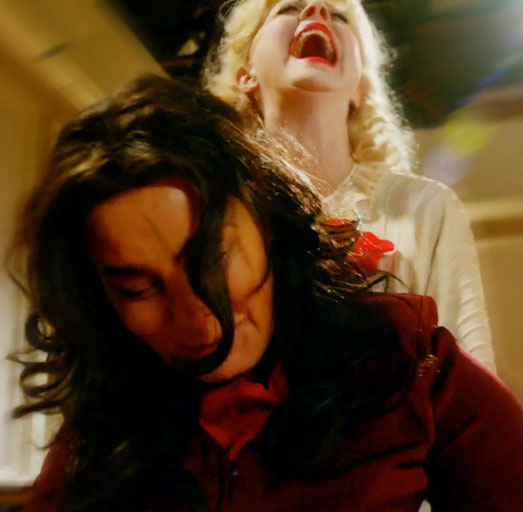
Davis is better with Buono than with B.D., whom she doesn't have the heart to tell is awful.  Davis goes to bat for Buono, down to bailing him out when he's arrested in a raid on a gay theater where he's been 'auditioning' a young man.  Crawford is frankly too busy struggling with being alone (the twins having gone off to camp) to notice anything beside herself, and at last, after a lot of physical struggle where both costars physically hurt the other whenever they can, What Ever Happened to Baby Jane? is completed.


Mommie Dearest brilliantly plays with all variations of 'mother'.  We have, despite the title, very little of Crawford's relationship with her oldest daughter, Christina, the author of the notorious best-seller that has permanently ruined Crawford's reputation.  She's mentioned only in one scene, where Crawford insists she won't send her daughter flowers or a card congratulating her on Christina's opening night.  However, we see the complex nature of Crawford's emotional world when shortly after, she does indeed sign her card, closing with 'Mommie Dearest'.  It's both a clever joke and an indication that Joan Crawford was more complex emotionally on this aspect of her life.

With Lange's performance and Tim Minear's script, we see how damaged Crawford was when it came to the issue of mothers: both as a daughter and a mother.  This episode was Lange's best performance so far; from the scene at the bar where she talks about how fraught her relationship with her own mother was, how much she hated her and would gravitate towards anyone who showed her a modicum of love, to the intense fear of being alone, Lange both shocks and breaks your heart as Crawford.

Sarandon too gives a brilliant performance, especially since she is more central to Mommie Dearest than Lange's character.  Davis' own fears and pain about her children come to the forefront.  Of particular note is when Davis calls the hospital where her own adopted daughter Margo is.  The mentally challenged girl cannot keep attention to Davis on the phone, and Davis' mixture of regret and pain at not being able to help her are played so well.

Both Lange and Davis work well together whenever they are raving at each other, which makes perhaps one flaw in Mommie Dearest more evident.  There is a montage of their filming What Ever Happened to Baby Jane? that leaves something to be desires.  We see how Davis took advantage of a scene to kick Crawford in the head (whether this was an 'accident' or deliberate is a bit unclear, but we get strong hints she did it on purpose).  It makes Crawford's revenge (adding weights to her when Davis has to drag her off after ruining various takes by laughing as a result of being 'ticklish') both understandable and sadly not as well-drawn as could have been.

According to stories, Crawford's dead weight caused her to fall on top of Davis, who suffered from a bad back.  Davis had to go to a hospital for two days as a result of her injury, and one would think a whole or major part of a Feud episode could have been focused on the acts of violence the two rivals took on each other.  Sadly, it was reduced to a montage.

Yet I digress, for we have in Mommie Dearest one of the best-written and acted episodes of this short series.  We see the evolution of Davis' view of Buono, who at first horrified and appalled her (when told he was a Shakespearean actor despite having no major work outside San Diego, she snaps "I'm sure his Falstaff is the talk of Tijuana!"), turn to admiration (when Aldrich tells her she likes him, she retorts, "I like talent!") and even a bit of genuine affection (her "WHAT A DUMP!" line and her bailing him out of a shocking situation).

Burgess does well as Buono, and we even get a little history lesson when we see Buono hanging out at a gay theater, forgetting that once these types of establishments not only allowed for illicit hookups between men but that they ran the constant risk of being raided, with their patrons arrested and thus publicly outed and humiliated to a less tolerant world.

Credit also goes to Shipka, who 'acts' badly and also shows she too wishes for her mother's approval.

From playing Mama Said There's Be Days Like This in a montage to showing how both Crawford and Davis were products of their childhood, from the performances to the verbal catfight between them (down to Davis insisting she was robbed in 1950 thanks to her All About Eve costar, 'that bitch' Anne Baxter, and Crawford's retorts that Davis both demeaned Judy Holliday and it was Gloria Swanson who was robbed that year), Mommie Dearest had it all.  There was a great script in turns insightful and witty, brilliant acting all around, and some bits of strong comedy and drama.


Mothers and Daughters...


Daughters and Mothers...


10/10

Next Episode: More, Or Less