Tuesday, June 26, 2018

Gotham: The Sinking Ship The Grand Applause Review


Image result for gotham the sinking ship the grand applause
GOTHAM: THE SINKING SHIP 
THE GRAND APPLAUSE

The Sinking Ship The Grand Applause has as its mantra 'The Enemy of My Enemy is My Friend', for the tangles of partnerships, frenemies and usual Gotham craziness makes for a remarkably packed episode, odd in that this is not the season finale.

Captain Jim Gordon (Ben McKenzie) talks his former partner, Harvey Bullock (Donal Logue) back onto the Gotham City Police Department.  He needs all the help he can get given how strong the hold Mafia Princess Sofia Falcone (Crystal Reed) is over Gotham.

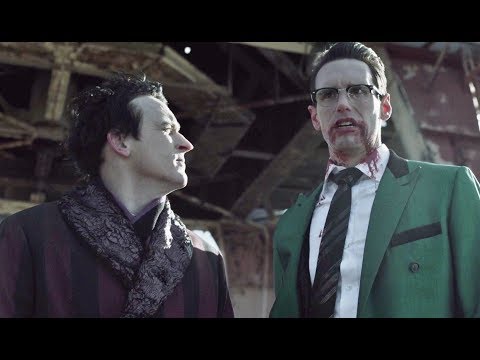
Princesses, however, make many enemies.  Among them is Oswald Cobblepot aka The Penguin (Robin Lord Taylor), who now has an unlikely ally: Edward Nygma aka The Riddler (Cory Michael Smith).  As Penguin has helped Nygma find 'the Riddler within', they now forget all that's gone on between them to take down their mutual enemy.

Throw into this mix an even stranger ally: Dr. Leslie 'Lee' Thompkins (Morena Baccarin), still smarting in more ways than one from Sofia taking her down as the head of The Narrows and the hand-whacking that came with that.  Plans shift wildly as betrayals and assassinations go on left right and center.

Penguin gets Riddler to rescue Martin (Christopher Convery), the little boy Penguin has taken a paternal interest in, away from Sofia.  However, this appears to be part of a larger plan, though at times it seems poor Pengy keeps getting the worse for it.  Riddler finds that Solomon Grundy remembers himself as Butch Gilzean (Drew Powell), which means Solomon/Butch manages to get Riddler into the arms of The Sirens: Barbara Kean (Erin Richards) and Tabitha Galavan (Jessica Lucas).  Their plan is to turn Riddler over to Sofia to get him to tell where Penguin is.
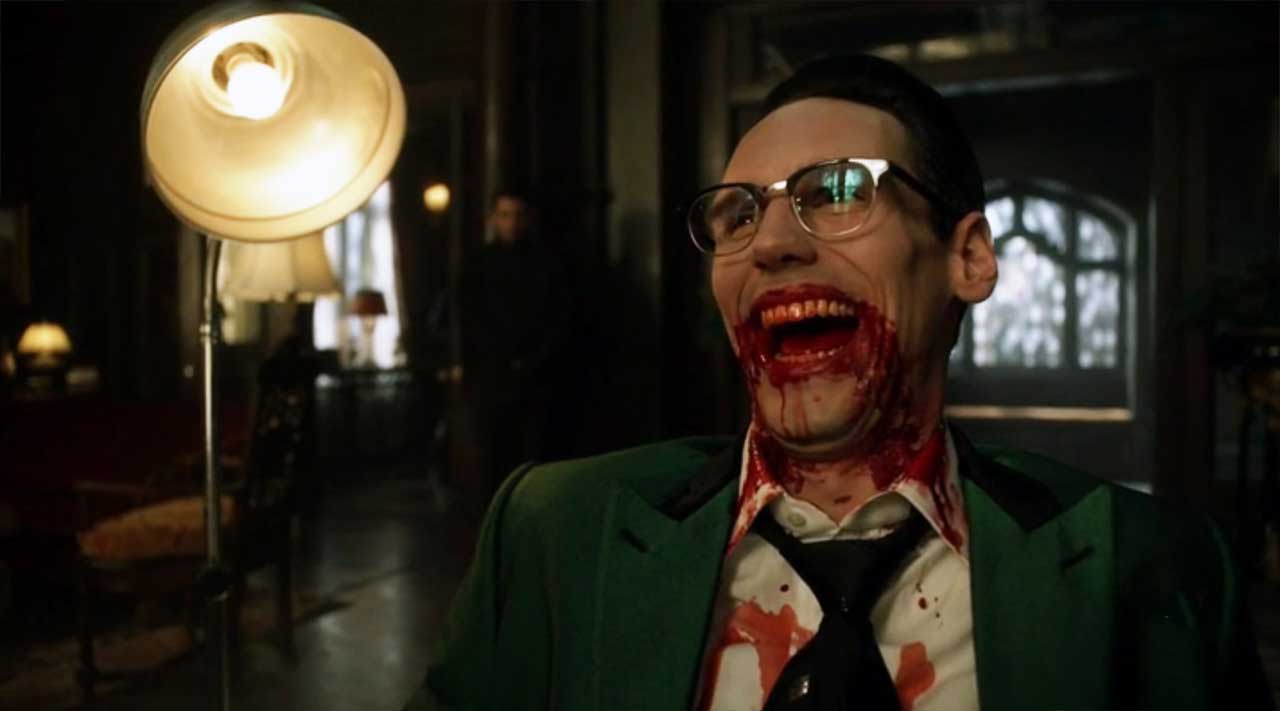
Image result for gotham the sinking ship the grand applauseNo need for that, for Lee opts to use Riddler's original plan: get Mr. Freeze (Nathan Darrow) to refrigerate Penguin as a 'gift' for Sofia.  Edward finds himself conflicted: delighting that Pengy now is where he himself has been, but also unhappy about it.  This, however, had been a rouse, as Penguin was programmed to free himself quickly.  He learns that Sofia has learned the whereabouts of Mr. Penn (Andrew Sellon), the accountant everyone is after.  He also learns that her goons will kill Riddler, and for once, Pengy faces a moral dilemma: go to where Penn is to kill Sofia or save Riddler.

Gordon and Bullock get to Penn first, having to face off against Sofia's assassins Victor Zsasz (Anthony Carrigan) and his own BFF, Wendell aka Headhunter (Kyle Vincent Terry).  It's a brutal shooting war, one where Gordon is shot several times.  In a twist, it's Sofia who ends up getting shot in the head by Lee, she coming to Gordon's last-minute rescue.  Another last-minute rescue is of Riddler by Penguin, who says that with Edward, he has indeed found someone he can trust, given that despite a great deal of torture, he would not give up Penguin's location.

In the subplots, Selina Kyle (Camren Bicondova), feeling guilt over the death of the Wayne Enterprises scientist, wants to get the jewels she had stolen from the family back to them. She turns to her own frenemy, Bruce Wayne (David Mazouz), who helps her with money as as muscle.  Their relationship continues to be one of Cat-and-Bat.  Barbara, for her part, has been suffering migraines, and at the end, has a frightening vision of yet again another frenemy, Ra's al Ghoul (Alexander Siddig), coming to her.
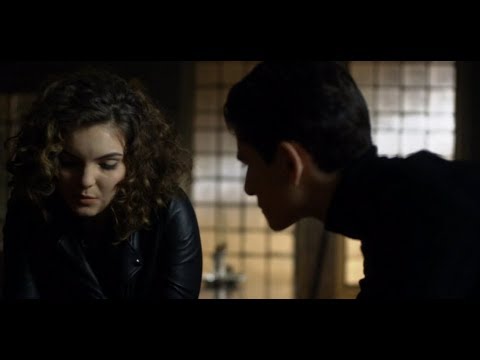
Image result for gotham the sinking ship the grand applauseIn The Sinking Ship The Grand Applause, there are many standout performances.  Gotham, in my view, is the best-cast series where every actor/actress seems not just right for the role but also continuously give excellent performances.  I will single out two actors in particular, though I should mention just how good all of them were.

One of those standouts in a group of standouts is a recurring character: Carrigan as Zsasz.  He continues to add a great subtle humor in his interpretation of the assassin.  Carrigan makes Zsasz almost into this if not innocent at least an unwittingly amusing figure.  His way with his lines, whether in telling people to face his wrath or in asking what his next job assignment is almost always shows that Zsasz is not just a cold hitman, but almost childlike in his manner.

Carrigan, in my view, simply has not been given enough credit for playing up the humor Zsasz has.

The second standout is Bicondova as Selina.  Her role was smaller than most of the main cast, but that is what makes it more impressive.  She showcases our future Catwoman as not a straight-up villain in the Riddler/Penguin/Barbara mode, but as an anti-heroine.  She has a conscience, she has a soul, and she knows right from wrong.  In her guilt and fear (such as asking Bruce to give the jewels back since she is too afraid to present her atonement herself), Bicondova reaches deep into making Selina a very sympathetic figure.

She has a great partner in Mazouz, who has made Bruce Wayne into a deeper, richer, more lived-in character.  We continue to see how this person will eventually become The Dark Knight as he fights alongside Selina against the fences who were trying to keep the jewels, but also see a young man still with heart and compassion towards this young woman he is drawn to physically and emotionally.

For my money, Taylor is my definitive Penguin, a man constantly beaten up.  There really is nothing better than to see this Pengy raging, but he too had his moment when he learns that Riddler has been sent to be killed.  We see that for once, he has doubts about whether to rescue someone, to put someone else over his own plans.

Image result for gotham the sinking ship the grand applause
Smith, for his part, is my second-best Riddler, delighting in his wickedness but also finding himself shocked that the man he swore to kill and torture has now come to his aid.  Logue too makes Bullock more complex, still with some dry humor but also aware of his frenemy's flaws.  Baccarin makes the former gentle doctor into a figure of fear as she enacts her own revenge, and McKenzie rallies to make Gordon into an honest cop who struggles with his conscience on doing wrong to do right.

Reed too makes Sofia into this one whacked-out psycho, though she should know by now that 'monologuing' will be the death of anyone.

The only real drawback is that Darrow, my favorite Freeze, was not given much to do save for having an Obligatory Shirtless Scene.

Gotham this year has gone from success to success, and The Sinking Ship The Grand Applause has again hit another high-point.  If not for the weak use of Darrow and having Penn in a very bizarre baby-like setting which was a bit nutty even for Gotham, we might have seen the episode go all-out.  However, it did a fantastic job, with absolutely brilliant performances, lots of action and even a moment of humor and heart.

9/10

Next Episode: One of My Three Soups

Monday, June 25, 2018

Thor: Ragnarok. A Review (Review #1064)

THOR: RAGNAROK

I am not a Thor fan.  I wasn't crazy about Thor and I don't even remember Thor: The Dark World to where I wasn't sure I'd even seen it.  Apparently, I have. Out of all our characters in this longest and most expensive soap opera, Thor is the one I care about the least.

Now I come to the newest adventure with our Norse god. Thor: Ragnarok is a departure from his other adventures in that it lays the comedy thick on our more serious, almost humorless deity.  Contrary to any impression I may have left, I am not averse to humor in a comic book-based film.  It's only when it is so self-consciously aware that I get annoyed.

Thor: Ragnarok is fully aware of itself, and therein lies one of its major problems.

Our Norse himbo Thor (Chris Hemsworth) quickly defeats the demon Surtur, who has pledged to bring on the destruction of Asgard, or Ragnarok.  Thor has to throw in some quips and 'unaware' self-mockery before he finally manages to get back to Asgard.

That took some time because the new Keeper of the Gate, Skurge (Karl Urban) was too busy trying to impress some Asgardian hotties with some weapons he's fond of: machine guns he found on 'Midgard' (Earth), in a place called 'Texas'.  As such, he couldn't hear Thor calling to be swept back up.

In any case, once Thor gets back he finds his father, Odin (Anthony Hopkins) too busy watching bad theatrics celebrating his other son, Loki, to care much for anything.  No surprise that Odin is really Loki in disguise and the real Odin is in a nursing home somewhere on Midgard.

"THEY SEEK HIM HERE, THEY SEEK HIM THERE", they might just as well say before Thor comes upon Dr. Strange (Benedict Cumberbatch), who helps the Brothers Norse find Odin, who then tells them they have a long-lost sister who is going to kill them all before fading away.  Said sister, Hela, Goddess of Death (Cate Blanchett) now manages to defeat them, even destroying Thor's hammer.  Their escape kind of goes off and Thor ends up on Sakaar.

Sakaar is a rubbish planet, and that isn't a commentary: it's a planet where trash is dumped.  Our hunky hero finds himself at the mercy of The Grandmaster (Jeff Goldblum) who runs a gladiator-type competition.  "Sparkles", as The Grandmaster dubs him due to Thor's failed efforts to literally bring down the thunder, is thrown into the arena.  Loki, for his part, has managed to get to Sakaar before his brother, and managed to be among the Grandmaster's Court because...reasons.

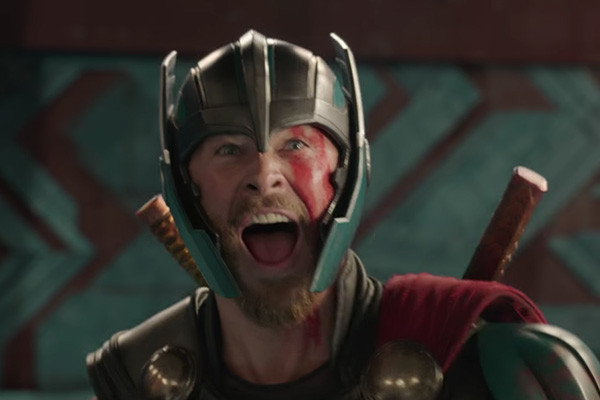
Related imageThor is forced to undergo the cruelest torture: have his hair cut.  He also faces off against the Grandmaster's greatest fighter, who happens to be The Hulk.  Thor's thrilled: "he's a friend from work!", he shouts delightfully to the Grandmaster, while Loki looks on with fear.

Hulk, smash, however, and there has to be an actual fight.

At this point I'd argue that in a Thor/Hulk fight I would put my money on the god of thunder.  All Hulk has is brute strength, but Thor has both great physical strength and a warrior's strategy.  Needless to say, however, Thor loses because the Grandmaster ain't about to let his champion win.

Eventually, there is an escape after Thor manages to get Hulk to become Bruce Banner (Mark Ruffalo), and he gets help from Scrapper 142 (Tessa Thompson), who is really the last of the Valkyrie after all her sisters were killed by Hela in a previous coup attempt.

Oh right, Hela.  Well, she's laying siege to Middle-Earth, I mean, Asgard, with Skurge now her henchman.  Only Heimdall (Idris Elba), the previous Gatekeeper, stands in her way as he has hidden the sword that will allow her to invade and conquer the other Nine Realms.  Eventually all "The Revengers" as Thor has taken to calling his compatriots, get back to Asgard to fight Hela to the death.

This is going to make me sound like an awful snob, but I think the reason so many genuinely loved Thor: Ragnarok is because the target audience is either 14-year-old boys or those who think like them.

Image result for thor ragnarok
For example, to escape Sakaar "The Revengers" will have to go through a massive wormhole called "The Devil's Anus".  Granted, I've no proof of this, but I imagine screenwriters Craig Kyle, Eric Pearson and Christopher Yost (46, 37 and 44 respectively at the time of the film's release) all high-fived each other and giggled when they wrote "The Devil's Anus".

I imagine most 14-year-olds would find 'The Devil's Anus' hilarious.  I, sadly, am not 14-years-old and I don't think like one.

What would have been funny, if I had been asked, would be to call it "The Devil's Furnace". At one point however, Loki, with that same straight face he used, would use the exact same line he did in the film: "I'm asking for safe passage through the Anus" by mistake, not realizing what he'd said.  I'd even have allowed Thor, Banner and the Valkyrie to have burst out laughing at his malapropism.

That, however, didn't happen, because Thor: Ragnarok was not interested in trying to be serious.  Now, I can roll with comedy, even in a comic book-based film.  Ant-Man, for example, was a MCU film I genuinely liked in part because it had humor.  However, Thor: Ragnarok's big problem was that it was simply trying too hard to make everyone aware of how 'funny' everything is; it's like someone telling a joke and then asking, "Did you get it?", which as The Betty White once observed, only punctuates how it wasn't funny to begin with.

As I digress, if you look at a genuinely funny comedy, Some Like It Hot, you see the humor comes not necessarily from the premise but from everyone's reaction to it.  It is ludicrous to think anyone would have been taken in by "Josephine and Daphne", but everyone played it as if they were that dumb.  They weren't going on tangents, they weren't making asides, they weren't trying to rattle off quips.  They played the oddball premise perfectly straight, which made Some Like It Hot funnier.

Image result for thor ragnarokThor: Ragnarok, on the other hand, kept pounding away the 'LOOK!  WE'RE BEING FUNNY!' bits right from the get-go.  Thor gives a long-winded explanation to his capture and has to pause while spinning.  Over and over we get this 'funny' bits that serve to make the film longer than Some Like It Hot was.  OK, by nine minutes, but still.

There's almost a smugness to Thor: Ragnarok, as if we're supposed to congratulate it for working overtime to be quippy.  We see this every time Hemsworth interacts with someone save Blanchett and maybe Hopkins, when he played it more straight.  Note I said 'straight', not 'great', because no Hemsworth Brother has ever shown me they can actually act, though the film did serve up the Obligatory Shirtless Scene that apparently Hesmworth is required to have in all his films.

Now, I'm told that Chris Hemsworth is a growing comedic genius, somewhere along the lines of a Cary Grant.  I don't find that to be true.

Yes, like Grant, Hemsworth is an incredibly, breathtakingly beautiful man.  Unlike Grant, however, I still think Hemsworth's 'comedic' abilities come not from him genuinely being funny, but by being an incredibly, breathtakingly beautiful man put in forced comedic situations.  Grant never played comedy with an awareness that the character or situation was supposed to be funny.  Hemsworth always plays his 'comedy' fully aware that it's supposed to be funny.  Therein lies the difference.

The one highlight for me was when Hemsworth and Cumberbatch are together, but not because they were actually funny or because Strange was even necessary to Thor: Ragnarok.  My enjoyment came from this 'Battle of the Baritones', to see which one of them could speak in a lower register.

It's hard for me to work up chuckles with exchanges like these:

Thor: "No, I don't have a phone but you could have sent an electronic letter.  It's called an 'email'".
Strange: "Yeah, do you have a computer?"
Thor: "No. What for?"

Image result for thor ragnarok
A lot of what passed for comedy, from "Loki's Midsummer Night's Dream" bit to various exchanges between characters to the playing of Pure Imagination when Thor is introduced to the world of Sakaar to the Valkyrie falling off her ship after she just threatened anyone who would take Thor away from her was, for me, a case of simply trying too hard.

I figure Blanchett had a ball vamping it up for all its worth, but I couldn't feel anything for Hela. I spent most of the time trying to figure out where I'd seen Skurge before, and like everyone else he too was in on the joke, though he wasn't much part of the goings-on save for looking sad from time to time.  Ruffalo was perpetually a Nervous-Nelly when not in Hulk mode, and he wasn't that funny as Hulk either.

Come to think on it, Thor: Ragnarok seemed like two films mashed together, going from one to the other only when the first story seemed to be running out of steam.

Interestingly, Thor: Ragnarok is the first MCU film that I can remember where the CGI was so painfully obvious and fake. In this oddball mashup of Spartacus, Gladiator, The Running Man, Robin Hood and even Androcles and the Lion, it only makes matters worse.

To the film's credit, it is awash in vibrant color, and Immigrant Song is put to good use at the only two real good battle scenes which bookend Thor: Ragnarok.  However, I wonder if the battle scenes were good because of Immigrant Song

Bloated, boring and worse, self-aware to the point of parody, I wonder if Thor: Ragnarok set out to deliberately insult my intelligence.  Comedy, to my mind, only works when the characters aren't aware of it.  Everyone here was aware of it, and no matter how hard they tried, when you point out that something is meant to be funny, it almost always isn't.

Next Marvel Cinematic Universe Film: Black Panther

DECISION: D-

Sunday, June 24, 2018

Won't You Be My Neighbor?: A Review

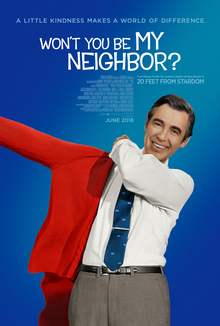
WON'T YOU BE MY NEIGHBOR?

There is a phrase used many times in film reviews, which I have avoided until now, but after seeing Won't You Be My Neighbor? the documentary about Mister Rogers' Neighborhood host Fred Rogers, I feel compelled to use it now.

Won't You Be My Neighbor? is a film we need at this time.

Whether it is nostalgia, a hope for see those mythical tattoos from his alleged time as a sniper, or an exploration as to this man's unique worldview, Won't You Be My Neighbor? is neither hagiography nor take-down.  It is respectful, kind, gentle, compassionate but with a quiet strength and even anger at how the world has become so mean and a desire to make it a better world. 

It a reflection of the man himself.

"Love is at the root of everything, love...or the lack of it," Fred Rogers says near the beginning of the film via archival footage, and we see how Rogers came about to become an unlikely television pioneer.

Fred Rogers was studying to be a minister, eventually being ordained into the Presbyterian Church.  However, while visiting his parents he became, if not fascinated by television itself at least by the potential television could have.  He was also distressed by many aspects of children's television in the mid-to-late 1960s: the fast pace, the pie-throwing and other forms of physical violence, and most of all by how children were talked down to.

Using his education in child development along with his Christian faith to guide him, his first venture onto television was The Children's Corner, a fifteen-minute show on local Pittsburgh television.  Here, he developed the puppets, voices and model for what would become Mister Rogers' Neighborhood.

Image result for won't you be my neighborRogers became a passionate yet quiet advocate for public television, facing off the formidable Senator John Pastore (D-RI), who was determined to cut PBS funding.  Rogers' now-famous testimony before Pastore's committee ended up charming the curmudgeonly Senator so much that he congratulated Rogers, telling him, "Looks like you just earned the $20 million".

He thought he had done enough programming at one point, around the late 1970s, to repeat the episodes and move on to other projects such as Old Friends, New Friends, a variation on Mister Rogers' Neighborhood more for adults that was not successful.  However, when he learned that children were still being mislead, unintentionally or not, by advertisers, programmers and adults who could not or would not show children the difference between fantasy and reality, he felt compelled to return to his 'mission field'.

Of particular note was his distress when he learned children were being injured attempting to fly like Superman, the children unaware that what they were seeing was not real.

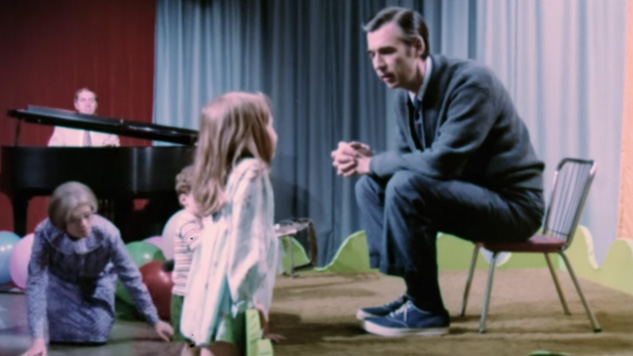
Fred Rogers, through his program, led by example in a gentle, confrontational manner.  He washed his feet in a pool with 'Officer Clemmons', a black man at a time when others threw acid into pools that had swimmers of various races.  He, through the Land of Make-Believe section of the program, tackled uncomfortable topics like assassination, fear of change and the Challenger explosion even if he himself did not appear in person but through providing the puppets' voices.

The film also touches on the workings of Mister Rogers' Neighborhood, and his nonchalance at the antics of some of the crew, along with his acceptance of parodies such as Saturday Night Live's Mister Robinson's Neighborhood skits with Eddie Murphy. While he told David Letterman in an interview he did not think they were all funny, he did say he also thought they came from a place of affection.

However, the film also suggests that some parodies and spoofs were hurtful, reminding him of when Rogers himself as a child had been bullied for his weight.  The parodies might have brought back uncomfortable memories of 'Fat Freddy'.  It also touches on his own childhood where he was not allowed to express anger or fear, but found an outlet through music.

Image result for won't you be my neighborAfter I left Won't You Be My Neighbor?, I found myself inspired by Fred Rogers and his worldview.  I don't know if this was director Morgan Neville's goal.  I doubt it was, but his portrait of Rogers, respectful and observant, showed that the man was as he appeared to be.

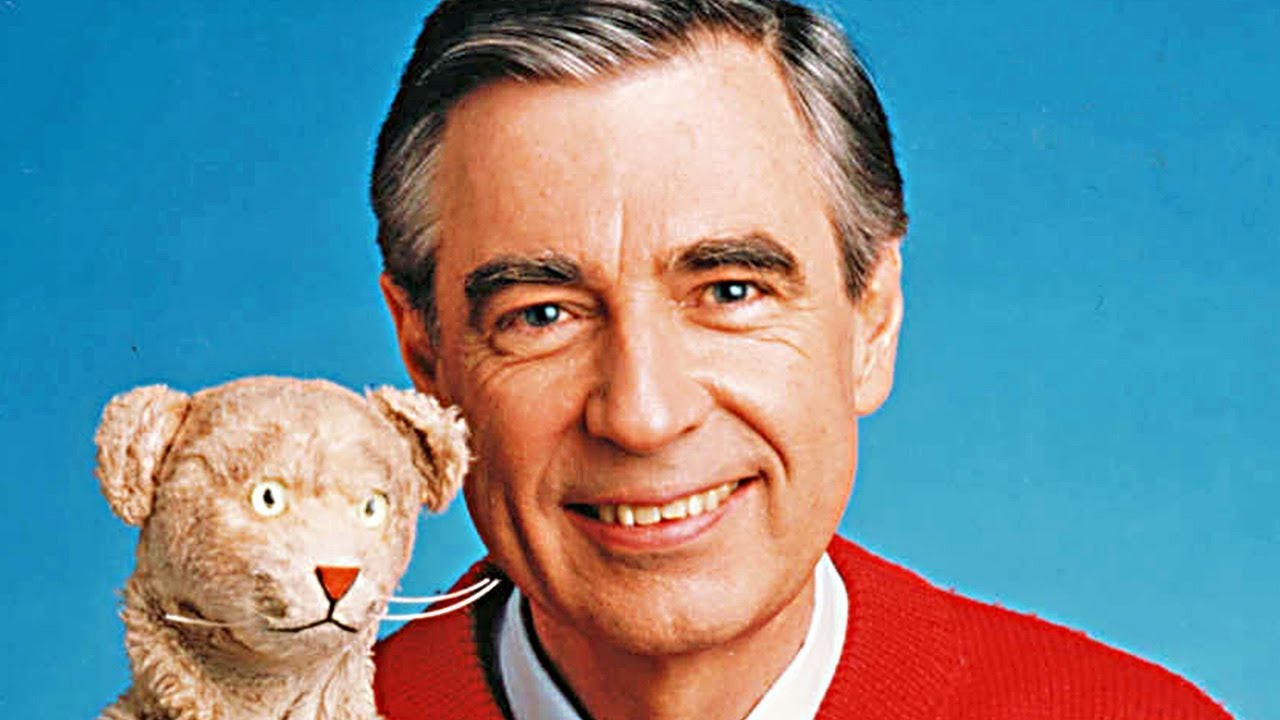
There was no subterfuge, no 'funny hats', just a man with his sweaters and sneakers, doing what he could to make children feel happy and safe in a world of uncertainty.

His worldview was one based on Christianity, but his Christian faith was a living and not doctrinal faith.  At a commencement speech, one of the things he mentions that he finds distressing, along with the destruction of the environment, is the eroding of the Sabbath.  He lived out his faith in a way not many of us do: by being a doer of The Word and not just a Hearer of The Word.

For Fred Rogers, his true model was Jesus Christ.  Both taught by parables, both had compassion and love for everyone, and both called the little children to come to them. Both also loved life and laughter.

One Mister Rogers' Neighborhood production member recounts when the crew was goofing around and took Rogers' camera to take a picture of the production member's behind before leaving the camera back for Rogers.  Mr. Rogers never said anything about that picture, but at Christmastime he quietly presented a poster-size print of that cheeky pic to that cheeky crewman.

Fred Rogers was also a firm Christian in his righteous anger.  Just as Christ was enraged when he saw the Temple defiled with moneylenders, Rogers too was quietly enraged when he saw how children's television was misused.  The fast pace, the disrespect for others, the over-stimulation all grated at him.  For Rogers, he saw that most children's television wanted to just make them laugh.  He wanted television to make them think and more importantly, make them feel.  Rogers above all else respected children and their feelings as they developed their growing worldviews.

For me, that suggests that Rogers did truly accept people as they were, even if in the case of Clemmons, he asked the aspiring singer to keep his homosexuality secret for fear of losing sponsors. Eventually Rogers came around and his widow Joanne remarks that they had many gay friends.  This, along with Rogers' somewhat eccentric fixation with the number 143 as both meaning "I Love You" and his ideal weight which never shifted, are about the only genuine criticisms Won't You Be My Neighbor? can find to the man.

What we get in Won't You Be My Neighbor? is of a man who lived out his faith, who saw the world as Christ did: with compassion for all and love for all, especially children.  We see a man who saw the potential and pitfalls of television and in his own small way to use it for good, to show that love and compassion and kindness are the true treasures.

I end with this small meditation.  It is impossible to know what Rogers would think of the world we live in now, where vitriol is spread nightly on television and various online forms and where children's programming is both faster-paced and more interested in indoctrinating than exploring. 

I can only guess, but I imagine his heart would break at the idea of children being separated from their families.  I also imagine his heart would break at the idea of adults chasing other adults out of restaurants.  Both, I think, would violate his vision that 'you are special', and that your worth is inherent in your existence.

One of Rogers' many songs was I Like You As You Are, and one can imagine Christ saying this to those He met.  Won't You Be My Neighbor? really is a film for these very troubled times, times we have troubled due to our own making.  It's not a reminder of 'gentler times' or a gentle stroll down Memory Lane. 

It's a reminder of what Christ taught were the Greatest Commandments; the First: To Love Your God With All Your Heart, With All Your Soul, With All Your Mind, and With All Your Strength. 

The Second: To Love Your Neighbor As You Love Yourself. 

I aspire now to be a Healer not a Hurter, thanks to Mr. Rogers.

Image result for won't you be my neighbor
1928-2003

DECISION: A-

Saturday, June 16, 2018

Chris Hardwick: Some Thoughts


Image result for chris hardwick
I have never liked Chris Hardwick.

My main issue with Hardwick was his sycophancy towards those he claimed he and his organization, The Nerdist, to be reporting on.  He made himself the emblem of 'nerd culture', the cheerful, grinning face of Comic Cons everywhere, the 'fan who made good' and became a star in his own right, admired, respected, even perhaps seen as a bigger star than the ones he was perpetually kissing up to.

In reality, to me, he was a duplicitous part of the marketing machine, a poser, someone who touted himself as an expert on all things pop culture, specifically nerd culture (video games, sci-fi/fantasy shows, comic books/films), but who used his position to enrich himself by being at the beck and call of the studios to be a de facto promotional tool.

Yes, I would call Chris Hardwick a tool.

I found him odious in his gleeful cheerleading, refusing to ask tough questions and dismissing those who disagreed with him.

Now, we find that Chris Hardwick may have been more than just Marvel Studios' favorite fraudulent fan.

Chloe Dykstra, Hardwick's former girlfriend (emphasis mine, which I will get back to), posted an essay which details years of abuse and of deliberately blacklisting her in the entertainment industry.  She does not name Hardwick directly, but the details are hard to miss.

Dykstra states her abuser was someone almost 20 years her senior.  She's 29, he's 46.

The unnamed boyfriend went from "a mildly successful podcaster to a powerhouse CEO of his own company".  Hardwick was a podcaster who now wields great influence through his 'many-headed beast', The Nerdist.

Dykstra refers to him as 'a cheery-sounding famous guy'. Hardwick's public persona is that of a perpetually grinning, upbeat man.

All signals point to this unnamed person being one Chris Hardwick.

Image result for chris hardwick doctor who
The details of Hardwick's alleged actions range from the boorish to the criminal.  According to Dykstra, he told her to drop all her male friends, to not leave her hotel room at a San Diego Comic-Con while he went out and partied with various beauties, and to serve as his sexual plaything, ready to indulge his desires whether she wanted to or not.

In other words, she had to have sex with him whenever he wanted, not whenever they wanted, which veers dangerously close to if not actual sexual assault as there was little to no actual consent on her part.

A particularly ugly charge regards when she is recovering after surgery for an ectopic pregnancy.

After being told she'd come out of the surgery fine, her mother thanks God.

Hardwick's first statement is, "That's great.  When do you think I can have sex with her again?"

His reaction here isn't illegal.  It's just grotesque.

Related image
While people get hung up on the sordid and sad details of Miss Dykstra's post, I think we need to look at another part which is getting lost in the tawdry bits.

According to her, after she left this toxic relationship after three years for another man, Hardwick "made calls to several companies (she) received regular work from to get me fired by threatening to never work with them. He succeeded. I was blacklisted".

That is criminal in a literal sense.

Hardwick, if this is true, deliberately sabotaged another person's career out of spite, using his influence to pressure others not to hire someone out of revenge.  This is something Harvey Weinstein, unintended Godfather to the #MeToo movement, would have done and may have done.

Hardwick used his connections, his name, his fame to keep someone else from finding a job and furthering her career.

There is no way of dressing this up if true.  What Chris Hardwick did to sabotage Chloe Dykstra's career, if proven true, is no different than what Weinstein did, or what any other Hollywood producer or bigwig did to make sure someone did not get work because they used personal influence against them.

How is that not immoral?  How is that not illegal?  How can that be defended?

Related image
What makes the charges, all of them, more appalling is how Hardwick presented himself publicly: as a woke male feminist, championing gender equality.

Take for example the 13th Doctor on Doctor Who.  Hardwick stood on a stepladder to look down his nose at anyone who had objections to why a female was cast as The Doctor, calling those who objected 'a**holes' and 'not real fans'.  On his @Midnight show, he went one better, insinuating they were losers and horror of horrors, virgins who in his words 'have never screwed anything'.

Given his own sexual appetites, it's no wonder he fixated on that.

As he dismissed and ridiculed those who had an issue with the reasoning behind this change, he was allegedly simultaneously forcing his own girlfriend to have no life outside him, serve as essentially his 'call girl', openly asking when she'd be ready to service him sexually after a traumatic experience and working to derail a woman's career once the relationship ended.

Over and over, as Hardwick promoted himself as both a major player in the industry and as a progressive friend to female representation, he appears to have worked to discredit a former lover.

That smearing continues today, when he issued his response to Dykstra's post.  He denies any assault, then he carefully adds that during the relationship 'Chloe had cheated on me, and I ended the relationship'.  He goes on to say that Miss Dykstra wanted to get back together and even start a family, but that he 'did not want to be with someone who was unfaithful'.

Not since Harvey Weinstein declared he was going to take on the NRA as a result of the various allegations against him has there been such a tone-deaf response.

It's classic victim-shaming.  She cheated on MeI was the victim.

Hardwick now is essentially saying the opposite of what he has said anytime anyone else, from Harvey Weinstein to Kevin Spacey to Bret Ratner to Louis CK to Charlie Rose to Matt Lauer to Al Franken to Jeffrey Tambor to Joss Wheadon even such seemingly-mild men as James Levine and Garrison Keillor among too many men has faced similar charges: always believe the woman.

For Chris Hardwick, it's "always believe the woman...unless the woman is accusing me.  Then she's just a bitter ex-girlfriend/'broad' (though I figure another word would be used)".

Image result for chris hardwick signing
Perhaps because of his reputation as this woke male feminist, or perhaps because he represents to so many non-virgin nerds a cooler version of themselves, Chris Hardwick's #MeToo moment has become unique.

In all the time the #MeToo/#TimesUp movements have burst onto the scene, I cannot recall a time when someone was as vociferously and ferociously defended as Chris Hardwick.  I do not know why he, out of all those accused, has met this level of impassioned defense.

When Garrison Keillor, of all people, was accused of sexual harassment, Minnesota Public Radio wasted no time in firing him and going so far as to change the name of his former radio show A Prairie Home Companion to Live From Here to disassociate themselves from his alleged acts.

I don't remember people calling for 'due process' and insisting Keillor was 'innocent until proven guilty'.  I don't remember anyone doing the same for Tambor or Rose or Spacey or just about anyone else accused of sexual harassment/assault.

For Chris Hardwick, however, I keep seeing everything from 'we need to hear both sides' and 'he's innocent until proven guilty' to 'Chloe Dykstra is just getting back at her ex-boyfriend'.

It's puzzling to me why Chris Hardwick, of all those myriad of accused, is getting the greatest benefit of the doubt.

Image result for chris pratt son
Let's say that instead of Chris Hardwick, it was Chris Pratt who was accused of what Hardwick is alleged to have done.  Hardwick and his BFF Wil Wheaton would be pushing others and each other out of the way to condemn Pratt, to say what a horrible person he was, to run him out of the industry.

Instead, Wheaton asks for 'time to process' before making any statements when it comes to Hardwick.  Fine, but Wheaton and Hardwick have constantly and consistently insisted we always believe the accuser when they make sexual harassment/assault accusations against others (since in at least Kevin Spacey's case, the accusers were men).

Wheaton, Hardwick or any of Hardwick's defenders have never, to my knowledge, ever asked that we 'hear both sides' when it came to Weinstein or Spacey or Tambor or anyone else.  Wheaton, Hardwick or any of Hardwick's defenders have never, to my knowledge, said any of the accused should be given due process or that they were innocent until proven guilty.

Instead, Wheaton, Hardwick and Hardwick's defenders were almost always the ones who would call for boycotts and protests and attack anyone who dared defend the accused. They have been consistent: always believe the women/accuser.

Now, it looks like when it comes to Chris Hardwick, it's 'always believe the women...unless they accuse someone you like or even identify with.  Then she's a liar'.

I wish I knew why, of all the men caught up in this maelstrom, Chris Hardwick is the one that has to strongest and fiercest defenders.

You cannot have it both ways.  You cannot call for someone's metaphorical head and then turn around and insist we 'hear both sides' just because you're a fan of one accused.  You Must Be Consistent.

If it had been Chris Pratt and not Chris Hardwick who was accused, and if you have always said 'always believe the accuser', then you must believe Chloe Dykstra and call for Chris Hardwick to go.

You cannot have it both ways.

P.S. I don't think anyone will accuse Chris Pratt of anything excepting giving bad performances.  I may think he's just a good action star and not an actual actor, but from all I've read and heard he also is a genuinely nice guy.

Thursday, June 14, 2018

A United Kingdom: A Review

A UNITED KINGDOM

The recent marriage of the Duke and Duchess of Sussex, known also as Prince Harry and Meghan Markle, brought to mind another romance that involved royalty and race.  As the Duchess is the first member of the House of Windsor to be of mixed-race (perhaps the second if stories about Queen Charlotte, wife of George III, are true), it seemed a good time to look at A United Kingdom, the true story of an African king and the (white British) woman he loved.  A United Kingdom has a very respectable Masterpiece Theater-polish to it, but it never comes alive to make these interesting people either real or worth knowing about.

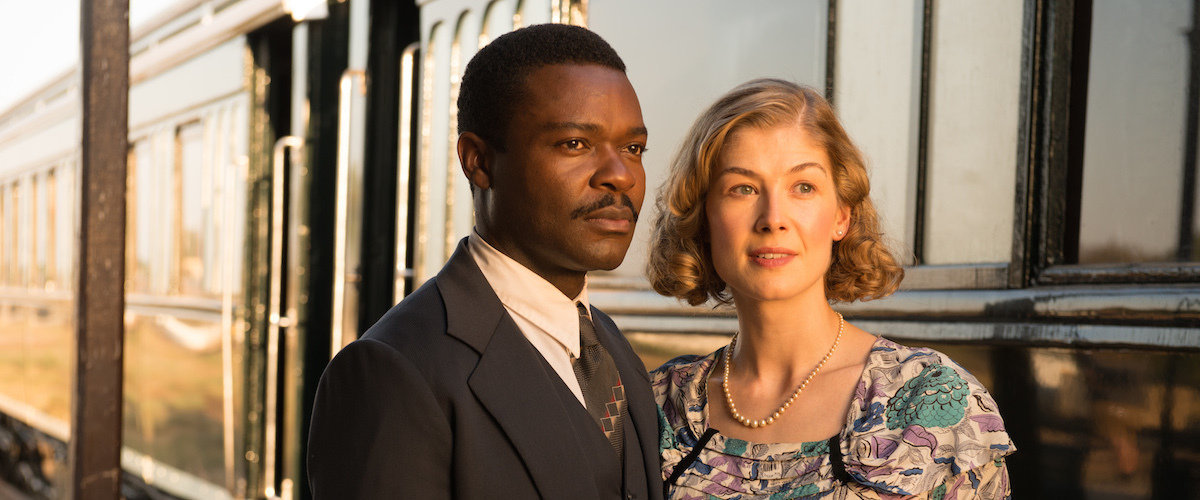
Seretse Khama (David Oyelowo) is the hereditary head of an African nation, Bechuanaland, currently finishing his studies in England.  It is at a dance that he meets Ruth Williams (Rosemund Pike), a typist.  They soon quickly fall in love, brought together in part by their passion for jazz.

The idea of marriage is firmly opposed by Ruth's father, but it isn't just the whites who are not happy.  As Seretse was a child when he inherited the throne, his Uncle Tkeshedi (Vusu Kunene) is also appalled at the prospect of a white Queen.  It's bad enough in his view that the British have Bechuanaland as a 'protectorate', but to have them in the Royal household is too much for him.  Tkeshedi insists Seretse put away his fiancee and get another one, an African one.

He stubbornly refuses to, causing a rift in the Royal family.  While his people are not crazy about Ruth, they do love Seretse.  However, owing to the rift the British are now slowly crouching in more into Bechuanaland, no doubt helped by the fact that the land is rich in minerals.  The British also want to appease the South African regime, one that is fiercely racist with their apartheid policies. Nevertheless, they marry and the rift breaks out into the open.

Seretse is exiled, but he wisely advises Ruth to remain, sensing that if both leave neither will be allowed to return.  Their relationship soon gets entangled in international politics, as the Labor and Conservative Parties use them for their own needs.  Eventually, Conservative Prime Minister Churchill is forced to keep his promise of allowing Seretse to return if his party won the general election, and in the end, Seretse comes up with a better plan: renounce the idea of monarchy and instead push for independence for the new nation of Botswana.

We learn that they remained married, with Seretse becoming the first Botswanian President.

Image result for a united kingdom movie
The issue with A United Kingdom is that it commits a great sin: it constantly and consistently tells but does not show.  Again and again we hear how 'this is a great crisis' or 'they are so in love' but we don't see it in the performances or the screenplay.

It's very strange that it takes fifteen minutes for us to see a marriage proposal when in those ensuing moments all Ruth and Seretse have done is talk of love but not actually show there was any affection, let alone this burning passion deep within.

In fact if memory serves correct, it isn't until half an hour that they even kiss, and that's because it's their wedding night.

Guy Hibbert's screenplay seems to want to focus on the political machinations thwarting our two lovers but keeps getting pushed back into focusing on their love affair.  I can almost sense the struggle between Hibbert and director Amma Asante as to what story they will tell.

We see this when we go to Parliament, and as a side note it's the cheapest-looking Parliament I've seen on film.

We see scenes of an agitated Prime Minister willing to sell out the Kharmas to keep South Africa in the Commonwealth, then go into scenes of Seretse crying when he hears his newly-born daughter's voice on the phone.  Back and forth, back and forth between what appear to be competing stories, both not interesting thanks to some bad decisions.

There's the decision to divide A United Kingdom between political drama and romance.  Then there's the decision to make everything so noble, so elegant.  The worst is that we again are told but don't see the evolution of the people.  Seretse's sister Naledi (Terry Pheto) on first sight openly hates Ruth.  At the end, she is her greatest friend.  How this turnaround came about we can guess.

Oyelowo and Pike are simply too good of actors to be this boring.  Asante is too good a director, having made the excellent Belle to have done such a lousy job.  It's not a good sign when you spend much time trying to figure out who a particular actor is, one who is devouring the scenery with relish as the 'evil' imperialist, only to realize it's Tom Felton, aka Draco Malfoy.

A United Kingdom, as I've said, is very respectable but dry as the Kalahari Desert.  This should be a most fascinating story, and the Khamas deserve better.

Related image
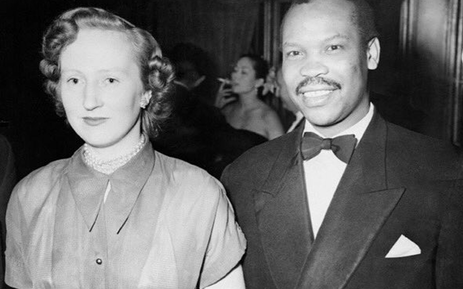
Sir Seretse Khama: 1921-1980
Lady Ruth Khama: 1923-2002

DECISION: D+

Wednesday, June 13, 2018

The Jazz Singer (1980): A Review


THE JAZZ SINGER (1980)

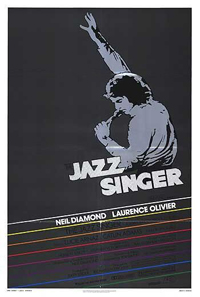
Neil Diamond has nothing to be embarrassed about when it comes to The Jazz Singer, at least musically.  Diamond is a true songsmith, creating a fantastic set for the third version of this story.  Even acting-wise, I won't bash Diamond because judging from his work here, he did the best he could in his film debut.  Granted, it was not a very good performance, but somehow he managed to do better than one of the greatest actors of the Twentieth Century, who just embarrassed himself.

Yussell Rabinovitch (Diamond) is a young assistant Cantor at the temple with his father, the main Cantor (Laurence Olivier).

As a side note, I wondered at the pronunciation of the name: Rah-bin-OH-vitch, when I would have pronounced it as Rah-BIN-oh-vitch.  Oh, well...

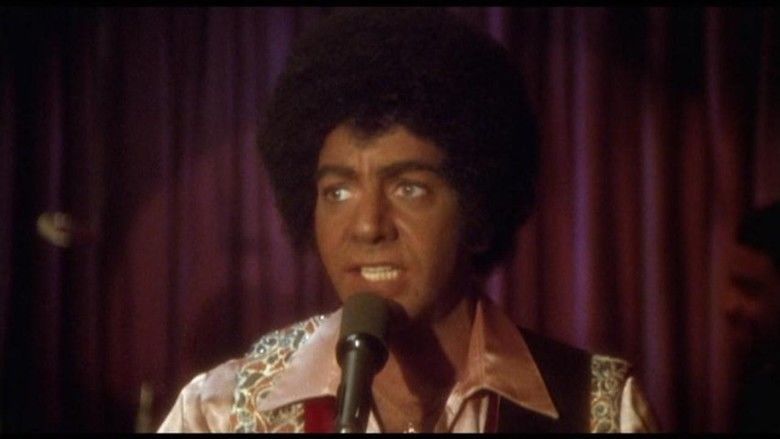
Yussell, married to Rivka (Catlin Adams) wants to be a good son and nice Jewish boy, but he also has a secret passion for contemporary soul and rock music (oddly, not jazz, but that's beside the point).  He has been performing with a group of African-American friends in various clubs, and at the latest gig has to don blackface in a failed effort to mix with the African-American audience.

This brings his secret life into the open, much to Cantor Rabinovitch's displeasure.  Yussell works to be the man his father wants him to be, but then his friend Bubba (Franklyn Ajaye) in California working as a background singer, tells him that one of Yussell's songs, Love on the Rocks, is getting covered on an upcoming album.  Yussell is asked to go to California for two weeks, and he goes with the reluctant blessings of the Cantor and the silent acquiescence of his wife.

Yussell, who goes by the stage name Jess Robin, is unhappy by the rock version of his ballad and shows the singer how it should be done.  Even though this gets them all fired, his original version intrigues Molly Bell (Lucie Arnaz), who works at the studio.  She soon becomes Robin's manager, forcing a gig as a last-minute opening act to the curiously named Zany Grey.

Image result for the jazz singer 1980While Robin is a success, Rivka is unhappy with her husband, yearning for the old life in New York's Jewish community and not the flash of California.  Jess, however, needs to follow his muse and what he thinks is his true calling, and Rivka leaves him.

This allows him the opportunity to knock boots with Molly, and the sight of this shiksa and Yussell's abandonment of five generations of Cantors sends his father into hysterics.

From what I understand, Jess' musical career is a betrayal of Holocaust survivors, at least in Cantor Rabinovitch's mind.

Despite having a big television special booked, Jess is in too much emotional turmoil to go on.  He flees and becomes a wandering minstrel, singing in various honky-tonks.  Eventually Bubba finds him and convinces him to return, not just to his career and Molly, but their new baby, Charlie Parker Rabinovitch (the closest connection to jazz the film actually has).

Getting ready for his comeback appearance as yet again Zany Grey's opening act, Jess is asked to perform the Kol Nindre for Yom Kippur, his father unable to.  He does go and reconciles with the man who declared him dead, the joy of his grandchild breaking the ice.

Jess Robin then takes to the stage, with Cantor Rabinovitch and Molly together in the audience, as The Jazz Singer belts out his new song, America.

As I watched The Jazz Singer, I thought the filmmakers could have saved themselves a lot of time, effort and embarrassment if they had opted to make a Neil Diamond concert film rather than adapt a silent film that had already been remade back in 1952.  This is especially true given that more than once, The Jazz Singer consisted of Diamond performing before live audiences, whether it was Summerlove, America or even a countrified version of You Are My Sunshine.

Related imageAs a side note, this section where Robin wanders across Texas made me wonder whether Diamond harbored a secret desire to be a country singer and was allowed to live this dream out, given that it made little sense in terms of the film itself.

Not that his ghastly blackface made things any more logical.  Whether this was screenplay writer Herbert Baker and director Richard Fleischer's odd tribute to the original film or some wildly misguided bit of comedy we don't know, but I can imagine audiences cringing rather than laughing at this, and the passage of time has made this scene look worse.

At least the original had the benefit of being in a time when blackface was acceptable, which does not make it right, but at least within some context of reality.

Misguided is the best word for The Jazz Singer, starting with the fact that there was no actual jazz sung.  I know they kept the title for name recognition and to stay true to the original, but it sounds silly to call it 'the jazz singer' when he doesn't actually sing jazz.

That is a minor point compared to the misguided performances.  Laurence Olivier should be remembered for his brilliant turns on stage & screen of his beloved Shakespeare, but at the tail end of his career he was humiliating himself with tawdry projects.  Perhaps not as shocking as the never-released Inchon, The Jazz Singer has to be among the lowlights of Lord Olivier's résumé. Forever hamming and coming across as hysterical, unhinged or dotty, Cantor Rabinovitch is unintentionally funny.

His 'distress' at the young woman his son has taken up with is downright laughable.

Image result for the jazz singer 1980
I'm not going to bash Arnaz much given she was given very odd directions.  For example, when she 'offers her body' to Jess she's directed to make this into a humorous suggestion, but then she looks as if she's genuinely upset and puzzled as to why Jess didn't take her up on her offer.  It makes Molly among the dumbest characters in film history: apparently unaware that offering her body to a married man makes her look sleazy.  Not that in the 'romantic' montage her serving ham to a Jewish Cantor doesn't already make her look downright like a yutz.

As for Diamond, I still think he did his best but he's obviously not an actor.  The script gives him little to work with: we don't know what is in him to create such ballads as Love on the Rocks.  We don't know what motivated his dreams, and as a side note, someone should have told him to cut his hair.  He said the lines, sometimes convincingly, so there's that.  He was better and more confident when singing, which is his forte. Again, a concert film would have been better, cheaper and more productive.

As lousy and ill-conceived as The Jazz Singer is in terms of acting, writing and directing, let alone as a vehicle for Diamond, the soundtrack itself is a wonderful piece of work. The songs are all pretty great except for perhaps On the Robert E. Lee, sung at what is the squarest Hollywood party in history.

There's a banjo in it for goodness' sake!

The Jazz Singer is longer than it should be (we could have cut Diamond's country troubadour bit) and disorganized (Jess' struggle with his family and heritage sometimes falls by the wayside).  Apart from the music there isn't much to recommend in it, unless you count the camp humor at its unfortunate silliness.  My recommendation is to buy the soundtrack and watch The Jazz Singer only if you want to laugh at how it all went wrong.

DECISION: C-

Tuesday, June 12, 2018

Romeo and Juliet (2013) Broadway Review

ROMEO AND JULIET

I am aware that Romeo and Juliet is a tale of woe, but that does not excuse the 2013 Broadway production from being so woeful.  Apart from one performance this production is shockingly bad, appealing to tweens all thrilled with the flattest, dullest Romeo to strike the Great White Way.

The conceit of this version is that the Capulets are black and the Montagues are white.  How having a black Prince of Verona does not affect his relationship with the Capulet/Montague feud given how they opted to make race an issue we know not.

Romeo Montague (Orlando Bloom) falls passionately in love with Juliet Capulet (Condola Rashad), and she reciprocates.  The problem is that their families are in a blood feud.  Despite this, they opt to secretly marry with the help of Juliet's Nurse (Jayne Houdyshell) and Friar Laurence (Brent Carver), the latter in the hopes that their union will end the bitter feud.

However, things cannot be as such, as Juliet's cousin Tybalt (Corey Hawkins) fights with Romeo's best friend Mercutio (Christian Camargo), Romeo's efforts to stop this lead to Mercutio's death, then Romeo kills Tybalt in anger.  From there, cascades our cycle of sadness on both these noble houses.

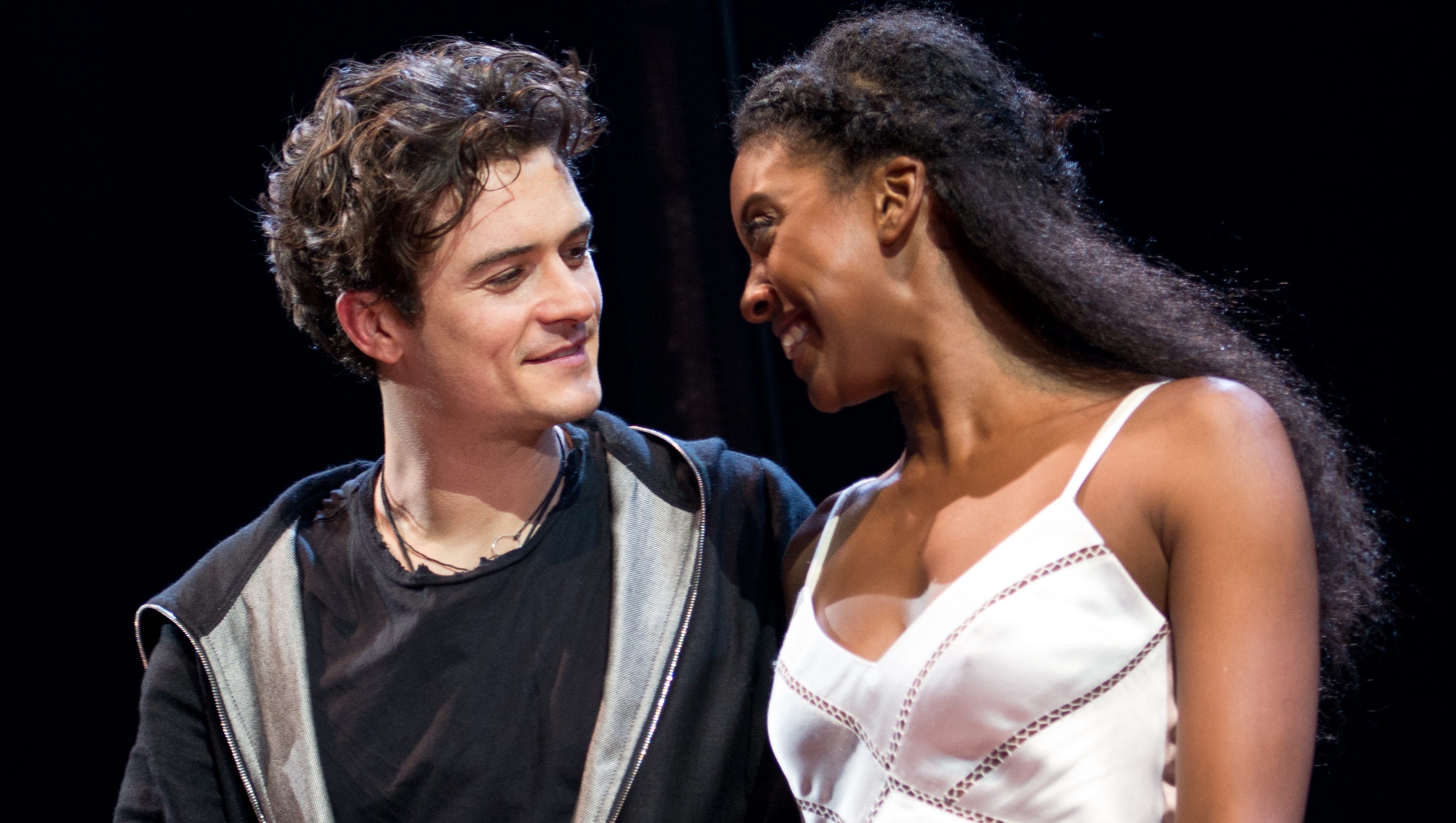
Related imageYou know the target audience of Romeo and Juliet straight from Romeo's entrance.  Channeling a bad James Dean impersonator trying to do Shakespeare, Orlando Bloom rides atop a motorcycle in this 'contemporary' version.  When he removes his helmet to reveal the ethereal beauty that is Bloom, you could hear cheers and I think squeals of delight from teen girls, aroused at seeing Legolas so close.

It's a curious thing in a production when you see pretty quickly that this is going to be a disaster.  I saw it from the moment we heard the rumble of the bike.  I figure director David Leveaux wanted us to think of Romeo as this classically cool figure, smooth and charming, even hip.

His entrance, however, ended up making it look like Romeo and Juliet had slipped into Grease 2, with everyone about to start singing Who's That Guy.  I happen to like Grease 2, a guilty pleasure I admit, but it's sad when something as bad as Grease 2 is actually on a higher level than Romeo and Juliet.

I'm not such a purist that I cannot have a contemporary production of Shakespeare, but there has to be a reason for it.  There was no reason for it, apart from appealing to Bloom's squealing groupies.  Oddly, I have always thought that Bloom is competent only in period and fantasy films, floundering whenever he tries to play contemporary.

Note I said 'competent', not 'good', because Romeo and Juliet showcase just what a lack of acting talent he has, with nothing to recommend a career apart from his beauty.  His Romeo is an embarrassment, good only for spoofing.  Bloom has a really amusing tic in Romeo and Juliet: thrusting his right arm out in many of his line readings.

I did not keep count, but that might make for a good drinking game: a shot every time Bloom thrust his arm out to show he is ACTING.  That, however, is the least of his theatrical sins.

Image result for romeo and juliet 2013 broadway
Bloom's 'call to arms' is part of a larger issue: how he is not the character but the star.  He constantly performs to the audience, as if the other actors were not actually there, not even Juliet.  Bloom's performance appears to come from a mind that think they are all props for his one-man show.  In many scenes, he is speaking directly to the audience and seems to barely recognize his other actors.

Add to that his line reading is hilariously bad.  In the Balcony Scene, his declarations of love sound as if he were stoned.  As he pushes through "It is The East...", he makes this not the romanticizing of the fair Juliet, but pretty much a declarative statement, with no sense of love or passion.

His only bright spot, it appears, is in his Obligatory Shirtless Scene.

I wish I could say that his cast pushed Bloom to at least try to up his game, but it looks like they were all trying to act as badly to keep up with him.  Rashad was slightly better as Juliet, but she came across as insipid instead of love-struck.  She also seemed to be rushing through her dialogue, almost in an effort to get this over with the faster.

In my notes, the only complimentary thing I could say about Rashad as Juliet is 'she plays dead very well'.

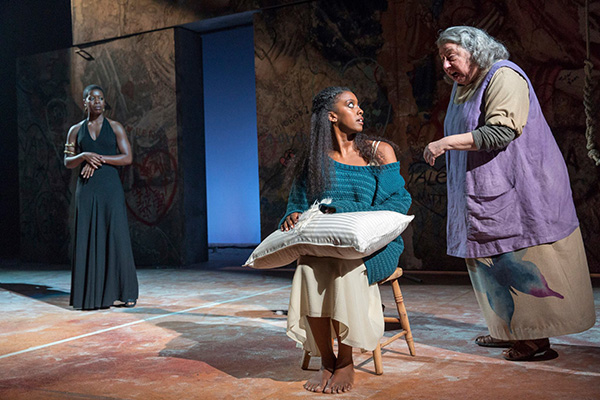
Hawkins was overdoing things as the angry Tybalt and Camargo never got the humor of Mercutio.  Houdyshell didn't make the Nurse into the salty character I remember from Romeo and Juliet, but more of a scold to where I wondered why Juliet would think of her as a confidante.

Related imageThe only bright spot was Chuck Cooper as Lord Capulet, who brought a bit of whimsy and humor to his interpretation.

A massive surprise is finding former American Idol first first-runner up Justin Guarini as Prince Paris.  Even more astounding is that Guarini in his small role actually manages to out-act almost everyone, even if his Paris came across as an idiot.

Again, I'm not saying he did a great job.  I'm saying he did a better job than those who have or are alleged to have most experience acting on stage or screen.

I put this in part on Leveaux, who could not get his actors to make the characters real.  I cut him some slack given he had some poor material to work with in Bloom, but other aspects are inexcusable.

This Romeo and Juliet did one thing that I detest in any Shakespeare production: it rhymed.  For reasons I cannot fathom Leveaux let the actors rhyme the lines.  For example, there's this line, spoken by Lord Montague (Michael Rudko) upon discovering their children's bodies:

"That while Verona by that name is known, there shall be no figure as such rate be set, as that of true and faithful Juliet".

"Set" and "Juliet" rhyme, nothing wrong with that.  However, for nearly the whole of Romeo and Juliet, the actors emphasize that their lines rhyme.  In this case, Rudko put force on 'set' and 'Juliet' to enhance the rhyme, but he wasn't the only one doing it.  In fact, I think everyone in Romeo and Juliet did it.  It was only in terms of degrees.

I find that such a pet peeve when watching any Shakespearean production.  Shakespeare's language should sound natural, as if it comes from actual speech and not the force theatricality that many productions are plagued with.  It needs to sound real, and in this version, they seem to almost enhance and emphasize how unreal it sounds when spoken.

Truthfully, I've seen high school productions that have better acting and directing.  I've never wanted these two characters to actually die so much as I did after this monstrous rendition of Romeo and Juliet.


2/10