Sunday, January 13, 2019

On the Basis of Sex: A Review

ON THE BASIS OF SEX

In these divisive times a film like On the Basis of Sex, the biopic on Associate Supreme Court Justice/cultural icon Ruth Bader Ginsburg, could have slipped into total hagiography to where one expects the Notorious RBG to walk on water & bring sunshine into the world. On the Basis of Sex, while still tilted towards worshipful complete with 'inspirational' tropes, has strong performances and narrows things down to one moment in Justice Ginsburg's life that crystallize her worldview.

Ruth Bader Ginsburg (Felicity Jones) is passionate about law and her husband, Marty Ginsburg (Armie Hammer).While she chafes under the open sexism of Harvard Dean Ernest Griswold (Sam Waterston), she perseveres, not just with her own classes but with Marty's after he's diagnosed with testicular cancer along with caring for their daughter Jane.

With Marty's cancer in remission, the Ginsburgs still struggle. Ruth cannot find employment despite her qualifications due to her gender and reluctantly takes a teaching position at Rutgers while Marty enters tax law. She sees the protests and social change but isn't active in it, despite Jane's (Cailee Spaeny) more militant manner. Ruth still wants to try her hand at practicing law but finds the sexual barriers firmly up.

Then comes an obscure tax issue that piques her interest. A Colorado taxpayer was denied a caregiver deduction after hiring a nurse to care for a mother in declining health. The denial was made on the basis of sex. There is one difference to other cases however. The person denied the deduction on the basis of sex was a man.

Image result for on the basis of sexLifelong bachelor Charles Moritz (Chris Mulkey) is the plaintiff. The law states that the deduction is for women, men being allowed the deduction only if their wives are incapacitated or widowers. Ruth is convinced that Moritz's case can be the precedent to chip away at gender-based discrimination, reversing laws and rulings that favor men and separate men and women.

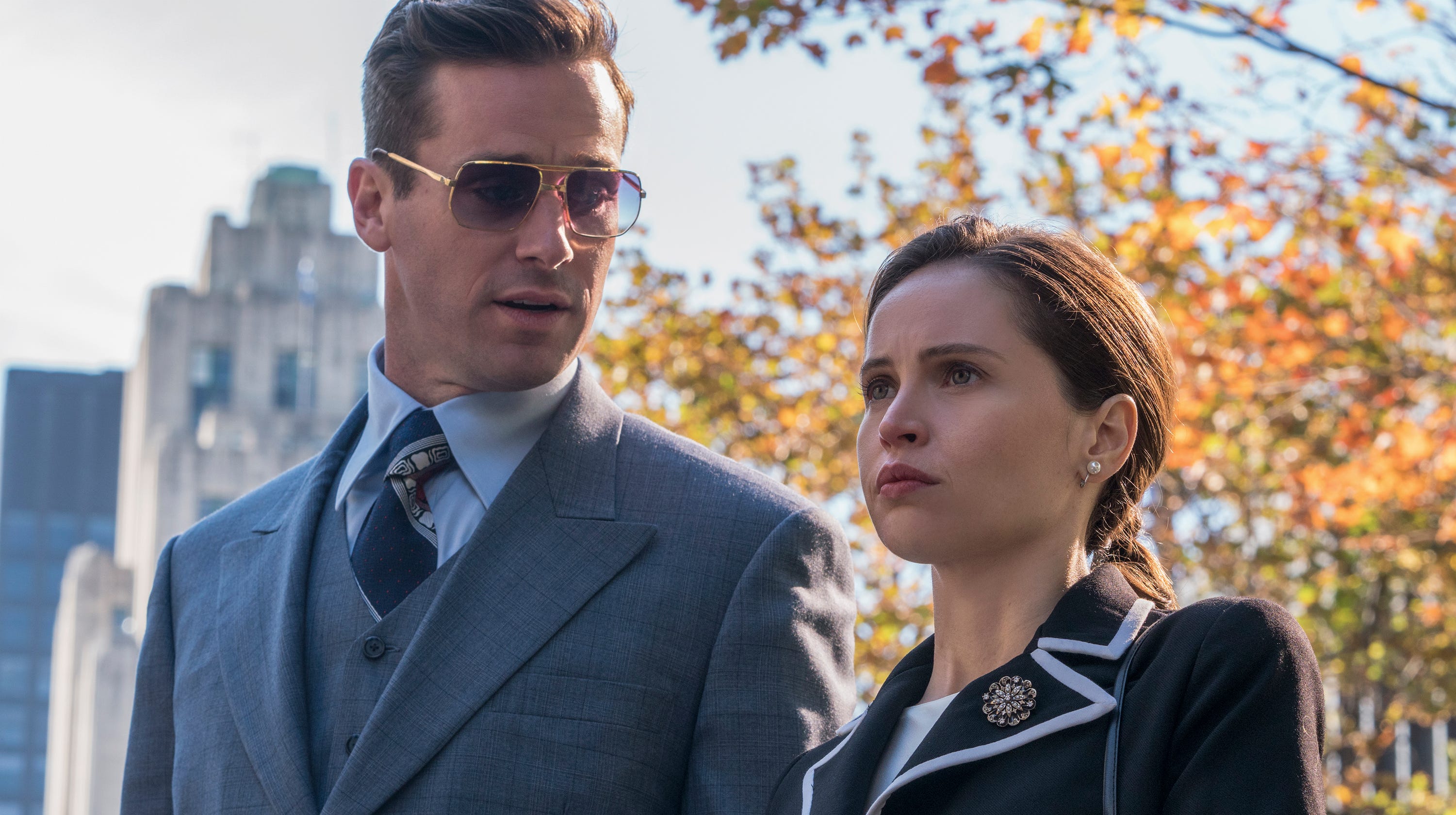
The case goes to the Tenth Circuit Court of Appeals, where she must make her case against her old nemesis Griswold, now Solicitor General, and her former Professor Brown (Stephen Root), now the IRS chief, both of whom are determined to 'keep women in their place'. This case is made harder by the fact that Ruth has never argued a case before and both she and Marty, who reluctantly co-leads, seem to bungle their arguments.

Keeping to heart what they learned in law school, to not take the temperature of the weather of the day but the climate of the era, Ruth argues that essentially the times, they are a-changing, and that these laws that create separate statuses for men and women are antiquated.

In the end, we learn that the Tenth Court agrees with the Ginsburgs, that Marty Ginsburg died in 2010 and that eventually Ruth Bader Ginsburg was appointed to the Supreme Court on a Senate vote of 93-6. The real Justice Ginsburg herself appears at the end, walking the steps to the Supreme Court.

Related image
On the Basis of Sex was written by Daniel Stiepleman, who just happens to be Justice Ginsburg's nephew. Given that, one could argue that the film was not going to show the subject in anything close to a negative light. Even the few moments when Ruth Bader Ginsburg is slightly off-putting, such as her arguments with Jane (about the film's only domestic drama), she still is shown primarily in a positive light.

As a side note, it does seem peculiar that Green Book, co-written by one of the main character's sons, has been criticized in some circles for painting said character in a positive light, yet that kind of criticism has not been leveled at On the Basis of Sex, written solely by the main character's nephew. If one argues that something like Green Book whitewashes a character due to the writer being related to that character, why can't the same by argued about On the Basis of Sex?

Yet I digress.

There were elements in Mimi Leder's film that were off-putting, falling into 'inspirational biopic' tropes. There was Mychael Danna's 'stirring' score, playing soft brass at key moments. One almost expects Fanfare for the Common Man to start playing as Ginsburg speaks to the three-judge panel. There were shots of Brown and Griswold bathed in darkness, missing only their mustaches to twirl to indicate how evil they were.

Image result for on the basis of sexThis is how Root and Waterston were directed, in particular Waterston. In an early scene at a faculty dinner to welcome the female students, he asks each of them to state their names, where they are from and why they were there, taking the place of a man at Harvard Law. It's one thing to have contempt for women in a "male" field. It's another to be so open about it.

Granted, this may have happened, but one wonders if perhaps a slightly more subtle manner may have worked better.

In other things, Leder and Stiepleman did extremely well. The subtly of showing Cosmopolitan Magazine billboards and catcalling to Ruth and Jane while they talk about the hurdles women face in the legal system worked much better than just pointing out the chauvinist manners of a Brown or Griswold.

On the Basis of Sex also benefits greatly from Felicity Jones' performance as Ruth Bader Ginsburg, a woman who is able, competent and wants true equality for both sexes. She brings a quiet strength and dignity mixed with a burning righteousness. You respect Ginsburg and see her as a heroine. Hammer's Marty is essentially the adoring husband, forever supportive and with never a negative word to say. Even in the one scene where they come close to arguing about how Marty seems fine in letting his law firm coworkers belittle her he is remarkably even-keeled.

For all the grief Nancy Reagan got for perpetually looking adoringly at her husband, she might have drawn lessons from Marty Ginsburg.

One surprise is Justin Theroux as Mel Wulf, the ACLU lawyer best described as her frenemy: supportive but also critical of her methods. From his voice to his manner, Theroux gives a strong performance as the closest thing Ginsburg has to an equal in law. Unlike Marty, he isn't worshipful or deferential, but unlike Brown or Griswold he isn't dismissive or contemptuous. 

On the whole, On the Basis of Sex is a respectable portrait of this Associate Justice, a look at the formation of this formidable legal mind. It's well-acted and directed, making its own case as to why Justice Ginsburg is a woman for all seasons.

Born 1933


DECISION: B-

Wednesday, January 9, 2019

Gotham: Year Zero Review

Image result for gotham year zero

GOTHAM: YEAR ZERO

Year Zero, the premiere episode of the fifth and final Gotham season, does what a season premiere should do: set up the stories for the season, in this case a shortened final one. Perhaps this is for the best, as Gotham could be a bit overstuffed in a regular 22-episode run. At last, we have what perhaps we should always have had: a more Bruce Wayne/Batman-centered series versus a Jim Gordon-centered one. Year Zero is not a bad way to start but nothing more.

We get a quick flash-forward to Day 391 of Gotham in the grips of chaos, with the unlikely alliance of Captain Jim Gordon (Ben McKenzie) and Harvey Bullock (Donal Logue) with their frenemies Oswald Cobblepot aka The Penguin (Robin Lord Taylor) and Edward Nygma aka The Riddler (Cory Michael Smith).

Then we shift to Day 87 where we learn what has happened since No Man's Land. The city island is held by various factions, including Penguin, The Scarecrow (David W. Thompson), the Sirens Barbara Kean (Erin Richards) and Tabitha Galavan (Jessica Lucas) and the GCPD. There's mention of a war between Mr. Freeze and Firefly, but we didn't see that, alas.

The Gotham City Police Department is holding on despite being cut off from supplies at the government's orders, but help comes from Bruce Wayne (David Mazouz), who will defy the embargo and bring in a helicopter with supplies. He does this in part to help his own frenemy, Selina Kyle (Camren Bicondova), who gets surgery to keep her alive but may never walk again.

The shipment is attacked, a fight breaks out between Penguin, the GCPD and the Sirens for it, costing Tabitha her life and Penguin to return to hobbling. Each group faces their own internal issues, with Scarecrow causing havoc save for the helicopter attack.

Edward, for his part, is struggling to find himself, puzzled and angered over why he keeps ending up in a different place each night, fighting his dual natures without much if any control over either.

Barbara swears revenge on Penguin, and Captain Gordon, ever loyal to his principles, will fight to regain Gotham for good and for the good.

Image result for gotham year zero episodeWhat Year Zero did, as I said, was set up the stories for this upcoming season. In that respect, it did its job well. We even got a tease about what the future holds: eventually sworn enemies will find it necessary to join forces for a common good/goal.

What we did not get were answers to some questions, which I figure will be teased out later. For example, when last we left Gotham both Edward and Lee Thompkins were essentially dead, placed in the hands of mad scientists Dr. Hugo Strange.

What exactly did he do to Riddler? What did he do to Dr. Thompkins, whom we have not seen? Jumping 87 days leaves us with no explanation as to how Riddler/Ed came back. While we know he will find his way to being his old selves again, I do hope we get an actual answer.

Year Zero also has a bit too much 'poetry', such as when we open with We'll Meet Again playing as our disparate group joins up. Drawing a bit much from Dr. Strangelove?

However, sometimes that 'poetry' worked, such as when Bruce is attacking Scarecrow's men in the dark. We can firmly see Mazouz becoming the Dark Knight, and he really has grown into this complex figure.

There were quite a few standout performances, such as Mazouz and Bicondova, who is drawing on the emotional aspect of our Catwoman as she struggles with her paralysis. Taylor is consistently great as Pengy whether he's raging or being sarcastic, finding humor in the most dangerous of circumstances.

Smith did not have much to do but his confused Edward worked well. I would fault Richards as being slightly over-the-top, but given that's how our Bonkers Babs is, I cut her some slack.

On the whole Year Zero is a good but not great way to set up this abbreviated Season Five. It will be interesting to see not just how much they pack into twelve episodes but how they pack in not just all these characters but the Joker and the upcoming Bane.

5/10

Next Episode: Trespassers

Tuesday, January 8, 2019

2018: Some Odds and Bitter Ends


Now that we've moved from the Best and Worst of 2018 (So Far), it is time to look at some other categories that I think merit special note.

These other categories allow me to expand my views which would not fit into a Best Of/Worst Of List. Enjoy!

BIGGEST SURPRISE

I Can Only Imagine
I've been critical of 'Christian cinema' as many faith-based films and filmmakers tend to either 'preach to the choir' or be more focused on the message than on the delivery. In the former, that's fine: if you don't want your film to be for general audiences but a specifically Christian audience only, more power to you.  If you are in the latter, you cannot and should not sacrifice craftsmanship for sermons.

I'm looking at YOU, Alex Kendrick...

However, I Can Only Imagine, like last year's The Case for Christ, took a positive step in Christian/faith-based filmmaking. It focused on Bart Millard's story while not watering down Millard's Christianity. His faith is important in his story, I imagine even the central part of his life. However, I Can Only Imagine does what good Christian films should do: tell the story efficiently but not beat the viewer with messaging.

The film did not preach about salvation. Rather, we found in Millard someone we could relate to, someone who was 'just like us'. It reminded us what is true: Christians are just like other people. They are not 'free from sin', they are fully functional people who have moments of anger, regret, even genuine kindness.

Middle America is right to complain that Christians are almost always portrayed on television and film as vile people. I Can Only Imagine reminds us that, to coin a phrase, 'Christians Are People Too''.

BIGGEST DISAPPOINTMENT

Solo: A Star Wars Story

There were many disappointments this year, but I think this newest film in the Star Wars Cinematic Universe is at the top of the list.

Ever since Disney got their hands on that galaxy far, far away, it has been hellbent on milking its property for every cent it can get. Sometimes they managed things well (Rogue One). Sometimes it's been bad (The Last Jedi). Their next decision was to have prequels of all our characters, and the first one was on our roguish Captain Han Solo.

Solo: A Star Wars Story's failure has all but killed future 'origin' stories for other characters. It wasn't necessarily a financial failure (though it will never really make up the money spent on it) but a thoroughly artistic failure. The original directors, Christopher Miller and Philip Lord, were fired almost near the end due to Disney's displeasure at Solo being more comedic than what they envisioned. Ron Howard, as workman-like a director as can be found, was brought in to finish a more 'standard' Star Wars film.

The end result is more an endless series of 'fan-service' than a truly original origin story. LOOK! Here's Han and Lando gambling over the Millennium Falcon! LOOK! Here's that famous Kessel Run you've heard all about FINALLY on-screen! LOOK! Here's how Han and Chewbacca finally met for the first time!

I've talked to other, bigger Star Wars fans who say it threw in too much into it. I think there was panic, a greater focus on film-via-committee than in making something Star Wars fans and general audiences would actually embrace. Disney gave people what they thought people wanted.  They ended up pleasing almost no one.

What can one say about a film where Alden Ehrenreich's not-good/not-bad version of Han Solo was one of the least criticized aspects?

In what can be seen as sweet revenge, our duo of Miller & Lord went on to produce Spider-Man: Into the Spider-Verse, a film both critics and Spidey fans love. Imagine if they'd been allowed to do their version of Solo: A Star Wars Story.

MOST OVERRATED FILM

A Star Is Born 4.0
Some of my regular readers and correspondents think I started out hating A Star Is Born, or as I call it, A Star Is Born 4.0 given it's the fourth version of the story. That's not true. I didn't go in or even leave the theater hating A Star Is Born with the burning fury I have now. That level of despising that I have against it now grew, and it grew because my brethren lost their collective minds over this bit of fluff.

My fellow critics have every right to see something as they wish to. However, once they started referring to A Star Is Born 4.0 as 'transcendent', declaring it not just one of the best films of the year but of all time, some turning point in cinematic or human history, then I began to grow more and more passionately against it.

I have nothing against Lady Gaga, who I think can become a fine actress. However, she is essentially playing herself, and I'm agog at Gaga's elevation to being thought of as the new Vivien Leigh or Katharine Hepburn or even Barbra Streisand. Streisand at least had Broadway acting experience by the time she reprised her role in Funny Girl.

Same goes for cowriter/director Bradley Cooper. I don't understand why his lush is held up as something that would bring envy to Peter O'Toole and Richard Burton (both no strangers to boozing). The critical worship and adoration for A Star Is Born 4.0 astonishes me. Even the praise it has received I could live with, if the film were actually that good.

It's the third-best version of a story told four times.

Perhaps it is because I've seen all four versions and know the story well, but why so many in the theater were sobbing their eyes out when Jackson Maine hangs himself is a total mystery. Even my mother got in on the act, telling me how tragic this version was because he dies at the end. "Mom, the guy dies in EVERY version", I replied, which surprised her.

It's one thing if you don't know A Star Is Born isn't original, as I think many sobbing did. It's another when film reviewers/critics, who should be more versed in cinema, behave as though A Star Is Born 4.0 is original. Truth be told, I think just about everything involving A Star Is Born 4.0 is...Shallow.

MOST UNDERRATED FILM (TIE)

Venom

Acrimony

For the first time in these annual lists of Odds and Bitter Ends, I find two films that I think have been unfairly bashed and trashed. The odd thing is that on one of those films, I myself did the trashing and bashing.

I make no argument that either Venom or Acrimony are 'good' films. In fact, I gave Venom a negative review and do not regret it. It is almost a spoof of comic book-based films.

How does one take Venom seriously when you have Tom Hardy jumping into a lobster tank and acting like he's trying out for Son of Bobby Boucher?

However, I know the audience I went with loved Venom. They seemed to revel in the sheer stupidity of it all, taking our anti-hero into its heart no matter how ridiculous everything was. As the year has ended and I look back in some anger, I feel a softening towards Venom.

I feel almost able to embrace the absolutely terrible script, bad acting even from Michelle Williams, the cliched story, lousy special effects and just total awfulness of it all. It's almost as if I too can enjoy Venom so long as I let it wash over me, as if I can gain pleasure watching Venom if I watched it more for camp enjoyment than as an actual film.

Perhaps here you could ask why I couldn't do that with A Star Is Born 4.0. The answer is simple: my fellow critics don't behave as if Venom is greater than The Dark Knight versus their idea that A Star Is Born 4.0 is greater than Citizen Kane.

Image result for taraji p henson acrimony dance
While I've softened on Venom, I have not shifted on my view of Acrimony. Yes, it's a bad film, but I found it a 'so-bad-it's-good' film, so delightfully and wildly bonkers that one can't help but marvel at its insanity.

Taraji P. Henson has never received the respect and work her talent merits. Even in her greatest film role, Hidden Figures, she was shamefully overlooked for Best Actress over the 'cutesy' Emma Stone in La La Land. I don't want to say she is 'reduced' to "Angry Black Woman" roles, but there's something about Acrimony that leaves me unapologetically in love with Henson's totally committed performance for this totally whacked-out character.

I'm convinced that Henson's Cray-Cray Dance in Acrimony will be studied by film students for centuries to come as a sign of an actress giving her all to such awful material. It's just so wildly wrong it's almost right. One both marvels and laughs at just how Tyler Perry can keep being simultaneously trashy and moralistic.

Acrimony is not a good film by any stretch, but I found it highly enjoyable, a delightful romp if ever there was one.

I also would rather watch Acrimony than A Star Is Born 4.0. I'd sooner take the former's lunacy over the latter's pomposity.

Now as we enter The Year of Our Lord 2019, I continue to hope for good films and for the bad ones (and the A Star Is Born-overrated types) to be at a minimum.

Monday, January 7, 2019

The Worst of 2018 So Far


As in last time, this is more a "Worst Films of 2018 that I have Seen" list than a list of the worst films of 2018 overall. Some notorious flops were skipped by me, either because they didn't come to El Paso or because I just didn't get around to them.

Sorry, A.X.L.

Some films on this list will shock you, as they have appeared on many Best Of 2018 Lists and are held in high regard. I do urge you to read my case before getting on my case.

Number 10:
Robin Hood
Robin Hood is an embarrassment through and through. It tries to be so much and ends up being nothing.

It is another failed franchise starter, another bane of my cinematic experience. The original title was Robin Hood: Origins, which should give you an idea of where the filmmakers wanted to take this unjolly route through a Sherwood Forest Cinematic Universe. It altered the legend into total nonsense to do so.

Seriously, making Will Scarlet into the new Sheriff of Nottingham?

It tried to be hip and hep with today's Millennial audience by going all Antifa and politically aware when it ended up coming across like Representative Alexandra Ocasio-Cortez trying to form a coherent argument on, well, anything. Putting aside the muddled pleas to be 'of the times' with its misguided virtue-signalling, Robin Hood also made the dunderheaded decision to be 'contemporary' in its costumes and sets, making the whole thing more ridiculous.

Above all else, it was simply boring, with lousy performances all around. I like Taron Egerton, but he is not giving Errol Flynn a run for his money. He doesn't even give Kevin Costner a run for his money.

Number 9:
Red Sparrow
Red Sparrow may have been a good book, but it's a lousy film.

Red Sparrow has a whiff of franchise starter too, in this rather sordid tale of our Russian spy-ette in training. It’s not a surprise given that there are two more novels based on our sour Domenika, but Red Sparrow has killed off any chance for more features.

The selling point for Red Sparrow was that Jennifer Lawrence would do her very first nude scenes on film. Up to this point, she’d managed to keep her clothes on, a point referenced in Seth MacFarlane’s awful We Saw Your Boobs opening Oscar song. Now she was going to bare all, but what she didn’t bare was an actual performance.

My mom has much better and succinct reviews for films. For Red Sparrow, she said, “She’s beaten up a lot”, and that seems to cover it all. It had bored performances and far too many stabs at twists that almost never paid off.

Number 8:
Papillon

Papillon is not really a ‘terrible’ film, but it is a rather boring one. For the second year in a row, Charlie Hunnam finds himself on my Ten Worst List, which is making me think that outside Sons of Anarchy and a good body he really doesn’t have much to offer.

For all the talk of Remi Malek as a Best Actor contender for Bohemian Rhapsody he seems to match Hunnam in bad acting. Granted, I never saw the Steve McQueen/Dustin Hoffman original, but this Papillon never made a case as to why I should care about our lead, let alone why the original film should be supplanted by this one.


Number 7:
Isle of Dogs
Now here me out.

I know many thought highly of Isle of Dogs, whether just based on the animation or whatever subtext about immigration they read in the film. I think the animation is quite good. I just found the story rather dull. Isle of Dogs is not a film I would willingly sit through again, which is one of the points of consideration when I make a list.

Again, it is not terrible, but this film is not for me. And that’s before I even get into things like ‘cultural appropriation’ and ‘white savior complex’ which plague the film. I just found it far too self-consciously cutesy for my tastes.

Number 6:
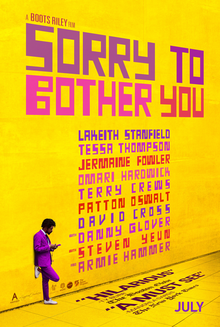
Sorry To Bother You

Again, I find myself defending an unpopular position.

Sorry to Bother You was held up as this monumental work, a wild film of social justice and satire. I wasn’t laughing.

I saw some really clever moments in it, such as when our hapless hero literally falls into people’s homes when ‘bothering’ them with his phone calls. However, the social messaging was one I thought was wildly overboard, and that’s before this variation on Bamboozled turned into The Island of Doctor Moreau. 

Sorry to Bother You is so overt in its messaging that even before the whole thing went bonkers with its equestrian escapades, I felt perpetually beaten by its efforts to be insightful that came across as silly at best. Yes, many loved it, but I couldn't.

Number 5:
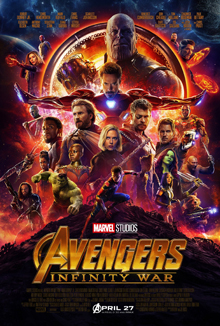
Avengers: Infinity War

I’m at it again, being a hater on a film that like the almost Satanic A Star is Born 4.0, is held as some turning point in both cinema and human history.

I however cannot get emotional about characters who I know are coming back. Perhaps it is because I endured endless seasons of ‘EVERYBODY LIVES’ on Doctor Who, but the whole ‘see beloved characters die’ trope has worn thin with me. As I know most if not all of our characters are coming back, why would I be blubbering about them disappearing?

Moreover, this All-Star Special of the world’s longest and most expensive soap opera has finally reached saturation point with me. I find that these characters really, really annoy me. Tom Holland’s Peter Parker is now a joke: this perpetually stupid kid who seems totally clueless about everything. Seriously, how is this Peter Parker anything close to a genius when he keeps reminding me of Nigel Bruce’s Doctor Watson (a character so stupid he wouldn’t be able to find his way out of a room if all the doors and windows were open)?

I'm told there was a greater effort for comedy in Infinity War. I think they went wildly overboard in their efforts.

I genuinely do not care about Endgame, or the Marvel Cinematic Universe, anymore. I didn’t care all that much then, as I didn’t grow up reading comics nor would I spend days in a theater for a ‘marathon’ of the MCU.

If people enjoyed it, fine. Let those of us who didn’t move along.

Number 4:
The Death of Stalin

Yep, I’m in trouble now.

After trashing three films beloved by critics and audiences, now I find myself going after the Big One, a film that many (especially my loyal followers) loved. So, why did I put The Death of Stalin on my Ten Worst List, and relatively high to boot?

Simple. While I respect what the film was going for, I found it all much too broad for my taste. I still remember one scene where Steve Buscemi’s Khrushchev says out loud, “Your father’s dead and your brother is shooting a gun”. Somehow, I don’t need to be reminded so often, “THIS IS A COMEDY!” I like to laugh naturally, not be told to laugh.

Again, I get what they were going for, it just didn't appeal to me.


Number 3:
The Spy Who Dumped Me

This is the worst type of comedy. It isn’t just that it’s unoriginal (though it’s unoriginal). It isn’t just that it’s almost sadistic (though it’s sadistic). It isn’t just that it misuses people both with talent (Justin Theroux) and people of questionable talent (Mila Kunis). It isn’t just that it misuses someone who is somewhere in the middle of Theroux or Kunis (Kate McKinnon).

It’s that it just isn’t funny. I wanted the Kunis and McKinnon characters to die. I wanted them to die horrible, slow, agonizing deaths. I wanted them tortured and then tortured some more. I wouldn’t have objected if they tortured their corpses.

I am appalled at how awful The Spy Who Dumped Me was, and worse, that I found two films I found more painful to sit through.

Number 2:
Life Itself
Smug does not cover how pretentious Life Itself is. This is the type of film that thinks it’s simultaneously highly intellectual and moving.  

Cue a Representative Ocasio-Cortez joke again, because this movie is incoherent, pompous, pseudo-intellectual and wildly misguided in its sentiment. Intended to be heartwarming and life-affirming, Life Itself is the complete opposite, especially given how often parents spanning generations and continents bite the dust in the film, mostly in rather grisly ways. You have cancer, suicide and literally getting under a bus. 

Essentially, Life Itself can be summed up as "the emotional Crash", where all these disparate people and events are tied together unbelieveable ways. They're also apparently tied in to Bob Dylan's Time Out of Mind album.

Above all else, one cannot forgive how Life Itself made one almost hate one of the best albums ever.

Number 1:
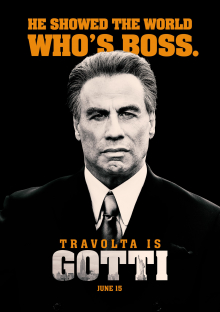
Gotti

At least to their credit, all these other films at least had the semblance of movies. Gotti did not.

It was already bad enough that it looked cheap, but it is wildly jumbled both in terms of message and even setting.

What possessed anyone to let E (aka Kevin Connolly from Entourage), a man with limited directing experience, to be at the helm of something as ‘big’ and ‘important’ as this biopic of the notorious ‘Teflon Don’?

Some of E’s decisions are mindbogglingly bizarre. It’s bad enough he’s ripping off Goodfellas left right and center, but when he does so, why did he opt for the Pet Shop Boys’ West End Girls to accompany an attempted hit on Gotti via a car bomb.

Hey, I love PSB, but this choice was…curious, at best.

Above all else that went so wildly wrong with Gotti (the cheap sets, jumbled story, bad performances, anachronistic music thanks to Pitbull’s overinflated ego), the worst was that Gotti gloried our Mafioso to where I’m genuinely surprised it didn’t read “A Cosa Nostra Production”.

Goodfellas, in its craftsmanship, made no bones about showing how ugly and monstrous these people were. Gotti, conversely, seems to have been made by Gotti fans or family attempting to portray our murderous crime boss as basically a good guy with few if any flaws. It’s almost grotesque to see how celebrated John Gotti was in Gotti.

That is the element that pushed it down even more, though yes, the awfulness of the whole film apart from its laudatory manner toward its subject matter would have been enough to make Gotti the Worst Film of 2018 So Far.

Next time, some Odds and Bitter Ends.

Sunday, January 6, 2019

The Best of 2018 So Far


This is not a "Best of 2018" list exactly. Rather, this is a ranking of the best films I have seen that were released in 2018 as of this date. As such, some films that have been highly praised will not appear on this list because I have not seen them.

Over time, I expect to see more 2018 releases, which will perhaps invite this list being revisited. For now, let's go over the Top Ten Films I have seen this 2018.

Number 10:
Disobedience
Disobedience snuck up on me with its tale of forbidden love and redemption in a Hasidic British community. Rachel Weisz is extraordinary as this woman yearning for acceptance but continuously struggling between the world of her youth and the world of her present. As the obscure object of desire, Rachel McAdams more than matches her costar. For me though, it is Alessandro Nivola as the rabbi full of faith caught between these forces that delivers the best performance in the film.

In any sane world Disobedience would be the talk of awards, but it has fallen through the cracks, a real shame given how good the three leads are.

Number 9:
A Quiet Place

I was most reluctant to watch A Quiet Place as I am not a fan of horror films. However, cowriter/director John Krasinski created an intelligent film more about family than about aliens. Few films have used both silence and sound to great effect. Moreover, A Quiet Place has us care about this besieged family and the parents willing to do anything to protect their children.

A Quiet Place is really more about parental love and the struggles of protecting children from 'monsters' than it is about aliens. It's a very human story among the creatures, and one that works both as a straight horror/science-fiction film and allegory about love.

Number 8:
Green Book

Green Book has been sold as a male Driving Miss Daisy, which is both a good description and a subject for ire.  Green Book is loved and hated in equal measure, seen as both a film about two different men who find an unlikely friendship or a film that almost trivializes racism, making it almost adorable.

I am in the former camp. I can see where the latter side is coming from, and the film is not without flaws. However, I found it entertaining and thought it was more about two wildly different men looking past their own prejudices racial and social than about overall racism. It's an interesting story that held my attention and did make me think more about the barriers individuals put up due to class than to race.

Number 7:
The Favourite

I do not think The Favourite is historically accurate: there is scant evidence that Queen Anne indulged in 'the pleasures of the flesh' with her female courtiers, or even her male courtiers in her widowhood. However, who does not love a little royal decadence, complete with racing ducks?

What lifts The Favourite are the triumvirate of Olivia Colman as our somewhat bonkers Queen Anne and her dueling ladies Rachel Weisz and Emma Stone. Each commands the screen in this wild tale of court intrigue and one-upsmanship, with power at stake. One can be Team Sarah or Team Abigail as the film really does not take sides. The Favourite is more than a film about three 'wicked' women. It's about power struggles both political and social, with some kinky royal sex, racing ducks and literally wigged-out Prime Ministers.

Number 6:
I Can Only Imagine
If films are about emotional experiences, I still continue to be moved by I Can Only Imagine, the biopic of Mercy Me frontman Bart Millard. I confess to not being a Mercy Me fan, but the song I Can Only Imagine has hit people of all faiths or lack of faith on a deeply emotional level, that longing for those loved ones now gone and 'what it would be like to be by Your side'.

It has its moments of comedy and may play fast and loose with chronology & facts, but the overall story of this one man's life, filled with loss, love, pain and ultimate forgiveness external and internal is just as impactful as the song itself. It also has strong work by J. Michael Finley, an actor better known on Broadway than in film, as Millard. It's so good you pretty much forget he's far too old to play him as a high school student, but you roll with it.

Number 5:
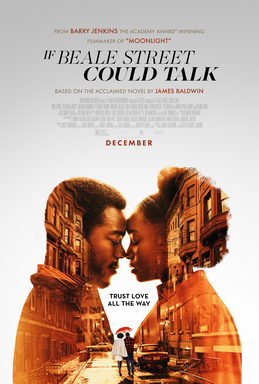
If Beale Street Could Talk

If Beale Street Could Talk does better what films like The Hate U Give tried for: discuss and advocate for social justice without being lecturing, at least until the end. It does this by giving us a tender and beautiful love story with beautiful people whom you care about. The film has a lyricism and poetry that envelops and welcomes you. It has beautiful performances all around and evokes a tenderness within it.

It does not shy away at the end from its message about the high rate of African-American men in prison, especially those caught in an unfair and uncaring legal system. It's an important message though the ending delivery of it caused the film to stumble a bit. That, however, does not take away from the gentility and beauty of this beautiful love story.

Number 4:
Spider-Man: Into the Spider-Verse
Spider-Man: Into the Spider-Verse surprised me tremendously. Spidey has been much-abused in film: Spider-Man 3 is still among the worst films ever made, and the Andrew Garfield films have much to answer for. Even the Tom Holland films, while good, I found lacking, making Peter Parker into a total idiot. I found it acceptable in Spider-Man: Homecoming, but by Avengers: Infinity War I was hoping our friendly neighborhood Spider-Man would disappear...permanently.

With this animated version we get a somewhat new Spidey in Miles Morales, who proves himself to be a fantastic version: a mix of what made me love Peter Parker with his own combination of swagger and confusion. The animation is simply beautiful, thrilling and true to comic book format. The fact we have so many multi-verses where our various Spider-people (and Spider-Pigs) can mix well into the story also helped me get past a plot point involving Miles' version of Peter Parker.

I should note Peter/Spidey is the comic book character I hold closest to my heart, so for a while I was emotionally devastated. However, when I remembered there are millions of multi-verses, I felt better and could love Spider-Man: Into the Spider-Verse all the more.

Number 3:
Won't You Be My Neighbor?
The first of two documentaries on my Top Ten List, one leaves Won't You Be My Neighbor? with a greater respect and appreciation for Fred Rogers. This is not a hagiography or celebration of Mr. Rogers, nor does it revel in any 'cute' aspects of the 'persona'.

We find that Fred Rogers was as he appeared to be: a good man who wanted to make the lives of children better. There was no 'dark' side to Mr. Rogers, but there was a complexity, touches of eccentricity (his obsession with the number '143') and a greater depth than his detractors did not perceive.

I left Won't You Be My Neighbor? determined to be a healer not a hurter, someone who wanted to do good for his fellow man. I can't think of a greater legacy that any man could leave his fellow men.

Number 2:
Leave No Trace

Leave No Trace is an astonishing work, with two of the best performances of the year.

Ben Foster has never broken through to the level his talent deserves. Leave No Trace is another addition to his extraordinary catalog of performances. He captures the complexity of the character, this haunted man who loves his daughter but who also damages her in that love.

Thomasin Harcourt McKenzie is a real revelation as his daughter, a girl who loves her daughter and who has never questioned her circumstances, at least not openly, until a new world starts emerging to her.

Leave No Trace is a beautiful and haunting film that like A Quiet Place and If Beale Street Could Talk touches on the bonds of family, only this one shows that they do carry a price that may be too high.

Number 1:
Three Identical Strangers

The second of two documentaries on my Top Ten List, Three Identical Strangers is perhaps the wildest film of the year, shifting from a feel-good story of three separated triplets brought together by the most bizarre set of circumstances to a horror film about essentially mad scientists and their fiendish experiments.

Three Identical Strangers takes all these turns where three men are found to be similar yet different, their lives simultaneously enriched and wrecked by outside forces working in some bizarre version of a Mengele-like universe. It's one of those 'you can't believe this even if it is true' films, something that leaves one simply astonished, shocked, angered and heartbroken.

Next Time, no surprise, my Ten Worst Films of 2018 So Far.

Saturday, January 5, 2019

If Beale Street Could Talk: A Review (Review #1163)


IF BEALE STREET COULD TALK

If Beale Street Could Talk, based on James Baldwin's novel, can be seen as both a direct and beautiful love story and a social justice film on the dysfunctional criminal justice system. Either way, If Beale Street Could Talk is a moving film that stumbles only at the end when it hits the viewer a touch too hard on the message it wants to send.

Told in voiceover and a series of flashbacks along 'present day', we learn of Tish Rivers (KiKi Layne) and Alonzo or Fonny Hunt (Stephan James). They have been in love since forever. On the day Fonny is going into prison for a crime eventually revealed to be rape, Tish tells their story.

Their story involves their romance, her becoming pregnant at 19 to his 22, and the difficulties this entails for both their families. Tish's ever-understanding and wise mother Sharon (Regina King), her loving father Joseph (Colman Domingo) and supportive but sarcastic sister Ernestine (Teyona Pariss) stand by her. Lonny's mother, the fiercely religious mother Alice (Anjanue Ellis) is appalled, telling Tish and Sharon to their faces she hopes this 'bastard' gets shriveled up in the womb.  Lonny's equally snobbish sisters are equally appalled, defensive of their mother.

The Hunt family is the least of their problems, though only Frank Hunt (Michael Beach) is happy about the new grandchild. We learn that Lonny is falsely accused of rape by Victoria Rogers (Emily Rios), a Puerto Rican who married a New Yorker and who is having mental health issues resulting from her rape.

Image result for if beale street could talkThat Victoria was raped is not disputed, even by the Rivers'. That Victoria is herself suffering as a result of her attack is similarly not disputed. What is disputed is whether Lonny did it. Victoria had identified him in a police lineup, but that identification is questionable given that Victoria may not have had a firm look at her attacker.

It also should hinder the case against Lonny that he has an alibi: he was quite far from the attack site with both Tish and Daniel (Brian Tyree Henry), Lonny's friend recently out of prison for a drugs charge. He took a plea rather than run the risk of a longer sentence and is haunted by his short stint in prison.

Now Lonny faces prison for a crime he did not commit, thanks in large part to Officer Bell (Ed Skrien), with whom Lonny and Tish had a run-in and who is overtly racist. He is the one who helped Victoria identify Lonny as her attacker despite not working in the area where the attack took place.

In a desperate act to save Lonny, Sharon flies to Puerto Rico, where Victoria has fled to, in order to convince her to return and testify that Lonny is innocent. Eventually coming into contact with Victoria, it's clear that she is still traumatized by her attack and in no condition to do anything even if she were willing.

We learn that Lonny, rather than face the uncertainty of trial and a long sentence, did what many young black men incarcerated are forced to do: take a plea and plead guilty to a lesser charge even if they are innocent of all charges. By now Alonzo, Jr. is born and Tish, loyal and loving, brings their son to the prison for a visit.

Image result for if beale street could talk
If Beale Street Could Talk as I understood it is a metaphor for all black neighborhoods, the 'every story' of African-Americans. Though written in the 1970's, the story still resonates because of how well the film works as both a love story and social commentary.

We see some of the trademarks from director and screenplay adapter Barry Jenkins' previous film, Moonlight; there's the effective use of music in Nicholas Britell's score, a jazz-influenced music that both sets the mood and feels natural. There's the haunting James Laxton cinematography, a film bathed in soft colors that render things more beautiful. There are many close-ups, particularly among our lovers, who silently tell us how their bonds will survive all obstacles.

Finally, there are the performances, elegant and romantic and tender and soft. Even small roles like Dave Franco as Levy, the Jewish landlord who is willing to rent to our unmarried couple and Diego Luna as Pedrocito, a friend/waiter to Tish and Lonny are able to stand out.

However, it is the main cast that excels. Layne's Tish is gentle and loving yet strong, a woman who loves deeply and well. James does not slip as Lonny, the artist who endures with a quiet dignity yet still feels the rage of his circumstance. King is simply extraordinary as Sharon, the strong mother who never fails to be wise and compassionate. Whether she is defending her daughter against her future in-laws or expressing sensitivity to Victoria, King plays the type of mother we all wish for but few of us are blessed with.

It is a major credit to both Jenkins and Baldwin's novel that the film works on two levels. One can see If Beale Street Could Talk as a tender and beautiful love story. The main love story is that of Tish and Lonny, these two beautiful people, beautiful on every level, whose love endures through dreadful hardships yet never breaks.

You could also see it as a beautiful love story among a family. The Rivers family is a positive one, with wise and loving parents who stand by their daughters and protect one another. The strong father and mother impart wisdom and compassion. Their bonds do not break and the love they have for each other is a beautiful thing to see.

Related imageIf Beale Street Could Talk can be seen on that level, the story of love familial and romantic nearly shattered by immense, intense and unfair circumstances. However, Jenkins and Baldwin are too smart to not have us see beyond this surface. The film is also, in its quiet and elegant way, about a very contemporary problem: the incarceration of African-American men.

Tish's voiceover tells us at the end that Lonny was forced to do what many young black men do when falsely arrested: take a plea rather than have a long, dragged-out process where resources are limited and the justice system fails to protect both the accused and the victim. Daniel serves as foreshadowing, the malevolent presence of racism and disinterest among the legal system.

We see this in the limited work from Lonny's lawyer Hayward (Finn Wittrock), a lawyer who seems to care but who also can do little to nothing for his client. We see this in how it is the Rivers family who use their limited resources to help Lonny. The tragedy and unfairness of it all hits you in the same way the moving and beautiful romance between Tish and Lonny does.

It is perhaps here that If Beale Street Could Talk falters slightly. Near the end we are shown a montage of photos where we see the injustice of black men serving prison terms for crimes they did not commit, almost always because of racism. That and ending the film with the singing of My Country 'Tis of Thee struck me as gilding the lily, a bit overt in the message that takes away from the beauty and tenderness of Tish and Lonny's love story and the unfairness of their circumstance.

It's as if Jenkins did not trust us to understand what he was telling us, so he essentially was hitting us over the head in such a way that took me slightly out of the film. It does not take away from the overall brilliance and beauty of If Beale Street Could Talk, but it does feel a bit jarring and out-of-place when a more straightforward manner might have worked better.

You already have Tish tell us that Lonny, like many black men, plead guilty to something they did not do so as to spare their families more grief. That, and our embrace of these two beautiful people in love, would have been enough.

If not for this small side-trip into 'if you don't get it let me spell it out for you', If Beale Street Could Talk is a beautiful and elegant film about two young people in love, whose love will free them even if the world goes out of its way to keep them apart.

DECISION: B+

Wednesday, January 2, 2019

Kennedy Center Honors 2018: A Review


I've been following the Kennedy Center Honors for circa ten years, admiring how there is at least one night to salute people in film, television, theater, dance, and music (classical to rock) that have contributed to the cultural life of America and the world.  Every year, I would watch and be impressed by just how much great art was being produced.

However, in 2012, I skipped the show.  The idea of sitting through a salute to David Letterman and Led Zeppelin was simply too intolerable after having endured the idea that Oprah Winfrey was somehow an 'artist'.  Many things Lady O is, but someone on the same level as Lucille Ball or Johnny Carson she is not. 

As an alternative, I have submitted ten recommendations totaling 60 people.  Since I began my retrospective, a few suggestions have found themselves honored and a few have died. The following is an alphabetical list of my recommendations, with one asterisk meaning honored, two meaning dead. Three asterisks are for those who have died since the original post was written. 

John Adams
Vladimir Ashkenazy
Emanuel Ax
Burt Bacharach *** 
Shirley Bassey
David Bowie**
Monserrat Caballé**
Shirley Caesar
Michael Caine
Carol Channing ***
Francis Ford Coppola
Albert Finney ***
Gloria Estafan *
John Fogerty
Jane Fonda
Harrison Ford
Phillip Glass *
Gene Hackman
Herbie Hancock *
Dustin Hoffman *
Billy Joel *
Frank Langella
Annie Lennox
Sophia Loren
Sidney Lumet **
Shirley MacLaine *
David Mamet
Wynton Marsalis
Keiko Matsui
Reba McEntire *
Ian McKellen
Loreena McKennitt
Marian McPartland **
Liza Minnelli
Joni Mitchell
Mary Tyler Moore **
Rita Moreno *
Bill Murray
R. Carlos Nakai
Bob Newhart
Maureen O'Hara **
Peter O'Toole **
Christopher Parkening
Bernadette Peters
Malcolm John "Dr. John" Rebennack, Jr. ***
Diana Rigg ***
Lionel Ritchie *
Carlos Santana *
Martin Sheen
Carly Simon
Maggie Smith
Mike Stoller
George Strait
James Taylor *
Kiri Te Kanawa
Eli Wallach **
Betty White ***
Nancy Wilson**
Neil Young
Franco Zefirelli ***

At a time when we're told how important 'representation' is, we can break down my recommendations as such: Men: 33, Women: 25, Minorities: 14.

Breaking it down even further: 5 African-Americans (Bassey being British, would not count as 'African-American'), 2 Asians, 4 Hispanics, 1 Native American (as prima ballerina Maria Tallchief is the only Native American honoree so far).


Image result for kennedy center honors hamilton
With this year's Kennedy Center Honors, the Kennedy Center has dropped the pretense of actually being about lifetime achievement and has opted to be another glitzy awards show. It was a curious hodgepodge of honorees, some highly worthy, some clearly embarrassing to get the 'young kids' interested.

The honorees were as follows: Cher, Philip Glass, Reba McEntire, Wayne Shorter and "the creators of 'Hamilton': Lin-Manuel Miranda, Thomas Kail, Alex Lacamoire and Andy Blankenbuehler.

There were several breaks in tradition for this year's KCH. One was the honoring of the creative team of a musical show whose average age is 42, which I find odd for something touted as a 'lifetime achievement award' (the other honorees' average age is a mere 75 with the youngest, McEntire, being 63). Second was that these same average-age-42 honorees performed on stage, thus making me wonder why one work merited 'lifetime' recognition.

Curiously though, the "creators of 'Hamilton'" did not sit in the honoree's box seats. Rather, they were in the audience, albeit slightly removed from the other audience members.

I can't quite include the nature of the presentations as a third, but for some time now the Kennedy Center Honors has moved away from their traditional format of having someone speak about a particular honoree, then show a film about his/her work and conclude with performances honoring said honoree.

The choppy nature of the individual presentations was meant to be a shift from the perceived stale nature of the show, but what I think has happened instead is it has essentially removed all context of what makes the honoree's work, struggle, success or triumphs important.

Image result for kennedy center honors jon batiste
Take Glass' section for example. We had former Honoree Paul Simon talk about Glass then go to a performance of Glass' work by Jon Batiste. The performance itself was brilliant, but there was no explanation as to why Glass' work is so revolutionary, no mention of how he came to be so minimalistic as to drive some listeners crazy and some to rapture.

Instead, we got some performances of his work which to someone not versed in Glass would be odd to confusing to boring. You had a performance of music from his score to Koyaanisqatsi, but whoever hadn't seen or heard of the documentary would wonder what it was all about.

As a side note, the camera work for this segment seemed to be as crazy as a 'Life Out of Balance'.

Again and again I think the honoree's were short-changed by not putting their life's work placed in some context. I'm puzzled as to why for example despite it being a lifelong dream that she accomplished, no footage of McEntire as Annie Oakley in the Annie Get Your Gun revival was used (unless there isn't any). I'm sure there's a soundtrack which they could have put over pictures of McEntire as Oakley, so this triumph was not that important I guess.

Image result for kristin chenoweth kennedy center honors 2018
It would have been a damn sight better than Kristen Chenoweth's rendition of Doin' What Comes Naturally. Chenoweth, a mainstay of the Kennedy Center Honors, is by no means a bad singer. She has an extraordinary voice, but I found it far too chirpy for both the song and for Annie Oakley. It is almost operatic, which works for something like Wicked, but for the down-home Annie Oakley?

I guess I'm used to people like Judy Garland, Betty Hutton or REBA!, who seem more able to play 'country' than the more polished Chenoweth.

As a side note, I see opera diva Renee Fleming also popped up here again, this time for Shorter's tribute. Is she contractually obligated to perform at the Kennedy Center Honors until she gets one herself? Maybe by the time she gets that rainbow ribbon, Fleming's film will consist of nothing but her Kennedy Center Honors performances. It will save money on buying broadcast rights anyway.

They certainly did not make the case as to why Hamilton had to receive special recognition. Sure, it is popular in certain circles, but when was the last time you heard anyone sing The Schuyler Sisters in public? People have sung and know songs like Fancy and I Got You, Babe, but despite its wild praise I cannot think of a Hamilton song that has reached the level of a Climb Every Mountain, an I Could Have Danced All Night, a Don't Rain on My Parade, an I Feel Pretty or even an All that Jazz.

Contrary to what my friend Ryan Guzman thinks, I have nothing against Hamilton: The Musical. He loves the show. I have not seen it. My argument has never been that it's a lousy show or that the songs aren't good. My argument is that it is not as popular as works by Rodgers & Hammerstein, Lerner & Lowe or Kander & Ebb. They sound like great songs that work within the show.

I just am not convinced they will enter the Great American Songbook, at least not yet.

Image result for s. epatha merkerson kennedy center honors
In terms of overall performances, I would rank them thus:

Glass, Shorter, Cher, McEntire and whatever the Hamilton crew came up with. It's interesting that the level of musical performances was inverse of the popularity of the honoree.

I imagine Philip Glass and Wayne Shorter are the least known of the honorees but their music is what I found both the best-performed and the best overall. Glass' tribute had a wonderful performance by the aforementioned Batiste and Koyaanisqatsi (even if I would have preferred selections from Kundun or the Bela Lugosi Dracula).

For me, the best performance of the night was S. Epatha Merkerson's rendition of Knee Play 5 from Einstein on the Beach with violinist Jennifer Koh. The music and the poetic recitation by Merkerson was almost like listening to a deep act of worship.

It was the only time in the 2018 Kennedy Center Honors where I was moved deeply.

I am not well-versed in jazz, but Shorter's music I find is extraordinary. It helps when you have Esperanza Spalding performing it. Her performance of Endangered Species and Elegant People showcased both Spalding's extraordinary talent and Shorter's extraordinary music. It was smooth and elegant, sophisticated yet accessible. It made me wonder, "Wayne Shorter and Esperanza Spalding, where have you been all my life?"

Granted, the only thing I remembered about Spalding was when she got all that hate from Believers enraged she won Best New Artist over Justin Bieber (who given how the Kennedy Center Honors are is sure to be recognized in ten years). It should be remembered she also beat out Drake, Mumford & Sons and Florence & The Machine, showing at on occasion the Grammys can get it right.

Not that I dislike Mumford or Florence.

Image result for adam lambert kennedy center
Many have commented on how brilliant and moving Adam Lambert's version of Cher's Believe was. I would say it was very impressive, especially given he changed the song from a techno dance track to a tender, heartbreak ballad. I also learned that the lyrics aren't "Do you believe in love, that's a'love?" but "Do you believe in life after love?"

No matter how hard I try, I still keep hearing "I can feel something inside me-self" despite the lyrics actually being "I can feel something inside me say".

Lambert opted not to be glam but to be vulnerable, and it worked beautifully. Yes, his cover of Believe was effective. Curiously, Cher's tribute went from an "I don't need you" song to an "I need you" song when Cindy Lauper performed If I Could Turn Back Time, a pairing I found curious.

Image result for little big town kennedy center honors
Both Lambert and Lauper did great work, but what was Little Big Town about?

I remember all the grief Luke Bryan got when he covered a couple of Lionel Richie songs, criticism that I think was racially motivated (aka 'a white country singer should not sing a black artist's music'). The criticism was wildly invalid because Richie has written country songs like Stuck on You and Lady. Yet the same people who went after Bryan, the King of Bro-Country, have so far kept quiet on Little Big Town doing their versions of Gypsies, Tramps and Thieves, I Found Someone and Baby Don't Go.

None of those songs, as far as I know, were meant to be country. Their versions were also not very good.

Even that I could overlook if I thought their versions were good. I'll admit I've never been a LBT fan, so that might color my view, but I was not impressed.

Image result for lady antebellum kennedy center honors
At least they did better than Lady Antebellum, who slept-walked through their crappy renditions of Is There Life Out There? and The Greatest Man I Never Knew. I'll comp to never being fond of Lady A either (you tend to lose country credibility with me when I hear a techno version of Need You Now). Yet I cannot explain how Lady A could take two songs and make them so uninspired and boring...apart from the fact that it's Lady A we're talking about.

I'm pretty disappointed at how bad all around the McEntire section was. We have the sleep-inducing covers from Lady Antebellum, we have the chirpy Chenoweth doing what didn't come naturally, and McEntire's signature song, Fancy, was done by her daughter-in-law in an underwhelming manner. Kelly Clarkson is a fantastic singer, but I thought her Fancy was dominated by brass and lost that element of scandal mixed with defiance.

Personally, it is a sad sign when the best part of a REBA! tribute is Bobby Bones.

Finally, after hearing two songs from Hamilton (The Schuyler Sisters and One Last Time), I can say that yes, the score is good to great. I was not in tears or thought of them as powerful/moving though One Last Time was excellent. However, there was no case for including Hamilton or its creators as Kennedy Center Honorees.

Image result for david rubenstein kennedy center
Kennedy Center Chairman David Rubenstein did his damndest to, and bless his heart for trying.

"Therefore, in this 41st year of the Kennedy Center Honors, it is fitting that we not only recognize the lifetime achievements of each of our four outstanding honorees, but also recognize a trailblazing work in the groundbreaking musical Hamilton, which has made an incomparable impact on the field of arts and culture in our country. Together, these eight artists have inspired us with their storied careers of unparalleled artistry and achievement".

Lordy, Lordy is he full of it.

Why specifically was it 'fitting' to recognize 'a trailblazing work' in the 41st year? 41 years seems a rather odd number to specifically single out one musical. I've been inspired by Philip Glass and Reba McEntire. I've even sung Believe (albeit with mangled lyrics).

However, in no way has Lin-Manuel Miranda inspired me with his 'storied career of unparalleled artistry and achievement', unless said 'unparalleled artistry' is to rhyme 'shiny' with 'hiney' (as he did in a song from Moana) or adopt a bad Dick Van Dyke-like Cockney accent in Mary Poppins Returns.

Seriously, doe anyone outside Broadway know any songs from In the Heights?

Look Dave, let's cut the crap. You selected 'the creators of Hamilton' for one reason and one reason only: ratings. You heard it was wildly popular (even if most people couldn't sing/rap you My Shot or Cabinet Battle #1 or 2 if their life depended on it). You figured that with such a wildly popular show being specially saluted, you would get boffo ratings.

It didn't work.

The Kennedy Center should just decide what to do with these presentations: eschew obscure yet influential artists to get at more 'popular' fare in the hopes of getting more viewers or surrender to low ratings but keep to their original goal of honoring those who have spent a lifetime creating, even if many have not heard of them.

There's nothing wrong with including 'popular' artists, people like a Gloria Estefan or Paul McCartney. There is something wildly wrong with including people who have not had a lifetime record (vis-a-vis 'the creators of Hamilton').

Image result for the book of mormon broadway
Thank Heaven Rubenstein and the Kennedy Center board didn't get the idea of honoring 'the creators of The Book of Mormon' for their 'trailblazing work'.

However, given how the Kennedy Center Honors is now, it wont be too long before perhaps Murray Perahia finds himself sitting next to Cardi B next to the empty Presidential Box.