Wednesday, November 16, 2022

An American Tragedy: A Review

AN AMERICAN TRAGEDY

An American Tragedy is the first adaptation of the Theodore Dreiser novel. Pretty much forgotten now compared to the second adaptation, A Place in the Sun, this adaptation has some positives in one performance and echoes of the silent film era. However, it is also a bit of a slog which has not dated well.

Handsome, ambitious hotel porter Clyde Griffiths (Phillips Holmes) loves good times and good-time girls. A car accident where he is a passenger, however, forces him to flee Kansas City. Moving to Lycurgus, New York, Clyde finds a job as section head of a garment factory thanks to distant relatives.

There is a strict rule against fraternizing with employees, but Clyde cannot control his lust for pretty, innocent Roberta Alden (Sylvia Sydney). They begin a secret romance, but soon Clyde's eyes shift to Sondra Finchley (Frances Dee), the factory owner's pretty and wealthy daughter. As he squires Sondra about, "Bert" begins having doubts about Clyde's loyalty and love. This grows more complicated when Roberta ends up in trouble. 

Roberta pushes Clyde into marrying her, but he knows such a thing will keep him from Sondra and her money. Does this, however, mean he would commit murder to keep what he is so close to obtaining? A trial convicts him of such an act, though perhaps he is more morally than legally guilty. 

An American Tragedy came when film was still struggling to enter the sound era. As such, director Josef von Sternberg shapes the film in some ways as a silent film. There are title cards filling in information and written in a somewhat dramatic fashion that could be straight out of a silent film. However, they all play over the sound of flowing water, the suggestion of the impending tragedy coming across.

The film has strong visual moments, such as a wild Jazz Age party early in the film. An American Tragedy has touches of Josef von Sternberg's visual style. The factory, for example, has things going on in the fore and background, in keeping with von Sternberg's method of filling the screen with as much as possible.

Josef von Sternberg in some ways seems an odd choice to direct An American Tragedy. His forte was in the elegant, grandiose lives of the wealthy in exotic locales. An American Tragedy is squarely Middle American working-class. Despite this, he makes the most of the locations. There is a scene where Roberta hands Clyde a note, and he moves off to read it. We cannot get a full image of Clyde's reaction, but we know that it elicits a smile from Roberta. 

Sylvia Sydney is the standout in An American Tragedy. She plays the innocent so beautifully, unaware of Clyde's darkness. She is shocked by his kisses, and her naivete when coming close to her end is beautifully played. 

It is curious that while Phillips Holmes is not bad looking, he seems a poor choice to play this selfish individual. I found him to be overly dramatic, someone who seemed to be trying for a stereotypical silent film performance. His courtroom scenes were particularly weak, though to be fair the lawyers were all hamming it up to the Nth degree. I do give him credit for making Clyde cold and sinister underneath the charm. However, I found him somewhat stiff in manner. 

Dee was sadly pretty much a nonentity in An American Tragedy. She may have been the motive, but she was on screen so little that she had no real impact. 

This may be due to the film's surprisingly brief running time of 96 minutes. It is curious, however, that despite its remarkably short length the courtroom scenes felt rushed. A lot of An American Tragedy seemed to have information filled in via newspaper headlines. That had the effect of rushing things to move the story forward. 

Once or twice is nothing out-of-the-ordinary for early sound films. An American Tragedy, however, seemed to go slightly overboard with this technique.   

An American Tragedy is worth watching for Sylvia Sydney's performance and for certain cinematic elements from Josef von Sternberg. It is not a bad film by any stretch, though not as good as it could have been. 

DECISION: C+

Monday, November 14, 2022

Jimmy Savile: A British Horror Story. The Television Documentary


JIMMY SAVILE: 
A BRITISH HORROR STORY

The name Jimmy Savile means little to nothing to American audiences. The British, however, were mad about this flamboyant, eccentric television host. His programs ranged from the kid-friendly Jim'll Fix It (where he granted wishes that children had written to him) to the music presentation show Top of the Pops. His death was mourned by the British public. It also burst wide open what had been whispered about for decades: the Sir James Savile was a pedophile. It went beyond merely lusting after Lolita-type girls. The scope, length and coverup of Savile's sexual abuse was horrifying when uncovered.

Jimmy Savile: A British Horror Story attempts to cover the scandal that erupted when the truth came out. It is unfortunate that in a way, the documentary too fell under Savile's fame to give the victims their time.

Using archival footage from Savile's decades-long career and newly-filmed interviews, Jimmy Savile: A British Horror Story divides its story in two parts. Part 1: Making a Monster recounts his rise from Northern miner to radio DJ, when he grew to become the number-one DJ in the country. With his outlandish behavior and bizarre wardrobe, he became a natural for television. He had a wild persona that also appeared to reveal an extremely charitable one. He soon became a massive fundraiser for hospitals, raising millions of pounds for such organizations as the Leeds General Infirmary, the Broadmoor Hospital for psychiatric help and the Stoke Mandeville Hospital, which specialized in spinal injuries.

This charitable work earned him the affection of the upper echelons of politics. Figures such as Margaret Thatcher and the-then Prince of Wales feted him. The latter even pushed successfully for a knighthood. It wasn't until after he became Sir James that the fainted, most tepid question about Savile's alleged predilection for "little girls" even made print.

It is only now in Part 2: Finding the Monster, that we begin delving into the nightmare Savile created. Though there had been whispers about Savile, few people questioned his public persona as just merely eccentric. The eccentricities extended to being a porter at the hospitals he raised funds for, with 24 hour access and even private rooms for him. Anonymous letters sent to an underfunded Child Abuse Investigation group from Scotland Yard went unfollowed. When he was finally brought in for questioning in 2009 (two years before his death), he was defensive and dismissive of the allegations. 

Moreover, no one was willing to speak publicly to charge Savile with anything. It was only after Savile's death that his myriad of victims felt free to speak publicly of Savile's decades-long predatory behavior had done to them. Friends Reunited, a British version of Facebook, was full of anger and condemnation for all the loving tributes Savile was receiving. The producers of a documentary that Savile's former employer, the British Broadcasting Corporation, had rejected, took their work to the rival Independent Television which broadcast The Other Side of Jimmy Savile on their Exposure program. The scandal horrified the public that had so loved Savile. 

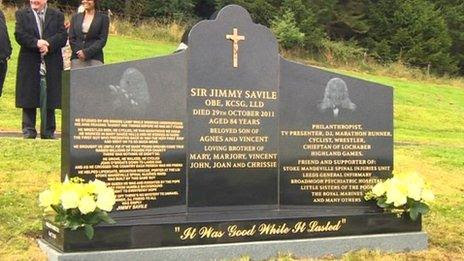
Savile's victims had ranged from ages 5 to 75. They dated as far back as the 1950s. Horrifying tales of molestation to rape sickened the public. It was to where Savile's grandiose headstone, down to its cruelly worded "It was good while it lasted" inscription was taken down in the dead of night rather than wait for someone to do it.

Perhaps the closest comparison that American audiences of A British Horror Story would understand is that of Bill Cosby. The man who had been "America's Dad" being a serial rapist shocked generations who had grown to love "The Cos". Jimmy Savile, however, was more than just an avuncular host. It would be as if a combination Art Linkletter, Bob Hope and Dick Clark had raped children for decades with higher-ups either not interested or covering it up to protect their brand and reputation. The horrors in A British Horror Story, however, did not come as thoroughly as I think they could have and should have.

Director Rowan Deacon had all the elements to make his two-part series gripping television. It could have been a condemnation of the culture of celebrity that shielded Savile. It could have given a voice to the hundreds of Savile's victims. Instead, A British Horror Story ultimately ended up being almost curiously fixated on pop psychology and the very celebrity that Savile used to commit monstrous crimes.

We get vague suggestions that Savile's Catholicism and close relationship with his mother may have colored his actions. Could his charitable work have been a way to absolve himself from his crimes? Was there something unnatural about how close he was in his early years to "Duchess" (Savile's nickname for his mother)? The idea that Savile used his charitable work as cover to allow himself entry into places where vulnerable people could be at his disposal appears not to enter Deacon's mind. Rather than suggest that Savile put up a front, he plays on the notion of "Catholic guilt" and potential absolution.

In a sense, that almost seems to let Savile off the hook, to suggest that whatever good he did was a way to cleanse himself from the evil. It would be easier to say Savile was evil and used his position to violate people, full stop. 

A British Horror Story also wants to push the Savile/Thatcher and Savile/then-Prince Charles connections into something more lurid. Again, rather than put up the idea that Thatcher and the Prince and Princess of Wales were taken in and duped by Savile, Deacon seems to bring up Savile's connections to the British Prime Minister and Royal Family for unclear reasons. 

Thatcher may have heard the whispers of Savile's nymphet fixation, but it is not as if she was procuring young girls for him. It is plausible that HRH the Duke of Edinburgh may have also heard about Savile's attractions to tween girls, but there is no way of knowing he did. A British Horror Story, by bringing this up and putting more focus on the relationships, does not tackle the corrosive nature of celebrity to hide crimes.  

I think a greater focus should have been put on the press, which had the story (or at least inklings of it) and did little to nothing. It's not until close to the end of Savile's life that one reporter, Lynn Barber, does the most genteel inquiry to Savile himself when she asks about rumors that he likes young girls. To be fair, no victim wanted to speak out openly prior to Savile's death. Also, Savile had become close friends with police, who sadly dismissed the accusations against "our Jim".

Still, I think A British Horror Story let the press off rather lightly.

It also takes up too much time going over what the British public already knew about Savile's colorful persona. Part 1 takes up nearly the whole hour and a half covering his career that it gives the last few minutes on a police interview and the first questions asked openly. Part 2 takes so long speculating on how Catholicism might have been a way for Savile to clear his conscience that by the time we get to his crimes, the program is nearly over. Sam Brown is the only victim to speak in A British Horror Story about her experiences on-camera (the few others via archival footage). Her sections are sad and painful to hear: the guilt she carries, the experiences themselves. It seems a terrible disservice to focus more on Savile's funeral than on Brown's story.

One of the oddest parts of A British Horror Story was how much foreshadowing the film does. Savile's comments about his outside activities or open flirtations were, at the time, seen as humorous or at least merely part of his eccentric image. We see a montage of him saying, "My case comes up next Thursday," clearly taken as a joke about his life off camera but now through hindsight seen as admissions of guilt. Things he said decades ago about the Loch Ness Monster or how he's a "very tricky fellow" can be seen today as creepy. However, at the time, they were not intended as such.

I do not know if one can make the connections between what he said then and what we know now.

As a side note, I thought that My Case Comes Up Next Thursday would have been a good alternate title for A British Horror Story. However, could it have been too jokey for the subject matter? 

Jimmy Savile might have done good in the millions he raised for various organizations. There may be, surprisingly, people who still think well of him. Jimmy Savile now is reviled, more so given he got away with it. Jimmy Savile: A British Horror Story is a lesser primer on the monstrous acts he did than a condemnation of a corporate culture and a public too dazzled with fame to bring him to justice. It may have been good while it lasted, but for those who suffered through his evil work, it will never be over.


4/10

Saturday, November 12, 2022

Black Panther: Wakanda Forever. A Review

BLACK PANTHER: WAKANDA FOREVER

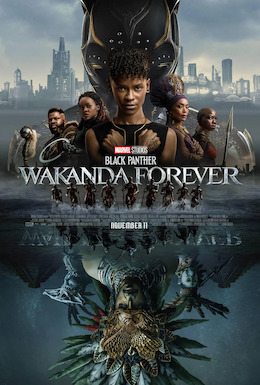
I think it is fair to say that out of all the Marvel Cinematic Universe films, Phase Four, the sequel to Black Panther is the most anticipated, or at least, the most hyped. After Black Panther star Chadwick Boseman's sudden and unexpected death, there was concern over how to proceed with the franchise. Black Panther: Wakanda Forever is adequate, but longer and unwieldly in its execution. 

The sudden death of King T'Challa of Wakanda, the Black Panther, has not only thrown Wakandans and the world into turmoil, but left the Royal Family adrift. Princess Shuri (Leticia Wright) still grieves a year after T'Challa's death, haunted by her inability to save him. Queen Ramonda (Angela Bassett) urges her to start moving forward, but she has problems of her own.

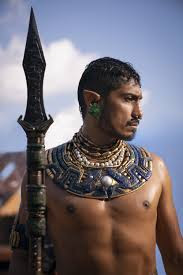
The other nations want Wakanda's vibranium supply, and they will go to any lengths to get it short of war. An attack on an American ship that has found vibranium on the ocean floor has been attacked. It is not the Wakandans who have done this. Instead, it is a new hereto unknown people: the Talokan. Their king, a half-human half-merman known as Namor (Tenoch Huerta) infiltrates Wakanda and gives an ultimatum: hand over "the Scientist" who made the vibranium-detecting device or face war.

That "scientist" turns out to be sassy MIT student Riri Williams (Dominique Thorne). She is pleased to receive Wakandan royalty, but not pleased when Okoye (Dania Gurira) threatens to take her to Wakanda by force. With some help from "colonizer" Everett Ross (Martin Freeman) they avoid capture, but Namor takes "the scientist" and Shuri to his underwater kingdom of Talokan, where we learn his backstory.

The rescue by self-exiled Wakandan Nakia (Lupita Nyong'o) only serves to antagonize Namor more. That leads to an attack on Wakanda, where not all survive. Ultimately though, a new Black Panther arises, one that forces peace and allows for grief. It also allows for a new, hereto unknown Prince of Wakanda to be found.

I point out that Black Panther: Wakanda Forever is close to three hours, two hours and forty-one minutes to be exact. That makes it close to half-an-hour longer than Black Panther as well as the second-longest Marvel Cinematic Universe film (after the three-hour, two-minute Avengers: Endgame). It is also longer than Dune: Part 1, albeit by only six minutes. As such, Wakanda Forever seems to live up to that name. I would not say it is overindulgent, merely bloated.

Director and cowriter Ryan Coogler (writing with Joe Robert Cole) made some very curious decisions in Wakanda Forever. For example, there is an early scene where we cut back and forth between a French raid on a ship carrying vibranium and Queen Ramonda addressing the United Nations in Geneva about that exact raid. I wonder why we could not cut Ramonda's address, focus on the raid and culminate with the captured mercenaries being brought forward.

Other moments were cringe-inducing. Hearing Dora Milaje General Okoye refer to the FBI as "the popo" might have been funny (it was to the audience I saw Wakanda Forever with). However, I do not think Okoye would even be aware of the term, let alone use it. This break from character took perhaps the most unintentionally silliest turn when K'uk'ulkan/Namor was showing Shuri around his underwater kingdom.

First, this rather serious, slightly pompous and menacing Mesoamerican warrior king tells Shuri the various dangers of trying to enter Talokan, until he breaks out into something close to a smile and says cheerily, "Or we can get you a suit!". This, to my memory, is the only time Namor comes close to showing any humor. That already is strange enough. As Shuri floats along to see the wonders of Talokan in her underwater suit, the end result has her looking like SpongeBob SquarePants' Sandy Cheeks!  

As a side note, while Namor makes a big thing out of pronouncing his name as "Nah-MOOR", no one else seems to have gotten the memo. If memory serves correct, "Nah-MOOR" is used only once. Everyone else pronounces it "NAY-moor". I'm of Mexican descent, and I would say "NAY-moor". To be fair, I heard "K'uk'ulkan" and my mind drifted to the Mexican bogeyman "El Cucuy", but I digress.

Jokes aside, Wakanda Forever has serious problems due specifically to the script. It is meandering and filled with plot points and characters that add nothing to whatever it is trying to say. The Namor origin story could have been cut down or cut altogether, for it includes how the Talokan people came to be, Namor's own origin and the origin of his name. Same with the extended Talokan attack on Shuri, Okoye and Riri in Boston.

It is curious that what is meant as a major action piece felt dull. It is even more curious that anyone would bother saving Riri given the two major problems with her. There is how inconsequential she was to Wakanda Forever and what an unlikeable character she was. In the former, Riri disappears for long stretches of Wakanda Forever. She is essentially the Maguffin, what most of the plot centers around but who has no real impact in the story itself. She was superfluous, there only to tie Riri into the MCU for the upcoming Ironheart Disney+ series. 

As another side note, I did wonder why El Cucuy referred to her only as "The Scientist". I guess even he could not be bothered to learn her name. 

Wakanda Forever serving as a de facto Ironheart pilot leads me to the latter: her unlikability as a character. If I had been Queen Ramonda, I would have been, "Here, take this obnoxious child to Talokan and do what you wish, oh Feathered Serpent". Perhaps Thorne played the part as written: as this sassy, allegedly wisecracking definitely backtalking girl genius. However, all that backtalking and alleged wisecracks just made her insufferable. When offered hospitality by the Talokans, she starts babbling about it all being part of some "supervillain s-hit". Over and over, Thorne's performance stretches the idea that Riri is any kind of genius.

Tony Stark can get away with snark when facing great danger. Riri Williams cannot. Tony Stark is an adult and billionaire. Riri Williams is a nineteen-year-old student who makes her money by writing other people's schoolwork. Here again, if perhaps Wakanda Forever had made her a realistic figure (say, a teenager terrified of the FBI chasing her or underwater people in general), we could have had something.   

Again, this might have been the character as written, so I want to grant some leeway on the subject. The returning cast, however, has no escape. I know there are calls to nominate Angela Bassett for Best Supporting Actress in Wakanda Forever, but my question is, "why?". It was forced in my opinion, especially whenever she has to be dramatic. This plagues all the performances in Wakanda Forever, an over-the-top and excessively dramatic set of acting that never came across as believable. 

It is curious that while those involved in Wakanda Forever wanted to make a three-hour tribute to Chadwick Boseman (the film's Marvel credits show only Boseman, which I think is the first time they featured only one actor), they acted on film as though their heart was not in the film itself. I am sure they would argue the contrary, but what I saw on the screen never came across as acting, but merely moving their mouths and bodies. 

The stiff acting, behaving as if all this is meant to be deep versus entertaining, was hard enough. Seeing Freeman and Julia Louis-Dreyfus as his boss/ex-wife in a subplot that went nowhere made things harder. The Michael B. Jordan cameo similarly came across as unnecessary. At the very least, I wondered why it could not have been part of a second vision versus having two visions.

If there are positives in Wakanda Forever, they are in the still-strong technical elements. Ludwig Goransson's score blended African sounds with some vaguely Mayan ones, and the lyrics to the vocals complement the story (though I think you would have to both be listening and know Spanish to get what is being sung is almost literally telling you what is being shown). Ruth Carter's Afrofuturistic costumes now also feature Mesoamerican clothing for the Talokan, though the comment I read about why they wear feathers underwater is a valid point of curiosity.   

What I came away with after watching Black Panther: Wakanda Forever is a film that is, adequate. Nowhere near the worst Marvel Cinematic Universe film (I doubt any MCU film will dethrone Eternals for that dubious honor), but a letdown after the first Black Panther. We now close the chapter on Phase Four of the world's longest and most expensive soap opera.  

DECISION: C-

Next MCU Film: Ant-Man & The Wasp: Quantumania

Sunday, November 6, 2022

Till (2022): A Review

TILL

There are, for the most part, two types of biopics. There is the insightful biopic, the type that works to get into the mind of the subject and explore his/her world. Then there is the reverential biopic, the type that works to canonize the subject to where you think he/she almost walks on water. Lawrence of Arabia is a good example of the former. Gandhi is a good example of the latter. Till, the biopic of Mamie Till-Bradley, veers closer to the latter. While it suffers from a perhaps excessive running time and a lack of strong vision, Till is also elevated by a strong central performance.

Mamie Till (Danielle Deadwyler) is forever fretful for her only son, Emmett "Bo" Till (Jalyn Hall). She warns her precocious fourteen-year-old about how different life is for a "Negro" in Mississippi than it is in their hometown of Chicago. Nevertheless, Emmett goes to the Deep South to visit his cousins in August 1955.

Mamie still worries for Emmett, mentioning at least twice that this is the longest they have been separated. Mamie's fears are sadly and horrifyingly founded. While down in Money, Mississippi, Emmett forgets that there are unwritten rules for blacks when they interact with whites. In a wildly misguided effort to compliment shopkeeper's wife Carolyn Bryant (Haley Bennett), Emmett whistles at her. This one wolf whistle sets off a chain of events that sent shockwaves throughout the world.

A few days after the incident, Carolyn's husband Roy (Sean Michael Weber) and his half-brother JW Milam (Eric Whitten) force their way into Emmett's uncle Reverend Moses' (John Douglas Thompson) house and take him by force. As news hits Mamie, in her heart she knows Emmett is dead. His mutilated body is found three days later.

Mamie, against advice, decides to have an open casket so the world can see what was done to her son. This horror is too great for even the Mississippi justice system to ignore, and a trial of Roy and JW is set. Mamie, despite the best efforts of black activists, knows too that these white men will not be convicted. Using her mother's pain, Mamie Till-Bradley will now advocate for true justice for all.

Till tackles a necessary story, particularly in these deeply troubled times when race relations have become so fraught. Till is very respectable, and therein lies the issue. Everyone involved in Till acts as if they are fully aware of the importance of telling Mamie and Emmett Till's story to where it comes close to being remote, a dry history lesson versus a story of a mother's grief turning into courage. 

I could not help thinking how strong Till would have been if a more experienced writer and/or director had helmed the film. My mind thought of someone like a Spike Lee or Harriet's Kasi Lemmons, if they or someone else had helmed the project. Instead, it is Chinonye Chukwu in her third feature film who directed and cowrote the film (with Keith Beauchamp and Michael Reilly). 

Till feels terribly distant, remote, removed from both the horror of Emmett Till's murder and Mamie's grief & courage. There is something a bit off about most of the acting. I found many of the performances very stiff, ones that suggest the actors were again fully aware that Till is "an important story". It is, and the subject matter merits being treated with compassion and delicacy. Instead, there is an almost odd restraint in most of Till that keeps viewers slightly separate from things.

I do not think it is the fault of the actors, but of their directing. There was an unfortunate element of forced foreshadowing to Mamie's deep anxiety. It might be historically accurate, but it also pushes audiences to be forever waiting for the moment when the situation comes upon us. I in no way advocate for a graphic depiction of Emmett Till's torture and killing. However, by keeping things restrained to the degree they were, the full impact of the horror does not hit the viewer to the degree that I think it should.

There is also a curious element of introducing us to important figures who should be more impactful. The closing credits mention how Medgar Evers (Tosin Cole), who drove Mamie to where she was staying during the trial, was himself murdered. However, given he and his wife Myrlie (Jayme Lawson) share one if two scenes at the most, it does not have the impact it should have.

As a side note, Whoopi Goldberg, who plays Mamie's mother Alma Carthan in Till, played Myrlie Evers in Ghosts of Mississippi

That is not to say that we do not get flashes of what Till could have been if helmed by more experienced hands. The scene where Mamie is at the morgue, looking over the mutilated corpse of her only child, is deeply heartbreaking. The entire scene is well-crafted: we are held back from seeing Emmett's brutalized corpse for a long time, then we get bits of what remain, until Mamie finally lets out the deep, shattering wails of grief. It is impossible not to react to this scene of unbearable agony, and Deadwyler is deeply moving here. It again is impossible not to shed a few tears at this moment.

Deadwyler gives a strong performance as Mamie, a woman of true courage who pushes her grief and anger down in the pursuit of justice for both her son and other mothers' sons victimized by hate crimes. It is, however, again the screenplay that restrains her from time to time. For example, I thought Till could have benefitted from a moment where Mamie's firm resolve to show her son in his horrifying condition came about. 

Instead, she just comes in and says she wants an open casket. What motivated her to take this step? What struggles, if any, did she have about her taking this momentous step? Till does not reveal them, opting to just move forward. It is curious that later in Till, we get a long take of Deadwyler on the stand, with only the voices of the defense and prosecutor speaking to her. Deadwyler rises above the material, but once again I sense a hesitancy to show the mix of anger, courage and a mother's grief while testifying.

Till was respectable. What it should have been was fiery, passionate, firm. I am glad that Mamie Till-Mobley's story now has been told on film. I only wish it had been done both sooner and better. 

Emmett Till: 1941-1955
Mamie Till-Mobley: 1921-2003

DECISION: C+

Saturday, November 5, 2022

My Policeman: A Review (Review #1665)


MY POLICEMAN

My Policeman is Harry Styles' second stab at transitioning from pop star to serious dramatic actor. I can see why Styles and/or his team would find My Policeman so attractive (no pun intended). The story revolves around deep romantic and repressed emotions, one that attempts to dive into the tortured lives of a love triangle. My Policeman is a pretty-looking film with era-appropriate styles (again, no pun intended). It also is substandard fare on a subject that we have seen before, save for Harry Styles' ass. 

That is new.

Flipping back and forth between what should be present-day and 1957, My Policeman involves the romances of Tom Burgess. In the present-day sections, Tom (Linus Roache) is extremely upset that his wife Marion (Gina McKee) has brought the stroke-afflicted Patrick Hazelwood (Rupert Everett) to their home. Marion struggles with Tom's overt hostility but reading Patrick's journals from his early life and times help her perhaps understand things.

In 1957, young Marion (Emma Corrin) fancies her friend's brother Tom (Styles), just starting his career as a policeman while she begins her teaching training. A furtive courtship begins, but with the twist of a third party. That is museum director Patrick (David Dawson). Tom and Patrick met on police business, and Tom wants Patrick and Marion to educate him on things like music and books. 

They soon become fast friends, but the marriage of Tom and Marion is a bit of an issue. As My Policeman goes on, we learn that Tom and Patrick had become romantically and sexually involved, but the closeted Tom would find being an openly gay or bisexual policeman impossible, especially as homosexuality was still a crime. Patrick is not closeted but not openly gay. Marion eventually gets wise to what's been going on. 

Patrick and Tom going on a work-related sojourn to Venice is the last straw for Marion, and from there their various lives are affected, ruined and hurt by all these secrets and lies. Will there be a reconciliation of hearts before it is too late?

Having indulged in the pleasures of the flesh with female characters (and his director) in Don't Worry Darling, Styles now opts for some potential queer-bating in My Policeman. This story of repressed gay romance, adapted from Bethan Roberts' novel, is frankly a few years too late. It, perhaps through no fault of its own, seems to crib from other gay-themed films like Call Me By Your Name and especially Brokeback Mountain. There is even a scene that, while not exactly mirroring Brokeback Mountain, is too similar to be casually dismissed as accidental.

To be fair, in this version the wife does not literally observe her husband in passionate lip-lock with his BFF, but the suggestion is clear enough for her to be equally, or perhaps more exaggeratedly shocked. I say "exaggeratedly" because some of the acting is borderline laughable. The audience watching with me literally laughing at what is meant as a serious drama validates that idea.

I think Corrin was directed by Michael Grandage to play Marion as if she were playing a caricature of Diana, Princess of Wales. The mostly soft tones, the shy glances, almost suggest she is auditioning for The Crown. Her older counterpart McKee was no better, forcing the drama to veer dangerously close to mannered and skimming farce.

I do not think that it falls on the actors alone. Roache too was forced and exaggerated, really working hard to make the drama real but having the opposite effect. Curiously, this is the second film that I have seen where Roache plays a closeted figure. In Priest, he was the central character, and I think one of My Policeman's major flaws is in how we get not just a maddening back-and-forth but a curiously jigsaw structure from screenwriter Ron Nyswaner. 

My Policeman already has a bad habit of jumping from the past to the present, cutting away what drama that was slowly building. Worse, it structures the past in a way that jumbles things much more. We are introduced first to Tom and Marion, with Patrick coming in later. After more past-and-present, we then go back to Tom and Patrick for their story. 

Even more confusing, we have present-day Marion reading Patrick's journals and it appears she is shocked by the revelations. They should not be shocking to her because she was fully aware that Tom and Patrick were lovers. 

Everett had little to do apart from, in a halting manner, ask for cigarettes. Dawson was much better as the younger Patrick. While a bit more fey to be seen as straight, Dawson reveals a man who has fallen in love with a man who simultaneously returns his affection but locks himself away. Patrick gives himself body and soul to Tom, and unlike Tom is not afraid or ashamed of his feelings and desires. 

There is a quick smile when his assistant tells him a policeman is here to see him. To see that smile instantly turn into trepidation upon seeing two other officers coming to question his vices reveals a strong performance.

Let us move on to Harry Styles, who now has his heart set on being his generation's Gene Kelly (he sings, he dances, he acts). Harry Styles can be called "an actor" insofar as he is physically capable of saying words written down for him. As to creating a way to make those words sound as if they come from a character, he is not an actor. He has an admittedly pretty but expressionless face. It is a surprisingly stiff face no matter what the situation Tom is in.

What should be a struggle for Tom to express his desires carnal or romantic come across as blank with Styles. Another actor, one with more training and experience, might have made his conflict real. Styles could not. Take the scene where Tom and Patrick consummate their desires. In a slightly drunken stupor, Tom stars running his finger up and down Patrick's neck. This leads Patrick to start fondling Tom, culminating to Patrick going down on Tom. Tom essentially hitting on Patrick comes out of nowhere, as we have had no suggestion that Tom has any interest in Patrick or any other man. Being hesitant around Marion is not proof enough to say Tom is gay. 

That conflict, that unspoken desire, never comes across in Styles' performance. Give him credit, perhaps, for trying. However, it is so clear that Harry Styles is trying. He is not acting. 

The only time Styles seems to come alive is during the tasteful, dare I say artistic, sex scenes between Patrick and Tom, of which there are quite a few. These scenes are at least more romantic and real than something like Bros. It should be said that Styles struggles not just with a lack of acting ability, but with a script that hampers pretty much everyone. 

My Policeman is also hampered by focusing more on the lush production values and score than on the conflicting love stories. Its jumbled screenplay and similarities to other films, plus some cliches such as having soft music playing while Patrick is beaten, pushes My Policeman to be almost a parody of the earnest gay love story. Plot points, such as Marion's BFF having her own secret, come and go. Other plot points are left curiously unanswered.

Why is Marion shocked at Patrick's journals when she knew what he and her husband were up to? What happened after Tom was exposed? What happened in between 1957 and present-day to keep Tom and Marion together? All these questions are left unanswered. I put it to how My Policeman was going hither and yon, unable to focus long enough on anything. 

My Policeman is not terrible, but it is rote and sadly unoriginal. Respectable if poorly structured with weak acting save for David Dawson, My Policeman should have been retitled Brokeback Brighton

Wednesday, November 2, 2022

Tár: A Review


TÁR

In this age of cancel culture, we have seen more than one artist face a "reckoning" about his/her life. Said artist, or any public figure really, can be living or dead. Tár, the first new Todd Field film in sixteen years, tackles this heady topic. A punishing length pushes Tár down, but the central performance elevates it just enough to make it viewable.

Maestra Lydia Tár (Cate Blanchett) is not only a renowned music conductor and composer, but a legend among the public. Once mentored by Leonard Bernstein himself, Lydia is now among the rare premiere conductors known to the public at large. She is also openly gay and an EGOT (Emmy, Grammy, Oscar and Tony winner). She advocates for more female composers and conductors, serving as mentor and teacher to the next generation.

Lydia is not tolerant of any woke mindset dominating Julliard students. She berates student Max (Zetphan Smith-Gneist) for not playing Bach due to Max being in his own words a BIPOC who thinks of the composer as merely "a white cis heterosexual male". Lydia goes back to Germany, where she conducts the Berlin Philharmonic and her partner Sharon (Nina Hoss) is concertmistress. Lydia is a seemingly detached hard nut to crack, showing only real fondness for their daughter Petra (Mila Bogojevich).

Lydia is seemingly professional with her longsuffering assistant Francesca (Noémie Merlant), but there are storm clouds gathering in the horizon. A former protégé, Krista Taylor, is a shadow on Lydia's life. The exact nature of their relationship is vague, but Lydia advises her fellow conductors not to hire Krista. Lydia is too focused on completing her recordings of all the Mahler symphonies to think on Krista or on her growing fascination with rising cellist Olga (Sophie Kauer). After Krista's suicide, the situation metastasizes into a scandal, one threatening Lydia emotionally and career-wise. Soon other elements start emerging to ruin Lydia, everything from a vindictive Francesca to an edited video of her berating Max, altered to suggest she was saying racist and anti-Semitic things. 

Tár is a punishing two hours and forty minutes, and you feel every single minute of it. For some, this is a good thing. For others, it is a marathon of endurance. I fall somewhere closer to the former, as I found Tár sometimes dragged, particularly in the first half. I joke that at one point, the sudden thunder of music was there to wake the audience up. 

Tár may be a bit like classical music: too grand and aloof for even more receptive audiences. Perhaps that is why Field opted to center Tár around this rarefied world. That she was both female and a lesbian would make Lydia more rare, though the film makes clear the latter is not an issue and the former a minor one at that.

As side notes, I remember my city's symphony orchestra having a female conductor: Maestra Sarah Ioannides. It is a curious thing that the male "Maestro" was used for Lydia Tár when "Maestra" has been used with little to no controversy by the few female conductors that have come before. Moreover, I think that the title "Tár" (complete with accent) makes Tár appear more opaque than it ought to be. Even one who would enjoy listening to the complete Mahler collection would look at "Tár" and think, "What ever is that?" 

Tár is dominated by cold greys, suggesting a sterile world. The dream or fantasy sequences were too artsy for my tastes, with almost funhouse mirror reflections of potential sexual harassments. A mention by Lydia's predecessor Andris Davis (Julian Glover) of "Jimmy Levine" brings to mind the scandal that erupted when longtime New York City Metropolitan Opera conductor James Levine was accused by several men of sexual molestation. That, however, may be one of Tár's great flaws: it might be too "insider" for most.

Fortunately, Tár is also dominated by Cate Blanchett's masterful performance. As Linda (Lydia, it is strongly suggested, is a stage name to mask more humble roots), Blanchett is efficient when defending Bach, slicing Max's woke posturing as such. "Don't be so eager to be offended," she counsels. When being perhaps too tender with Olga, or more open with Petra, Blanchett dominates the screen.

We see Lydia as brilliant but also not fully aware of how others see her actions. Her arguments and tenderness with Sharon reveal a woman both lashing out and in need. The big moment is when she storms onto the stage where her frenemy Elliot Kaplan (Mark Strong) takes over her scheduled conducting. It reveals all those suppressed emotions she would not allow herself: vulnerability, rage, fear. The laughter she erupts into when the new owners of the apartment next door ask if she will be "making noise" with her piano playing, along with accompanying mock-song on an accordion, are oddly funny and frightening.

Tár, I suspect, may be a bit esoteric for many. The length too is an issue. I think those issues Tár touches on (accepting the art but not the artist, the fury of mob reactions) could have been delved into better. Despite what could have been negative to criminal acts that Lydia Tár may have done with past females, you do have some sympathy for her at the end. To see this Grande Dame of Classical Music reduced to conducting a symphony for cosplayers is a sad sight. I do not exactly accept the end given how others accused of impropriety have survived, but sad nonetheless.

I can offer the mildest recommendation for Tár, with the added caveat to see it at home. Like in a symphony concert, that allows for an intermission.      

DECISION: C+

Tuesday, November 1, 2022

Triangle of Sadness: A Review (Review #1663)

TRIANGLE OF SADNESS

Ah, the idle rich. People who are inept, unaware, slightly if not totally bonkers but have the misfortune of having a lot of money. Triangle of Sadness is, from what I gather, a takedown on the bad and the beautiful. What I actually saw was an unnecessarily long film that hits its target because its target is a million miles wide and an inch deep.

Separated into three parts, Triangle of Sadness begins with Part 1: Carl and Yaya. Carl (Harris Dickinson) and his girlfriend Yaya (Charlbi Dean) are supermodels in a difficult relationship. It is difficult because modeling is one of the few industries where women earn more than men, thus reversing traditional gender roles. 

As these two struggle in their relationship, we shift to Part 2: The Yacht. Carl and Yaya board a luxury ship which will serve a mutual purpose: the ship will get publicity from Yaya's influencer status, and she will get to showcase her seemingly fabulous life. Aboard our ship of fools are Russian oligarch Dimitri (Zlatko Buric), his wife Vera (Sunnyi Melles), nice old couple Winston and Clementine (Oliver Ford Davies and Amanda Walker) who made their fortune as weapons manufacturers, tech billionaire Jarmo (Henrik Dorsin) and Therese (Irene Berben), who due to a stroke can utter only "In den Wolken" or "Up in the clouds". 

The captain, Thomas (Woody Harrelson) is locked in his cabin, drunk on both alcohol and Marxism. The crew is instructed to cater to the guests' various whims no matter how odd, culminating in a forced swim to please Vera. Unfortunately, this little whim costs the crew valuable time in food and ship preparation. The Captain's diner is a disaster: bad food and a storm causing mass vomiting and chaos. The pirates' raid the next morning literally sinks the ship.

At last, we are in Part 3: The Island. Dimitri, Jarmo, Therese, Carl and Yaya survive the sinking, as does Nelson (Jean-Christophe Folly), a black crewmember whom some still think was with the pirates. Also surviving are ship purser Paula (Vicki Berlin) and Abigail (Dolly de Leon), the Filipino toilet cleaner. Abigail is the only one who can build fires and gather food, as our group of elites is either too stupid or too arrogant to do either. Unfortunately for them, Abigail becomes de facto dictator in our One Percent Lord of the Flies world. Her power is so great she can forbid Carl and Nelson from rations after they took pretzels for themselves, then uses pretty boy Carl to satisfy her sexual appetites in exchange for privileges. However, are they truly alone on the island? It may be that they are actually better off than they realize, but Abigail won't give up power so easily.

Triangle of Sadness (the title coming from the area in the forehead that wrinkles) sank for me at Part 2, the longest section of this nearly two-and-a-half-hour film. As a side note, the original French title of Sans Filtre (Without Filter) to my mind is even more on-the-nose. I tuned off when we met "Clemmie and Winnie". Naming our war profiteers after Sir Winston Churchill and his wife, Clementine, was too overt for me to tolerate. 

A lot of Triangle of Sadness was so terribly overt in its alleged takedown of vapid elites that I am genuinely puzzled how anyone could think it clever, let alone funny. For a comedy, I did not laugh even once at Triangle of Sadness. Given how I managed to laugh at terrible comedies like Bros or Marry Me, it says how poor writer/director Ruben Ostlund worked at this.   

I go back to Triangle of Sadness' overt nature. Every single thing is spelled out in such large letters that it is never real. Right from the get-go when Carl and Yaya are arguing over the restaurant bill, I saw not plausible real people or even characters. Instead, I saw actors saying words written for them that did not sound real but forced. I know of no couple who would use terms like "gender roles" when having a fight over money.

I do not know any yacht crew, let alone captain (even if he was a socialist lush) who would force his crew to take a swim merely because some rich bitch insisted on it. Everything in Triangle of Sadness is too overt, to openly insincere, for me to accept it as anything other than a bad film that takes up far too much time.

I do wonder if that was the whole point: to make things so openly bad, forced and insincere. All the performances were exactly that: performances. Each actor behaved as though they were not only fully aware they were "acting" but also aware audiences would never see them as remotely real. No amount of posturing would make be believe that, once stranded, the survivors save Therese would not pull themselves together to do work. 

It is one thing to take orders from Abigail. It is another thing to meekly submit to her proletariat tyranny. "In there, cleaning toilet. Here, I am Captain," Abigail declares when Paula attempts to pull rank on her. All that Ostlund needed to do was tell them, "Look at me. I am the Captain now!"

Curiously, and this may be a bizarre comment, Triangle of Sadness seems to have taken part of its plot from of all things, a Golden Girls episode. Like in the second season episode Vacation, our survivors think they are stranded on a desert island only to discover that they are actually on the wrong side of a resort. I kept wondering why our group of wealthy idiots or our working-class heroine never bothered to explore the island. 

Triangle of Sadness is simply too forced in its allegory of the rich abusing their workers and the vapid nature of the beautiful people. Many times, we hear and see messages of "Everyone's Equal Now" (words that appear behind the catwalk) but hammering the hypocrisy of this idea over and over again makes it too obvious that no one in Triangle of Sadness really thinks that. Arguing between capitalism and Marxism (Captain Thomas insisting he is not a Communist) as the ship spins out of control, again, too obvious.

As for the notorious vomiting sequence, I was not appalled by it. I have seen vomiting before, so I was not shocked by seeing it on screen. 

Since I never bought into this world, I never bought anything in the film. Going all-in on the idiocy only made me aware that Triangle of Sadness was nowhere near as funny or clever as it thought itself. It also made me have some sympathy for its devils. Finally, it is simply way too long. 

DECISION: F