Sunday, August 31, 2025

Show Boat (1936): A Review (Review #2035)


SHOW BOAT (1936)

This review is part of the Summer Under the Stars Blogathon. Today's star is Irene Dunne.

I believe that there are at least two Broadway musicals that changed the musical theater. One of them is Oklahoma! where the story was as important as the singing and dancing. I think that Show Boat was the other. It too blended songs with plot but also tackled serious subjects like racism and miscegenation when musicals were seen as lighthearted confections. This second adaptation of the Jerome Kern & Oscar Hammerstein musical is a strong, beautiful adaptation with fine performances. It also has one moment that will probably shock modern audiences but which accurately albeit sadly reflect both the times it was set and made.

The Cotton Palace riverboat comes down the Mississippi to bring entertainment to the various communities on the river. Captain Andy Hawks (Charles Winninger) has brought a cavalcade of stars to sing, dance and act for audiences white and black. His wife Parthy (Helen Westley) is not keen on Andy giving townsfolk so many "free samples" of the various entertainments aboard the Cotton Palace. She is even less keen on her daughter Magnolia (Irene Dunne) being BFF with the main female performer, Julie LaVerne (Helen Morgan), the Little Sweetheart of the South. 

As it stands, Julie is keeping a secret, which is revealed when jealous crewman Pete (Arthur Hohl) goes to the local sheriff. Julie is biracial, passing for white and married to her white leading man, Steve Baker (Donald Cook). Steve will not leave Julie even though he married her knowing that she was half-black. This leaves the Cotton Palace in a jam. Very reluctantly, Parthy goes along with the idea to make Magnolia's theatrical dreams come true.

Joining her in those aspirations is charming gambler Gaylord Ravenal (Allan Jones), who becomes the new idol of wide-eyed theatrical patrons. Magnolia and Gaylord fall in love and eventually move away to Chicago. Gay's gambling starts out strong, affording them a nice life. However, like all gambler's lucky streaks, it ends. Feeling shame, Gay moves away, unaware that Magnolia is with child. She now has to rebuild her life, aided by former Cotton Palace hoofers Frank Schultz (Sammy White) and Ellie May Chipley (Queenie Smith). Also commenting from time to time are the "Negro" crew, husband and wife Joe (Paul Robeson) and Queenie (Hattie McDaniel). Will Magnolia and Gaylord reunite in the end, or will Old Man River just keep rolling along? 

I think I should start by getting what I figure will be the most controversial part of Show Boat out of the way. Late in the film, there is a musical number which was added to the film adaptation. Gallavantin' Aroun' is performed in blackface. If one is not prepared for such a moment (and to be honest, I doubt anyone who saw the 1951 version would know of it), the sight of Irene Dunne and her fellow performers painted up that way would shock, perhaps anger. 

As a side note, Show Boat has black audience members watching this number from the segregated balcony seats. I can only imagine what the black extras must have thought at the sight of this spectacle.

I in no way condone blackface. I think thought that viewers should keep some things in perspective. Blackface was sadly an acceptable entertainment style both for when Show Boat is set as well as in 1936. Mercifully, such practices were slowly fading out. I also think that under director James Whale, Show Boat gave some dignity to the two main black actors. Paul Robeson and Hattie McDaniel have a great duet in Ah Still Suits Me, another addition for the film adaptation. Their characters are treated with more respect than other black characters in movies from the era. 

McDaniel's Queenie even manages to put Pete in his place early in the film. Pete, who has been pursuing Julie despite knowing her racial background, notices that Queenie has a new piece of jewelry. He asks her where she got it. "It was a gift to me," Queenie coyly says. "Who gave it to you?" Pete barks. Queenie slyly replies, "Ask me no questions and I'll tell you no lies," laughing as she walks away. 

McDaniel and Robeson in Show Boat did something that few black actors at the time were allowed to do, which was to play fully formed characters. Joe and Queenie were a loving couple whose relationship was a subplot, again rare for the time. They were also full participants in some of the musical numbers. Can't Help Lovin' Dat Man has three women singing sections of the song: Dunne, Morgan and McDaniel. In a way, this puts McDaniel on equal pairing with her white counterparts.

Robeson has perhaps the standout musical number in Show Boat: Old Man River. I think Robeson's rendition of Old Man River is the definitive version, deep, resonant and filled with that sense of despair that the lyrics call for. Director James Whale did something quite extraordinary in Old Man River. He first does a full 360-degree turn of the camera to Robeson's singing. He then shows the lyrics on screen. When he sings "Tote that barge!", we see the crew toting that barge. When he sings "Lift that bale!", we see Robeson struggling with the weight of the bale on his back. "Get a little drunk" shows him stumbling out of a saloon. "And you land in jail" shows him and others behind bars. It is an exceptionally filmed sequence. I think it is very rare in film when we see the lyrics literally play out before us. Whale was highly creative in his filming.

Irene Dunne is beautiful and charming as Magnolia. She handled the musical moments well, making Magnolia a sweet and delightful young woman who eventually ages to a grande dame of the theater. Her final scene with Allan Jones while the next generation takes to the stage is deeply moving. Dunne balances the singing and acting. While I found her tones a bit operatic, they were also casual, and she kept a good Southern drawl.

Helen Morgan had created the role of the tragic Julie in the original Broadway production and recreated her performance for this film adaptation. Morgan's personal problems plagued her life, which is why Show Boat was her final film, dying five years later. I was moved by her performance as Julie, a woman who finds in Magnolia a sister and confidant whom fate allows her to help secretly. Helen Westley and Charles Winninger were delightful as Parthy and Captain Andy, a couple that bickered but showed genuine love between them.

If there is a weakness in Show Boat, it is in Allan Jones as the rakish Gaylord Ravenal. I did not think that he was either attractive or charming enough for the role. He sang well, but he seemed a bit nondescript for the character. 

Show Boat has moments of tenderness and even moments of humor. During a performance of a melodrama, we see Elly May's malapropisms where she claimed to have been plucked by a passing mule when she meant "male". In the same scene, an audience member threatens to shoot down the actor playing the villain for his evil on-stage actions, forcing the poor actor to flee for his life.

Show Boat is a well-acted, well-crafted film. The unfortunate blackface number aside, Show Boat is a film that entertains and showcases some great talents in Irene Dunne, Paul Robeson and Hattie McDaniel. This is a Show Boat that will sail for years to come.

Friday, August 29, 2025

The Horn Blows at Midnight: A Review

THE HORN BLOWS AT MIDNIGHT

This review is part of the Summer Under the Stars Blogathon. Today's star is Alexis Smith.

It might be the end of the world as we know it, but no one feels fine in The Horn Blows at Midnight. A star vehicle for Jack Benny, The Horn Blows at Midnight has a good concept but is played too broadly for it to reach its potential.

An unsuccessful trumpeter (Benny) finds that the radio house band that he plays with is somewhat beneath his talents. His bandmate, harpist Elizabeth (Alexis Smith) does her best to perk him up but also endures the grandiose ideas of "the artist", who literally keeps hitting wrong notes during rehearsals before the radio show goes live. The radio show is sponsored by Paradise Coffee, which promises the listener to send him to sleep.

That's the trouble, as the soft narration does cause the trumpeter to nod off and begin to dream. Now, he is Athanael, an angel in the heavenly host. Here too in Heaven 1945-1946, Athanael is not particularly good. Despite his lack of skills, Athanael has an ally in the Department of Small Planet Management office. That is the angel Elizabeth (Smith again), who is sweet on Athanael. The department head or Chief (Guy Kibbee) has given Athanael a major assignment. The Boss has decided that Planet 339001 has to get destroyed. The creatures of this planet, also known as Earth, have gotten out of hand. Athanael is to blow the first four notes of the Judgment Day Overture, signaling the end of the world. He must do so at exactly midnight, not a minute before or after.

Landing at the Hotel Universe, Athaneal blows not his horn but his chance. Pretty cigarette girl Fran Blackstone (Dolores Moran) is also on the roof, about to commit suicide. Athaneal's bumbling has foiled an attempted robbery by debonair thief Archie Dexter (Reginald Gardiner), for which Archie blames Fran. His bumbling also saves her life, but he misses his cue. 

Two beings thrilled that the world did not end are renegade angels Osidro (Allyn Joslyn) and Doremus (John Alexander). These two fallen angels have gone native long ago and hoodwink fellow angel Athaneal into thinking that they will show him the ropes. As he has failed in his mission, Athanael is now himself a fallen angel, a most reluctant one. Elizabeth pleads with the Chief to give Athaneal a second chance to blow his horn. He agrees, but it won't be easy. Osidro and Doremus are working feverishly to prevent Athaneal from completing his mission. They get Dexter and Fran to steal the trumpet, which Athaneal barely recovered. Will Athaneal manage to blow the world with his trumpet playing or will he wake up from his heavenly slumber?


I do not want to say that The Horn Blows at Midnight blew its chance to be funny. I think though that it was probably not the best idea to wrap a comedy around the end of the world. The film premiered shortly before the end of the Second World War. The nation had gone through a lot, seen a lot, endured a lot. All that misery and death came before the full horror of the Final Solution became widely known. As such, I do not understand who decided that a comedy about the world ending was what the public wanted to see. 

Perhaps in different hands, Sam Hellman and James V. Kern's screenplay might have worked. Strange as it sounds, director Raoul Walsh was not those hands. There was something rather forced about the h humor, as if everyone behaved as those all this was funny but knew that it wasn't. The best way for me to phrase it is that things were broad. There was no real buildup to, for example, Osidro and Doremus. We hear about fallen angels, but these two were just there. Efforts at humor mostly fell flat. When the hotel security confronts Dexter about the missing elevator, he asks if he's getting blamed for it. Dexter says he did not steal the elevator, though he did steal Whistler's Mother

The broadness continues when Fran, in part of the plot to steal Athaneal's trumpet, attempts to "seduce" him. As played by Moran and Benny, they know that it is supposed to be funny. They just did not make it funny. Worse, The Horn Blows at Midnight seems to have stolen a line from the Marx Brothers. As Fran demands that Athaneal hold her closer, he replies, "If I got any closer, I'd be standing behind you". That bit was heard in the 1937 film A Day at the Races


To be fair, there were a few moments of cleverness in The Horn Blows at Midnight. In that same seduction scene, Fran tells Athaneal, "Can't you see what my eyes are saying?". "Yes", he replies, "and you ought to watch your language". When Osidro and Doremus spy Elizabeth, they instantly know that she too is an angel. They quickly put together that she is there to help Athaneal. When one of them asks if that is what Elizabeth came to do, the other replies, "She didn't come down to pitch for the Brooklyn Dodgers". 

Another thing that weakens The Horn Blows at Midnight is the casting. Jack Benny is a comedic genius, but his genius lies in his persona. You do not see Athaneal, well-meaning but bumbling angel while watching. You see Jack Benny, ham actor who is in on the joke. His voice, his delivery, his asides mannerisms are all from his radio and television show. It is pretty hard to separate the Jack Benny persona of the cheap, vain man when he is meant to be a different character. 

Jack Benny would spend years mocking The Horn Blows at Midnight, using it as a punchline. He would have done better to have spent some of those pennies to buy up and burn every copy. I think everyone else did as good as they could with the material they had. Gardiner and Kibbee probably did the best as the sophisticated thief and the gruff but loveable Small Departments Chief. I wonder if a different movie, where Athaneal and Elizabeth have to stop Dexter from stealing the Horn of the Last Judgement would have worked better. 

Alexis Smith, I think, did her best. I also think that her heart was not in the project. She at times looked genuinely frustrated at having to play second harp to Benny. Try as she might, Smith could not convince me that she was wild about Benny. If there is anything good here, it is the sadly brief sight of Marx Brothers foil Margaret Dumont early on, attempting an operatic number while still being a bit of a diva. 

I think that there is a story rattling somewhere in The Horn Blows at Midnight. The film might be worth a remake in better hands. Angels we have heard on high, but few will want to sing the praises of The Horn Blows at Midnight

Thursday, August 28, 2025

There's No Business Like Show Business: A Review


THERE'S NO BUSINESS LIKE SHOW BUSINESS

This review is part of the Summer Under the Stars Blogathon. Today's star is Donald O'Connor.

Long before the concept of a jukebox musical came into prominence, There's No Business Like Show Business took the idea of building a whole story on a songbook to create an entertaining film. With a massive number of Irving Berlin's songs and some surprisingly solid performances, There's No Business Like Show Business makes for enjoyable viewing.

With some voiceover by Terry Donahue (Dan Dailey) and his wife Molly (Ethel Merman), we learn that they are old-school vaudevillians of some renown. They go from just The Donahues to The Three Donahues and then ultimately the Five Donahues. Molly loves show business, but she also is unhappy to make their two sons and one daughter travel up and down the vaudeville circuit. Terry is fine with his kids being young hoofers, but eventually Molly gets her way, and the kids go to Catholic school.

When they grow up, the kids do literally get in on the act. The youngest, Tim (Donald O'Connor) proves himself a double threat, able to sing and dance. The oldest, Steve (Johnnie Ray) was not a dancer but could sell a song. Their daughter, Katy (Mitzi Gaynor) was more a dancer than a singer, but could easily carry a tune. While they carved out respectable careers, the kids were also working to be their own beings.

Steve is the biggest rebel, shocking the family by joining the Catholic priesthood. Tim for his part, is a Lothario, squiring pretty showgirls all over town. Katy is the opposite, working to keep the wolves at bay. Tim in particular comes to butt heads with hat-check girl Victoria Hoffman (Marilyn Monroe). He flirts with her, but no dice. She is focused on a stage career more than on some two-bit hoofer. She does start making waves. She also, despite herself, starts falling for Tim.

Molly and Terry are not pleased by a lot of their kids' decisions. Molly especially dislikes the now-Victoria Parker. She sees Victoria as some designing woman plotting to steal their material for her own act. As their lives and careers go through ebbs and flows, the Donahues find themselves both on the welcoming and receiving end of showbiz. Will Tim and Victoria get together or will he self-destruct? Will the Five Donahues ultimately come together, or will they be short a member? Is it possible that they might actually end up with more than Five Donahues at the end? 

There's No Business Like Show Business is not plot-heavy. It is a very simple story. However, it has many qualities that enhance the viewing. At the top of that list is the Irving Berlin songbook. There's No Business Like Show Business manages to squeeze in about sixteen Berlin songs into the film. Curiously, all but one or two are performed on a stage. Puttin' on the Ritz is heard at a dance hall for restaurant patrons. A Man Chases a Girl (Until She Catches Him) is the only number that can be called a musical number. Here, the song does express a character's feeling, if not push the plot forward.

It is also a rare solo number for Donald O'Connor. I think Johnnie Ray got more solo numbers (If You Believe and a section of the first rendition of Alexander's Ragtime Band where he sings at a piano). In that long Alexander's Ragtime Band number, O'Connor does have his own section where he performs the song as if he were Scottish, down to the bagpipes playing and him in a kilt. I guess that I am wrong about O'Connor not having a specific musical showcase for himself, but I digress.

The veteran hoofer dances with statues and up on the roof. He even "hears" Monroe's voice accompanying him (though she does not appear dancing with O'Connor here). It is probably the rare moment in There's No Business Like Show Business where director Walter Lang showed a moment of imagination in the musical staging. This is a very strong number. Donald O'Connor has incredible physical dexterity in his dancing. He uses his whole body, even throwing in a little bit of bouncing off the walls. 

Every other song is performed on a stage. In fairness, If You Believe and a reprise of When the Midnight Choo-Choo Leaves for Alabam is performed at Steve's farewell party before he heads off to seminary. One does have to give screenwriters Phoebe and Henry Ephron credit in how they snuck in Let's Have Another Cup of Coffee as a radio commercial jingle. In the When the Midnight Choo-Choo Leaves for Alabam number, O'Connor and Gaynor do solid imitations of Dailey and Merman. 

I think that There's No Business Like Show Business does give some of the actors a chance to showcase their musical range. While she is billed third after Merman and O'Connor, the film is pretty much a Marilyn Monroe film. She does not appear until almost half an hour into There's No Business Like Show Business. However, we see in the entirety of Monroe's performance some wonderful musical moments. There is Heat Wave, where she is appropriately sultry without being sleazy. There is also the sly Lazy number, where she shares the screen with O'Connor and Gaynor. Here, she is fun and flirtatious and quite charming.

The curious thing is that in the film, Monroe also gets a chance to show some dramatic range. Near the end of the film, she and Tim are having a fight. Monroe has a strong monologue where she talks about how. unlike Tim, she did not grow up in a vaudeville family. As such, she has had to struggle and fight for the success that she has. He, too drunk and arrogant to listen, suggests in a subtle but definite way that she essentially is using her feminine wiles to get ahead in showbusiness. This naturally angers her.

We see two Marilyn Monroes in the film. The beginning has her speaking with the stereotypical breathy voice, which she attributes to her vocal coach. When they reunite in Florida, Monroe's voice and manners are stronger, more confidant. Her character has gone through a change from Victoria Hoffman to Victoria Parker. Monroe brought about that sense of confidence. She even managed to show the intelligence behind her character. Pleading with Tim to let her use the Heat Wave number that Molly had planned to use, we end that scene with the band leader calling her the new champion, holding her hand as a boxer who has won his bout would.

Mitzi Gaynor is a human dynamo in There's No Business Like Show Business. She leaps about with wild abandon, exuberant and joyful. She is delightful and adorable in A Sailor is Not a Sailor, playing off well against the bombast of Ethel Merman. She can also handle the dramatic moments well, such as when she reunites with her long-lost brother. 

Donald O'Connor was surprisingly strong in the dramatic moments. Of special note is when he has a confrontation with his father that leads to a shocking slap. He also has those scenes with Monroe, where he plays some comedy in his efforts to woo her. However, when he makes a vague suggestion that Victoria has slept her way to the top, we see a hurt man lashing out. 

Ethel Merman never became the star on film that she was on Broadway. She still kept her big, brassy manner in There's No Business Like Show Business when singing, projecting to the back row in Poughkeepsie. To be fair, Merman was also able to handle much of the dramatic moments in a softer manner. I did not think much of Dailey, whose musical and dramatic style did not rise to where Monroe, O'Connor, Gaynor or even Merman were.

Perhaps the worst was, as the song goes, poor old Johnnie Ray. Part of me thinks that he was made into a priest as a way to get him out of the story. The film is open about how he was not a dancer. Ray did not dance much and certainly not alone as O'Connor and Gaynor did. His singing was not terrible, but he was a bit weak all around. He was miscast and probably the weakest part of the film.

On the whole, though, I was surprised at how entertained I was with There's No Business Like Show Business. It is splashy and bright, almost choking with Irving Berlin songs that almost always go well. Let's go on with the show indeed.

DECISION: B+

Wednesday, August 27, 2025

Strait-Jacket: A Review

STRAIT-JACKET

This review is part of the Summer Under the Stars Blogathon. Today's star is Joan Crawford.

One of the many infamous moments in Mommie Dearest is when Joan Crawford screams out to her adopted daughter, "TINA! BRING ME THE AX!" Crawford then proceeds to chop down a tree in her garden, swinging the ax with crazed frenzy while wearing an elegant evening gown. While this moment has been parodied and become a joke, there was a film where Joan Crawford did swing an ax with crazed frenzy. Strait-Jacket will entertain the viewer, though whether it is in a camp manner or not depends on said viewer.

Lucy Harbin (Crawford) comes home early to discover her husband Frank (Lee Majors) in bed with his ex-girlfriend, Stella Fulton (Patricia Crest). Lucy is shocked and devastated by this discovery. She does what any other woman would do in this situation: she stumbles onto an ax and hacks them to death. The so-called "Love Slayer" is found to be insane and for the next twenty years is locked up in the booby hatch.

Making things worse is that Lucy and Frank's daughter Carol saw both the liaison and the ax murders. Now, the adult Carol (Diane Baker) has revealed the truth about her bonkers mother to her boyfriend, Michael Fields (John Anthony Hayes). Why has Carol revealed all now? Simple. Lucy has finally been released from the funny farm and will be living on a real farm. She will stay with Carol, who has been living with Lucy's brother Bill (Leif Erikson) and his wife Emily (Rochelle Hudson). 

Lucy is uncertain and afraid of the outside world. Carol, however, is understanding and patient, welcoming her mother back to life. They go shopping and appear to start bonding. However, Lucy begins having terrifying dreams and hears childish taunts about her ax-murdering days (we'll leave aside for the moment her oddball flirtation with Michael). A visit from the hospital psychiatrist appears to push Lucy over the edge. It also pushes the psychiatrist into being the first person literally axed out.

Could Lucy have returned to her whacking days? Carol fears that her mother has gone all loony again. Less afraid is farmhand Leo Krause (George Kennedy), but he too gets cut out of things. Has Lucy gone loca? Who is behind these new killings? The answer proves shocking.

I admire films that do not pretend to be anything other than a good time. Strait-Jacket is such a film. This is a slasher film with bits of humor. The credit for such a curious blend belongs to three figures behind the film. The first is Robert Bloch, who wrote the screenplay. The man who wrote the novel Psycho gave us an interesting story of a woman driven insane who may be driven insane again.

As a side note, I like the title Insane Again for this stab at the "hagsploitation" or "Grande Dame Guignol" genre. 

We get nice twists and turns as the story rolls on. There are bits of sly humor, such as when Leo thinks that he is getting attacked but is really hit by clothes on the clothesline. One line in the opening section does come across as I presume unintentionally funny. In Carol's voiceover, she says of her mother, "She was very much a woman, and very much aware of it". That particular line seems more suited to a noir film than a psycho-biddy film. It does not help that Joan Crawford appears to make a valiant but ultimately unhinged effort to try and pass herself off as a woman in her twenties. 

The plot is not perfect. If one looks at Strait-Jacket, there are parts that do not make sense. For example, Lucy hears the Lizzie Borden children's rhyme; instead of "Lizzie Borden took an ax, gave her mother forty whacks" it's "Lucy Harbin took an ax, gave her husband forty whacks". We learn that this was a recording as part of the plot to drive her bonkers. However, Strait-Jacket shows two little girls playing jump rope outside the store where Lucy hears this taunting rhyme. They begin singing it to her. They even throw in a second rhyme, "Take the key and lock her up, my fair lady" that only Lucy can hear. Those two elements could not have been part of the master plan. That came from Lucy. 

I figure that this might have been a bit of misdirection from the second figure behind Strait-Jacket: director William Castle. Castle, a man not averse to cheap gimmicks to promote and make his films, showed some surprising touches in Strait-Jacket. There is a wonderful shot of Kennedy's Krause looking at slaughtered pigs that seems a bit of foreshadowing. He also did his best to shoot Crawford in literally the most flattering light. 

We still have some oddball moments that show how Castle was more showman than auteur. The actual killings look comical and extremely fake. 

It is unknown if slipping into the film a shot of a Pepsi pack, which Crawford heavily promoted while married to its head Alfred Steele, was a Castle promotional stunt.

The third and perhaps strongest element in making Strait-Jacket enjoyable is that formidable force known as Joan Crawford. I once heard someone remark that Crawford played Strait-Jacket as if it were Mildred Pierce except with an ax. The thing about Crawford is that she never cheated on a performance. She never winked at the camera. She always took whatever material she was given seriously. It did not matter how awful the film was. It did not matter how outlandish the material was. She always played things seriously.

You can see that in some of her other post-What Ever Happened to Baby Jane? films. If you stumble onto something like Berserk! or Trog, Joan Crawford took the same professional tone there that she did here. I would argue that Joan Crawford was actually quite good in Strait-Jacket. She made Lucy into a sympathetic figure, a woman attempting to keep her sanity even as it teeters dangerously close to collapsing. She and Diane Baker have a wonderful chemistry, with their scenes being a highlight of the film. In her at times crazed defense of Carol to her prospective in-laws and genuine sadness at the end, Joan Crawford does a standout job.

The part where she openly flirts with Michael is so bizarre, but again, bless Crawford for trying.

There is granted, one element in Crawford's performance that is simply too impossible to ignore. In the early section, her vanity got the best of her. There is no way that Joan Crawford, who was anywhere from 56 to 60 years old when Strait-Jacket was released, could pass for a woman in her forties. I'm not sure that she was supposed to be in her sixties for the bulk of Strait-Jacket. Her character may have technically been in her forties given that Carol was supposed to be in her early twenties. Crawford does look too old for any of this to make sense. However, I find it oddly brave of her to even try.

In terms of the acting, I think Castle did a serviceable job directing his cast. Diana Baker did a very respectable job as Carol. Baker made Carol into a woman torn between loving and hating her mother. Sometimes, she shows a very sympathetic and protective side. Other times, her hostility and anger come through. This film is an early role for George Kennedy as the loutish farmhand. He is delightfully despicable as Leo Krause, taunting Carol by calling Lucy a loony. It is to where one enjoys him getting his comeuppance.

One should give Castle credit for directing Mitchell Cox as Dr. Anderson, the psychiatrist who literally gets the chop. Why? Cox was not an actor. He was a Pepsi executive who got this role in Strait-Jacket due to Crawford's connections to Pepsi. He was clearly not an actor, but he did not embarrass himself either. 

The film has a very effective score from Van Alexander, part spooky part dramatic. There are also some wonderful close-ups of Crawford, a credit to cinematographer Arthur Arling. 

One final note about Strait-Jacket. In both Strait-Jacket and Mommie Dearest, we see Joan Crawford wielding an ax in a crazed manner. We also see in both films a scene where the male partner's heads are cut out of pictures. I do not offer anything other than an observation on how there are similarities in both stories. 

Slightly campy, slightly creepy, Strait-Jacket balances genuine thrills with a bit of amusement. The film has a strong and committed Joan Crawford performance (one that is perhaps too committed to the material). I am always entertained by Strait-Jacket, even it is a bit second-rate. It is, however, a cut above her later work. 

DECISION: B-

Tuesday, August 26, 2025

The Loneliness of the Long-Distance Runner. A Review

THE LONELINESS OF THE LONG-DISTANCE RUNNER

This review is part of the Summer Under the Stars Blogathon. Today's star is Tom Courtenay.

There was a time in British cinema where "the angry young man" dominated. These tales of working-class alienation and despair were prominent with such films as Look Back in Anger and Saturday Night and Sunday Morning. Even Sir Laurence Olivier got into the act with The Entertainer. Another film entry into the kitchen sink drama is The Loneliness of the Long-Distance Runner. This is an absolutely brilliant film, with a standout performance by Tom Courtenay as our antihero.

Young Colin Smith (Courtenay) has been sent to Ruxton Towers, a youth detention center (what is called a borstal in Britain) after having been found guilty of breaking into a bakery and stealing money. Here, Smith is at most indifferent to things, at most hostile to the people around him. He has one standout quality: Colin is an excellent athlete.

This piques the attention of the borstal Governor (Michael Redgrave). Ruxton Towers will have the chance to compete in an athletic tournament with the posh Ranley School. The Governor is sure that Smith will defeat Ranley in long-distance running. Smith does have great skill in this event and soon gets the priviledge of running through the nearby fields unaccompanied. As he runs, Colin has the chance to reflect on his life prior to Ruxton Towers.

He remembers his father's death and how his mother (Avis Bunnage) spends his father's life insurance money on needless luxuries such as a television and a fur coat. He also sees Mrs. Smith bring in Gordon (Charles Dyer), her new lover to live at the home with Colin and his younger siblings. He remembers his best mate Mike (James Bolam) and the scrapes that they got into together. He remembers Audrey (Topsy Jane), his first love and first lover. He also thinks about what the future holds for Colin Smith. He remembers the break-in and his efforts to pull a fast one on the cop doggedly pursuing him. He remembers how he was eventually caught, thanks to the rain.

Now he is here at Ruxton Towers, running but going nowhere. The Governor dreams of glory for Ruxton and by extension for himself. On race day itself, Colin soon overtakes Ranley's best runner, the upper-class Gunthorpe (James Fox). As he nears the finish line, the past comes at Colin in flashes. His mother. His father. The cop. Mike. Audrey. Gordon. Will Colin win the race, or will he win for himself?

I think The Loneliness of the Long-Distance Runner has one of the greatest performances in film in Tom Courtenay. Colin Smith is another angry young man, frustrated in life but finding no escape. I'm reminded of a line from Pet Shop Boys' West End Girls: "we've got no future; we've got no past". That describes Colin Smith perfectly. He sees what the future holds for him: a life like his father's. This is not what he wants. I think that he wants near-endless visits to Skegness with Audrey like the one that he took with her, Mike and Audrey's BFF Gladys (Julia Foster) who is also Mike's girlfriend.

However, that would take money, which Colin does not have. Worse, he sees how his mother flittered it away. He is powerless to persuade her not to splurge so rampantly. He is powerless to stop Gordon from trying to usurp Colin's place as head of the family. In short, he is powerless.

Unlike other angry young men in the kitchen sink genre, Colin Smith is a remarkably decent, thoughtful young man. He is angry, but it is the world around him that has shaped him so. Another angry young man, Laurence Harvey in Room at the Top, carried a permanent chip on his shoulder. Colin, on the other hand, shows a thoughtful, tender side, in particular with Audrey. He is a reflective young man, aware of the hardness of life and his inability to change it despite his wish to. "All I know is that you've got to run, running without knowing why, through fields and woods. And the winning post is no end, even though the balmy crowd might be cheering themselves daft". Colin understands through his time at Ruxton Towers that, for all the success that he might have for his athletic skills, he is still very much alone, condemned to stay in one place.

Metaphor has never been so well used in film as it is for The Loneliness of the Long-Distance Runner

Yet, I have wandered off from Tom Courtenay's performance. His Colin Smith is an antihero for the ages. Colin is cynical and sullen. Yet within him, Colin is also tender and caring. He has a brief scene where he looks in on his dying father. As everyone else seems to have forgotten the cantankerous old man, Colin quietly covers him with his blanket. Courtenay reveals Colin's anger at his mother's frivolousness to downright disinterest in her late husband on the family shopping spree. Sitting quietly, smoking, he observes her buying needless thing after needless thing, his impotency and condemnation clear. 

Courtenay reveals Colin's tender side when he is with Jane's Audrey. "I know enough, you know, to want to know more," he tells her. This line from Allan Sillitoe's adaptation of his own short story reveals so much about Colin. He thirsts for something more, something better, but knows that he will not find it. I think that he is disgusted with the world as it is but cannot find a way to change it. 

As his benevolent antagonist, Michael Redgrave is correct as the pompous Governor. He imagines that he cares about the young men at Ruxton Towers and in Colin's future. In reality, Colin and the audience knows that the Governor cares about glory and tribute for the institution and by extension, for himself. In the climatic race conclusion, Colin's smile is countered by the Governor's scowl. In this exchange, brilliantly directed by Tony Richardson, we see not just their battle coming to its conclusion. We see in a sense that battle between the haves and the have-nots.

The Loneliness of the Long-Distance Runner reveals itself in other ways. The use of the traditional British hymn Jerusalem is used ironically. This ode to patriotism is heard twice: in the opening and in counter for when an escaped borstal resident is returned and punished. The second use of Jerusalem is also when a "concert" for the boys is ended. This concert consists of a man doing bird imitations and an elderly couple singing a very old song in an old-fashioned way. It is such a laughable sight to have a bird imitator attempt to entertain young men. It does, however, reveal that disconnect between those in power and those under them. It is a credit to both Richardson and Courtenay that one is unsure if Colin Smith is singing along to Jerusalem because he genuinely believes in its sentiment or to mock said sentiment.

In one of the flashbacks, Mike and Colin have muted a television speech extolling a revived patriotism in the new Elizabethan age. The delight Mike and Colin have at how silly the man looks reveals much about their world and views on it.

Richardson even manages to have a bit of comedy in The Loneliness of the Long-Distance Runner. The break-in ends with deliberately sped-up action that would be seen in a silent movie, down to John Addison's music. Colin's efforts to hide the discovered money are also amusing. It does show that even a kitchen sink drama can have a genuine sense of fun.  

I finished The Loneliness of the Long-Distance Runner highly impressed with everything in it. Colin Smith is an antihero that you end up admiring. He is unbowed and true to himself. "I got caught. Didn't run fast enough," he tells an interviewer at Ruxton Towers. There is a lot of meaning in that line. The Loneliness of the Long-Distance Runner is simply brilliant, with a standout performance by Tom Courtenay. Anyone who takes time to see The Loneliness of the Long-Distance Runner will find a masterclass of storytelling. 

DECISION: A+

Monday, August 25, 2025

Sinners: A Review (Review #2030)

SINNERS

Gather around, brothers and sisters, to hear about those who pursued the Devil to find that the Devil pursued them back. Every year without fail, I find that there is one movie that is wildly and irrationally overrated. This year, it looks like Sinners is a strong contender for that title. Overly long, sometimes unintentionally hilarious, Sinners thinks it is saying a lot when it actually says nothing.

Twin brothers Elijah "Smoke" and Elias "Stack" Moore (Michael B. Jordan in dual roles) have returned to Mississippi after stealing money from Chicago mobsters. 

At this point, I want to stop to say that "Smoke/Stack" is the first thing that I found hilarious. I figure that writer/director Ryan Coogler meant it to have them called "Smoke" and "Stack". However, I cannot take characters whose nicknames are "Smoke" and "Stack" seriously, let alone see them as menacing. It's as idiotic as having the twins nicknamed "Wrist" and "Watch". Yet, I digress.

Smokestack want to start a juke joint. They get their cousin Sammie (Miles Caton), a skilled blues guitarist, to join their venture. He is also a PK or preacher's kid. Sammie's father Jedidiah (Saul Williams) disapproves of this devil's music and wants his son to follow in his steps to be a preacher. However, the call of the blues and of beautiful women like the married Pearline (Jayme Lawson) is too strong to get Sammie on the path of righteousness.

Smokestack get blues legend Delta Slim (Delroy Lindo) to drop his weekly booking at another juke joint to be the headliner for their new establishment, Club Juke. They also get their friends the Chows to supply both the booze and the signage for Club Juke. Smokestack finds a bouncer in Cornbread (Omar Miller), a large man working the sharecropping cotton fields. 

One person who probably wouldn't get bounced out is Annie (Wunmi Mosako), the Voodoo Queen of the Delta and Smoke's estranged wife. Smoke/Elijah and Annie lost a child despite her powers. She is, however, an excellent cook. One person who would get bounced out is Mary (Hailee Steinfeld). She is Stack/Elias' former lover and, if my calculations are correct, 1/8th black (she says that her mother's daddy was half-black, making her mother's makeup as quarter-black). Mary has been passing as white, so any association will be dangerous for both Mary and Stack.

There is a more dangerous force out there. For once, it is not the Klan. It is Remmick (Jack O'Connell). He is an Irish vampire who has managed to escape the nearby Choctaw community and found delicious refuge with KKK members Joan and Bert (Lola Kirke and Peter Draimanis). At the juke joint's opening, Sammie (whose stage name is Preacherboy) plays some mean blues that has summoned the music of the past and future. Everything from traditional African dancers to hip-hop DJ's float onto Club Juke. However, that also summons Remmick and his growing vampire clan. Not to be left out, Remmick, Joan and Bert try a little bluegrass before being rejected entry.

However, you can't keep white vampires out permanently. They turn Mary into one. She in turn turns Stack into one. Annie, in tune with the spirits, realizes the danger that they are in. Now, the remaining survivors find themselves besieged at Club Juke by a multicultural vampire horde. Who will live to see the sun rise? Who will continue to play the blues long after October 16, 1932? Will Preacherboy Sammie become a musical legend, or will he turn towards the light?  

I rarely criticize fellow film reviewers publicly. I still will not mention specific names here. I will say, however, that a certain reviewer that I see on the YouTube stated that Jack O'Connell was "terrifying" as Remmick. I literally burst out laughing at this statement. My first thought on hearing this was, to quote Sophia Petrillo, "You're nuts". I did a lot of laughing while watching Sinners. I figure that writer/director Coogler did not mean for me to do so. I do wonder though, what kind of reaction he thought I should have had when I see a group of vampires break out into Will You Go, Lassie? outside the juke joint. I do not know if a trio singing a folk song is "terrifying". I was more puzzled as to what exactly this was doing in this very long film. Less terrifying is seeing O'Connell break out into an Irish jig while singing All the Way to Dublin, with a group of new vampires dancing along.

I was howling with laughter at this. To be fair, I may be among the few Mexican Americans who loves Celtic music, so I did enjoy the soundtrack. 

It is not as if I do not get what Coogler was aiming for. There is the scene when through Annie's voiceover, we get to hear Preacherboy's I Lied to You as we have dancers of the past, present and future all sweep around him. Here, Coogler makes an overt call-out tying in Preacherboy's blues to both traditional African music right down to twerking dancers and gangster rap. I get that Coogler was stating how all this music ties itself together, bringing Africa to America (with a little Chinese opera in the mix thanks to the Chows). 

The sequence, however, felt self-indulgent, almost comical. I suppose it would have been too much to ask that singers in the Mahalia Jackson, Marion Anderson, Diana Ross and Ella Fitzgerald manner pop up in this elaborate fantasy number.

What would any of those women know about the African American musical experience?

Preacherboy could summon up DJs and twerkers. He could not summon up Louis Armstrong or Smokey Robinson. Hip-hop and rap were heavily represented at Club Juke. There was just no room for jazz or Motown. 

I know many people simply loved that sequence and think that it is a highlight of Sinners. That is their right. I watched thoroughly bored, thinking that Honeydripper covered a similar subject better. Granted, there were no vampires in Honeydripper

Sinners was meant to be horror. Again, I get that. Also again, I was laughing when I was not counting down the time. Sinners at over two hours and fifteen minutes is simply too long. Honeydripper, sans vampires, is almost fifteen minutes shorter. Granted, it might be longer than it needed to be too. However, it is well over half an hour before we even get to the juke joint opening. I felt as if the film was just spinning its wheels. At an hour and fifteen minutes, I was bored and felt as if it ran out of story.

I think Sinners lost me early on, when we get the Smokestack Twins. Try as I might, I cannot take characters named "Smoke" and "Stack" seriously. That others never commented on how they were Smokestack, let alone did it without breaking out in giggles, I cannot explain.

I also cannot explain the performances. I felt that almost all the acting was a bit too stylized and unnatural. Michael B. Jordan in his dual role felt far too forced in the Smokestack swagger. I never believed that Smoke or Stack were real people. They were more caricatures of men working to look tough and menacing. 

That sense of exaggeration extended to almost everyone in Sinners. Hailee Steinfeld felt very overly dramatic as Mary, the woman who longs for Stack but whose fair complexion gives her a little white privilege. She was a bit overwrought before she became a vampire. Once she got the bite, she just became comical. Jack O'Connell was nowhere near "terrifying". He was hilarious and not in a good way. Except for Delroy Lindo (underused) and Mosaku as Annie the Voodoo Queen, I think the acting was pretty lousy.

As a side note, if Annie got the bite too, how does she narrate after she makes her sacrifice? Moreover, we see Annie and Smoke reunite postmortem with their child. I did not care, and I won't delve into any theological matters involving how the Voodoo Queen can achieve an almost heavenly resolution. 

I will say that I did like the music. 

Sinners got its mojo working, but it don't work on me.  

DECISION: F

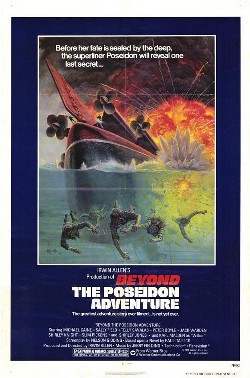
Beyond the Poseidon Adventure: A Review

BEYOND THE POSEIDON ADVENTURE

This review is part of the Summer Under the Stars Blogathon. Today's star is Shirley Jones.

Nothing succeeds like success. After The Poseidon Adventure became a massive hit, it is not a surprise that a sequel followed. Perhaps seven years was too long a wait. Perhaps that was also the first sign that Beyond the Poseidon Adventure was going to be a disaster, but not in the good way. Not exactly a remake per se, Beyond the Poseidon Adventure is neither fun nor exciting.

It is right after the Poseidon capsized on New Year's Day when the tugboat Jenny comes upon it. The Jenny's three crew, having survived the same storm that threw the Poseidon over, see that they can claim salvage rights to the Poseidon. Jenny's captain, Mike Turner (Michael Caine) is eager to find anything in the Poseidon that will get him to pay his debts and save the Jenny. His second-in-command, Wilbur (Karl Malden) is also excited on the salvage prospects. Their passenger, the ever-perky Celeste (Sally Field) goes along with this because she has no choice.

Once near the Poseidon, the Jenny crew are surprised to find another ship coming alongside the Poseidon. It is the Greek medical ship Irene, headed by Dr. Stefan Svevo (Telly Savalas). He claims to have received the Poseidon's S.O.S. and search for more survivors. Pulling their resources, the Irene and Jenny crew go into Poseidon. Here, they encounter others who have lived through that New Year from Hell. The first group is made up of nurse Gena Rowe (Shirley Jones) and passengers Frank Mazzetti (Peter Boyle) and Suzanne Constantine (Veronica Hamel).

Frank is desperate to find his daughter Theresa, and fortunately Theresa (Angela Cartwright) did survive. She is found in the purser's office, alongside hunky elevator operator Larry Simpson (Mark Harmon) and Dewey "Tex" Hopkins (Slim Pickens). Tex has a bizarre fixation for a Baune 1865 wine that he found, saying that there are only six in the world. Despite the diamonds, gold and cash around him, Tex thinks the wine is worth far more and will not let it go. Eventually, they come upon two more survivors: Harold and Hannah Meredith (Jack Warden and Shirley Knight). They seem almost resigned to die, as Harold is blind and will not leave, causing Hannah to refuse to leave him. They are talked into joining the others in a bid for life.

The Greek medical team splits from the Jenny trio, who mix their salvage search for a rescue of the Poseidon survivors. There is in truth a malevolent reason for not trusting the Greeks. Far from being rescuers, Svevo has come in search of what we eventually discover is plutonium, along with arms for smuggling. Svevo has an inside person among the survivors, but this agent will not live to reveal anything. After the inside person's body is found, the survivors fear that there is a serial killer aboard. Svevo cannot let anyone outside his circle live. Who will make it out Beyond the Poseidon Adventure?


Irwin Allen pulls double duty as both producer and director in Beyond the Poseidon Adventure. That should have been the second sign that the film was going to be wildly misguided, or perhaps misdirected. There is no sense of danger or menace to be found. Instead, you see a lot of actors floundering about (no pun intended). Allen as a director could not build up suspense or danger or interest in what was going on. So many scenes look as if not even the actors are taking things seriously. 

Savalas seems to be having a grand time being a villain. He apparently decided that it was better to make Svevo into a calm villain. Savalas never rages or rants. He is quite rational, cooly detached from things. He is a highlight of Beyond the Poseidon Adventure, as if he accepted that this was a nice paycheck. Bless Shirley Jones, who also managed to play scenes straight even while having to say idiotic things. "If Captain Turner's right and there is a homicidal maniac on board this ship and it's not Dr. Svevo then he's in as much danger as we are" she scolds I believe Mazzetti. Any actress who could get through such a line without breaking out into laughter deserves credit.

As a side note, wouldn't even homicidal maniacs be more interested in saving their own lives than in going on murderous sprees if they are trapped on a sinking ship? 

I think a major problem with Beyond the Poseidon Adventure is that, unlike the original, we get very little chance to know the characters. If anything, we are given little bits about who these people are. Blind. Perky (irritatingly so). Whiny. Loud. Bossy. Murderous. As such, there is no sense of why we should care. That may also be why more often than not, we would not mind seeing some of these people die.

That is the case with Sally Field's Celeste. Put aside for a moment that for the longest time we did not learn her name (if memory serves right, she was referred to as "Honey"). Right from the get-go, you sense that Celeste is a dimwit who would be better off being left aboard the Poseidon. How else to explain how her idea of "helping" during the storm was to smash the tugboat's window? To be fair, she did not intentionally smash it. However, why did she think that using a coatrack would help in the situation? Beyond the Poseidon Adventure wants to suggest some kind of romance will eventually evolve between Celeste and Mike. It is a strange suggestion given that Captain Mike is pretty contemptuous of Celeste and understandably so. 

The film ends with Celeste pulling out a large diamond after they have lost the rest of the treasures that they managed to salvage. Mike looks at our perky (VERY perky) heroine. "Gonna kiss me now?", she asks. "I was gonna kiss you anyway", he replies. That may be the most eye-rolling bit of dialogue from Nelson Gidding's adaptation of Paul Gallico's novel. However, other elements fail to keep us interested.

Peter Boyle was affected by being one of the one-note characters. I think that he might have been the new Rogo from The Poseidon Adventure, the one who questioned every decision and was crabby about it. However, while I think that Boyle tried, the end result was more laughable than interesting. It takes, I suppose, a lot of work to be out-acted by Mark Harmon, but there it is. Stabs at pathos, such as with Karl Malden and Slim Pickens' characters, also fall flat. Tex's true identity, along with his refusal to let go of the bottle, were more absurd than moving. To be fair, I did admire Tex's devotion to his wine.

I don't know if, unlike Boyle, Michael Caine tried to make any of this serious. Predating his open cash grab role in Jaws: The Revenge by eight years, Caine seems to have problems when in stories involving water. He barked a lot and was given a pretty thankless role, so to speak. Maybe he did the best he could with it. Or maybe he realized that Beyond the Poseidon Adventure was silly and opted to roll with it. 

All of that, I suppose, could be forgiven if Beyond the Poseidon Adventure were action-packed. There were efforts at that with shootouts and an explosion to top off the film. However, they were not exciting. They seemed to be more play than real. I am also curious about the plutonium found on the Poseidon. Again, I won't wade into the waters as to why the Poseidon was being used to smuggle arms and plutonium, especially given that this was going to be the Poseidon's final voyage. 

The Poseidon ultimately explodes due to the damage the ship has. I do not recall that Svevo's men managed to get the plutonium's container aboard the Irene before the explosion. Even if they did, I figure that the ferocity of the Poseidon's explosion would have taken the Irene out. As such, shouldn't the plutonium have also exploded? If it did, how did anyone manage to escape?

Oh well, perhaps that is thinking too much on things. Beyond the Poseidon Adventure is a misguided effort to keep things going from the first film. To misquote a lyric from West Side Story, let Beyond the Poseidon Adventure sink into the ocean.

DECISION: D+