Tuesday, December 14, 2010

Metropolis (1927): A Review


METROPOLIS

*Author's note: The screening of Metropolis I attended had the score written and performed live by the Alloy Orchestra. At the time, we were informed that their original score would be included in the re-release of Metropolis on DVD. Unfortunately, as I understand it the owners of the rights to Metropolis opted to go with the original score written in 1927 by Gottfried Huppertz. One can go about hearing it in a roundabout way merely by synchronizing their music to the video. Normally, I'm a stickler for seeing a film as shown, and I would recommend listening to Huppertz's score, but after hearing the Alloy Orchestra's version, which I think is brilliant, I would opt for their score.

Tales Of A City...

How can it be that a film could survive for close to a hundred years undiscovered within the bowels of a South American archive? Frankly, that is an academic question, though granted, an important one, because now, Metropolis, one of the Greatest Films of All Time, is now here, at last, as close to how Fritz Lang envisioned it, and even now, few films are available to capture the lavishness, the epic nature, the dazzling visuals of Metropolis.

In this two-and-a-half hour version (I would like to point out that Metropolis is about the same length as most Harry Potter films), we have a richer, deeper, more grand story than we've seen in any other version. The film speaks on the coming mechanization of the Twentieth Century, of how man will be subjugated to machines, and how some will be pushed down while a few will enjoy the fruits of their labor.

However, it isn't a boring lecture on workers' rights, but a thrilling visual feast with the central theme stated openly: The Mediator Between the Head and Hand MUST Be The Heart.


Freder (Gustav Frohlich), is the son of Joh Fredersen (Alfred Abel), Head of Metropolis. As a child of privilege, he like his fellow citizens above ground, knows nothing of how Metropolis is kept running. The hidden hand is of the mass of workers slaving beneath the city, keeping the powerful machines running while they are virtual slaves.

One day, a beautiful woman named Maria (Brigitte Helm) appears in Freder's world, taking a group of worker children with her. Freder becomes entranced with Maria, and he goes into the underworld to follow her. Here, he sees the horrors the workers endure, as well as the message of peace and hope Maria gives them. Freder tells his father of what he's learned, but Fredersen is dismissive of his son's concerns.

Freder, we learn, indeed knows of the dark heart of this paradise. He goes to the Mad Genius of Metropolis, who happens to be his father-in-law, or at the very least the mother of Fredersen's son, Rotwang (Rudolf Klien-Rogge). To create dissension between the workers, he shows Fredersen his latest creation, a robot that through his genius takes on the shape of Maria.

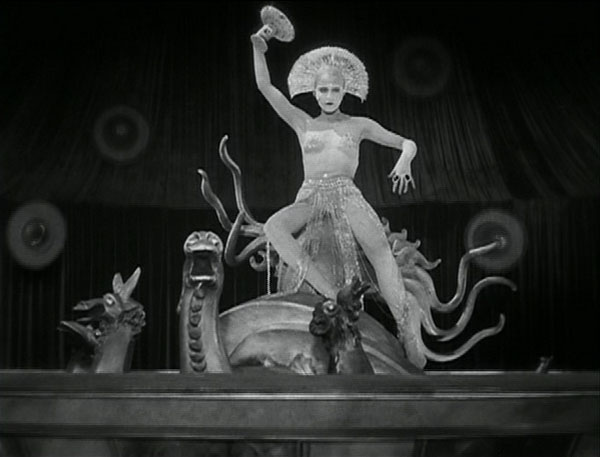
Meanwhile, as Freder learns of what is going on beneath Metropolis, he takes the place of Worker 11811 (Erwin Biswanger), who now goes above ground and witnesses the decadence of Metropolis itself, especially the pleasure district of Yoshiwara. The False Maria urges revolution and a violent overthrow of those above and drives the men who live in Metropolis itself to heights of lust with her Danse Erotique, while the True Maria is taken prisoner by Rotwang.

The Mad Inventor has a secret agenda: blaming Fredersen for his daughter's death, he plans to destroy all Metropolis: above and below. When the workers decide to overthrow their overlords, they abandon the machines, and thus they soon start to fall apart. Those who live above ground become so insane with merriment they do not care about anything. In the chaos of revolution, the children of the workers are forgotten, but soon the water pumps start erupting, threatening all the children with drowning.

The True Maria and Freder find each other in time to rescue them, and the workers seize the False Maria and burn her at the stake. Rotwang recaptures the True Maria and takes her to the cathedral. Freder rescues her, and at the end of the revolution, worker and management realize, through Maria's intervention, that the Mediator Between Brain and Hand MUST Be the Heart.


Metropolis builds up the visuals to heights remarkable today, let alone in 1927 when it premiered in Germany. Take for example when Maria is captured. The imagery is both brilliant and terrifying when she is taken.

Another example is when the False Maria emerges from the robot. It also comes when we have an analogy to the Creation of The Tower of Babel, when we are shown how man continues to repeat the same folly. The title cards tell us as much:

One man's hymns of praise became another man's curses.

Lang not only captures us visually, but also, along with screenwriter and then-wife Thea von Harbau, a story that is still relevant today: how some labor unseen while others obliviously benefit from their work, and how machinery can overwhelm the humanity each person has at birth. Take when we first see the workers: they shuffle slowly, heads down, in lock formation, one group to their machines, one group to their homes beneath Metropolis. The imagery immediately captures us and at the same time is one every worker can relate to. This is counterpoint to how we see the Club of The Sons, a garden of earthly and carnal delights.


Somehow in Metropolis, Lang manages to make the machinery so massive and overwhelming that in one powerful scene, it actually devours the workers, who then having been sacrificed can easily be replaced. When we go to the False Maria's Erotic Dance for the Sons of Metropolis, it becomes visual spectacle.

The action in Metropolis builds and builds as the situation in the film becomes more and more out of control, culminating in the not just a thrilling conclusion (will the children survive the flood? will the revolution destroy all Metropolis? will the True Maria survive?) but manages to give us both a peaceful and satisfying conclusion.

I will grant that at times the acting in Metropolis may appear to Twenty-First Century eyes a bit wild and exaggerated. In many silent films that should be forgiven, but I want to stick up for Helm's performance. She had to play two characters: the gentle and loving True Maria and the wicked, decadent False Maria. With the False Maria, she has to do two things: create fiery revolution with the workers, passionate lust with the Club of Sons. That she manages to do all that without speaking is a sheer acting tour de force.

Let me now speak of the restored version. With nearly half-hour's worth of new footage, we get a deeper, richer story. For example, we never saw what Worker 11811 saw once Freder took his place. Now we can, and his adventures in Yoshiwara give us a greater insight into the world Metropolis is.

The same can be said for Josaphat (Theodor Loos), Fredersen's assistant who is nearly driven to suicide because he does not keep Freder in check. Admittedly, it becomes quickly clear which scenes are the newly-discovered ones: they are the ones that looked scratchy compared to the rest of Metropolis. However, while perhaps at first that might prove distracting, soon one quickly accepts it to where by the end of the film, one has thoroughly forgotten about it and it becomes a non-issue.

The effects of Metropolis are still being felt, from other innovative films like Blade Runner right down to how we must be vigilant that in order to achieve certain goals, the human element is taken into account. It is a visually amazing film with relevant themes: in short, a thorough masterpiece. Metropolis, now restored, rises to greater heights. Hands, Head, Hearts--although we are missing Health (and a few more minutes of the film), each part and viewer will be completely satisfied.

DECISION: A+

Monday, December 13, 2010

The Proposal: A Review

THE PROPOSAL

The Devil Wears Parka...

In a film like The Proposal, you have to rely on all the characters having a basic level of stupidity. Otherwise, nothing in it would work.

All the people in the story simply have to carry on without thinking things through, because if they did, they'd realize that they wouldn't do anything they actually do. Instead, they'd act and do things rational people would, and where's the funny in that? In The Proposal, there isn't all that much funny to begin with.

Margaret Tate (Sandra Bullock) is to the book publishing world what Miranda Priestly in The Devil Wears Prada is to the fashion magazine world: the Boss From Hell. She's mean, pushy, uncaring, and terrorizes all her underlings, chief among them Andrew Paxton (Ryan Reynolds), her long-suffering, slightly emasculated, put-upon personal assistant. Maggie delights in exercising her power in the office and doesn't shrink from bullying people to get her way.

Unfortunately, Maggie has a problem: she's Canadian (which, I understand, is a treatable condition, but I digress). Her visa won't be extended, and she faces deportation. In order to avoid this, she pushes (threatens is the better word) Andrew into getting a quickie marriage so she could stay. Of course, Andy goes along with this (even after knowing that if this fraud is discovered he will go to prison), but with a few conditions: he is to be made an editor, his book is to be published, and he will go on a previously-planned trip Maggie had earlier curtly cancelled.


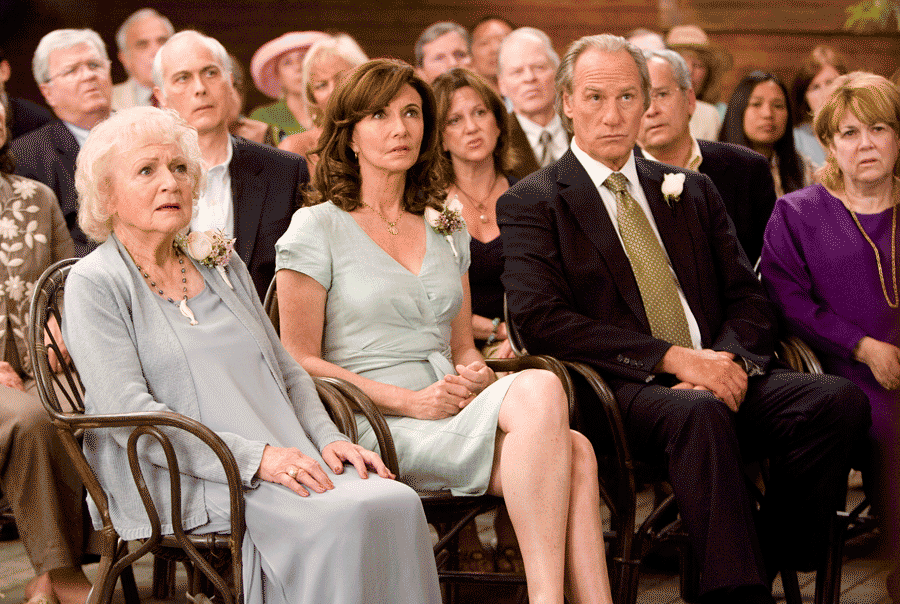
This trip is to his home state of Alaska, to celebrate his Gammy's 90th Birthday. In order to gather information about each other to satisfy an INS agent who suspects they are trying to pull a fast one, Maggie goes with him, and there they are greeted by his parents (Craig T. Nelson and Mary Steenburgen) and his beloved Gammy (The Betty White*). Maggie does discover a few things about Andy and Alaska: he comes from a remarkably wealthy Alaskan family but wants to pursue his own interests rather than those of Poppa, the Paxtons (especially Gammy) are overall a loving group, and that while Sitka has a very small population (around 9,000 residents) somehow Ramone (Oscar Nuñez), a man of suspicious foreign extraction, manages to hold down several jobs in town (thus giving credence to the idea that illegals really are stealing American jobs).

Maggie and Andy continue this 'engagement' ruse, and thanks to some more plot contrivances they now have to get married IMMEDIATELY. In the three to four days they spend in the Great North, wouldn't you know it: they realize they're in LOVE...for real.


As I watched The Proposal, I kept telling myself to cut it some slack. It's not supposed to be smart, I tells myself. It's not supposed to make sense in reality. It's supposed to be idiotic. Even after telling myself all that, the film still felt dumb, namely because it was.

It might have been funny if Reynolds and Bullock switched roles and he, the Boss from Hell, cajoled his female employee into marriage (given Reynolds in real life is Canadian, and Bullock in real life is as American as you can get, it would have been more accurate). Of course, if that had happened, it would have constituted a form of sexual harassment since the comedy comes from the fact that its a female being brutal to the man.

There are things to like in The Proposal. Reynolds is to my mind an all-around actor. Here, he goes back to his Two Guys, A Girl, and A Pizza Place comedic roots. He has perfected the look of a man stunned at the goings-on around him, a mixture of puzzlement and disbelief registering on his face whenever he is surprised by something that is suppose to be funny. Reynolds also manages to have at least one dramatic moment when he tells his father he has no interest in taking the Paxton mantle in Sitka.

Of all the performances, the best is that of The Betty White. The Betty White is unashamed to be blunt and open about whatever she thinks, and her directness is oddly endearing, especially since The Betty White delivers her dialogue with almost an innocence to it. However, near the end of the film she gives a dramatic scene which shows The Betty White is a strong actress who can play things both for laughs (her turn as a shaman--or is it a shawoman?) and for tears (a dying request).


However, Bullock appears actually too nice to be brutal as Maggie. She's suppose to be a terrifying creature in the office, but her harshness isn't all that harsh, more slightly rude and unthinking than cold and cruel. Given that she's supposed to evolve into a caring, even loving woman at the end of the film, her transformation doesn't appear like a 360 degree one, just a slight attitude adjustment. It should be pointed out that Bullock or director Anne Fletcher never made any effort to give Bullock's character any Canadian inflections. Couldn't they have thrown in at least one "a-boot" or "eh" at the end of a sentence to at least make her sound something close to a Canadian?

Bullock has a charm, and just like Reynolds has perfected his comedic styling, she has her own mannerisms: to be perpetually flustered by all the goings on (specifically with a small Paxton family dog). The actors aren't to blame for The Proposal falling flat. The fault lies on Pete Chiarelli's script, which depends a lot on contrivances to either move the plot forward or get the characters into silly situations.

Take for example a now-famous moment when Bullock and Reynolds crash into each other completely nude. While it is good to see that both of them have amazing bodies, how neither knew the other was in the bedroom they are forced to share borders on the stupid. I have often wondered why characters in comedies, especially romantic comedies, have to be on the whole stupid. The Proposal doesn't answer that.

We have the obligatory confession scenes, where the main characters reveal things about themselves they've never revealed about themselves, and the sudden change of heart at the altar, and while I know that I shouldn't take any of it as the actions of rational people, I can't help think maybe, just once, characters should have an ounce of intelligence.

I digress to point out that I felt almost embarrassed for Nuñez as Ramone. It was already pretty awful he had to perform a strip scene (granted, I did chuckle, but more out of embarrassment than amusement), but to have him pop up every so often in various jobs was just wearing a bit thin. Finally, ending the film in a montage of interviews with the INS where we get the idea that Ramone is in the country illegally is cheap. I would have found it funnier if the character were named Scott Gomez (who as far as I know, is the only famous Hispanic Alaskan), thus giving him the ethnic background the film-makers were looking for and still having a bit of a pun.

The Proposal is slight, dumb, predictable, not the greatest of comedies. Yes, it's harmless, so I shouldn't be too harsh on it. In the end, The Proposal is not indecent, but it's not very funny either.


*If you wonder why I refer to her as THE Betty White, it is because she has gone beyond being a mere actress (although a good one), she has become a Millennial Generation icon, a woman embraced by people not even born when The Golden Girls ended. Somehow, she is now a bone fide symbol of our times. She is more than just Betty White. She is now THE Betty White, and this is how I shall refer to her from now on: as The Betty White.

Sunday, December 5, 2010

Tangled: A Review


TANGLED

It's a positive in my book when a film released in 3-D, the bane of my cinema experience, can be enjoyed completely in 2-D. Disney might be trying to cash in on the 3-D craze, but in this case I think they are merely following the lemmings of animation who are headed over an artistic cliff. Tangled, the reworking of the Rapunzel fairy tale, doesn't signal a second renaissance in Disney animation. However, it does signal a budding resurgence of light entertainment.

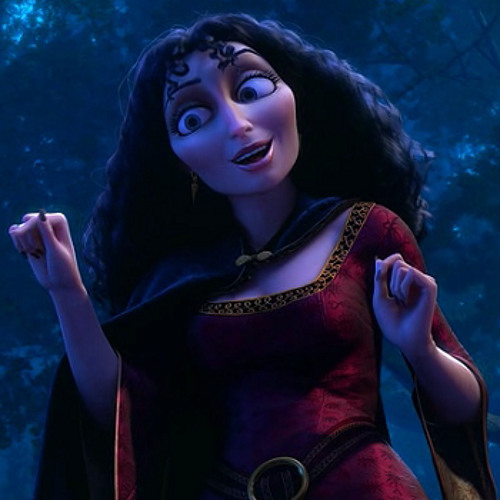
I will say 'reworking' since, to be frank, I don't remember the story save for that "Rapunzel, Rapunzel, let down your long hair" bit. In our version, a magical flower is discovered by Gothel (Donny Murphy), who I think is a witch, but who looks suspiciously like Cher. Gothel uses this flower to keep herself looking young forever (just like Cher). The Queen, who is hours from delivering birth, is deathly ill, and a search for said flower takes place. Even though Gothel tries to hide it, it is discovered, brought to the Queen, and she gives birth to Rapunzel (Mandy Moore).

Gothel attempts to take a bit of Rapunzel's hair, but discovers as soon as it's cut, the golden blonde turns brown, and the magic is gone. Not wanting to lose her chance to stay young, Gothel makes off with the Princess and keeps her locked away in a high tower in a hidden forest. Rapunzel has only the chameleon Pascal to keep her company (figure then Rapunzel is in a French-speaking world).

Cut to many years later. A trio of thieves, the Stabbington Brothers (Ron Perlman) and Flynn Rider (Zachary Levi) steal the diadem of the Missing Princess. Flynn cheats the Twins and makes off with the jewels, with only Maximus, a Royal Guard horse, to keep the mad pursuit. Flynn discovers the hidden alcove, and once up in the tower, he is promptly hit on by Rapunzel: hit on meaning she uses her handy-dandy frying pan to knock him unconscious.

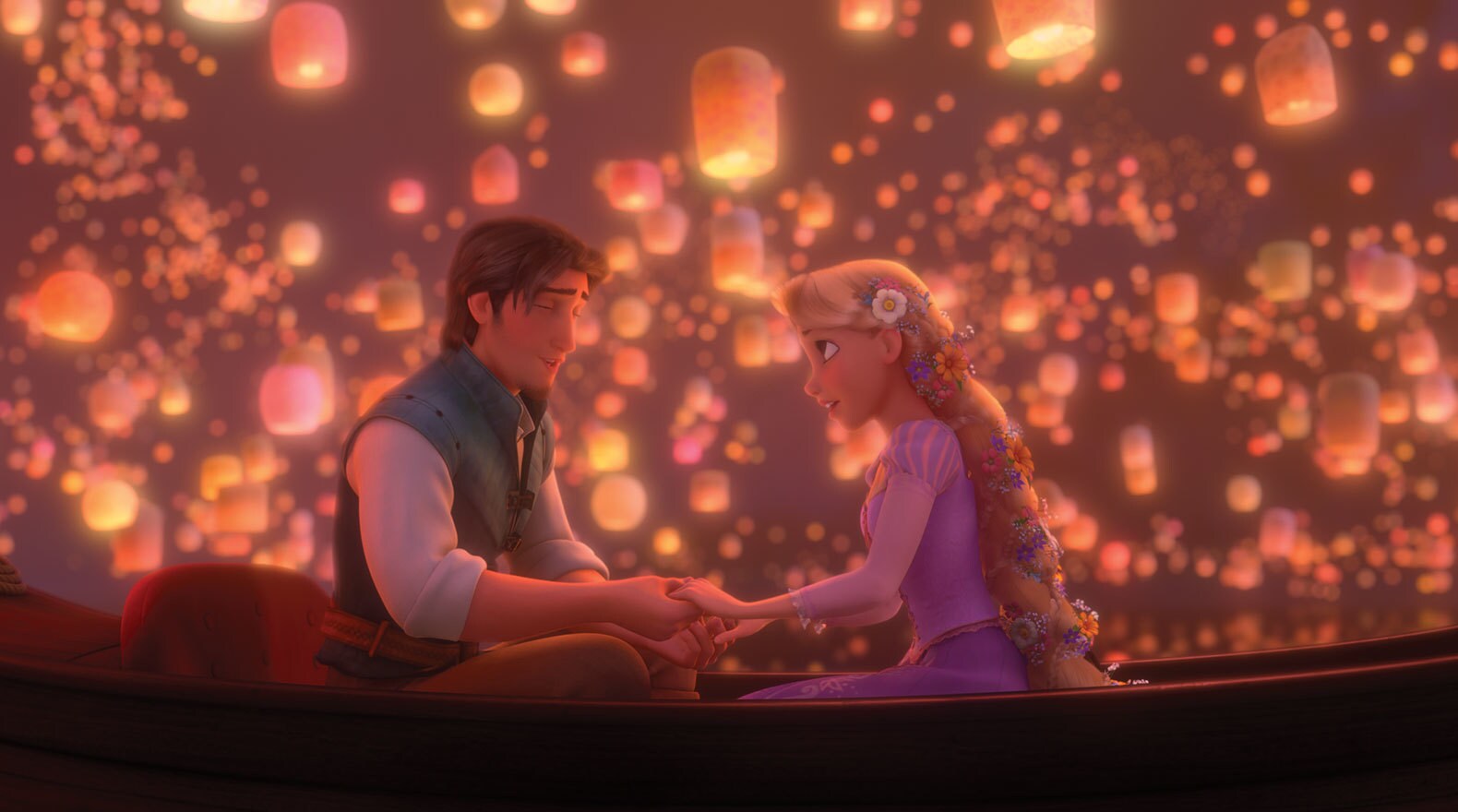
Eventually, after a series of knockouts, they strike a deal: he'll take her to where lanterns flow into the sky (always on her birthday, coincidentally enough) and she'll give him back the diadem. Off they go, with the Twins, Gothel, and Maximus all in varying pursuits. Eventually, after a somewhat humorous visit to a tavern, they get to the village where they realize what they feel. However, Gothel & the Stabbingtons have joined forces to split the lovers up. In the end, the bad guys get what they deserve, and we end the way all fairy tales end.


Tangled has some curious flaws. The songs by Alan Menken and lyricist Glenn Slater weren't all that memorable. They weren't even all that good. It may not be fair to compare previous Disney films to Tangled in the music department, but you don't leave the theater humming any of the tunes. There is no Beauty and The Beast, no Circle of Life or Can You Feel The Love Tonight, no Under the Sea or Part Of Your World, or even Ma Belle Evangeline or Dig A Little Deeper from last year's The Princess & The Frog.

The few songs I can remember: Mother Knows Best, I've Got A Dream, and I See The Light range from good but not quite up there with the previously mentioned (I See The Light) to downright bizarre (I've Got A Dream is sung by a group of ruffians that made it almost appear like Flynn and Rapunzel had wandered into an animated version of a gay bar). In fact, I was surprised that when Rapunzel finally touches ground (so to speak) she didn't have a song of discovery.

Another curiosity is how Gothel isn't a traditional villain. For most of Tangled, it almost seemed as if she really does care about Rapunzel and isn't as big a villain as she could have been. Same can be said for the Stabbington Brothers. When she does appear as almost threatening, it's done in a very rushed manner near the end, as if we had to dispose of her before the closing credits.

 I also wasn't crazy about the voice-over narration provided by Flynn in the beginning and the end when frankly it wasn't needed. Dan Fogelman's script could have cut that device without affecting any aspect of the story.

This isn't to say Tangled doesn't have some wonderful things in it. When Flynn and Rapunzel arrive at the kingdom, they are greeted with some beautiful animation, culminating when they see the lanterns floating all around them. While I wouldn't have shelled out extra to see the film in 3-D, the sheer beauty of this scene is still appreciated in 2-D.

It might also be a surprise to see that the leads have very good singing and speaking voices. Let me explain: Levi (best known for television's Chuck) has a strong and pleasant singing voice, which surprised me. It isn't a surprise that he has charm with a hint of exasperation when he speaks as Flynn, but this is the first time I have heard him sing, and Levi shows he can handle a song rather well. Moore, known primarily as a singer (at least from what I know), knows her way around a song, but she projects both an innocence and a strength when she speaks.

In fact, while Levi and Moore handle their parts (speaking and singing) rather well, the best performances were actually mute. The chameleon Pascal, in an odd way, dominates Tangled, where every expression and change in color shows whatever mood he is in. Maximus, while not in the film for that long, has his moments whenever he shows his contempt for Flynn but also his insistence that he pursue her. You do end up liking them and they play off the leads and the characters wonderfully.

Tangled is heralded as Disney's 50th Animated Feature (has it been that long since Snow White & The Seven Dwarfs?) but alas, it will not rank up there with Snow White or Beauty and The Beast. It isn't in the traditional animation, but it doesn't look totally computer-generated.

It's a second-tier film in the Disney canon, but while it could have been better (the songs won't rank high on anyone's list), Tangled is enjoyable and light, with good performances from Levi and Moore. At least the plot and songs won't tie you up in knots.

Wednesday, December 1, 2010

Love & Other Drugs Review (Review #161)


LOVE & OTHER DRUGS

I might never believe trailers again. When I saw the trailer for Love & Other Drugs, I was lead to believe it was a romantic comedy about Viagra. I wasn't told there was an illness. I wasn't told there was a lot of nudity. Well, while trailers sometimes are accused of giving away the whole movie, Love & Other Drugs takes a slightly different route: it doesn't show the best parts.

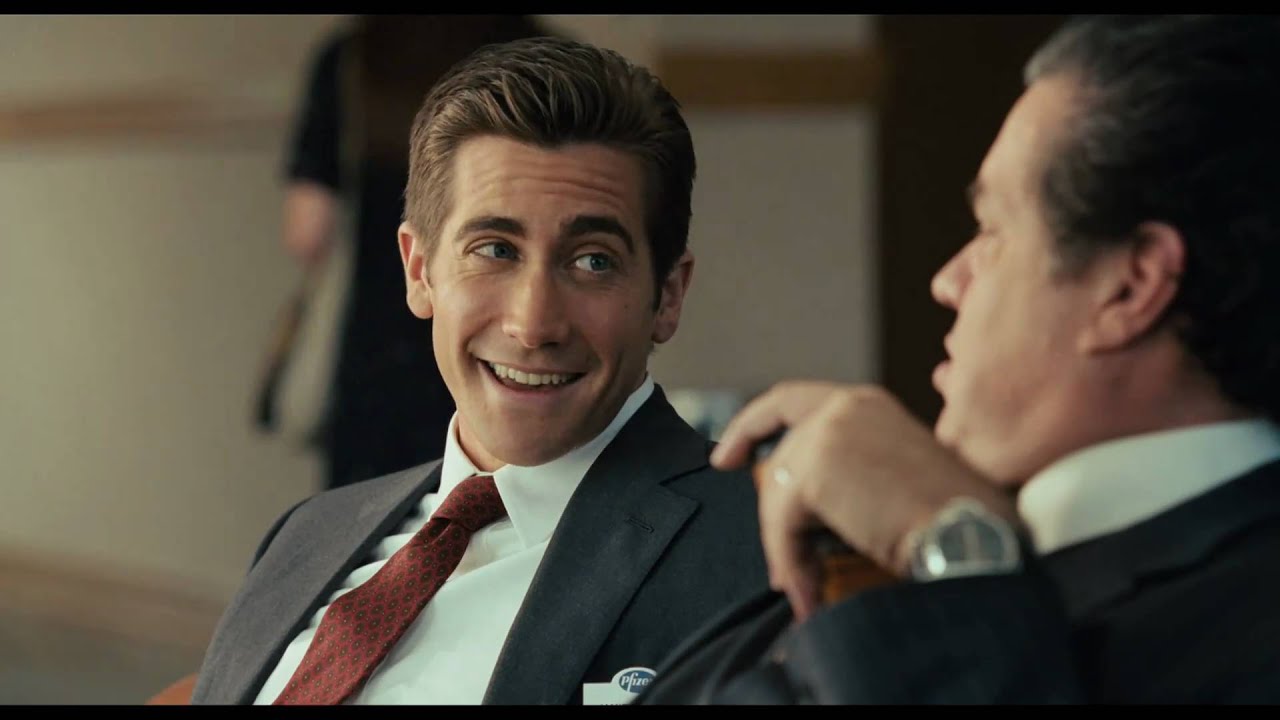
Jamie Randall (Jake Gyllenhaal) is a thorough player and I mean player with a capital P. He's a smooth-talking charmer who can get any woman to do anything for, or should I say to, him. A shameless slut, Jamie hasn't been able to live up to the expectations of his wealthy parents (George Segal and the late Jill Clayburgh), who would have liked Jamie to have a respectable job that pays well.

It is at the suggestion of his multimillionaire dot-com brother Josh (Josh Gad) that Jamie reluctantly goes into pharmaceutical sales. Joining Pfizer, he continues his Jack The Lad routine, schtupping every woman, right down to the Pfizer trainer who was at first hostile to him but who eventually succumbs to his charms (he's Jake Freaking Gyllenhaal, for goodness sake. Who wouldn't fall for his Dutch charms?). Under his mentor/trainer Bruce (Oliver Platt), Jamie has a bit of trouble translating his obvious charms to sell his main drug, Zoloft, to the doctors in his area. However, he soon sleeps his way into seeing Dr. Stan Knight (Hank Azaria).

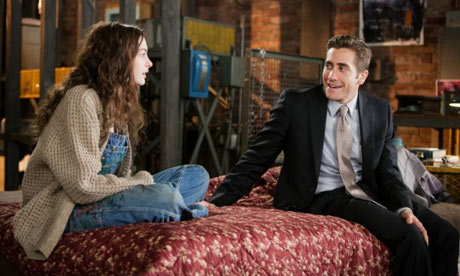
Dr. Knight's newest patient is Maggie Murdoch (Anne Hathaway) who is in the first stages of early-onset Parkinson's Disease in spite of being only 26. As part of the examination, she bares her breast to both Knight and Jamie (masquerading as an intern). This is the first of Hathaway's 'Julie Andrews moments', and while she's at first furious that this salesman saw her topless, she soon realizes that he's a good opportunity for meaningless sex. They begin an affair, but against both their stated wishes and good sense, they actually start having feelings for each other.

It's at this point that Love & Other Drugs segways wildly into about three different directions. It goes from the story of how Jamie becomes the seller for Viagra, to the story of Jamie growing into a man, to a romance between a physically ill woman and an emotionally ill man. Somehow director Edward Zwick and scriptwriters Zwick, Charles Randolph, and Marshall Hershkovitz (adapting Jaime Reidy's book Hard Sell: The Evolution of a Viagra Salesman) decided that it was not good to focus on one story. Instead, they appeared to have adapted a 'let's throw a lot at the audience and see where it leads us'.

I feel compelled to state for the record that I do not know the difference between Zoloft and Prozac, therefore, in a way, I wasn't buying whatever Jamie was selling. What I also couldn't buy was the uneven tone in Love & Other Drugs. It could never decide what it wanted to be.

Was it a raunchy romantic comedy? Josh's appearance throughout indicated as such, as did the 'Pajama Party' scene where we're treated to one of Viagra's notorious side effects. Was it a romantic drama? Jamie waiting all night for Maggie's return from a "Caravan to Canada for Prescriptions" indicated as much, as did when he stopped the bus to tell her the equivalent of 'you complete me'. How about a character study? Well, Jamie having a virtual heart attack when he finally admits that he loves her would present us such a possibility. Love & Other Drugs was simply all over the place, trying to be so many films that it lost focus on whatever it could have been.

It could be that Jamie was presented as such an unrepentant catnip to every woman he meets that it soon started becoming a joke. It plays from the Rom-Com Playbook: an incredibly good-looking man gets any woman he wants because they become entranced by his physique, and then, he finds The One. The One plays hard to get (either physically or emotionally) but he soon realizes that life cannot be lived outside her presence, and eventually she realizes he is The One too.

Maybe Love & Other Drugs was borrowing from Made of Honor as well: Jamie was such a sleazy narcissist you almost want him to fail.

Gyllenhaal and Hathaway, to their credit, do have a strong rapport, making their teaming enjoyable as they play off each other. However, at the beginning of the film, Hathaway sounded forced and unnatural, delivering her dialogue as if it were dialogue. It was most often in the comic parts where she fell flat. When she is dealing with her Parkinson's, that's when Hathaway shows herself to be a strong dramatic actress. When she finds herself at a conference with fellow Parkinson's sufferers, her face says everything about the joy of not being alone as well as the fear that she will eventually be completely unable to control her body.

It's at those moments when she does her best work.

Gyllenhaal clearly enjoyed being the object of desire and is determined to show us, after Prince of Persia: The Sands of Time, that he still has a 'body of work' that belies the fact he's about to turn 30. Be that as it may, he curiously was better in the comic scenes than in the dramatic ones. It was a yin and yang type deal between them: when one was good, the other wasn't.


The fact that both Segal and Clayburgh were only in one scene seems such a waste. They were there to basically establish that Jamie had a family and that it was a financially successful one, one he hadn't been able to match. It makes their cameos, which is what they basically turned out to be, even more of a waste when one considers how often his brother Josh was in the film.

As played by Josh Gad, he's one of these perpetually adolescent man-child characters that Zach Galifianakis has perfected. Fat, slovenly, socially inept, obsessed with sex, down to masturbating to Jamie and Maggie's sex tapes (did people make sex tapes in 1996, and does anyone else find that last bit downright creepy?) but insecure with women; not only did Josh as a character add nothing to the story, it looked as though he was a leftover from a previous draft when Love & Other Drugs was purely a sex comedy with Viagra (no pun intended).

Platt is also wasted in a role that has him disappear as soon as Jamie finds success, only to come back near the end just to make things more confusing.

One character plot point that was just left hanging there for no real reason involves the rivalry between Zoloft wunderkind Jamie and his Prozac rival, Trey Hannigan (Gabriel Macht). I haven't seen Macht since he starred as The Spirit, and while it makes me happy he managed to have a career after that debacle his character was underdeveloped, almost unnecessary, to the plot/s of the film. He starts as merely a rival to Jamie, but then we learn from Maggie that she once had been Trey's lover, and Trey to be married. Once Jamie and Trey confront each other with no real resolution, Trey disappears from Love & Other Drugs, never to be seen again. Whatever conflict we had between Jamie and Maggie about her past with his rival are hinted at in one point, but disappear as soon as Zwick feels there is no need for it.


It's at this point I should discuss the nudity. Hathaway and Gyllenhaal are very attractive people. I don't begrudge them that. However, it is typical in American films that it is the woman that has to bear more, and whether this has to do with sexism or with the dual standard of keeping the man under wraps so to speak I do not know. It wasn't off putting to see two lovers be nude with each other (lovers tend to be naked in each other's presence) but their nudity wasn't erotic or even romantic.

It may have to do with the fact that they were just sexually involved without any interest in a relationship, but curiously, once they do develop true romance between them, they tend to be dressed. I can guess that the nakedness of both Gyllenhaal and Hathaway was to bring in audiences titillated by the idea of seeing two stars in a full state of undress. Honestly, I think the film would have been fine if it had held off on being so up front about them being naked or nearly naked.

One thing that did begin to grind at me was the soundtrack. It's not that I disliked the songs selected (anyone who picks a Bob Dylan song can't be all bad): it's the fact that more often than not, the songs themselves were getting in the way.

Edward Zwick appeared as if he were trying to be a Cameron Crowe or Martin Scorsese, two directors who almost always manage to mix songs to the screen seamlessly. Zwick tried, but couldn't keep it up (no pun, I swear). It soon become a game to figure out what song they were playing; it was fun hearing Praise You by Fatboy Slim again, but while he made the effort to make them relate (having the Kinks Well-Respected Man play as Jamie begins his selling career or Belinda Carlisle's Heaven Is A Place on Earth when they begin to sell Viagra) by the time the film ended I think even he gave up trying to find just the right song for the moment.

I will quickly point out that some of Love & Other Drugs' dialogue was downright silly. At one point, Maggie decides to perform oral sex on Jamie. "You're my little blue pill", he tells her. Why does that sound a bit cheesy to my ears? Somehow, I don't think that line will rank up there with, "You had me at hello", or "We'll always have Paris", or even "Love means never having to say you're sorry".

Love & Other Drugs is an odd mix of The Social Network with Love Story, mixing the creation of a juggernaut like Viagra with a passionate romance where the female faces a debilitating illness. In fact, in the montage where Jamie starts trying to find treatments and cures for Maggie, the Theme to Love Story started floating to my mind. It was an unconscious reaction.

Love & Other Drugs could have been a good film, if it had only decided what kind of film it was.

Tuesday, November 30, 2010

Burlesque: A Review (Review #160)

BURLESQUE

Cher And Cher Alike...

In order to enjoy Burlesque, you have to be willing to forgive a lot. You have to forgive that Christina Aguilera, playing the lead role of Ali, is not an actress. You have to forgive that Cher, playing her boss/mentor Tess, can act better than she did here. You have to forgive a cacophony of clichés that make up the plot.

Still, given that Burlesque is basically a vehicle for Aguilera to segway into film doing what she does best (which is sing), the film itself can be remarkably entertaining.

Ali (Aguilera) leaves Iowa for the big lights of L.A., looking for a chance to sing and dance; she becomes entranced by the Burlesque Lounge, where she sees Tess (Cher) on stage, as well as resident Queen Bitch Nikki (Kristen Bell). Ali is also taken in by the charms of bartender/composer Jack (Cam Gigandet). Ali dreams of being up on stage, but Tess doesn't think our heroine has what it takes. Tess, however, has problems of her own.

Her ex-husband/club co-owner Vince (Peter Gallagher) wants her to sell the Burlesque to real estate mogul Marcus Gerber (Eric Dane). Ali soon catches Gerber's eye. The pregnancy of another dancer, Georgia (Julianne Hough) gives Ali a chance at last to be up there, in the lights. Another fortuitous opportunity comes for her to show Tess, the wardrobe master Sean (Stanley Tucci), the ticket seller/performer Alexis (Alan Cumming), Marcus, Jack, and all the other burlesque dancers that she's got A Voice.

Soon, she becomes the toast of the town, squired by Marcus while Jack secretly pines for her but, alas, he's unable to pursue her because he's engaged to an actress in New York. Eventually, Ali and Jack do come together, but there are other things to deal with, specifically with Tess only a day away from losing the Burlesque to Marcus. Ali comes up with a clever solution, and it all ends with a mega-production number, Show Me How to Burlesque.


Writer-director Steven Antin borrows freely (if not downright steals) from the Kander & Ebb musical library. The first time we are at the Burlesque Lounge, Cher's number, Welcome to Burlesque, is shamelessly reminiscent of Willkommen from Cabaret, right down to the Burlesque Girls and the orchestra coming out to show how beautiful they are. I truly expected Cher to turn to the camera and say "Willkommen, Bienvenue, Welcome, Im Burlesque, Au Burlesque, To Burlesque".

I should point out the lyrics to the song DO indeed say, "Welcome to Burlesque". Coincidence?

There is another number involving Cumming and two female dancers that it is basically the Two Ladies number from Cabaret in all but name. Given that Cumming won a Tony for the revival of Cabaret, it makes this number, the only one I remember inter-cut with a scene between Marcus, Vince, and Tess, both pointless and a reminder of a better musical. Cumming's Emcee is no match for Joel Grey's version, who was downright creepy as the decadent Master of Ceremonies, but I digress.

The staging for the numbers, where each song is sung on stage, echoes Chicago (stage and screen). In fact, when Nikki performs a rather sleazy version of Diamonds Are A Girl's Best Friend, it ends with Ali imagining taking Nikki's place in an elaborate number...not unlike when Roxie Hart dreams of All That Jazz in the film version of Chicago.

In short, Burlesque is not original.


You also have some very odd choices in who does what. Gallagher has proven that he is a good singer (see The O.C.) but he's not given a chance to perform. In fact, he is wasted in Burlesque, given very little to do but look anxious about not getting his ex-wife to sell the club. The same goes for the aforementioned Cumming, who really had nothing to do with the story.

The worst waste was Tucci, who played basically the same character from The Devil Wears Prada. Is he the go-to guy for gay best friend to the star? Hough, taking a breather from Dancing With The Stars (there was a good joke about that show that flew over my head since I don't watch it and only recognize Hough by name, not face) didn't contribute much, but did a remarkably good job given the small role she had.

The bigger roles didn't distinguish themselves at all. Bell was comically over-the-top as Nikki, fuming and making faces throughout to where I wondered if she was supposed to have been played for laughs. Gigandet (making this an unofficial The O.C. mini-reunion with Gallagher, though I don't think they shared any scenes together) brought to mind a line from the trailer to Tangled: he brought The Smolder.

That was his expression throughout the film, and while he took great care to show off his physique he didn't take much care to project any real emotion or conflict to Jack. McSteamy, to his credit, took a rather clichéd character and did the best he could with the role but wasn't quite convincing as either a suave man-about-town or a greedy developer.


The two leads are good singers. Cher managed to have a strong solo number (You Haven't Seen The Last Of Me), even though the song and accompanying performance were irrelevant to the story (such as it was). She played yet another cliché: the wise mentor to the rising star. However, while for most of Burlesque her performance was weak (whenever she was suppose to be upset about the situation with the bank it never looked as if she truly was upset but was trying to be), she did manage to have a strong scene where she is showing Ali how to apply make-up, where we delved a little into her background.

As for Aguilera, she is magnetic whenever she is performing. I don't doubt that she is a strong singer. As an actress, one shouldn't be too harsh, given that Burlesque is really just a vehicle for a possible second career for Aguilera. She managed not to look foolish, and perhaps with more training she may become a competent actress, if not one on the Meryl Streep level.

As I've stated, the musical numbers are too close to Chicago to be thought of as original, but they are remarkably catchy and if you aren't too harsh with the production value you could enjoy them. One thing that was a major problem was Bojan Bazelli's cinematography.

It went over-the-top on some of the production numbers (MORE LIGHTS, I could almost hear him scream), but in one scene where Marcus first offers Vince and Tess his offer, the camera was unwieldy, as is whoever was holding it was losing his grip and trying not to let it fall out of his hands. It was not just distracting but downright bizarre.

That is ultimately the only real thing you could ask from Burlesque: to be mildly entertained. It isn't original. It doesn't have great performances. It doesn't have a compelling story. In spite of all that, it isn't a bad film.

Still, now one knows why Burlesque is not as popular as it once was.

Monday, November 29, 2010

Killers (2010): A Review

KILLERS


You make a film with two stars best known for their television work. The Powers That Be are absolutely determined to make Katherine Heigl (best known for Grey's Anatomy, where I understand she had sex with a ghost) and Ashton Kutcher (best known for That 70's Show, where I understand he had sex with everyone) into legitimate film leads/major box office draws.

Killers is the pairing of two people playing the same characters they've played in all the other films they've failed at and trying to make both a successful and entertaining film this time round. It's amazing that while Hollywood is insane, they don't know what the definition of insanity is.

Jen Kornfeldt (Heigl) is an uptight, insecure, recently dumped girl (or to be more specific, a Katherine Heigl character). She goes to Nice with her parents (Tom Selleck and Catherine O'Hara). There, she runs into Spencer (Kutcher), a good-looking guy who isn't funny or clever or smart (or to be more specific, an Ashton Kutcher character). While she wants to forget her recent romantic tribulations, he is there for a specific reason: Spencer is an assassin for the government. Both are attracted to each other and have a whirlwind romance. Spencer decides to walk away from being a hit man, much to the anger of his superior, Holbrook (Martin Mull).

Three years have passed, and Spencer is living the life he's always wanted, but before you know it, one of those wacky neighbors/co-workers films like Killers is saddled with, Henry (Ron Riggle), tries to kill Spencer. Why? Well, because he has been deep undercover, infiltrating Spencer/Jen's lives in order to get the $20 million bounty on his head. Of course, Jen never knew about Spencer's past, but plot contrivances have her walking in just when the first attempt is made on his life. Now, both are on the run from the various killers.

You should be able to figure out that all those wacky neighbors and offbeat co-workers of both Spencer and Jen are not there merely by accident. Otherwise, it wouldn't be a movie.

Spencer and Jen have not only to stay one step away from the contract killers after them, but they also have to find out who put out said contract, who killed Holbrook, and deal with Jen's newly discovered pregnancy. At the end, we get a "surprise" twist as to who has unleashed all these killers (one guess as to who that could be), and at the end, it all ends with a joyful baby guarded by two generations...take it from there.


I kept wondering through Killers how much better it could have been if co-writers Bob DeRosa and Ted Griffin had made a few different choices. It would have been funnier if the roles were reversed: if it were Heigl who was the trained assassin and Kutcher was the lovelorn put-upon son. I figure that couldn't have happened because we wouldn't have been treated with the obligatory shirtless Kutcher sequence (which may be part of his contract).

The film would have been funnier if Jen not be aware that people were trying to kill her husband. Let her go off to San Francisco, as she was intended to do before coming back at the exact moment necessary for the plot, and he, fearing they are after her, tries to get to her while avoiding all these murderers. Jen, meanwhile, is romanced and menaced by other assassins who get confused and think the hit is on her.

See, I fixed the script without even meaning to.


Robert Luketic couldn't get a performance out of anyone in Killers. Heigl (who's cornered the market on uptight yet romantically desperate girls) and Kutcher (who I don't think changed his facial expression throughout the film) delivered their lines in a forced and unconvincing manner. Even when they are suppose to be stumbling over their words, it looked fake. They don't sound real or convincing.

Take the moment when Kutcher, after their first date, confesses to Heigl that he is a government contract killer. It didn't look like he was even trying to act. Instead, Kutcher was merely reciting words given to him without any sense of emotion. He wasn't interesting, he wasn't funny, he had nothing to offer except some abs, but frankly, given they are now a dime a dozen, it isn't much to offer.

Heigl seems content to appear dumb and desperate. Seeing them together attempting jaunty banter is especially painful because neither appears interested in what is going on: Heigl appears to think she's too smart for the material and Kutcher appears to think he's acting.

The supporting cast added nothing. Mull (who I don't remember from any movie since Clue) is underused, and I don't think we actually had a reason to kill his character, which is a remarkably downbeat moment for a comedy. Furthermore, I don't remember if we actually found out who killed Holbrook. O'Hara was wasted (in every sense of the word) throughout Killers, and Selleck was confusing looking stern for looking funny.

The comedy isn't funny, the action isn't exciting, the performances are dull, the situations idiotic. Basically, Killers is about a rather violent family squabble where the women are basically out of it and the men remarkably stupid. There really is nothing to like about Killers, not even Kutcher's killer abs (and frankly, having seen Taylor Lautner, Kelso's looking a bit past it).

If anything, I grudgingly admire Heigl and Kutcher's persistence. You would think that Heigl and Kutcher, who are both 32, would somehow have the intelligence of adults their age to see that Killers just ain't that good on any level: comedy, action, romance. Given that neither appears to live within what is generally called 'reality', it's almost a given that both have either given up trying to actually act and just get quick cash and a nice trip to Nice (no pun intended), or both, at age 32, aren't on the same mental age as their physical age would indicate.

At one point of Killers, Ashton Kutcher pulls out a gun to Katherine Heigl's surprise and disapproval. "That's my training, baby. I'm sorry," he tells her.

All I could think of was, it certainly wasn't his acting training he was referring to.

Sunday, November 28, 2010

Harry Potter & The Deathly Hallows Part 1: A Review

HARRY POTTER & THE DEATHLY HALLOWS PART I

Wanding Down...

At least this can be said about the Harry Potter series: whatever whimsy, whatever lightness, whatever cuteness, whatever sweetness, whatever child-like innocence there was in the franchise is completely gone (along with Dame Maggie Smith as Professor McGonagall and John Cleese as Nearly-Headless Nick, the latter not having been seen since Chamber of Secretsfive films ago.

Harry Potter & The Deathly Hallows Part I  is a dark, unhappy, and very self-important film. The fact that it is still thought of as a children's film is absolutely boggling to my mind. There is killing, there is torture, there are Nazi overtones, and yet somehow because it is a fantasy world, it is considered Juvenile Cinema.

It is not.

In fact, I would be hard-pressed to take my child to see Part I no matter how much he/she begged, and I would not allow my child to see it as part of a field trip. Yet I digress.

Part I is a long, slow intro to Part II, and whatever enthusiasm I had built up for the previous Potter films is also gone.

The Wizarding World is under siege. The Dark Lord Voldemort (Ralph Fiennes) has reunited his coven: Lucius (Jason Isaacs), Narcissa (Helen McCrory) and Draco Malfoy(Tom Felton), along with Narcissa's sister Bellatrix Lestrange (Helena Bonham Carter) and Professor Severus Snape (Alan Rickman). Baldy-mort (as I lovingly call him) is still trying to get at Harry Potter (Daniel Ratcliffe) and stop him from getting the remaining horcruxes (objects that contain parts of Voldemort's soul...I think).

With this Dark Group having taken over the Ministry of Magic, aided by non-Grease Pink Lady Dolores Umbridge (Imelda Staunton) Harry, along with his best best friends Ron Weasley (Rupert Grint) and Hermione Granger (Emma Watson) eventually set out to find the remaining horcruxes (of which there are four or five). To destroy the horcruxes, they need the Sword of Gryffindor (last seen in Chamber of Secrets as well). Once that's found, we then find that they now have to look for The Deathly Hallows: three objects (The Elder Wand, The Resurrection Stone, and The Cloak of Invisibility) that will make whoever possesses all three the Master Over Death.


In short, Part I is essentially a gigantic scavenger hunt, and the overview I have given is an amazingly abridged version of the actual film, where all this is spread out over an incredible two-and-a-half hours.

If Part II is just as long, and if we are to consider Deathly Hallows to be one film, that would make the whole thing an astonishing five hours long, which is about the equivalent of the first two The Lord of The Rings films (Fellowship of the Ring and The Two Towers) combined or half the length of the original cut of Greed.

It is an indication of how for such a length as this very little actually happens that in said running time, our trio manages to find exactly one horcrux (and there at least three if not four more to go). Part I suffers from frankly too much going on and too many characters flitting in and out, sometimes for no real purpose other than to please the hard-core Pot-Heads who won't be satisfied unless every word of J.K. Rowling's magnum opus is put in.


Take for example, the wedding between the characters of Fleur Delacour (Clemence Poesy) and Bill Weasley (Domhnall Gleeson). My first question while watching was, "Who's getting married?" My second is, "How is this relevant to the overall plot of Part I?" The fact that Fleur came from Goblet of Firethree films ago, and hadn't been seen or heard from since (at least to my memory) because she wasn't relevant to the plots of any of the following films has the non-reader asking, 'Where'd she come from and why is even back in the first place?'

I figure their romance was something expanded upon in Sprawling Rowling's work, but given she wasn't important in Order of The Phoenix or Half-Blood Prince, couldn't it have served to shorten the film by just cutting out their wedding? That is, unless they serve a greater purpose in Part II, which would then reduce Part I to merely a trailer for another film that will be in 3-D for no reason other than to make Rowling & Company even richer.

I bring up 3-D for a reason: Part I was suppose to be in 3rd Dimension, but the technical aspects couldn't be worked out by director David Yates in time for the premiere, so the idea was abandoned. I would argue they should never have attempted to make Part I (or Part II) 3-D in the first place, and I digress to say how vociferous I have been in my furious objection to having 3-D in any recent release.

Whatever my problems with Avatar and James Cameron, to his credit he always intended Avatar to have been in 3-D: he conceived it, planned it, and executed it with that intent. All other recent films (Part I & II, Clash of the Titans, Despicable Me, Megamind, the upcoming Yogi Bear) were either hurriedly converted or shaped to merely cash in without much if any thought as to how the effect would work for the overall plot.

The after-effects of this misguided idea are apparent in Part I; there are at least three moments when the planned 3-D effect was obvious, and when seen on the flat screen it's also apparent just how silly and pointless it all looks: when we see a snake for the first time leaping into the camera, when our Troubled Trio meets a ghostly figure lunging at them at a safe-house, when Bellatrix throws her wand at the fleeing group; it all looks so fake and dumb and such a waste.


Back to my original complaint. It's a sign of the chaos in Part I that I was completely unaware that two of Harry ex-girlfriends, Cho Chang (Katie Leung from Order of the Phoenix) and Padma Patil (Afshan Azad, first seen in Goblet of Fire but at least in all succeeding films) were even in the film. I did recognize Neville Longbottom (Matthew Lewis), but let's be honest: it was a cameo (and frankly, given the chaos going on about them, why would any student calmly go back to Hogwarts on the Hogwarts Express to begin with).

Given that Longbottom actually had something to do in Order of the Phoenix but nothing since, why was he even here for his thirty-second appearance is a mystery (unless, again, it's because it's important in Part II, which means Part I is again, just a trailer for something half a year away). Also mysterious is the sudden need to have wand-maker Ollivander (John Hurt) in the story, given we haven't seen him since The Sorcerer's Stone, six films ago.

He hasn't shown up since the first movie, and now, now he shows up?

We also have the Sprawling story to contend with (again, adapted by Steve Kloves). What Part I is a series of searches, but we soon start getting searches within the searches. Ostensibly, the Trio are looking for the remaining horcruxes, but then they have to start searching for the Deathly Hallows. I started to wonder if the Deathly Hallows were also horcruxes, or were they needed to destroy the horcruxes (which I figure they weren't since the Sword of Gryffindor fit that description, although we needed to search for that as well).


Soon, it becomes all a jumble as to what exactly they are suppose to be looking for, and the various searches take so long and take them so many places one soon starts forgetting where and when they are in the story. Near the end, when they go look for Luna Lovegood (Evanna Lynch) and her father Xenophilius (Rhys Ifans), and I digress to point out how I hate these elaborate names Sprawling Rowling gives her characters, although I suppose his name is to signify he is a Lover of Foreigners, unlike the Xenophobic Voldemort & Coven, I actually wondered out loud, 'Have they left The Shire yet?'

When Ron returns after leaving the group, Hermione states that they've been wandering the forest for weeks. Weeks? I thought. Just how long is this journey? I though it was a mere days, not weeks.

Given that the story was so sprawling and expansive, it's difficult to give a fair assessment of performances since the screen was dominated by the three leads (which gives me pause to wonder if my thoughts that the adults weren't all that necessary has proven accurate). With the exception of Grint, they were bland, blank, and boring. When Harry & Ron fight and Ron walks away from the quest, I didn't believe a bit of it; they hadn't fought because they'd reached a point where they couldn't tolerate each other anymore. They fought to give them something to do. Later, when Harry & Hermione dance in the tent (magically provided by her never-ending pursue), it all looked so mechanical, so forced, so glum and unhappy. There was no joy in their dance, and no rhyme or reason for it.

The audience didn't think so: they were laughing at this point.

While I figure this dance bit was done to lighten the heavy and dark mood of Part I, it didn't have that effect. Never have the three leads felt like puppets being pulled as opposed to real people. Watson, Ratcliffe, and even Grint did what they were told to do because they were told to do. Frankly, they all looked exhausted, as if they just want to get the film done and over with (don't blame them).


As stated, Rupert Grint, who has been the most consistently effective of the three, continues to delve deeper into the conflicts within Ron: his genuine love for Harry in conflict with his growing passion for Hermione coupled with his own fears for himself and his family. When he travels with Harry & Hermione, Grint manages to show how Ron is spent both physically and emotionally with his eyes and face as well as mixing in a strong anger and jealousy at his perception of a romance between his best friends. Sometimes it can get a bit silly: when we get to the horcrux, the imagery Ron sees borders on pornographic. I was taken aback at how that moment pushed the boundary of 'children's entertainment', and if you see it, you'll know why I say it put the 'whore' in 'horcrux'.

As for the adults, Fiennes was still all breathy delivery as Baldy-mort. Bonham Carter clearly relishes being a villainness, and her Bellatrix is one of the better performances: she looks delightfully deranged. However, they are they exception. Given that the adults from various other Potter films pop in and out so quickly, one can't accurately gauge their performances for brief appearances. The fact that house elf Dobby (voiced by Toby Jones and last seen in Chamber of Secrets) gave the most emotionally compelling performance should tell you where most of the characters (and the actors who portrayed them) fit into the scheme of things.

There ARE good things in Part I. The animation for the telling of The Story of Three Brothers, telling us how the Deathly Hallows came to be, is remarkably beautiful (and sadly, a far better and more interesting story than Part I overall). It was reminiscent of shadow puppets, and it was far more unique than recent animation, which made it more spellbinding (no pun intended).

There was also some very good camera work in the final chase in the forest before the Trio are captured and taken to the Malfoy's lair. Part I may also be the first and only film to show the Dursleys in even the slightest sympathetic light; again, given they disappeared within the first seven minutes at the most, it's hard to say, but it is the first time Uncle Vernon, Aunt Petunia and cousin Dudley aren't abusing Harry in one form or another. They actually look...sad.


There is a strong undercurrent of the struggle between multiculturalism and Aryan/Nazism in Part I, which I figure is in the book and one of the many reasons Rowling's books are so well-praised. The obsession Voldemort & his crew have about the purity of the blood is very Nazi-like, as are the uniforms worn by guards at the Ministry of Magic, which looked like SS or SA outfits. When Hermione has the word 'mudblood' appear on her arm, it brought to mind memories of concentration camp prisoners tattooed with numbers on their arms.

Whether Rowling or the filmmakers made this a deliberate part of Part I or whether it just grew out of the story I have no way of knowing. However, it does indicate that there is a deeper story itching to get out, but unfortunately Part I drowned in so much searching high and low for various things that it we could only get inferences from what was on the screen.

I have two points of logic from Part I. Assuming that Draco (Felton, unfortunately underused) really didn't recognize Harry after Hermione altered his appearance somewhat, wouldn't he have easily recognized Hermione and Ron? Am I suppose to guess that Draco, who always appeared conflicted about being part of the coven, was secretly working in his own way to save the Trio? Will all this play out in Part II?

Second, how is it that Dobby can easily find a way in and out of the Malfoy's lair? This last one is another one of those Deus Ex Machinations Rowling simply can't live without. It would be a Harry Potter film without something suddenly popping in out of thin air to save our heroes as oppose to having our heroes actually do anything to get themselves out of their scrapes.

It's sad that a series I was starting to slowly embrace has so quickly pushed me away. My mind started wandering more that our Trio. I started writing verse to match Jo's work. Here it a rough draft:
History will not record/The Darkest Deeds of The Dark Lord
The Pure in Heart cannot perceive/The Weak of Mind, so easy to deceive
The wicked work of the Family Malfoy/United in their love to kill and destroy
First draft, folks, so be kind.

Part I is an unhappy production: bored performances, quick cameos that didn't add much if anything, a massive story that really tells very little, and endless scenes of nothing going on. In the end, I found that Harry Potter and the Deathly Hallows Part I was more Deathly Hollow.

DECISION: D+

Next Harry Potter Film: Harry Potter & The Deathly Hallows Part II