Wednesday, May 31, 2017

The Saratov Approach: A Review (Review #915)

THE SARATOV APPROACH


When it comes to The Saratov Approach (in my mind, a clunky title since I'm not sure exactly what the 'approach' refers to, though I have my ideas), two things stick to my mind.

The first is that it is based on a true story, so it isn't hard to respond emotionally to the story.

The second is that behind it, there is a bit of proselyting behind it, and for better or worse it can be used as a tool to promote the Latter-Day Saints (aka Mormons).  These two elements combine, don't necessarily clash, but still tug at my mind after watching.

Elders Propst (Maclain Nelson) and Tuttle (Corbin Allred) are LDS missionaries in Russia (I should note that for the most part, members of the Church of Jesus Christ of Latter-Day Saints dislike the term 'Mormon', so I'll try to be respectful of their beliefs but will on occasion refer to them as Mormon).  They are surprised when Nikolai (Nikita Bogolybov) asks them to come to his apartment to hear the message.

Propst and Tuttle go on the appointed day, accidentally forgetting the Book of Mormon.  Propst suggests coming back another day, but Tuttle insists on pushing on.  Poor choice: as Nikolai and another man, Sergei (Alex Veadov) brutally beat them and hold them for ransom, believing that as 'rich Western Christians' they will get them a nice bounty.

To their surprise, neither the U.S. government, the LDS Church in Salt Lake, or the Tuttle and Propst families are going to pay the ransom (though the families would do it in a heartbeat if it got them their sons back).  The government and Church do what they can, but their hands are as tied as the two Elders.

Tuttle is a crying wreck, but Propst thinks that Nikolai might be the key to help them escape.  He begins a charm offensive with Nikolai, which pays dividends: he moves the Elders to more comfortable settings, feeds them and gives them drinks (juice of course, the Elders turning down offers for beer, coffee and tea).  Sergei is displeased that no ransom will be paid, but the Elders continue to hold onto their faith, and in the dramatic week reveal things about themselves as they have never had a particularly close relationship, having differing views on how to reach the Gentiles.

Eventually, Propst and Tuttle come to believe they are in God's hands and that their Heavenly Father has a plan for them.  Despite having a chance to escape, they opt not to, and just before Sergei takes them out, with a fearful Nikolai helplessly watching, he has a sudden change of heart and leaves.  Propst had marked his hand with the same tattoo Sergei has: one that Sergei got in the Russian Navy in honor of a fallen comrade saying "Forever Loyal". 

The Elders safe, they decline the Church's offer to end their Service early and go to another undisclosed European city, returning to testify against their captures.  Sergei gets four years in prison, Nikolai two years probation.


It is difficult if not impossible to divorce the action and spiritual aspects of The Saratov Approach, true story or not.  It is almost as if the horrible circumstances our two Elders are in were used to show the strength of their Mormon faith.  I'm not dismissing that their faith did help them endure this horrifying ordeal, but at the same time there was something vaguely propagandistic about it all.  It was as if I can imagine having Elders come to my house and offer The Saratov Approach to show how Mormonism gave them the hope in their Heavenly Father and thus, I should really consider the truth of the LDS Church. 

This is what brings some division to me with regards to the film.  On a technical level The Saratov Approach, though limited with a small budget, is on the whole a good film.  As portrayed by Allred and Nelson the Elders were not painted as saints but as people with flaws, with fears (especially Allred's Tuttle, who came across as almost perpetually fearful versus the more muscular, masculine, macho Propst).  We can put aside the fact that they both look to be in their 30s and thus a decade too old to be actual Elders (Allred was 34 when The Saratov Approach was made, but I could find no age for Nelson but figure he was similarly in his 30s).

Nelson was the de facto lead as Propst was the Elder who seemed to keep his head and be in charge (down to drawing the tattoo as a subliminal way to reach out to Sergei).  That doesn't take away from Allred, who gave a strong performance, particularly when he has a monologue about how he changed his decision about serving on a mission.  It was a quiet moment, but well-acted.


Writer/director Garrett Batty even allowed for moments of levity, as when the Elders distract themselves from their situation by discussing the merits of the Utah Jazz versus the Chicago Bulls.  We also get a couple of flashbacks to their time in Russia, which allows us a brief respite from the ordeal and a chance to see how they differ in reaching out to people.  A final flashback by Propst on his whole life and how it might have led to this moment of trusting in the Heavenly Father is beautifully filmed.

If there was an issue with things, it might be those flashbacks and a dream sequence, which at times felt long and which didn't quite work out because we already could figure it was a dream sequence and undercut some tension (though to be fair, it was effective and frightening). 

As a non-Mormon, one who knows that their declaration of being Christian is a subject of debate among my evangelical brothers and sisters, I am still slightly wary with regards to the idea that The Saratov Approach is just a movie with no desire to promote Mormonism whatsoever.  It isn't straight-up propaganda like Meet the Mormons was since it was based on a true story.  It had good performances, some effective moments of tension, and a positive message.  Even the low budget didn't get in the way.

I can't fault a film for being good, though again I'm still a bit hesitant to not think that films like these and Freetown (another 'Mormon Elders in Danger' film) have a dual purpose to those of us not in the Mormon faith.  It seems Mormon cinema is built around a lot of films revolving around Elders, be it "Mormon Elders in Danger" movies like Freetown or The Saratov Approach, or comedies ranging from the goofy The R.M. to the more serious but still light The Best Two Years.  Yet I digress.

Ultimately, I'd recommend The Saratov Approach for its performances and its story of fear versus faith, but with a slightly jaundiced eye towards the proceedings, suspicious that its true-life story serves more than one purpose.   

DECISION: B-

Tuesday, May 30, 2017

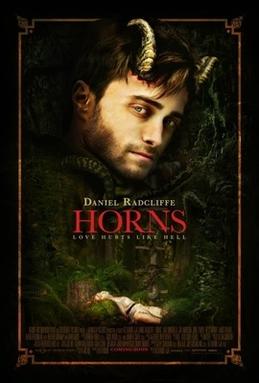
Horns: A Review

HORNS

I had no interest in watching Horns.  Apparently, this is something I share in common with the majority of Americans, who did not flock to see the film adaptation of the novel by Joe Hill (aka Stephen King's son).  A King fan at work insisted I watch it.  With that recommendation, I set out to see Horns, with also a curiosity to see how Daniel Radcliffe could sound as an American (his Harry Potter co-star Emma Watson doing OK but not completely convincing). 

Ratcliffe sounded fine.  It was the rest of Horns that was horrible: a film tonally deaf with characters I didn't care for, an almost monstrous view of humanity, and one that simply never decided what it was going to be.

Ignatius "Ig" Perrish (Radcliffe) is accused of murdering his girlfriend Merrin (Juno Temple). He protests his innocence but no one, not even his family, believe his claims of innocence. Despondent over her death and his town's reaction, he turns to drink and lives a dissolute life.  After one particular night of boozing, culminating in Ig urinating on Merrin's memorial and being beyond angry with God, he wakes up to find he has two small horns growing out of his head.

These horns are an embarrassment to him, but they also now give him strange powers.  The horns give him the power to release the darkness within others, not only by revealing other's deepest darkest secrets to him but making others act out their hidden desires, usually sexual.  Ig now sees this as a chance to clear his name.

He seems to delight in getting other people to do all sorts of wicked deeds (burning down buildings, indulging in forbidden sex), but he also remembers his time with Merrin and the bond he has with his friend/lawyer, Lee (Max Minghella).  One of the people who might know more than he says is Ig's brother Terry (Joe Anderson), who drove Merrin away on the night in question, that fateful night when she broke up with Ig. 

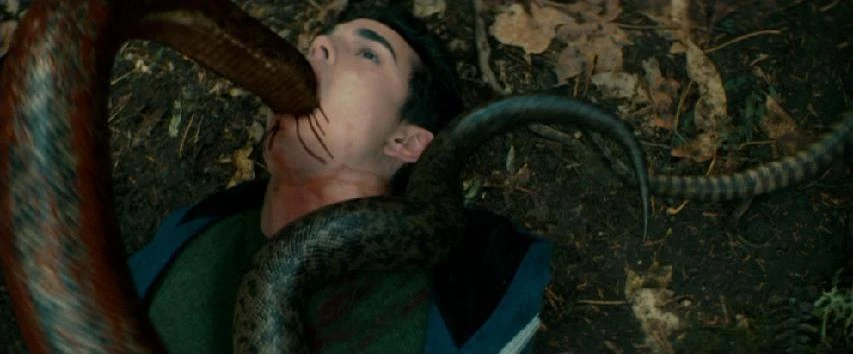
Did Terry do it?  Ig and his snakes believe he had something to do with it, and Ig has his own brother overdose on drugs.  Things take an ugly turn when Ig meets up with Lee again, who has been wearing Merrin's necklace (one that has a cross on it).  Once the necklace is removed, the truth is revealed at last: Lee killed Merrin after raping her, for he has always lusted after her and was jealous of her and Ig's relationship.  In the struggle, Lee attempts to kill Ig by having his car jump into the bay, but the only result is Ig being horribly burned.

Ig now seeks total revenge, and all hell breaks loose.  In the end, Lee is brutally killed himself, and Ig is too, but in some afterlife, he and Merrin are together again.


For me, Horns biggest flaw was that it never knew what it wanted to be. Director Alexandre Aja and screenwriter Keith Bunning never settled on whether Horns was a comedy or a horror film.  They never even committed to trying both because one element would end up undercutting the other.

You have horror when you see Ig horribly disfigured, his face burnt, even at one point holding court with snakes and a pitchfork.  You then try to shift to an odd comedy when he goes to Merrin's father, who has no reaction to seeing Ig with horns and a burnt-out face.

You have comedy at a bar fight, and then horror when the bar owner burns down the place (can't remember if there were people inside it).  You have real horror when Lee literally blows the head off Eric (Michael Adamthwaithe), a scene so ghastly, so grotesque that it isn't funny but downright revolting.

Though shortly after, seeing a snake go into Minghella and blow him up gives that a good run for its money.

Horns doesn't have anyone to root for.  As played by Radcliffe, Ig is a pretty horrible person, one you almost want to believe raped and murdered his girlfriend because his general demeanor is so unpleasant.  No one in town appears to be close to good (hence how just about everyone in town goes all bonkers whenever he shows up).  Ig is dumb (both smoking and using an inhaler) and unpleasant (urinating on the memorial of the woman he was passionately in love with).

The closest person to appear semi-kind is Merrin, and she is romanticized to an almost laughable manner with seemingly endless flashbacks to their long and lush romance.

I can't say that the mystery is all that mysterious, given that it is pretty obvious who killed her (even with a few false clues thrown in to try and implicate poor Terry). 

Horns also tries to be too clever with all the Biblical references (such as Eve's Diner, down to the apple).  It all conspires to make Horns clumsy, grotesque, and foolish in its efforts to be witty, sharp, and good.

There really is nothing in Horns that would be good: not the performances, not the story, not the effects, nothing.  Delighting in its own grotesque nature, Horns is not clever or funny enough to be witty and its efforts at comedy cut away from its efforts to be straight up horror.

It's a waste of everyone's time: those watching and those who made it. 


DECISION: F

Monday, May 29, 2017

The Great Wall: A Review

THE GREAT WALL

Mao Damon...

China, for better or worse, is now the de facto market Hollywood wants to reach.  This lucrative market is what the studios will now cater their films to, whether it is in terms of subject matter (such as removing any reference to Tibet in Doctor Strange or changing the villains from Chinese to North Koreans in the Red Dawn remake) or in terms of audience interest (it is no coincidence that such films as Pacific Rim, Independence Day: Resurgence, or Doctor Strange all featured Hong Kong or Chinese characters in major roles, sometimes down to hiring major Chinese stars known in China but unknown outside).

The Great Wall is, in my view, the most overt, blatant effort to make a film for China while pretending it is for Americans.  Leave it up Matt Damon, a man who loves lecturing others about his own wisdom, to spearhead this elaborate spectacle.  The Great Wall is pretty to look at, but logically questionable, dull, and gives us some massive Damonsplaining that would be laughable if it weren't idiotic.

Western explorers William (Damon) and Tovar (Pedro Pascal) go to the mysterious East in search of the mythical 'black powder', that secret weapon the Chinese have.  After escaping some marauding criminals, they are captured at The Great Wall itself, but Commander Lin (Tian Jing), the only female Commander and one of only two Asians who can speak English, has little time to worry about these barbarians. 

Whatever is outside The Great Wall is coming, and they have to keep them out.

We soon learn what is laying siege to The Great Wall, and what lengths they will go to keep them out.  They are the Tao Ties, monsters that spring forth every sixty years.  Fortuitously, William and Tovar arrive just as the TT are coming, and even better, William has earlier managed to slay one.  The Chinese are intrigued by William's archery skills, but suspicious of these foreign devils.


As to how Commander Lin learned English, it is thanks to Ballard (Willem Dafoe), another foreigner who has been held prisoner for 25 years.  He too came as a mercenary for the black powder, but now with these two fellow Europeans he feels he might not just escape, but escape with black powder.

For his part, William either decides to help the Chinese against the Tao Ties or be the white savior they have not been waiting for but whom they were in need of, depending on your view.  William's archery skills as well as a magnet he had with him might make it easy for the Chinese to defeat the Tao Ties, especially with him becoming an unofficial Commander. 

They do capture one, and with it perhaps a way to defeat the Tao Tie Queen (the one they need to kill to end the menace), but leave it up to higher-ups at Court to want to inadvertently undermine the European William.  It's now a desperate race to save China while Tovar and Ballard are plotting their own machinations, and only the clumsy Chinese soldier Peng Yong (Lu Han) can help to bring things together.

In the end, the Queen is defeated (taking most of the Forbidden City with her) and William and a perhaps repentant Tovar go back to Europe, with a tale to tell.


I find it fascinating that The Great Wall could have a lot going for it and botch it up again and again. One would think that a movie with monsters and a foreign setting (foreign to non-Chinese anyway) would be filled with action.  However, The Great Wall dragged itself down by trying to be so breathtaking that it only made people question points of logic. 

For example, Commander Lin was I believe in charge of the Cranes, a group of female-only elite squad that dived down elaborate ramps to spear the monsters.

From the look of it, however, it seemed such a ridiculous and wasteful use of the Cranes: these women essentially taking jabs at these monsters before being swallowed up by the Tao Ties.  It is laughable, and it isn't the last time something comes across as unintentionally hilarious.

Worse, parts that were meant to be hilarious looked dumb.  Little Peng Yong, I figure, was meant as some form of comic relief, but in The Great Wall, he just came across as dumb.  Why would he continue to wear his uniform after being sent off to wash dishes in the kitchen (and wear an apron over said uniform)?  Why would he be sent away to wash dishes (or peel potatoes, to be honest I was dropping off and the film was a bit opaque at the time to tell) just for dropping some paint?

Other points of logic come from Ballard (and poor Dafoe looked as if he had been essentially forced to make the film and wanted to be anywhere else but there).  It's fortunate that he spoke English, for imagine if Ballard had been French, or German, or Italian, and had taught Lin those languages. 

This is a perfect Segway into Damon's performance.  We know where Tovar is from (he's a Spaniard) and we figure why Lin speaks English with a Chinese accent (though she speaks it extremely well).  We however, can't figure where William exactly is supposed to be from.  Damon's accent spreads across the continent, wandering hither and yon to where it becomes an amusing guessing game which part of Europe he originated from.

I figured he was Welsh, Scottish, British, Irish and maybe some pan-Europa, with a dash of America. Damon should never have tried for an accent, showcasing his limitations as an actor (though he did have an obligatory shirtless scene to show off a buff 46-year-old body). 

Furthermore, while his performance was amusing for all the wrong reasons, his reason for being there makes one wonder whether Damon is a proponent of Kipling's 'white man's burden' worldview.  William is not so much converted to help his former captors as he is driven by a mad desire to show them how to get things done right.

Watching The Great Wall, he is an embodiment of the white savior, the figure who leads the non-Caucasians to knowledge and victory without whom they could not have achieved it.  The fact that Damon already has a reputation for holding himself intellectually superior on the subject of race and racial diversity against those who are actual minorities does not help matters.

Is it a case of Elysium Revisited?

I can't say much for the Chinese actors, who apart from Jing and Han weren't big enough storywise to care about, but I figure they appealed to the actual target audience of the film.  As for Pascual, it is interesting that the film wants us to see them as friends when the characters don't seem to at times even be on speaking terms.  Their 'witty banter' is forced and obvious, but it is hindered by the fact that Tovar and William seem thrown in together and don't appear to be real friends.

In other matters, the film was filled with pretty colors for the costumes (all solids that popped out at you), but the monsters were rather boring and the stabs at being 3-D worthy were painfully obvious in 2-D.

The Great Wall is boring, a bad thing to be regardless of what language a film is in.  Apart from some lavish costumes, there is nothing there to be of any interest.

Had Chairman Mao seen The Great Wall, he would have called for a Second Cultural Revolution and killed a few more millions of people.  Even HE would concede that The Great Wall was a Great Leap Backward.     

DECISION: D-

Friday, May 19, 2017

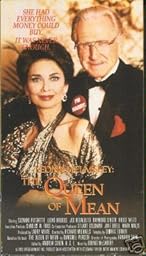
Leona Helmsley: The Queen of Mean. The Television Movie

LEONA HELMSLEY: THE QUEEN OF MEAN

In truth, "The Queen of Mean" was one of the nicer things said about the late hotel impresario Leona Helmsley.  The term most often used was that usually reserved for a female dog.  Perhaps this was why, when Helmsley died in 2007 at age 87, she willed $12 million to her dog.

Professional courtesy from one bitch to another?

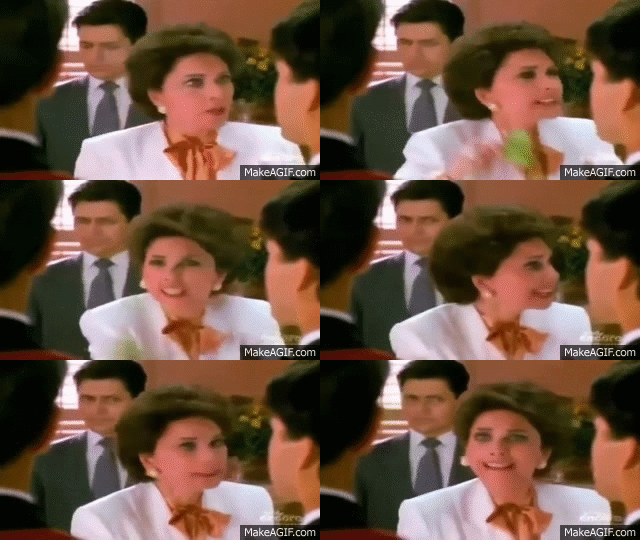
Few people were as publicly reviled in their lifetime as Leona Helmsley was.  She became infamous for her tirades at staff and for her haughty behavior, the nadir being when she allegedly said that "only the little people pay taxes".  The tales of her imperious manner, her tyrannical manner with staff, her vindictiveness send chills down the spine.

In short, Leona Helmsley was one of the most repulsive figures in America, a horrid woman who elicited no sympathy or pity, only disgust.  Leona Helmsley: The Queen of Mean, covers the story of this most notorious figure.  It does attempt to give some light into understanding how this girl from the wrong side of Brooklyn clawed her way up to the upper echelons of Manhattan society, but it also suggests just what a monster she was.  After rewatching the television film, it's surprising that in some ways, The Queen of Mean pulled some of its punches on this most infamous of 'nasty women'. 

Using the framing device of her tax evasion trial, we see the rise and fall of Leona Helmsley (Suzanne Pleshette), who stars life as Leona Rosenthal, the much-ignored daughter who fails to attract her mother's love or attention and compared to her older sisters, the beautiful Sonya and the 'unwell' (read, fat) Sandra.  She marries, has a son, Jay, but is not above beginning an affair with Joseph Lubin (Bruce Weitz).  Divorcing her first husband to marry Joe, Leona rises in income level, but falls in quality (she has no hesitation to stealing silver salt-and-pepper shakers from a classy restaurant),

Leona divorces Joe when he tells her he's moving them all to Lumberton, North Carolina, the idea of leaving the posh Manhattan no reason to follow a man she supposedly loves.  Now as Leona Roberts (attempting to hide her Jewish background as well as her age), she pushes ahead in the real estate industry, getting many Manhattan buildings to go co-op.  She also gives in to sexual harassment and starts sleeping with the boss until she meets the fabulously wealthy and powerful Harry Helmsley (Lloyd Bridges).


Despite having her own small empire and Harry being married (to a Quaker, no less), Leona makes short business of turning Helmsley into her latest conquest.  She soon cajoles the weak Harry into leaving his wife of 33 years to marry her by faking another beau. 

Despite appearances, Leona's private life is not easy: her mother, apparently having had a stroke, still won't 'look at her' and Jay following Mama's footsteps by marrying and divorcing in quick succession.  Leona's only real friend is Paul Summerton (Joe Regalbuto), as he is the only one who isn't afraid of her and is not afraid to tell her what's what.  Perhaps it is his brazen manner that appeals to Leona, as he is, apart from Harry, the only one who can talk to her in any way that shows familiarity.

Leona now becomes The Queen of the Palace Hotel, reveling in the power she has in the city and over Harry.  However, there are missteps, particularly thanks to Jay.  She gets Harry to give Jay a cushy job, one that he quickly takes advantage of by trying to undercut Harry.  Placed in charge of ordering furniture and material for the Helmsley hotel chains, Jay double and even triple bills the hotel for material already ordered, then takes the excess material and sells them to other chains, pocketing the difference.  Leona attempts to suppress the information by firing the accountant, but word gets to Harry.

Harry, who is generally weak-willed when it comes to Leona, is enraged at both of them for their actions.  Finally standing up for himself, Harry dresses them both down in a tirade.  Leona gets the message: don't mess with Harry Helmsley when it comes to business, and she lets Jay know that if he puts her relationship with Harry at risk, she'll make him pay.

Despite this, Leona's arrogance and power go unchecked.  She snaps her fingers at anyone within reach, her obsession for perfect image reaching sometimes hysterical levels.  She berates staff for leaving water on the lettuce, has her poor assistant Mark (Maurice Godin) shine her shoes in front of others, and on a whim has a deck of cards with her picture on all 52 cards ordered for the hotels, then on a similar whim insists that, despite her approving them all they have to be redone.

Leona's tyranny at some point drove even the loyal Paul away, and without his words of caution she goes completely demonic.  She fires people for the slightest cause and shows no sympathy for Jay's widow or I figure her grandchildren.  About the only sympathy she has is for Harry, who is slipping due to a series of small strokes.  She also, with or without Harry's blessing, starts billing the company for personal expenses to their home, and this is what brings about her downfall. 

Leona bills furniture and work done to her home to the company, even billing a girdle as a business expense.  Her comment about 'only the little people pay taxes' (which she disputed) doesn't help.  Her decades of riding roughshod over everyone catch up to her, and she is convicted of tax fraud (Harry having been declared not competent to stand trial).


It's curious that The Queen of Mean didn't go all-in for just how vicious Leona could be.  It does show her to have been a repulsive figure (her abusive manner towards everyone, even Harry, her demeaning of everyone who worked for her, her tirades and the abusive manner she had with all save Paul).  In other ways, however, the movie asks us to be more sympathetic to Leona, particularly when it comes to her desperate search to be loved and approved of by her mother.

It's a credit to Pleshette that we get any sympathy for Leona Helmsley.  The scene in the nursing home where Leona begs her mother to look at her when it's clear Mrs. Rosenthal is physically unable to is heartbreaking.  Pleshette, who received an Emmy nomination for her work, shows us the horrible, abusive figure Helmsley was, but she also gives us an image of a troubled woman, devastated by the death of the son she rarely talked to.

Pleshette makes Leona almost human, but she also dives into the manipulative, shrewish, shrewd seductress she was.  The script, while not going for the jugular when it comes to how monstrous Helmsley was, has moments of humor at Leona's expense.  After Harry tells his wife their marriage is over, we hear Leona gloating to her sister Sondra.  Remarking in voice-overs that she'll return the fake engagement ring to her tomorrow, Sondra tells her to keep it, as it's costume jewelry, and she comments how surprised she was that Harry couldn't tell it was a fake.

Leona laughs and says,  "Harry wouldn't know a fake if it hit him across the face".  Without missing a beat, Sondra replies, "That's obvious, Leona.  Good night".  It's clear Leona wasn't in on the double entendre.

Neither was she amused when a decorator who had shelled out money to buy antique chairs was told she wouldn't pay for what she called, "second-rate antiques".  Enraged, he coldly remarked that she was right: there was only room for one second-rate antique in the Helmsley apartment.  Paul found it hilarious, but Leona was incensed at the rare put-down.

Regalbuto was droll as the acerbic Paul, the closest thing to a friend Leona had, almost the clichéd 'truth-teller' to a bitchy woman.  Bridges made Harry into almost a simpleton, a weak man who was quickly beguiled by this temptress that managed to get him to do anything, at least until he found that Jay was trying to pull a fast one.  His own tirade showed he did indeed have a backbone, one he rarely used but which he could muster.  His decline into dementia does touch your heart.

Here's where The Queen of Mean could have done better.  Paul comes and goes with very little sense, and ultimately disappears without a word.  He tells her after the decorator ridicules her that she has always been tough, but she was also fair, at least until now.  After that, we didn't get a real blowout between them, or any sense that he, who almost cheered her own as she set about seducing a married man, had finally had some moral awakening. 

It would also have been nice to have seen the evolution of the Mark character, this much-harassed and demeaned personal assistant to a woman so frightening the staff referred to her as "Momma" and whose impending arrival terrified everyone.  He finally quits when she orders him to pick up the playing cards with her pictures on them that she had tossed in another of her fits.

As to why this particular act, while demeaning not the worse thing he'd endured, was the straw that broke the camel's back is unknown.

Leona Helmsley: The Queen of Mean was ultimately not as vicious in its portrayal of the notorious tycooness as it could have been.  It does have a particularly powerful performance by Suzanne Pleshette, giving the monster a touch of heart within her black soul.  It is entertaining and a little glimpse into someone who united people of all persuasions for her vile, cruel, arrogant manner.

She always denied saying that 'only the little people pay taxes'.  In the end, Leona Helmsley was the one that ended up paying: with a prison term and a reputation beyond saving.   


1920-2007
 
7/10 

Thursday, May 18, 2017

Psycho III: A Review

PSYCHO III

Anthony Perkins not only acts but directs Psycho III, which tries to make our most genial nutcase more wholesome (or as wholesome as he's allowed to be).   At least until Psycho III decides it was going to be a genuine slasher film.  I admit to enjoying the film, finding the homages to other Hitchcock films and some subtext almost amusing.  However, it was a bit too gory then, and too 80s now, to be up to either the original Psycho or the sequel.

Picking up a month from the events in Psycho II (even if there are three years between the films), Psycho III involves Norman Bates (Perkins) still seeing and hearing his dead mother, though as to who is his actual mother is a subject of debate. He killed Emma Spool, who in the last film claimed to be his real mother.  Her disappearance is a catalyst for some of the story.

Into his life enter three people whose stories collide.  There's Maureen Coyle (Diana Scarwid), an ex-nun whose crisis of faith led to the accidental death of a nun. Already suffering emotionally, her guilt only compounds her emotional agony.  She hitchhikes with Duane Duke or just plain Duke (Jeff Fahey), a charmer who has dreams of making it big in rock n' roll.  Finally, there's Tracy Venable (Roberta Maxwell), a crusading journalist who wants to get the story about how Norman, a formerly criminally insane figure restored to sanity and society, sees the issue of allowing people like him out.

Norman, whose sanity is thinly disguised, is alarmed by the appearance of both Venable and Maureen.  Maureen has a similarity to one of his victims, Marion Crane, down to her initials. He struggles with Maureen's appearance at the Bates Motel, and is unaware that Duke, whom he hired as a part-time Assistant Manager, attempted to have his way with her.  Maureen, distraught and confused about things, attempts suicide by slashing her wrists in the bathtub.  In her haze and confusion, she sees, not Norman dressed up as his Mother, but the Virgin Mary, confusing Mother Bates' butcher knife for a crucifix.

Norman saves her life and rushes her to the hospital, and Venable's curiosity is aroused.  She suspects that Norman is behind Mrs. Spool's disappearance, and after Duke fails to pick her up, gets him to work as a spy. Duke did manage to pick someone up, but after their one-night stand unceremoniously kicks her out.  Poor choice, as she's killed: stabbed repeatedly in the phone booth.


By now Maureen and Norman have bonded, though both struggle with desires of the flesh.  The Bates Motel is inundated with guests for a Homecoming game, and a pretty guest is murdered there too.  By now, Venable is convinced Norman is up to his old tricks again, and pushes to investigate further, especially after finding the Bates Motel number in her apartment.  As there are no bodies to be found, the Sheriff (Hugh Gillin), can do nothing. The Sheriff is actually fond of Norman, thinking he is innocent but unfairly hounded.

As Norman continues to struggle with his mind, he pushes Maureen away.  He also finds that "Mother" is missing.  Duke has discovered Norman's biggest secret and puts the squeeze on Norman for a lot of money in exchange for his silence.  Norman, as Norman, kills Duke, but not without a fierce struggle.  Maureen returns to Norman, and is accidentally killed.  Norman, finding his last chance of love gone, rages against Mother, but now has devolved into her.

Venable, for her part, has been digging into the past and makes a shocking discovery about Norman and Mrs. Spool.  She rushes to the Bates Motel and makes another shocking discovery: Maureen dead.  Patsy makes yet another shocking discovery: Norman Bates in full drag, and he/she goes after her.  Patsy, too dumb to flee, screams out the truth: Mrs. Spool was Norman's aunt, not his real mother.  She had murdered Norman's father in a jealous rage, having been in love with him but he not returning the affections.  Emma had then abducted Norman and convinced herself he was her child.  It didn't take long to find them, and Emma Spool was institutionalized while Norman was returned to Norma.

Norman, now bonkers beyond hope, starts slashing Mrs. Spool's corpse.  He is taken away, declaring that he's 'finally free'.  Or is he, for while he's driven away to the institution, he cradle's Mrs. Spool's severed hand, smiling...


Perkins had studied films enough to give shout-outs or rip off other Hitchcock films, depending on your point of view.  The opening is a direct call-out to Vertigo with its bell tower and falling corpses, and Maureen's death is almost a shot-for-shot copy of another character's death in the original Psycho.

The killing of Red, Duke's one-night stand, is similarly deliberately reminiscent of Psycho, and while the shock of Marion's murder still takes audiences off guard, here, we kind of were waiting for it.  I think that even if you hadn't seen either Psycho or Psycho II you would think she wasn't long for this world. 

He also, thanks to Charles Edward Pogue's screenplay, has some fun with symbolism and a touch of humorous in the macabre.  For example, Maureen's death involves a literal Cupid's arrow: her love literally killing her.  Norman casually kills small birds by enticing them into his birdfeeder, then cheerfully stuffs them while munching on cookies, giving it a creepy, ghoulish overtone.  Perkins' line readings also deliberately lend themselves to an off-kilter interpretation,

When he hires Duke, he tells him that Duke will take the day shift.  "I prefer the nights", Norman tells him in a way that even the somewhat dimwitted Duke would take notice of.

In a certain way, Psycho III allows itself to have some fun with its premise, the dark humor coming from certain moments (such as when the Sheriff unwittingly takes some ice cubes with blood on them and sucks on them, Norman having stuffed a victim's body into the ice chest at the motel.


However, where Psycho III does get a little off is in the graphic nature of the violence.  Like a lot of actors-turned-directors, Perkins loves calling attention to how a film looks, and Psycho III does have some well-crafted visual moments.   However, when some people are killed, the graphic nature of the violence is surprisingly gruesome almost sadistic.  This is particularly true with both the girl killed on the toilet and Maureen's death. 

It seems to be more in line with the Friday the 13th/Nightmare on Elm Street type of teen-geared slasher films than a well-crafted Hitchcock film.  At times it almost plays like parody (not that the romp between Duke and Red didn't have its moments of unintentional humor).  At least when Duke is killed, the humor was intentional (as Norman picks up the guitar to smash his head in with it, Duke's final words are what he's said twice before, "Watch the guitar"). 

Some of the performances were good, some not.  The best was Maxwell as Venable, who minus her idiotic race up to the Bates house (or never using the tire iron she had for protection), came across as a determined figure.  Fahey was surprisingly good as the lecherous Duke, who uses his looks to his advantages but who is sleazy at heart.  Scarwid was a bit over-the-top at times (particularly when she was a novice nun), but at others she can be more grounded.  It's Perkins who at times is too obviously off, with his hesitancy and manner almost signaling "I'M NUTS!"

Psycho III is also humorously dated: Norman offers Duke the job for "$5 an hour", and the rate for a single room is $25.95, two things that would be laughable today.  Again, so 80s.

Psycho III is a bit too graphic, derivative of other slasher films of the time.  Still, it is an entertaining film for those who like Norman Bates and one last, somewhat morbid somewhat macabre somewhat humorous last turn to our favorite Mama's Boy.   
    
DECISION: C+

Monday, May 15, 2017

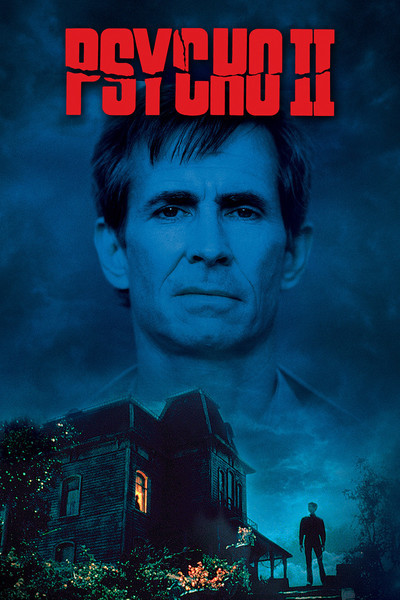
Psycho II: A Review


PSYCHO II

For better or worse, Anthony Perkins' greatest screen performance became a curse on him, condemning him to be seen as one type: the murderous lunatic.  For the longest time Perkins found work but still found himself tied to his most famous character: Norman Bates from Psycho.  It's a reconciliation between Perkins and his character in Psycho II, a sequel that isn't up to the level of the original, but which is still a pretty good film in its own right.

Twenty-two years after the events of Psycho, Norman Bates (Perkins) is found to have been restored to sanity and released.  This infuriates Lila Loomis, formerly Lila Crane, sister to his victim Marion (Vera Miles, reprising her role from Psycho).  Despite Lila's loud objections, Norman's psychiatrist, Dr. Raymond (Robert Loggia) finds that Norman is able to function in society and gets him out.  He also gets him a job as a cook's assistant at a diner, and return of his property, including the Bates Motel.

Norman is displeased by hotel manager Toomey (Dennis Franz) who has made the place a den of drugs and illicit sex.  Using his property owner's rights, he fires Toomey, which infuriates the latter.  Norman also bonds with Mary Samuels (Meg Tilly) a waitress at the diner.

Norman, however, cannot escape the past, as he keeps finding notes and phone calls from "Mother", pushing him towards insanity again.  Mary is there to try to help him past his issues, but there is something amiss.  A boy is murdered by someone who looks like Norman's late mother in their basement, and Toomey disappears as well.  There is someone inside the Bates home, peering through a peephole and Norman is locked in the attic at one point, after having seen his mother's room exactly as it was when he left.

The hijinks and murders continue, pushing Norman closer to the idea that his Mother isn't really dead.  He soon agrees with one phone call regarding his mother, and he soon starts referring to the difference between "Mrs. Bates" and his real mother.

Has Norman Bates gone mad again?

We eventually learn that Mary is not an innocent bystander to all this, but part of an intricate plot to put Norman back into the institution.   She, however, has seen that Norman is a good man now and won't be a party to the scheme anymore. There is however, a third player in the machinations, someone no one is aware of who is playing her own game, inadvertently foiling the schemes of Mary and Lila, with her own agenda.

The bodies of Toomey and the boy are found, and suspicion builds around Norman, who appears to have gone mad again, talking to 'Mother'.  Mary, who has been unmasked by now, is desperate to help, but cannot.  In the chaos, she accidentally kills Dr. Raymond and is convinced Norman is now a threat to her.  When she and Norman accidentally discover the murdered Lila in the fruit cellar, that proves to Mary that Norman is indeed a killer, but fortune smiles on Bates and is saved at the last minute.

The 'real Mother' emerges from the shadows, but true to form, Norman murders her and puts her in 'Mother's' room, and opens the Bates Motel for business.

Psycho II (back when Roman numerals were still being used for sequels) builds its story pretty logically.  A second viewing shows that Tom Holland's script didn't cheat but that almost everything works towards its conclusions, that the twists within it do work.

I say almost because at times I thought the coincidences of things worked a little too well, as if having both Lila and "Mother" simultaneously work at Norman is a bit hard to believe.  There is also the matter of the boy who got killed in the fruit cellar after failing to escape with his girlfriend during a botched make-out session,

It does seem a rather extraordinary coincidence to have them go into the fruit cellar when Norman is locked up.  Granted, since Norman getting locked in the attic and the murder weren't connected it could be a wild coincidence, but it is a bit much.


Still, with regards to the plot Psycho II is a pretty well-constructed one.

Another highlight are the performances from the cast.  At the center of it is Anthony Perkins as Norman Bates.  He does wonders whenever we see his hesitancy, his fears about his condition.  By the end though, one isn't quite sure whether he has really gone mad or is just pretending in order to play with Mary (and by extension, his old foe Lila).

When he is on one phone call to 'Mother', Mary rushes to another phone pretending to be 'Mother' and ordering him to hang up.  There is a strange smile in Norman, as if he knows what is really going on but decided to have some fun with this, a way of teasing and taunting his tormentors.

At the end, when we see "Mother", even then we wonder whether Norman has really gone crazy again or is just now either evil or just more comfortable with how he'd like things to have been.  It's a standout performance.   

Miles, returning to the role of Lila, is all anger and righteous fury, but even if you hadn't seen the original you can see why she is so determined to see Norman locked up again.  It's not an unsympathetic performance, and her own demise is shocking and a little sad.

Tilly, despite her Oscar nomination for Agnes of God, I don't think has been given enough credit for being a good dramatic actress.  Here, her Mary was again sympathetic, the island of kindness that Norman clings to, making the revelation about her surprising.  Her evolution from secret antagonist to secret ally to ultimate victim is a strong performance, and it's a shame Tilly hasn't been more recognized for her abilities.

Jerry Goldsmith's score, again not close to Bernard Herrmann's iconic music for the original, manages to hold its own.

About the only real place where I would take Psycho II to task (and the reason I knocked it down a bit) is in the more graphic nature of the film.  First, there was more open nudity in Psycho II than I think was necessary (another shower scene that showed a bit too much), but second and more important, the more graphic nature of the violence. 

The final confrontation between Mary and Norman was almost a bit comical (the stabbings looking fake), but other parts were more graphic and gruesome (particularly Lila's murder, where she's stabbed in the mouth).  That and "Mother's" end didn't work for me, the latter both because of the graphic nature of it and for the obviousness of it.

When "Mother" meets her end it was obvious she was going to get whacked, and when Lila's body is discovered that too could I think been done better (perhaps not show us where she was hidden and had it revealed at the same time the characters found her).  Not only would this have shocked the audience, but confirmed that Norman was sane at the moment (when Lila's body is found, it looks like Norman is genuinely shocked by it, the pretense over).

Psycho II is a pretty strong film on its own and a good, though not necessary, sequel to the original.  It didn't need to have been made, but fans of the original I doubt would have much to complain about.  More graphic than necessary to me, Psycho II still has some strong performances and a logical script in its favor.

It even has a door ever so slightly open to a sequel.

Saturday, May 13, 2017

Bates Motel: The Final Thoughts


BATES MOTEL:
THE FINAL THOUGHTS

As I think back for the last time on Bates Motel, I think, 'what a good show it was'.   I also think, 'how disappointed I was at the end'.

I am not a type to throw out the baby with the bathwater, so I give credit where it is due.  It was an exceptionally well-acted show by the two leads.  Vera Farmiga was as of this writing the only cast member singled out for Emmy consideration for her performance as Norma Bates, and the lack of recognition for her and the show is still pretty surprising.

Well, not completely surprising, given how the Television Academy is hung up with sword and sorcery.

Farmiga and Bates Motel shifted the whole view of Norma Bates.  From the films, Norma Bates was always a horrible person: abusive, clinging, possessive, almost inhuman towards her much put-upon son.  Bates Motel changed that, and made Norma herself a victim of domestic violence, a woman who at heart was good, but who through a series of disastrous decisions and her own ego created a situation that led to Norman Bates becoming who he did.

Farmiga made Norma very real, even rational.  She was a bit clingy (nothing excuses her continuing to on occasion share a bed with her teenage son because she wanted company), but she also didn't want or think Norman should be perpetually by her side.  She certainly lived: having affairs with various men culminating in her marriage to Sheriff Alex Romero.

Here is where Norma went wrong.  Even if Norman was in a mental institution when she married, she should not have kept this news from him.  Again and again she delayed telling Norman about his new stepfather, and her choice damned them all to the ultimate fate they all met.

The show was brilliant about how it slowly, steadily built the world to where Norman's eventual fate was all but certain.


Freddie Highmore was also equally brilliant as Norman Bates. He had the added block of having to adopt an American accent to mask his British heritage, and not once did it ever sound forced or unnatural.  Highmore could play Norman for sympathy, but he could also, as the show progressed, show Norman's cruelty, his egoism and selfishness, his haughty manner, his arrogance.  Highmore made Norman both a figure of immense sympathy and immense loathing.

This is his final chance to get some recognition for his work on Bates Motel, but again, given he never had to fight dragons, it's doubtful.

Perhaps because so much focus was on Norman/Norma, a lot of times other good actors and characters kind of went by the wayside.  That to me was the case with Olivia Cooke's Emma Decody, who I felt was badly underused.  About one of the handful of sane people on the show, her character was smart and kind, but despite pining for Norman for a few seasons, it was with his half-brother/uncle Dylan that she ended up with. 

Part of me never bought Dylemma, and I think it was because it almost felt like they had to be put together to justify her staying on the show.  I think so much more could have been done with Emma and it felt like such a waste to see her sometimes relegated to almost a non-entity.


With regards to Max Thieriot's Dylan, I really struggled with him. The motorbike, the leather jacket, it all worked to make Dylan a very James Dean-type character, and I wasn't awed by it all.  Granted, I can't remember seeing Thieriot in anything else, but I almost always thought he wasn't a very good actor.  Handsome, yes, and from appearances a great guy to hang out with, go hunting or watch a ball game with.

However, Thieriot always seemed to have the same expression on his face: a mixture of surprise and sadness, as if he couldn't show any other expression.  There were moments when I thought both Dylan and Thieriot were actually relevant/good to the overall story, but for the most part I simply didn't care that much for either.

Finally, Nestor Carbonell rarely could do bad in my eyes as the morally flexible Romero.  He was an honest man and good officer, but he also could live with White Pine Bay being the Venezuela of marijuana trafficking, with this idyllic little community an underground hotbed of drugs that makes Ciudad Juarez look like Mayberry.

It wasn't until the final season when I lost interest in him, having him turn into this avenging angel/superhuman figure able to survive getting shot many times.


The final season was for me a terrible disappointment.  We knew that eventually we were going to have to hit the events of the film Psycho, down to the famous shower scene.  In their infinite wisdom, the Bates Motel producers opted to change a lot (Marion Crane, for example, while introduced, survives, and it's her lover Sam Loomis who gets knifed in the shower).  Adding to that, they decided to cater to current politically correct trends by not having Norman dress up as Norma for fear of offending transgender people.

Again and again I argue that Norman thinking he was Norma when he killed whoever in the shower had anything to do with transgenderism.  I don't think that even transgender Bates Motel fans would think him thinking he was his mother would be reflective of their community or suggest transgender people were murderers.  It was a silly reason to change what had come before.

While I might buy the idea that they didn't want to be a straight copy of Psycho (and had changed things already with having Sam Loomis married, which he wasn't in the movie), I still think they could have still kept things closer to how they were (such as seeing poor Marion bite it, though can one really kill off Ri-Ri). 

It would have prevented having seen Dylan kill his own brother, and for me one of the two worst moments on the series finale: see Norman have a happy-like ending (a reunion with his mother in some ethereal paradise).  Yes, he was not in his right state of mind, but something about him being given a happy-type ending, with a joyful reunion with his mother in the afterlife, just didn't sit right with me.

I see nothing wrong with seeing Norman Bates die in a hail of bullets from the police, a sad figure which he always was.  I see nothing wrong with Norman Bates being institutionalized, with at least a hope of him rehabilitated.  Instead, he gets sent to a form of Heaven, and I just don't buy it.


Not that I buy Romero's almost-superhuman ability to survive getting blown away.  Earlier in the season, he'd been shot in what would have killed any other man, but somehow he managed to survive hours with no medical attention and he managed to essentially self-medicate his own serious wounds.  After being nursed to health, and even after knowing Norman had been locked up for various murders, he still went after Norman in his poor condition.  Add to that, when Romero was distracted by Norma's corpse (since it never occurred to Romero to secure Norman even after giving him a fierce beating), he gets shot two or three more times...and can still leave taunting final words to Norman.

I think he got shot in the head, and still managed to have some final words.  Maybe he wasn't shot in the head (even if that is what I would have done), but there you go.

I'm glad the show ended when it did.  Sometimes, even shows that have a certain end time overstay their welcome.  Bates Motel didn't.  It ended when the story ended, even if to me the story didn't end well.  I wasn't overwhelmed by the ending, feeling a bit let down by it. 

I'm glad I watched Bates Motel (even once winning a Super-Fan contest).  It was on the whole a well-crafted, well-written, well-acted show.  Now that it's over, I'll have mostly good memories of it, though I doubt I would rewatch the series.  If I catch an episode I might stay to see it, but I wouldn't watch the entirety of it or own any of the seasons on DVD myself.

Overall, 8/10 for Bates Motel.