Friday, July 31, 2026

Summer Under the Stars 2026: Some Thoughts


Diane Keaton died on October 11, 2025. Now, almost a year after her death, Keaton will finally be a Turner Classic Movies Summer Under the Stars player.

The logical question, at least to me, is "What took them so long?". TCM could have slotted Keaton as one of the living performers during their annual August programming. It is not as if they could not. When Goldie Hawn was featured, one of the films shown was The First Wives Club, which also starred Keaton. If one looks at the Summer Under the Stars schedule, the only premiere that Keaton will have is 1995's Father of the Bride Part II. Therefore, she could have been featured for many years prior to this year. TCM usually features a few living performers as part of the Summer Under the Stars lineup. 

They, for whatever reason, opted not to have Diane Keaton be one of those living performers. Instead, this year they opted to feature the filmography of George Hamilton as the only currently living stars. No doubt this decision was motivated by his date, August 12, being his 87th birthday. The same applies, somewhat, to Robert Redford; he would have been 90 on his day, August 18th. 

George Hamilton. A man who, if now recalled at all, is recalled for his grandiose suntan. I do remember he was mentioned in the documentary The Kingmaker. That documentary about Imelda Marcos briefly shows her palling around with Hamilton. There have also been allegations, never confirmed, that Marcos used Hamilton as a "front" to launder stolen Philippines government money. Whether he was a "dupe" or willingly participated in any schemes only he knows. 

I do not think that George Hamilton has ever been accused of being a great actor. However, he is both one of the five debuting performers as well as the only living performer featured this year on Summer Under the Stars. 

What does surprise me more than this year's slate is how parsimonious Turner Classic Movies has been with its schedule announcements. On July 21, TCM announced its full monthly slate. In past years, the full schedule had been announced and posted a full month in advance. There was publicity about who was going to be featured. There were videos about who was going to appear. It was a nice production.

Now, TCM had been parceling out the information bit by bit. We have had a drip, drip, drip method of announcing who will be featured. I have never seen it like this before. I find it very peculiar and perplexing. Knowing who was going to be featured allowed a chance to watch a particular performer's film early enough to have a coinciding review. Now, it feels like a mad rush to squeeze in a review to match that performer's day.

I understand that there are screening rights issues that might prevent certain films or performers from being shown. However, one would think that the slate would be "locked in" long before mid-July. Let us say that the network had the slate all set and ready to go. Why then, did they opt to do a metaphorical striptease when it came to announcing the performers and their films this year?

I cannot recall another year where TCM took this approach. I do know that schedules can change; in 2020, they substituted previously scheduled performers John Wayne and Bette Davis for Natalie Wood and Olivia de Havilland respectively. I understood replacing de Havilland for Davis as de Havilland had died less than a month prior. I do not know why Wayne was replaced. My guess is that, given the chaotic year of 2020, his politics were toxic. Yet, I digress.

I do not know why Turner Classic Movies this year opted to not announce their full August schedule a month in advance as they have other years. I do not understand why Turner Classic Movies has adopted this method this year. I figure that there has to be a logic to it. I welcome knowing what it is. Still, I do not see a method in their madness. 

As stated, George Hamilton is the only living performer being featured this year for Summer Under the Stars. He and Keaton are five of this year's debut performers. The others are Marie Windsor, Bonita Granville and Brock Peters. Peters and Hattie McDaniel are the African American performers. No silent or foreign language performers will be shown this year. It is quite curious. 

The choices are not terrible. Not even George Hamilton. I just find the entire process rather piecemeal, which is out of the ordinary for this network. I have sadly lost enthusiasm for Turner Classic Movies and its Summer Under the Stars 2026 presentation. It does not seem fun anymore.  

Disclosure Day: A Review (Review #2193)

DISCLOSURE DAY

The truth is out there. Something else that is out there is a better movie than Disclosure Day. A mishmash of plots, self-serious to the point of parody, filled with shockingly awful performances, Disclosure Day is a low point in Steven Spielberg's filmography. 

It is also far too long and dull for what we did not get.

Daniel Kellner (Josh O'Connor) holds a major secret in his backpack. Shadowy Wardex Corporation head Noah Scanlon (Colin Firth) will do anything to get this secret back. The secret, kept in a myriad of flash drives, is the existence of aliens who have been in contact for decades. To get those secrets back, Wardex does not shrink from taking Daniel's girlfriend, Jane Blankenship (Eve Hewson).  Daniel, however, has a few tricks and an alien device up his sleeve. He and Jane manage to escape with the backpack and find shelter in Jane's former nunnery.

Daniel does not want to be involved in as much as he is. He is adamant that Hugo Wakefield (Coleman Domingo) take the information he has from him.  Hugo, who like Daniel worked at Wardex until they went rogue, assures him that he will be relieved of his package. He asks him to be patient. Hugo is also building some kind of massive set for an important reason.

Meanwhile, aspiring Kansas City television news reporter Margaret Fairchild (Emily Blunt) is wondering whether she should move again. This suggestion does not sit well with her current boyfriend, musician Jackson (Wyatt Russell). He is also puzzled on how, after a cardinal flies into their apartment, she is able to speak Russian. He'd be more puzzled if he saw Margaret use Jedi-like powers to get out of a speeding ticket, though she is barely aware of doing that. The big meltdown comes when she is presenting the weather. Margaret starts struggling to speak, then slips into unintelligible gibberish and collapses.

Scanlon knows that gibberish is alien. Daniel understands that gibberish as easily as he understands English. Soon both Margaret/Jackson and Daniel/Jane start racing away from Wardex's goons. Scanlon, however, can communicate with Jane telepathically using his own alien technology. He can even use his powers to try to get Jane to kill Daniel. 

The chase eventually leads Daniel, Margaret and Hugo to find each other. What happened on February 23, 1996, to the younger Daniel and Margaret that makes them so special to aliens? What are those animals, if they really are animals? Now that Margaret has managed to return to her Kansas City news station, will she get the world to listen?

I have seen Disclosure Day twice. I have fallen asleep watching Disclosure Day twice. However, I have full confidence that I did not fall asleep at the same point in Disclosure Day. Therefore, I think I saw the whole film. What I cannot do is fully remember it. I put that down to finding Disclosure Day very unmemorable. 

There are many problems with Disclosure Day. Director Spielberg and screenwriter David Koepp (from a story by Spielberg) repeatedly attempt to show the world is at the brink of total annihilation. For example, a North Korean expert is at the news station with an interpreter. We are told from time to time that there is an impending nuclear war. However, that is all we are told. We are never really shown that there is an impending nuclear war. For a film that is aiming to put us in suspense, Disclosure Day is almost shockingly distant and remote. 

There is never a genuine sense of tension throughout the film apart from when Margaret and Daniel escape onto a moving train. To be fair, that moment does have some tension as to whether or not they will survive. Apart from that though, a lot of Disclosure Day is laughable. 

This is not hyperbole: the audiences that I saw Disclosure Day with were laughing at certain points. I do not think that Spielberg or Koepp wanted us to laugh when Margaret was able to spirit Daniel from Wardex's secret lair by having everyone think that she was someone else. I did ask myself if Margaret was a literal shapeshifter given how her appearance changed based on who was coming up to her. I also do not think that the aim was to have audiences laugh when Margaret calls Daniel to warn him that Scanlon's men know where he and Jane are. Maybe that was because it was amazing that she could drive so much without paying attention to the road.

Daniel too was able to look at Jane for long periods of time while driving without looking where he was going. I sat in amazement, not at the aliens or how Scanlon was communicating through his mind. I sat in amazement at how people could simultaneously drive and turn their heads to face their passengers in conversation. 

I have, with some fairness, been accused of becoming almost fixated on small details. The Waymo-like driving is one of those details. Another is on how Jane's former digs had the word "monastery" on its plaque. Granted, I am not Catholic. However, I thought a "monastery" was for men, and a "convent" was for women. I understand that some nuns do have "monasteries". However, I think it would have been easier to distinguish between "monastery" and "convent" for those of us not within Catholic theology.  Minor issue to be sure. 

Disclosure Day, for reasons I cannot fathom, touted itself as a film that would do more than shake people's faith, specifically Christianity. In some circles, I have been told, it would obliterate theology altogether. I think such reports are silly. I especially think that if Disclosure Day struggles distinguishing between "monastery" and "convent". To be fair, that is a minor issue and I personally prefer "nunnery", but I digress. Disclosure Day does make some curious stabs at being more theological than it ultimately is. If memory serves correct, Scanlon quotes Christ's words at the Garden (or a variation thereof). At another point, someone asks if knowing the existence of aliens would not make us question our faith. "I will not become anyone's religion", an angry Margaret at one point says.

Again, I do not know why Disclosure Day seems to think that the existence of aliens would wipe out faith, specifically the Judeo-Christian one. I also do not know why Disclosure Day would even care about such things.  


In terms of the film's technical aspects, Disclosure Day is closer to spoof than genuine film. The performances are all almost pretty bland to bad. Credit should be given where it is due. For the most part, Emily Blunt did well as Margaret Fairchild (separate from how one fights the temptation to call the character "Morgan Fairchild"). It is not a great performance. The scene of her helping Daniel escape was a source of unintended comedy. However, she did have good moments, such as when she casually slips into Russian or Korean without being aware that she is not speaking English.

She is the best performance in Disclosure Day. However, that is almost by default. Everyone else seems borderline idiotic. Josh O'Connor is so blank and dull as Daniel. He makes nebbishes look weak. Colin Firth seemed to act as if Disclosure Day were a James Bond spoof if we go by his performance. As a side note, John Williams' score made Scanlon's final appearance sound as if he was a Bond villain entering his lair. Hewson and Domingo were there. Wyatt Russell managed to look positively bored throughout the film. If he hit one note, it would have been amazing.

One of the most bizarre elements in Disclosure Day is when we see footage of President Nixon showing off the aliens to a guest. According to Daniel, he tells Jane that the person walking around with Nixon is someone who was "a big star in the fifties". Judging by how Nixon's guest looked like, I think Dick was showing the aliens off to Jackie Gleason. To be fair, the name of this big star was not mentioned. However, this figure was rather rotund. Why audiences now would know who this "big star" was Disclosure Day cannot answer. Those of us who think it is The Honeymooners' star that Nixon was showing the aliens off to are left to ask, "Why Jackie Gleason?". Moreover, why can't Daniel just say it's Jackie Gleason. It is doubtful that most people his age would know the Richard Nixon/Jackie Gleason/aliens connection. Or who Jackie Gleason is, unless they have seen Smokey and the Bandit

Disclosure Day is disjointed and is filled with pretty dull performances apart from Emily Blunt. It is really trying to be serious but seems dangerously close to veering into a downright spoof of an alien/chase film mashup. How (un)sweet it is.


Sunday, July 26, 2026

Dr. Jekyll and Mr. Hyde (1941): A Review

DR. JEKYLL AND MR. HYDE (1941)

Ten years after Fredric March won Best Actor for playing dual roles, two-time Oscar winner Spencer Tracy tried his hand at matching March's performance. The 1941 Dr. Jekyll and Mr. Hyde remake suffers from an unintended sense of comedy. The film was miscast three times over, but each actor did their best. 

Dr. Harry Jekyll (Tracy) is a good man. He believes that the base aspects of a person's character can be removed through science. Jekyll is engaged to British belle Beatrix Emery (Lana Turner), the daughter of respected Sir Charles (Donald Crisp). Sir Charles is dubious of Jekyll's medical theories. He is also displeased by how loose Beatrix comes across. By the standards of the time, Beatrix would be a Victorian tramp. She lets him kiss her in public.  

A real Victorian tramp is lusty Cockney barmaid Ivy Peterson (Ingrid Bergman). Jekyll and his friend and colleague, Dr. John Layton (Ian Hunter), rescue Ivy from a rough man. She wastes no time attempting to seduce Jekyll. While she does not get her way, Jekyll seems open to the suggestion. He still is devoted more to his experiments than to Beatrix. One fateful night, he takes his concoction. From that emerges his dark side, which takes the form of "Mr. Hyde".

Mr. Hyde wastes no time either. He quickly forces Ivy to be his mistress. Beatrix and Sir Charles have left for the Continent, so Jekyll will be fine to play with his basic instincts. Good news comes to Jekyll when he learns that the Emerys have returned. Even better news is that Sir Charles has finally agreed to let them marry sooner than originally planned. Jekyll swears off Hyde. That in turn will please Ivy, who turns to Jekyll for help. Things, however, do not go as planned.

Jekyll can no longer control his split nature. Which of his two sides will win out? Will both Ivy and Beatrix survive the ravishes of Mr. Hyde? Will Dr. Jekyll similarly be able to survive Mr. Hyde as well? 

I think that our three leads did as well as they could with the roles they played. However, all three of them look rather silly attempting to be the characters. Spencer Tracy was best when playing the everyman. He excelled at being a good man, the best friend, the sidekick. Here, I think he gave it as good a go as his skills permitted. However, I found a lot of his performance elicited more chuckles than suspense.

I think it is because of a variety of factors. There was director Victor Fleming's decision to have Spencer Tracy speak in a whisper when playing Hyde. One does not need to make the villain cartoonish or silly. However, whenever Tracy is Hyde, his whispers come across as one of two things. Either he is trying to make Hyde more menacing by whispering or trying to suppress giggles himself that one could see him as threatening. Either way, the end results are more humorous than horrifying.

Spencer Tracy was also not known for using makeup. He had surprisingly little makeup as Hyde. He mostly attempted to show off the dark side by widening his eyes. That, added to his persistent whisper, only made Mr. Hyde a figure of fun than of danger. 

A second factor was the decision, presumably by Fleming, to not have Tracy even try for a British accent. That leads to a bizarre situation of having this very American man in London high society. Presumable, Dr. Jekyll is British. If he is supposed to be British, Tracy's very American tones make no sense. If he is supposed to be American, there is never an explanation as to why this Yank is in London high society.

Spencer Tracy's performance here is a rare miss. He comes across as exaggerated to downright silly. He apparently thought that widening his eyes showed menace and murder. Instead, it looked like someone trying to elicit chuckles at spookiness. Bless him, for he is trying, so there is that. It is that in his trying, Tracy just looks comical.

Dr. Jekyll and Mr. Hyde is equally perplexing when it comes to the two female leads. If I understand things, Ingrid Bergman and Lana Turner were meant to play each other's roles. I get that both wanted to play against type. Bergman wanted to play someone sleazier and Turner the sophisticated lady. That being said, neither looked logical. 

Ingrid Bergman is a Cockney by way of Sweden. One was unaware that the East End of London extended all the way to Stockholm. Like Tracy, Bergman tried to make this tart believable. In her defense, she did act the part of the tragic Ivy well. However, like Tracy she ended up looking foolish. The issue is her Swedish accent. Ingrid Bergman almost always sounded Continental. In Dr. Jekyll and Mr. Hyde, that European tone is so at odds with this working-class barmaid. In terms of performance, Ingrid Bergman does quite well. In terms of sound, it comes across as laughable.

Lana Turner, curiously enough, is the best of the three. One could see Turner trying to be this innocent, posh British lady. Oddly, to her credit Turner did not try for an accent either. I think that would have made her look absurd. Throughout the film, you could see Lana Turner working to play this role. It might not have been convincing but one gives mad props to her for making the effort.

One element that does look creepy is in how obvious the age differences were. Spencer Tracy was 41 when he made Dr. Jekyll and Mr. Hyde. Lana Turner was twenty-one years younger. In their scenes together, Turner looks old enough to be Tracy's daughter. That is because she was old enough to be his daughter. It looks almost obscene to have someone that much younger play Tracy's love interest. Ingrid Bergman was twenty-six. Although their fifteen-year age gap wasn't as horrible as that of Tracy and Turner, it still looked a bit peculiar. 

In his smaller role, Donald Crisp does well as Sir Charles Emery. He is respectful without being haughty, supportive without being a simp. Crisp does not have much to do in Dr. Jekyll and Mr. Hyde. He does make his presence known as the man who tries to understand Jekyll.


John Lee Mahin, Percy Heath and Daniel Hoffenstein's adaptation of the Robert Louis Stevenson novel sometimes takes surreal and downright perverted turns. In one dream or fantasy sequence, Tracy's Hyde imagines his dueling broads as horses. He whips them repeatedly, turning this into some whacked-out S&M scene that is quite daring now, let alone in 1941. The sadomasochism in Dr. Jekyll and Mr. Hyde is barely concealed. Ivy, for example, is clearly being whipped for Hyde's erotic satisfaction. He also repeatedly assaults her, though the screen goes black every time that he does. 

There are good elements in Dr. Jekyll and Mr. Hyde. Franz Waxman's score and Harold Kress' editing create that moody, gothic atmosphere. They, along with Joseph Ruttenberg's cinematography, all received Academy Award nominations. Each elevate the film and makes for interesting viewing. However, the three performances are why this version of Dr. Jekyll and Mr. Hyde ultimately fails. Spencer Tracy, Ingrid Bergman and Lana Turner all tried. They are not bad performances. They just are not particularly good ones either.       

Dr. Jekyll and Mr. Hyde fails to match the original. I understand that efforts were made to hide the Fredric March version so that the public would not compare it to this remake. Fortunately, the original survived and will stand the test of time better than this remake. 

To be fair to this remake though, the original never featured women being whipped like horses.

Friday, July 24, 2026

For Whom the Bell Tolls: A Review

FOR WHOM THE BELL TOLLS

I have, as of this writing, not read an Ernest Hemingway novel. Apart from the biopic In Love and War, I think I have never really come across anything Papa related. No, I tell a lie: I have gone to a local bar named Papa's after Hemingway. I therefore have no knowledge of how close or far For Whom the Bell Tolls is to the original novel. I trust that it is close to it. I also trust that few people would want to sit through it even if they have read the novel. 

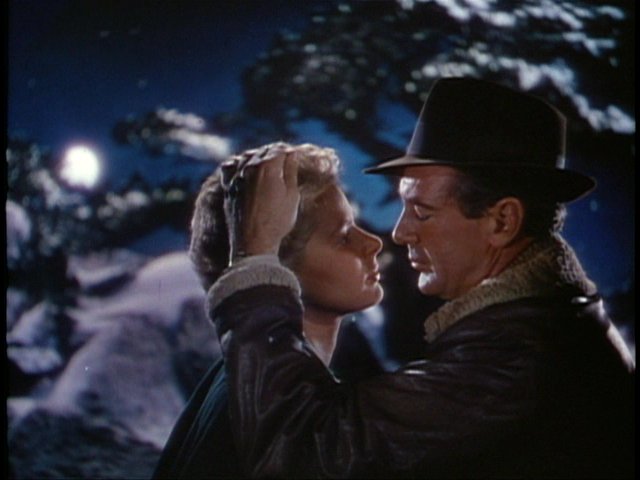
Robert Jordan (Gary Cooper) is in Spain fighting for the Republicans during the Spanish Civil War. He has just finished a successful mission to blow up a bridge, though at a high cost. Robert is forced to kill his friend rather than have him fall into enemy hands. Now, Robert is tasked with blowing up another bridge. He makes contact with the Republican partisans in the mountains. There is Anselmo (Vladimir Sokoloff), the old man of the mountains. There is fat Pablo (Akim Tamiroff), who was once a strong revolutionary but has grown disillusioned and boozy. There is Pablo's wife Perla (Katina Paxinou), a fierce and strong woman. There is fiery Agustin (Arturo de Cordoba) and wily gypsy Rafael (Mikhail Rasumny).

And then there is Maria (Ingrid Bergman). Our simple 19-year-old peasant girl is still growing out her hair. She has survived the horrors of the Francoist supporters who killed her parents. She quickly falls in love with Roberto. Perla, ever wise, knows that Ingles (English in Spanish and Perla's name for Robert) is also drawn to Maria. Robert wants to keep his growing attraction in check. Love cannot come in the way of war. 

However, the Francoists have targeted the bridge themselves. Pablo is unreliable, letting his bitterness, booze and ideas of protecting his own people overrun his thinking. It is to where Pablo has sabotaged the dynamite needed to blow up the bridge. Roberto can still do it, but it puts all their lives at risk. Who will live and who will hear the bells toll for thee?

For Whom the Bell Tolls was highly successful both financially and critically on its release. The film was the second-highest grossing film of 1943. It received nine Academy Award nominations including Best Picture. At the 16th Academy Awards, For Whom the Bell Tolls received acting nominations in all four categories for Cooper, Bergman, Tamiroff and Paxinou. Out of all those nominations though, the film came away with only one win. 

I like to think that this is a rare time when the Academy overall made the right choice in rejecting all but one of For Whom the Bell Tolls' nominations. The film is a punishing two hours and forty-five minutes long. I cannot imagine that the Hemingway novel is that massive. To be fair, some of its length is due to both an overture and intermission. I do not object to Victor Young's Castilian-tinged score, one of the film's nominations. In fact, Young's music actually does a lot of heavy lifting in the film. 

Of particular note is during a battle scene between the guerillas and the Francoist military. The music sells the action, for without it, the scene would be rather dull. 

One does wonder how some of the casting could have been thought of as worthy of recognition. Out of the four acting nominations only Katina Paxinou came away a winner for her turn as the fiery and intelligent Perla. The film does come alive whenever she is on screen. Paxinou makes Perla this fierce yet wise woman. She dismisses her looks as being "old" and "ugly", yet she is also courageous and unafraid of any man. Paxinou becomes the leader of this group of guerillas due to her mix of courage and intelligence. When some of the Republicans want to rescue another group of guerillas she scolds them for their foolishness. "What good is courage if you have no head?", she angrily states. You can see that abandoning the group to their fate tears at her. However, she also sees that her group would die needlessly. Katina Paxinou gives the standout performance in For Whom the Bell Tolls. It is easy to see why hers was the only Academy Award win.

Gary Cooper was fine as Roberto. He was solid and stoic and firm in the role. However, his love scenes with Ingrid Bergman were a bit flat. It looked odd separate from the eleven-year age gap between Cooper and Bergman. The term that I would apply is "overwrought". It is as if they wanted to push For Whom the Bell Tolls to be this big epic romance when it somehow ended up being a drag. 

I think the struggle to make this a convincing or even plausible love story is due in large part to Ingrid Bergman. She is one of the greatest actresses to ever work in film. She, however, was wildly miscast here. She is a twenty-eight-year-old Nordic woman trying to play a nineteen-year-old Iberian peasant. It is almost laughable to think that Ingrid Bergman could pass herself off as a simple Spanish teen peasant. Bergman clearly thought that For Whom the Bell Tolls was the prestige production of her 1943 filmography. She cut her hair for the part, preventing any retakes for the film that she made immediately before For Whom the Bell Tolls.

That other film that Bergman thought was inferior to For Whom the Bell Tolls was Casablanca


I can see why she thought For Whom the Bell Tolls would be an acting stretch. It was enough of a stretch for her to be nominated for Best Actress for this instead of for Casablanca. However, no amount of makeup could make up for her almost exaggerated protestations of love for Roberto. I hate saying that Ingrid Bergman gave a bad performance. Therefore, I blame director Sam Wood (who was not nominated for his work on the film). I can say that because Akim Tamiroff, the final acting nominee, did sometimes play Pablo as if it were a comedy.

Another poor decision from both Wood and screenwriter Dudley Nichols (also not nominated). I do not understand why they had a flashback to Pablo's early days in the civil war. We both saw what had happened and had Perla tells us what happened. Sometimes the characters would mouth the words to Perla's voice. It looked odd and did not work.

I can give some credit to some of the acting. As well as the aforementioned Paxinou, Arturo de Cordoba did well as the fiercely loyal partisan Agustin. It also helped that he was the only actual Latin actor in the film. Yes, there is Pedro de Cordoba (no relation) as the villainous Colonel Miranda. However, that is a stretch. 

I think that For Whom the Bell Tolls was far too long for its own good. I think if the film had not been so convinced of its sweeping epic nature, it would have been good. I fear that Ernest Hemingway is a hard writer to adapt to film. 

DECISION: D+

Wednesday, July 22, 2026

Dr. Jekyll and Mr. Hyde (1931): A Review (Review #2190)

DR. JEKYLL AND MR. HYDE (1931)

The duality of man gets the creepy treatment in Dr. Jekyll and Mr. Hyde. An Oscar-winning performance and impressive visual effects elevate this early adaptation of the Robert Louis Stevenson horror classic. 

Renegade British Dr. Henry Jekyll (Fredric March) is convinced that man is capable of separating the noble aspects of himself from the depraved nature fighting within each person. His colleagues are at most cooly receptive to downright contemptuous of such ideas. Dr. Jekyll will not be denied his scientific breakthrough.

What he is being denied, repeatedly, is early marriage to Muriel Carew (Rose Hobart). Her father, Brigadier General Carew (Halliwell Hobbes) is adamant that they marry on the anniversary of his own nuptials seven months away. Jekyll is desperate to get married. He is not so desperate for Ivy Pearson (Miriam Hopkins), a tart who fancies him after he rescued her from an abusive man. She tempts him openly, but he resists.

Now convinced that his experiments have yielded success, Jekyll drinks his concoction. To his horror, they transform him into a hideous, ape-like figure who cannot control his animal side. He tells his butler Poole (Edgar Norton) that this mysterious figure is a friend named Hyde. Hyde, however, cannot hide his darker impulses. Frustrated that the Carews are in Bath (Muriel's father presumably keeping her as far from Jekyll as possible) Hyde pursues the luscious tart, Ivy. He forces her to become his mistress until Jekyll discovers that the Carews are returning early.

Jekyll attempts to break off his liaison with Ivy, who is unaware of Hyde's other identity. He also swears off drinking his concoction. However, the poison has taken over Jekyll, who has no control over when Hyde will come out. The lives of everyone involved are in danger with the mad doctor and his alter ego running rampant through London. Who will live and who will die by the time that both Jekyll and Hyde end their reigns of terror? 

Fredric March won Best Actor for his performance in Dr. Jekyll and Mr. Hyde. He was declared a co-winner with Wallace Beery for The Champ despite March receiving one more vote than Beery. According to Academy rules at the time, if two nominees came within three votes of each other, a tie was declared. Out of the two of those, I lean towards Beery. In the early parts of Dr. Jekyll and Mr. Hyde, I found Fredric March a bit theatrical. There is also the matter of accents. 

Fredric March does not have a British accent. He sounds like an American. As such, March sticks out with everyone else who spoke with British accents. Some of the actors were British. Others were not, such as Miriam Hopkins. She adopted a convincing Cockney accent. Therefore, hearing March sound nowhere near British made his own foreignness stick out. 

None of that says that Fredric March gave a bad performance. He had a difficult task in that he had to portray two characters and portray them convincingly. Fredric March did an excellent job in convincing one that he was both Jekyll and Hyde. He made Jekyll into a good, if frustrated man. Hyde was a brutal beast. He could be a little more over-the-top, but that was the character. March changed voices, even whole inflections, between Jekyll and Hyde. Fredric March was quite effective and strong as both characters. "I'm no gentleman, but I have money", Hyde sneers to Ivy. That is quite true even now on how some men manage to get beautiful women. 

Despite being a Pre-Code film, I think Jekyll wanted marriage to get some, yet I digress.

Miriam Hopkins was equally strong as the sleazy but doomed Ivy. Unlike March, she had an accent that sounded effective and convincing. Hopkins was quite daring in her come hither manner. Even for a Pre-Code film, one is taken a bit aback by how brazen Ivy was. Yet, when she ends up being the terrified and abused mistress, one feels for Ivy. 

Everyone else is acceptable. That is not to say that they were good. I found the rest of the cast a bit theatrical in their manner. However, it was not a major issue.

Dr. Jekyll and Mr. Hyde's director Rouben Mamoulian elevates the production with a mixture of inventive camerawork and visual effects. The film begins with a four-minute sequence from Jekyll's point of view, down to seeing Jekyll reflected in the mirror. There are other instances where Mamoulian has us see things from Jekyll's perspective. In doing this, the initial shock of seeing Hyde emerge works extremely well. The limitations of the time do give us some time-lapse images of Hyde returning to Jekyll and vice versa. However, that is near the end of the film and is no less effective. 

The film also has a very curious transition method of split screens. On one side, we see for example Hyde running through the park. On the other, before shifting the scene, we see people at Muriel's formal engagement party wondering where Jekyll could be. Just before Jekyll's first transformation, we see a clever montage of both his naysayers and Ivy's shapely leg almost taunting Jekyll to drink.

The transformation from Jekyll to Hyde is still very effective visually. We see a mix of March's acting and strong makeup work plus the overall visuals shape the change to be extremely well-handled. Even after almost a century the effects still hold up well. The film also has great subtext, such as when a boiling kettle underscores Jekyll's internal rage. 

Dr. Jekyll and Mr. Hyde does have some curiosities. Chief among them is how Jekyll is pronounced. Most people say "Jeck-ill". In the film, it is "Jee-Kyl". I found that very peculiar. 

Dr. Jekyll and Mr. Hyde still holds up very well. Fredric March's performance is hard to top even though others have tried. The film has all those spooky London fogs and gothic touches that work to give it a more menacing feel. There is no need for a split decision: Dr. Jekyll and Mr. Hyde is a strong and effective adaptation. 

Tuesday, July 14, 2026

Peter O'Toole Oscar Nomination Number One: An Analysis

PETER O'TOOLE OSCAR NOMINATION NUMBER ONE: AN ANALYSIS

There would be time enough to reward Peter O'Toole in the future. 

Perhaps that is a reason why O'Toole lost the Best Actor Oscar on his first nomination. How were people in 1962 supposed to know that the Academy of Motion Picture Arts and Science would nominate O'Toole seven more times without ever awarding him a competitive Oscar?

The 35th Academy Awards showed a lot of lust in the dust in its slate of nominees. The grand biographical epic Lawrence of Arabia led the nominations tally with ten. Hot on its heels was the relatively small-scale drama To Kill a Mockingbird, which had eight. Curiously, these two films faced off in only five categories. At the time, certain categories were split between black-and-white and color films. Therefore, Lawrence of Arabia and To Kill a Mockingbird could both be nominated for Art Direction and Cinematography (and both win the former) with no difficulty. In the five categories where they did compete against each other, the overall tally was evenly split between them. Lawrence of Arabia won in three of those five categories: Picture, Director and Score. To Kill a Mockingbird won in the other two categories: Adapted Screenplay and Actor. 

The other Best Picture nominees were also nominated in multiple categories. Mutiny on the Bounty, The Music Man and The Longest Day received seven, six and five overall nominations respectively. In a surprising turn, these other nominees did not face off against Lawrence of Arabia and/or To Kill a Mockingbird often. It is a hodgepodge of categories where only in Film Editing did four of the five Best Picture nominees compete against each other. To Kill a Mockingbird failed to be nominated for its film editing, with The Manchurian Candidate taking that fifth slot that year. Lawrence of Arabia won that category, one of its seven overall wins.

That black-and-white/color split caused part of that failure to have the Best Picture nominees square off as often. The Longest Day and To Kill a Mockingbird were the black-and-white films that faced off in Cinematography and Art Direction. The former won the first category, the latter the second. The three Best Picture nominees in color competed against each other in Color Art Direction (Lawrence of Arabia, The Music Man and Mutiny on the Bounty) and Color Cinematography (Lawrence of Arabia and Mutiny on the Bounty). Lawrence of Arabia won those. When there was no black-and-white/color split, it was Lawrence of Arabia winning Best Sound over The Music Man and in Original Score over both Mutiny on the Bounty and To Kill a Mockingbird. The Music Man, as an adaptation of a Broadway musical, was in a separate category of Musical Adaptation, which it won.

Overall, the Best Picture race was a battle between T.E. Lawrence and Atticus Finch. The Longest Day, The Music Man and Mutiny on the Bounty had little to no chance of winning here. Those five, six and seven nominations were not in Best Director. The remaining three Best Director slots were filled by Divorce Italian Style's Pietro Germi, The Miracle Worker's Arthur Penn and in something of a surprise, Frank Perry's David and Lisa. The man who later brought the tawdry Mommie Dearest to life can claim to have been nominated for Best and Worst Director. 

The five Best Picture nominees were hit films, up to a point. The Longest Day, Lawrence of Arabia and The Music Man were the top three films respectively. Mutiny on the Bounty was fifth and To Kill a Mockingbird was sixth. There is a bit of a caveat in that Mutiny on the Bounty did not recoup its budget. Therefore, despite having a big box office, the film was a flop. It was also a flop at the Oscars, losing all seven of its nominations. 

Further evidence that no other film other than Lawrence of Arabia and To Kill a Mockingbird had a major chance to win comes from the acting nominations. Out of the twenty acting nominees that year, not one came from The Longest Day, The Music Man or Mutiny on the Bounty. Only Lawrence of Arabia and To Kill a Mockingbird were nominated in the acting categories. Both received two acting nominations each. Lawrence of Arabia famously had no female roles, so it was not in Lead or Supporting Actress. Its nominations were in Lead for Peter O'Toole and Supporting for Omar Sharif. To Kill a Mockingbird had its nominations in Lead for Gregory Peck and Supporting Actress for Mary Badham. 

It would be here in Best Actor where the young Turk and the old veteran would fight it out. Now, let us look at the competition.

The nominees for Best Actor in a Leading Role of 1962 were:

Burt Lancaster for Birdman of Alcatraz

Jack Lemmon for Days of Wine and Roses

Marcello Mastroianni for Divorce Italian Style

Peter O'Toole for Lawrence of Arabia

Gregory Peck in To Kill a Mockingbird

Two of this year's Best Actor nominees were already Oscar winners. Jack Lemmon had won on his first nomination: Best Supporting Actor for Mister Roberts. All of his future nominations were in the Leading Actor category. This nomination for Days of Wine and Roses was his fourth out of an eventual eight, with a second Oscar forthcoming. Burt Lancaster had won Best Actor on his second nomination for Elmer Gantry. This nomination for Birdman of Alcatraz would be his third out of an eventual four overall, all for Lead Actor. 

Two of this year's Best Actor nominees received their first nominations; those would be both Peter O'Toole and Marcello Mastroianni. The latter made Oscar history with his nomination for Divorce Italian Style. It was the first time that an actor was nominated for a leading performance in a non-English language film. He would receive two more Leading Actor Oscar nominations for A Special Day and Dark Eyes. Mastroianni would earn a place in Oscar history as one of the few people nominated multiple times for acting Oscars in a language other than English. For his part, Peter O'Toole would receive a career total of eight Oscar nominations, all for Lead Actor, and would go on to lose all eight.

Our fifth nominee, Gregory Peck, was the sole actor with previous nominations and no wins. His nomination for To Kill a Mockingbird was his fifth nomination. He had been nominated for three years straight from 1945 to 1947, with a fourth nomination in 1949. 1948 must have been a quiet year for Peck. It had been thirteen years since that nomination for Twelve O'Clock High

Two past winners. Two first-time nominees, one in a foreign language film. A beloved veteran who had yet to win an Oscar. Looking at it now, one wonders why they even bothered to hold a ceremony given that Gregory Peck was almost certain to win separate from how good or bad his performance was. 

Peter O'Toole was not completely out of the running. Lawrence of Arabia had the most nominations: ten versus To Kill a Mockingbird's eight. It was the bigger hit. He and he alone was Peck's greatest threat. However, had O'Toole won, it would have felt a bit like an upset win. Peck had lost four times before. He was adored by filmgoers and his fellow actors. Atticus Finch seemed tailor-made for Gregory Peck. It was almost as if he were playing himself.

Gregory Peck had all the cards to win this year. As stated, he was the only returning nominee. He was totally beloved by the Academy membership and Hollywood community overall. Lawrence of Arabia was pretty much set to dominate the Academy Awards. To Kill a Mockingbird could not mount a threat for all of its other battles with Lawrence of Arabia. That film was too big, too powerful, to have another be a strong rival; no other Best Picture nominated film was not going to be a serious threat. 

Curiously enough, that dominance was reversed in Best Actor between To Kill a Mockingbird and Lawrence of Arabia. It was Peck who was essentially too strong to have anyone else overtake him. O'Toole was Peck's greatest threat. He, however, was not going to get past Peck's wild card: those previous nominations. Giving Peck the Oscar would be a way to reward Peck on a personal level while throwing To Kill a Mockingbird a bone.

The battle was always going to be between Gregory Peck and Peter O'Toole. The other three had little to no chance. Lancaster and Lemmon were already Oscar winners. That, along with how neither Birdman of Alcatraz nor Days of Wine and Roses were as big as either To Kill a Mockingbird or Lawrence of Arabia pretty much killed their chances. Mastroianni was in a foreign language film. Sophia Loren, who presented Best Actor that year, had been the first person to win an acting Oscar for a foreign language performance in Two Women. I think her win was a combination of Loren's star power and a relatively weak competition. We were not going to see a repeat for Lead Actor here. Peck and O'Toole were too strong to have Mastroianni sweep in.

Most people that year may have focused on Lead Actress to see if Bette Davis could win her third Oscar. That bit of potential history, coupled with the juicy story of the longstanding feud between Davis and her non-nominated What Ever Happened to Baby Jane? costar Joan Crawford might have distracted some. When it came to Best Actor, there was hardly any suspense. 

It was a combination of personal affection and an overdue narrative that got Gregory Peck the win. In a most curious way, Peter O'Toole's first nomination out of a future eight losses would go unrewarded because someone else was considered overdue.

Here, now, is my ranking from Best to Worst:

Peter O'Toole

Gregory Peck

Marcello Mastroianni

Burt Lancaster

Jack Lemmon

Peter O'Toole burst onto the world's stage as T.E. Lawrence. His performance was complex, befitting this most enigmatic of men. He showed Lawrence as brash, arrogant, who then became almost drunk with his own publicity only to become disillusioned, haunted and tortured. The arrogance of youth was blended with ancient wisdom in his performance. This was a man who came to Arabia utterly convinced that he knew more than the generals, because he did. He evolved into a man whose loyalty became divided both politically and internally.

At one point in the film, Lawrence has reached the Suez Canal. As someone calls out "Who are you?" to him, we see Peter O'Toole's admittedly beautiful blue eyes. This is a now-haunted man, who cannot answer that question because he simply does not know. The double meaning of the question is clear. It is both a literal question and a metaphorical one. 

Technically, Lawrence of Arabia was not Peter O'Toole's film debut. It was, however, a thunderous debut for audiences. It is a towering performance which for me has grown in stature. 

Here is where I get into the "unpopular opinion" section when it comes to Gregory Peck's win. His performance in To Kill a Mockingbird is held in such lofty terms as to be downright deified. So many lawyers will almost certainly tell you that Atticus Finch/Gregory Peck inspired them to become lawyers. Atticus Finch was voted the Greatest Screen Hero by the American Film Institute. He is nobility itself. He is the embodiment of moral courage. He is practically perfect in every way. 

Curiously, Lawrence of Arabia's T.E. Lawrence was ranked at Number 10 on the AFI Heroes and Villains List, the highest listing for a historical figure.

I think that it is a very good performance. Having revisited To Kill a Mockingbird after so many years, I think there are issues. Nowadays, Peck's Atticus Finch can be seen as a "white savior". Here is Atticus Finch, all nobility, all moral rectitude, strutting about telling the rural jurors to "do their duty" and do right by "the great levelers" of the court system. Finch's closing statement, to my mind, comes across as rather grand to pompous, especially in its delivery. This is not to say that what he was saying was wrong. It is, rather, to say that Atticus Finch was addressing the wrong audience. 

The jurors in the Tom Robinson trial were rural white men. I figure most were not well-educated, certainly not to Finch's level. Yet, here is Atticus Finch, not speaking to them but almost speaking at them, lecturing them about doing their duty. He did not seem to want to win them over into doing the near-impossible. He seemed to be scolding them for not overcoming decades of prejudice because he, Atticus Finch, said so.

To be fair, the "white savior" trope could be thrown at T.E. Lawrence. Here was this brash British officer trying to liberate the Arab peoples and unite them under one banner. I would argue that Lawrence is different than Finch because Lawrence was a real person. Moreover, it was his efforts to meddle in Arab affairs that were not shown in Lawrence of Arabia in the best light. That did not happen in To Kill a Mockingbird. Far from it. Atticus Finch is nobility itself because he is that white savior, not despite him being a white savior. Yet, I digress. 

There is also whether Gregory Peck acted or played himself. Peter O'Toole was wrong for the role of T.E. Lawrence on many levels. O'Toole was about a half foot taller than the real Lawrence. He also was a gregarious Irishman versus the more retiring British officer. Gregory Peck, conversely, was pretty much the same as Atticus Finch off and on screen. 

Again, this is not to say that I think Gregory Peck gave a bad performance. His scenes with the children were a standout for him in terms of acting. He was gentle and loving but firm in his own way. Overall, though, I still think that Atticus Finch is closer to how Gregory Peck was than when he played Josef Mengele or Douglas MacArthur.

Finally, when it comes to Peck, we cannot dismiss the "overdue" narrative. To Kill a Mockingbird was his fifth nomination. It was also his last nomination. The Academy may have felt that, now that they awarded Peck the Oscar, they had done right by him. To be fair, they were not going to nominate him for something like Old Gringo. Still, no one questions why Gregory Peck never received another acting Oscar nomination (he was awarded the Jean Hersholt Humanitarian Award four years later).

Now, as regards the other nominees, I put Marcello Mastroianni third because he, like O'Toole and Peck, gave an actual performance. His sleazy Count had something of an exaggerated manner. However, Divorce Italian Style was a farce. I think that Mastroianni played the part correctly. With the forlorn face and slightly droopy shoulders, Mastroianni made the character a deliberately ridiculous figure. We were meant to laugh at him and see him as a bit of a cartoon. He was comically sinister.

Lancaster's great flaw in Birdman of Alcatraz was that he made his character one-note. Lancaster's Robert Stroud was always righteously angry. Sometimes, I thought that Lancaster was literally posing while delivering his lines as if he were playing a statue come to life. Lancaster's square jaw and tight face always said, "I AM NOBLE". Gregory Peck at least had gentle moments with children. Burt Lancaster just had his birds.

It is curious that Jack Lemmon keeps popping up during this Peter O'Toole Retrospective. This is the first of an eventual three times that Lemmon and O'Toole would face off against each other. They would not face off against each other until 1980 on O'Toole's sixth nomination and Lemmon's seventh. They would duel again two years later on what would be Lemmon's final Oscar nomination. Both would lose those three times.

I have seen five of Jack Lemmon's eight nominations. I have yet to see the two films that won him the Oscar: Mister Roberts and Save the Tiger. It is unfortunate that each time that Lemmon and O'Toole face off, the former always lands at or near the bottom. Lemmon's nomination for Tribute was probably his worst. His nomination for Days of Wine and Roses, to my mind, is not far behind.

Having seen Days of Wine and Roses twice, I still am astonished at its lofty reputation. It is constantly sold to me as this gripping portrait of the destructive nature of alcoholism. I see it as the alcoholic version of Reefer Madness. One drop of booze, apparently, can turn a teetotaler into a sex-crazed harpy with vaguely incestuous designs. 

My puzzlement over Days of Wine and Roses' lofty reputation extends to Jack Lemmon. This nomination, his fourth, was for a supposed straight drama. His previous nominations for Mister Roberts and Some Like It Hot were for comedies. The Apartment, I would argue, qualifies as a dramedy. Days of Wine and Roses was, I figure, meant to showcase Jack Lemmon as a dramatic, serious actor. 

If so, why was I laughing watching him throughout the film? I think it has to do with how apparently Lemmon and film director Blake Edwards approached the film. Lemmon had vetoed the original teleplay's director, John Frankenheimer, from directing the film version. According to Frankenheimer, Lemmon nixed him as the film version's director because Lemmon said that Frankenheimer "couldn't direct comedy". Reflecting decades later, Frankenheimer still seemed astonished at Lemmon's reasoning. "I never saw it as a comedy", Frankenheimer said.

The end results show that apparently Jack Lemmon and Blake Edwards saw Days of Wine and Roses as a comedy. There was a lot of mugging and slapstick early on in the film. Lemmon, for example, had a bouquet of flowers but was unaware that the elevator had cut the flowers off the stems. His "striptease" while revealing a bottle of booze was deliberately silly and exaggerated. Worse is what I am constantly told is his big dramatic scene. Lemmon's character had hidden a bottle in his father-in-law's greenhouse with an elaborate system: fifth row, third table, fourth pot. Lemmon is supposed to evoke shock and tears as he becomes more desperate in his efforts to find that bottle of alcohol, smashing the greenhouse due to his inability to find it and/or accurately recall his own code.

In the original teleplay, Cliff Robertson made the scene one of desperation, even terror. In the film version, Jack Lemmon made the scene one of unintended comedy. Ranting and raving like a crazed lunatic, this is some of the wildest overacting that I have seen. I wasn't shocked. I wasn't astounded. I Whatever Robertson's flaws as an actor might have been, he was nowhere near as over-the-top as Jack Lemmon was when he did the same scene. I think Jack Lemmon's nomination for Days of Wine and Roses is terrible and should not have happened. I think The Music Man's Robert Preston, Sweet Bird of Youth's Paul Newman or The Man Who Shot Liberty Valance's John Wayne would all have been better choices.

In an ironic twist, Cliff Robertson would go on to beat Peter O'Toole for the Best Actor Oscar. 

Peter O'Toole should have won Best Actor for Lawrence of Arabia over Gregory Peck for To Kill a Mockingbird.

In conclusion, the Academy made the wrong choice in not awarding Peter O'Toole the Best Actor Oscar on his first nomination. 

Saturday, July 11, 2026

Divorce Italian Style: A Review

DIVORCE ITALIAN STYLE

Love and lust among the Mediterranean set can be murder. Divorce Italian Style is a surprisingly lighthearted black comedy of how one man managed to get what he wanted even if it meant leaving bodies all around.  

Ferdinando Cefalu (Marcello Mastroianni) may have the title of Count, but he does not have the resources of one. In his town of Agramonte, the Cefalu family has fallen on hard times. Ferdinando's father has been forced to rent half of the family home to his wealthier brother, who are slowly taking over. 

This is not so bad for Ferdinando, for he can look in on his luscious cousin Angela (Stefania Sandrelli). Unfortunately, the Count has a Countess, Rosalia (Daniela Rocca). Rosalia is generally sweet and devoted to Fernie. Fernie, however, finds her unattractive and would be happier without her. Divorce is illegal in Italy, so Ferdinando cannot get rid of his loyal wife. There is, however, a certain option that he can look into to find himself sans wife: Murder. 

He can't literally just kill her outright. He can fantasize about boiling her or seeing her drown in quicksand. Angela, whom he discovers is just as passionate about him as he for her, is sent off to a convent school. It looks like all Ferdinando can do is fantasize and endure his good wife.

Then, he like all of Italy, becomes engrossed in a criminal scandal. A woman has murdered her philandering husband in a crime of passion. The defense attorney manages to get the wronged wife a light sentence for her crime. What is sauce for the gander is sauce for the goose in Ferdinando's mind. Therefore, all he needs to do is find Rosalia a lover, catch them in the act, and shoot one or both dead.

Easier said than done. Rosalia is faithful and finding a suitable lover is hard. Then comes the perfect pigeon. Carmelo Patane (Leopoldo Trieste) was one of Rosalia's former suitors before the war. Carmelo, who had mistakenly been declared dead during the war, is now very much alive. He is now an art restorer, and it just so happens that the Cefalu mansion's murals need some work. 

This wicked plan has a few hiccups. There is Rosalia's stubborn but weakening resistance to her old flame. There's how Carmelo is himself married with three children. Getting a faithful wife to commit adultery is hard work. Things eventually start looking up for Ferdinando, culminating in a planned tryst for the painter and his girl while everyone goes to see the scandalous film La Dolce Vita. Things, however, do not go exactly as planned.

Things, however, do eventually turn Ferdinando's way. Admittedly, not as he had planned, but with the end results that Ferdinando and Angela can finally be together and be financially well-off. Ultimately, though, it looks like the new Countess may herself be looking to find Divorce Italian Style


There is a dark wit in Divorce Italian Style that makes the film if not flat-out funny at least very sharp. The Oscar-winning screenplay by Alfredo Giannetti, Ennio De Concini and director Pietro Germi know that the film is a farce. We see this through various visual and audio elements. Divorce Italian Style has Ferdinando's voiceover narration. He metaphorically welcomes us into his past (the film is mostly in flashback). We hear his frustration at having a loyal but to him, unappealing wife. We hear his yearning for that not-so-obscure object of desire. I do not know if he makes us part of his plan. However, it has the effect of making the viewer see Ferdinando as a gleefully amoral figure. 

We also see this in the various fantasies that Ferdinando has about seeing Rosalia meet her end. Seeing him dump her into boiling water and drowning her did not make me laugh out loud. It did, however, make me chuckle. This is because the various fantasies were played so broadly that they have the intended effect of looking farcical. Ferdinando may be planning to kill, but he shows himself as pretty inept.

As part of his scheme, he has secret audio recording equipment placed in the reception room where Carmelo is working. When he finally has a record of the now-lovers planning a second tryst, the tape cuts off before he can get the needed information. Seeing him rewind the tape to see if he can get more information is funny.

We also see the comedy through the performances. Marcello Mastroianni received a Best Actor nomination for his turn as the sleazy Count. Mastroinanni made Oscar history as the first man nominated for Best Actor for a foreign language performance. He was worthy of the nomination. Mastroianni plays Ferdinando as a mix of world-weary and selfish. His forlorn expression whether looking at Rosalia or Angela display how his mind and loins worked. He was wickedly funny in Divorce Italian Style. Mastroianni was not laugh-out-loud funny. Instead, he let the comedy come from a deliberately exaggerated manner. When, for example, he appears to have been a cuckold, he plays the part of the jilted and humiliated husband for the townsfolk. In that performance, however, it looks like he is overdoing the shock and shame of his position. 

In other hands, perhaps, it might come off as silly. In Marcello Mastroianni's hands, it comes off as someone more calculating. It is as if he knows that he has to play this role even though he is secretly delighted that Rosalia is out of his greased hair. In his faux sad expression and long cigarette holder, he makes Ferdinando a man unaware of how pretentious and absurd he is. 

The other performances balance the deliberately exaggerated tone Divorce Italian Style has. Daniela Rocca plays it mostly straight as the loyal and loving Rosalia. She, however, can slip into the farcical nature of Divorce Italian Style during the death fantasies. Leopoldo Trieste's Carmelo too kept within the deliberately farcical manner of the story. Director Pietro Germi kept a firm balance between showing these characters as exaggerated without anyone slipping into cartoonishly broad. They were absurd but everyone was in on the joke. 

Carlo Rustichelli's score kept to Divorce Italian Style's light, broad manner. The entire sequence of having the whole town desperate to watch the forbidden film La Dolce Vita was clever. It showed the townsfolk as quite desirous of scandal. It was also a nice in-joke since Marcello Mastroianni was the star of that look into the decadence of Rome's jet set. 

Divorce Italian Style is a wicked satire on the lengths people will go to circumvent the letter of the law by committing worse crimes. Divorce and murder may not be the funny business. Divorce Italian Style shows that they can blend for some good humor.