The play may be the thing, but All Is True dives into the man behind The Bard. As William Shakespeare comes to terms with his legacy artistic and familial, All Is True is a pleasant homage to him, albeit one that was a bit dry.
After the Globe Theater burns to the ground its owner, William Shakespeare (director Kenneth Branagh) goes home to Stratford-upon-Avon to rejoin his family. His years of absence, coupled with the early death of his only son Hamnet, has alienated him from the survivors. His wife, Anne (Judi Dench) has him sleep in the best bed rather than their formerly shared second-best one. His spinster daughter Judith (Kathryn Wilder) is bitter towards her father for favoring her dead twin. His married daughter Susanna (Lydia Wilson) is stuck with the Puritan John Hall (Hadley Fraser), whose forced piety makes her extremely unhappy.
William soon starts tending a garden, contemplating his life along the way. Visits from patrons and friends, such as the Earl of Southampton (Ian McKellen) and Ben Johnson (Gerard Horan) give him pause to think that perhaps he won't be forgotten. He also manages to stand up to Stratford bully Sir Thomas Lucy (Alex Macqueen), who has stomped upon the Shakespeares for two generations, and made amends with his family and its past. Judith finds happiness with rakish Tom Quinley (Jack Colgrave Hirst) and at last the Sweet Swan of Avon can put aside the cares and troubles of his soul before he too like chimneysweepers comes to dust.
Perhaps the biggest issue with All Is True is in how the film is staged. Good or bad, right or wrong, Branagh decided to have little cutting within scenes. As such, we get essentially a filmed play. There's a bit of unimaginative visuals in All Is True, which is surprising given how much freedom film can bring.
Take for example when Southampton pays a call to Shakespeare. We go from McKellen to Branagh to McKellen to Branagh and back and forth. It just feels so dry visually.
There are very few scenes that have any genuine passion in them. Instead, for most of All Is True there is a sense of excessive, almost stiff formality. Up to a point that can work given how tightly wound up the family dynamics are. However, even when Judith finally lets herself go with Tom it feels a bit remote, as if it was more acting than being.
The only genuine moment All Is True perks up from this somewhat somber tone is when McKellen rides up to pay a call on one he considers the son of Apollo. There's a wit and joy and veiled sarcasm as Southampton puts Sir Thomas in his place. This was a moment where Ben Elton's screenplay gave the film a spark, a life, but it was sadly a brief respite from the rather formal structure of All Is True.
This does take away a bit from some strong performances. Quibble about the illogic of casting people of the wrong age for the roles, but Dench and McKellen were delightful as Anne and Southampton. Dench kept to the formal manner the film had, but she also showed a warmth that came as she slowly reconciled with her husband. McKellen clearly stole the show in his much too brief role of Southampton, forever hedging on whether he was the handsome man of the sonnets.
Branagh, perhaps the most vocal Shakespearean champion of our age, brings the conflict of William Shakespeare the man. His Will is haunted, sad, but also made aware that he has brought real magic to people. Standing up to Sir Thomas shows now a man in full, not afraid of his legacy or his future.
All Is True is a bit too formal in its telling of the Artist as an Old Man. However, it has just enough in it to make one wonder about the man who gave us so many brave new worlds.
The 93rd Academy Awards reminded me of the Best Picture winner Nomadland: started out interesting then dragged, and dragged and dragged. Add to that one of the most disastrous closing moments and you had a muted feel to what is meant to be the highpoint of a year in film.
Much history was made last night. Let's hit some of them.
All but one of the Best Picture nominees won at least one Oscar. Only The Trial of the Chicago 7 went home empty-handed, losing all 6 of its nominations.
Best Actress winner Francis McDormand is one acting Oscar short of tying Katharine Hepburn's record four wins in this category. McDormand also won as a Best Picture producer.
Best Actor winner Anthony Hopkins at 83 becomes the oldest winner in any acting category.
Best Supporting Actress winner Youn Yuh-jung (Minari) becomes the second Asian actress to win in this category. Unlike the previous Asian actress to win here, Miyoshi Umeki for Sayonara, Yuh-jung won for a primarily Korean-language performance.
Yuh-jung's fellow nominee Glenn Close now has tied Peter O'Toole for the most acting Oscar nominations without a win at eight losses in total.
Best Original Song nominee Diane Warren has it worse. Her loss for the The Life Ahead song Io Si (Seen) is her twelfth loss with no win yet.
Nomadland's director, Chloe Zhao, is the second woman and third Asian director to win in this category (after Ang Lee and Bong Joon-ho).
Best Costume Design winner Anne Roth (Ma Rainey's Black Bottom) becomes the oldest female winner in any category at 89.
Best Hair & Makeup winners Sergio Lopez-Rivera, Mia Neil and Jamika Wilson (Ma Rainey's Black Bottom) become the first all-non-Caucasian winners in this category.
The record of the Best Film Editing winner (Sound of Metal) ending up losing to Best Picture to a fellow Film Editing nominee (Nomadland) continues for the eighth year.
There were a few genuine surprises. I don't think anyone expected Mank to win outside Production Design, so its Cinematography win over the heavily-favored Nomadland led Film Twitter to audibly gasp. Most people, I think, also didn't think Sound of Metal would take anything outside Sound, so its Film Editing win was also a surprise. Best Original Song going to Judas and the Black Messiah's Fight For You may have surprised, but this category never had a favorite or frontrunner. However, it says a lot about this year's Oscars when the biggest upsets were in Live-Action and Documentary Shorts (Two Distant Strangers and Colette respectively).
Most winners were expected, so even the highly divisive Best Documentary Feature winner My Octopus Teacher wasn't a surprise. However, it was near the end that things fell apart in spectacular fashion.
This year, the Academy Award producers Jesse Collins, Stacey Sher and Academy Award-winning director Steven Soderbergh, with the Academy's blessing, opted to restructure the award presentations. Some elements worked (not cutting off speeches), some did not (having clips for a few categories but not for the acting ones). Why exactly Best Documentary Feature had clips of the nominees but Best Actor didn't is a puzzling and curious choice.
Other elements drew tedious to the small audience who braved the entire presentation. Presenters waxing rhapsodic about each nominee's history soon lost its luster and become both rote and boring. However, it was the final three awards that made the 93rd Academy Awards a fiasco that somehow has eclipsed the La La Land/Moonlight chaos as among if not the worst final presentation in the Academy's history.
Since time immemorial the final award is Best Picture. For reasons still unclear it was decided that the final three awards would be Best Picture, Best Lead Actress and Best Lead Actor. Once Nomadland was announced as Best Picture the entire affair had an anticlimactic feel, as if we were done. I figure some viewers probably changed the channel to the more competitive and suspenseful San Diego Padres vs. Los Angeles Dodgers baseball game. Instead, it went for a "Hollywood ending" that blew up spectacularly in their faces.
It was highly expected that the late Chadwick Boseman would win for Ma Rainey's Black Bottom, a sentimental wave carrying him to victory. The Academy and the award producers could see how it would all play out: a standing ovation for someone taken much too soon, a weeping widow accepting an award her late husband had a very good chance of winning had he lived, a beautiful, iconic crowd-pleasing feel-good moment. Television viewers would have had a beautiful end credit scene.
Instead, a very unenthusiastic Joaquin Phoenix unenthusiastically, almost catatonically, read Anthony Hopkins' name for The Father before unenthusiastically accepting on his behalf and the entire show ended almost abruptly (and probably unenthusiastically).
Immediately pundits and Boseman fans began howling with rage, going so far as to attack and belittle Hopkins for committing the horrible sin of winning. Unsurprisingly racism was thrown about to explain this loss. People were angry that Hopkins had won over Boseman, and things grew to almost idiotic levels. "Why didn't Hopkins give a speech?!" the Boseman group howled. "Why didn't Hopkins show up?!" they bemoaned.
The concept that an 83-year-old man could be asleep at 4 A.M. in his Wales home versus opting to fly in to a COVID-infected area when so many people (including probably himself) thought he had little to no chance of winning somehow escaped those enraged over something said 83-year-old man had no control over.
As shocking as it may be, Anthony Hopkins had no say in whether or not he won an Oscar.
Worse, those whose emotions ranged from being "in shock" to "devastated" over Boseman's loss either never saw The Father or let their feelings for Boseman blind them to a sad fact: Best Actor was highly competitive. Anyone who saw all five nominees and was honest with him/herself knew the race was between Boseman, Hopkins and Sound of Metal's Riz Ahmed. Many were reporting that voters were checking off Hopkins because they "knew" Boseman was going to win anyway, a warning sign that Glenn Close supporters willed themselves into ignoring last year. Those who do not learn from history...
Hopkins had as good a chance of winning as either Boseman or Ahmed (Mank's Gary Oldman and Minari's Steven Yeun were highly unlikely to win). Finally, and perhaps most shockingly, Anthony Hopkins gave a brilliant, devastating performance in The Father.
It wasn't as if Chadwick Boseman lost to James Coco.
I confess that I would have voted for Hopkins over Boseman, though it would have been an extremely difficult choice. I wavered between them and Ahmed, but I ultimately decided that while Boseman was brilliant in Ma Rainey's Black Bottom, he was still "acting". His performance seemed stubbornly stagey, as if he was acting on the stage. Hopkins was "being" as this proud, stubborn but ultimately lost and pained man. Ahmed, Boseman and/or Hopkins were all worthy of a win, but that it was ultimately Hopkins was and should not be seen as a slam or rejection of Boseman.
Too many pundits wanted Boseman to win because it would be "the last chance" to honor him. I'm not big on turning a category into a de facto Lifetime Achievement Award, which is what those pulling for Boseman seem to have wanted. Yes, Chadwick Boseman gave a sensational performance in Ma Rainey's Black Bottom, but sentiment alone is not a reason for someone to win an Oscar. Would there have been the outrage we've seen if a living Boseman had won over a living Hopkins or a dead Hopkins had won over a living Boseman?
Anthony Hopkins deserved to win. He did not "steal" anything from anyone. To say otherwise, especially after Hopkins' classy and brief acceptance speech where he paid tribute to Boseman is disgusting. Toxic fandom hits new lows when people feel free to beat up on an 83-year-old for winning for a performance said fans probably haven't even seen.
In retrospect, it's more boggling that the Academy opted to have Best Actor presented last when Best Actress was the more competitive and suspenseful category. Best Actress simply had no frontrunner. It was anyone's guess who would win. One day it was Promising Young Woman's Carey Mulligan who had it in the bag. Next day Ma Rainey's Black Bottom star Viola Davis was about to make history as the second black Lead Actress winner. Day after that, The United States vs. Billie Holiday's Andra Day could also be the second black Lead Actress winner.
Instead, it was McDormand, and her accepting right after accepting Best Picture felt bizarre, almost uninteresting, anticlimactic.
It seems more and more clear that the Academy and producers thought Boseman would win and wanted to end on that note. It was a cynical use of a late beloved actor for a "big moment" versus actually focusing on those nominated. This disastrous moment will haunt the Academy for years to come.
Speaking of those no longer with us, the In Memoriam was shameful. Playing at what looked like double speed, the Academy rushed through the montage to where it was almost impossible for viewers to match the name with the face, let alone their accomplishments. In a year we lost one of the last figures of the so-called Golden Age of Cinema (Olivia de Havilland), to give her 3 seconds of remembrance is galling. The use of Stevie Wonder's As isn't to me horrifying or in bad taste. Dubious, yes, but not monstrous.
However, given the hyperdrive In Memoriam followed a bizarre comedy bit about Best Original Song nominees/winners trivia that concluded with Glenn Close shaking her money-maker to Da Butt, it seemed so tone-deaf and coarse. The Academy should really just hand over In Memoriam to Turner Classic Movies, which manages to give the honored dead both time and context.
The 93rd Academy Awards started well only to slowly speed up to a rushed, chaotic and disastrous finish. And I'm sure the Academy of Motion Picture Arts & Sciences will wonder why ratings continue to fall.
Is one condemned to repeat the mistakes of our fathers? Icon asks itself that question, and while it does not break new ground in its story, it is elevated by a strong central performance that makes it worth a watch.
Young love has repercussions for high schoolers Sam Tolentino, Jr. (Parker Padgett) and his girl Ana (Devon Hales). She becomes pregnant and now debates on whether or not to have an abortion. Should she want one, it is $850, which neither of them has. Sam decides the best way to raise the money quickly is to sell drugs for his friend's brother Curtis (Johnny Lo).
Unbeknown to Sam, he is essentially following in the footsteps of his father, Sam Tolentino, Sr., currently serving time in prison himself. Sam's mother Lisa (Julia Denton) has been firm about keeping all contact with his father off, but with the chaos of his life he begins his own search. That search leads to shocking discoveries about Sam, Sr. and about himself. Ultimately, Sam Tolentino, Jr. realizes he does not have to repeat history.
Writer/director Tony Ahedo made a film that in some ways is quite familiar. A lot of Icon seems almost predictable: the unexpected teen pregnancy, the poor method of acquiring fast money, the troubled relationship with the parents. You are not surprised by much if anything in Icon expect perhaps when Sam gets revenge on thugs who beat and robbed him.
Even the aspect of Sam, Sr. not living up to the hopes and ideas that Sam, Jr. has are almost to be expected. As a side note, I figure this is where Icon gets its name: Sam not so much deifying his father but holding out an idea of him being someone worthy of adoration.
What Icon may lack in originality it makes up with a wonderful performance by Parker Padgett, a young actor starting to make his mark. His Sam is flawed, difficult, in so many ways making ghastly decisions one after another. However, he is also regretful, pained, deeply hurt and determined to do right.
Padgett's tic of rubbing his hair fiercely whenever confronted with a major issue might have been distracting but I found it a reflection of Sam the person. Perhaps it was a bit distracting given how I noticed and mentioned it. However, Padgett gave a very real portrait of an average young man, finding himself in this situation and attempting to work it out on his own.
It does make one wonder if he had told Lisa rather than try to keep all this secret things would have worked better for everyone concerned.
Parker Padgett holds your attention throughout Icon as Sam: his thrill at young love, his fear when confronting Curtis, the total emotional collapse on a drunken night, the disappointment and rage when he finds his father is no one to look up to. He's the dominant force in Icon, and while at times a certain unreality came through on the whole this film should be a good calling card for his future career.
In her role as Ana, Hales did a good job though at times like Padgett and the rest of the cast seemed a bit held back by the script. Sometimes dialogue and performances felt as if they were dialogue and performances versus being from real people. Denton's Lisa suffered the most from this, her performance seeming forced and not quite real.
Icon also falls into some other traps a lot of teen-centric films do, like the musical montages that percolate through the film. These are minor points, for on the whole I think Icon is a surprisingly moving film that will appeal to most audiences. It isn't perfect but neither are the characters.
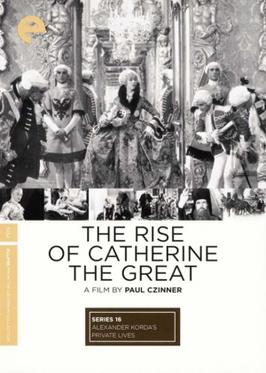
The story of Catherine II, Czarina of All the Russias, has proved itself again and again irresistible to filmmakers. We have a curious case in 1934 in that there were two Catherine the Great films. One is Josef von Sternberg's rather risque The Scarlet Empress starring his muse Marlene Dietrich. The British had a ready answer: Catherine the Great (also known as The Rise of Catherine the Great). The latter is quite sumptuous, befitting the Czarist Court, but in other ways it's a bit bizarre to slightly comical.
Young German Princess renamed Catherine (Elisabeth Bergner) arrives in St. Petersburg full of trepidation on having to marry the Grand Duke Peter (Douglas Fairbanks, Jr.), heir to the Russian throne. His aunt, the Empress Elizabeth (Flora Robson) has decreed it so, and fortunately both find themselves enchanted with each other.
Soon, however, things deteriorate, with Peter preferring the company of other women. Catherine finds herself alone, claiming lovers but not actually having any. Peter is incensed that women control his life, and once Elizabeth is dead the now-Czar Peter III can do as he wishes. Humiliating Catherine by flaunting his mistress as de facto Empress, the Czar's courtiers rally around the Empress, elevating her to the throne. Despite her firm orders, her husband is quietly murdered to ensure her reign as Catherine the Great.
The Rise of Catherine the Great is a bit of a comedy within its grand costumes and lavish sets. While nowhere near as broad or farcical as Hulu's The Great, The Rise of Catherine the Great has more humor than most Catherine biopics. On his wedding day, the Grand Duke asks a courtier if he's ever been married. "Not officially," he replies, "but I have dabbled in it". Robson, who made a name for herself as Elizabeth I on film, stomps and bellows with delight, easily rattling off quips like the best of them. "Without love, marriage is simply immoral. The whole aim and sense of it is to have a man here, under your thumb".
Robson plays Empress Elizabeth as a bit of a nut, a delightful nut but a mercurial one, nonetheless. She's a highlight of The Rise of Catherine the Great. It's the two other leads that I have issues with.
The Rise of Catherine the Great is the first Catherine-connected project that I know of where Czar Peter III comes across as not only generally sane but also dashing, if not handsome. One feels that Fairbanks, Jr. is slightly miscast as Peter, at least the Peter most often presented by history. No mice executions or Frederick the Great hero worship for our Grand Duke. Apart from a minor dislike for Russia this Grand Duke Peter is rational, even noble.
A scene with his generals has him contemplating what "Ivan Ivanovich" thinks of their war games. The generals do not know who "Ivan Ivanovich" is, until Catherine explains that he is referring to the regular soldier on the field, essentially a metaphor. For someone who was allegedly bonkers, this Peter is surprisingly insightful.
When it comes to our Empress, I was less than impressed. Oftentimes through Bergner's performance Catherine comes across as a fluttering idiot, more pawn than provocateur. She doesn't seem capable of leading herself, led alone leading a coup d'etat to seize the Russian throne. I thought she was a low-rent Dietrich, though to be fair her quiet anger when disgraced by her husband at a state dinner was well-acted.
If any enjoyment comes from The Rise of Catherine the Great, it comes courtesy of the sumptuous nature of the film itself. This film is not afraid of showcasing the opulence of the Czarist Court. There is also the funny bits of dialogue, such as when Peter tells his aunt off. When told that if he does not produce an heir, she will, he replies "Which one of your many lovers will you make an honest man?", causing the Empress in part to faint.
The Rise of Catherine the Great doesn't fully rise to the subject matter, but if one is tolerant of questionable history and a somewhat fluttery lead, you can get something out of the film.
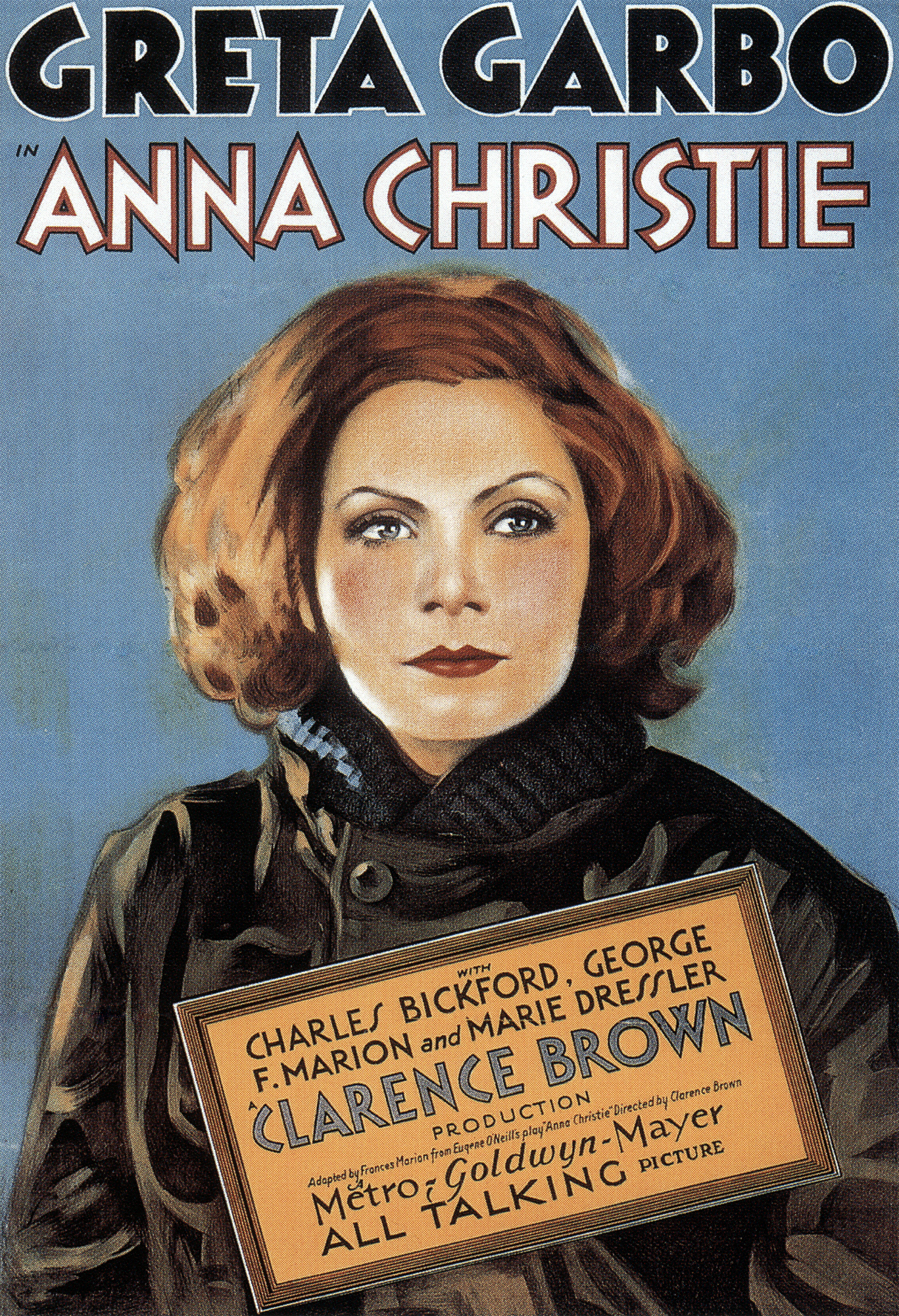
"Garbo Talks!" That was the selling point in Anna Christie, as Greta Garbo, the Swedish Sphinx, finally was heard on film for the first time. A bit daring if stage-bound, Anna Christie still holds up surprisingly well.
After a nearly fifteen-year absence, Swedish sailor Chris Christopherson (George F. Marion) is going to see his daughter Anna (Garbo). Anna thinks her estranged father has moved up slightly in the world, but instead she finds he still sails on a tugboat despite his constant condemnation of "the old Devil Sea".
Despite Chris' duplicity Anna soon takes to the seagoing ways, serving as unofficial shipmate and restoring their relationship. It isn't until they rescue Irish sailor Matt (Charles Bickford) that there is trouble. Chris is distressed that his daughter would fall in love with a sailor, fearing the worse for his virtuous daughter.
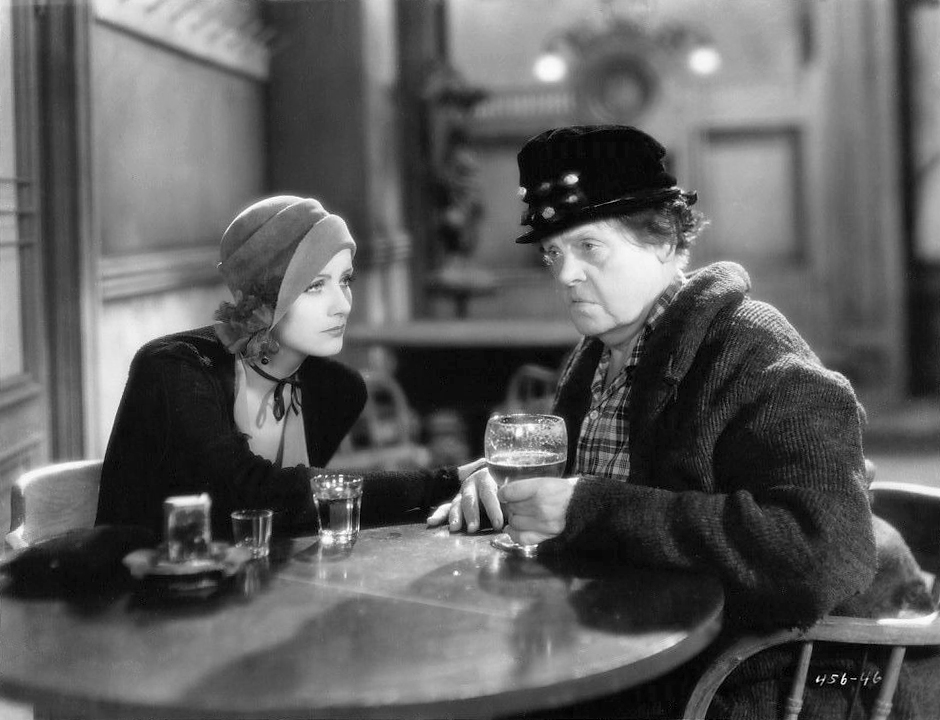
Little does Papa Christopherson know that Anna has a past. Like Chris' discarded mistress Marthy (Marie Dressler), Anna has worked in the world's oldest profession to keep body and soul together. Anna's past in a Minnesota brothel is something she keeps secret, fearing her shame will drive both men away. At last though, she tells them the truth, and after both men struggle with the news, things sort themselves out with Matt not reneging on his proposal and Chris embracing his daughter and future son-in-law.
MGM executives despaired that Garbo's Swedish accent would cost them their biggest star. They had seen other silent film stars, both foreign and American, fall due to either their accents or their voices. Here, they found the perfect material to allow Garbo to have an accent, but would audiences respond to both said accent and her voice?
The answer is a firm "yes" on both counts. Anna Christie, daughter of a Swede brought up by Swedes, should have an accent. Truth be told however, I found her English quite strong. Apart from saying "yob" for "job" I didn't find Garbo's accent that strong as to make her unintelligible. Her speaking flowed quite smoothly, and soon you find the novelty of Garbo speaking, let alone speaking English, wears off. She sounds excellent and speaks quite well.
Garbo's low, sultry voice also added to her performance. It made it plausible for her to be this alluring woman to be a former hooker despite looking no less for wear. She seems almost too elegant to have plied the same trade as the more dowdy, frumpy Dressler, but that husky voice makes her first line, "Gimme a whisky, ginger ale on the side...and don't be stingy, baby," blend allure with a sad world-weariness.
Overall, Garbo's performance in Anna Christie is excellent. She shows true love to Matt, genuine affection for Chris, and even hints of regret and fear when Matt tries to send Marthy away. Near the end it does become a bit theatrical, but given that Anna Christie still has some of the early sound film limitations of single set scenes and limited camera angles that can be forgiven.
Despite the struggles of early sound films, we see that Anna Christie did take surprising steps technologically. A sequence where Marthy and Chris walk to the bar is an extraordinary one, with both dialogue and street sounds coming through. The scene at Coney Island where Anna and Matt are on the roller coaster too show that director Clarence Brown were making efforts to break away from whatever barriers they faced. The roller coaster ride may not have the fluidity we are used to, but it was a bold step to film it without a rear-screen projection.
Anna Christie also has mostly strong performances from the cast. Had the category existed Marie Dressler would almost certainly been a Best Supporting Actress nominee for her performance. In turns comic and tragic, Dressler's Marthy elicits sympathy and laughs in equal measure for her drunk tramp. She dominates her scenes with Marion and is more than equal to Garbo when they share the screen. Her drunk moments were funny, but her farewell to Garbo on Coney Island is deeply moving.
Marion's Swedish Papa was strong and effective, also in turns funny and serious. It's a curious accident of history that he could either be "Chris Christopherson" or if we go by Anna's nom de guerre "Chris Christie" but I digress. I admit finding Bickford's Irish rogue a bit hard to believe, but that is a minor point.
Anna Christie is a bit stagey and it has title cards which show how it might have still been shown as a silent film. On the whole however, it is a good film that holds up well.
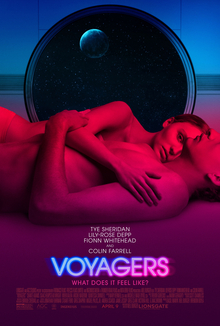
Is it a good or bad thing to say that a movie isn't terrible? That's what I can say about Voyagers. "It isn't terrible". A film that could have been better if it had taken some chances, Voyagers is passable fare but a bit frustrating in how it could have been more.
In the year 2063, if man is still alive, we find that climate change has gotten worse, so much worse that it requires a search for a new planet. Such a planet has been found, but it will take 86 years to get there. To circumvent the unfortunate aspect of traveling such a long time scientists genetically engineer humans who will be raised on the spaceship, breed in space, and then have their grandchildren colonize this new world.
I asked myself why not spend all that money they used on the spacecraft, selective breeding and raising these kids on climate change solutions instead, but whatever.
Going up with these space tykes is Richard (Colin Farrell), disillusioned with life on Earth One who will act as father-figure and mentor on the spaceship Humanitas as the children grow, with them now as teens.
I asked myself why did anyone think that sending only one adult into space with children who would be far too young or small to handle things should anything go wrong was a good idea, but again, whatever.
The teens are drugged daily with "The Blue" a drink that suppresses their base instincts to make them docile and keeps their hormones in check (presumably until they are of age to breed the children whose own children will colonize the new world).
At this point, Drax's whacked-out scheme in Moonraker is sounding more rational.
Two of our teens, friends Christopher (Tye Sheridan) and Zac (Fionn Whitehead) discover The Blue's secret and secretly opt out of drinking it. Soon, their male aggressions and desires soon start emerging, and those desires lead to Sela (Lily-Rose Depp), the Medical Officer who has a close bond with Richard.
Once Richard is out of the picture a power struggle emerges between calm, rational Christopher and power-mad Zac, splitting the small group of teens into two camps. As they have all stopped drinking The Blue, no surprise that things like sexual desire and fierce fighting start breaking out left right and center. Everyone on the Humanitas believes an alien has entered the ship, but that is in doubt, perhaps an excuse for Zac to launch a coup d'etat against the duly elected Christopher.
The aggressions and lusts in space reaches a fever pitch until order is finally restored, with eventually the original plans brought back as the descendants see the new world at long last.
Many but many people have seen the parallel between Voyagers and Lord of the Flies to where it's a surprise writer/director Neil Burger does not literally give a story credit to Sir William Golding. The kids descending into chaos once adult supervision, isolated from society, is gone. The power struggle between two alpha males. A mysterious outside force as a danger. The killing of other members to hold on to power.
Seriously, all that was missing was a conch. Voyagers might as easy been titled Space Lord of The Flies. The only major change was the addition of women, and that didn't make Voyagers any better.
The women here were more objects of lusty desires than anything else. Even Sela, ostensibly the most rational of the group, had little to do apart from getting her boobs felt up by Zac (a moment that will either startle or cause laughter to viewers) or engage in PG-13 touching with Christopher. To keep that PG-13 rating, Voyagers had to fade to black before we saw Christopher and Sela indulge in the pleasures of the flesh, and even when we return to them, we see they kept their underwear on.
One wonders how if things had kept to the original plans, any of these kids would have managed sex, let alone such things as the inevitable child rearing.
Other problems that have been pointed out by others is that in Voyagers, the minority characters are either minimized or killed off and for all the unleashed decadence none of these kids find any same-sex attraction. I don't know if having the black or Indian characters take charge or seeing Christopher and Zac taste each other's forbidden fruit would have improved Voyagers, but it would have been a nice change of pace. I don't think the killing of the minority characters or lack of homosexual characters was intentional but given the times we're in now the suspicion that it was hovers over the film.
Perhaps Voyagers' biggest problem is how serious it all is. There's a catatonic nature to everyone's acting that they look and act like zombies. Up to a point that's understandable as they are initially drugged, but that doesn't explain why Farrell's Richard can't seem to crack a smile and behaves just as zombie-like as his wards. Even after they are off The Blue, this group of hot pretty young things look so dull and emotionalless.
The exception is Whitehead, who chews into Zac's sudden and unexplained villainy with relish. I don't blame him as Zac is the only member of our runway model cast that is allowed to have anything close to emotions. I love Tye Sheridan as an actor, but Voyagers has to be among his worst performances. He was called to be a leader and heroic, but he looks so unhappy. Depp, attempting to ignite her own career following in her father's footsteps, similarly looked flat.
To Voyagers' credit the production design kept to a futuristic spaceship aesthetic of clean bright white corridors, though at times the special effects department got carried away with showing the speed it could travel down said corridors. The score too had some moments, though sometimes it blared too much and other times it was missing when the film could have benefitted from some music.
Voyagers could have been more, better, if it had taken some risks or not gone familiar routes. Again, all I can say is that Voyagers isn't terrible. It's serviceable, but among all its faults, that teens in space can be so tame when exploring carnal desires has to be the most outlandish element in Voyagers.
It's rare when a serious nonfiction book is turned into somewhat schlocky documentary, but don't count out Irwin Allen's ability to turn somber into sensationalist. While The Sea Around Us was quite innovative for its time, and did influence future nature films, it's quite dated today.
Based on Rachel Carson's book on marine life, The Sea Around Us features narration that shifts from Genesis to Darwin to start its documenting of the mysteries of the deep. "This then is the Sea Around Us: born of the rain, cradled in the deep, guided by the Moon" we are told by one of its two narrators.
As we hop and skip around the ocean depths and various beachheads, we see all sorts of creatures, from tiny plankton to massive commercial fishing ships. We're treated to a battle royale between an octopus and a shark, along with such sights as shark walkers and crab herders, baby turtles and melting glaciers. All of these mysteries and wonders, however, are in peril. "What is the fate of the world? Is this The End?" we are asked in bold letters.
In some ways, The Sea Around Us is prescient in its warnings about the state of the oceans. It's a delicate balance between the needs of Man and the abuse of the waters. As a side note though, seeing that glaciers have been melting since at least 1952 can both help or hurt the cause of global warming/climate change if both sides can say it's been going on for over half a century.
The film also has some simply beautiful moments. A sequence involving the Nudibranch species is quite beautiful and arresting. The Sea Around Us also pioneered the manner of many future nature documentaries with its mix of footage, offbeat narration and music. It can be considered a precursor to the Walt Disney True Life Adventures series of documentaries.
In other ways however, The Sea Around Us is pretty bad. This is the type of film that while innovative at the time now looks like something you'd show to a bored elementary school class. The narration, written by Allen, seems more interested in being cutesy and/or clever than informative. When discussing microscopic marine life, the narration says "All movement is motivated by a desire to eat or not to be eaten", and the bit about shark walkers (men who wake drugged sharks for marine parks in the Sea World vein) was almost silly.
Whether the octopus/shark fight is real or staged I don't know, but somehow it looks now like something out of Ed Wood. For a documentary about the "wilderness of water", there's a lot of above-water moments that seem a bit off.
Anyone who is old enough to remember when educational videos were on reel-to-reel cameras and shown in classrooms would think they'd seen The Sea Around Us even if they hadn't. It just has that literal old-school feel. A bit sensationalistic in its approach to nature to where one sees why Carson never allowed another film adaptation of her work, The Sea Around Us has good moments but not enough to keep people fully engaged.