Wednesday, February 10, 2010

Precious: A Review


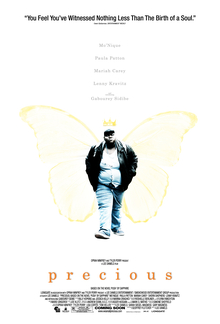
PRECIOUS: BASED ON THE NOVEL PUSH BY SAPPHIRE

As I watched Precious, one word kept returning to my mind: heartbreaking. It is heartbreaking to see people who should love each other hurt each other so viciously physically, emotionally, psychologically or a combination thereof. It is heartbreaking to see how so many people can go through life with great potential but be ruled out by society at large. It is heartbreaking to watch helplessly as efforts to help people can only go so far. It is heartbreaking to see how the lure of virtually free money can corrupt the human spirit. In spite of all the horror we see throughout Precious, we still get the sense that an individual can not only survive but thrive.

Our entry into this despairing world is Precious Jones (Gabourey Sidibe), an overweight black teenage girl living in late 1980's Harlem who narrates most of the film. She is a bright individual who loves math but has incredible obstacles. At 16, she is virtually illiterate and pregnant with her second child. 

The father of both her children is her own father. At home, her mother, Mary Johnson (Mo'nique) is beyond sadistic. She is a vicious, angry woman, more interested in her television shows and the welfare check that comes with Precious than in her own daughter. Mary has no qualms about belittling Precious and being violent towards her. Precious handles the sexual and emotional abuse by going into fantasies of glamour, of her being thought of as beautiful and exciting and most sadly, as white. The cruel realities of life, however, always bring her back.

Precious is moved to an alternative school called Reach One Teach One due to her second pregnancy. Here, she meets Miss Rain (Paula Patton), a young, pretty teacher who has the students in the small class write their lives. Precious also comes into contact with a social worker (Mariah Carey), who has to sort out the complex family situation with Precious, Mary, and Precious' children. 

It's at this school where she has a new sense of life and hope, of a world opening up to Precious. After her second child is born, she has one more encounter with Mary, which is extremely painful and difficult to watch. It seems as though every time Precious comes close to gaining a step forward, life pushes her back, with one last blow from both her parents basically dooming Precious.
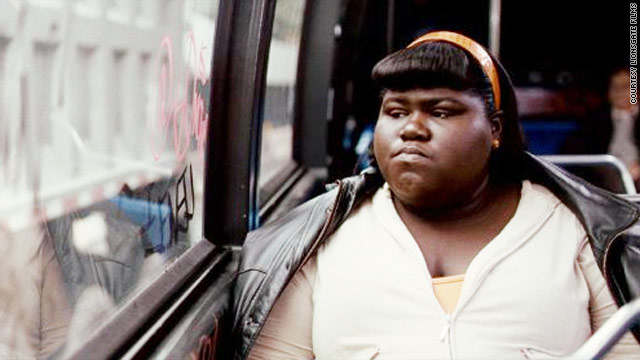

One runs the risk of frightening people away from Precious if one went by the story itself; the film, however, is much more than a series of horrors inflicted on a black girl who is so wrecked emotionally and physically that she fantasizes on occasion that she's white. The film has parallels to another film about a black woman who is raped and abused but through education and the kindness of strangers (along with a spark within her) rises to believe herself worthy of life: The Color Purple.

Also like in that film, the performances are remarkable. Gabourey Sidibe is magnificent as Precious. She plays her not like a stock victim, but ultimately as a survivor. Sidibe creates a character who still doesn't give up hope, even in her most outlandish fantasies. Paula Patton's Miss Rain is also not just "the inspirational teacher", but a woman who has her own issues and who truly cares about all her students.

I also have to give credit to those performers who have small roles but who also leave an impressive mark. There's the small role of Nurse John (Lenny Kravitz). It may surprise some to see rock star Kravitz in the film. However, his performance is solid as that of a potential love interest who is confident in himself and his masculinity in a female-dominated field. 

Mariah Carey took an enormous gamble by deglamorizing herself and going for an extremely small role of social worker Ms. Weiss. She has about three scenes in the picture, with only the final one being long. However, Carey has disproved definitively that she is just a diva trying to be a film star. In fact, she did what true actresses do: focused on the reality of the character as opposed to the vanity of the performer. By dressing down, we forget that Carey is a singing superstar and believe her to be an overwhelmed case worker who learns a horrifying tale and who is not afraid of confronting the cause of so much misery.

That leads us to Mo'Nique, a true revelation. It's easy to think of her as a raunchy comedienne, but she never hits a false note as Precious' mother. Throughout the film, she is one of the most vile women to appear on the screen, but every now and again, she lets you see the vulnerability and hurt that is within Mary, how in her own way, she let someone else's opinion of her and the conclusions she drew from that ruin so many other lives. At the end, when we hear from Mary, and see how she realizes how it all went so tragically wrong, it tears at you like few performances have. I was on the verge of tears myself, and while I cannot bring myself to excuse or justify all the terrible things she did, we experience some form of catharsis. We get something we wouldn't imagine was possible: a little bit of sympathy for Mary at the end.

Director Lee Daniels and screenwriter Geoffrey Fletcher pulled no punches in having us dive headfirst into a nightmare world where people are devalued or considered only for what the welfare check can bring in. They never stray from making this a sadly all-too-real world, no effort to make it pretty or exaggerated. It stays true to life, and we get no sense that the world of Precious is anything other than reality, a horrifying reality but real all the same. There was the occasional odd moment, in particular a subplot involving lesbians that I felt was unnecessary, but those are minor criticisms to an overall excellent film.

Precious isn't an easy film to see. We don't have a happy ending. Even though we know where her life will end up, we still leave with a sense of hope. This is due to Precious herself, someone who has endured the most horrifying and cruel of situations and is able with some good people and her own sense of worth realize that she may be seen as fat, ugly, black, uneducated, but...she's here. She has a right to exist, and have the best life possible. If in nothing else, that's what makes her and the film truly Precious.

Saturday, February 6, 2010

Leap Year: A Review (Review #45)


LEAP YEAR

Amy Adams' Ireland Vacation Videos...

During the romantic comedy Leap Year, the main character declares twice that she doesn't believe in superstitions. However, she does apparently believe in at least one superstition, otherwise you wouldn't have a movie. Judging from the film itself, she also believes that women are needy and desperate to get married to men who are clueless or callous or both about how they keep them waiting without giving any indication that they will ever get around to proposing. A misstep for its star, Leap Year does not have anything to justify its existence.

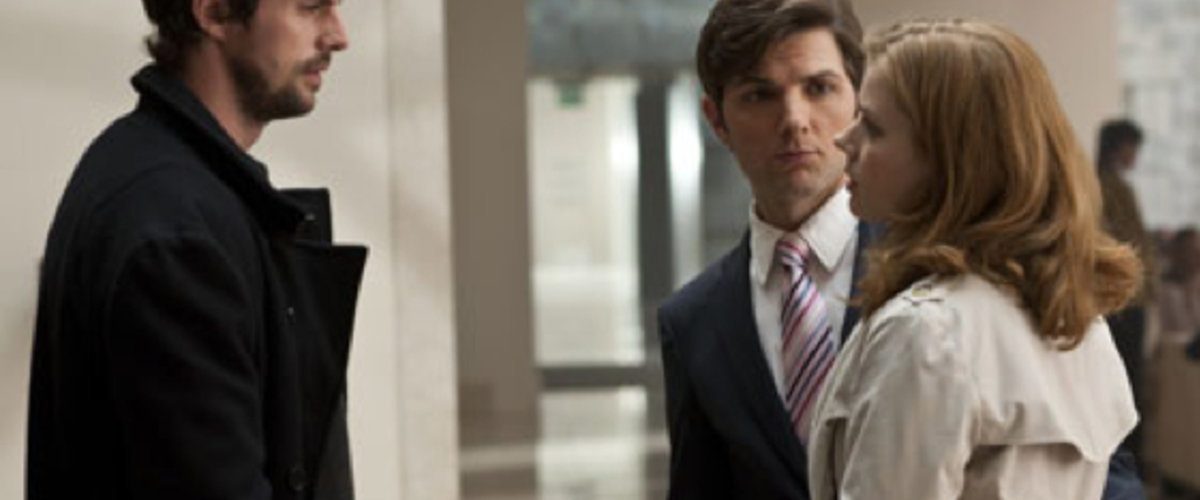
Anna Brady (Amy Adams) has been dating Jeremy (Adam Scott) for four years now, and she's just heard that he's gone into a jewelry store, coming out with a small box. Expecting an engagement ring, Anna is disappointed to find that is not the case. This hits her especially hard given that they are about to move in together. Anna finds no solution to having Jeremy pop the question.

No problem says her dad Jack (John Lithgow). The Irish have a tradition where on February 29, the woman can propose to the man in Dublin. As coincidence would have it, Jeremy is in Dublin for a medical conference. With that, she leaves her job as an apartment stager and bounces off to Eire. 

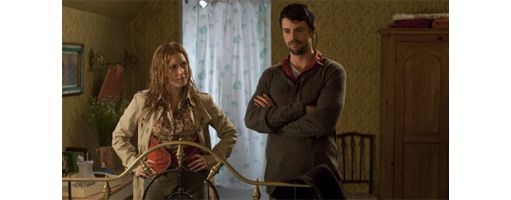
Anna for all her trouble is met by a variety of obstacles to get to Dublin in time, starting with a major storm that forces her to land in Wales and then sail to Ireland. Once she finally makes it her ancestral homeland, she meets the requisite colorful Irish characters that were holdovers from The Quiet Man as well as innkeeper/bar owner Declan (Matthew Goode).  Desperate to get to Jeremy by February 29, she hires Declan's taxi service to make a mad dash to Dublin; he agrees so that he could use the money Anna offers to save his bar/inn. More hilarity and romances ensue.

What should ensue is a walk to the exit. Leap Year is not imaginative or clever or fun. What it is really is quite puzzling and almost sad. It is one plot contrivance after another plot contrivance that appear to exist only to stretch out both the premise and the film itself. The part about Leap Day being so close, Jeremy being in Dublin on Leap Day and the requisite big storm that keeps Amy (I mean Anna, it really does not matter) from landing in Dublin itself all takes place within Leap Year's first fifteen minutes if memory serves right.

If you haven't walked out of Leap Year by now, you are either being held by force or are asleep. On this jolly jaunt through the lush Irish countryside, we have cows blocking the road, missed trains, stolen luggage, a force sharing of rooms, and character exposition at a wedding Anna and Declan have managed to crash for no real reason except to have character exposition and good Irish music, as well as a gratuitous attack on the bride. 

Throughout the whole of Leap Year, everyone looked so uncomfortable and unhappy to be there save for Lithgow, who is exactly one scene to get the plot rolling. His cameo was the most enjoyable element in Leap Year, probably because he was having a ball thinking about the check he was going to cash for this idiotic spectacle. 

Amy Adams has both talent and a sparkling, charming screen presence. Her two Oscar nominations as of this writing and such films as Enchanted and Night at the Museum: Battle of the Smithsonian demonstrate as much. Yet here, she seemed curiously detached from the film, as if she knew she was going through the motions and just enjoyed the time in a beautiful country such as Ireland. 

Goode, who is British, managed to find an Irish accent, but he also is another person who is frankly too talented to be in something this frightful. Both their characters come off badly: she appears totally dumb and he downright cruel.

Adam Scott has a face of someone I wouldn't trust, so he appears to be perfect for Jeremy, a man so sleazy and heartless in his approach to Anna one wonders why any woman, let alone our heroine, would want to be near him, let alone marry him. He is a stock character: the boyfriend who is meant as an impediment to the real romance. He does not even bother acting as if this is remotely sensible. Like Lithgow, he takes the money, enjoys his Gaelic galivant and moves on.

As stated, John Lithgow had fun, but that was because he knew he was going to be on screen for about five minutes and just to serve as plot device so he could just roll with it and not worry about how everyone else would fare out.

Here's another point of logic. In all her travails in travelling to Dublin proper, I kept thinking, "if Jeremy knows that Anna is in Ireland, why doesn't he drive down to rescue her?". He could skip a seminar or two for the woman he loves. Why doesn't he send someone to pick her up and take her to Dublin? At the very, very least, send her money and train tickets. I can suspend disbelief for something even as light and silly as Leap Year. I cannot suspend that Anna can be that stupid, let alone that Amy Adams would play a character that stupid.

Let me sum up my feelings about Leap Year this way: at a certain point, when both our leads are near a cliff, part of me was desperate to yell, "JUMP! JUMP! JUMP!"

Friday, February 5, 2010

A Single Man: A Review


A SINGLE MAN

Sometimes, in the eagerness to please critics, a novice filmmaker will go all out in the "art" department. He or she will adapt a work with a pedigree, hire excellent actors, and give us various bits of visual notes that proclaim, "This is an art film". A Single Man goes for all that, and I would offer A Single Man's writer/producer/director Tom Ford this piece of advice: sometimes, less is more.

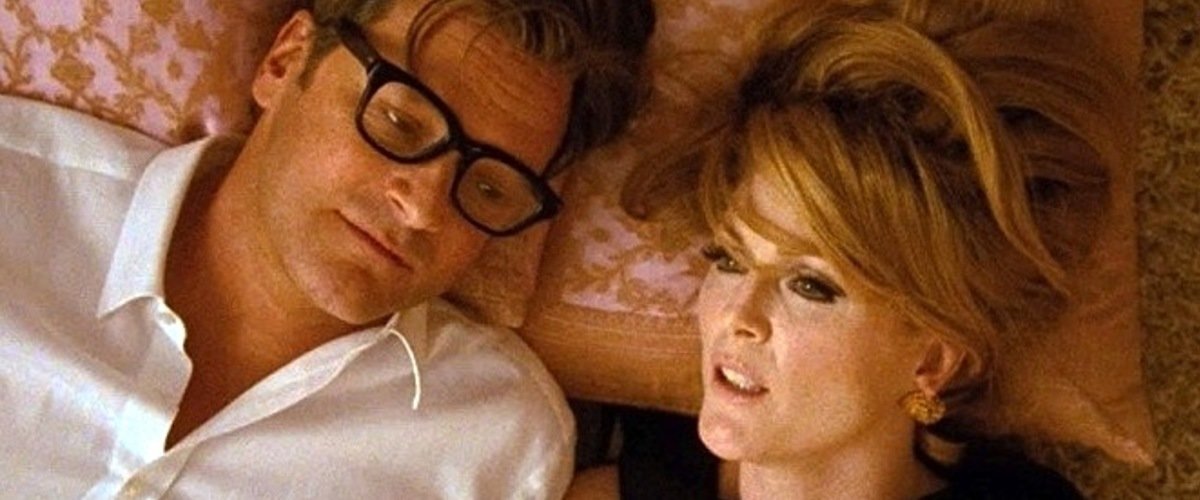
The film is on the last day in the life of George (Colin Firth) a British professor of literature currently working in California. It's his last day because he's decided to kill himself after the death of his partner Jim (Matthew Goode). To keep up appearances, he continues about his business: teaching his college course, picking up booze (and almost picking up a man) at a liquor store, having dinner with his platonic friend Charley (Julianne Moore), a woman with whom he slept with once, and getting a little too close to Kenny, (Nicholas Hoult) a student who is getting a little too close to him.

Now, while A Single Man is set in 1962 during the height of the Cuban Missile Crisis, I kept wondering if we were in the 1950s. This confusion as to the time frame is the least of the issues. I could tell this was an "art" film because there were so many flashbacks that it became almost maddening. 

So. 
Many. 
Flashbacks.

Add to that how A Single Man was for me more focused on how artistic it all could be, with this curious gauze that announced themselves as being artistic.

I get the sense that couturier Ford could not help himself in including so many scenes that played like dream or fantasy sequences to the point where one wonders whether they are taking place in reality or in fantasy. There is a flashback of when George and Jim were talking about previous experiences with women or lack thereof. The way it was filmed, black-and-white with them sunning themselves in what looked like rock formations, looked like a fantasy sequence. 

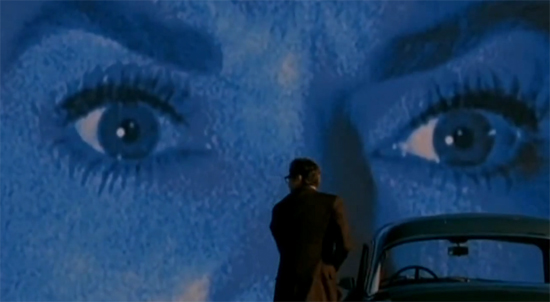
It was a bit too much, as were the constant shots of clocks (I counted three before half the day was done) or when George drives up to the liquor store with Janet Leigh staring at him, or when George marvels at the beauty of two shirtless tennis players while his colleague Grant (Lee Pace) talks with him.

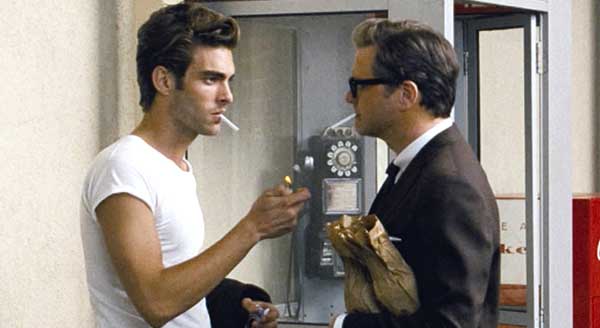
It was almost all too melodramatic. The dialogue sounded like dialogue as opposed to real people speaking. The scenes between George and male hustler Carlos (Spaniard Jon Kortajarena, who judging from his IMDB profile has done no acting except playing "himself" on Spanish television) as well as between George and Charley sound like they were being read from a script. 

I suppose Ford wanted to stay true to the Christopher Isherwood novel which A Single Man is based on, but it didn't sound natural. Let me sum up the melodramatic aspect of the film this way: I have no way of knowing this, but must every gay man listen to opera, especially while planning a suicide?

This isn't to say there aren't some wonderful things in the film. Colin Firth has shown us that he is a first-rate actor and more than just Mr. Darcy. Early on, he is told over the phone of the death of his companion and on how Jim's family would rather not have him go to the service. In a silent moment, we see the pain, hurt, torment, anger, and agony of George's loss and rejection with just Firth's face: all the conflicting emotions that are overwhelming him. It's a beautiful moment from Firth. 

As excellent as Firth's performance in A Single Man is, he has many who can keep up with him. I've been a champion of Julianne Moore, but here, she's the weak point. Her performance apart from being brief didn't ring true. I put that down to mainly what I think was meant to be a British accent, which sounded like a British accent as opposed to someone who is British speaking English. Goode only appears in flashbacks, but while he's also limited in screen time he makes the most of it. As Kenny, Hoult managed to speak as an American and his native British accent also never registered. 

As I reflect on it, overall the performances were better than what I first thought.

Take Kenny for example. Throughout A Single Man we never really know how far his interest in George goes. Even at the end, we can't be sure, even though we get some signals. "We're invisible", Kenny tells him once they get back to George's place if memory serves correct. Is that a hint?

If that's too subtle, we have those silent glances. Oh, those silent glances. We get those silent glances between two men. How artistic.

This may be why I found A Single Man a bit difficult to embrace. It's so artistic, and while not diving deep into full levels of pretentiousness, it does take a skinny dip into those waters. Abel Korzeniowski's score was too reminiscent of the score for The Fountain for me to not think of that music when I heard this music. Eduard Grau's cinematography was lovely to look at, but at times too self-conscious of the fact this is "art". Finally, I hated the ending. Yes, it may be true to the novel. However, again I thought, "art, art, art". Enough with the art.

A Single Man has wonderful performances, especially Colin Firth, but they are drowned in its own efforts to be a great film. If it had toned down its artistic aspirations, you would have had a wonderful character study of a man forbidden by society's mores to grieve. As it stands now, A Single Man finds itself drowning.

Wednesday, February 3, 2010

82th Academy Awards Predictions


Well, the nominations are out, and they took some of my suggestions. I am bitterly disappointed that (500) Days of Summer got no Oscar love, but there you go. You can't always get everything you want. Still, we have to work with what we have. 

Now, I haven't seen all 10 Best Picture nominees, so it's hard to gauge which one should win, but I've decided to give my predictions as to which one will win.

BEST PICTURE: THE HURT LOCKER

No science-fiction film has ever won Best Picture as of this writing, and I do not see Avatar being the first to do so. That fact also eliminates the brilliant District 9 from the running. The Blind Side is, frankly, too popular to win, and conversely A Serious Man is too elite to win. UP has the better chance for Animated Feature. The big momentum is toward The Hurt Locker, and unless there is a serious vote split, I expect to see the words "Iraq War" and "Win" finally connected.

BEST DIRECTOR: Kathryn Bigelow (The Hurt Locker)

Talk about Revenge of the Exes. Tarantino & Cameron already have Oscars (original screenplay and directing/editing/producing respectively), and Jason Reitman & Lee Daniels helm films that don't have the push The Hurt Locker has. We should remember the Best Director Oscar usually goes to whoever helmed the Best Picture (usually: Spielberg won for Saving Private Ryan but Shakespeare in Love won the big prize). The former Mrs. James Cameron will make history as the first female Best Director winner.

BEST ACTOR: Jeff Bridges (Crazy Heart)

Clooney and Freeman have already won Oscars. Jeremy Renner should realize that people don't normally win on their first nomination. This should apply to Colin Firth as well, but if there's an upset here, watch out for the former Mr. Darcy. Bridges not only has the critics on his side. He's also the only returning nominee not to have won plus he's a Hollywood legacy. His performance is strong, but he also has the "overdue" narrative. Right now, Bridges is too far ahead to lose.

BEST ACTRESS: Carey Mulligan (An Education) * (Winner: Sandra Bullock for The Blind Side)

This is my "no guts, no glory" selection, as Sandra Bullock realistically is the clear frontrunner. Who would have thought driving that bus would have such benefits? While Sandra Bullock has the strongest pull going in her direction (and I won't be surprised if she wins), she has some potential strikes against her. She's a popular star as opposed to an "artistic" actress. The Proposal and especially All About Steve could put a Norbit Effect to her chances if enough people hold those films against her. As for the other nominees? Streep and Mirren are already past winners. Gabourey Sidibe is both too young and too unknown to be a real contender. If enough critics charm the more traditional Academy members, Mulligan could be this year's Marion Cotillard (who unexpected won for La Vie en Rose).

BEST SUPPORTING ACTOR: Christoph Waltz (Inglorious Basterds)

Damon's Afrikaner with a conscience won't pull off an upset. Invictus wasn't a hit and he has an Oscar, albeit for writing. In recent years the Academy has abandoned the Supporting Acting categories serving as quasi-Lifetime Achievement Oscars, so out goes Christopher Plummer. Stanley Tucci has two strikes: he plays a horrible character in a horrible film. Whatever the merits of The Lovely Bones, and I found none, it's going to be a tough sell to give an Oscar to someone playing a child murderer. As for Harrelson, few people have seen The Messenger. Expect the envelope opening to be followed by a Waltz onstage.

BEST SUPPORTING ACTRESS: Mo'nique (Precious)

We might as well get used to saying it: Academy Award winner Mo'nique. Penelope Cruz won last year. How she got a nomination for Nine can be explained by voters thinking with their heads rather than their brains. In a repeat from last year's Amy Adams/Viola Davis Doubt battle, Up in the Air's Vera Farmiga and Anna Kendrick are going against history. More often than not, two actors or actresses from the same film nominated against each other tend to cancel each other out. Maggie Gyllenhaal was already a surprise nomination. She, however, can't count on a Crazy Heart drive to get her over into taking Mo'nique down.

BEST ANIMATED FILM: UP

Since we pretty much know Up won't win Best Picture, consider this the consolation prize. It is a popular and critical hit. It also has advantages over the other nominees. Coraline might be too dark for the Academy. Fantastic Mr. Fox may be too artistic. The Princess & the Frog probably the most likely to pull a surprise upset, may be too Disney to win. Finally, The Secret of Kells may if not is too obscure to win. 

BEST ART DIRECTION: THE IMAGINARIUM OF DOCTOR PARNASSUS * (Winner: Avatar)

Right now, I see the battle between the wild The Imaginarium of Doctor Parnassus and the stately The Young Victoria. Nine suffers from being dominated by one set, and Sherlock Holmes had more style than art direction. As for Avatar, since most of the visuals were computer generated, isn't this a bit of a cheat? I'll give the slight edge to Ledger's last film since it seemed all about visuals. However, do not discount royalty.

BEST CINEMATOGRAPHY: THE HURT LOCKER * (Winner: Avatar)

Again, Avatar was CGI-heavy, so I argue that it isn't strictly capturing what was on the screen as what was put on the screen. The White Ribbon will be its main challenger, up to where I was going to make it the choice until I remembered the pull Best Picture has. While not as strong today, I think Cinematography and Picture do coincide, which is why I am leaning Hurt Locker

BEST COSTUME DESIGN: The Young Victoria

Coco Before Chanel would be the logical choice given that the film is centered around a fashion designer. However, the Academy has a weakness for "costume dramas" and stories about royalty give the biggest reasons to have those lavish dresses. More often than not, the Oscars tend to favor the lavish threads of royalty in this category.

BEST ORIGINAL SCREENPLAY: Mark Boal (The Hurt Locker)

The Coen Brothers have four Oscars here, for Fargo and No Country for Old Men so I figure the Academy will want to spread the wealth around. The Messenger is another war film, but as it is not nominated for Best Picture, I am ruling it out. As time goes by, I think better of Quentin Tarantino's Inglorious Basterds but it did not have the impact that Pulp Fiction had. Narrowing down to two, The Hurt Locker's only serious competition is UP, but again, the Animated Category could be the place where they honor it. Eliminating the nominees thus, I expect Mark Boal's screenplay to be selected.

BEST ADAPTED SCREENPLAY: Neill Blomkamp and Terri Tatchell (District 9) * (Winner: Precious)

This is one that is more emotional than logical for me. However, seeing that District 9 won't win Best Picture and has no other major nominations, this may be the only real chance the Academy has to honor it. The only major obstacle would be the highly praised In The Loop, However, that has two strikes against it. Few people saw it, and Adapted Screenplay is In The Loop's only nomination. Films rarely win the only category they get nominated for. I do not see In the Loop pulling off what would be a major upset. 

BEST DOCUMENTARY FEATURE: Food, Inc. * (Winner: The Cove)

The documentary branch has of late shown much love to what I call advocacy films, which are more about converting someone to a particular viewpoint than straightforward documentaries. Curiously, Capitalism: A Love Story wasn't included, a surprise given how Michael Moore is well-regarded by the documentary branch. Food, Inc. is also one of the few that is more generally known than its competition. That might give it a leg up.

BEST DOCUMENTARY SHORT SUBJECT: China's Unnatural Disaster: The Tears of Sichuan Province * (Winner: Music by Prudence)

It's a safe bet that few of us have seen any of the nominees; I wish these short films were more available. Many of the ones that I have seen are quite good and should be better known. Therefore, why do I predict China's Unnatural Disaster for the win? Just like the documentary branch loves advocacy films, they also loves disasters/tragedies. It is difficult to make a fair assessment given the lack of access, but this is as good a guess as I can make.

BEST FILM EDITING: Avatar * (Winner: The Hurt Locker)

I'd rather go for The Hurt Locker. However, I feel that the sheer lavishness of Avatar will push it to a win, even if I thought it rather too long. The Academy is a bit split when it comes to Film Editing. More often than not, the Best Film Editing winner goes on to win Best Picture. That is no longer a certainty, but this year I think it won't. 

BEST FOREIGN LANGUAGE FILM: The White Ribbon (Germany) * (Winner: The Secret in Their Eyes (Argentina)). 

Last year, Departures from Japan pulled an upset over Israel's Waltz with Bashir, which had been the favorite. That goes to show anything's possible. This year, I think they'll play it safe. In retrospect, this is the most open category, as I can see The White Ribbon, The Secret in Their Eyes and A Prophet all having good shots. I lean towards the one that has nominations outside this category. 

BEST MAKEUP: Star Trek

Count this as Star Trek's only win. Let's remember, it's called The Young Victoria, not The Old Victoria. Besides, it should get an Oscar just for the Green Girl.

BEST ANIMATED SHORT FILM: Logorama

Just a shot in the dark. Curiously, Partly Cloudy, which opened UP, isn't a nominee.

BEST LIVE-ACTION SHORT FILM: The New Tenants

Again, another shot in the dark. It is again unfortunate that these films are not screened for larger audiences. The Animated and Live-Action Shorts are a holdover from when theaters screened one or two films per evening. A full program consisted of an animated short, a live-action short, a newsreel and either a single film or two films. There was the main attraction and/or a secondary film, hence the A and B-Movie. As theaters went away from that, the Academy did not follow suit. I would like to see a revival of that tradition. Better than seeing literal commercials before the movie.

BEST SOUND EDITING: Avatar * (Winner: The Hurt Locker)

Star Trek comes close, but my thinking is that a technical film will dominate technical categories.

BEST SOUND MIXING: Avatar * (Winner: The Hurt Locker)

See BEST SOUND EDITING.

BEST VISUAL EFFECTS: Avatar

See BEST SOUND EDITING.

BEST ORIGINAL SONG: The Weary Kind (Crazy Heart): Ryan Bingham & T. Bone Burnett

Wouldn't they love to give T. Bone the Oscar. They gave one to Eminem and Three Six Mafia, so why not give it to someone with actual talent? Randy Newman finally ended his losing streak long back, so no loss for him. Moreover, while I like both songs from The Princess and the Frog, I expect they will cancel each other out. Finally, Take It All from Nine is not terrible, but it was not something that overwhelmed..

BEST ORIGINAL SCORE: UP (Michael Giacchino)

I was right: Sherlock Holmes did have good music, one of the few highlights from the film. I would make the case that few people, if any, remember the music for Avatar. Same goes for The Hurt Locker. The score for UP is so beautiful and it never takes center stage.

CONCLUSIONS

Now, again, I haven't seen all the nominees for Best Picture, let alone all the nominees for every category, though I'd love to. These are just educated guesses made to the best of my abilities. I suspect this year there won't be any big surprises: no Roman Polanski or Shakespeare In Love wins that will bring audible gasps. I will say that when it comes to the Oscars, I love being wrong.

August 2023 Update: Out of the major categories, I missed only one (Best Actress). Popularity does have its place. I should have been realistic in accepting that Sandra Bullock was unstoppable that year. I think I wanted some kind of upset, but I should have been intellectually honest and seen that there would be no upsets. Inglorious Basterds and Up in the Air did the worst: 1 win out of 8 nominations for the former, a perfect 0 out of 6 for the latter. To be fair, Up in the Air had two nominees in the same category, upping its total number of nods. 

In total, I got 15 out of 24. which is I think a 63% accuracy rate.  On the whole, not bad. 

Tuesday, February 2, 2010

Myra Breckinridge: A Review


MYRA BRECKINRIDGE

There is something to be said about a film where after watching for about an hour, one still has absolutely no idea of what the plot actually is. Myra Breckinridge, when released, became not only a financial but critical disaster. After seeing Myra Breckinridge, what I can say about the film is that it is stupid, insulting, crass, grotesque, and flat-out bad.

A plot summary is a bit difficult given how chaotic and convoluted Myra Breckinridge is. Nevertheless, I'll give it as good a try as possible. 

Myron Breckinridge (film critic Rex Reed) gets a sex change operation and become Myra Breckinridge (Raquel Welch). Myra goes to Hollywood to the acting school of Buck Loner (John Huston) and presents herself as Myron's widow so as to get half of the school which belongs to their shared family. Loner, who lusts after Myra, won't give it to her (no pun intended). 

Myra meets acting students Rusty Godowski (Roger Herren) and his girlfriend, Mary Anne (Farah Fawcett), whom she has developed fixations on (debatable if they're strictly sexual). Somewhere in this mix, we have talent agent/"big-time recording artist" Leticia Van Allen (Mae West), who uses her agency as a virtual male harem for her own pleasures (and among her stable of studs is future Magnum, P.I. Tom Selleck). 

Actually, I can't move on because somehow this story gets tangled up in itself. We have plot elements that involve Myra dropping her drawers to prove she's Myron and a female-to-male rape scene. Ultimately, we find that "it was all a dream".

Maybe everyone involved in this endeavor, starting from Vidal down to director/co-writer Michael Sarne (co-writing with David Giler) all the way through to Welch, Reed, and Huston thought they were all being so clever and daring.  What they were en masse was clueless about how all this was coming together because Myra Breckinridge really falls apart almost from the get-go and never fully recovers. It isn't satire, it isn't witty, it isn't fun. What it is, is, well, awful. 

As a side note, I image the 76-year-old West was just thrilled about being in her first film in 26 years and didn't care what was going on.

With Myra Breckinridge and Caligula, it's amazing to me that Gore Vidal is considered one of the great intellectuals of all time. Now, in fairness to Vidal, I've never read any of his works, and he has condemned both Myra Breckinridge and Caligula, but judging from these two, I might change my views on book burning. 

So many times every person's acting was so broad you think they were either untalented or not trying to act but giving parodies of acting. How could Huston, an experienced actor/director, have thought that Myra Breckinridge was a serious movie when he was required to speak in a super-broad Southern/Texan accent, a gigantic cowboy hat like the ones you get at state fairs, and spurs. Literal spurs. 

He walked around in spurs! 

You can't take that kind of character seriously, and while that might have been the case even in a comedy you have to have some element of reality. There is an endless cutting between scenes that have little to no relation to each other, as when Myra and Buck are discussing the future of the acting school between scenes of what's going on outside in the school's garden, including a gardener getting shot by an arrow. It gives Myra Breckinridge this schizophrenic feeling that makes the whole thing crumble into chaos.

There were so many things that were dumb and pointless throughout the film. In fact, the words "dumb" and "pointless" appeared often in my notes for Myra Breckinridge. Throughout the film, the personas of Myron and Myra switch on screen, sometimes sharing the screen, sometimes not, but it makes it confusing at times, especially when there is a strong suggestion of masturbation: one isn't sure if it's Myra or Myron who is masturbating, and frankly, the idea of seeing Rex Reed get it on with himself is almost as grotesque as seeing Mae West belt out Hard to Handle while with a cavalcade of men dubbed "The Van Allen Dancers". 

What does any of this have to do with whatever Myra Breckinridge is about? In fairness, as Myra Breckinridge has no actual plot, perhaps it was decided to throw everything and anything up on the screen so as to do something. 

I also have several questions about the story or what passes for a story. Why does Myron go through all these machinations of trying to convince Buck that he is really Myra, Myron's widow? Will his/her rights to inherit change when he/she changed sexes? If Myra went through a complete sex change operation, why will dropping her panties on Uncle Buck's desk prove she's really Myron Breckinridge? How will attempting to seduce Mary Ann and Rusty prove Myra's gotten revenge on both sexes?

Seduce is too gentle a word for it. One of the things Myra Breckinridge is known for is for Myra raping Rusty. It isn't funny. It isn't clever. It is sick. Sick, Sick, Sick. Rape committed by a man on a woman has never, to my knowledge, been a source of comedy. I doubt it's funnier when a woman does it. 

Another famous aspect of the film is the inclusion of film clips to punch up the visual jokes, but by including Laurel and Hardy appearing to comment or make light of forced anal sexual penetration of a man who has been tied up not only takes their work completely out of context, but is a smear on their work and their own reputations.

When one thinks on things, Myra Breckinridge doesn't make any real sense. At the end, we see Myron run Myra down with his car, but when we go to see the victim, we see it's Myron. Does this mean Myron ran over Myron? Where's the logic? Well, when you start and end your film with Myron and Myra doing a little soft-shoe I guess logic isn't what one looks for in Myra Breckinridge.

In the end, Myra Breckinridge reminds me of people who think they are clever and witty but who are really tasteless and don't know when they are being crass. Gore Vidal at work indeed. Huston's reputation survived it, but it took Raquel Welch decades to overcome this debacle. As for Rex Reed, maybe he got some good material out of it. I know I didn't. However, I do wonder if sometimes, in the dead of night, both Rex Reed and/or Gore Vidal ask themselves, "Where are my tits?".


Monday, February 1, 2010

And the Honorees Should Be: Part 2. Kennedy Center Honors Suggestions

*August 2023 Update: As I no longer follow the Kennedy Center Honors, I am at a loss as to wonder why I ever bothered to begin with. As I revisit past KCH posts, I take the opportunity to correct any grammar or spelling errors.

Well, this year's Kennedy Center Honors have come and gone. Who will be next year's recipients? I'm guessing most Americans won't actually care, which is a shame because we have so much artistic and creative output to be proud of. Still, here again I offer five new names for consideration, in alphabetical order. Granted, some of these named may have declined, but in case not, here are some suggestions.

Shirley Caesar
Born 1938
While Mahalia Jackson may have a stronger claim to the title the Queen of Gospel, I doubt many will put up much resistance to Bishop Shirley being the Grand Duchess. Putting aside her influence within the gospel world, we should remember that her vocal style have had an impact on R & B, jazz, pop and even blues performers. Everyone from Janet Jackson to Whitney Houston to Mariah Carey owes something to Dame Shirley. 

Gene Hackman
Born 1930
 
Gene Hackman has an everyman quality that has made his characters believable regardless of genre. This is coupled with Popeye Doyle in The French Connection. Lex Luthor in Superman. Coach Doyle in Hoosiers. Two Oscars and a powerful force on screen, Hackman was (and I'd argue is) not a star but an actor who knows what he's doing on the screen. He brought an extraordinary quality to his portrayal of honest cops and master super-villains, intense military officers and wicked sheriffs. I believe that quality is called, "talent".

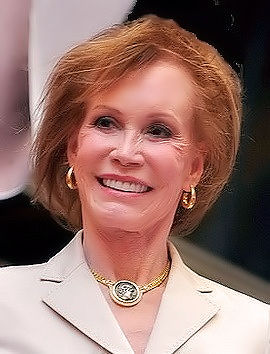
Mary Tyler Moore
1936-2017

 
She more than turned the world on with her smile. She's proven herself a first-rate actress. Her eponymous television show was among the greatest, but see her turn in Ordinary People and see if there isn't more to her than Mary Richards. Looking at other performances, primarily on television, she's proven her range in both drama and comedy. Yes, she may be Laura Petrie or Mary Richards to two or more generations of viewers, but what she also is an extraordinary talent.

Peter O'Toole
1932-2013

Few actors have shot out into film history on their debut. Peter O'Toole did. For argument's sake, let's say there was never another film in his career after Lawrence of Arabia. Wouldn't that have been enough to have made him a legend? Still, look over his various performances in My Favorite Year, The Ruling Class, The Lion in Winter, Becket, The Last Emperor. He's still very much in the game and he would say, as his shamefully overlooked performance in Venus proved. Alas, one of the greatest actors of his generation is also one of the last to keep working. The highs and lows of O'Toole's career make for fascinating viewing. 

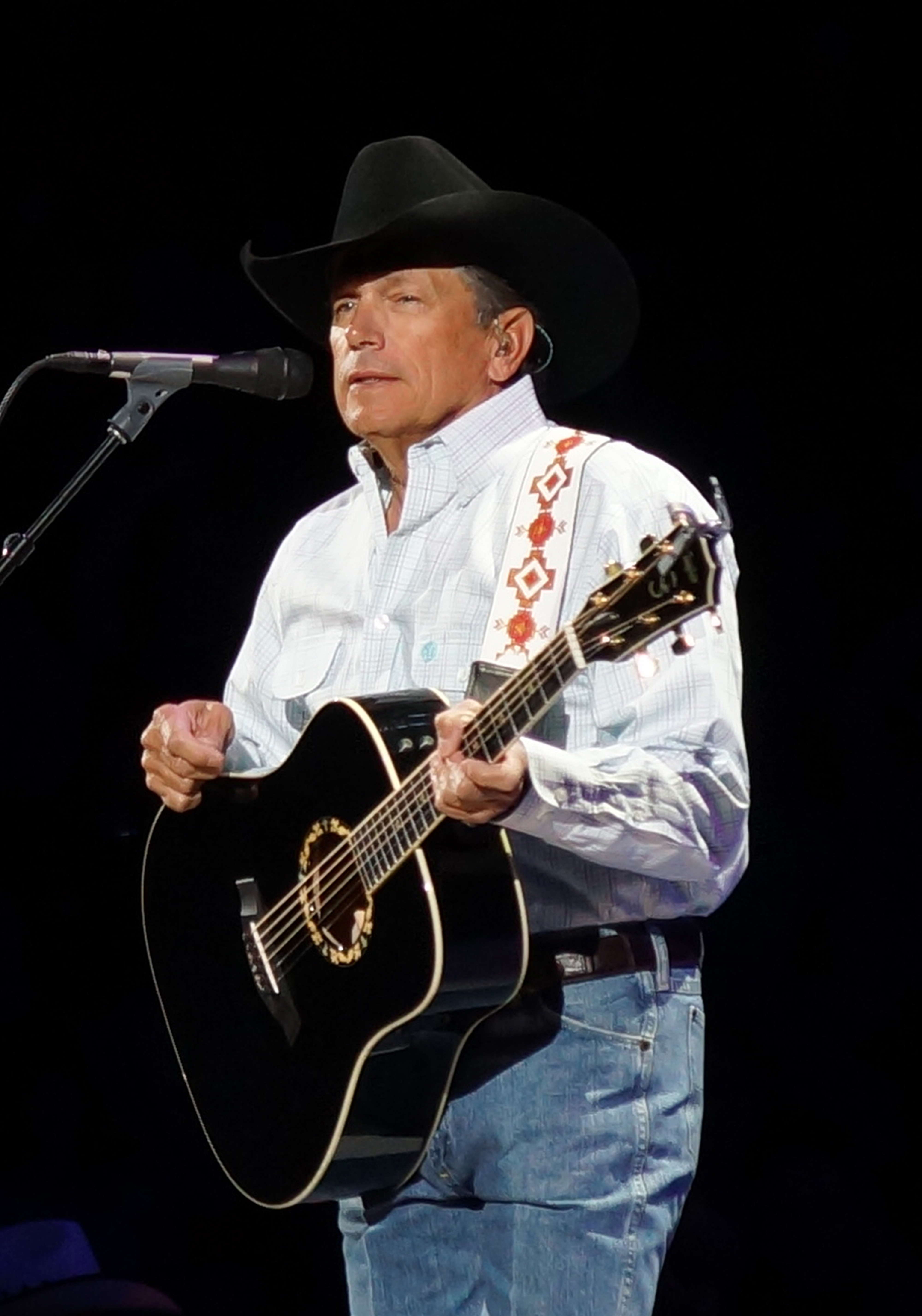
George Strait
Born 1952

There are musicians, then there are artists, then there are legends. There can be however, only one King. That would be George Strait. His career has been built on only one thing: to make the best country music around. He does it so well, Strait has become synonymous with traditional country. There are many pretenders to the throne, but he's showing no signs of ever abdicating.  His influence over two generations of country artists is undisputed.

These are only five that I could come up with. More to come in the future. Hey, guys at the Kennedy Center, as the song says, "Hey, look them over".

*February 2021 Update: Peter O'Toole died on December 14, 2013 at age 81. Mary Tyler Moore died on January 25, 2017 at age 80. As of this date, none of the following have been recognized. Tom Hanks, who has been honored, is 4 years younger than George Strait, the youngest suggested performer, who is 64 as of this writing.

*August 2023 Update:  As of this update (August 3, 2023) none of the other names current living have been Kennedy Center Honors recipients. Led Zeppelin, LL Cool J, "the creators of Hamilton", the television show Sesame Street, Garth Brooks (who is a decade younger than Strait), Amy Grant, U2 and Queen Latifah, however, all have. 

Obsessed (2009): A Review (Review #42)

OBSESSED


Black Mama, White Psycho...

Take note: Obsessed is a serious film. You can tell that from the fact that the star is billed as Beyoncé Knowles. Not Beyoncé. Not even as Sasha Fierce. She is Beyoncé Knowles, so we know she's serious, and that the film is serious. It's a pity no one else is serious in this unintended comedy.

Derek Charles (Idris Elba) is a successful business executive with a beautiful wife, Sharon (Knowles) and a new son. She wants to go back to school, but for now Sharon is occupied in setting up their home while he continues to work. 

At work, he meets new temp Lisa Sheridan (Ali Larter). She quickly becomes fixated on Derek, even though she knows he's married. Her flirtations come to a head (no pun intended) at the Christmas party, where she comes close to raping him. He rebuffs her repeated advances, even when she appears in his car wearing little except an overcoat. Despite his continuing rejections, Lisa won't be ignored, so to speak.

Lisa follows Derek to an out-of-town seminar, where she drugs him and later tries to commit suicide in his room. Detective Reese (Christine Lahti), who is investigating Lisa's apparent suicide attempt, doesn't believe Derek's claims that Lisa isn't his mistress, and neither does Sharon. Even after Lisa is discharged, she can't let go, threatening the Charles' baby and culminating in an epic catfight.

Now, I confess, I love a good catfight as much as any man, and the final Lisa/Sharon confrontation is the highlight. Obsessed, however, is such an odd mix of suspense and laughter. I'm prepared to have some suspension of disbelief, but there are too many points of logic to contend with. 

Let's tackle a few. If Derek is a major executive, why doesn't he just fire Lisa at the start? After she tries to rape him at the Christmas party, I would figure that's enough for termination, although I doubt he'd need any reason to.

There are at least two moments in Obsessed where only in the movies could those moments happen. One is right before Derek goes to tell Sharon what Lisa's been doing. Sharon's gotten off the phone with her sister. She tells Derek her sister's husband is leaving her for someone he met at work. What are the odds something like this will happen right before Derek tells her about the woman flirting with him? 

The second is when Sharon discovers Lisa in her house and knocks her out; only in the movies would Sharon just stay there instead of calling the police or hitting the panic button.

As one watches Obsessed, one is amazed at just how stupid everyone in the film really is. How does Lisa gain access to Derek's hotel room twice? How can Derek tell Sharon that Lisa coming on to him was "no big deal"? I would imagine a woman getting into my car in panties and an overcoat would merit a mention. When Lisa comes into the Charles' house while they're at dinner, why would the babysitter let Lisa waltz into their home to see their child and take her word that she was an old friend of the family rather than say, "I'll call her" or "Let me speak to her". Even while writing that part, I couldn't help but laugh at how absurd David Loughery's screenplay is.


I also wondered how Lisa thought a drugged Derek would be in much of a position to please her physically. Maybe I'm wrong and a man barely conscious can have successful sex with someone, but I doubt it. How is Derek's gay assistant Patrick (Matthew
Humphreys) be both the office gossip and clueless about what going on with his boss? How could Detective Reese just take Lisa's word that she and Derek had sex when I figure there are tests that could verify this? It's all too much to take.

As a side note, Sharon has made it clear she does not want her husband to have female assistants. Leaving aside how that reveals a certain insecurity over Derek's fidelity, does she also require the male assistants to be gay?

The performances match the ridiculousness of the plot. Ali Larter appears so uncomfortable throughout the film, as if she is trying to act but can't quite commit to either be camp or be serious. One would wonder if one of her other personalities from Heroes has taken over. Elba is unmemorable in his bland performance as Derek. Though their roles are small in the film, Lahti and Jerry O'Connell (as Derek's best friend Ben) are not given much to do. I especially fell sorry for Lahti, who's a very talented actress and deserves much better, though it's good to see her working.

Worse off is Queen Bey. Beyoncé Knowles tries, and she tries well, but certain scenes, like when she is ever on the phone, shows she's still learning to be an actress. She may prove an actress yet, but in Obsessed (which she produced) she still needs someone to act with and isn't at a point where she can handle monologue realistically. Even when she acts with someone, she still seems a bit hesitant, as if getting the lines out is more important than giving them meaning. Steve Shill could not get a good performance from Knowles, but given he could not get one out of Elba, the fault here to be fair lies with Shill more than with Knowles.

One technical aspect of Obsessed that made the movie worse was James Dooley's score. It made its presence known constantly and rather than set the mood it only hammered what we were suppose to feel more and more. It was so overwrought that I made a special note of how intrusive the music was in my notes on two occasions. When the music overwhelms the film, it can't make a movie better or more intense.

I figure that today, we're not afraid of certain things. We're not afraid of black men in positions of power. We're not afraid of woman taking the lead in pursuing romances. We're not afraid of firing temps. Judging from Obsessed, perhaps we shouldn't be afraid of any of those things, but we should be very afraid that anyone connected with this film might want to make more movies. That would be far more frightening than anything on the screen.

DECISION: F