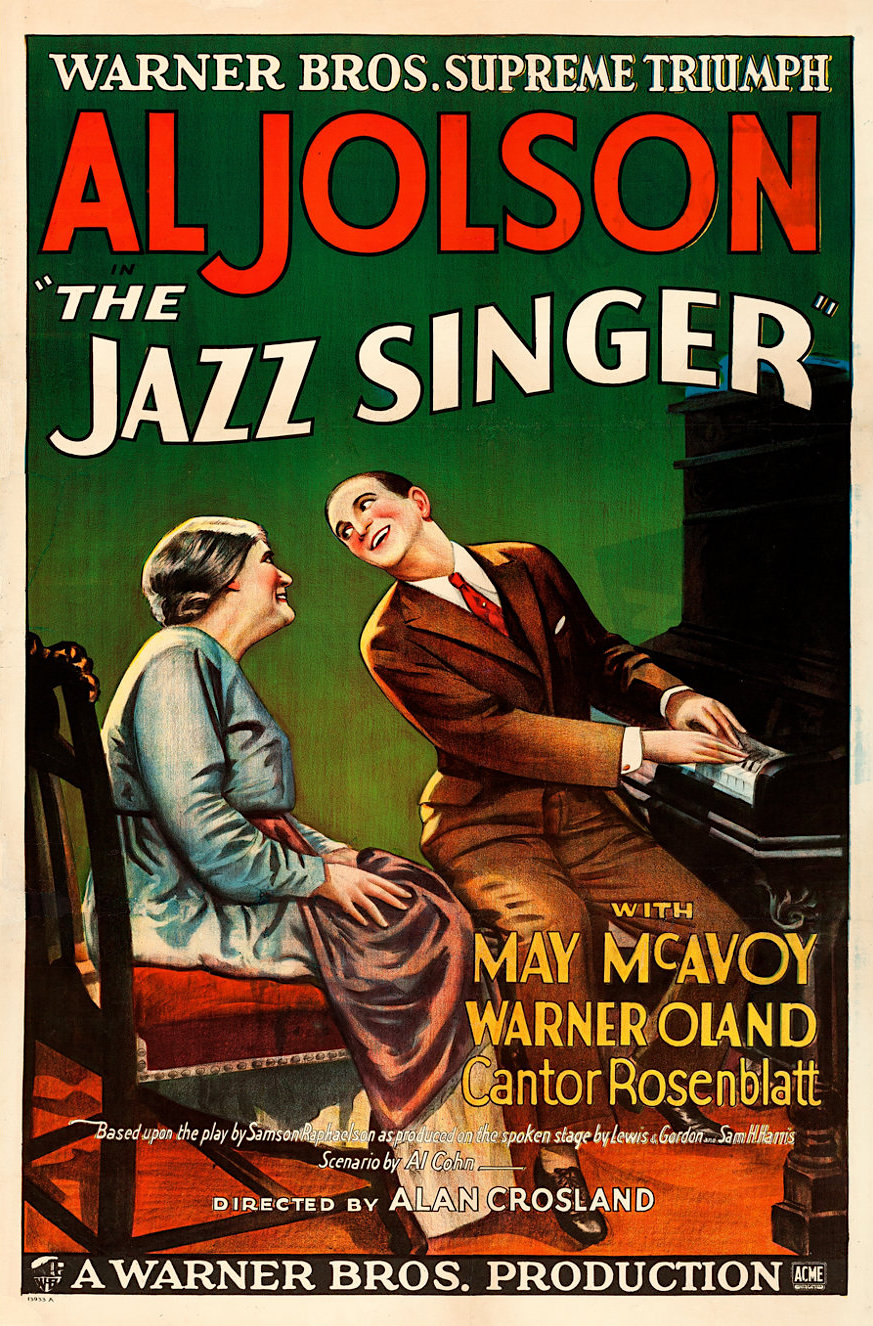
THE JAZZ SINGER (1927)
The Jazz Singer is built around a lot of preconceptions based on what people think it is rather than what is actually on the screen. People think it is the first sound film (it is not). People think it is a racist film (it is not). People think it's all Al Jolson in blackface belting out Mammy (it is not a major part of the story, though still understandably uncomfortable now to say the least). I think many people think they know The Jazz Singer, but in reality the film itself is far from the perceptions that have been built around it.
Cantor Rabinowitz (Warner Orland) is the fourth generation of cantors in his family, singing sacred songs for his Jewish congregation. He expects his son Jakie to follow and be the fifth generation. Jakie, who is the first generation born in the new country of America, has other dreams. He loves that ragtime and rather than sing the Kol Nidre on Yom Kippur, he'd rather be down at the dance halls belting out that new music. Cantor Rabinowitz is outraged by this and he is determined to whip Jakie into submission, but Jakie won't be denied. He runs away, taking with him only a photo of his beloved mother (Eugenie Besserer).
Many years pass, with the Cantor insisting he has no son, Mrs. Rabinowitz always hoping for her little boy to come home, and Jakie, not going by the improbable name 'Jack Robin', finding some success belting out such numbers as Toot, Toot, Tootsie. He attracts the attention of a local troupe, and of its star Mary Dale (May McAvoy), who asks him to join the troupe. He is having wild success, but he still misses his parents, especially his mother. He secretly writes to her, and while she's happy, she's also concerned that her little boy is falling for a shiksa.
An unexpected bit of luck comes his way when his tour is unexpectedly cancelled...so that he can go onto a major Broadway review. This would reunite him with both Mary and give him a chance to see his parents and perhaps reconcile with his father. He goes up to the Lower East Side and tearfully reunites with his mother. He tells her while singing a song he'll perform on Broadway, Blue Skies, that if he's a hit, he'll move them up to the Bronx where she'll meet the Goldbergs, the Ginsbergs, 'a whole lot of Bergs'. In comes in Cantor and is appalled by this...jazz singer.
The break between Rabinowitz and Robin appears permanent. Then comes a great crisis: Cantor Rabinowitz takes ill, dying really. Mrs. Rabinowitz and family friend Moisha Yudelson (Otto Lederer) beg Jack Robin to come and perform for Yom Kippur, but that would mean leaving the show just as he's about to make his Broadway debut. Eventually, he makes his decision, reconciling with his father who sees that he was born to be a jazz singer.
Years pass by, and Jack Robin, true to his word, is caring for his widowed mother as his name lights up the Great White Way. He sings his heart out, belting out My Mammy triumphantly.
Watching The Jazz Singer, it is surprising that for the most part, it is not a sound film. What it is instead is a silent film with sound sequences. Most of the sound comes from Jolson's musical performances, but the importance in The Jazz Singer is that in between the numbers Jolson includes bits of dialogue and adlibs. The first actual words heard were 'Wait a minute, wait a minute. You ain't heard nothing yet!', as prophetic a statement as ever there was in cinema.
The Jazz Singer showed how dialogue can work in films, and for all intents and purposes it was the beginning of the end of silent films. Pity that silent films were essentially discarded after the wild success of The Jazz Singer.
I think that people who have not seen The Jazz Singer would be surprised that it is really mostly a silent film with synchronized sound effects and music. As such, it has some of that silent movie acting, but for the most part the acting is quite effective. I think that modern audiences will laugh at Jolson, but not when he is acting in the silent parts. Instead, it's whenever he's singing that he seems wildly exaggerated, his eyes bulging out and his dancing so comical.
However, as an actor Jolson did a pretty solid job when he wasn't gyrating and showing an exuberance. I think the best performance was Besserer, who fits the ideal of My Yiddishe Mama. I confess to being moved at the scenes of her and Jolson as they tearfully reunite. Granted, at the Cantor's death she seemed over-the-top, but on the whole Besserer was almost cuddly as the Jewish mother we all had or wish we had.
Orland's performance too gave a rather one-dimensional role a bit more heart as the disapproving father, especially at the end when as a ghost he 'blesses' his prodigal son come home to honor his heritage. McAvoy is beautiful as the potentially shiksa girl (whether she is actually Gentile or Jewish is not answered), but unlike Jolson or Orland, we never hear her speak, making one wonder about her own voice.
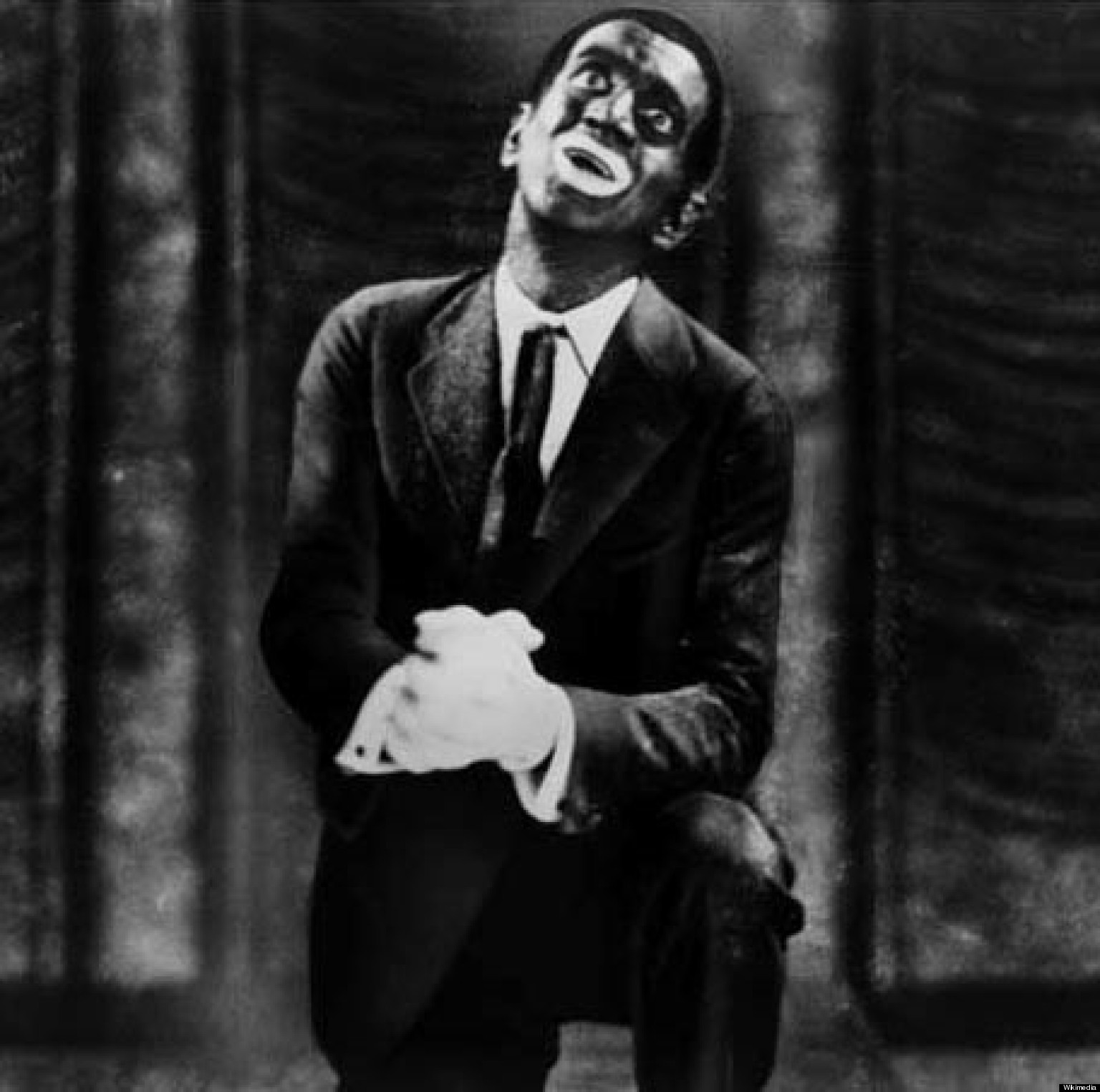
Now let's look at the more controversial aspect of The Jazz Singer: the blackface. I think many people may think that Jolson is just there ridiculing African Americans or portraying them in a negative light. Now, blackface is not acceptable now and should not have been acceptable then, but the actual blackface did not play a major role in the film. In fact, it isn't until the end of the film that he dons the infamous makeup, and in both cases, it is to sing songs, curiously both related to mothers: Mother of Mine and more notoriously, My Mammy.
I think in this case, the perceptions are more damning than the actual reality. The blackface looks ghastly and is understandably troubling but given some of the really horrific images of African Americans in films prior and post-Jazz Singer, it is quite tame. It does not make it right, but I think context is important.
An aspect of The Jazz Singer that I don't think gets enough discussion, probably due to the blackface aspect, is how the film is more about the conflict between the older generation from the old country with their native-born children. At one point, 'Jack Robin' tells his father that if he'd been born here, he would understand.
The Jazz Singer is really more about the immigrant experience in general and the Jewish experience in particular; it's about that struggle between the idea of keeping to tradition and the customs of the ancestors as epitomized by Cantor Rabinowitz and joining the dominant American culture as epitomized by his son. Even his name change from the very Jewish-sounding Jakie Rabinowitz to the more goy 'Jack Robin' reflects a truth about Jewish and Jewish-American life, one that is more real than something as heavy-handed as Gentleman's Agreement.
In terms of history, The Jazz Singer is important, though misconceived as either the first sound film or a virulently racist film when it is neither. It's well-acted, with a universal story, even if it is easy to parody. It's a film of its time (as a side note, the two remakes I think fail to understand that 'jazz' was the in-thing, so using it in the title of the 1952 & 1980 remakes is a mistake) and better than what people may think it is.
There is only one thing that The Jazz Singer is both in myth and reality: after this film, it was clear that we ain't heard nothing yet.
DECISION: B+
Tuesday, January 16, 2018
Monday, January 15, 2018
Lady Bird: A Review (Review #1000)
As a Texan, my initial reaction to hearing a movie titled Lady Bird was the same as that of my mother, "You mean the First Lady?" Ask anyone from between El Paso and Texarkana about 'Lady Bird', and one of two images will crop up: Mrs. Lyndon Johnson or Hank Hill's hound dog. I cannot say that Greta Gerwig naming her main character 'Lady Bird' did not end up confusing almost all Texans, along with lovers of history, but Lady Bird, while still very much within the trappings of indie films, is still a beautiful tribute to mothers, daughters, and other strangers.
Christine (Saoirse Ronan) insist on being called 'Lady Bird'. Her mother Marion (Laurie Metcalf) is coolly tolerant of such things, not enthusiastic about them but willing to acquiesce. Marion and her husband Larry (Tracy Letts) are facing financial difficulties but still opt to send Lady Bird to Catholic school rather than public school after Lady Bird's adopted brother Miguel (Jordan Rodrigues) saw a stabbing at his school, something Lady Bird insists on questioning.
Miguel and his girlfriend Shelley (Marielle Scott), who is also living with Lady Bird's family, are not keen on much. Lady Bird, however, is keen on one thing: getting out of Sacramento, California. She applies to various East Coast universities despite both their limited incomes and Marion's hope that Lady Bird stay local to save money. In this her senior year, Lady Bird finds love, first with Danny (Lucas Hedges), until she accidentally discovers his closeted secret, then with Kyle (Timothee Chalamet), a hipster rich kid whose nonchalance on all matters borders on the catatonic.
Lady Bird continues to navigate life with her off-again, on-again BFF Julie (Beanie Feldstein) and with Jenna (Odeyah Rush), the most popular girl in school who is also one of the wealthiest. Getting some wise words from Sister Sarah (Lois Smith) and Father Leviatch (Stephen Henderson), Lady Bird finds that who she is as Lady Bird is not far from who she is as Christine. She does manage to get to New York City, with her mother deeply hurt by Lady Bird going behind her back to get there.
Finally, in NYC, she finds her true self, and that home is something to appreciate.
In many ways, Lady Bird's screenplay is, to my mind, overrated. It has moments that I didn't think realistic (how Lady Bird and Julie find out Danny's desires do not match her own is a bit convenient) and other elements that are introduced then disappear (Father Leviatch withdraws from directing the school spring play after having successfully directed the fall musical, apparently due to some illness, only to never see or hear from him again).
As a side note, while I am not familiar with school musical productions, I was unaware that Catholic schools were big into Steven Sondheim, but I'm not Catholic either, so there it is.
Lady Bird has a lot of the trappings of indie films: the cliched characters (Chamalet's hipster, Feldstein's lovelorn student for the cool teacher), but it also has an authentic aspect that must be noted. Of particular note is when Marion and Lady Bird are shopping at a thrift story (by the looks of it, a Goodwill). As the mother and daughter argue over something, Marion pulls out a dress and instantly the argument is forgotten as both comment on how wonderful the dress is.
Moments like these, moments that feel authentic and true-to-life, moments that most people have had, are what pushes Lady Bird higher, that make it better than those hip films with the 'wise-beyond-her-years' students.
Part of Lady Bird's success also comes from the fact that Lady Bird herself is not 'wise-beyond-her-years'. As played beautifully by Ronan, Lady Bird can be dumb, thoughtless, and cruel, awkward and silly. Ronan and Gerwig shape Lady Bird into someone who does not have all the answers, who is flawed but still a basically decent person. Even her prank against Sister Sarah is actually both pretty tame and almost endearing (she places 'wedding' ribbons and a sign saying "Just Married to Jesus", which in Catholic theology is pretty accurate).
In most films, Lady Bird's put-down of a pro-life advocate at the Catholic high school would have been celebrated as a sign of her independence. In Lady Bird, this dismissal of a woman whose mother chose not to abort her has actual consequences, ones that both upset Lady Bird and cause a fury within her.
Lady Bird also has Metcalf as the loving mother, and I'd argue Marion genuinely loves Christine even if she is not particularly adept at showing it. Metcalf and Gerwig again make her flawed but real. Looking back at it, in most other films when Lady Bird snaps at her mother's mothering skills, it would be a put-down that Marion would have no response to.
Marion, however, tells her daughter that Marion's mother was 'an abusive alcoholic', and it sounds so real to make it clear to Lady Bird (and the audience) that Marion knows she is not perfect but she is also by no means a villain or uncaring or insensitive. Like everyone else in Lady Bird, Marion is a good person doing the best she can.
It is so nice to see Hedges play something other than an angry young man (see Manchester By the Sea but don't see Three Billboards Outside Ebbing, Missouri). His Danny looks like he's genuinely in love with Lady Bird, but when we get a twist (which I still don't fully believe) his last major scene where he breaks down in tears over it all show why Hedges has a bright career. Chamalet may be a stock character, but he does his role well too.
What makes Lady Bird so good is that while it has the trappings of an indie film with the characters and situations, our characters are not perfect or all-knowing. What they are is all-caring, even when they don't show it. We all want to fit in with the 'popular' kids and sometimes pretend to live in nicer homes. We all snap at our relatives but, like Miguel recognizes when Kyle honks for his sister, 'even she deserves better'. We all break with our friends only to make-up with them and find they really are BFFs. We all struggle with our parents, only to feel we need them when we need a shoulder to cry on.
Lady Bird is a moving, delightful, real film. It isn't perfect, but then again neither are the characters.
Don't it always seem to go, that you don't know what you've got till it's gone?
| 1912-2007 |
DECISION: B+
Sunday, January 14, 2018
Chavela: A Review
CHAVELA
Chavela Vargas, even in her own time, was a most controversial figure. A female singer who was nowhere near 'feminine' except in her sexual tastes, Vargas defied expectations as far as she could in the macho culture of her beloved Mexico. Chavela, the documentary of her life and art, chronicles her journey to becoming an icon to both Mexican music lovers and lesbians.
In certain ways, Chavela is a surprisingly routine story. Born Isabel Vargas Lizano in Costa Rica in 1919, she exhibited early signs that she was not like other little girls. Her parents, embarrassed by her, hid her away whenever visitors came. Ultimately divorcing, her parents soon became totally absent from her life.
It is here that the siren call of Mexico and Mexican music comes calling to her. Chavela makes her way there and begins performing in clubs and cabarets. At first, Vargas attempted to fit into the norm of female Mexican singers in the 1950's, but in her own words, she looked like a transvestite. Rather than the coquettish, jolly female singer most Mexicans were used to, she cut her hair short, sang low and lowly, and most shockingly of all, wore pants.
While it was an open secret that Vargas was a lesbian, she herself was not open about it. She had no problems seducing the wives of the politicos and intellectuals who came to see her perform (even saying that when Elizabeth Taylor married for the third time in Acapulco, Vargas 'woke up with Ava Gardner'), her stage persona allowed her to be as open as one could in the macho culture of Mexico.
Vargas then hooks up artistically with Mexican music legend Jose Alfredo Jimenez, who found in her a wonderful drinking buddy and excellent interpreter. Vargas found that she was essentially an alcoholic; she could not perform without a few shots of tequila to begin, and after Jimenez's own alcohol-related death in 1973 she not only became inconsolable but pathetic. She would be drunk on stage, incoherent, and I think even falling down in front of audiences.
Soon bookings dried up, but she didn't. Some people even assumed she was dead when, thanks in part to a new and younger lover (and eventually giving up booze), she made a comeback 12 years later in 1991. She also found surprising support in Spain, where among her fans was film director Pedro Almodovar. He pushed for a brief tour of Spain and France, where she became a hit. The revived success allowed her to publicly come out as a lesbian. It also allowed her to finally appear at the Palacio de Bellas Artes, the apex of Mexican musical halls.
Despite being in her 80's, Vargas was hotter than ever: making a cameo in Frida, where she sings to Salma Hayek's title character (with whom she had a passionate love affair) and continuing to perform. In 2007, another twelve years after her comeback, age finally catches up with her, and in 2012 the vain 93-year-old Vargas finally is forced to appear in public in a wheelchair. On August 7 of that year, Vargas finally dies, perhaps unable to die as she wished (literally dropping dead on stage), but with a long life to create her music and life.
Chavela makes use of an archival interview in 1994 when the then-74-year-old talks about all sorts of things. It is from a video recording, which gives it a greater intimacy. Now, it's a strange thing for me to write a Chavela review only insofar as I have a background about her.
My parents were not fans, and moreover I disagree with one of the people interviewed in Chavela in that I don't think she was the best interpreter of Jose Alfredo Jimenez (I still think Vincente Fernandez is). Also, while I personally think her singing is strong, evoking a perpetual melancholy in her songs, La Llorona is the only song of hers that I think is good.
My issue is on thinking on how someone without a Hispanic/Mexican background would find Chavela and Chavela Vargas herself. I came into Chavela knowing who Vargas was. How would someone who didn't know end up thinking of her?
I think co-directors Catherine Gund and Daresha Kyi have a great deal of respect for Vargas and consider her a great artist. Perhaps that is why perhaps some less-savory aspects, such as Vargas assaulting her lawyer/lover at one point, or why she had such mass appeal in Spain versus her adopted Mexico are not deeply explored.
We take whatever Vargas says as truth, including her assertion that she woke up with Ava Gardner, something that I don't think has ever come to light. This openness about a one-night stand with Gardner is more surprising given that Vargas would not reveal which wives she seduced. Other elements, such as a romance with an American, Betty-Carol Sellen, are mentioned by Miss Sellen herself but what impact that had on either is not touched on.
Chavela does make its case about the artistry of Vargas, especially whenever we see Vargas' performances, accompanied by cursive text translating the lyrics versus the more plain translations (only Sellen and Laura Garcia Lorca, relation to Spanish poet Federico Garcia Lorca speak in English). As mentioned, Vargas' voice is sorrowful, rich and filled with pain.
I personally think something is lost in translation with Chavela, though because I know of her before this film I may not be the most objective of reviewers. However, with a fascinating portrait of a woman and some remarkable footage and photographs (including a few of a topless Frida Kahlo), Chavela is a well-crafted film of an artist who was not one to look back even if others had her doing so.
DECISION: B+
Chavela Vargas, even in her own time, was a most controversial figure. A female singer who was nowhere near 'feminine' except in her sexual tastes, Vargas defied expectations as far as she could in the macho culture of her beloved Mexico. Chavela, the documentary of her life and art, chronicles her journey to becoming an icon to both Mexican music lovers and lesbians.
In certain ways, Chavela is a surprisingly routine story. Born Isabel Vargas Lizano in Costa Rica in 1919, she exhibited early signs that she was not like other little girls. Her parents, embarrassed by her, hid her away whenever visitors came. Ultimately divorcing, her parents soon became totally absent from her life.
It is here that the siren call of Mexico and Mexican music comes calling to her. Chavela makes her way there and begins performing in clubs and cabarets. At first, Vargas attempted to fit into the norm of female Mexican singers in the 1950's, but in her own words, she looked like a transvestite. Rather than the coquettish, jolly female singer most Mexicans were used to, she cut her hair short, sang low and lowly, and most shockingly of all, wore pants.
While it was an open secret that Vargas was a lesbian, she herself was not open about it. She had no problems seducing the wives of the politicos and intellectuals who came to see her perform (even saying that when Elizabeth Taylor married for the third time in Acapulco, Vargas 'woke up with Ava Gardner'), her stage persona allowed her to be as open as one could in the macho culture of Mexico.
Vargas then hooks up artistically with Mexican music legend Jose Alfredo Jimenez, who found in her a wonderful drinking buddy and excellent interpreter. Vargas found that she was essentially an alcoholic; she could not perform without a few shots of tequila to begin, and after Jimenez's own alcohol-related death in 1973 she not only became inconsolable but pathetic. She would be drunk on stage, incoherent, and I think even falling down in front of audiences.
Soon bookings dried up, but she didn't. Some people even assumed she was dead when, thanks in part to a new and younger lover (and eventually giving up booze), she made a comeback 12 years later in 1991. She also found surprising support in Spain, where among her fans was film director Pedro Almodovar. He pushed for a brief tour of Spain and France, where she became a hit. The revived success allowed her to publicly come out as a lesbian. It also allowed her to finally appear at the Palacio de Bellas Artes, the apex of Mexican musical halls.
Despite being in her 80's, Vargas was hotter than ever: making a cameo in Frida, where she sings to Salma Hayek's title character (with whom she had a passionate love affair) and continuing to perform. In 2007, another twelve years after her comeback, age finally catches up with her, and in 2012 the vain 93-year-old Vargas finally is forced to appear in public in a wheelchair. On August 7 of that year, Vargas finally dies, perhaps unable to die as she wished (literally dropping dead on stage), but with a long life to create her music and life.
Chavela makes use of an archival interview in 1994 when the then-74-year-old talks about all sorts of things. It is from a video recording, which gives it a greater intimacy. Now, it's a strange thing for me to write a Chavela review only insofar as I have a background about her.
My parents were not fans, and moreover I disagree with one of the people interviewed in Chavela in that I don't think she was the best interpreter of Jose Alfredo Jimenez (I still think Vincente Fernandez is). Also, while I personally think her singing is strong, evoking a perpetual melancholy in her songs, La Llorona is the only song of hers that I think is good.
My issue is on thinking on how someone without a Hispanic/Mexican background would find Chavela and Chavela Vargas herself. I came into Chavela knowing who Vargas was. How would someone who didn't know end up thinking of her?
I think co-directors Catherine Gund and Daresha Kyi have a great deal of respect for Vargas and consider her a great artist. Perhaps that is why perhaps some less-savory aspects, such as Vargas assaulting her lawyer/lover at one point, or why she had such mass appeal in Spain versus her adopted Mexico are not deeply explored.
We take whatever Vargas says as truth, including her assertion that she woke up with Ava Gardner, something that I don't think has ever come to light. This openness about a one-night stand with Gardner is more surprising given that Vargas would not reveal which wives she seduced. Other elements, such as a romance with an American, Betty-Carol Sellen, are mentioned by Miss Sellen herself but what impact that had on either is not touched on.
Chavela does make its case about the artistry of Vargas, especially whenever we see Vargas' performances, accompanied by cursive text translating the lyrics versus the more plain translations (only Sellen and Laura Garcia Lorca, relation to Spanish poet Federico Garcia Lorca speak in English). As mentioned, Vargas' voice is sorrowful, rich and filled with pain.
I personally think something is lost in translation with Chavela, though because I know of her before this film I may not be the most objective of reviewers. However, with a fascinating portrait of a woman and some remarkable footage and photographs (including a few of a topless Frida Kahlo), Chavela is a well-crafted film of an artist who was not one to look back even if others had her doing so.
![]() |
| 1919-2012 |
DECISION: B+
Thursday, January 11, 2018
2017: Some Odds and Bitter Ends
As I look back on 2017, I find it is time to search for my Odds and Ends, separate categories that I think merit a brief look. Unlike my Ten Best/Worst Films of 2017 So Far List, I don't think this requires updating.
BIGGEST SURPRISE
Perhaps people may think that because I am a Christian (flawed, doubting and struggling as that may be), I would give Christian films a pass. Oh contraire, mes amis. I am an 'art before theology' reviewer, not one to let a bad film get a positive review even if I agree with it. For far too long, evangelically-bent filmmakers have made bringing the Cross over more important than crafting something worthy of praise. We can forgive early Christian films like Second Glance or End of the Harvest or any other Christiano Brothers films for their low quality and generally poor acting (save for David White, who is almost required to be in any film with a Christian-related theme and who can actually act).
What is harder to accept is that with more resources at the disposal of a new generation of Christian filmmakers, they still can make pretty lousy movies. I look at the Kendrick Brothers oeuvre and shudder at how lousy some of their films are: Facing the Giants and Courageous were not only poorly acted and badly-written, but up to a point almost racist. It wasn't until War Room, where these WASP filmmakers realized that African-Americans are fellow believers (and David Kendrick took himself out of the central role) that they managed to stumble into a good film.
I think Christian films are improving, and The Case for Christ has to be a high watermark for this Renaissance. Lee Strobel's journey from antagonistic atheist/agnostic to a spiritual awakening was a portrait of a good man who found he was not as good as he thought he was. It touched on real-life issues of abandonment and disappointment to reach his embrace of faith. The Case for Christ did two things right: first, it looked as issues we all face. Too many Christian films present a world without sin from believers: no cursing, no drinking, no sex. That's not the world of the church I go to.
Second, it hired professionals to do their job. The Case for Christ had actual actors, those who have training in giving performances, rather than believers who recite lines. I don't think the actors are believers, and I don't expect them to be. If they do their job, they will convince me they are the characters they are portraying.
BIGGEST DISAPPOINTMENT
My late friend Fidel Gomez, Jr. was dead-set against Spider-Man: Homecoming (no puns intended). I know that we had planned to see it when it reached the second-run theaters, especially over his very loud objections. However, the film was so successful that by the time it did, he had already died. As such, I went to see it in the first-run theaters in its final weeks a week after the funeral. There was simply no reason to wait anymore.
One could make a case that such terrible circumstances would color my view of Homecoming, but no, I found this reboot to be a little too self-aware. Homecoming was determined to get 'representation' in all the high school characters, but sometimes there can be too much of a good thing: I don't know what the overall racial/ethnic makeup of Queens is, but is Peter Parker the only white guy there? I felt they were trying to check off as many boxes as they could, and soon it was getting comical. Flash is now a Latino? As a Hispanic, I don't care, but this Flash was rather weak as a bully.
Too jokey for my tastes, too much fan-servicing, with only Tom Holland's turn as Spidey worth anything, I felt so let down by how smug Homecoming was. If I want a John Hughes movie, I'll see a John Hughes movie, thank you very much.
MOST OVERRATED
There are always candidates for the most overrated. For a while, Spider-Man: Homecoming was it. Then there was Guardians of the Galaxy Vol. 2. I thought that Blade Runner 2049 and mother! had a strong case for most overrated. However, I think the one that has to be the winner here is The Last Jedi.
I don't think any Star Wars film has divided fans as The Last Jedi. I am not one to know the nuances of Star Wars lore, and frankly I don't care who shot first (Han did, by the way). I found The Last Jedi better than Star Wars: The Remix (aka The Force Awakens), but this is nowhere near the level of The Empire Strikes Back.
The wild hyperventilating that The Last Jedi has caused my fellow reviewers, to the point that they rank it among the best Star Wars films of all time, is what makes it the Most Overrated Film of 2017. The fans don't agree with their view, with some even calling that it not be considered Canon. I really do not care about things like that, but calling The Last Jedi the equal of or even superior to Empire Strikes Back is just beyond what I can stand.
That, and what they did to Admiral Ackbar...
MOST UNDERRATED
Oh yes, Geostorm is a lousy movie. I am not defending Geostorm or saying that it is worth anyone's time apart from its eventual late-night repeated showings on FX or TNT.
However, part of me cannot bring myself to hate it as much as others did. I don't think it's a crime against cinema or something to draw one's ire. It's actually just a dumb, witless movie that one can derive camp pleasure out of. How can one hate a film where we're asked to think of Gerard Butler as a scientific genius?
Geostorm is so delightfully daft with its odd plot points (one brother has a strong Scottish brogue while the other doesn't), leaps of illogic (at the Democratic National Convention, not only does the Vice President follow the President in speaking, but when the convention is getting vaporized by a machine in outer space, not one Secret Service agent bothers to save him...he pretty much has to fend for himself), and crazy inconsistencies (in the opening scene, a security guard recognizes Butler's character, but three years later, the men and women aboard the satellite he essentially created don't know who he is...with one thinking he was dead).
I simply cannot hate a film that has a bit about how someone with highly important situation will meet someone at a specific time and place, all but telling us said character is not going to make it. I simply cannot hate a film that plays like a misguided Spaceballs.
Truly, I saw films I thought worse than Geostorm, films that my brethren loved (Blade Runner 2049, Three Billboards Outside Ebbing, Missouri) and some whose popularity escapes me (Spider-Man: Homecoming, The Last Jedi). I think the last two are better than Spaceballs: The Unintended Sequel, but I would rather see this bit of fluff to the pseudo-pretensions of the first two.
Wednesday, January 10, 2018
The Worst of 2017 So Far
As I look back on 2017, I find it is time to search for my Ten Worst Films of 2017 So Far. I say 'So Far' because I have a lot more films to watch, which means that this list will be updated. However, at the moment I have 50+ films for this year, so it seems as good a time to look back.
Now, I should point out that as this list consists of films I have seen, my list may differ from other of my fellow reviewers. Also, I can add that this list will be amended in that there are two films that are on my Worst List but I have not written reviews for them yet. As such, I don't want to spoil the surprise.
So, without further ado, my Ten Worst Films of 2017 So Far.
10.) Geostorm
Having said all that, I have a bit of a soft spot for Geostorm, probably because it is trying so hard to be serious and topical but is totally unaware of itself. It could have been the serious environmental film it aspires to. It could have been a harmless romp. Instead, it ended up being nothing. It took good actors (Ed Harris, Andy Garcia) and not only did nothing with them, but showed just how desperate for work they are. They reduced Mare Winningham to one scene...I think one line.
Why not make her the President of the United States or the Secretary of State?
Still, while it did not reach the 'so bad it's good' threshold, Geostorm is a film that can be enjoyed if you want to laugh at it, not with it.
Few films have been as full of themselves as Guardians of the Galaxy Vol. 2. It's the kind of film that thinks it's oh so clever, oh so funny, oh so wonderful when it really is just the same tired old routine we saw before.
It was too long for the story it didn't tell, it went off in tangents that could have been cut, it was too self-aware, too many fanboy/meme-ready bits and call-outs to the audience. What was the point of Star-Lord turning into Pac-Man?
The fact that so many of my fellow reviewers loved it makes Guardians of the Galaxy Vol. 2 a nominee for the Most Overrated Film of 2017 too.
08.) Battle of the Sexes
I'm pretty pleased that major awards talk for Battle of the Sexes has died down. It was bad enough that Emma Stone beat out Natalie Portman for her cutesy song-and-dance shtick, but her efforts to pull an Eddie Redmayne backfired on her more than his drag fiasco.
The real story of the 'Battle of the Sexes' between Billie Jean King, a lesbian, and Bobby Riggs, a showboat, is more interesting than the film version. Why did I mention that King is a lesbian? Because Battle of the Sexes was more interested in her sex life and sexual awakening as a woman who is sexually active with women than it was with her tennis prowess.
Battle of the Sexes never made the case as to why this event was that important, and it is a terrible shame that it could not muster the interest.
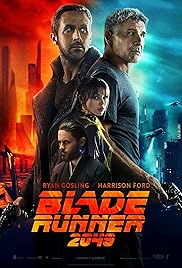
07.) Blade Runner 2049
Another contender for the Most Overrated Film of 2017, Blade Runner 2049 is like the dark twin of Guardians of the Galaxy Vol. 2. Both are hopelessly self-aware, but while Guardians of the Galaxy Vol. 2 thinks it's hilarious, Blade Runner 2049 thinks it's deep.
There was a deaden, dull manner to Blade Runner 2049, a film so pompous it imagines itself to be the final word on science-fiction dystopian features. It's the type of film that thinks it's on a higher level than a Metropolis or the original Blade Runner. Avant-garde actor Ryan Gosling is beginning to grate on me, and this story just goes on and one that I was fighting furiously to stay awake.
I wish my dear friend Fidel Gomez, Jr. were here, but I feel that if he had lived to see it, he would have put Blade Runner 2049 much lower on this list.
06.) The Dark Tower
Maybe even lower than this botched effort to adapt his favorite book series.
In a certain way, The Dark Tower was doomed before it even got started. The Steven King epic spans several novels, with intricate plots and subplots to create this expansive universe. It would be already intensely difficult to capture that in one film, but why they opted for a ninety-minute film to begin this series is beyond idiocy.
The Dark Tower was also hampered by the decision to make it a more routine action/sci-fi film and one that centers around the boy versus The Gunfighter*. Idris Elba was the only good thing in The Dark Tower, with Matthew McConaughey reminding us that he has spent most of his career in bad roles in bad movies.
Had Fidel lived, I might have talked him into seeing The Dark Tower and convincing him that Elba was a worthy Gunfighter, but alas, I think he would have just been angry about the whole thing.
05.) The Great Wall
It has not been a good year for Matt Damon.
Suburbicon bombed.
Downsizing bombed.
Then there's the whole 'Damonsplaining' bit. Not satisfied with telling a black female director how he knows more about diversity in film than she did, he opted this year to tell women he knows more about sexual harassment and assault than they do.
Matt Damon believes that because he played a genius in Good Will Hunting and because he attended (but did not graduate from) Harvard, that he is Hollywood's reigning intellectual. He genuinely believes his own intellectual prowess, making Damonsplaining all the more amusing.
However, long before his second bout of Damonsplaining, or before Suburbicon, or before Downsizing, there was The Great Wall, his naked play for the Chinese market. The Great Wall was not made for American audiences. It was made for the growing and devouring Chinese market, which isn't unusual these days.
Think of all the films that have Hong Kong settings or major roles for Chinese characters: Transformers, Pacific Rim, Doctor Strange, The Dark Knight, Geostorm, Independence Day: Resurgence. The Great Wall, however, was different: a film with a Chinese setting, major Chinese stars, much dialogue in Chinese...it's a surprise Damon didn't end up playing Deng Xiaoping marching alongside his hero Chairman Mao.
Whether Mao is Xiaoping or Damon's hero is still up for debate.
The Great Wall, however, was boring, with nothing to recommend it except the costumes. Worse, Damon still ended up on the hot seat for this his first of three flops. His character was accused of being the 'white savior': the noble European who can save the hapless 'ethnics'.
With this variation of Damonsplaining, 2017 was not a good year for Mao, I mean, Matt Damon.
04.) The Lost City of Z
The first of two Charlie Humman films to make my Ten Worst Films of 2017 list, The Lost City of Z somehow received a Best Adapted Screenplay nomination from my film review group. This is another film that takes itself far too seriously to where it ends up being dull.
Worse, it is practically a rip-off of better films, particular two of Werner Herzog's masterpieces: Fitzcarraldo and Aguirre, The Wrath of God. As for Humman, he is so blank in The Lost City of Z it amazes me that he keeps getting pushed to be a star when he has yet to show he is an actor (though again to be fair I have not seen Sons of Anarchy). Even future Spider-Man Tom Holland could not lift up this dull journey to deepest, darkest Peru.
03.) Power Rangers
Power Rangers may capture, better than any movie this year or in the past few years, what is wrong with Hollywood. It takes an old property and 'updates' it. It goes out of its way to put in 'representation' in terms of casting. It has shameless product placement to the point of parody.
It just fails at just about everything.
The updating will not bring in the fans of the original series based on nostalgia because Power Rangers is nothing like what they loved. It didn't bring in new fans because they'll either think it is not for them or because they have no connection to the property and the film does not make a case as to why it should be.
The representation seems like pandering to the point of silliness: having the 'nerd' Billy turned into an autistic character, a Chinese character (again, a stab at the foreign market) and one of them potentially be a lesbian is almost a cry of desperation. Again, there's nothing wrong with a lesbian character, even if it alters the original. It's the fact that they wanted it both ways: to suggest it without having to deal with it or have it play a role in the film.
Having the campy Elizabeth Banks pose inside a Krispy Kreme shop while eating one is just unforgivable.
Worse, Power Rangers strongly suggested there would be a sequel. Take a note, Hollywood: worry about the first film before telegraphing that you plan to make more.
The second of two Charlie Humman films to make my Ten Worst Films of 2017 list, King Arthur: Legend of the Sword also showcases more of what is wrong with Hollywood.
While Power Rangers suggested that there was going to be a sequel (because all bad movies require follow-ups to their lousy stories), Legend of the Sword flat-out told us this was going to be the first of a long-lasting cycle. I've long said that a film with a colon in the title means that it is the beginning of a hoped-for series. The plans for King Arthur were for more than just a six-feature series centered on our Wart.
It was the first of a whole franchise. The Camelot Cinematic Universe?
Legend of the Sword was going to be a kick-off to a group of films about our Arthurian king, and then there would be stand-alone Merlin and Lancelot films, maybe a whole slew of them, until like The Avengers, they would join forces.
Am I the only one who thinks this is a pretty daft idea to begin with, let alone unworkable?
As if all that franchise-planning was not bad enough, the powers that be thought their next big franchise should get the thing started by putting it all in Guy Richie's hands. No silly mythmaking or Once and Future King theatrics for our working-class filmmaker. No, this Arthur Pendragon was going to be a bloke from the mean streets of the East End of Camelot, a commoner with lots of muscle, a brawler and ladies man who liked a good pint and a good wench before wielding supreme executive power thanks to some watery tart.
Richie's frenetic style did not mix with the noble Arthurian legend, but in retrospect, that was the least of Legend of the Sword's problems.
I almost feel for Charlie Humman, this time being used as so much meat as the thug who would be King. Such a wild misfire, Humman simply needs to get back to basics, and people need to stop trying to force franchises on the public.
01.) Life
OK, so you want to make a cheap Alien knock-off? Fine. I really don't object to that. Really.
I object to you making it so boring, putting in cheap efforts to make me care about these cliches you throw at me and call 'characters'. I object to making a film that is predictable, down to the 'twist ending' that either signals a sequel or a bad way to end a film, period. I object to making this group of astronauts/cosmonauts into a collection of blithering idiots who cannot do anything right.
I object to just how clumsy, dumb, boring and depressing Life is.
Next Time: Some Odds and Bitter Ends of 2017.
*I know it's 'The Gunslinger', but I would inevitably end up calling him 'The Gunfighter', much to Fidel's irritation. It's a little bit of humor I can have that reminds me of him, a friend dearly and deeply missed.
Tuesday, January 9, 2018
The Best of 2017 So Far
As I look back on 2017, I find it is time to search for my Ten Best Films of 2017 So Far. I say 'So Far' because I have a lot more films to watch, which means that this list will be updated. However, at the moment I have 50+ films for this year, so it seems as good a time to look back.
Now, I should point out that as this list consists of films I have seen, my list may differ from other of my fellow reviewers. I can't judge a movie I haven't seen. So, with no further ado, let's go over My Ten Best Films of 2017 So Far from Ten to One.
10.) The Case for Christ
I despair sometimes about the state of Christian cinema. Sometimes they can be good (War Room) sometimes they can be shockingly awful (God's Not Dead 2). Just because I am a Christian does not mean I will give a faith-based film a pass, but I won't condemn it offhand either.
The Case for Christ is a bit of a misnomer, given that the film does not set out to make an actual case for Christ. Instead, it's a biopic of a good but flawed man, Lee Strobel, and his journey from atheist to believer. It is his journey to Him, and while it is clear that Strobel's investigation led him to Christ, it is also the portrait of a sinner, no different than you or I, with his own struggles and issues. Strobel's everyman qualities makes this not a screed for Christianity but the story of one man's spiritual journey.
It also helped that it had actual actors who may or may not be Christians. It was a professional production intent to tell a story, not a sermon.
09.) Dunkirk
Unlike other war films, Dunkirk does not focus on heroics. Far from it: its on-the-ground manner focuses on the unnamed soldiers' fears and desperation as they fight to live another day. Yet we don't see hysterics or defeatism. Instead, Dunkirk relies on a lot of quiet strength, both visually and story-wise, slowly moving towards making these men not superheroes but ordinary men and boys, caught in terrifying circumstances but determined to hold on.
We don't get big moments or big names (even One Direction pop star Harry Styles' debut is not played up, a marketing curiosity). Sometimes the characters don't even have names. That allows for a focus on the collective experience without making them shadows. Dunkirk honors the men at this crossroads of history without making their experiences fodder for war-cheerleading.
It is an homage to literal courage under fire.
08.) A Silent Voice
This animated tale of forgiveness and tolerance moved me emotionally, even if it felt rather long. A Silent Voice drew attention to the issue of bullying and physical disabilities without being mawkish or lecturing. Instead, despite being animated, it proved remarkably lifelike and authentic, a story about the power of forgiving and forgiving yourself.
With beautiful animation and a compelling story, A Silent Voice will move viewers to a deeper level of understanding and compassion for both the bullied and the bulliers.
07.) Jane
The first of three documentaries on my Top Ten List, Jane is a portrait of a true pioneer and icon: Dr. Jane Goodall. Using recently-rediscovered footage shot by her future husband, Jane is a tribute to a heroine for all ages, who ventured into so many unknowns: unknown field, unknown region, unknown territory for a woman, and made scientific breakthroughs. Jane is lifted up by a brilliant score from the legendary Philip Glass and with Dr. Goodall looking back with the same grace and dignity which she has led her life and work.
At a time when the rage is to make all-female reboots of classics (Ghostbusters, Lord of the Flies, Ocean's 8) and male characters are changed to females (Doctor Who, The Greatest American Hero) to have 'representation' and 'equality', when we're told that these are needed so 'little girls can have positive role models', I would suggest showing these little girls Jane. Goodall did not need to talk about 'gender equality' or 'representation'.
She went out and did it.
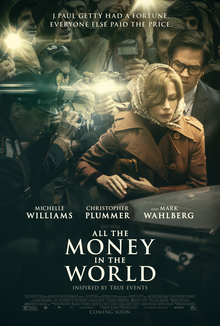
This true-life story about the J. Paul Getty III kidnapping found itself embroiled in scandal when Kevin Spacey, having completed his work in the film, was accused of sexual assault by a group of men when they were boys. Spacey was immediately replaced by Christopher Plummer as J. Paul Getty, the parsimonious oil tycoon who would not pay to rescue his favorite grandson.
I think Plummer was better as Getty, though perhaps we will never have a chance to see a comparison or the Spacey performance in an alternate version. However, regardless of the scandal, All the Money in the World itself is a tremendous effort, a riveting and tragic story with sharp performances by Plummer and Michelle Williams as the distraught mother batting all sides to save her child.
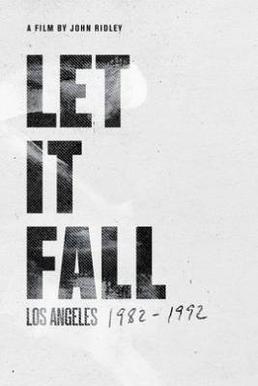
The second of three documentaries to make my Top Ten List, Let It Fall: Los Angeles 1982-1992 makes the case that the Rodney King beating, the acquittal of the four officers involved, and the ensuing riot that occurred as a result were not isolated incidents, but instead the end result of decades of police response and growing unease among the races.
The chaos, horror, violence and heroism of those dark days are chronicled with interviews and archival footage, reminding us that these issues are still haunting us, the road from Florence & Normandy leading to Charlottesville.
04.) Darkest Hour
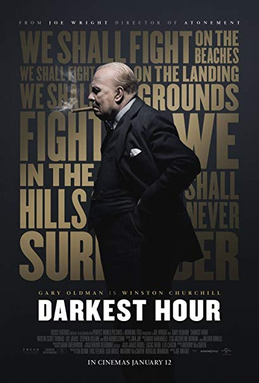
A bit of a companion piece to Dunkirk, Darkest Hour goes to the highest levels of power in those critical days and months of Britain's entry into World War II, when the fate not just of the Empire but of democracy itself faced its greatest peril up to that point. With a tour de force performance from Gary Oldman as Winston Churchill, Darkest Hour also has strong work from Kristen Scott Thomas as Clementine, the woman behind the man.
It may not be the final word on this iconic Briton, but Darkest Hour does give us not just the lofty speeches but also the more quiet moments of his early days as Prime Minister: the anxiety, the concern, the political maneuvering all around him. We get an idea of who this man was, and more importantly, what kind of people the British were as they began the ordeal of a second world war.
03.) Coco
As a Hispanic, I look carefully on matters of representation. Coco may be in part inspired by the idea of having more minority characters (Mulan, The Princess & The Frog, the upcoming Aladdin remake and even the Beauty & The Beast remake of this year), but it also has a universal appeal because of its themes of family and tradition.
Coco has spellbinding animation, a cute albeit familiar story, down to the 'shocking' twists that aren't shocking, and is hampered by mostly forgettable songs (Remember Me...I don't). Despite its familiar beats and somewhat predictable story, I still was emotionally moved by Coco and don't find shame in admitting I shed at least one tear at the end.
02.) The Work
The third of three documentaries to make my Top Ten List, The Work has been shamefully overlooked by both the public and The Academy, failing to make the final list of potential nominees. This documentary about prison reform and rehabilitation is shocking, raw, honest and deeply, deeply moving.
The temptation to see the Inside Circle Foundation program that The Work chronicles as some kind of New Age hippy-drippy gibberish is there. The program at one point does have some New Age music playing, and candles are lit. The film, however, forces you to look at these hardcore convicts at Folsom Prison for what they are: men, men with emotions, with pains, with their own issues apart from the brutality of some of their crimes. The same goes for the civilians who are allowed to participate in these group therapy sessions.
The Work is a powerful document to the transformative power of being authentic, honest, and open about who you are and as powerful a nonfiction film as I will see this year.
01.) Wonder Woman
The DC Extended Universe has had a bad run. Poorly conceived, poorly thought-out, poorly executed, poorly received. All but one of the DCEU films has been popular with both audiences and critics, and that same film is the only one that is actually good.
Again, going back to the idea of 'representation', what better representative of females can there be than Wonder Woman? Sure, there's Mother Teresa, but we haven't had the definitive biopic of her yet. Wonder Woman was not encumbered by the dead weight of the Extended Universe. It was an origin story that made sense, that had genuine characters, and that had both action and heart. Gal Gadot was born to play our Amazonian Princess, a characterization that showed Diana to be highly intelligent and compassionate, honest, strong, caring, and a lover of justice. The film does not skimp on the action and even allows for genuine moments of comedy to pass through.
Wonder Woman is a Heroine For All Seasons, All Ages, and All Genders.
If I had a daughter, I would tell her that Wonder Woman makes for a better role model than the Thirteenth Doctor.
Next Time, My Ten Worst Films of 2017 So Far.
Monday, January 8, 2018
Blade Runner 2049: A Review
BLADE RUNNER 2049
One of the great personal tragedies for me is that my dear friend, Fidel Gomez, Jr., who died suddenly and unexpectedly in August 2017, never got to see the sequel to one of if not his all-time favorite films: Blade Runner. I cannot remember whether he was eager for it or dismissed the idea of it. I would say he was intrigued with being able to revisit the Philip K. Dick dystopia of replicants and the humans who loved them. He did expect to see it, perhaps even going to the Alamo Drafthouse to see whether or not Blade Runner 2049 honored or shamed his beloved original; that expectation makes the fact that despite his plans and hopes he was taken by Death before he had that chance all the sadder to me.
As such, this will be a bit of a painful review, because it will be difficult if not impossible for me to watch Blade Runner 2049 without thinking of him in some way. I think, though, that even though I cannot say his thoughts on Blade Runner 2049 would equal my own, we tended to see things in a similar vein. As such, I think I can say with a certain amount of confidence that Fidel would have been extremely disappointed with Blade Runner 2049, finding that it took out almost everything that made Blade Runner this brilliant piece of filmmaking and drowned it in a sea of self-importance.
For those who didn't see Blade Runner, we are quickly caught up with things: replicants, human-like machines that are not robots but 'more human than human', are still out there. There's a newer, better model created by tech billionaire Niander Wallace (Jared Leto), but the older replicants are sought out to be 'retired' (read: destroyed) by police officers known as 'blade runners'. We now get a blade runner who is himself a replicant who goes by K (Avant-garde actor Ryan Gosling). K has just retired another replicant when he makes a curious discovery as he investigates the replicant's abode.
A box buried beneath a withered solitary tree. What could be inside that box?
The LAPD discover that the box is a de facto ossuary, containing the bones of a replicant. However, that replicant, a female, turns up another mystery. This replicant has given birth.
Can replicants reproduce? Can they actually be...human?
This question horrifies K's superior, Joshi (Robin Wright), who insists K investigate this, find the replicant child, and retire it. He now begins his investigation, tying the dead replicant mother to a former blade runner named Deckard.
With only his hologram woman Joi (Ana de Armas) to serve as a companion, he keeps searching for the whereabouts of this lost replicant child. Wallace, for his part, sends his replicant girl Luv (Sylvia Hoeks) to retrieve Racheal's bones from the LAPD and find the child also.
At first, with his own memories coming to him, K believes he either could be or is indeed the child he seeks. Memories are implanted into replicants to make them think they are human even if they are not, but K's own memories turn out to be real. He seeks out the best memory-implant specialist, Dr. Anna Stelline (Carla Juri), who confirms K's memory as real.
K tells Joshi he's 'retired' the replicant child, delighting her. However, he is on thin ice with the LAPD, and she gives him 48 hours to pull himself together before he too is retired. Luv is still on the hunt though, and K is now looking for Deckard (Harrison Ford), whom he finds in the radioactive Las Vegas.
It becomes a battle between Luv and K for the truth, with one last twist involving the real Lost Replicant Child.
I found Blade Runner 2049 has a sense of its own importance, that is when I wasn't falling asleep to its dour and pseudo-profound worldview. There is a certain heaviness, a certain morose and self-imposed grandness that is off-putting. It is as if director Denis Villeneuve and cowriters Hampton Fancher and Michael Green decided that whatever themes either Blade Runner or Dick's original story Do Androids Dream of Electric Sheep? weren't grand enough. As such, they had to hammer home the importance of Blade Runner 2049, the vastness of it all in terms of both visuals and themes.
This quasi-meditation on what makes us human can work, but Blade Runner 2049 decided that it would be the final word on the matter. What it ended up being was remote, aloof, even shallow in its profundity.
I know that K is a replicant, but Avant-garde actor Gosling did not have to make him into an almost literal robot. I'm souring on Avant-garde actor Gosling as a great thespian, finding him now to be a one-trick pony, an actor incapable of showing any actual human emotion but making a great go at having others think he's as profound as his long list of dour roles.
For the life of me, I do not understand why Blade Runner 2049 opted to make all characters emotional-less save for Wright and in a small role, Barkhad Abdi, who both showed some range. Edward James Olmos, who had a small but important role in the original, is reduced to one throwaway scene, a terrible disservice to him.
Even when the minor character of Coco (David Dastmalchian), a forensic agent at the LAPD, comes across Luv and is later murdered, he shows no emotion when confronting someone who clearly should not have been there.
I think Villeneuve and Company genuinely thought that because this takes place in a dystopian future, we were meant to lose all emotion. Over and over, I could not help thinking why hardly anyone was capable of showing emotion.
For all the buildup his character had, Leto, doing his Leto-like Method Acting with all caps, might just as well not been in the film. Same for Ford, who sometimes looks genuinely confused as to how he ended up there.
Sadly, Benjamin Wallfisch and Hans Zimmer's score was Vangelis-lite, echoing but not mastering the iconic music that Vangelis wrote for Blade Runner.
About the only saving grace Blade Runner 2049 has is Roger Deakins' beautiful and mesmerizing cinematography. Long overlooked and overdue by the Academy, this might finally be his year, even if I found just about everything else dull, monotonous, and self-important. There is also what I take to be a shout-out to Soylent Green, as the music to turn Joi on and off comes from the first movement of Beethoven's 6th or Pastoral Symphony, which was used so well in the Charlton Heston/Edward G. Robinson classic.
Blade Runner simultaneously entertained and made you think. Blade Runner 2049 just made you sleep.
Near the end, Leto's character says, "You don't know what pain is. You will learn". After watching Blade Runner 2049, I think I know what he was referring to.
DECISION: D-
One of the great personal tragedies for me is that my dear friend, Fidel Gomez, Jr., who died suddenly and unexpectedly in August 2017, never got to see the sequel to one of if not his all-time favorite films: Blade Runner. I cannot remember whether he was eager for it or dismissed the idea of it. I would say he was intrigued with being able to revisit the Philip K. Dick dystopia of replicants and the humans who loved them. He did expect to see it, perhaps even going to the Alamo Drafthouse to see whether or not Blade Runner 2049 honored or shamed his beloved original; that expectation makes the fact that despite his plans and hopes he was taken by Death before he had that chance all the sadder to me.
As such, this will be a bit of a painful review, because it will be difficult if not impossible for me to watch Blade Runner 2049 without thinking of him in some way. I think, though, that even though I cannot say his thoughts on Blade Runner 2049 would equal my own, we tended to see things in a similar vein. As such, I think I can say with a certain amount of confidence that Fidel would have been extremely disappointed with Blade Runner 2049, finding that it took out almost everything that made Blade Runner this brilliant piece of filmmaking and drowned it in a sea of self-importance.
For those who didn't see Blade Runner, we are quickly caught up with things: replicants, human-like machines that are not robots but 'more human than human', are still out there. There's a newer, better model created by tech billionaire Niander Wallace (Jared Leto), but the older replicants are sought out to be 'retired' (read: destroyed) by police officers known as 'blade runners'. We now get a blade runner who is himself a replicant who goes by K (Avant-garde actor Ryan Gosling). K has just retired another replicant when he makes a curious discovery as he investigates the replicant's abode.
A box buried beneath a withered solitary tree. What could be inside that box?
The LAPD discover that the box is a de facto ossuary, containing the bones of a replicant. However, that replicant, a female, turns up another mystery. This replicant has given birth.
Can replicants reproduce? Can they actually be...human?
This question horrifies K's superior, Joshi (Robin Wright), who insists K investigate this, find the replicant child, and retire it. He now begins his investigation, tying the dead replicant mother to a former blade runner named Deckard.
With only his hologram woman Joi (Ana de Armas) to serve as a companion, he keeps searching for the whereabouts of this lost replicant child. Wallace, for his part, sends his replicant girl Luv (Sylvia Hoeks) to retrieve Racheal's bones from the LAPD and find the child also.
At first, with his own memories coming to him, K believes he either could be or is indeed the child he seeks. Memories are implanted into replicants to make them think they are human even if they are not, but K's own memories turn out to be real. He seeks out the best memory-implant specialist, Dr. Anna Stelline (Carla Juri), who confirms K's memory as real.
K tells Joshi he's 'retired' the replicant child, delighting her. However, he is on thin ice with the LAPD, and she gives him 48 hours to pull himself together before he too is retired. Luv is still on the hunt though, and K is now looking for Deckard (Harrison Ford), whom he finds in the radioactive Las Vegas.
It becomes a battle between Luv and K for the truth, with one last twist involving the real Lost Replicant Child.
I found Blade Runner 2049 has a sense of its own importance, that is when I wasn't falling asleep to its dour and pseudo-profound worldview. There is a certain heaviness, a certain morose and self-imposed grandness that is off-putting. It is as if director Denis Villeneuve and cowriters Hampton Fancher and Michael Green decided that whatever themes either Blade Runner or Dick's original story Do Androids Dream of Electric Sheep? weren't grand enough. As such, they had to hammer home the importance of Blade Runner 2049, the vastness of it all in terms of both visuals and themes.
This quasi-meditation on what makes us human can work, but Blade Runner 2049 decided that it would be the final word on the matter. What it ended up being was remote, aloof, even shallow in its profundity.
I know that K is a replicant, but Avant-garde actor Gosling did not have to make him into an almost literal robot. I'm souring on Avant-garde actor Gosling as a great thespian, finding him now to be a one-trick pony, an actor incapable of showing any actual human emotion but making a great go at having others think he's as profound as his long list of dour roles.
For the life of me, I do not understand why Blade Runner 2049 opted to make all characters emotional-less save for Wright and in a small role, Barkhad Abdi, who both showed some range. Edward James Olmos, who had a small but important role in the original, is reduced to one throwaway scene, a terrible disservice to him.
Even when the minor character of Coco (David Dastmalchian), a forensic agent at the LAPD, comes across Luv and is later murdered, he shows no emotion when confronting someone who clearly should not have been there.
I think Villeneuve and Company genuinely thought that because this takes place in a dystopian future, we were meant to lose all emotion. Over and over, I could not help thinking why hardly anyone was capable of showing emotion.
For all the buildup his character had, Leto, doing his Leto-like Method Acting with all caps, might just as well not been in the film. Same for Ford, who sometimes looks genuinely confused as to how he ended up there.
Sadly, Benjamin Wallfisch and Hans Zimmer's score was Vangelis-lite, echoing but not mastering the iconic music that Vangelis wrote for Blade Runner.
About the only saving grace Blade Runner 2049 has is Roger Deakins' beautiful and mesmerizing cinematography. Long overlooked and overdue by the Academy, this might finally be his year, even if I found just about everything else dull, monotonous, and self-important. There is also what I take to be a shout-out to Soylent Green, as the music to turn Joi on and off comes from the first movement of Beethoven's 6th or Pastoral Symphony, which was used so well in the Charlton Heston/Edward G. Robinson classic.
Blade Runner simultaneously entertained and made you think. Blade Runner 2049 just made you sleep.
Near the end, Leto's character says, "You don't know what pain is. You will learn". After watching Blade Runner 2049, I think I know what he was referring to.
DECISION: D-
Subscribe to:
Posts (Atom)


.png)


.png)
.png)
.png)

.png)


.png)


_poster.jpg)

.jpg)