Friday, August 6, 2021

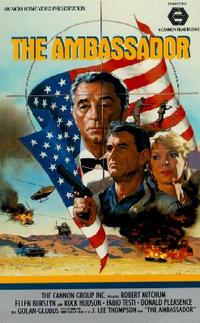
The Ambassador (1984): A Review

THE AMBASSADOR

This review is for the Summer Under the Stars Blogathon. Today's star is Robert Mitchum. 

If The Ambassador has any claim to fame, it is that it is the final film Rock Hudson made before his death from AIDS. It may not be the best film to end a career, but The Ambassador is not an embarrassment to him either.

Idealistic American ambassador to Israel Peter Hacker (Mitchum) believes he can get peace between the Israelis and Arab Palestinians if he can get the young people to talk and negotiate. His security chief Frank Stevenson (Hudson) is not convinced, but that's not his department. His job is to keep Ambassador Hacker safe, a tough task given Hacker puts his life in constant danger.

More dangerous liaisons involve the ambassador's wife Alex (Ellen Burstyn). The bored and desperate housewife has begun a passionate affair, with both her and her lover unaware of even so much as their names. Unbeknownst to the two sexmates, their latest tryst has been captured on film in graphic detail.

Who would want a pornographic film of the Ambassador's wife and her lover, and why would one go to such lengths? The answer involves the Mossad, but things soon spin out of control when the film is secretly copied by mysterious forces. Is it part of a blackmail plot that Ambassador Hacker rejects immediately, or does this film hold the key to stopping Hacker's peace negotiations. Hacker and Stevenson, aided by Israel's Defense Minister Eretz (Donald Pleasance) must get the film before it is broadcast on eager television stations. 

Things get worse when at last Alex's lover's identity is discovered: it is Mustafa Hashimi (Fabio Testi), who just happens to be a PLO member. While he too was unaware of the film, he agrees to pay a mere $500,000 versus the million demanded of Hacker. Never one to lose an opportunity, even if it involves the man who has been bonking his wife, Hacker uses Hashimi as a go-between to bring Israeli and Arab Palestinian youth together secretly to bring peace. That peace, however, will be paid by a lot of innocent blood, but perhaps Hacker despite himself is the right man for the job.

I figure that The Ambassador was aiming to be a picture of dignity, a true canvas of the suffering of humanity...but with a little sex in it, to quote Sullivan's Travels. You have the idealistic ambassador aware that peace in the Middle East can easily be achieved if the young people just talk about it in between scenes of Ellen Burstyn showing her boobs to the world. It might be a bit startling to see her topless within eight minutes of The Ambassador, but there it is.

I think that The Ambassador like the main character is surprisingly naïve but well-intentioned. It also does not quite feel like a feature film but a television movie, with lower production values. The fight scene between Hudson and Testi seems haphazard and a bit comical, as are the various shots of shadowy men following Mrs. Hacker through the streets of Old Jerusalem.

Despite the race-against-time plot, there seems to be little urgency in The Ambassador, as if people here are treading water. I put that down to director J. Lee Thompson, who got most of his cast to be very bland. Most because Robert Mitchum had some good moments, in particular when he sees his wife's pornographic performance.

There is a mix of sadness and horror though not anger, which I thought was curious. He expressed more anger at the idea of paying the blackmailer than in his wife's infidelity. For the most part though, Mitchum is quite calm throughout The Ambassador, whether it is being arrested by the Israeli military for consorting with terrorists (whom Hacker would insist were mere idealistic students) or facing off against angry Israeli students who balk at negotiations with those who don't recognize their right to exist.

I think Hudson did a pretty good job as Stevenson, forever growling at Hacker's idiocy yet remaining loyal to the job. I do wonder if perhaps a younger man might have done better, but in his final performance Hudson acquitted himself well as an older action star. 

Burstyn is another matter. It almost seems as if she is aware that she is too smart for The Ambassador, particularly when she has to rattle off puns about where she's been. She informs Peter that she's been "riding an Arab" and that she rode him bareback. She doesn't deliver these lines with any perverse glee but almost in anger, as if she is aware of the puns and thinks them silly. Whether surviving a terrorist bombing or being shocked to discover her lover is himself married with kids, Burstyn doesn't seem interested.

Pleasance in his smaller role did well, and even injected about the only real laugh I got. When berating the Mossad agent who had secretly recorded the Alex/Mustafa tryst, he angrily states "I don't care if she's sleeping with King Hussein! It's none of our business!". I don't know why I found that funny.

The action scenes seem small-scale, but the final massacre of the Israeli/Arab Palestinian massacre seemed excessively graphic in its bloody manner. Add to that an almost forced upbeat ending and I wonder whether The Ambassador should be recalled.

DECISION: C-

Thursday, August 5, 2021

Chimes at Midnight: A Review (Review #1505)

CHIMES AT MIDNIGHT

This review is part of the Summer Under the Stars Blogathon. Today's star is Margaret Rutherford.

Orson Welles, post-Citizen Kane, seem to forever wander in the cinematic universe, plying his acting wares to make ambitious films that managed to mostly come together despite always being short on funds to make them to the level he would have liked. Despite the limited budget, his Shakespearean adaptation Chimes at Midnight (aka Falstaff) rises to one of the great versions of Shakespeare's work.

Freely adapting from Henry IV, Henry V, The Merry Wives of Windsor and Richard II, the film centers on the relationship between the wastrel Sir John Falstaff (Welles) and his equally dissolute protégé, Prince Hal, also known as Henry, The Prince of Wales (Keith Baxter). Henry's father, Henry IV (John Gielgud) despairs for the future of both his realm and his heir. Hal is too involved in the pleasures of the flesh and the merry decadence of Falstaff's world than in taking up his duties as the next King of England.

Henry IV also has pretenders to the throne to contend with, but at last Hal soon starts becoming the monarch he is meant to be. First, he fights for his father at the Battle of Shrewsbury to secure Henry IV's hold on the throne, where he takes down the rebellious Henry Percy (Norman Rodway). Despite his love for Falstaff, Hal sees his mentor is not above trying to take credit for Hal's actions, and Hal now is divided between his love for his father figure and his duty to his father and monarch.

With Henry IV now fully in control, the heavy weight of his rise and his poor health finally are catching up to him. Hal now finally transforms into Henry V, determined to be the King his father and nation want and need him to be. Falstaff, however, now dreams of great riches and power with his dear boy as King. However, Falstaff is in for a rude shock when Henry V literally turns his back on his old friend, declaring "I know thee not, old man". As Henry V prepares to fight in France, the old jolly man dies of a broken heart, mourned only by the Hostess of the Inn, Mistress Quickly (Margaret Rutherford).

As Orson Welles continued to try and cobble his cinematic visions, I think audiences can see why Falstaff was a character so much like Welles. His almost decadent disinterest in the truth, his delight in mocking those in power unless useful to his own ambitions and the tragedy of rejection somehow make Chimes at Midnight seems closer to being a portrait of Welles than of Falstaff. Perhaps that is reading too much into things, but in this elegy for a con man the viewer can see that interpretation.

As a director, we see just how strong Orson Welles was. Visually, Chimes at Midnight uses the budgetary limitations to its advantage; the large cavernous sets give the film an almost epic feel, these figures dwarfed by their grand surroundings. The big set piece is the Battle of Shrewsbury sequence, one of the most bravura battle scenes in film. It's a strange thing that one can see the limited budget here in that it is not filled with massive armies or expansive vistas. 

However, Welles uses those very limits to his advantage. Using a variety of techniques: various speeds, fast cutting, Angelo Francesco Lavagnino's score, Welles creates this grand and tense battle. From the mist arising across the field to the closeups of the chaos of war, the Battle of Shrewsbury sequence is an intense and gripping battle that leaves the viewer enraptured.

At times, yes one can see that there was not a lot of money spent (one can for example, see the armies are surprisingly small, and Henry Percy is shown quickly closing his mouth postmortem), but on the whole one feels the brutality of the battle.


In terms of acting, Orson Welles shows his deft touch in the performances he gets from his cast. The double act between Welles and Baxter is pitch perfect. Welles gives a mirthful yet ultimately heartbreaking performance as Falstaff. He can be rakish and foolish, lumbering about in his armor and avoiding as much fighting as he can at Shrewsbury. However, the final encounter between Falstaff and Henry V is devastating, the look on Welles' face mixing fatherly pride with deep pain at the loss of their relationship.

Baxter too excels in his transformation from the foolhardy Hal to the noble Henry. You see how he enjoys the company of this court of fools, but as he matures and comes to accept his place the regal nature of Henry emerges. In that final farewell, Baxter shows a that bit of sadness at the parting, knowing he must now be a man but also having a tinge of regret at having to dismiss his former friend.

In smaller roles, Gielgud's Henry IV is commanding if perhaps appropriately stiff as the despairing monarch, Rutherford as the put-upon but ultimately mournful Hostess and Jeanne Moreau as Doll Tearsheet, Falstaff's loyal mistress.

Chimes at Midnight takes the rapscallion Shakespearean figure and gives him his due as both a delightful fool and an ultimately tragic figure. Featuring strong performances and some astonishing sequences, Chimes at Midnight is a monumental film built from a miniscule production.

DECISION: A+

Wednesday, August 4, 2021

Paris Blues: A Review

PARIS BLUES

This review is part of the Summer Under the Stars Blogathon. Today's star is Louis Armstrong.

The artist's life is not an easy one. Paris Blues gives us a generally sweet albeit familiar story that features strong performances from our four leads.

Expatriate jazz trombonist Ram Bowen (Paul Newman) and saxophonist Eddie Cook (Sidney Poitier) are enjoying the lush life of Paris, appreciated for their music and Cook facing little to no racism as he would back in America. Ram uses his connection to jazz legend Wild Man Moore (Louis Armstrong) currently on tour in Paris to submit his more serious composition to publishers in hopes of a career shift. 

While receiving Wild Man Moore at the train station, Ram encounters pretty schoolteacher Connie (Diahann Carroll), vacationing with her BFF Lillian (Joanne Woodward). Connie is put off by Ram's arrogance and rejects his advances, but Lillian, who is a fan of Ram's work, is enthralled. Connie's attention turns to Eddie, who is equally fascinated.

Soon the Ram/Lillian and Eddie/Connie romances blossom on the streets of Paris. Each couple comes to a crossroad in their relationships and careers. Eddie does not want to return to America due to the prejudice he'll face there, but Connie is not only tied to her roots but is working to improve African-American life. Ram does not want to give up his career but Lillian is not about to give up her life and children. Ultimately, one couple goes back to America, one goes its separate ways.

In some ways Paris Blues may be almost quaint, almost simplistic in how it handles issues like race. There's the issue of Connie's more optimistic views on how race relations are improving in America. I can't call them insincere but do seem slightly forced.

The coupling is another issue, as we see that in the couples end up paired along racial lines, which may have been a way to placate fears about miscegenation in the early 1960s when Paris Blues premiered. On this point however, I give Paris Blues some slack for a few reasons.

First, Paul Newman and Joanne Woodward were known for their long-lasting marriage, so it seems more believable that they would end up paired together cinematically as they had and would be in other films. Second, just the fact that the suggestion of interracial dating was even introduced moves things forward.

Ram was the one who flirted with Connie, not the other way around. Moreover, the fact that Connie rejected Ram's overtures due to personality rather than race in my view is a step forward. It shows she would have been open to the suggestion to dating outside her race as Ram would if not for his arrogance.

Paris Blues does hint that the City of Lights is more blasé about sexual matters. The opening shows interracial couples, along with cougars and even same-sex pairings. Granted, they were more to add a touch of decadence among the jazz set than actual characters, but that's a step forward.

It's a credit to screenwriters Jack Sher, Irene Kamp and Walter Bernstein that Paris Blues mostly works, particularly in the love stories. The plot point about Ram's musical aspirations seems rather dull but that fortunately is not the main focus of Paris Blues.

Paris Blues is also helped tremendously by the performances. Paul Newman is breathtakingly beautiful even in black-and-white, but he holds your attention as Ram, this cocky, talented guy struggling between his ideals and the beautiful woman he's fallen in love with. It's a contrast to how he treats Marie Seoul (Barbara Laage), owner of the club whom he has a familiar relationship with. She may be his friend with benefits, but with Lillian he's more vulnerable. Woodward holds her own as the lovestruck Lillian, unashamed of who she is but not willing to give up her life for a man.

Curiously, Paris Blues never fully answers if she is divorced, widowed or more shockingly a single mother. I took her to be divorced but I don't think she gave a definitive answer when asked by Ram.

Equal to him is Poitier as Eddie, the man who does not mind being called "Monsieur Noir" by children because he is treated with respect for his work and his being. Poitier and Carroll are excellent together as these lovers debating love and racism, between settling for what is good now and moving to make lives better for all. They play off each other well. While his role is small, Armstrong as Wild Man Moore brings life to his scenes, particularly when he plays his horn. The unofficial Battle of the Bands between his group and the Bowen/Cook group is a highlight.

It's no surprise that Paris Blues has such great music. Not only do you have Armstrong's appearance but also a score by Duke Ellington, which elevates the film tremendously. 

Paris Blues may in some ways be quaint in how it portrays the lush life and in its racial views. However, with some good music and good performances I think it is an entertaining film.   

DECISION: B-

Tuesday, August 3, 2021

The Mirror Crack'd: A Review

THE MIRROR CRACK'D

This is part of the Summer Under the Stars Blogathon. Today's star is Kim Novak.

It's an all-star cast for murder in The Mirror Crack'd, the adaptation of Agatha Christie's The Mirror Crack'd From Side to Side. It is a mildly entertaining adaptation done in by its far too lackadaisical manner.

Famed film star Marina Gregg (Elizabeth Taylor) is making a comeback in a biopic, starring as Mary Queen of Scots. She and her director husband Jason Rudd (Rock Hudson) have bought an estate in the quaint village of St. Mary Meade and will film nearby. Everyone in town seems excited save for Miss Jane Marple (Angela Lansbury), who is unimpressed with celebrity and can't fathom why anyone would be.

She, however, is impressed when local ditz Heather Babcock (Maureen Bennett) dies at the welcoming party for Marina. Babcock's drink had been poisoned, a drink that was originally Marina's but which she gave to Heather when Marina accidentally jolted her. Yes, Heather had bored Marina to tears by recounting an old story about how despite being ill she had broken quarantine to meet and even kiss Marina when she had entertained troops during the war, but that was no reason to kill Heather, was it?

Then again, who could want Marina dead? Perhaps her eternal frenemy Lola Brewster (Kim Novak), forever taunting her over her age and past breakdowns? Not the film's producer and Lola's lover Martin N. Fenn (Tony Curtis), who would lose millions if the Mary Queen of Scots biopic didn't go through. What of Marina's loyal assistant Ella Zielinsky (Geraldine Chaplin), who had a relationship with Jason? It's all a mystery to Miss Marple's detective nephew Inspector Craddock (Edward Fox), made more difficult by Aunt Jane not able to look in on things due to an injured leg. However, never count out the intuitive powers of an old English woman, who brings the case to a successful albeit tragic conclusion.

Perhaps those behind The Mirror Crack'd thought they'd take the formula that proved successful in previous Christie adaptations of Hercule Poirot novels and rework it with her female detective. Unlike Murder on the Orient Express or Death on the Nile however, The Mirror Crack'd did not have an exotic locale to whisk us to. The lack of the foreign, however, does not explain why The Mirror Crack'd kind of flopped.  

I think the filmmakers took some of the wrong lessons from previous Christie adaptations and applied them here to if not disastrous results at least lesser ones. One was by looking at the Margaret Rutherford Miss Marple films, which were so comedic that Christie openly hated them and drew weary of other film adaptations. As a side note, the hatred did not extend to Rutherford herself: Christie dedicated ironically enough The Mirror Crack'd From Side to Side to her. Those Rutherford films worked as light entertainment, but were also product of their times. Rutherford played her as a shrewd but slightly dotty old woman. The Mirror Crack'd, on the other hand, did not have that overtly light manner as Lansbury played her more seriously, the sore thumb among the hams populating the film.

Filling your cast with big names, or at least big names from the forties and fifties for a film in the eighties is not a guarantee of success. The Mirror Crack'd at times seems more interested in showing how much fun everyone in the cast is having at almost sending themselves up than in the story itself.

There is a lot of fun to be had in the bitch-fest Taylor's Marina and Novak's Lola have, trading barbs and insults at each other with barely repressed glee. They do get a chance to rattle off quips at each other and behind their backs in an almost wink-wink manner. There's when Lola crashes the party and jams herself into the scene. "Chin up, both of them," Lola tells Marina. "Do you know the two things I hate about you are?", Marina asks through a clenched smile. "No, what?" Lola replies. "Your face," is the answer.

Hearing Liz ridicule the idea that Lola would play the Virgin Queen, hearing Ella call Lola "Mary, Queen of Sluts" and seeing Novak wildly overact flirtatious with Inspector Craddock may have been fun for the actors, but it's no fun for audiences who want said actors to take this seriously. If one likes in-jokes like Marina sing-song saying "Bags, bags, go away, come right back on Doris Day" to a befuddled Rock Hudson, then fine. Bits like that can work, but not when your actors and story are not really bothering to try and make this real.

Instead, The Mirror Crack'd seems oddly lethargic and restrained for what should be a murder mystery. Part of the problem is the cast. Lansbury took as good a stab as she could with her Miss Marple, but no amount of makeup could make anyone believe that the then-54-year-old could possibly be this elderly spinster. Moreover, she wasn't a major player in The Mirror Crack'd. The leg injury Miss Marple had early in the film reduces her to almost an observer in the goings-on. How she managed to solve anything when she had everything relayed secondhand is a bigger mystery than who wants Marina Gregg dead. As if adding insult to injury, having Miss Marple say, "That'll teach me to be dogmatic" after a dog causes her fall is cringey, not funny.

Taylor similarly did what I think is her best, but she too suffered from what plagued almost everyone in the cast: they were not taking this seriously. Her acting at times veered towards parody, not more so than when as Marina she recites lines that fanboy Craddock immediately recognizes from a Marina Gregg film Danger in the Dark. Taylor's uninhibited cackle is probably the more real moment in her performance.

Taylor, however, was the model of restraint compared to Curtis and Novak. The two of them, particularly the latter, devoured the scenery like Charles Dickens orphans. Novak so openly and brazenly overacts that she transcends spoofing and slips into something beyond self-aware. It's like watching someone at a stage rehearsal working out their excessive tendencies and not realize she is actually on camera. 

One odd moment is when Fox and Hudson walk and talk. The 6'5" Hudson so towers over the 5'8" Fox that it looks almost freakish. Fox looks like a midget next to him, and why director Guy Hamilton allowed that is beyond me.

Jonathan Hales and Barry Sandler's screenplay is also illogical. One character is killed off pretty late in the film, yet no proof is presented as to who or why said character is killed. In fact, this character's death, once shown for the shock value of things, is not only forgotten but never mentioned again. As the case is wrapped up, we are left to wonder whether this death really was accidental or related to the previous murder. Add to that the fact that this character had been harassing other suspects to find out if they reacted and the whole thing seems looney.

Judging from the final product I think everyone involved in The Mirror Crack'd had fun making it. It's easy to see why: a nice paycheck without bothering to put in any effort and a chance to camp it up to an almost comic level must have made the production a lark. However, while one can have a bit of fun in a murder mystery it should be to the point where it's clear nothing is serious. Thanks to The Mirror Crack'd, perhaps the film's overall failure is a reason as to why as of this writing there has not been another Miss Marple feature film made.

DECISION: C-

Monday, August 2, 2021

Anne of the Thousand Days: A Review

ANNE OF THE THOUSAND DAYS

This is part of the Summer Under the Stars Blogathon. Today's star is Richard Burton.

With six wives it is no surprise that the tumultuous reign of  England's Henry VIII is featured often in film and television. Of particular note is his second wife, the unfortunate Anne Boleyn. If memory serves correct, Mistress Anne is the only one of the unmerry wives of Tudor to have whole films built around her. Anne of the Thousand Days is a well-acted film that despite its perhaps excessive length does manage to entertain.

As Henry VIII (Richard Burton) pauses before signing Queen Anne's death warrant, he remembers those halcyon days of not two years past. Desiring a male heir which his then-wife Catherine of Aragon (Irene Papas) could not deliver, he turns his eye to the beautiful maiden Anne Boleyn (Genevieve Bujold). She is no innocent flower, confessing to her fiancé Henry Percy (Terence Wilton) that she is not a virgin. However, she is deeply in love with Percy and is not interested in becoming His Majesty's mistress. She attempts to resist pressure from her family and Lord Chancellor Wolsey (Anthony Quayle). Anne also remembers how Henry discarded her sister Mary when she was his mistress, which also makes her leery of bedding our King Hal.

Hal, however, will not be denied, and is so desperate for her he'll tear the kingdom in two, creating a religious crisis by splitting from the Catholic Church to get Anne as his Queen and in his bed. Tragically, the child she is with turns out to be a girl, the future Queen Elizabeth I. As his frustration in getting a male heir grows, his eyes turn to pretty courtier Jane Seymour, much to Queen Anne's anger. 

She eventually falls from grace when accused of high treason due to alleged infidelities with men including her own brother. Anne maintains her innocence but Henry opts to behead a woman he loved rather than lose the chance for a male heir, unaware that the little Princess Elizabeth will be the greatest Tudor monarch of them all.

Anne of the Thousand Days has a simply perfect performance from Genevieve Bujold as the tragic second Mrs. Tudor. Bujold makes Anne a fully formed figure, contradictory in manner but fascinating to watch. She could be innocent one moment, lusty the next. Bujold made Anne into a strong woman, unafraid to tell Henry what was what, but she also showed a vindictive streak towards those who got in her way.

Whether it is throwing shade at Wolsey in forcing him to give up Hampton Court or demanding the execution of those who would declare Elizabeth a bastard as Henry's only legitimate heir Princess Mary had been, Bujold's Anne was clever, fiery yet also caring and concerned. In her rage at being denied the one man she loved or giving herself willingly to the lusty Henry, Bujold is a marvel in the role.

She manages to hold your attention more than Burton does, though to be fair the film is about Anne and not Henry. At times, Burton's bombast can come through, such as when he bellows "I AM ACCURSED!" on learning that her second child is a stillborn son. He can slip into being a bit theatrical at times but he is also surprisingly retrained when talking about how to woo maidens. Burton brings a certain calmness to our lusty monarch, one not usually associated with Henry VIII. 

He can still show his anger when things don't go his way and make veiled threats. "You shall dance to my tune, mistress," he calmly whispers as the musicians begin to perform an original composition. However, Burton tones down a lot of the grandiose nature usual for his performances and makes Henry if not loveable at least more rational when not raging.


Quayle was overtly manipulative and subservient as Wolsey, though his cardinal robes had the curious effect of making him look like he was wearing a giant red blanket. Despite the costumes being the only Oscar win of its ten nominations, the costuming failed to make Quayle's performance as good as perhaps he thought it was.  Though her role was small and she is technically wrong for it, Irene Papas is heartbreaking as the first Queen Catherine, making one wonder if perhaps a Catherine-centered film is long overdue. 

The film's Tudor-era inspired score was by Georges Delerue, who was familiar with the period due to writing the music for another film involving the King's Great Matter: A Man for All Seasons

Anne of the Thousand Days is perhaps a bit too sumptuous and can feel like it is dragging, but I think most people will be entertained by the power plays going on about. 

Sunday, August 1, 2021

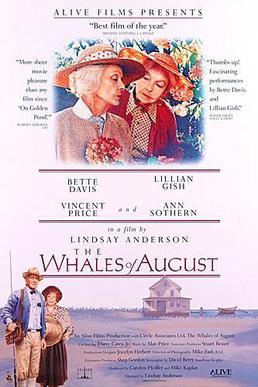
The Whales of August: A Review (Review #1501)

THE WHALES OF AUGUST

This review is part of the Summer Under the Stars Blogathon. Today's star is Bette Davis.

The Whales of August unites two of film's great stars of the silent and sound era at the end of their cinematic careers. A bit stage-bound and slow, The Whales of August picks up and is worth a visit for those willing to go through some travel.

Aging sisters Libby Strong (Bette Davis) and Sarah Webber (Lilian Gish) are in their family's Maine summer home. Here, the older Sarah cares for the more infirm, slightly bitter Libby as they struggle to find themselves in this, perhaps their final summer together. Sarah is finding it harder to endure Libby both physically and emotionally.

Their longtime friend Tisha Doughty (Ann Sothern) advises Sarah to sell the house and have Libby's daughter Anna take care of her. Sarah struggles with these options, while Libby gives the cold shoulder to Mr. Maranov (Vincent Price), a Russian count who has relied on the kindness of friends to see him through the years after the Russian Revolution threw his family out of his homeland. Sarah is charmed by the Romanov-connected Count but Libby thinks him a fraud. 

As the summer winds down Sarah opts to turn down Tisha's views on selling the family home, much to Tisha's embarrassment. Libby for her part pushes Maranov to not try and find shelter with them, wisely seeing him for the player he is. With the whales perhaps in sight, the two sisters have a rapprochement, the bonds of family strengthening them.

The Whales of August starts slow as it feels its way towards our four characters. It can be a bit trying to get to the heart of David Berry's adaptation of his play: the evolving yet declining push-and-pull between these sisters. I figure it is because the adaptation requires a perhaps too lengthy setup, not just for them but for both Tisha and Maranov (who apart from a handyman and a realtor are the only figures in the film).

However, once we get past the introductions The Whales of August starts to slowly move. I think it is because once the four of them share a tea we can get the various conflicts coming into view. There's whether Sarah will continue to care for Libby; there's little doubt she doesn't care about Libby, but whether to care for her is another matter. Fragile but fierce, Libby can be a handful.

There's the potential romance between Sarah and Maranov. While devoted to the memory of her husband Philip (killed in battle), Sarah does sparkle when the wily and elegant Count comes calling. This is sharp contrast to Libby, who does not trust him even if she cannot see him.

Finally, there's the well-intentioned Tisha, who has mediated between the sisters but who also may have overstepped herself by bringing a realtor without fully consulting Sarah, who is the legal owner. 

As the film moves, we see how these various pieces get their moments, all coming together to a quiet yet satisfying conclusion.

The Whales of August allow us to see some simply beautiful things. Even at the age of 93 in her final film, Lilian Gish has a simply luminous face that is magic on the screen. Gish is firm repudiation of the idea that silent film stars had no voices to carry them into sound films. However, Gish is also proof of what Sunset Boulevard's Norma Desmond said. "We didn't need voices, we had faces", and Gish's face is simply divine.

In terms of her acting, we see that full range for Sarah: irritation and love with and for Libby, charm at Maranov, joy at Tisha.

Davis can come across as more cantankerous than perhaps is good for the character, but she too shows some vulnerability as Libby. Her more short-tempered manner mask quiet fears, and Davis makes Libby into a woman who wills her way to strength while still holding affection for her sister.

At times both do show they are acting versus being, but on the whole Gish and Davis do show that struggle between loving and loathing your sibling.

Sothern brings a spark every time she's on screen as their longtime friend, and she can also move the viewer more than even Gish or Davis. Her story about losing her driving license is surprisingly sad, as is her farewell to Sarah. Knowing that whatever her intent the end result is that of anger, we see Tisha's deep sense that she has lost her friend, and that fear comes across beautifully.

Maybe Price came across as a bit too hammy as Maranov, but given the character was already a bit dubious we can cut him some slack. He does have one of the wittier lines in The Whales of August. When Sarah comments about him having to be cast adrift in this world again, he replies, "I have often been adrift, but I have always stayed afloat".

The film is also complimented by Alan Price's beautiful score and Lindsay Anderson's deft if perhaps somewhat slow direction.

The Whales of August should relate to those who have struggled to love the sometimes difficult sibling. Well-acted, if a bit slow, The Whales of August allows the viewer to see four legends in the twilight of their years, giving a farewell to all that has come before. 

DECISION: B- 

Summer Under the Stars 2021: The Catalog


This is the catalog for the Summer Under the Stars Blogathon. Films with a 🅤 will be shown for that star's day. Titles marked with a 🅣 are television productions. Titles marked with a 🅓 are documentaries.

August 1: Bette Davis: The Whales of August

August 2: Richard Burton: Anne of the Thousand Days 🅤

August 3: Kim Novak: The Mirror Crack'd

August 4: Louis Armstrong: Paris Blues

August 5: Margaret Rutherford: Chimes at Midnight 🅤

August 6: Robert Mitchum: The Ambassador

August 7: Abbott & Costello

August 8: Esther Williams

August 9: Kay Francis

August 10: George Segal: Elsa & Fred 

August 11: Kathryn Grayson

August 12: Ramon Novarro

August 13: Jane Fonda: Monster-in-Law

August 14: Gregory Peck: Old Gringo

August 15: Judy Garland: Ziegfeld Girl

August 16: Robert Young: The Bride Wore Red

August 17: Gloria Grahame 

August 18: Robert Redford: All Is Lost

August 19: Setsuko Hara: No Regrets for Our Youth 🅤

August 20: Van Heflin: Patterns 🅤

August 21: Katharine Hepburn: Dragon Seed

August 22: Tyrone Power: In Old Chicago

August 23: Eve Arden: Stage Door 🅤

August 24: Maurice Chevalier

August 25: Jane Wyman: Stage Fright 🅤

August 26: Tony Randall: Down with Love

August 27: Merle Oberon: The Epic That Never Was 🅓🅣

August 28: Lee Marvin: Gorky Park 🅤

August 29: Ingrid Bergman: Cactus Flower 

August 30: James Cagney: The Public Enemy

August 31: Fredric March: Tomorrow, the World!